
On the islands themselves, nobody checks a graduate's ancestry before draping a lei over their shoulders. Hawaiian and Pacific Islander families have handed leis to graduates of every background for generations, at ceremonies where the tradition never had a fence around it to begin with. Ke Alaka'i, the student newspaper at Brigham Young University-Hawaii, put the practitioners' own view plainly: your background doesn't gate you from receiving a lei, and the gesture is meant to signal unity and respect across everyone gathered for the day. Wearing one you were given, with the giver's blessing, is a different act than pulling a costume-store version off a shelf and calling it a graduation prop. What decides it is intention: how the lei was given, and how it's worn once it's on.
That settles the gentler worry. The sharper one is more practical, and a lot less forgiving: some schools and stadiums have physically stopped graduates from walking because they had a lei on, regardless of who gave it to them or why. Knowing a lei is culturally welcome doesn't tell you whether a specific gym floor will let it through the door, and that question is what the rest of this page is built to answer.
Is it disrespectful to wear or give a graduation lei if you're not Hawaiian or Pacific Islander
The appropriation worry usually comes from a good place: nobody wants to treat someone else's tradition as decoration. But the tradition's own keepers have been generous about this for a long time, on the islands and off them. Filipino, Samoan, Tongan, and other Pacific Islander families across California and the West Coast have folded lei-giving into their own graduation customs for decades, sometimes stringing garlands in school colors alongside the classic orchid version, and nobody in those communities treats a non-Hawaiian graduate receiving one as a problem. The distinction that actually matters isn't who's wearing the lei. It's whether the person wearing it understands roughly what it means and received it with the giver's consent, versus grabbing an artificial one at a party store because it looked festive. A graduate who accepts a lei from a family member, a mentor, or a friend who wanted to mark the day is participating in the gesture as intended.
Why some schools and venues have turned graduates away over leis
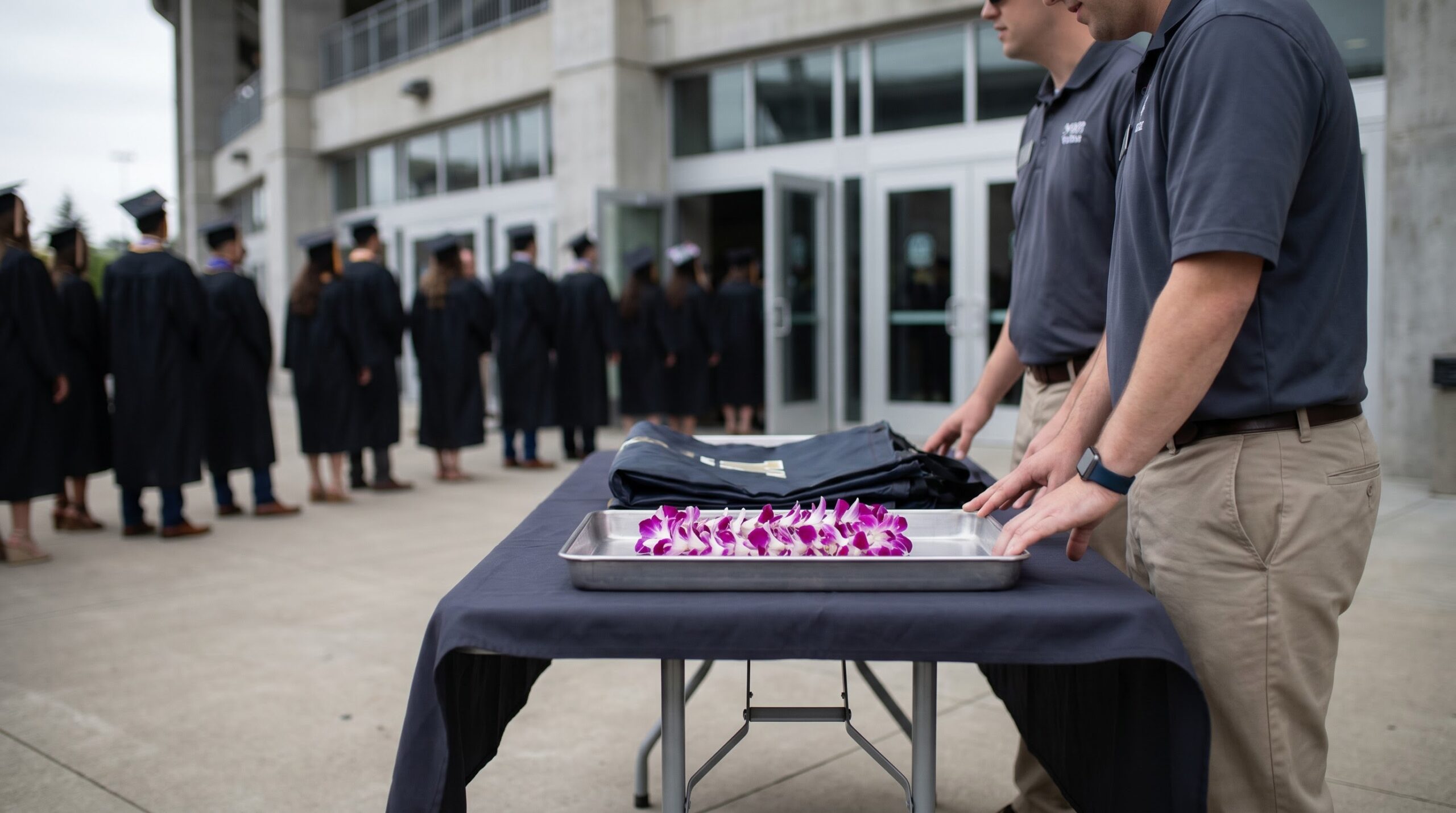
Cultural welcome is one question. Venue policy is a completely separate one, and the two don't always line up. Four cases from the past fifteen years show how differently this can go, and none of them were really about whether leis are appropriate.
| School or venue | Year | What happened | Outcome |
|---|---|---|---|
| Syracuse High, Davis County, Utah | Recurring since 2010 | Commencement dress code barred any "ornamentation" on stage, leis included | The rule has held for well over a decade; one Tongan student was told her diploma would be mailed to her if she wore a lei, and a parent later handed out 300 leis outside the ceremony in protest |
| Huntsman Center, University of Utah arena used for Salt Lake City school ceremonies | Ongoing, clarified 2024-2025 | Arena staff barred all leis from the floor, citing cleanup time between back-to-back ceremonies | The district later clarified that floral leis are allowed; candy and food leis, and decorated caps, are not, and get confiscated |
| Eastlake High, Chula Vista, California | 2024 | A senior with the principal's prior approval was stopped at the entrance and told to remove her Hawaiian leis or not walk | She chose not to walk; the district later said the leis qualified as protected cultural or religious regalia, after her ceremony had already happened |
| Leilehua High, Oahu, Hawaii | 2022 | The school banned lei-giving on the field, citing COVID-era space limits | Reversed after a parent petition; graduates now receive leis in staggered small groups, and the state education department said its guidance leaves the call to individual schools |
Swipe →
The pattern across all four has less to do with the flowers than with logistics nobody thought through in advance: floor space, cleanup time between ceremonies, or a bag-ban rule copied over without checking it against a specific tradition. None of that shows up on a school's public website until a family is standing at the entrance holding a lei. Before ordering anything, it's worth a direct call or email to the school or the venue itself, since a stadium or arena hosting the ceremony can layer its own rule on top of the school's, and food or candy leis sometimes draw a stricter answer than fresh flowers even at the same site.
What to do when someone hands you a lei
If someone gives you a lei, the etiquette is short enough to hold onto under pressure. Let them place it around your neck rather than taking it from their hands and doing it yourself; that's part of the gesture itself. Don't refuse it, even if you already have three on and a fourth feels like a lot, and don't take it off and set it down where the giver can see you do it, at least not until the moment has clearly passed. It helps to know roughly what you're wearing. A lei at graduation stands for pride in what the graduate finished and hope for what comes next, and each one a person receives marks a separate relationship. The disrespect people worry about was never really about wearing a lei that isn't "yours." It shows up when a lei gets tossed in a trash can in front of the person who gave it, or treated as a costume nobody bothered to ask about first.

Where the tradition is everyday, and where it still turns heads
In Hawaii, California, and much of the rest of the West Coast, graduation leis are as ordinary as the cap and gown. Florists who work that region's graduation season describe clients who've been ordering leis every year since childhood, some going back two decades or more in the same family. In that part of the country, a stack of leis past a graduate's chin signals how many people showed up for them, nothing more unusual than a full guest book.
Outside that band of the country, the same lei can read differently to people encountering it for the first time. A thread among teachers split hard on the question: some commenters flatly called a big lei display tacky for a formal public ceremony and suggested saving it for the family party afterward, while others jumped in to say West Coast and Hawaii graduations have always looked exactly like this, with orchid leis and school-colored versions singled out as some of the nicest touches on the whole field. Neither side is wrong about their own experience; it's a regional norm gap, worth reading as exactly that. Worth knowing which side of that gap your own ceremony sits on, before deciding how many leis feels right.
Flower, money, or candy: getting one without the same-day scramble
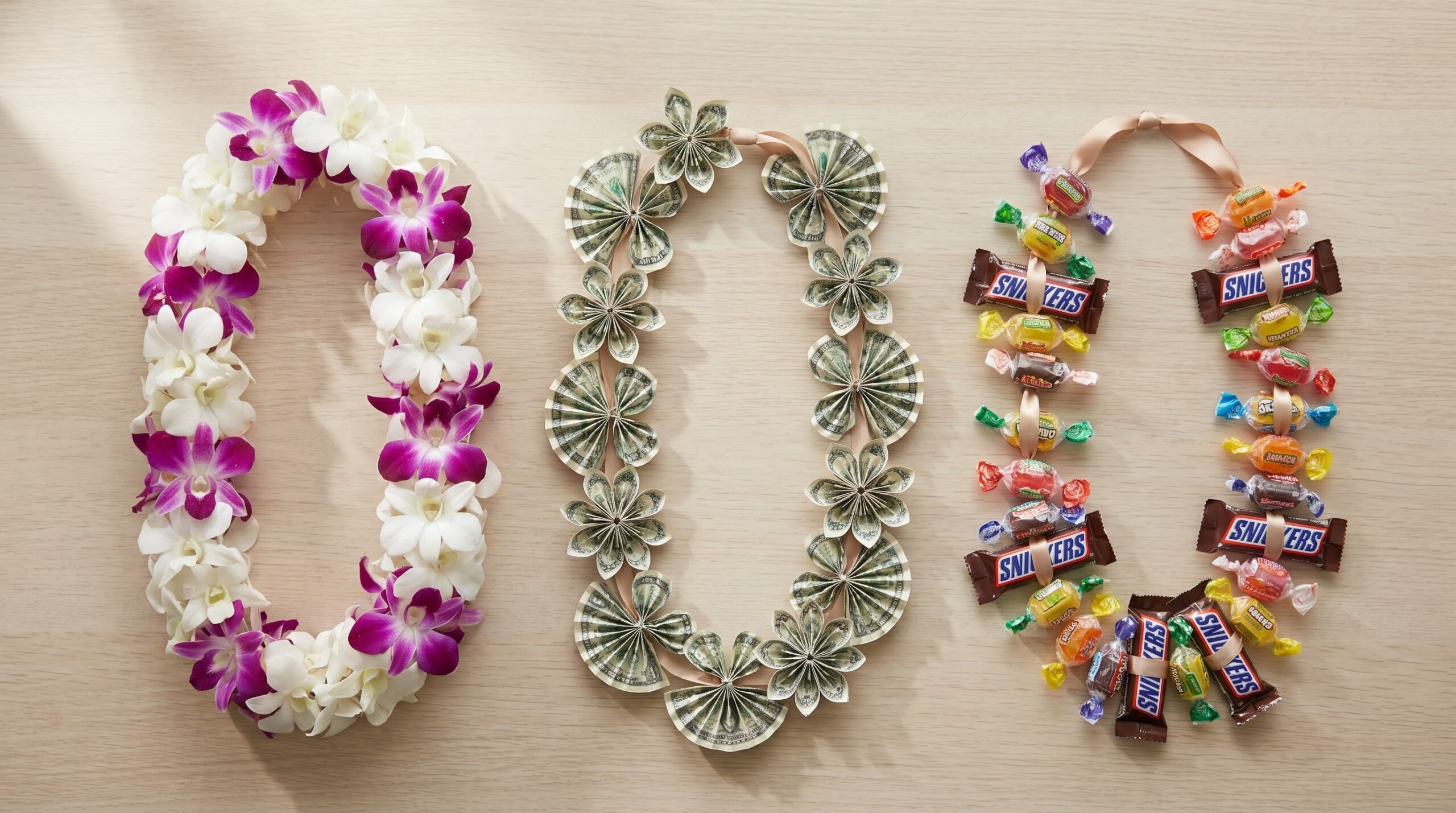
Three different objects go by the name "graduation lei," and they carry different weight as gifts. A flower lei, usually orchid or plumeria, is the traditional version and the one most schools and venues are actually writing policy about. A money lei strings folded bills into a garland shape and works as a discreet cash gift with a keepsake built in, the kind of thing a graduate photographs before spending it. A candy lei swaps in wrapped sweets, a lighter and less formal gift that shows up often in Hawaiian and Pacific Islander families right alongside the floral ones. None is a lesser version of another. It's common for one graduate to receive all three from different people on the same day.
The detail that trips people up most is timing. Leis are perishable and hand-assembled, and they need real lead time before the ceremony. One florist recalled getting her first graduation lei request the day of the ceremony and put it bluntly: "we had to turn them away." Local Hawaiian-style lei shops, florists who carry orchid and plumeria stock, and marketplace sellers on sites like Etsy all handle graduation leis, but the ones worth calling are the ones who can promise a specific pickup or delivery window on the spot. Ordering a week or more ahead, and confirming the venue's policy in that same call, solves both problems at once. Some graduates sidestep the neck-lei question entirely with a haku lei, a flower crown worn around the cap instead. It's a real, separate tradition rather than a workaround, and a venue that restricts neck leis doesn't always restrict one worn on the cap, though that's still worth confirming with the specific school.
Deciding whether to give or wear a lei at a particular graduation comes down to two separate checks: whether it fits the relationship and the culture around it, which the tradition itself answers generously, and whether the venue will actually let it through the door, which only a direct question to that school or stadium can answer. For the regular bouquet and color choices that suit a graduate who isn't doing a lei, our graduation flowers guide covers that ground, and our piece on graduation gift etiquette covers the timing of handing over any gift, lei or otherwise, along with the venue bag rules that go beyond flowers. If the graduate in question is a guy weighing whether he wants a lei at all, our guide to flowers for a male graduate takes that question on directly. All three sit alongside the rest of our congratulations flowers coverage for scenarios beyond graduation season.