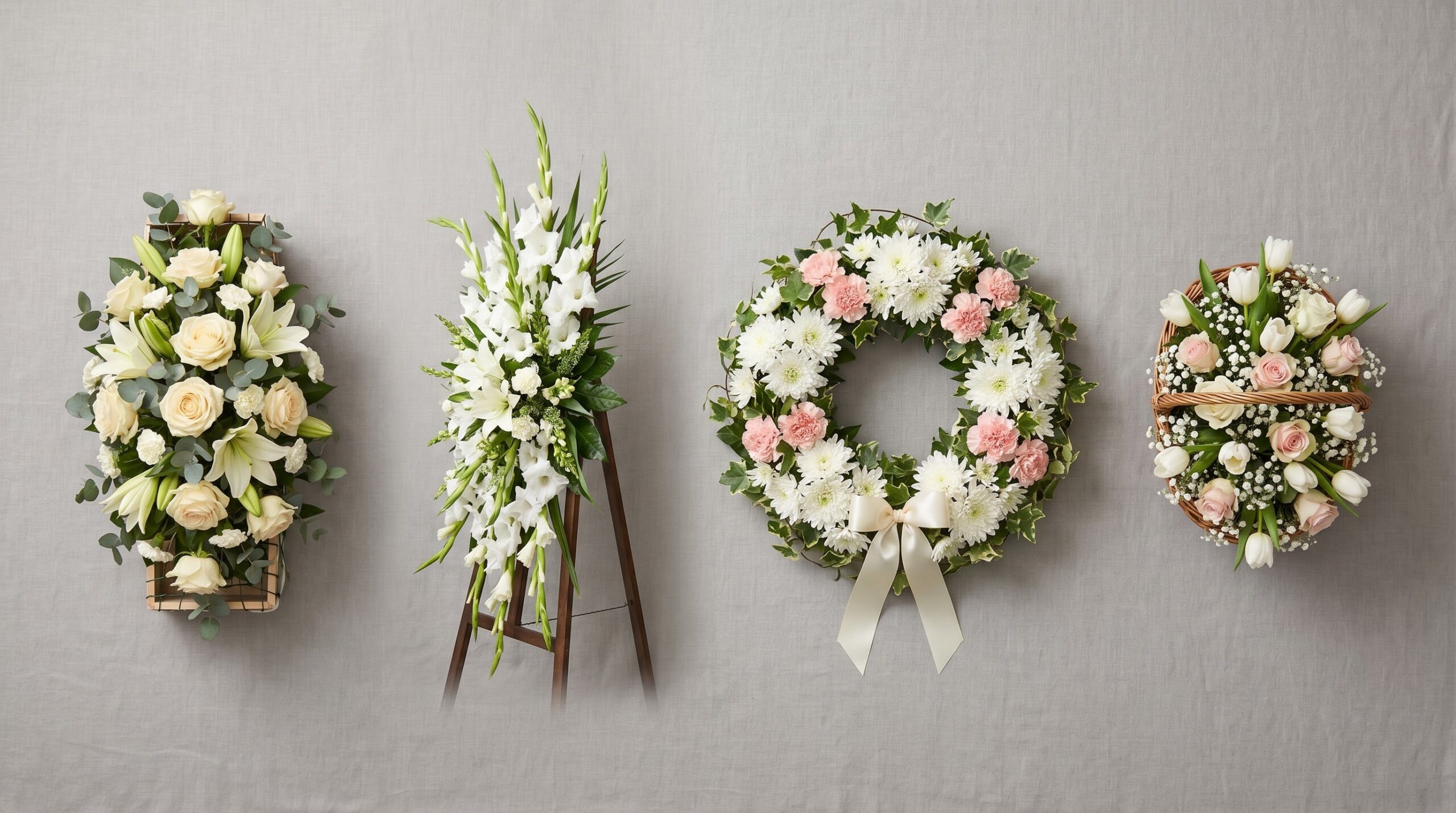
A casket spray at the funeral home's counter says $450. A standing spray a few pages later says $300. Nobody explains why, and the service is two days away. Real funeral flower prices run in fairly predictable bands once you know which piece you're looking at, and those bands hold up whether you get them from a florist's own catalog, an independent price aggregator, or a florist just naming numbers on an industry forum. A casket spray typically runs $200 to $500, sometimes more for a large, open-casket display. A standing spray runs $150 to $350. A wreath runs $100 to $350. A basket or smaller table arrangement runs $75 to $175. A cross or heart tribute runs $175 to $400, occasionally higher. A cremation or urn piece runs $100 to $250.
| Arrangement type | Typical price range | Who usually sends it |
|---|---|---|
| Casket spray | $200 to $500 (higher for large, open-casket pieces) | Immediate family only: spouse, children, parents, siblings |
| Standing spray | $150 to $350 | Extended family, close friends, or a coworker group chipping in |
| Wreath | $100 to $350 | Friends, coworkers, church or community groups |
| Basket or table arrangement | $75 to $175 | Coworkers, acquaintances, smaller or less formal gestures |
| Cross or heart tribute | $175 to $400, occasionally more | Immediate family or very close friends, often faith-specific |
| Cremation or urn piece | $100 to $250 | Immediate family, smaller-scale service |
Swipe →
Those figures come from checking a florist's own published pricing guide against CostHelper's independently aggregated ranges and against real prices florists have named on Reddit, so no single seller sets the number alone. The overlap is closer than you'd expect: one florist posting in an industry forum priced a funeral cross at $500, a casket spray at about $450, and a standing spray at $300, all sitting inside or just past the published bands. Another florist in the same community said flatly that no shop could realistically take on a casket spray for $100, which tells you where the real floor sits even when a listing implies otherwise. The basket or table tier is the cheapest florist-delivered option, but it's rarely under $75 once design labor and delivery are added; a grocery-store equivalent can run $30 to $60 if you skip both.
That price is paying for more than stems. A full casket spray usually takes 120 to 150 individual flowers plus the mechanics that hold it together and keep it upright on a moving casket, things like a floral foam saddle or an easel frame that can run around $45 retail on their own. Florists who've broken down the math publicly, among them Bloomstall and Adele Rae Florist, put the standard structure at roughly a 3.5 times markup over wholesale flower cost plus about 20 percent for labor, the same ratio that shows up in a wedding centerpiece or a grocery-store bouquet. Funeral work adds the pressure of building something large enough to be seen from the back of a room and getting it to a specific building by a specific hour, sometimes with almost no lead time. That's ordinary skilled-labor pricing, the same math the flower industry runs everywhere else.
You also have a legal right to see all of it written down before you agree to anything. The FTC's Funeral Rule requires every funeral home to hand you a General Price List you get to keep, with an itemized cost for every good and service, and the rule specifically treats flowers as what it calls a cash advance item, something the funeral home buys from a third party like a florist and passes through to you. If the funeral home charges you a fee for arranging that purchase, or if it keeps a rebate, commission, or volume discount on it instead of passing the savings to you, the FTC requires a plain disclosure of that fact on your paperwork. You don't have to guess whether a markup is baked in. Ask for the itemized General Price List before you order anything, from the funeral home or from a florist working off its catalog. It's a right you already have.
How much is fair to spend follows how close you actually were to the person who died, and no one is measuring your gift against the biggest number in the catalog. A casket spray is the family's own farewell, and etiquette across the industry is consistent on this: it belongs to the spouse, children, parents, or siblings, sometimes split among them, and guests aren't expected to order one even if the catalog lets anybody click buy. A standing spray, wreath, or basket is the natural landing spot for extended family, close friends, and coworkers, often as a shared purchase rather than one person covering the whole cost. A smaller basket or a simple bouquet is entirely appropriate from someone further out, a casual coworker or an old acquaintance, and nobody is quietly grading the dollar amount against your relationship to the person who died. Our step-by-step funeral flowers guide has a fuller breakdown of which type of arrangement fits your relationship to the family, including the casket-spray rule that it stays with immediate family regardless of who else wants to send something bigger.
A grocery-store bouquet, a Costco order, or a rental spray can be the right call, and none of them read as cheap to the people receiving them. Costco carries funeral-flower options through its own site, and families who've used it for a graveside or a smaller service describe getting standing pieces at a fraction of a florist quote. Grocery-store flowers work the same way for a hand-tied bouquet or a vase arrangement: people who've assembled one for a relative's funeral consistently say it looked far better than the price suggested, and a florist consultation isn't required to wrap stems in ribbon and set them by a photo. If you're set on real flowers but want to spend less, carnations run noticeably cheaper than roses for the same visual size, which is worth mentioning to whoever is placing the order. Rental is a real option too: some florists deliver a faux standing spray or casket-size arrangement for roughly half what the fresh version costs, then collect it after the service, so ask how pickup works when you order, so it's worth asking directly how the pickup is handled. The one place DIY gets harder is a large, open-casket spray built to sit on a moving casket through a viewing and a procession; that's a different construction job than a hand-tied bunch, with mechanics a florist has practiced and a home arrangement usually hasn't. For everything else, smaller sprays, baskets, a vase by the guest book, a grocery-store bunch says something real, sized to what you can actually give. Once you've decided to order from a florist, our guide to how to place the order and have it delivered to the funeral home on time and our page on what to write on the card or the ribbon cover the mechanics from there.
You don't have to buy flowers at all, and that's not just internet advice, it comes from inside the industry. A funeral home owner's wife, posting about a service her own family ran, put it plainly: flowers are "not necessary at all." Families she'd worked with have placed a loved one's boots, a favorite blanket, or photographs on the casket instead, and funeral directors elsewhere say the same thing quietly to families who ask. If you do buy flowers, know that most get thrown away within a day or two after the service, which is exactly why some people choose to donate to a cause the person cared about instead, or ask that flowers be skipped in favor of something that outlasts the afternoon. If you're the one who ends up with an armful of arrangements afterward, our page on what typically happens to the flowers after the service covers what families usually do with them, including which parts can be dried, pressed, or kept. If you paid for flowers personally as part of arranging the funeral itself, that cost is typically treated as a reasonable funeral expense the estate can reimburse once probate opens, the same as the casket or the service fee, provided you keep the receipt. Flowers other people send are simply their own gift, outside the estate process. And if you're still deciding whether flowers are the right gesture at all, or want to send something else entirely, that question belongs to a separate page on whether flowers are the right gift and what to send instead.
Walk away from this with two things: a number that matches the specific piece you're considering and your specific relationship to the person who died, and the knowledge that you can ask the funeral home or the florist for that itemized price list before you agree to anything. From there, you're calling a local florist with a real budget instead of a guess, choosing the grocery-store or Costco route for a smaller service, or deciding flowers aren't the right call this time and routing your money or your time somewhere else.

Enjoying our flower guides? Add YourFlowersGuide as a preferred source on Google. It helps more readers find us.
Add to Preferred Sources