If you've just been asked to handle the flowers for a funeral and every term on a florist's site looks like a foreign language, that's normal. Nobody grows up knowing what a standing spray is until they need one. You also don't have to assume flowers are mandatory. Plenty of funerals go ahead with a single arrangement, or none at all, and nobody thinks less of the people who chose that. The one fact that would have saved most first time buyers a mistake is this: anything that sits on or inside the casket itself is traditionally the immediate family's piece to send, one per casket. Everyone else, no matter how close they were, sends something that stands beside it instead. Once that's settled, the rest is just vocabulary.
What each type of funeral flower actually is
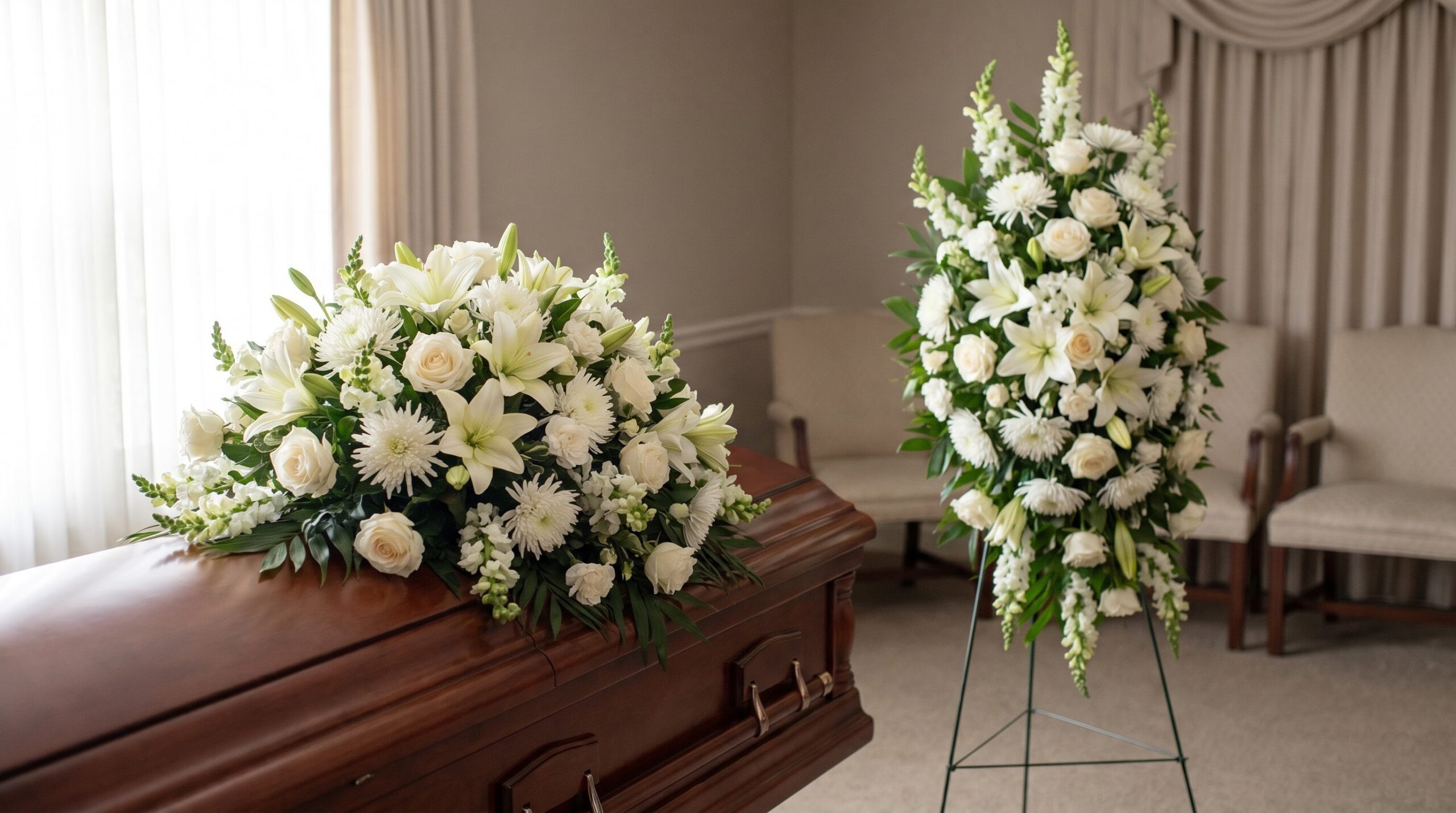
Two pieces belong to the casket itself. A casket spray is the blanket of flowers that lies across the top, ordered as one unified piece rather than several bouquets crowded together. Funeral homes typically expect a full casket spray, one running the entire length of the lid, when the casket stays closed for the service. A half spray, sized to cover just the lower section, fits an open casket viewing, where the top half needs to stay clear. The terms trace back to a period when caskets were called couches, which is why florists and funeral homes still say full couch and half couch interchangeably with full and half spray. A cushion, sometimes called a pillow, is smaller and softer in shape, and along with any small loose sprays it goes inside the casket rather than on top of it, tucked near the person rather than displayed for the room.
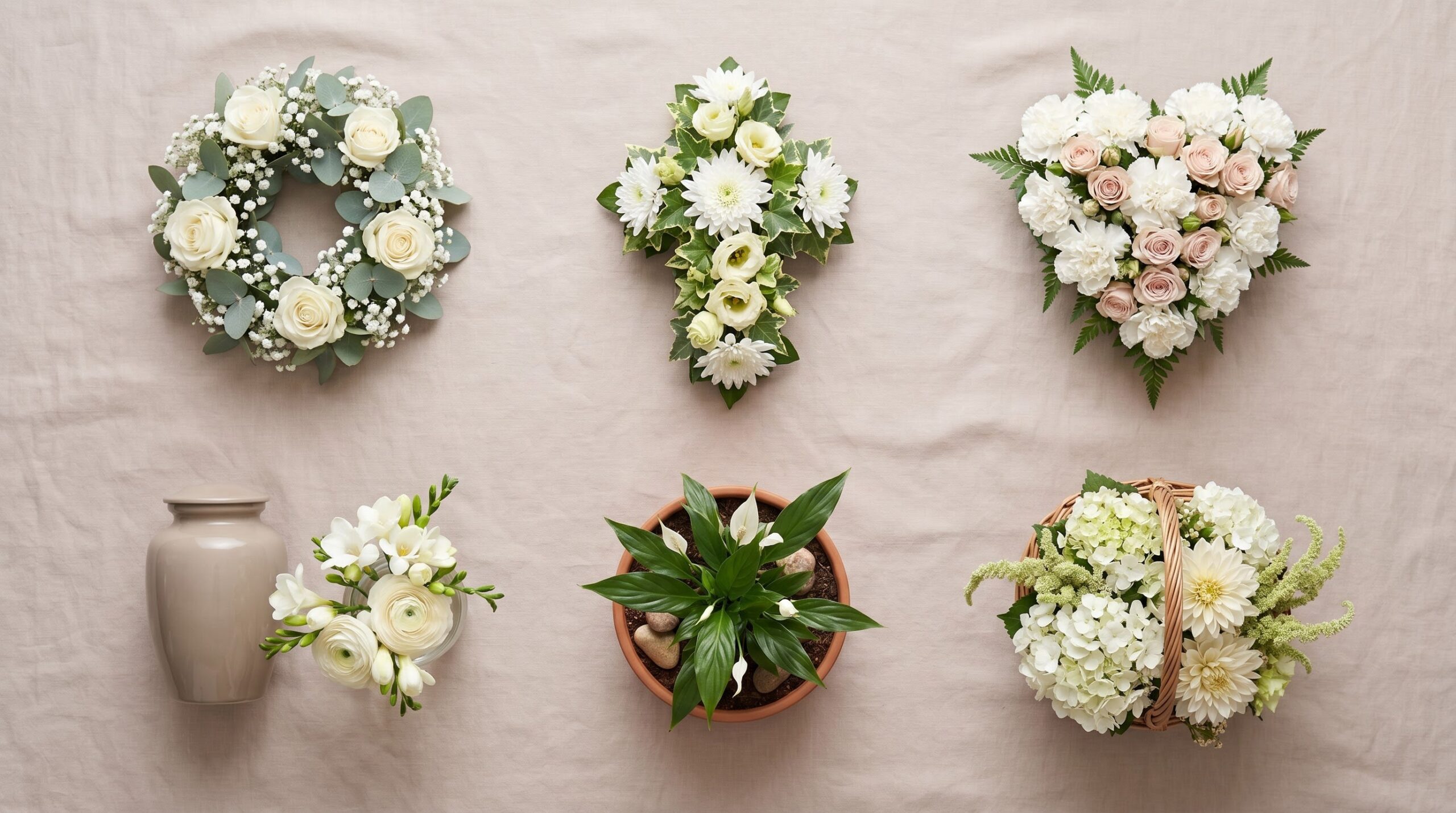
Everything else in the room is meant to be seen rather than touched. A standing spray is built into a tall, one sided shape on a wire easel so it reads clearly from across a room. That's why it's the default choice for anyone outside the immediate family who still wants a visible, personal tribute near the casket. A wreath, built in a circle, and pieces shaped like a cross or a heart serve the same visible tribute role. Each tends to signal something about the relationship: a cross for religious families, a heart for a spouse or a very close relationship, a wreath for almost anyone. A basket arrangement sits lower and reads less formal, and it's often what coworkers or a whole workplace send as a group.
A few pieces sit outside that split entirely. A letter or name tribute spells out a word, most often the relationship or a set of initials, built entirely from flowers, and it's one of the more personal, more expensive options in the category. A dish garden is a small planted arrangement rather than cut flowers, chosen specifically because it survives the week and keeps going in someone's kitchen long after the service ends. An urn or cremation piece is simply a smaller version of any of the above, scaled to sit next to an urn rather than a full size casket, since cremation services increasingly skip the casket sized pieces altogether.
Who is actually supposed to send each piece
None of this is written into law anywhere, but funeral etiquette guides converge on a fairly consistent answer, and it maps directly onto the piece types above.
| Your relationship to the person who died | The piece that's traditionally yours to send | Where it goes |
|---|---|---|
| Spouse, children, parents, or siblings, often paying together | Casket spray, full or half, matching the service | On top of the casket |
| Immediate family, occasionally a very close friend by request | Cushion, pillow, or a small loose spray | Inside the casket |
| Close friends, extended family, coworkers who knew the person well | Standing spray, wreath, cross, or heart | On an easel beside the casket or near the entrance |
| Coworkers as a group, neighbors, clubs, distant relatives | Basket arrangement | Displayed in the viewing room or chapel |
| Anyone, including people too far away to attend | Dish garden or a blooming plant | Sent to the family's home, useful well after the week is over |
Swipe →
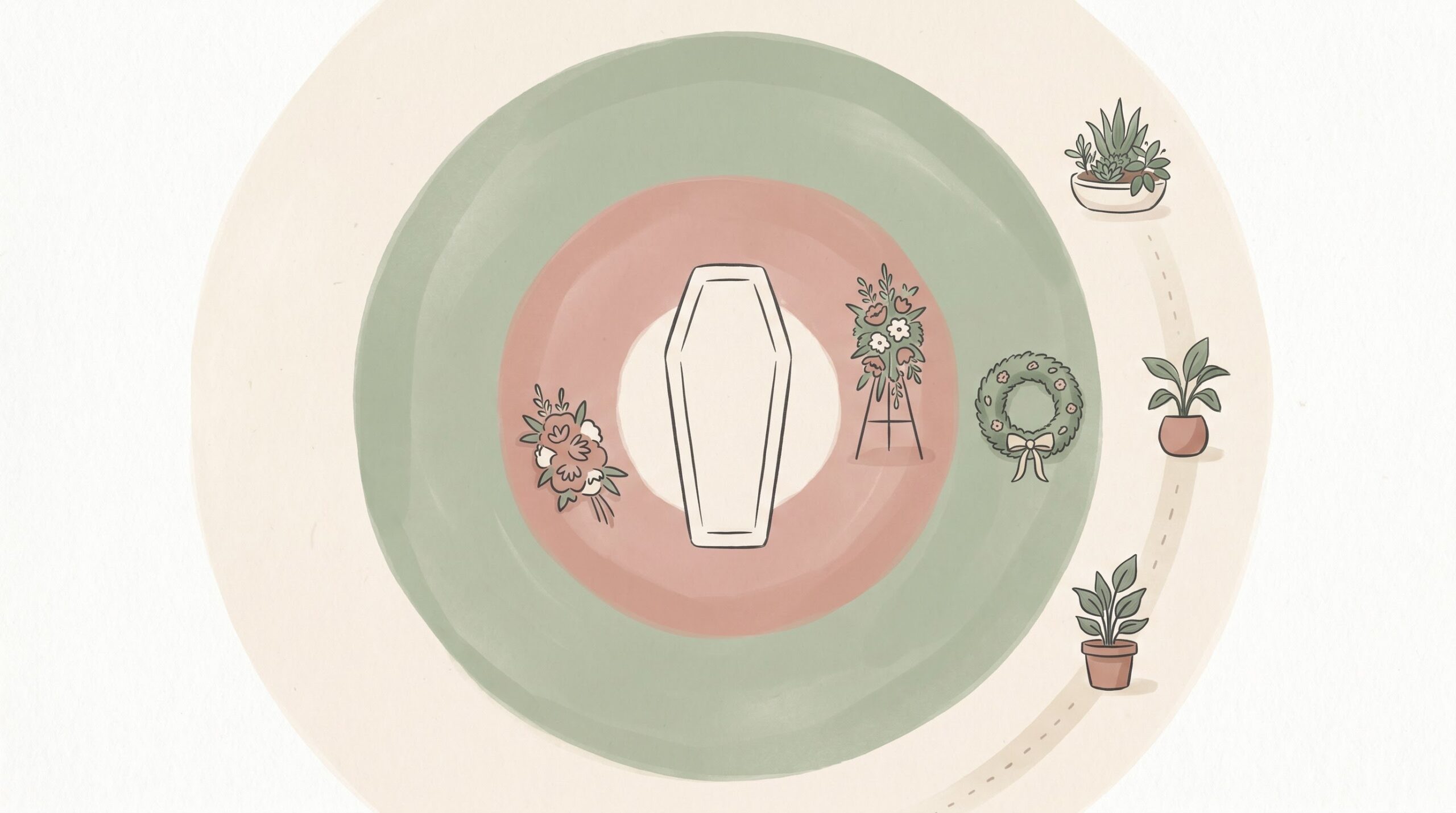
The pattern underneath all of it is simple. The closer the relationship, the closer the flowers physically get to the person. Immediate family gets the casket itself, close friends and coworkers get the space around it, and everyone further out sends something that eventually travels home with the family instead of staying at the service. Retail florist sites rarely mention any of this. A website will happily sell a full casket spray to anyone who clicks the buy button, whether or not it's actually their piece to send, which is exactly how the confusion starts in the first place. If you're not sure where you fall on that list, a standing spray or a basket arrangement is close to a universal safe choice for anyone outside the immediate family.
Whether you're even obligated to send flowers at all
You are not. Funeralwise, one of the more widely used funeral planning resources, states plainly that flowers are not mandatory at a funeral, only a traditional and appropriate way to express care. Families who'd rather receive something else are common enough now that "in lieu of flowers" reads as a normal line in an obituary these days, hardly worth a second glance. One funeral home owner described a service for a lifelong cowboy where the family skipped flowers entirely. They laid his saddle, his boots, a coiled rope, a gun, and a hide from one of his own horses across the casket instead, and called the result beautiful, not lacking. Other families have done something quieter: cutting flowers from the person's own garden rather than buying an arrangement, on the reasoning that it felt more personal than anything a florist could deliver same day.

If the family has asked for donations instead, that request is worth following rather than working around. Sending flowers anyway, even with good intentions, puts the family in the position of managing a delivery they specifically tried to avoid. If no request was made and you'd still rather do something other than order flowers, plenty of options exist: a favorite item, a framed photo, a handwritten letter placed near the casket, or a contribution toward the costs the family is actually facing. All of it lands the same way flowers were meant to, as a sign that someone showed up and cared enough to bring something. If cost is part of what's holding you back, it helps to know that funeral homes are required by federal rule to disclose any commission or discount they receive on flowers they purchase on your behalf. It's a detail almost nobody asks about, but the FTC's Funeral Rule specifically protects it, in writing. There's a fuller list of alternatives, including how to phrase a note that isn't flowers, on our sibling page about what to send instead of flowers when someone dies.
What color is expected, and where that expectation comes from
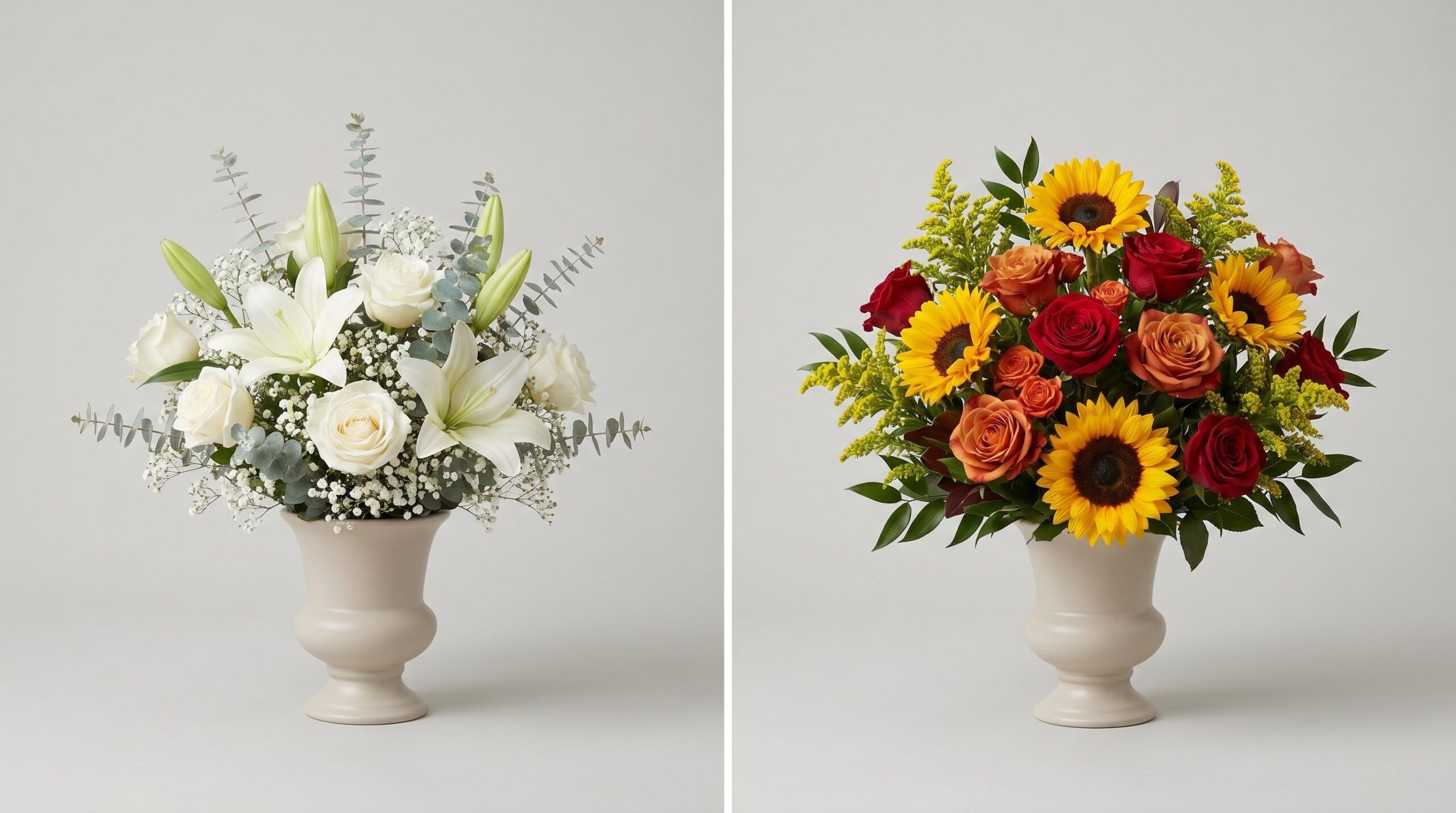
White has been the default answer for so long that it's stopped feeling like a choice. That's mostly a hangover from Victorian mourning customs, which favored pale, restrained arrangements, and florists have carried the expectation forward through a century of habit rather than any actual rule. It still fits a traditional service well: white lilies, white roses, or white chrysanthemums read as formal, quiet, and safe if you know nothing else about the family's preferences. But a growing number of services, especially ones the family frames as a celebration of life rather than a formal funeral, ask for the opposite on purpose. Sunflowers, bold red roses, or a mixed arrangement in the person's favorite color show up increasingly often at services meant to feel like the person being honored rather than like a generic solemn event. Showing up in all white to a service the family explicitly called a celebration can read as a small, easily avoided miscalculation, once you know to ask.
Faith and gender carry their own separate expectations that a general color rule can't cover. Some traditions avoid flowers altogether regardless of color, and among the ones that do use them, specific colors carry meanings that vary by faith and even by region within the same faith. Rather than guess, our page on what's appropriate at a Jewish, Catholic, Buddhist, Hindu or Muslim service breaks those differences out individually. Absent any other information, white or a soft pastel remains the choice least likely to clash with someone's expectations, which is exactly why it became the default in the first place.
If none of this is quite your question
A page built to cover types, who sends what, and color can't also cover everything downstream of that decision, so here's where the rest of it lives. If you know which piece you want and need what to write on the card or the ribbon, that's covered on its own page, along with real phrasing you can borrow instead of staring at a blank card. If a casket spray specifically is your piece to send and you want the rules around a casket spray specifically, half couch versus full couch explained in more depth, including who typically pays when siblings split the cost, that lives on its own page too. Real numbers, the kind florist sites usually swap for a vague "starting at" figure to earn a click, are broken out on what each type actually costs, without a sales pitch. The mechanics of how to send flowers to a funeral home, and whose name goes on the order get their own walkthrough too, down to timing and what to do when you're ordering from out of town.
If your real question is about timing or manners rather than which piece to buy, that's not this page's territory either. Broader etiquette, including how to word a card when you're not sending flowers at all, lives on our sympathy flowers etiquette page. If you're unsure whether you've missed the window to send anything, when to send sympathy flowers walks through the actual timeline, including what's still appropriate weeks later. And once the service itself is behind everyone, what actually happens to all those arrangements, whether they're donated, kept, or thrown out, has its own answer on what happens to the flowers after the service.
One last thing before you order
Two small questions tend to surface right before people actually place an order. The first is why lilies and chrysanthemums keep showing up as default funeral flowers in the first place. The short version is that both carry centuries of association with death and remembrance: lilies through Christian symbolism around the soul, chrysanthemums through a tradition that reads as mourning across much of continental Europe, even though the same flower signals joy or long friendship in much of Asia and the US. We cover that properly, region by region, on our page about why lilies and chrysanthemums carry funeral associations. The second is how funeral flowers differ from sympathy flowers, since florists use the two terms almost interchangeably. The distinction matters more than the marketing suggests, and it's covered properly on our sympathy flowers versus funeral flowers page rather than here.
Renting or using artificial flowers is also a real option, more common than florist marketing lets on, though it depends entirely on the individual funeral home. Some keep a small stock of silk pieces on hand for exactly this purpose. Plenty of others don't carry any at all, which makes one phone call worth more than an assumption either way. If you'd rather write a thank you note than shop for a casket spray right now, writing a thank you note for flowers you received is its own short guide too.
Before you call a florist or the funeral home, settle three things:
- Which piece actually fits your relationship to the person who died - Where it needs to go: the casket, the viewing room, or the family's home - Whether the family has asked for anything other than flowers in the first place
Answer those three and the rest of the order takes about five minutes.
Enjoying our flower guides? Add YourFlowersGuide as a preferred source on Google. It helps more readers find us.
Add to Preferred Sources