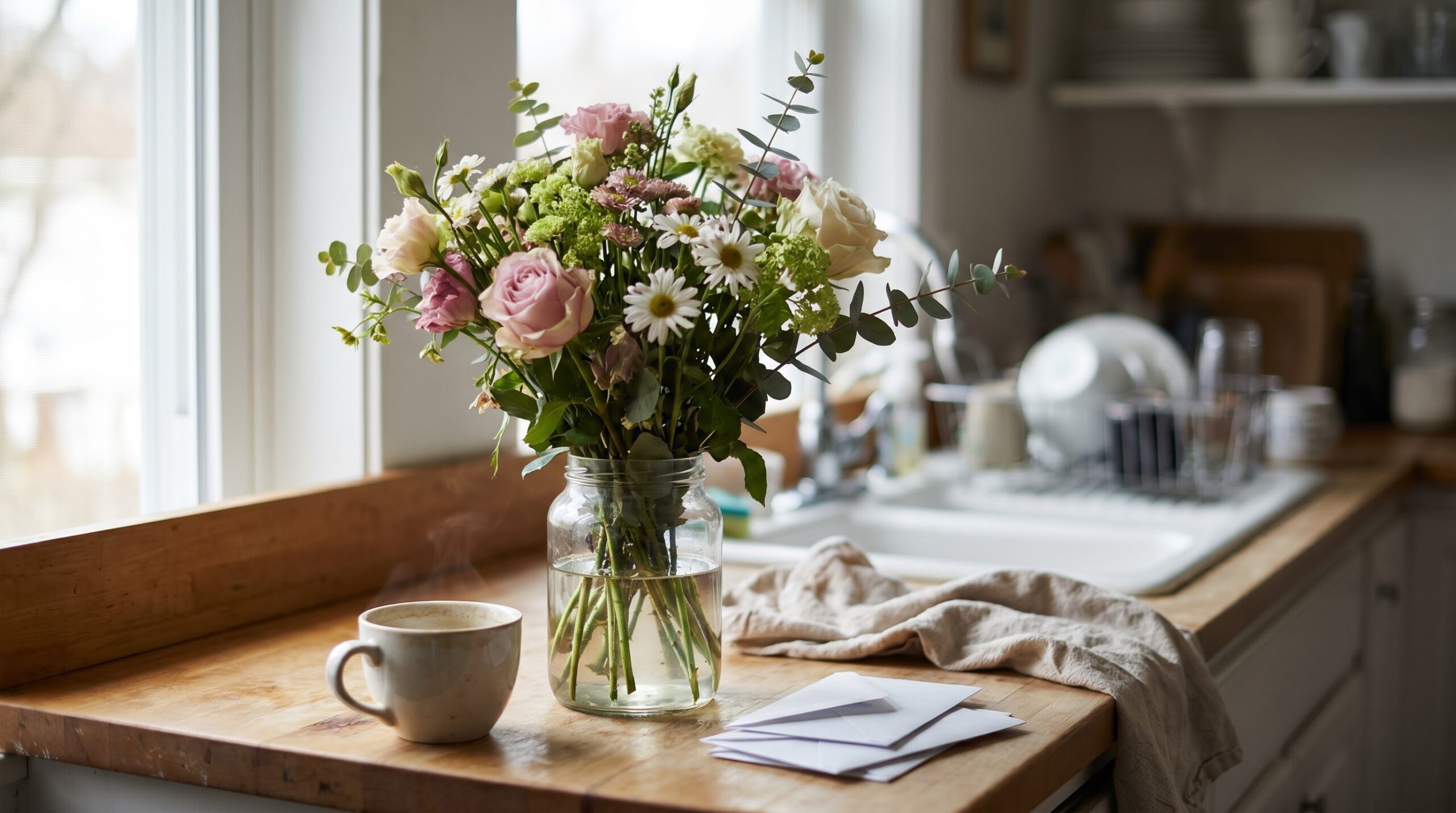
"Just because flowers" are exactly what the phrase promises: a bouquet that shows up with no birthday behind it, no anniversary, no fight you're aware of, given simply because someone was thinking of you. That's the whole definition, and it holds whether you're the one holding the stems right now or the one who just decided to send them. If you're standing in your kitchen with an unexpected armful of flowers and your first instinct, right after the pleasure of it, is a flicker of suspicion (what did he do?), you're not being paranoid and you're not overreacting. That reflex turns out to be close to universal, not personal, and there's real data behind why it fires. The answer is also fast, though: the flowers themselves don't prove anything one way or the other. What's actually worth watching for is a shift in behavior around them.
He brought you flowers, should you worry
Ask around and that flicker of suspicion is close to the default reaction, not the exception. A survey commissioned by the UK bakery chain Greggs asked 1,500 women in long-term relationships how they'd react if their partner turned up with a bouquet out of nowhere, and three in four admitted they'd wonder what he'd done. That number alone should settle the "am I the only one who thinks this way" question. It also explains why a Reddit thread titled "Flowers are not a complete apology," sitting at over 900 upvotes, has a top reply with 668 upvotes of its own that puts the reflex into words better than any survey could: "If he buys me flowers, my first response is 'What have you done that you think you need to apologise for?'" Nearly seven hundred strangers upvoted that line because they recognized it.
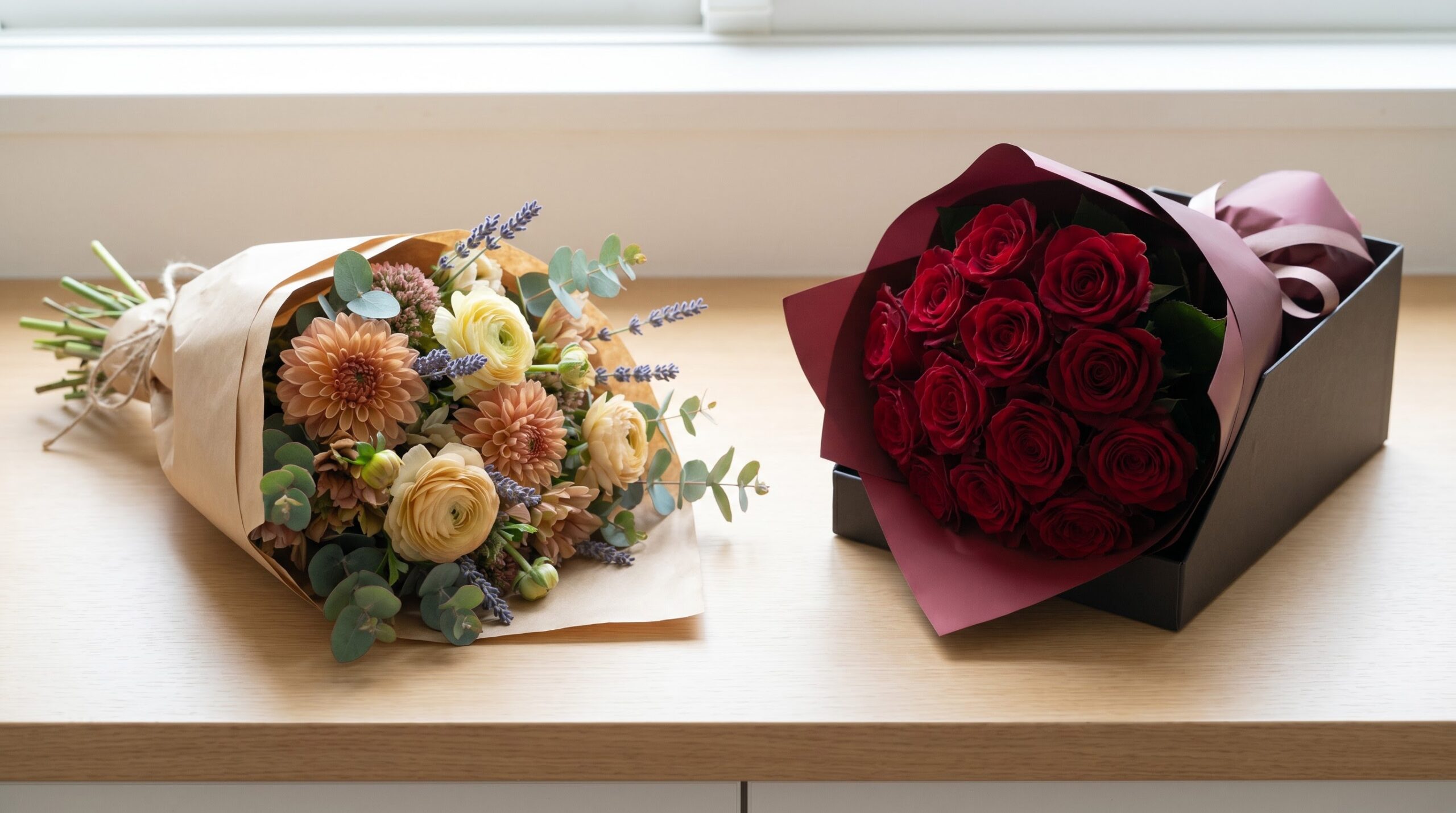
Part of why the gesture reads as loaded is that it's rare. Talker Research surveyed 2,000 Americans in 2025, in a study commissioned by the flower-subscription service BloomsyBox, and found that roughly one in five have never received flowers from a partner at all. When something almost never happens, it lands as significant even when nothing significant caused it. And whatever the motive behind it, the response to actually getting flowers is close to guaranteed: researchers at Rutgers, publishing in Evolutionary Psychology, found that every woman in their study broke into a spontaneous, unmistakably genuine smile at the sight of the flowers, the kind that involves the eyes and is hard to fake on command. Worth saying plainly alongside that finding: the research was partly funded by the Society of American Florists, so treat it as solid evidence flowers reliably lift mood, not as unbiased proof they're the right gift for every situation.
| What you're noticing | What the data actually says | Worth worrying about |
|---|---|---|
| The instant "what did he do" flicker | Three in four of 1,500 women in a Greggs-commissioned survey said they'd suspect something too | No, it's close to a universal reflex |
| The bouquet feels loaded because it's rare | About one in five Americans have never gotten flowers from a partner, so an unprompted bunch reads as bigger than it may be meant | No, scarcity explains the weight, not guilt |
| The real happiness you felt holding them | Every woman in a Rutgers study showed a genuine smile within five seconds of getting flowers, in research partly funded by the florist industry | No, that reaction is well documented and yours to enjoy |
| Flowers that only ever show up right after a fight | Real accounts describe resenting, even throwing out, bouquets that arrived on cue after every rough patch | Yes, this pattern is the actual signal |
Swipe →
Put those four side by side and a pattern falls out fast. None of the first three lines add up to a reason to put one bouquet on trial. The thing worth naming isn't a single delivery, it's repetition tied to timing: flowers that only ever arrive right after a fight or a cold silence, not flowers that show up on an unremarkable Tuesday for no reason at all. One Reddit user described exactly that cycle: "everytime something went sour he would show up with flowers the next time... I always ended up throwing out the flowers, and I resented them." That's the version worth paying attention to. A bouquet with no pattern behind it isn't.
If you're the one this happened to today, none of the above is telling you to stay quiet about something that genuinely feels off between you two. It's telling you that a single unprompted bouquet, on its own, isn't the signal. If your gut is reacting to something else entirely, a distance, a secrecy, a broken routine, trust that; it's real information. If your gut is only reacting to the flowers themselves, that's the reflex talking, common enough to name and let go of.
Why the gesture lands so well when it isn't an apology
In the same subreddit, one commenter summed up why the gesture works so well when it's genuinely unprompted: "'Just-Because flowers' are the only ones worth it IMO." Another put it more bluntly, in a comment that picked up 446 upvotes of its own: "Flowers are like 'random surprise for so' not an apology lol." The distinction those two comments are drawing isn't subtle. Flowers attached to nothing read as a gesture. Flowers attached to a fight read as currency, something spent to skip a harder conversation. The original poster in the 902-upvote thread said it flatly: "Flowers are not an apology. An apology is an apology." Nobody in that thread argued back. The upvotes were agreement.
For a giver deciding whether "for no reason" will land the way it's meant to: it will, as long as there isn't an actual apology owed underneath it. If there's something specific you did and you know it, when the flowers really are an apology is a different situation with different physics, and it deserves its own approach rather than a surprise bouquet standing in for a conversation. But if nothing is owed and you just want the flowers to say someone was thought of, that's exactly the read most partners give it, no explanation required. Timing barely matters here the way it does for a birthday or an anniversary among the other occasions worth planning flowers around; an unprompted bouquet on an ordinary day is, if anything, more effective than one that happens to line up with a date on the calendar, because there's nothing else it could be standing in for. Choosing which flowers to actually send is covered elsewhere in more depth, but the classic default is still hard to beat: a mixed bunch or a simple dozen roses, with whatever a particular color happens to signal worth a quick look only if you're choosing beyond "whatever's fresh at the shop."
Buying yourself flowers just because
The same instinct that makes someone else's unprompted bouquet land well applies to your own hands, too. Buying flowers for yourself with no occasion attached is a normal, well-documented thing people do, not a consolation prize for nobody else doing it for you. One woman described the running joke in her house on r/Marriage: "No but I love flowers and he knows this so I buy them for myself and he comes home confused like who got me flowers. I'm passive aggressive," she added, only half serious. The joke works because it flips the guilt-flowers reflex on its head. There's no one to suspect and no apology to decode, just flowers because she wanted flowers that week. If you've been weighing whether that's a frivolous purchase, it isn't. It's the identical gesture, aimed at yourself instead of waiting for someone else to think of it first.
None of this needs solving today. The only piece genuinely left is what goes on the card, and that blank space gets easier to fill once you know the bouquet already did its job just by showing up.
Enjoying our flower guides? Add YourFlowersGuide as a preferred source on Google. It helps more readers find us.
Add to Preferred Sources