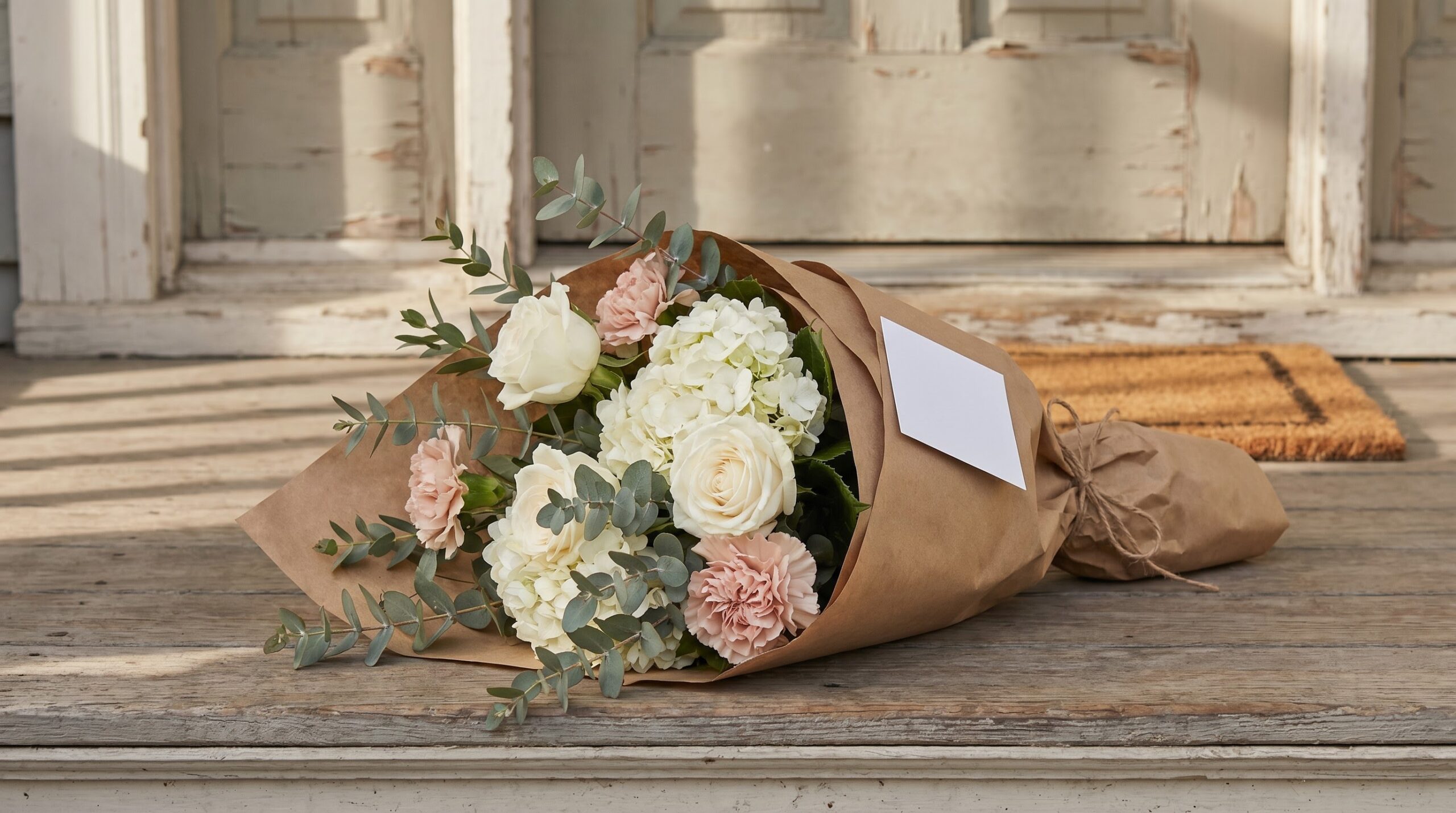
Send a florist-delivered arrangement with a card that has your name on it, and you have almost certainly done the right thing. Sympathy flowers are one of the most forgiving gestures in etiquette: people remember that you thought of them, and the exact shade of ribbon on the bow fades from memory within days. The ways this actually goes wrong are few and specific, and once you know them, most of the anxiety drains out of the decision. Carrying flowers into a viewing or funeral by hand instead of having a florist deliver them. Ignoring an obituary that says no flowers, please. Sending a bouquet to a shiva, where flowers simply aren't the custom. Having an arrangement show up at someone's desk at work, outing a loss they haven't chosen to share with coworkers yet. That's close to the whole list of real mistakes. Everything below covers where flowers should actually go, what "in lieu of flowers" obliges you to do versus merely suggests, whether it's even your place to send something, and which colors, faiths, and card wording keep a kind gesture from landing wrong.
Where sympathy flowers actually need to go
The instinct to carry something in your own hands to the service feels more personal, but it's the one move that consistently reads as a misstep. You don't bring flowers to a viewing, a funeral, or a reception. A florist delivers them ahead of time, either to the funeral home or to the family's house, and staff arrange everything before anyone else arrives. Emily Post's etiquette guidance puts the timing question simply: there's no fixed rule for exactly when flowers should arrive, only that they should reach the bereaved as soon as reasonably possible, whether that means the home, the house of worship, or the funeral home in time for the visitation.
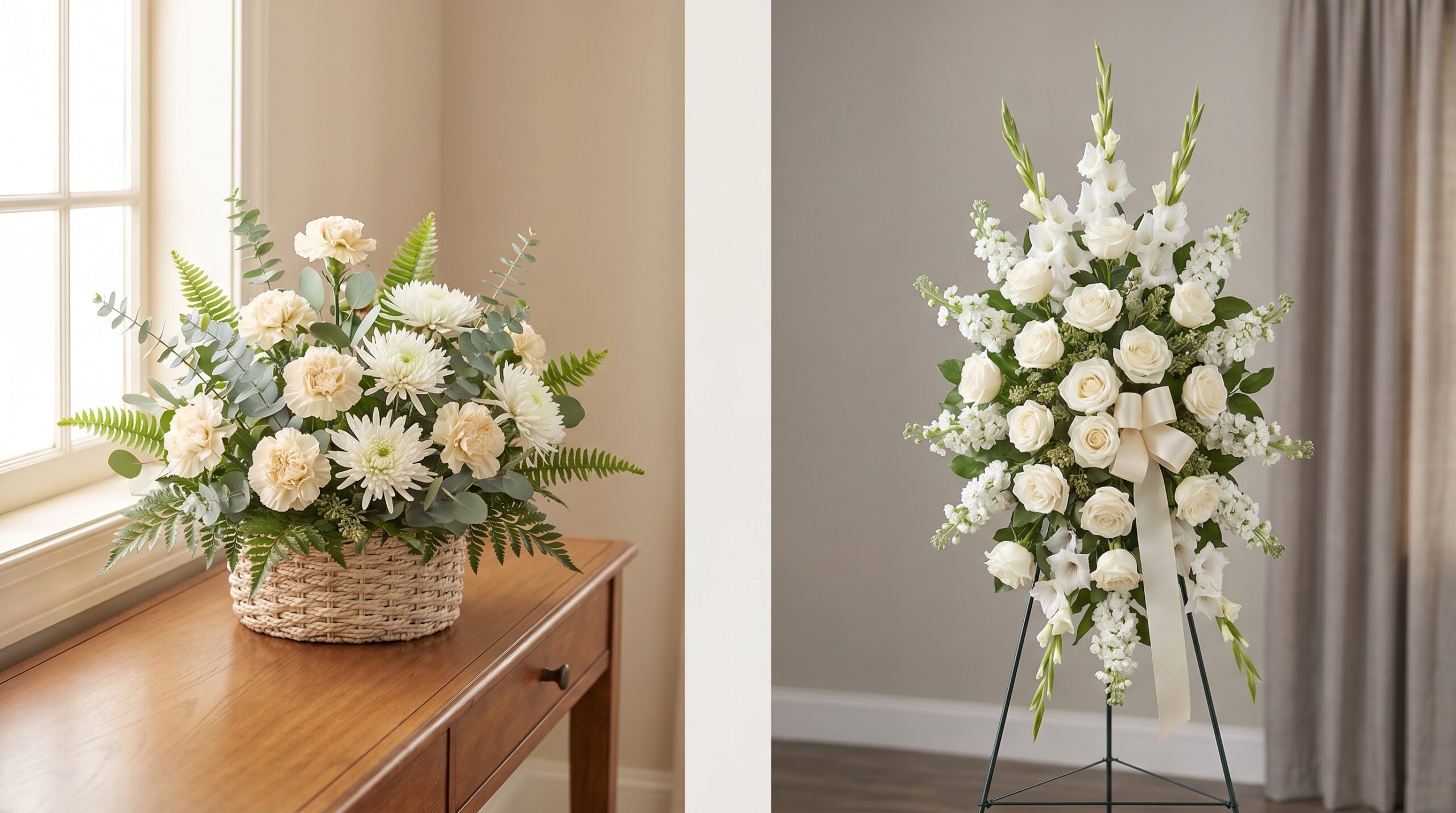
Which destination fits depends more on scale than on sentiment. A large, showy arrangement makes sense at the funeral home, where it joins a room full of tribute pieces surrounding the casket and reads as a public gesture of respect. A smaller, more personal bouquet or a living plant often lands better at the family's home, where it will sit on a counter for a week and quietly remind someone that a person cared, long after the funeral itself is over. Legacy.com's guidance is blunt about the hand-carrying instinct specifically: it's best not to arrive at the funeral with flowers in hand, since whatever a florist already delivered will be arranged and there may not be a place to put what you brought. The same logic covers dropping something off unannounced at a house in mourning. Order through a florist who confirms a delivery window rather than showing up with a bouquet and no warning; a family mid-grief may not be dressed for visitors or even home.
None of this is the full picture of which arrangement fits which setting. The fuller breakdown, including how a standing spray differs from a sympathy basket and when each one actually belongs, lives in the difference between sympathy flowers and funeral flowers.
What "in lieu of flowers" actually means
An obituary line reading "in lieu of flowers" sounds like an instruction, almost legal in tone, and that's exactly what trips people up. It functions more like a strong preference than a rule. Emily Post's guidance on the phrase is direct about this: it signals the family's preference for charitable contributions rather than a strict ban on flowers. You may still send flowers in addition, the guidance notes, but if you're sending only one expression of sympathy, follow the family's stated wish and pick the donation.
People online land in two camps on how seriously to take the exact wording, and both have a point. Some treat it as a strong suggestion and take it "with a grain of salt," reasoning that grief has its own logic and a family who truly objects to a small bouquet arriving later, quietly, at the house, is rare. Others feel just as strongly the opposite way: if a family asked for donations instead, overriding that with flowers anyway can read as centering your own preferred way of grieving over their stated wish. Neither reaction is wrong on its own. The wording itself is the better guide than either instinct. A specific fund named in the obituary, especially one tied to the cause of death, is usually a genuine request. A generic "donations preferred" line that reads like an obituary template filled it in automatically carries less weight.
| Obituary wording | What it actually signals | Are flowers still okay | What to do |
|---|---|---|---|
| "In lieu of flowers, donations to [organization]" | A genuine but flexible preference | Yes, afterward, sent to the home rather than the service | Make the donation first; add a small home arrangement later if you want to do both |
| "Donations preferred" or "contributions welcome" | A softer, more generic nudge | Yes, either works | Either is fine; the donation edges it slightly |
| "No flowers please" or "flowers respectfully declined" | The family means it literally | No | Skip flowers, send a card, or choose what to send instead of flowers |
| No mention of flowers or donations at all | No restriction exists | Yes | Flowers are a safe, standard default |
Swipe →
It's worth knowing where a lot of the advice softening "in lieu of flowers" actually comes from: florist and flower-delivery sites, which have an obvious financial interest in you buying flowers regardless of what the obituary says. That doesn't make the reading wrong, Emily Post's own guidance lands in roughly the same place, but it's fair to notice who benefits before taking etiquette advice from a company selling the product in question.
One more fear worth closing here in one line: if you're reading this well after the service and wondering whether you've already missed your window, you haven't. Sympathy flowers sent weeks later, especially to the home, are still genuinely welcome. When to send sympathy flowers walks through the actual timing in more depth, including how late is too late.
Whether it's actually your place to send something
If you're one relationship step removed from the loss, the coworker of someone whose father just died, the boyfriend of a woman whose grandmother passed, a friend of a family you've never technically met, the question underneath "should I send flowers" is usually smaller and more anxious than it sounds: would it be weird for me, specifically, to do this? Almost always, the answer is no. Flowers work as a gesture precisely because they ask nothing back. No reply is owed, no thank-you note is expected on a deadline, just a visible sign that someone was thinking of them during a week when very little else feels easy.
Emily Post's guidance maps who typically sends what by relationship. Friends, coworkers, and relatives may all choose to send flowers. Floral baskets and living plants suit any level of closeness; they're the safest default for someone you know only through work or a shared friend. Wreaths, crosses, and standing sprays tend to come from a group, and they're a good fit for a company or an association wanting to mark the loss collectively rather than individually. Casket arrangements and lid sprays are reserved for immediate family: siblings, children, or grandchildren of the person who died. When the calculation still feels murky, default small: a modest bouquet or basket to the home almost never overreaches. A large funeral-home tribute piece is the one category worth saving for closer family or a pooled office gift. Gender isn't a variable here at all; the arrangement, not the recipient's gender, is what varies by relationship, so sending flowers to a grieving man carries exactly the same weight as sending them to a grieving woman.
There's one real exception, and it has nothing to do with how close you are. Emily Post lists the workplace as one of three standard delivery destinations alongside the home and the funeral home, and for most losses that's fine. It stops being fine the moment the loss itself is private. If a colleague's family is grieving a miscarriage, a suicide, or an overdose, and they haven't chosen to share those specifics at work, a bouquet arriving at their desk with a card reading "so sorry for your loss" broadcasts a fact that was theirs alone to disclose, on their own timeline. Send it to the home instead, and let them decide what their coworkers eventually learn.
The colors and faiths worth knowing before you order
Color has no universal rule attached to it the way faith does. White carries old symbolic weight, associated with peace and calm, and it's the safest default when you genuinely don't know anything else about the household you're sending to. But bright color has become an increasingly common and welcome request too, especially when the person who died loved color, gardened, or simply wasn't a muted-palette kind of person. Lilies, roses, chrysanthemums, and carnations are the traditional backbone of Western sympathy arrangements, and any florist will default to some combination of them. One practical caution belongs here, specifically for anything headed to a house rather than a funeral home: true lilies (Asiatic, Easter, tiger, Stargazer, and their close relatives) are, per the ASPCA, severely toxic to cats, dangerous enough that even licking pollen off fur or drinking water from the vase can trigger fatal kidney failure. If you know a cat lives in the house, ask the florist to leave lilies out, or send a plant instead. Our guide to lilies covers which varieties carry the risk if you want to double-check a specific bouquet before it ships.

Color and format questions sharpen considerably once religion enters the picture, and this is where a lot of general etiquette advice goes vague, offering some version of "check with the family" and stopping there. That's true, but not especially useful on its own. The rules below draw from sources close to each tradition instead of florist marketing copy, and where two accounts genuinely disagree, the source closer to the tradition itself wins the argument over the one closer to a shopping cart.
| Faith | Flowers at the funeral or service | Flowers to the family's home | What's preferred instead | Source |
|---|---|---|---|---|
| Judaism | Not customary; skip them | Also not customary, including during shiva | Food the family can eat without cooking, or a tzedakah (charity) donation made in the deceased's name | Shiva.com, MyJewishLearning, Dignity Memorial |
| Islam | Depends heavily on the specific family; some welcome flowers, others see them as at odds with Islamic simplicity | Same uncertainty carries over to the home | A prepared meal for the household, or a sadaqah (charitable) donation in the deceased's name, when you don't know the family well enough to ask | Legacy.com |
| Hinduism | Welcome, and genuinely expected, at the funeral ceremony itself; guests wear white, never black | Less central; fruit is the traditional gift during mourning at the home, most often the 13 days ending in the terahvin ceremony, though customs run from about 10 to 30 days by community | Fruit for home visits; flowers are appropriate at the service | Legacy.com |
| Buddhism and East Asian traditions | White flowers are the traditional, safest choice; avoid red, which reads as celebratory rather than solemn | Generally fine, and the same color rule applies | White chrysanthemums or white lilies, the traditional choices | Funeralwise, Legacy.com |
Swipe →
Jewish mourning custom is the one spot where sympathy-flower advice online actually contradicts itself, so it's worth adjudicating openly rather than averaging the two answers into mush. Some florist blogs describe flowers arriving at a shiva house as something that "can be appropriate." Sources whose actual expertise is Jewish mourning say otherwise, and they agree with each other independently. Shiva.com's guidance states plainly that flowers aren't part of Jewish funeral tradition and shouldn't be sent to the funeral home or the family's home. MyJewishLearning's answer to the same reader question is that flowers simply aren't a customary practice for Jewish mourning. Dignity Memorial's etiquette page repeats close to the same line. Jews don't send flowers when someone dies; they bring or send food, or give tzedakah instead. When in doubt, don't send flowers to a Jewish household in mourning; send a meal or make a donation instead.
Garlands are worth a separate note for Hindu funerals, since they're easy to confuse with a floral gift a guest would send. A garland of flowers is placed on the body itself as part of preparing it for the ceremony, a practice handled by the family rather than something a well-wisher sends in. What a guest brings is different: flowers for the service itself are welcome, and fruit is the customary offering for a home visit during the mourning period.
One faith outside the table is worth a brief note, from the same Legacy.com etiquette guidance cited above: Mormon funerals welcome flowers but never arranged in the shape of a cross. Jehovah's Witness funerals welcome flowers. The faith's own guidance on jw.org sets no rule against them, asking only that funerals stay modest and free of lavish display, and funeral-industry guides consistently translate that into practice: a simple arrangement, a small bouquet, or a plant sent directly to the family, rather than an elaborate wreath, a casket spray, or anything shaped like a cross or carrying a religious symbol. If you're close enough to a specific family to ask, asking beats guessing every time, for any faith on this list.
Chrysanthemums deserve one specific mention of their own. In much of Europe they're associated almost exclusively with funerals and cemeteries, but in the United States they carry no such weight; they're a normal, unloaded flower for arrangements of any kind, sympathy included, which is part of why they show up so often in the table above. If you're curious how the same flower ends up meaning grief in Paris and simple friendship in Ohio, chrysanthemum's meaning shifts across cultures in ways worth knowing before you send one internationally. For a broader sense of what specific blooms tend to signal beyond sympathy contexts, our guide to what different flowers mean covers the rest.
Sizing the gesture and signing the card
Cost isn't etiquette the way faith rules are; there's no wrong number, and nobody grieving is running a price comparison. Relationship gives a rough sense of scale that most florists recognize without anyone stating it outright. Something modest, a small bouquet or a single plant, suits an acquaintance or a work connection you don't know especially well. A mid-size arrangement fits a friend, a closer coworker, or a partner's family. Something larger, or a contribution toward a shared casket spray from a whole office or team, fits immediate family or someone you were genuinely close to. None of this is enforced by anyone, and a modest bouquet with a specific, sincere line beats an expensive arrangement sent on autopilot every time.
Group gifts need a different kind of card than individual ones. Emily Post's guidance is specific here: when multiple people contribute, identify everyone through the group itself rather than listing names, something like "The Ramirez Family," "The Downtown Rotary Club," or "Marketing Department, Aldergate Inc." That single line also answers a smaller question that trails behind every office flower collection: who says thank you, and to whom. Funeral homes and families typically keep a record of what arrived and from where, so a group gift usually gets one acknowledgment back to the group as a whole; individual signers don't typically get a separate thank-you note for their five dollars.
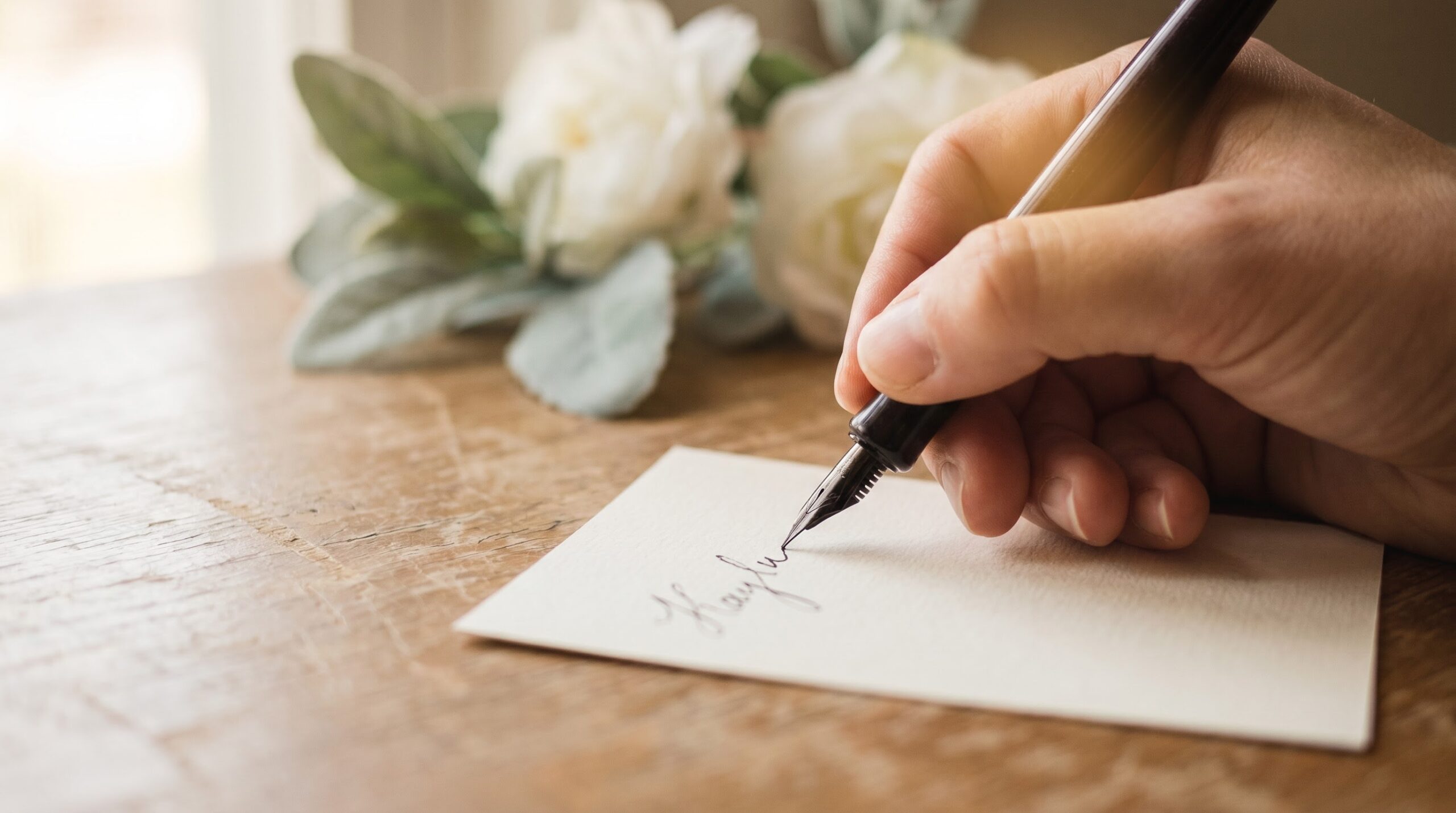
For an individual card, the freeze people describe, staring at a "with sympathy" card passed around the office with genuinely no idea what to write, is more common than it feels in the moment. A short, sincere line does the job completely; it doesn't need to be original. Sign your full name rather than just a first name, especially if the family might not immediately place who you are from context alone. If you have one specific, true detail, something the person did, a memory involving them, a quality people mention, it lifts a generic card into a real one. If you don't have that detail, "thinking of you and your family" or "so sorry for your loss" still lands exactly as it should.
Once the card is settled, the rest is mechanical. Order through a florist to the address that actually fits, the home for something personal, the funeral home for something meant to be seen at the service, and skip the trip to carry it there yourself. If the obituary named a cause, make that donation first and let flowers follow later if you still want to send them. That's the whole decision, start to finish.
Enjoying our flower guides? Add YourFlowersGuide as a preferred source on Google. It helps more readers find us.
Add to Preferred Sources