The pick that reads unmistakably like Valentine's Day, and the price mistake that undoes it
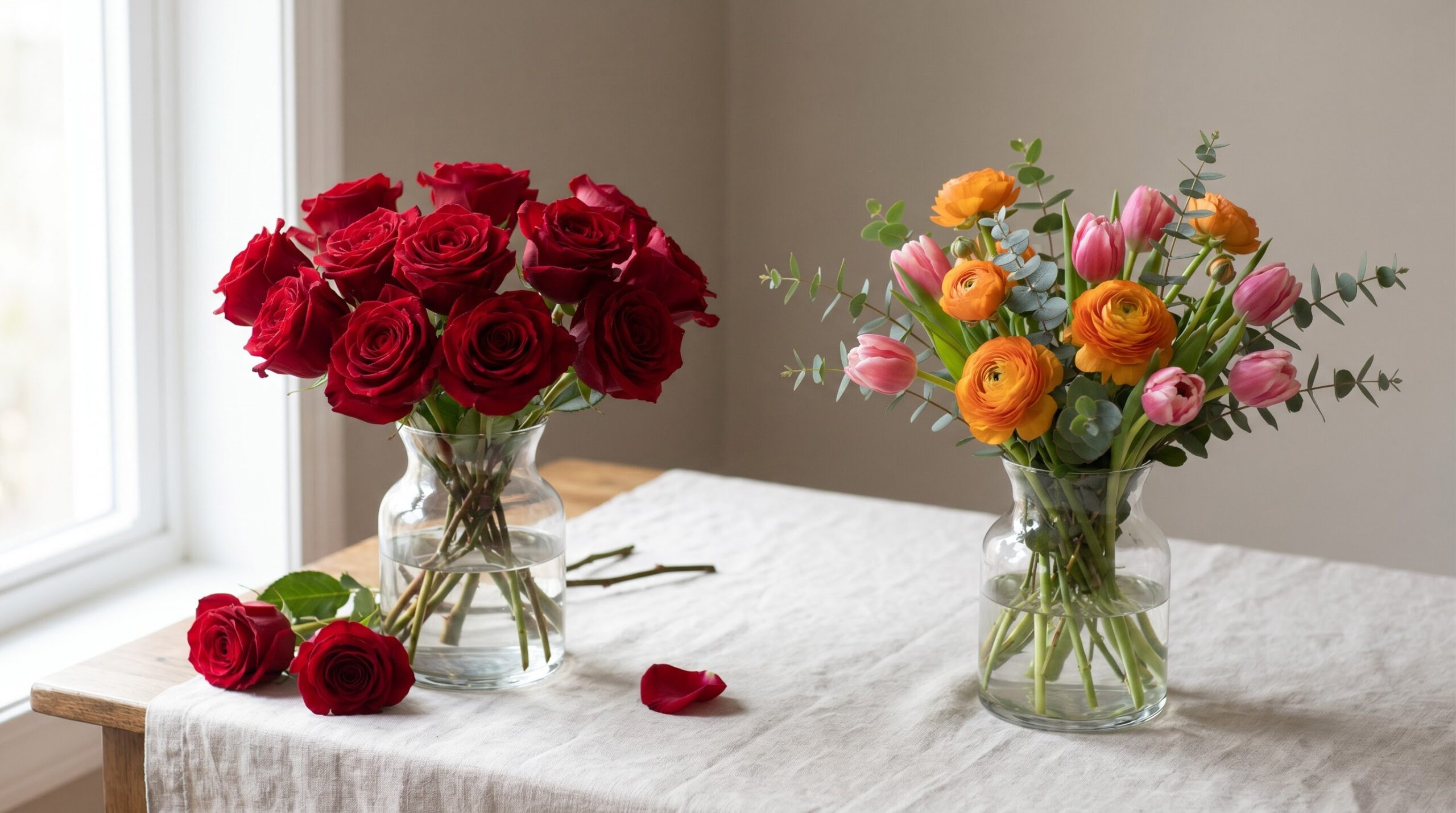
If you want the gift to read exactly like what it is, red roses still do that job better than anything else on the market. A dozen of them, delivered or carried in by hand, needs no explanation on February 14. It says romance, plainly, with no room for a recipient to wonder what you meant. If red feels like too on-the-nose a repeat of last year, or the relationship is newer and softer than a dozen roses implies, a bright mixed bouquet, or a color-honest alternative covered further down, does the same emotional job without borrowing the rose's full weight of meaning.
The bigger risk on this particular day isn't the flower. It's assuming a bigger price tag guarantees a bigger reaction. On r/Marriage, one woman wrote: "My man got me sam's club roses and an orchid from publix. I was over the moon." A few threads over, another described the opposite outcome from a costlier bouquet: "My wife didn't like the flowers and told me they felt cheap. She told me it was the worst Valentine's gift she ever received." Same holiday, same gesture in theory, two completely different landings. The difference wasn't the store. One commenter on r/relationship_advice put the actual mechanism plainly: "It's not about the cost it's about the value. You buy them because you value them."
That value shows up in the noticing more than the invoice. A grocery-store bouquet chosen because it's her favorite color will regularly outperform a florist arrangement grabbed on the way out the door. Showing up with nothing carries its own risk in a relationship that runs on this kind of gesture. On r/AskMenAdvice, a 610-comment thread carried one partner's real disappointment after being skipped over entirely: "She ended up being disappointed that I didn't get her a bouquet of flowers. She asked me, 'Am I only worth this much?' and 'Couldn't you even get me a bouquet?' which left me utterly speechless." That's not every relationship, though. Plenty of people mean exactly what one woman wrote on r/ExpectationVsReality: "I told my husband NO flowers please around expensive holidays. It's so dumb. Waste of money." Both reactions are real and both are common. The only reliable move is knowing which one you're actually buying for, and choosing on purpose rather than by default.
What the color you choose actually says
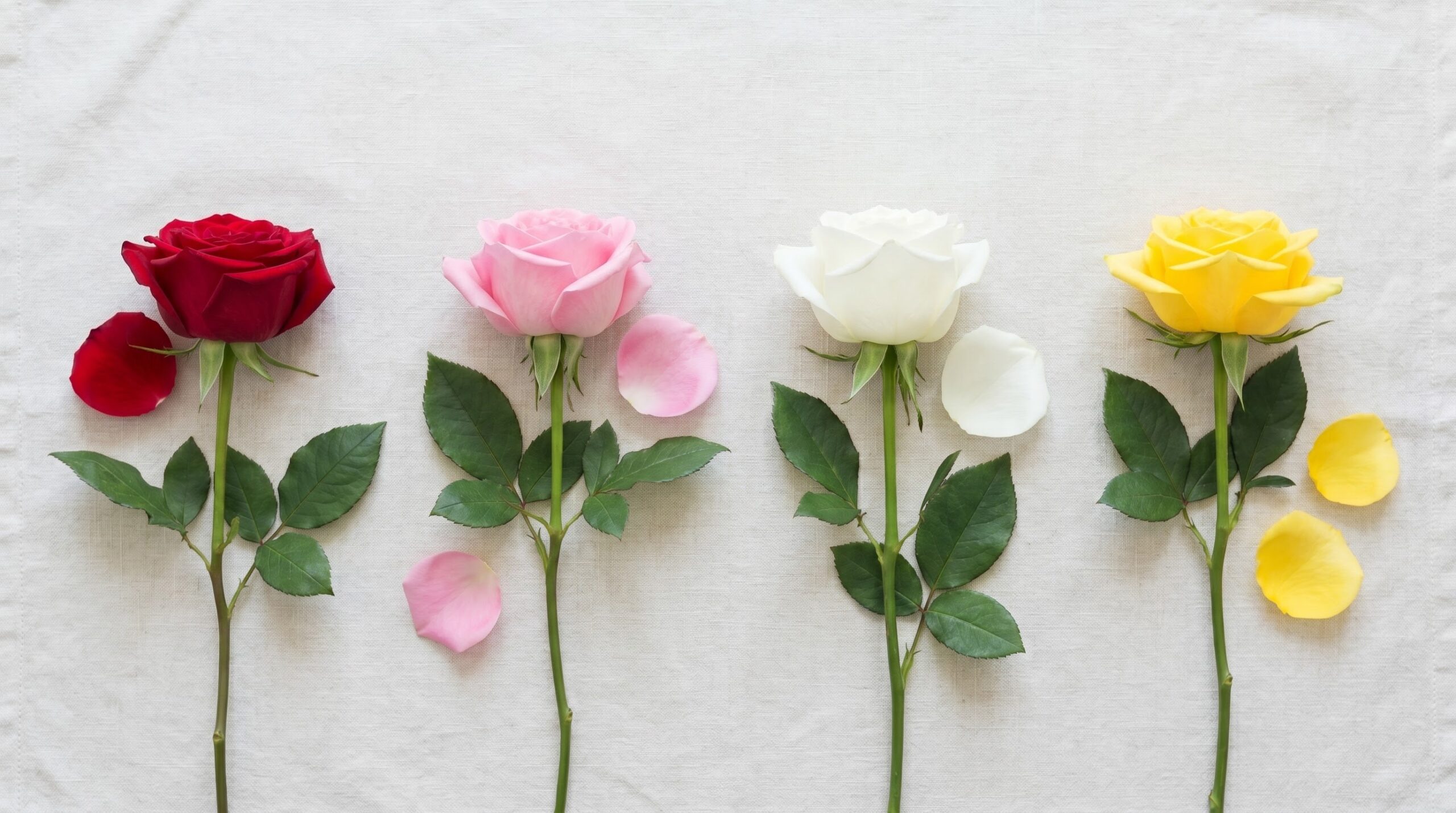
Every flower carries some symbolism, but on Valentine's Day color does more concentrated signaling than on any other date on the calendar, because the recipient is already primed to read romance into whatever arrives. Clemson University's Home and Garden Information Center breaks the four commonest colors down plainly: red for love and passion, pink for grace, admiration and gratitude, white for innocence, purity and reverence, and yellow for friendship, gladness and joy. That's the foundation. What actually matters is what happens when the color and the relationship don't line up.
| Color | What it signals | Safest for | Where it can misfire |
|---|---|---|---|
| Red | Unambiguous romantic love | A partner, at any relationship stage | Rarely misfires, which is exactly why it's the default |
| Pink | Warmth, admiration, gratitude | A partner you don't want to over-declare to, a mother, a close friend | Reads affectionate rather than passionate; thin if the relationship runs hotter than that |
| White | Purity and quiet reverence, romantically legal despite old superstition tying it to sympathy | A newer relationship, or paired with red as an accent | Some older relatives still read it as a sympathy color; skip it for that generation |
| Yellow | Friendship and cheer rather than romance | A parent, a friend, a coworker | Handed to a partner, it can register as a friendzone signal instead of a Valentine |
Swipe →
That last row is the one the flower industry's own color content tends to skip. UrbanStems runs one of the only real color guides in the niche and still calls yellow roses merely "acceptable" for a romantic partner, with no mention of the friendship read that actually lands. The Bouqs Co.'s list of 26 Valentine's flowers pairs every entry with a meaning and none with a warning. Neither tells you what happens when the color and the relationship don't match, which is the one part of floriography that actually matters on a day this loaded with expectation. For the fuller meaning behind red, pink and white roses beyond the etiquette layer, what red, pink and white roses actually mean covers that in depth. This page only carries the version you need standing in the aisle.
Is Valentine's Day flowers for your mom, your daughter, or your best friend too
Valentine's Day reads as romance-only in every florist blog in this space, and that's simply wrong for how a lot of people experience the day. Yes to a mother: skip the red roses, since that color belongs to a partner, and reach instead for something in the pink or lavender family, framed around the relationship itself rather than romance. Yes to a daughter or younger kids too, in the simplest version. A small, bright, unambiguous bunch, handed over with zero symbolism attached, works fine and needs no further thought.
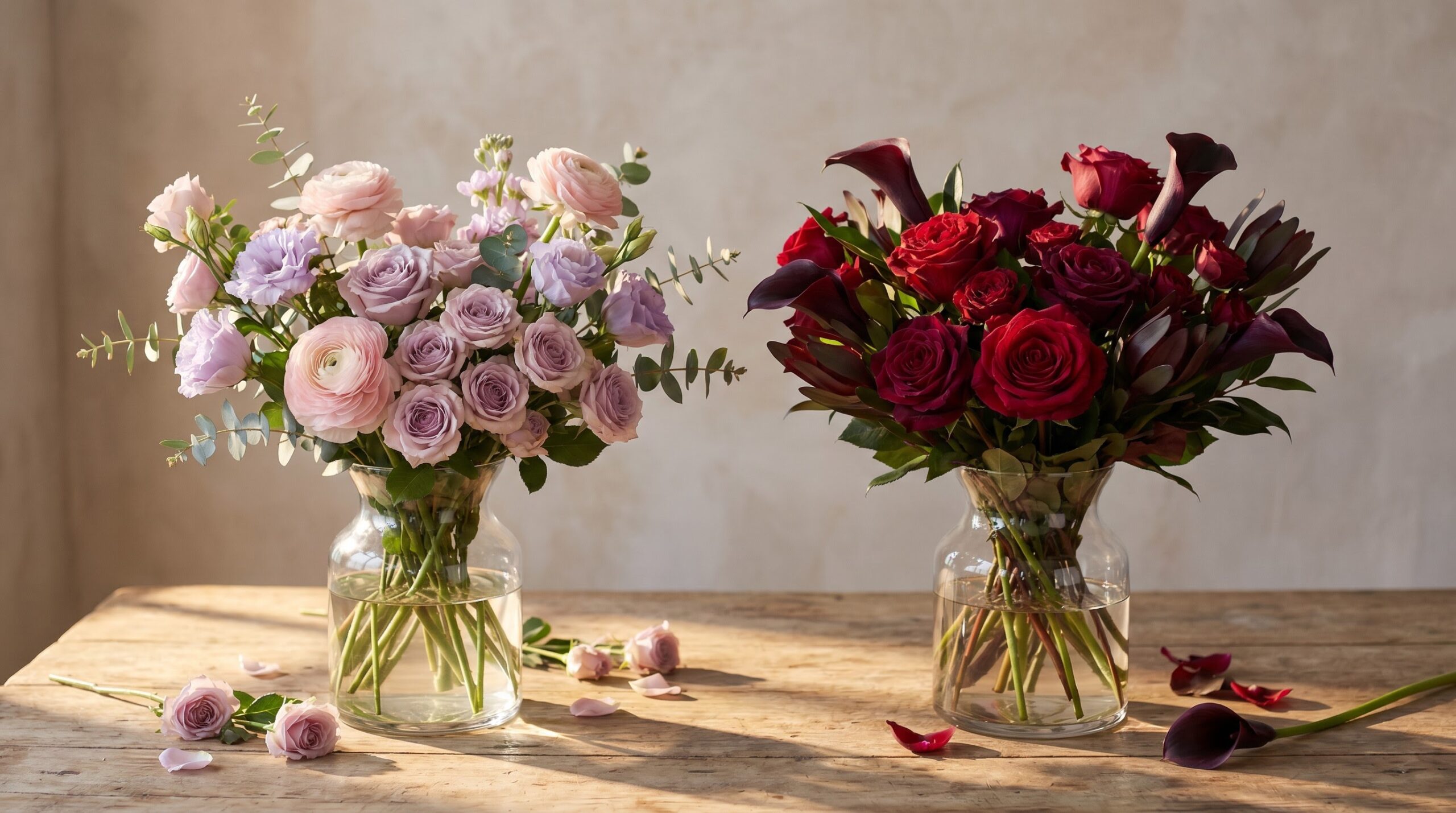
The harder question is one almost nobody searches an answer for and almost everybody who's dating someone new eventually asks themselves: should you get your girlfriend's mom flowers on Valentine's Day. It's a kind, low-risk gesture if you're already meeting the family and want to signal warmth without romantic weight, a lighter cousin of what you'd send for Mother's Day rather than an obligation. It reads as thoughtful, as long as the color stays in the gratitude range and the note doesn't lean romantic.
The recipient list runs the other direction too. On r/AskMenAdvice, a 981-comment thread carried a line worth sitting with: "He told me that guys usually only get flowers at their funeral, and a lot of his friends have admitted to wishing their girlfriends bought them flowers too." That whole side of the day, giving flowers to a man, deserves its own real answer rather than a single paragraph. Giving flowers to a man on Valentine's Day takes it on directly.
You don't have to give roses to make it count
Roses aren't a requirement, and skipping them doesn't read as skipping effort if you replace them with something actually in season. February's price surge is specific to roses, most of which get flown in from South America and the Netherlands to meet demand that spikes hard around one date. Tulips, ranunculus and alstroemeria don't carry that same markup, and February happens to sit squarely inside their natural growing window rather than a stretch season for them. One user on r/florists put it simply: "I have found that potted red tulips do really well for V-Day." A stem of ranunculus or alstroemeria reads just as intentional in a vase as a rose does, minus the cliché.
There's a real rose-fatigue undercurrent worth naming too. "I hate roses, because the smell reminds me of a funeral home," one woman wrote on r/AskWomen, and she's far from alone; the same association turns up across several separate threads. A commenter on r/AskReddit gave advice for a second date that applies just as well inside a long relationship: "Not roses, but flowers. The gesture is right on but you should go with something less symbolic." Flowers other than roses for Valentine's Day, and why the case for them is stronger this year lays out the fuller economic and seasonal case. The short version here is that the mixed, non-rose bouquet was never actually a compromise.
Pet safety, freshness, and why we even do this on February 14
One safety note belongs before anything else, because it gets missed constantly: grocery-store Valentine's bouquets routinely include lilies, and lilies are highly toxic to cats. Kidney failure is possible from something as small as a cat brushing pollen off its fur or drinking vase water. The ASPCA's guidance is specific about which ones to actually keep out of a cat household: Asiatic, Easter, Stargazer and Oriental lilies, along with daylilies, and treatment delayed past roughly 18 hours after exposure often turns fatal. The mix-up is common enough to show up in real reports from actual pet owners. One Reddit user on r/PlantIdentification described a florist-arranged "cat safe bouquet" that turned out to include lilies and tulips, and another, on r/Costco, wrote plainly: "As a year round flower buyer, Costco bouquets usually have lilies." If there's a cat in the house, checking the arrangement before it comes through the door takes thirty seconds and matters more than anything else on this page.
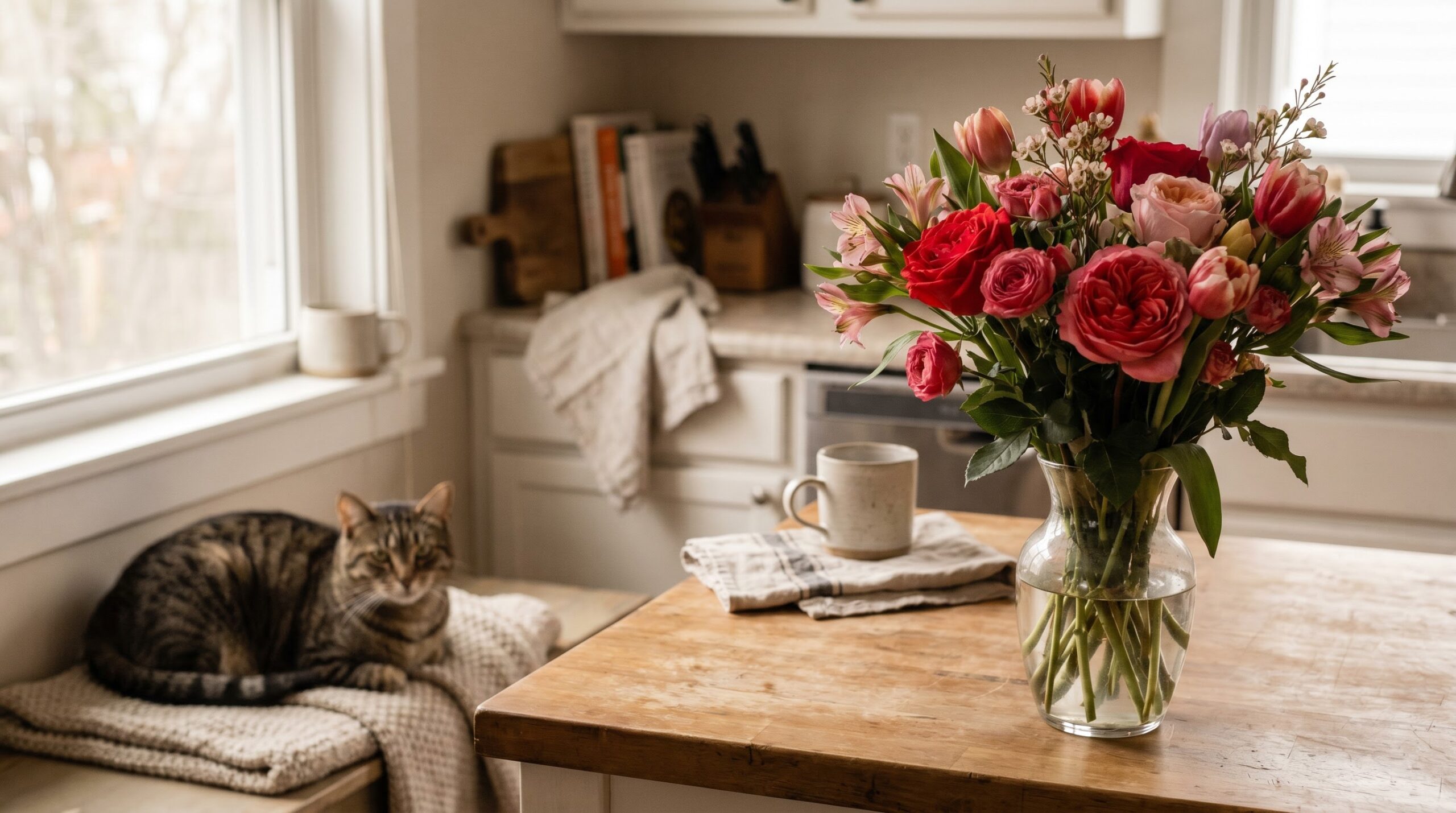
On freshness, the honest expectation for February 14 runs a little lower than the rest of the year, simply because volume this high strains the supply chain that keeps stems cold and hydrated between farm and vase. A bouquet grabbed that morning at the peak of the rush won't hold up quite as long as the same flowers bought on an ordinary week. Recut the stems at an angle before they go in water, keep the arrangement away from direct heat and fruit bowls, and change the water every couple of days; that alone adds real days to whatever you're given.
And since the question comes up every year: no, there's no single officially designated Valentine's Day flower. Red roses are custom, not decree. The custom itself runs older than any greeting-card company. The University of North Carolina's account of the day's literary history credits Geoffrey Chaucer's "Parliament of Fowls," written around 1382, as one of the earliest surviving texts to link February 14 with romantic love specifically, centuries before any commercial holiday existed. Flower-giving on the day itself has documented roots in Victorian floriography, when strict social codes made flowers one of the only sanctioned ways to say what couldn't be said out loud. The greeting-card side of the holiday traces to Esther Howland, who began hand-assembling valentines in the late 1840s and incorporated her New England Valentine Company in 1870, decades before Hallmark existed as a company at all.
Common questions about Valentine's Day flowers
Do flowers on Valentine's Day actually lower stress?
There's real research behind this claim. A Rutgers University study led by psychologist Jeannette Haviland-Jones tracked people receiving flowers during stressful stretches and found eased stress-hormone readings alongside longer-lasting mood improvement, plus, in a related study on older adults, more social engagement. The effect is real but modest, backed by an actual study rather than florist marketing.
What's the 3-5-8 rule florists mention?
It's a proportion trick for building a bouquet that looks professionally arranged rather than clumped together: three focal flowers for personality, five secondary or greenery stems for structure, and eight smaller filler blooms to fill gaps. It has nothing to do with meaning or etiquette, purely visual balance, and it scales up or down for bigger or smaller arrangements.
How long should Valentine's Day flowers actually last?
A well-cared-for bouquet typically holds five to seven days, though expect the lower end of that range around February 14, since peak-demand stems travel further and sit longer before reaching a vase. The care habits above claw back most of the difference; what you can't fix at home is how long the stems already spent in transit.
Is it safe to give Valentine's Day flowers to someone recovering from surgery?
Hospitals commonly restrict fragrant or pollen-heavy flowers near patients regardless of the date on the calendar, so treat a Valentine's Day gift for someone in recovery the same as any get-well bouquet: call the ward first, favor low-pollen and low-scent stems, and skip lilies entirely, since many hospitals ban them outright.
Walk in with the pick already decided: the flower, the color, and the person it's actually for, chosen on purpose rather than grabbed at random. If price and timing are the thing weighing on you before you commit to anything, why Valentine's roses cost nearly triple by February 14, and when to actually buy them is the next stop. If the day isn't about a partner this year at all, a galentine's bouquet for a friend follows the same yellow-or-pink logic as the mom section above, no red required. And for the flowers that carry you past February 14, into anniversaries and the ordinary days that don't need an occasion, flowers for an anniversary, or just because picks up where this page stops.
Enjoying our flower guides? Add YourFlowersGuide as a preferred source on Google. It helps more readers find us.
Add to Preferred Sources