Taxonomy and origin
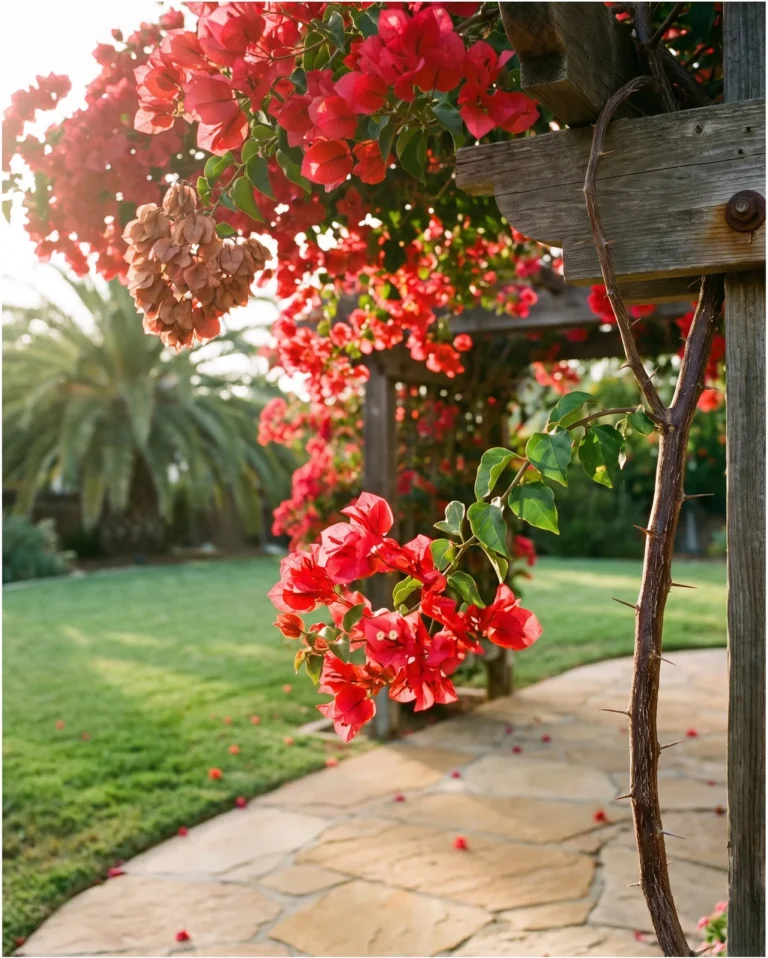
Bougainvillea is a woody climber from tropical South America, armed with curved thorns 1 to 2 inches long. It does not climb on its own: tie the stems to a fence, wall, or pergola, or the plant sprawls where it lands. It belongs to the four-o'clock family, Nyctaginaceae, and the genus holds 14 to 18 species. Bougainvillea glabra comes from Brazil and Peru. The plant carries the name of Louis Antoine de Bougainville, the French explorer credited with finding it in South America. The genus name marks his round-the-world voyage of 1767 to 1769.
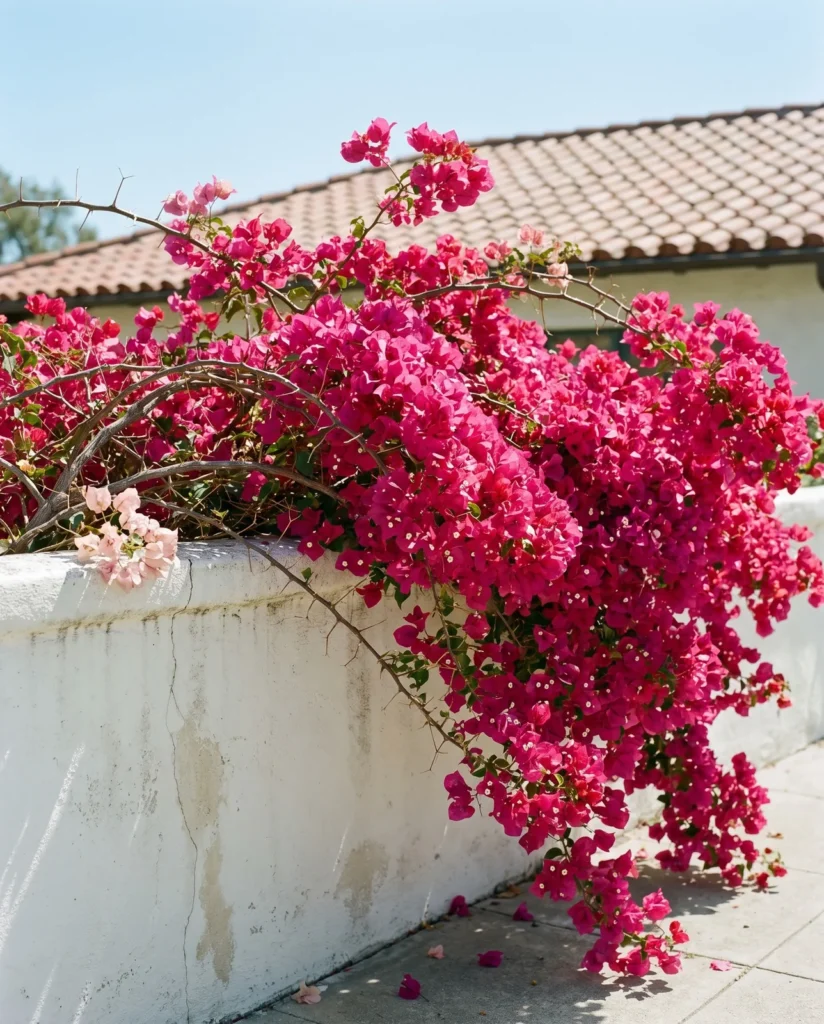
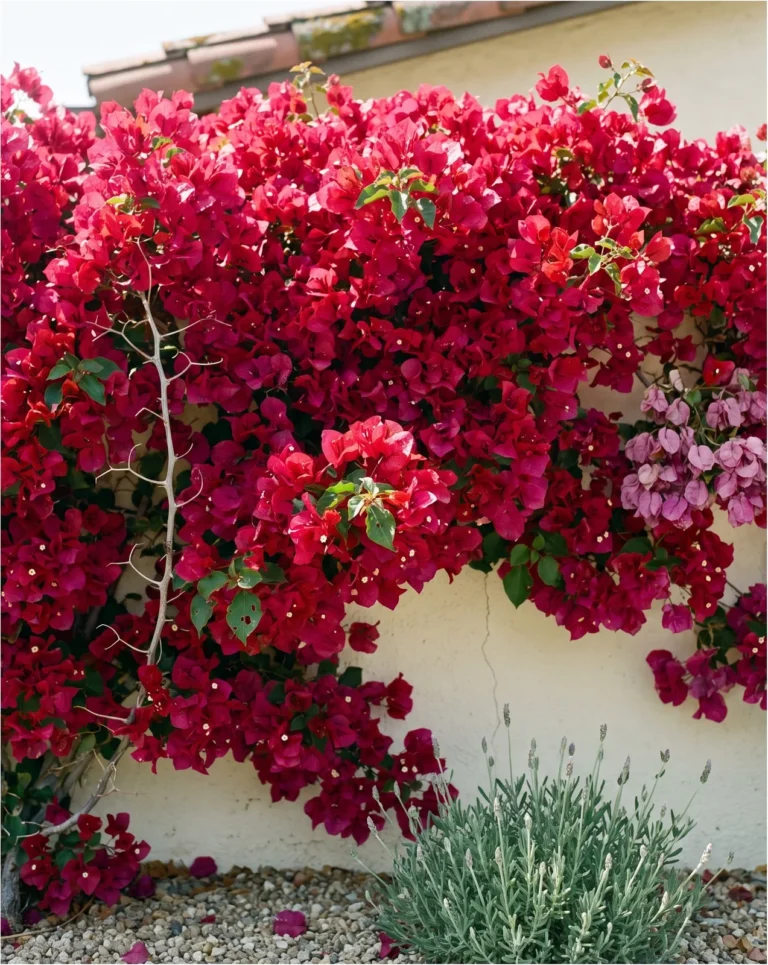
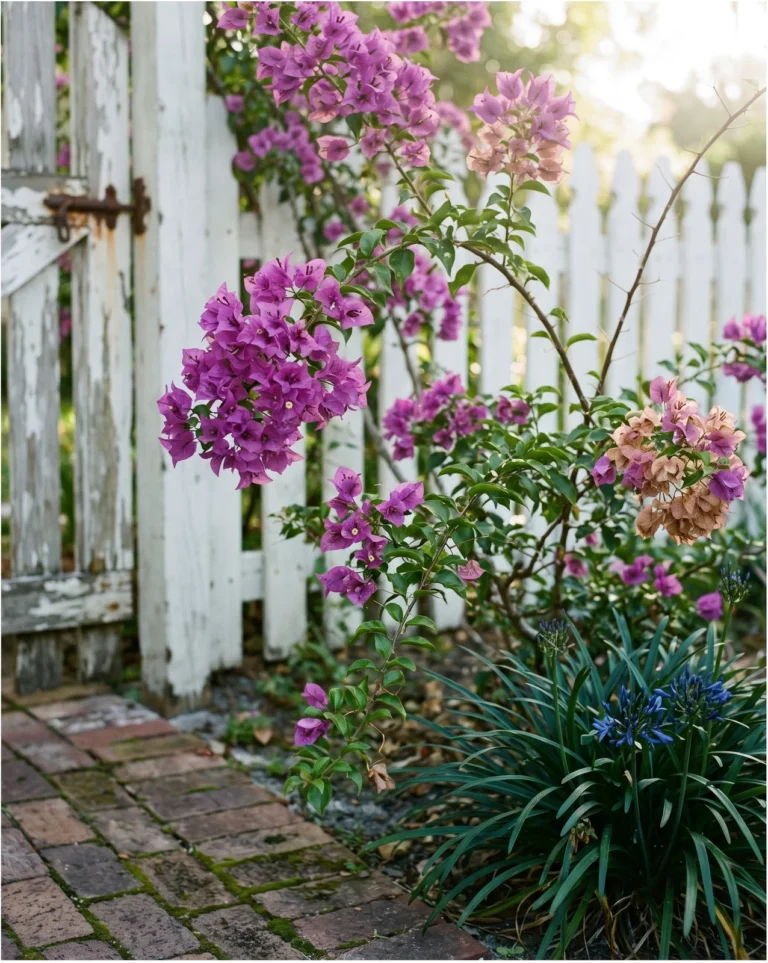
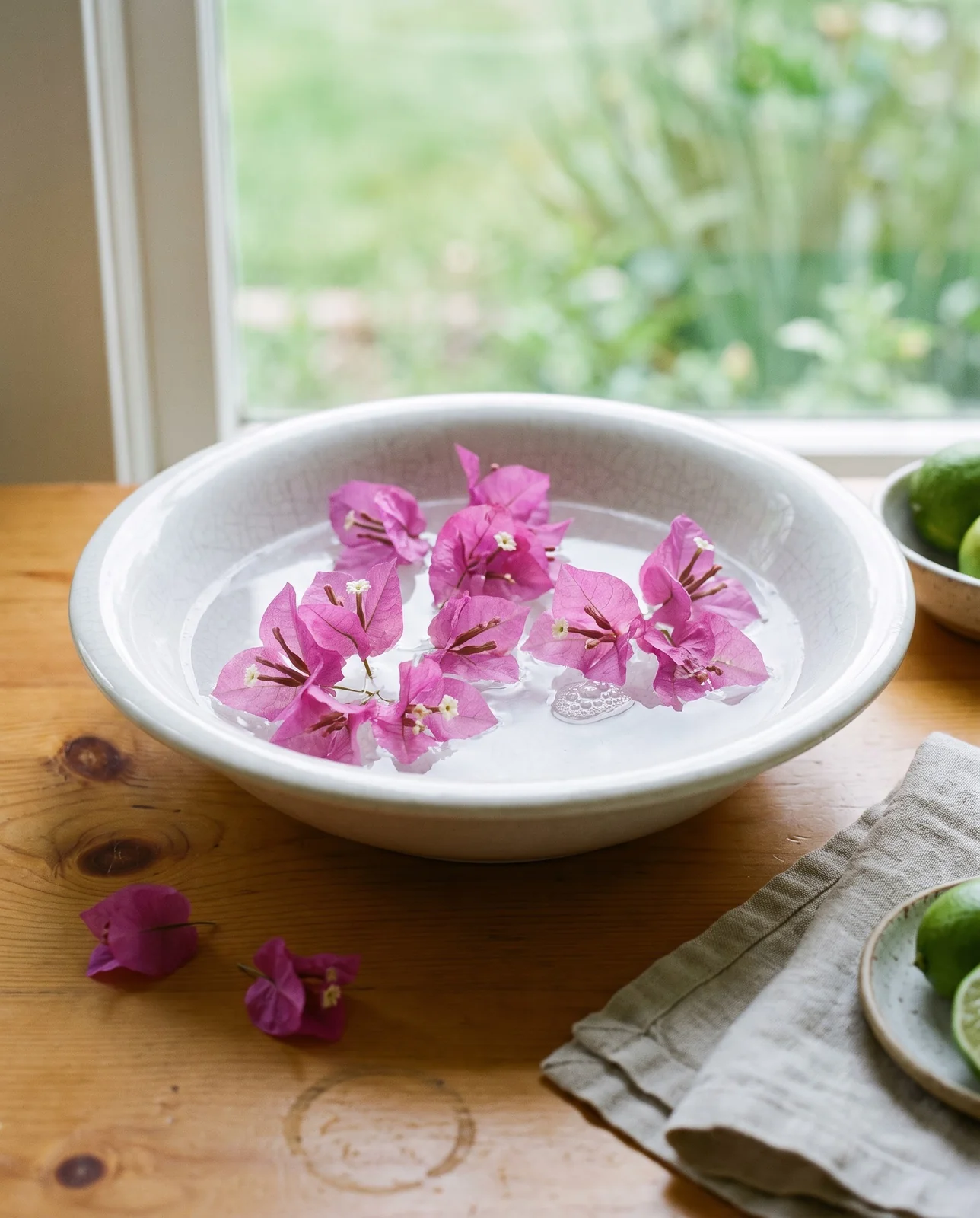
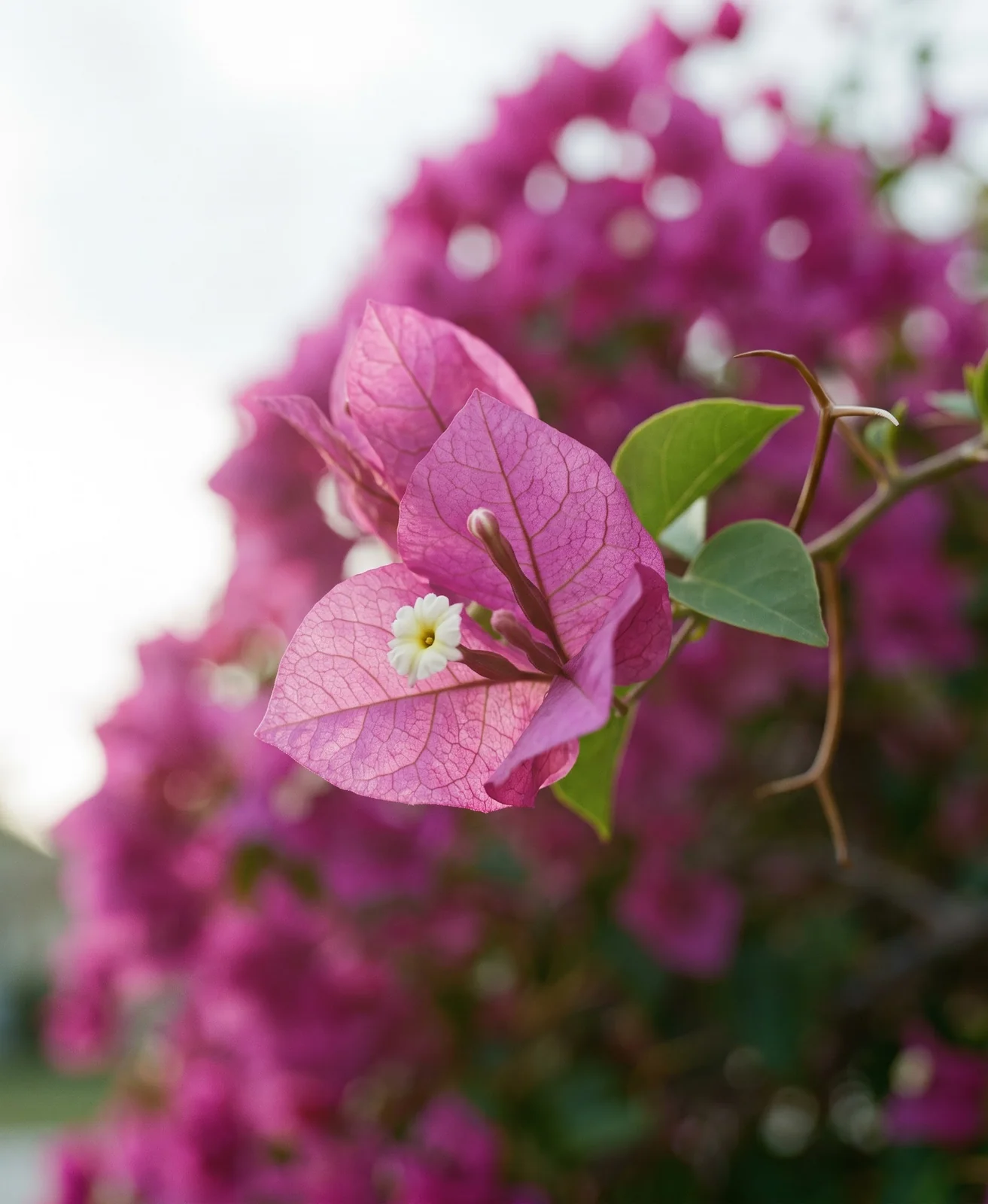
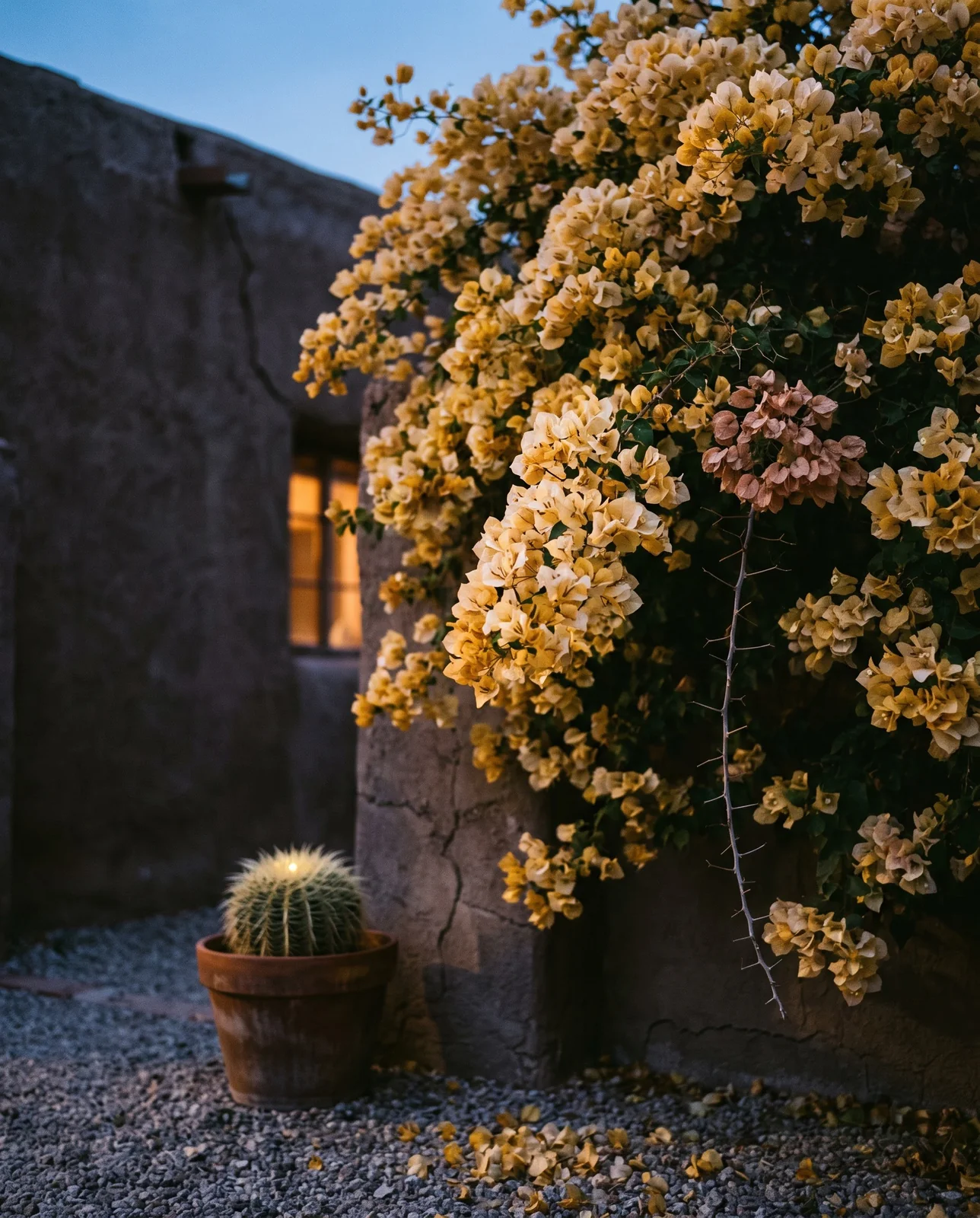
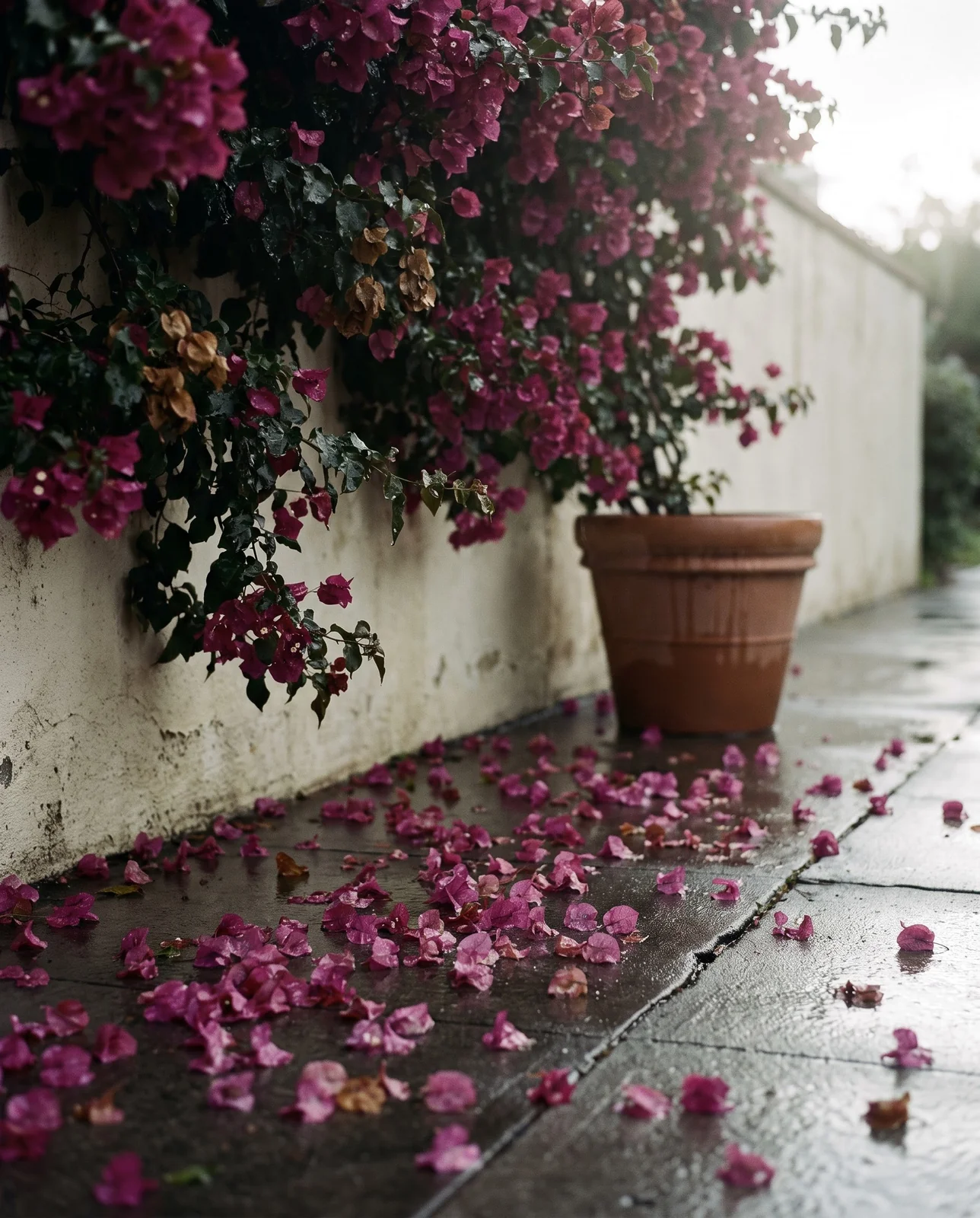
None of that color is petal. Each cluster of three true flowers is wrapped in three to six papery bracts, and those bracts carry the pink, purple, red, orange, white, or yellow that people buy the plant for. The flowers themselves are tubular, about an inch across, and creamy white to yellow, tucked in far enough that most people never notice them. The bracts outlast the flowers inside them, so the color holds for weeks. The yellow, orange, and crimson forms came later, from a cross between Bougainvillea peruviana and B. glabra.
Bloom time
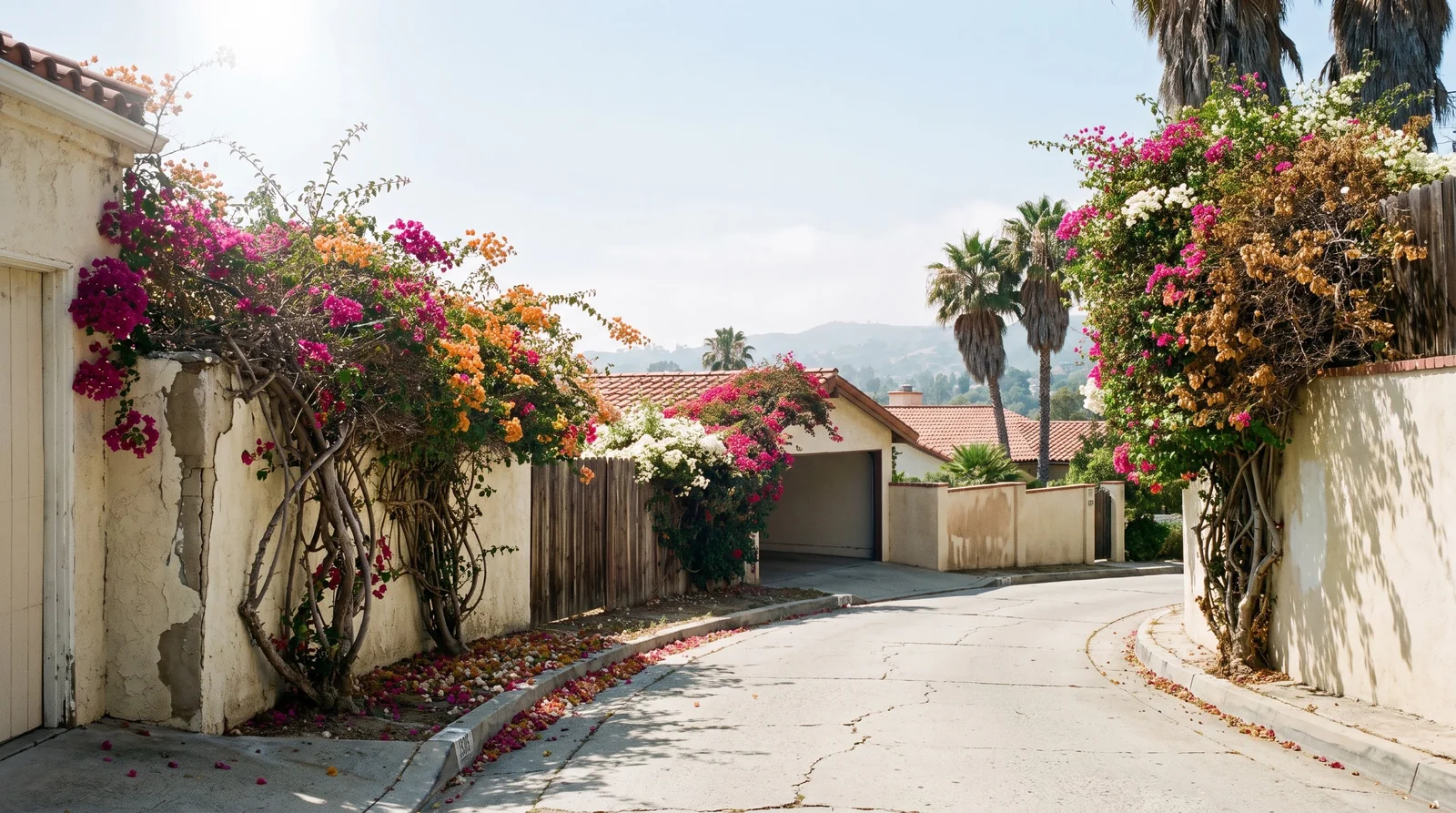
Outdoors in frost-free ground, bougainvillea blooms from spring through fall, and in the warmest places year-round. The color comes in waves, heaviest from spring into early summer and again from late summer into fall. Every wave forms on new growth, so a plant that has stopped making shoots has stopped setting bracts. Once a flush opens it holds, and a potted plant in a sunny spot can carry one for up to eight weeks. An established plant blooms over a longer stretch of the year than a young one. Day length and temperature set the timing together. Bougainvillea normally flowers in the short days of winter, and warmth decides how heavily. Where winter brings frost, the plant spends that window dormant or indoors, so its outdoor year runs spring to fall.
Leaves but no flowers: why bougainvillea stops blooming
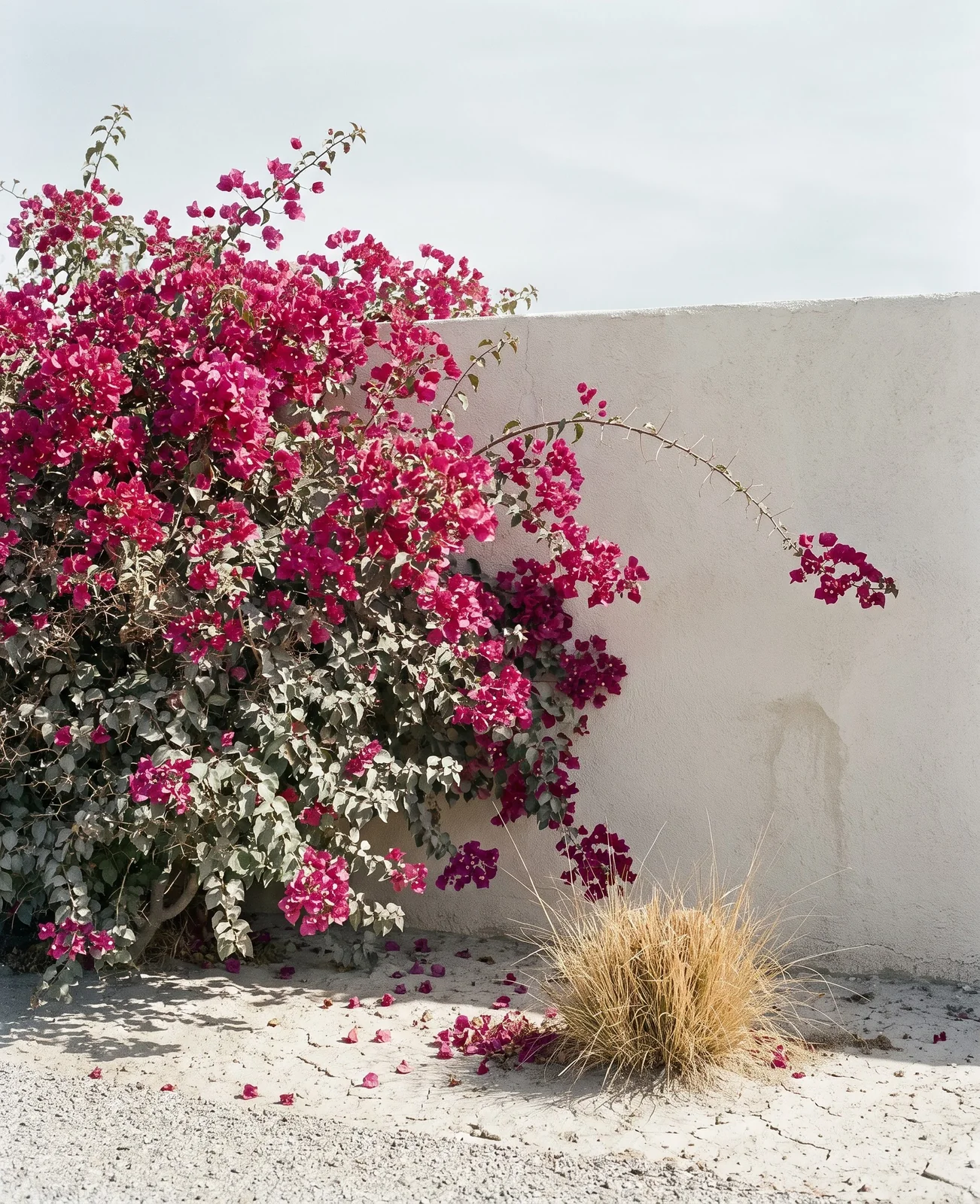
Water is the usual answer. Too much of it, or roots sitting in wet soil, makes the plant drop its bracts or stop blooming altogether. Mild drought stress does the opposite. It brings on flowering even under long days, and commercial growers dry their plants to the edge of wilting on purpose. At home, let the leaves go slightly limp before you water, and buds usually show four to six weeks later. Once they do, water normally again, because a blooming plant that wilts drops its bracts and flowers.
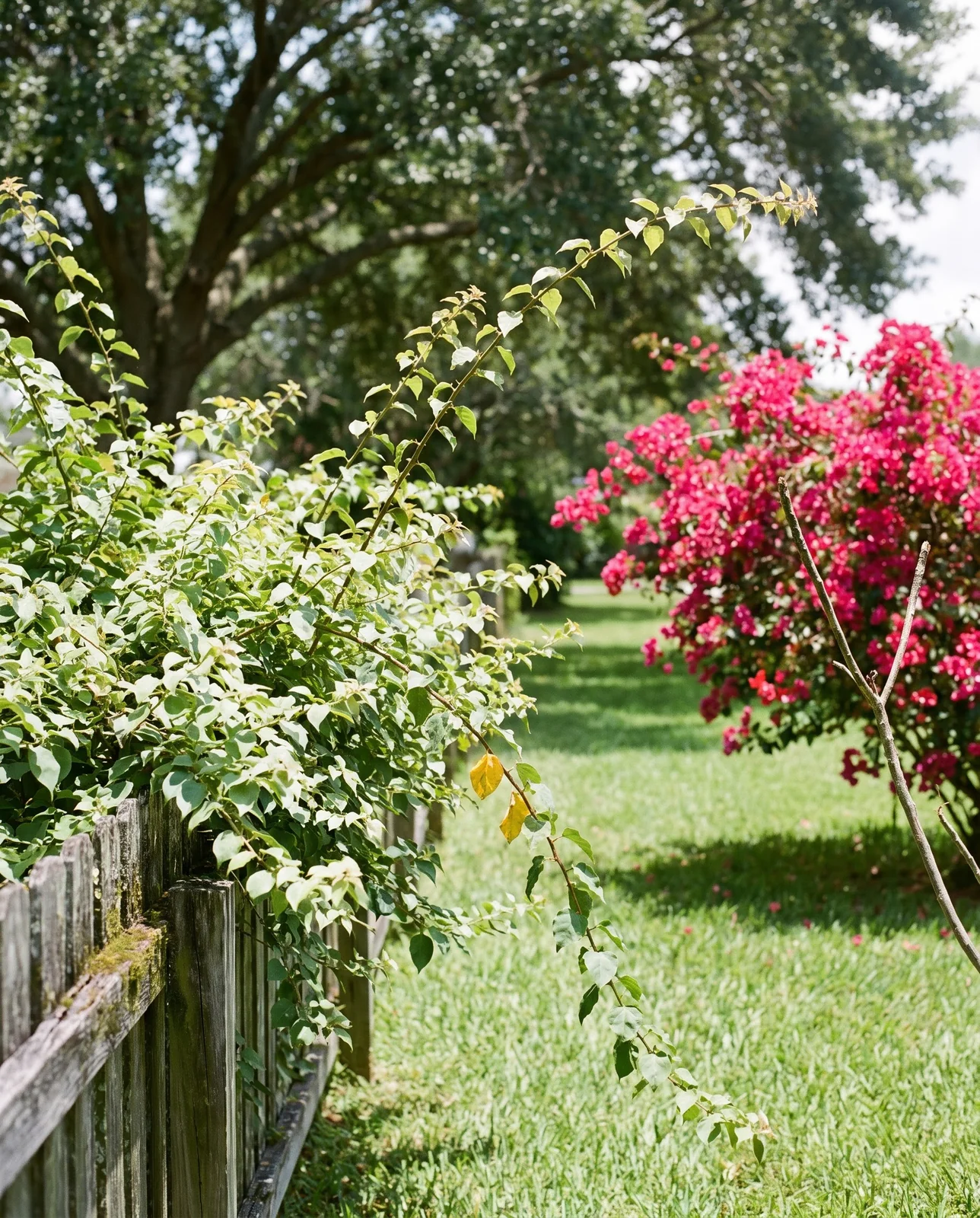
Sun is the second check. In part shade bougainvillea makes healthy dark green leaves and few flowers or none. Feeding is the third. A high-nitrogen fertilizer buys foliage, so a heavy feeder ends up with a big green plant and no color. Overfeeding adds growth and holds bloom back, so feed less and feed weaker. Pot size works the same way: crowded roots push the plant toward flowering, and a container that is too large delays it.
Time explains the last two. A bougainvillea planted in the ground grows rampantly and stays reluctant to bloom for a couple of years. Feeding and watering it through that stretch delays the flowers further, since these plants bloom better neglected. Old wood is the other cause. Bracts form on new growth, so pinching and pruning are part of getting any bloom, and a plant left uncut runs short of shoots that could carry them.
What to check when it will not bloom
Order matters. Feeding and watering a plant that needs drying out sets the flowers back further.
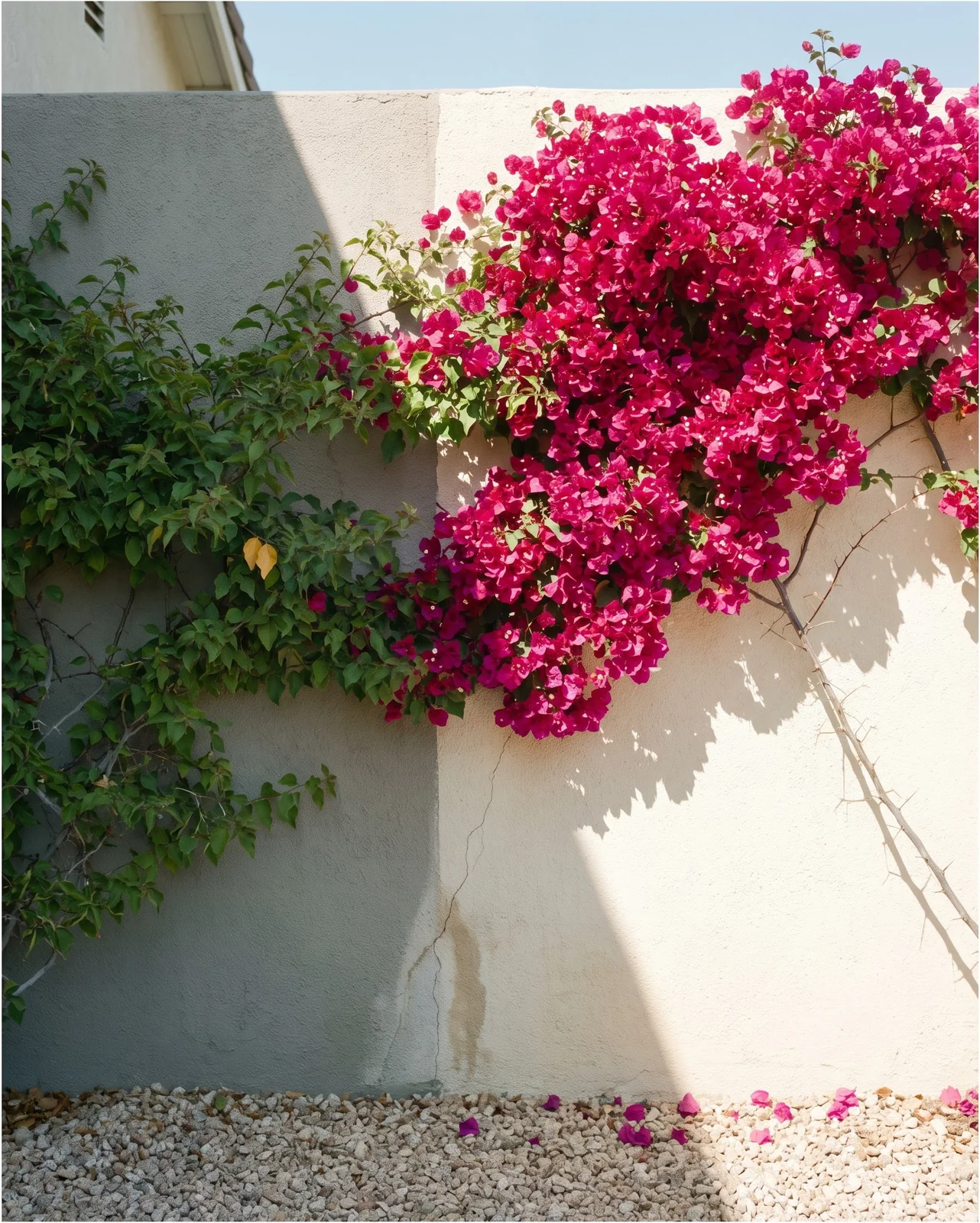
Pots and winter care
North of its hardiness range, bougainvillea lives in a pot and comes indoors before the first freeze, the same arrangement that suits bird of paradise and other frost-tender tropicals. The pot has to drain hard, because the root system is very fine and does badly in peat-heavy mixes that hold water around it. Indoors there are two honest choices. Keep the plant growing in the brightest window, with steady warmth and light watering. Or rest it in a cool bright room, with very little water, no feeding, and no leaves worth looking at in midwinter.
A resting plant wants a night minimum near 50 F, and a bright spot between 40 and 50 F suits it well: a sunroom, a south-facing window, a well-lit basement. It survives above freezing on fairly dry compost, and it sheds its leaves doing it. A plant kept in active growth wants ordinary room warmth, above 60 F, and all the sun the window gives.
When flowering ends in fall, water less often, let the pot dry further between drinks, and stop feeding. A young plant, roughly one to four years old, takes one deep watering every three to four weeks through winter. Leaf drop is expected: bougainvillea is semi-deciduous in cooler climates. In February and March, rising light and warmth restart growth, so increase water again. Repot then if it needs it, in a loam-based, peat-free compost.
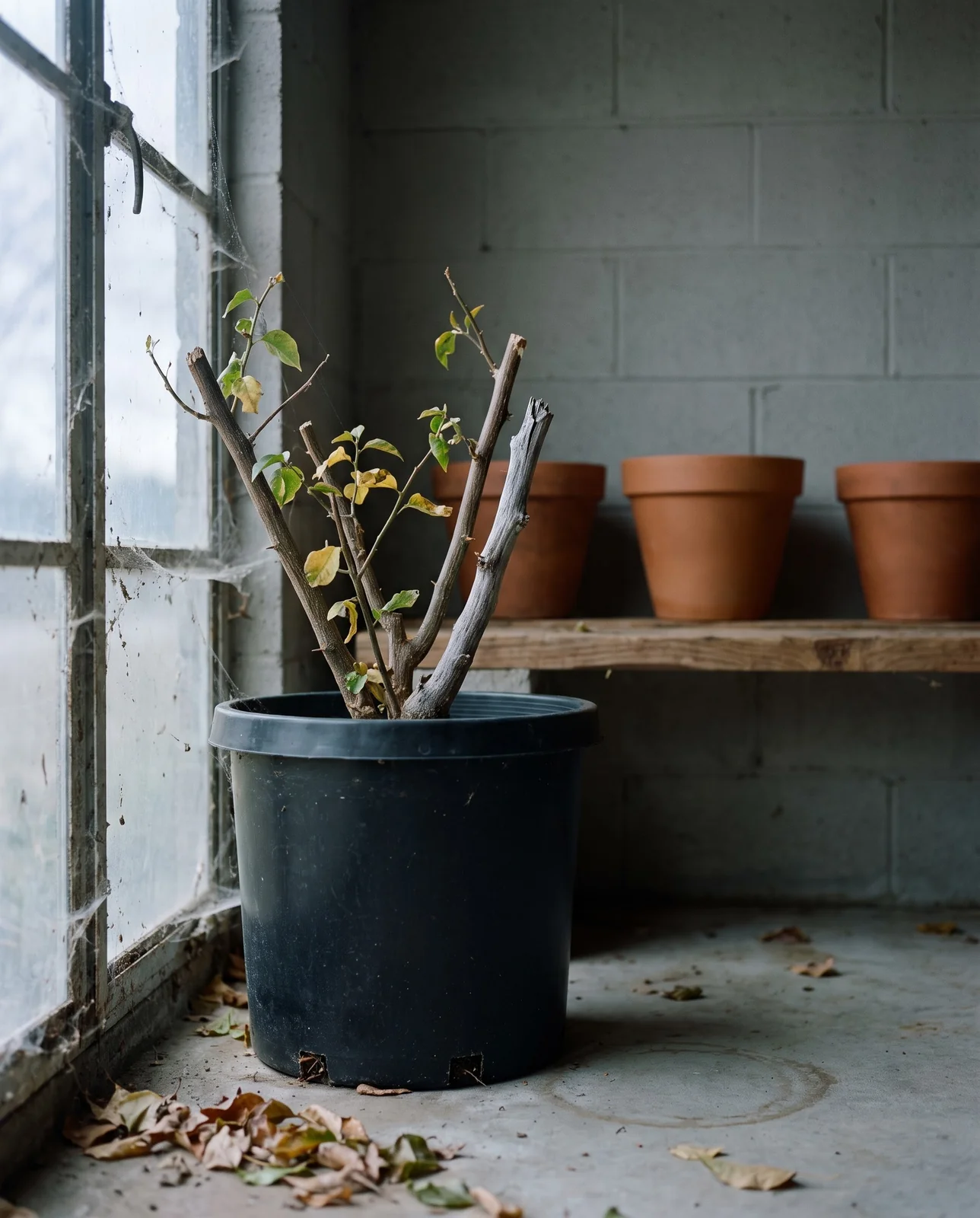
Winter by zone
What winter asks of you changes every half zone, from ground plants that never come inside to pots that spend five months in a window.
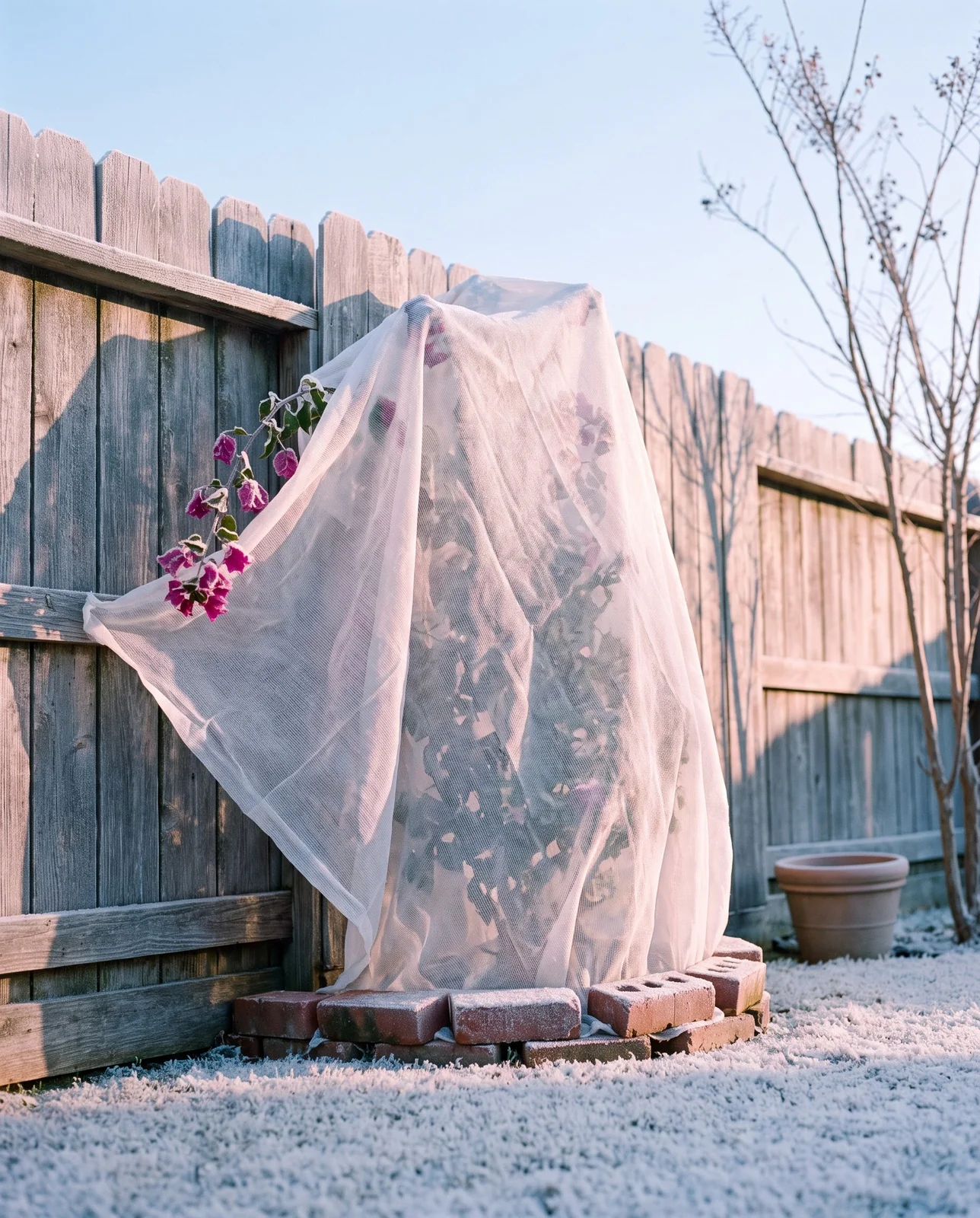
Pruning and training
Two cutting times both work: right after a bloom period finishes, or in late winter to early spring just before growth begins. Your winter decides which. Cutting after a flush keeps the plant in cycle: take the long growth that carried the bracts back by half once they fall, and a second flush follows in late summer. A single late-winter cut suits colder ground, because the foliage guards the plant against cold damage and a fall pruning strips that guard away. In a borderline zone, wait until the end of February or into mid-March. Either way, the cut forces the shoots that carry the next bracts, since the plant flowers on the current season's growth.
Cut hard to hold the size, and cut individual stems where you want the plant to branch. Branching is the point, because every new shoot tip is a place bracts can form. Pinching does the same work at a smaller scale: the more you pinch once a flowering cycle finishes, the more the plant branches and blooms. Nurseries pinch a young plant at four weeks to shape it, or pinch to a stake when they want height.
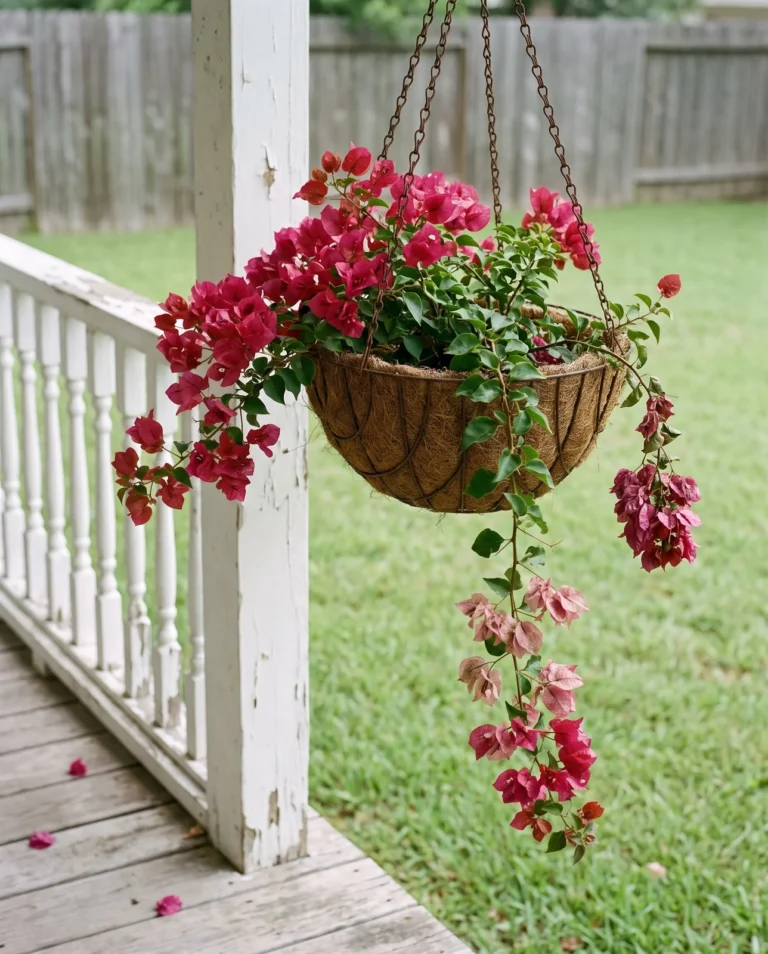
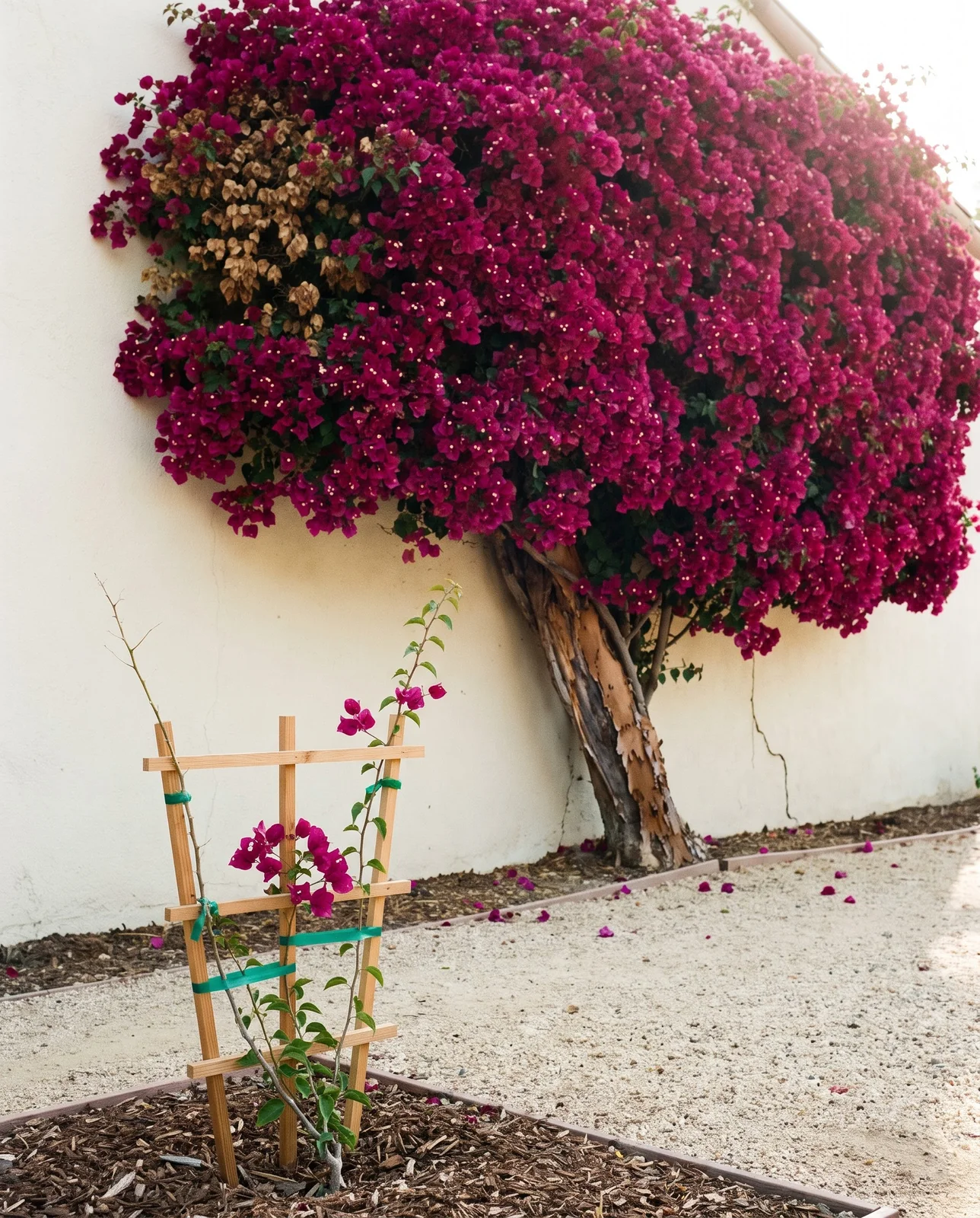
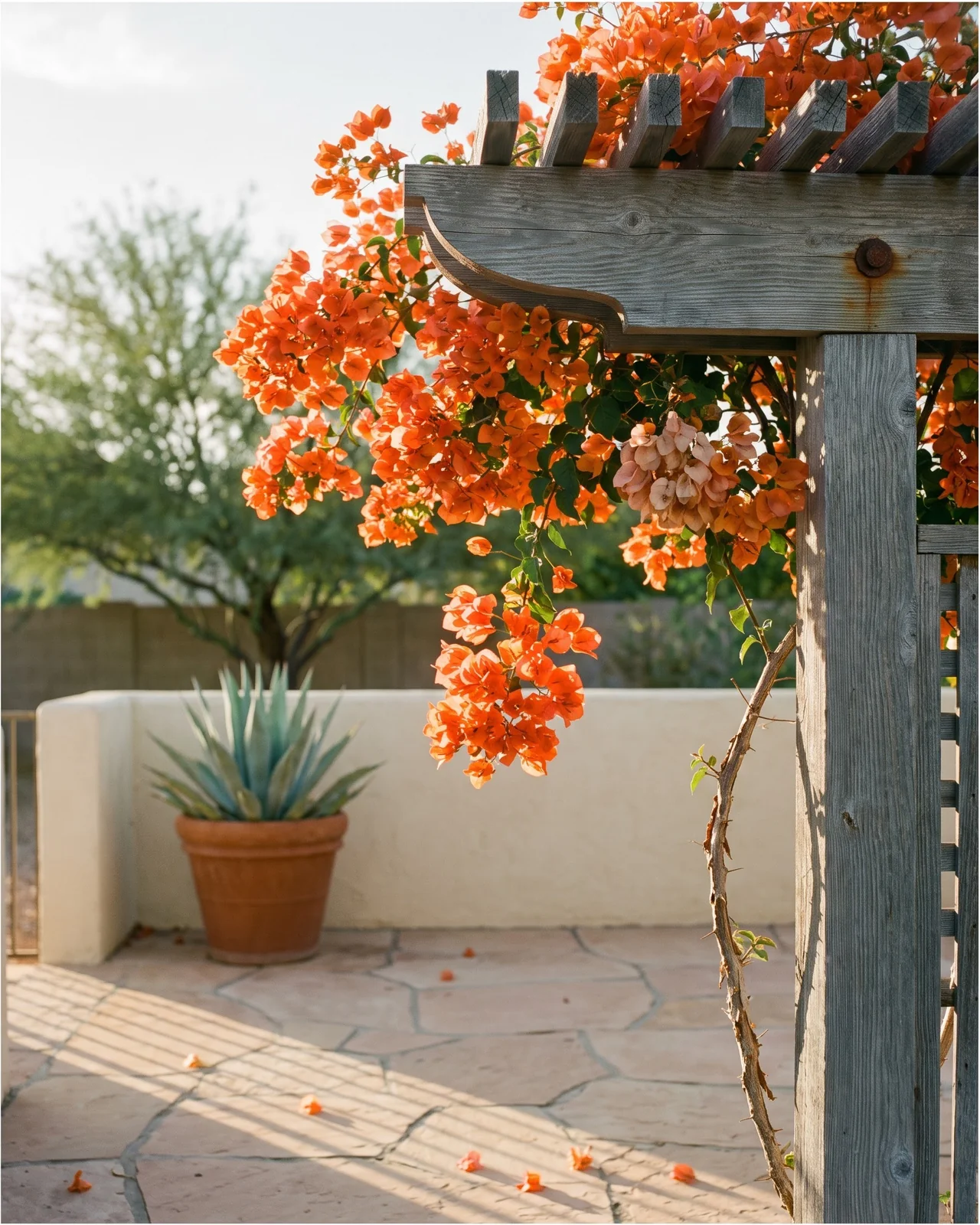
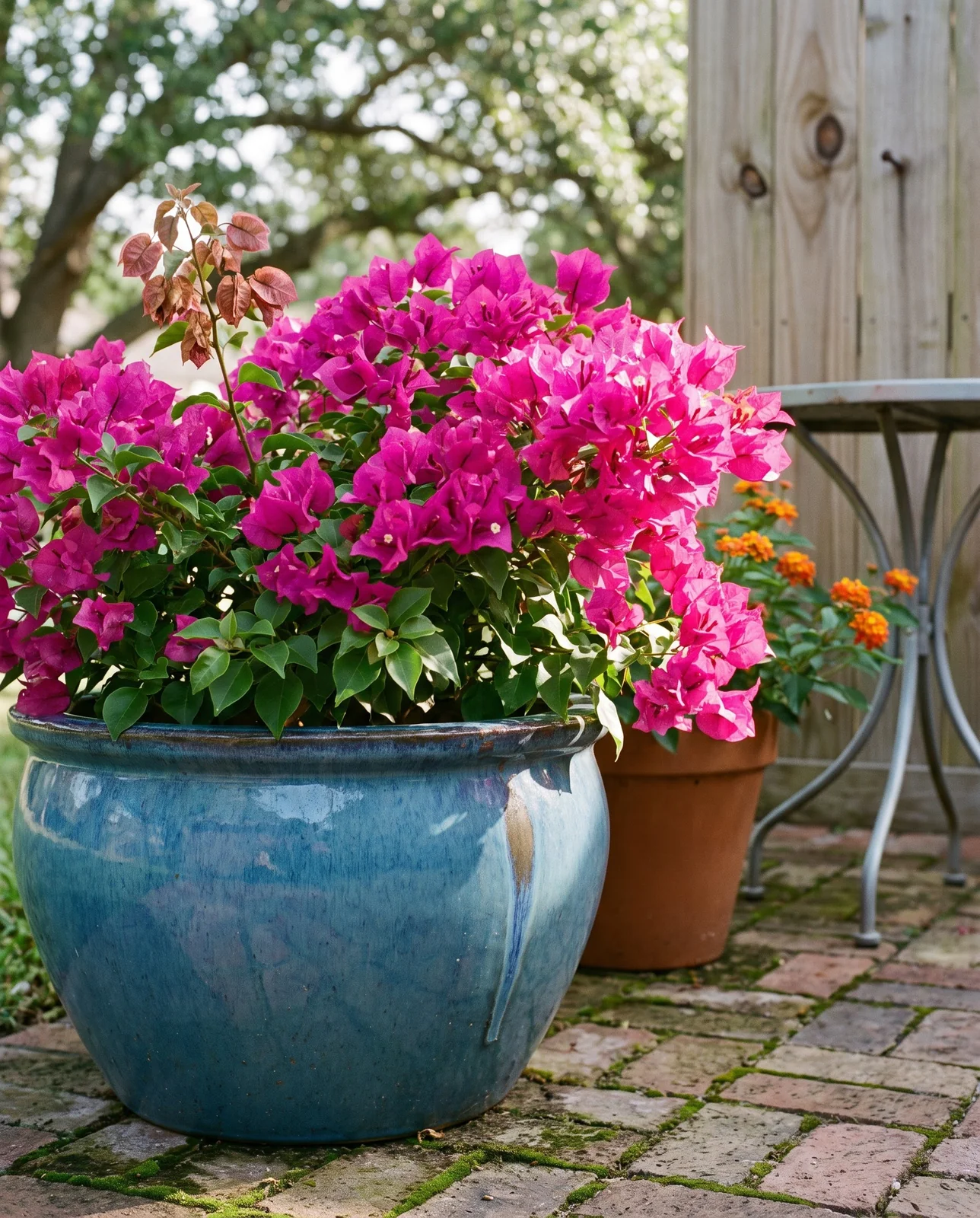
The form you want decides the cuts: aggressive growth for a hedge, vertical training for a trellis, a full bushy plant for a pot. Traditionally it goes along trellises and fences, and in containers it is trained shrubbier. It also takes espalier, a large basket, and training as a standard, that small tree with a bare trunk and a head of color, held to size by spur pruning.
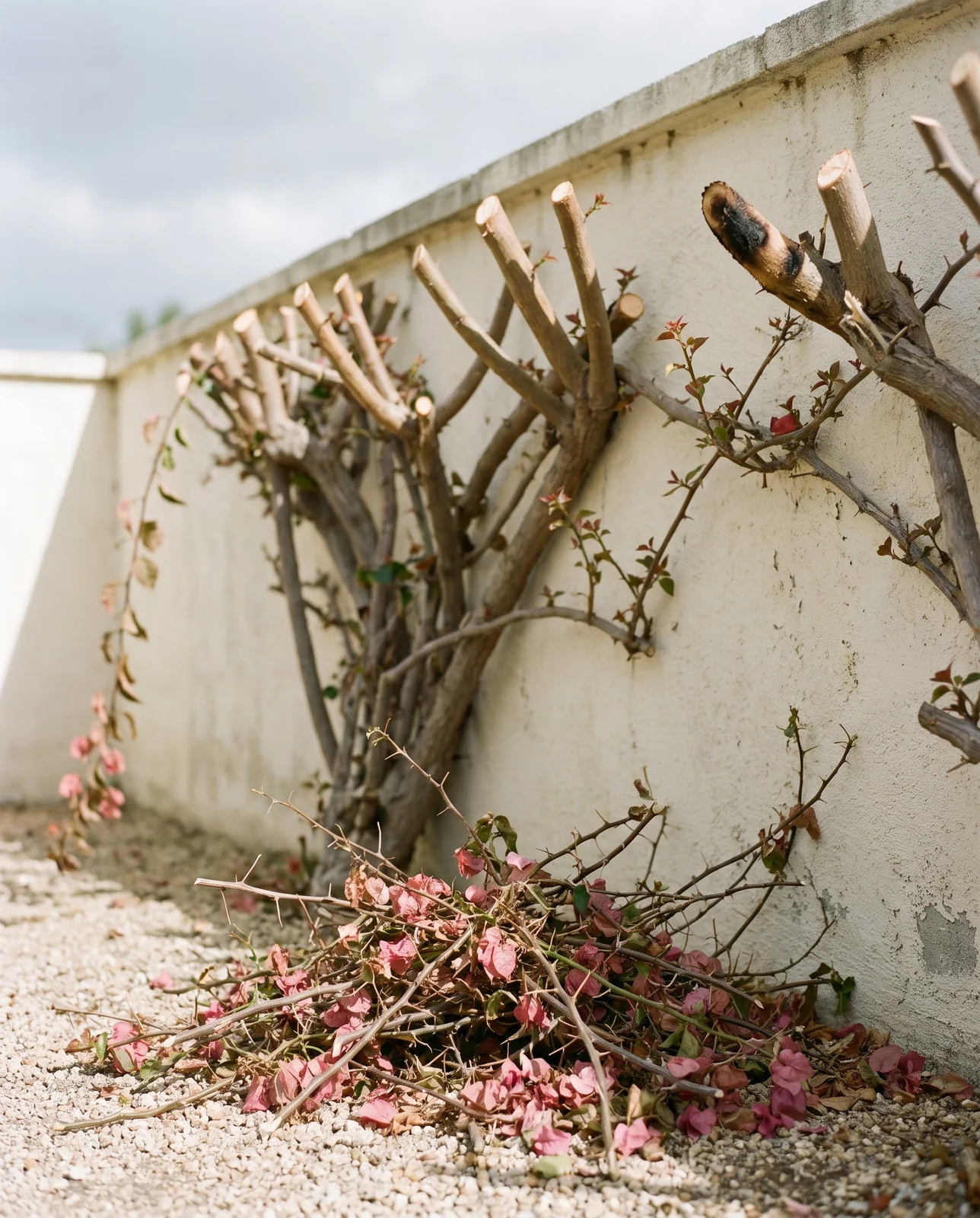
When to prune, month by month
Timing decides whether a cut costs you a flush or buys one.
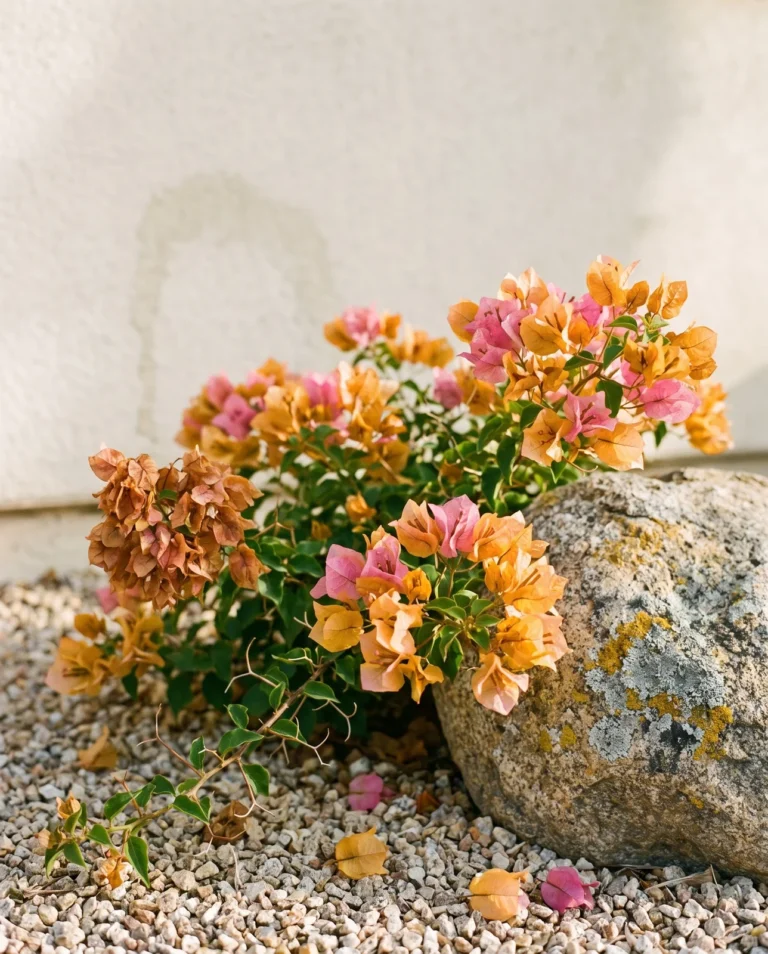
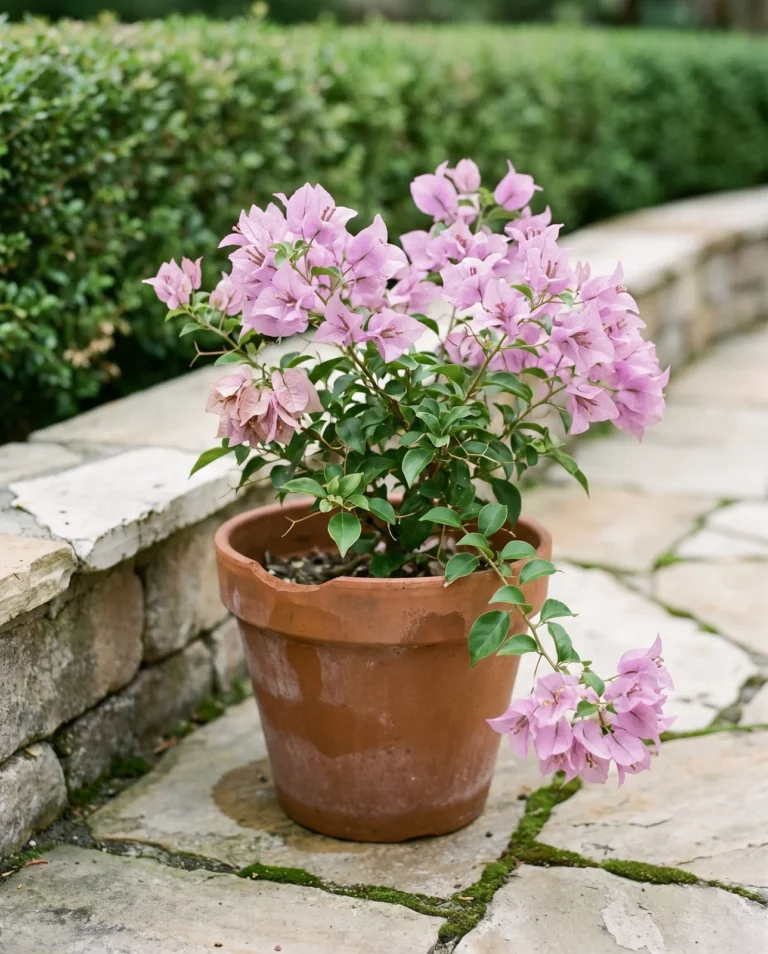
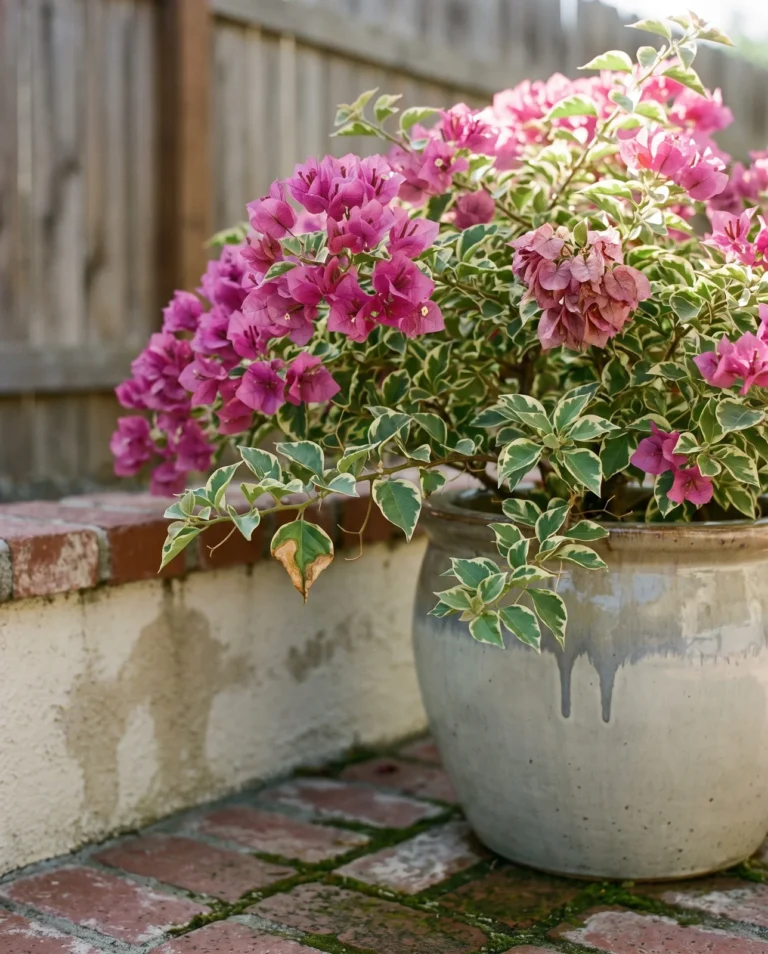
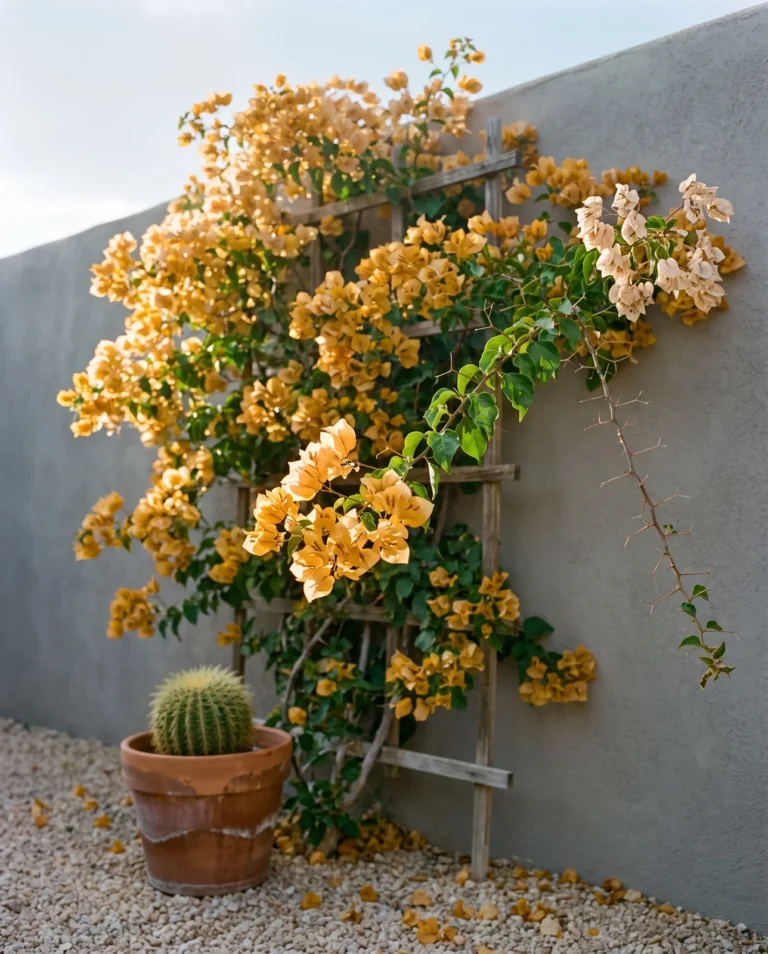
Bougainvillea varieties worth knowing apart
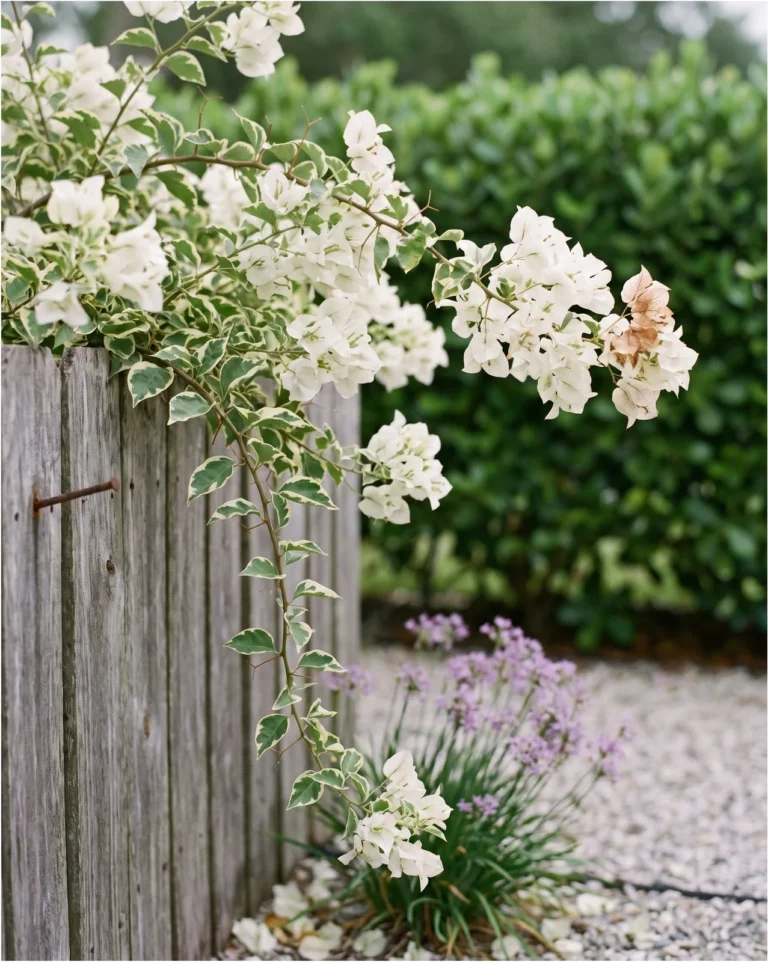
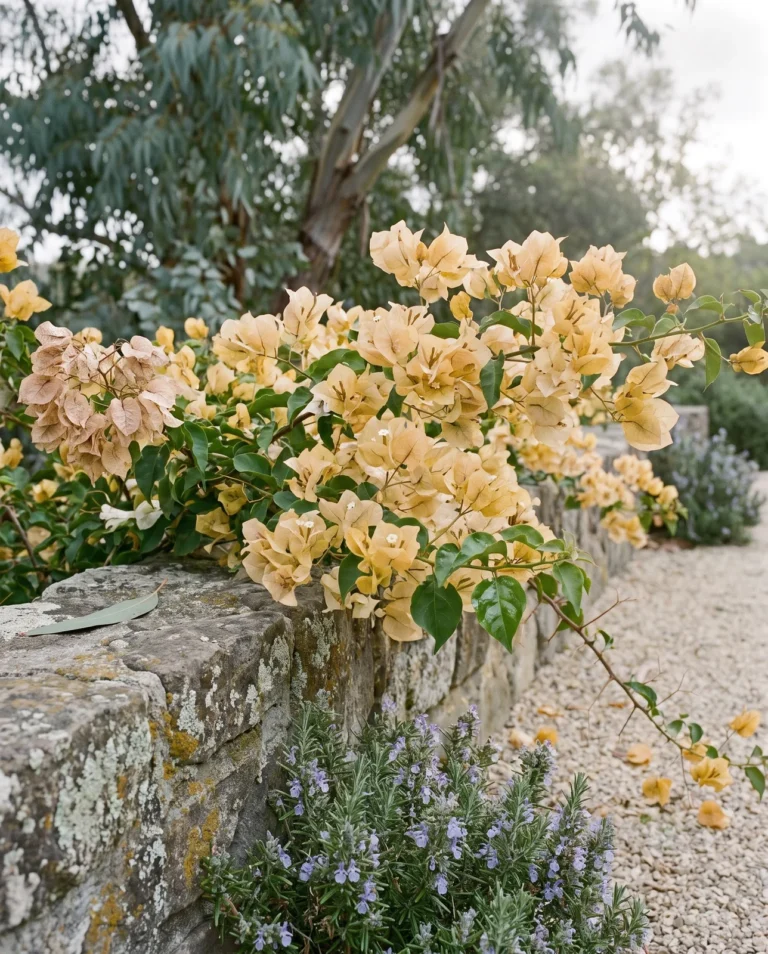
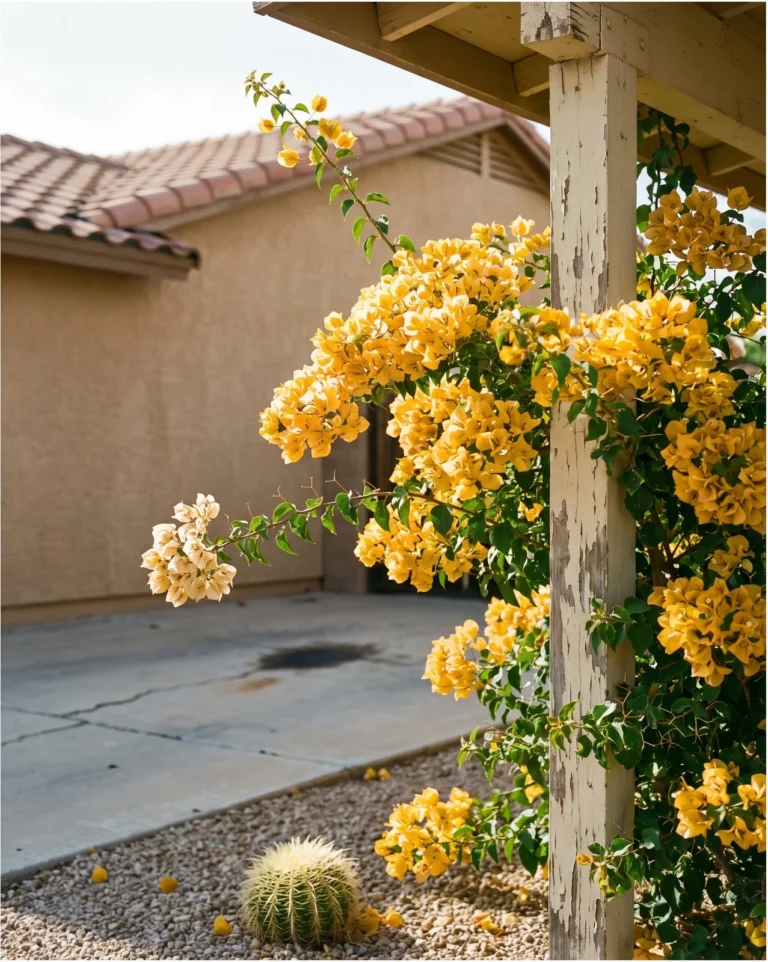
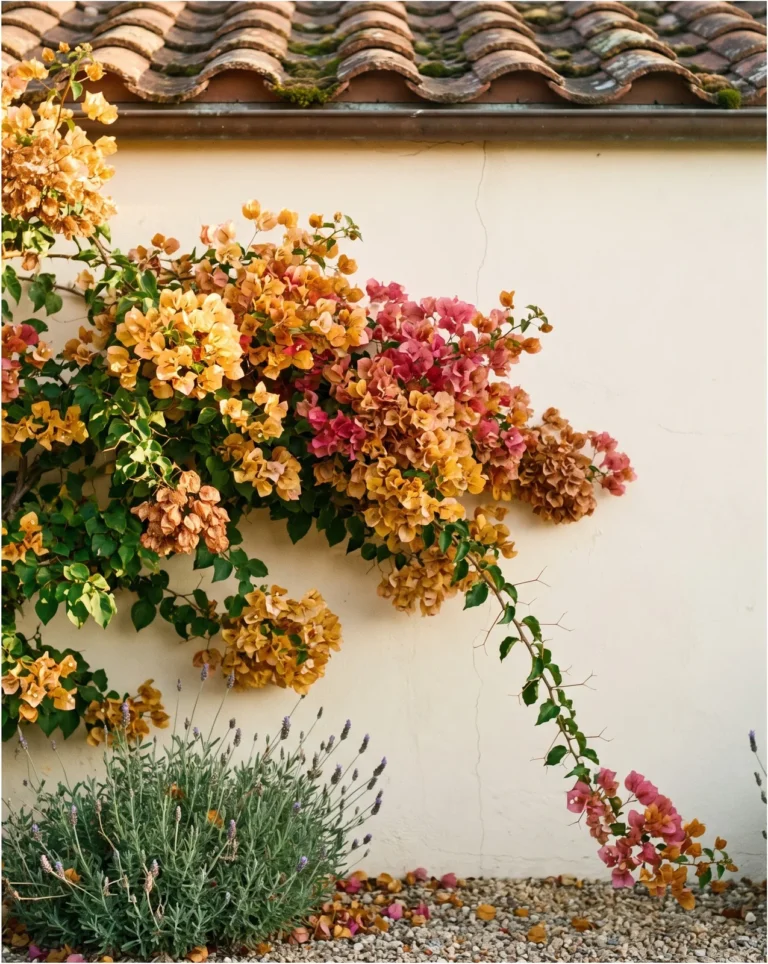
Color is the easy half. Habit decides whether a plant covers a wall or fills a patio pot, and a few forms trade the thorns or the green leaves for something else.
Light
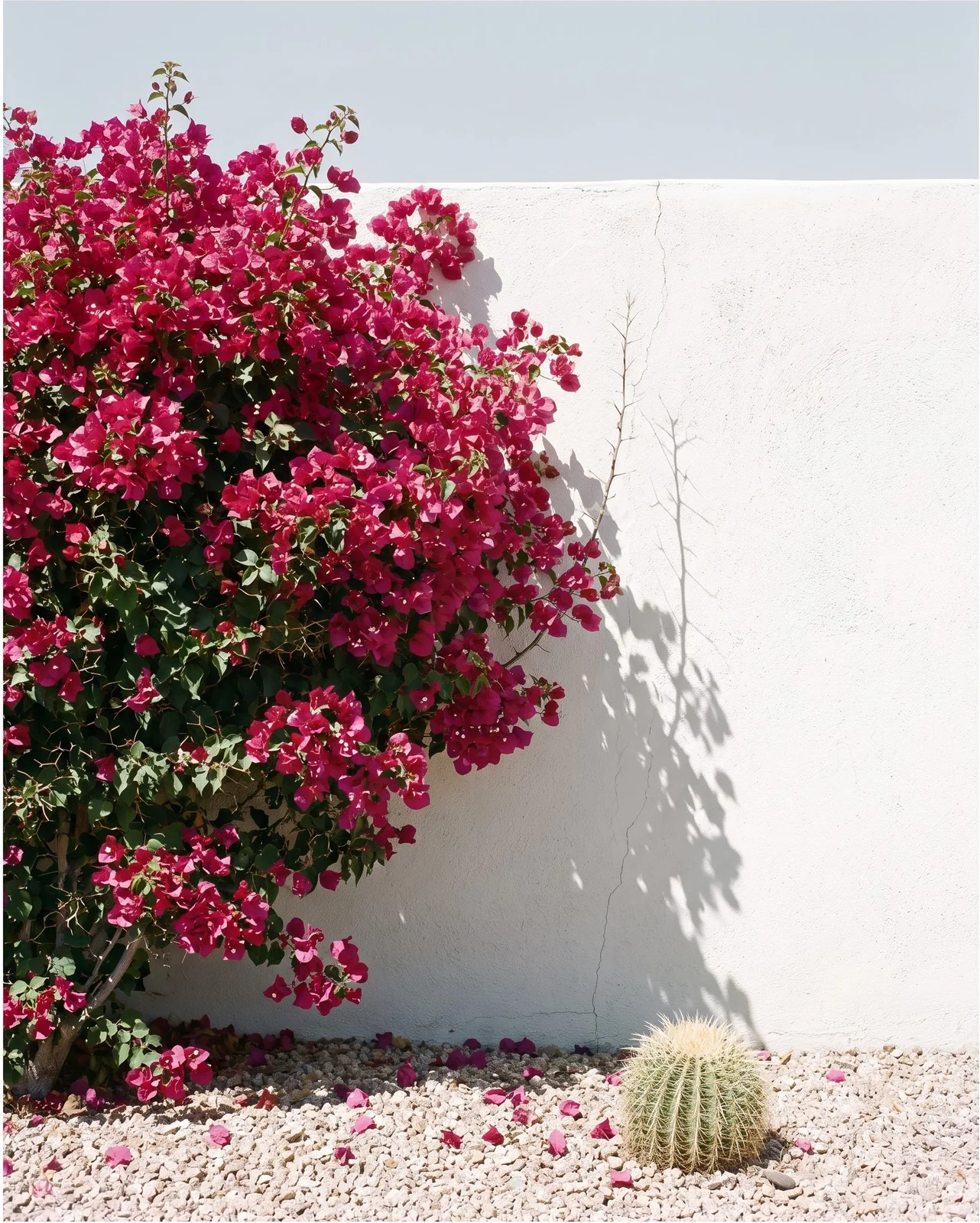
Full sun is the requirement, and for bougainvillea that means six or more hours of direct light a day. The floor is four hours of direct sun, provided the rest of the day stays bright. Light does more than feed the plant. Strong light, moderate temperatures, and longer nights together bring flowering on sooner and heavier, a combination that turns up in very early spring. Put the plant against a south or west wall with nothing shading it at midday. A pot has one advantage: you can move it to follow the sun.
Water
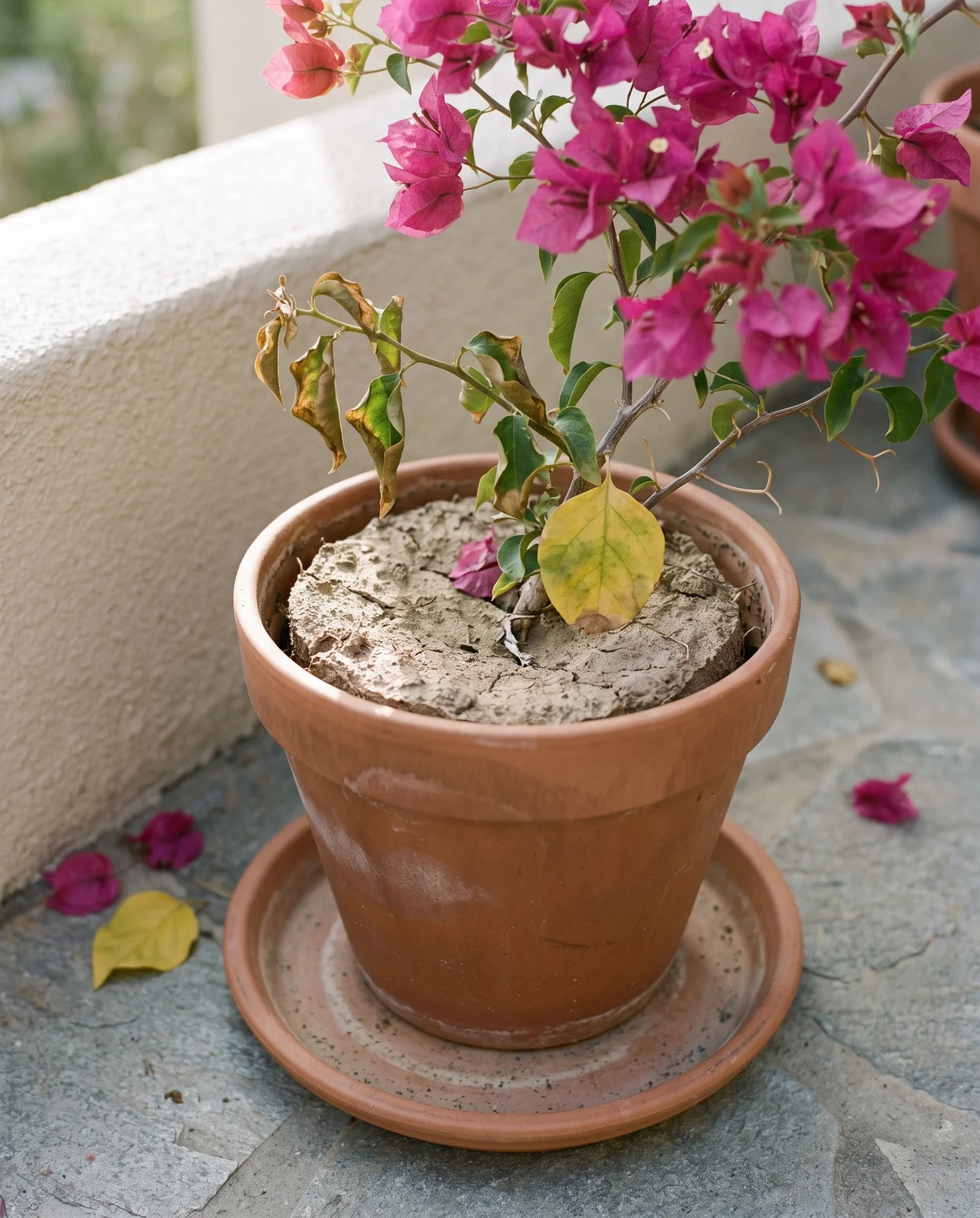
Water deeply, then let the soil dry out before watering again. That one habit covers most of what bougainvillea asks for, in the ground and in a pot. Once established it is extremely drought resistant and grows in almost any soil that does not stay constantly wet. It holds up in a hot bed beside lantana and other plants that resent a daily sprinkler. A pot in full sun dries far faster than open ground, so the interval shortens in summer and stretches in cool weather. Read leaf drop carefully, because it follows overwatering, underwatering, low light, and cold alike. Weigh the pot or push a finger into the mix first: a soaked plant shedding leaves and a bone-dry one need opposite fixes.
Soil and feeding
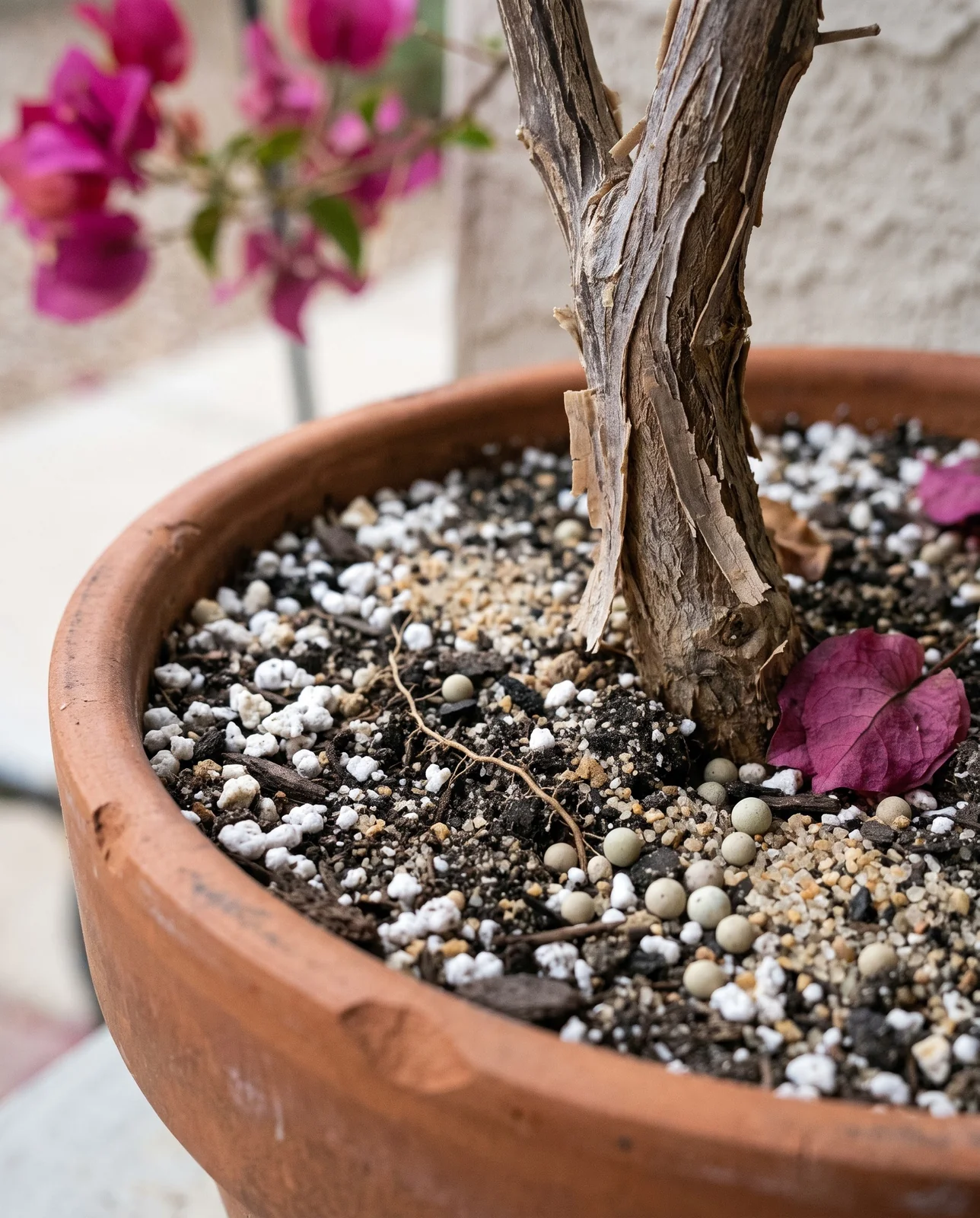
Bougainvillea wants soil that drains and leans slightly acidic, a pH of 5.5 to just over 6.0. Alkaline ground is where trouble starts: chlorosis, the yellowing that spreads between the leaf veins, is a known problem there. Heavy soil that holds water is the other failure, and drainage comes before fertility. A raised bed, a slope, or a container beats improving a wet clay hole. Those fine roots fail first in soggy ground, so pick the site for how it drains after a long rain.
Feed lightly. In the garden, a general-purpose 10-10-10 at half the labeled rate, once a month, in early spring and midsummer, is enough. In a container, use a balanced formula at half strength when the growing season begins and again in early summer. Balanced means a 1:1:1 ratio, something like 20-20-20 or 14-14-14. Both rates are deliberately weak, on a plant that flowers better hungry. Yellowing on new growth points somewhere else, usually a magnesium or iron shortage, and a micronutrient blend or a chelated spray corrects it.
USDA hardiness
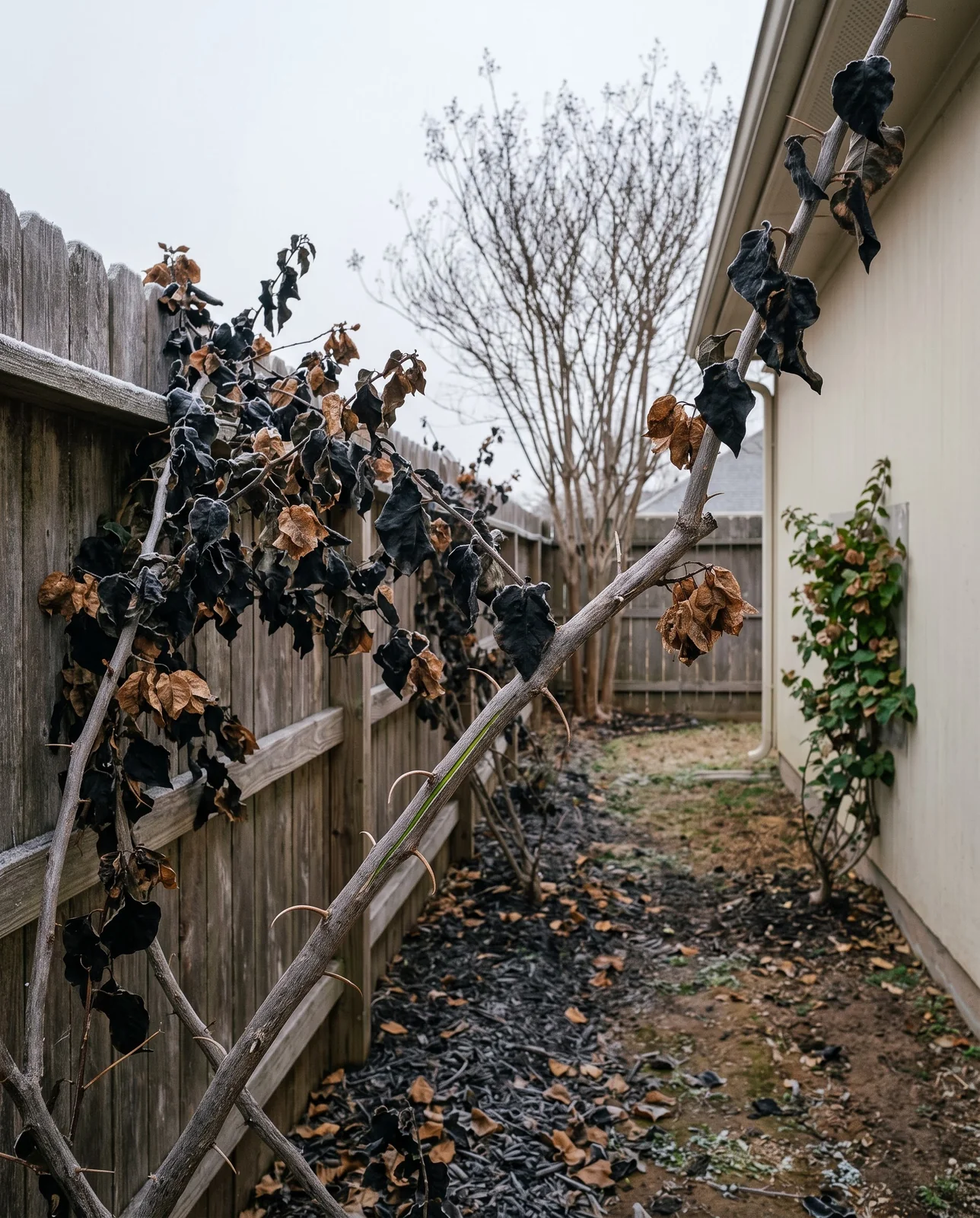
Bougainvillea is hardy outdoors in zones 9 through 11. Zone 9 is the edge: the plant thrives in zone 10 and survives zone 9 only where it is protected. The thermometer tells you more than the map does. Substantial winter damage arrives once temperatures hit the mid to low twenties. A plant frozen back is usually still alive at the root, and the bill comes due in color, because flowering is greatly reduced for a year or two after a freeze takes the top growth. So whether it returns every year depends on which side of that line you garden. Zones 10 and 11 never interrupt it, zone 9 costs you the top growth in a hard winter, and north of there it comes back only if it wintered indoors.
Height and spread
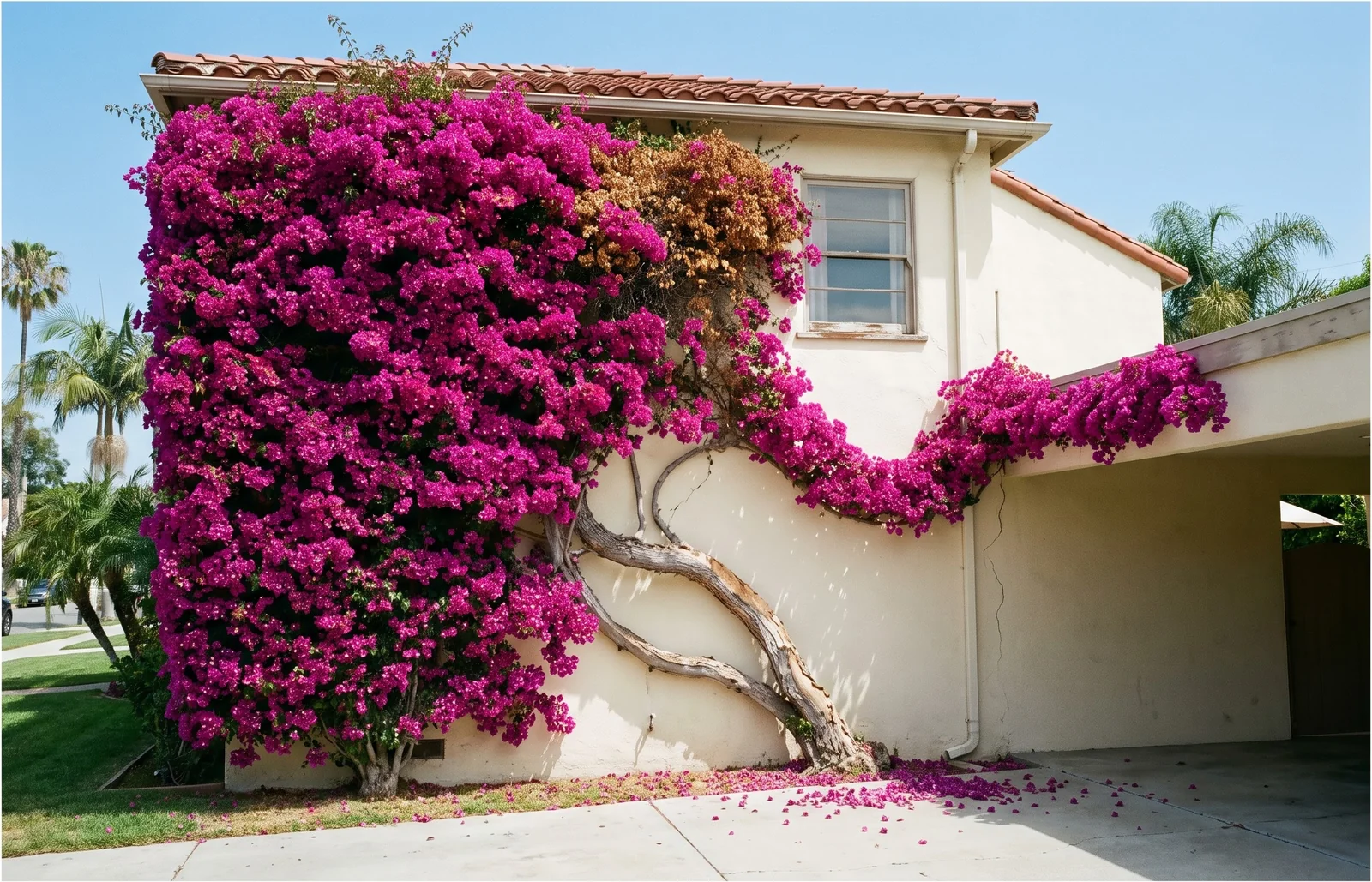
Bougainvillea glabra runs 10 to 20 feet tall and 6 to 10 feet wide. Bougainvillea spectabilis runs 15 to 40 feet each way, the same figure the group carries as a whole. Held back by a pot and a glasshouse roof, the same plants stay 13 to 26 feet tall and only 3 to 5 feet across. At the far end of the scale, a single glabra stem in a warm climate has been measured at 20 to 30 meters, roughly 60 to 100 feet. Those are the numbers for a plant left alone. In an American garden the pot, the yearly cut, or the winter stops it first.
Planting and support
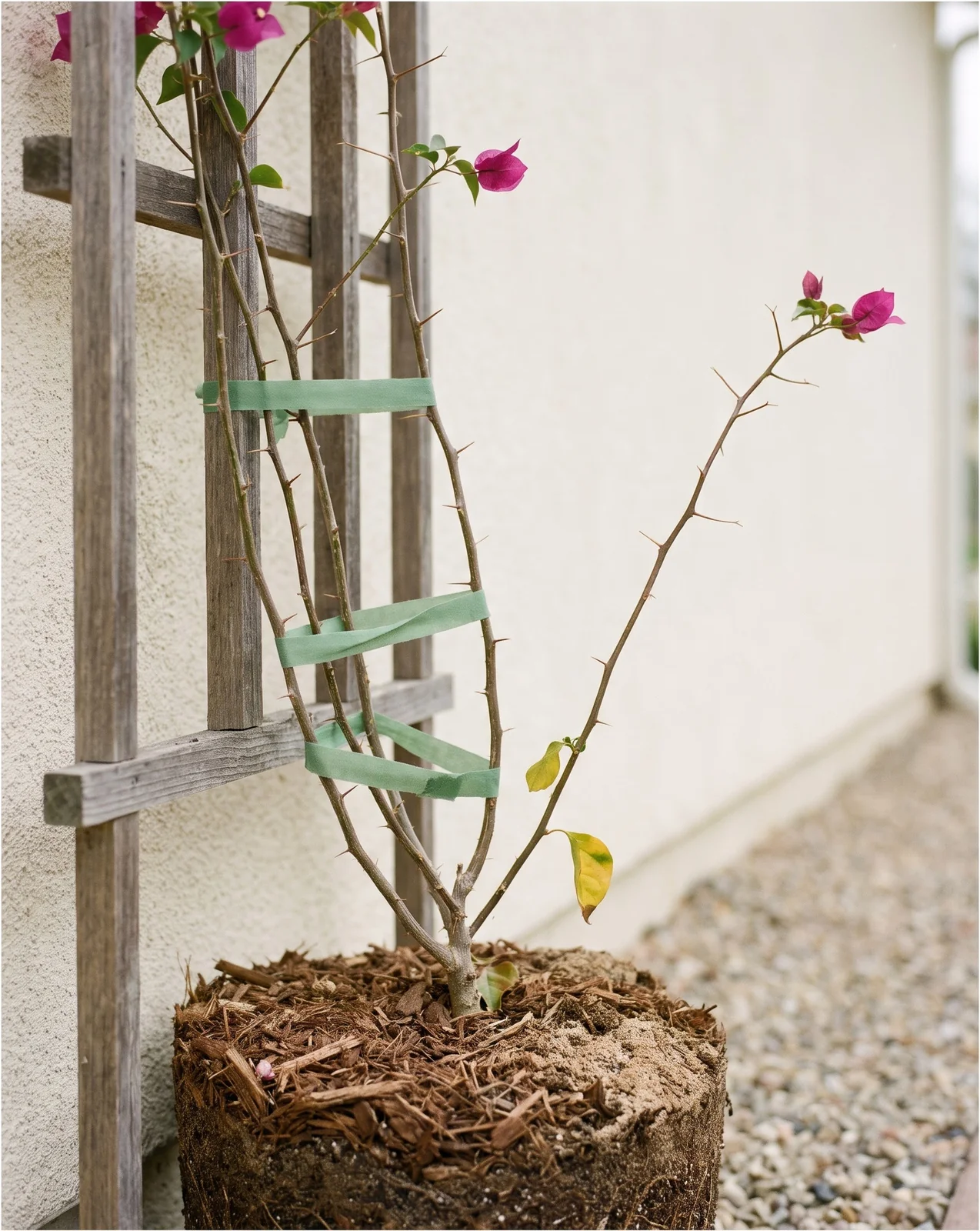
Plant it once and disturb the roots as little as you can. Bougainvillea roots are sensitive to movement and may not recover from rough handling, so the root ball goes into the hole intact, with no teasing and no scoring. If an established plant has to move, lift as much root ball as the shovel will carry. Careful handling doubles as root rot control, with a broad-spectrum fungicide drench at planting or transplanting. Put the trellis, fence, or pergola up before the plant goes in, because a young cane is easy to guide and a thorny mature one fights back. On the coast it takes salt well enough to be a standard south Florida choice, though the tolerance is only moderate and a spot a little inland is safer.
Thorns, skin, and pet safety
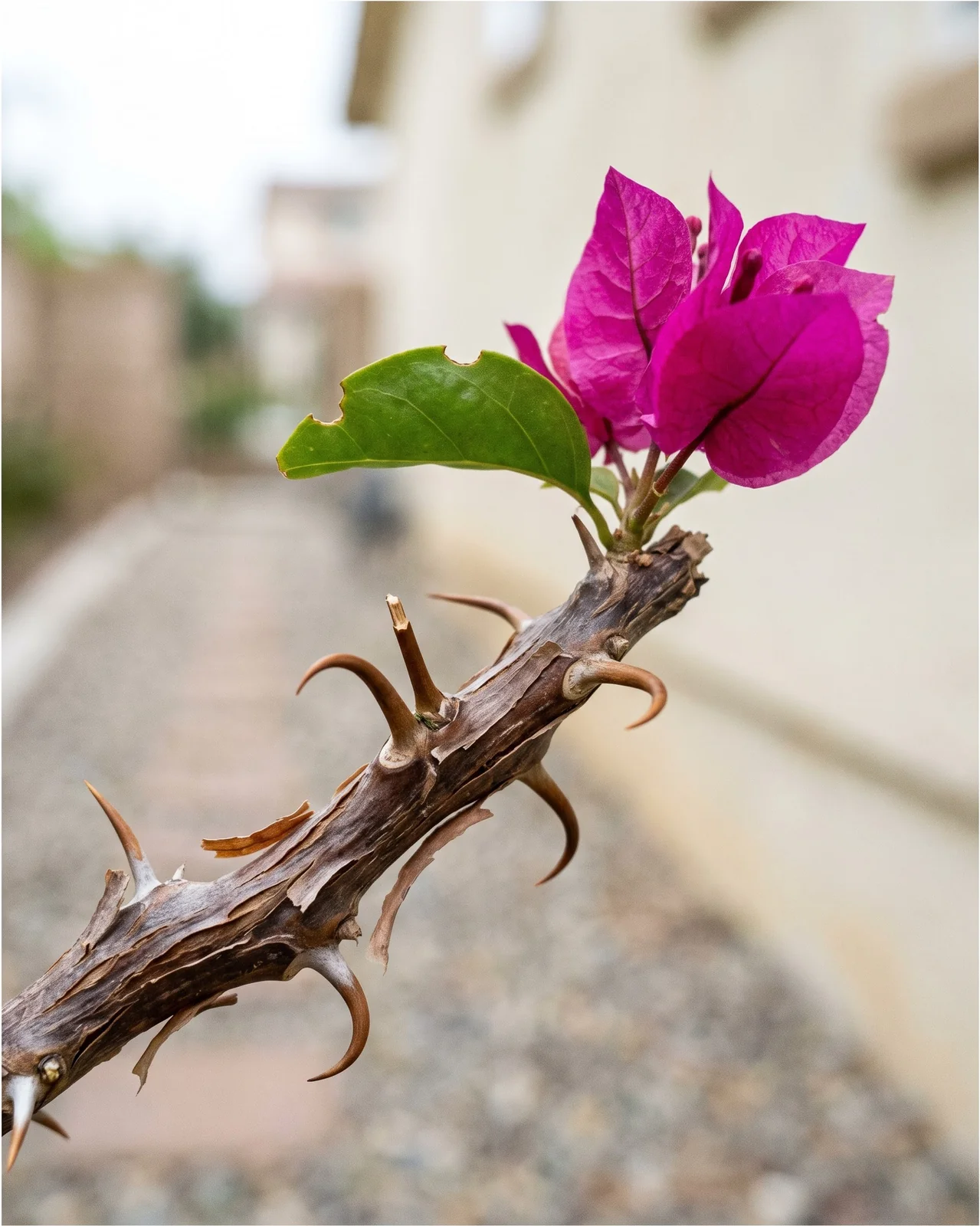
Bougainvillea has no entry on the ASPCA plant lists for dogs or cats, so no rating exists either way. The documented hazard on this plant is mechanical. The leaves are not toxic, but a thorn prick can bring on dermatitis, a rash that behaves like poison oak or poison ivy, with pain, itching, stinging or burning skin, blisters, swelling, and sores. The thorns count among the plant's recognized problems, so keep it out of high-traffic places where somebody would brush past it. A doorway, a narrow walk, and the edge of a play area are all the wrong spot for it.
Propagation
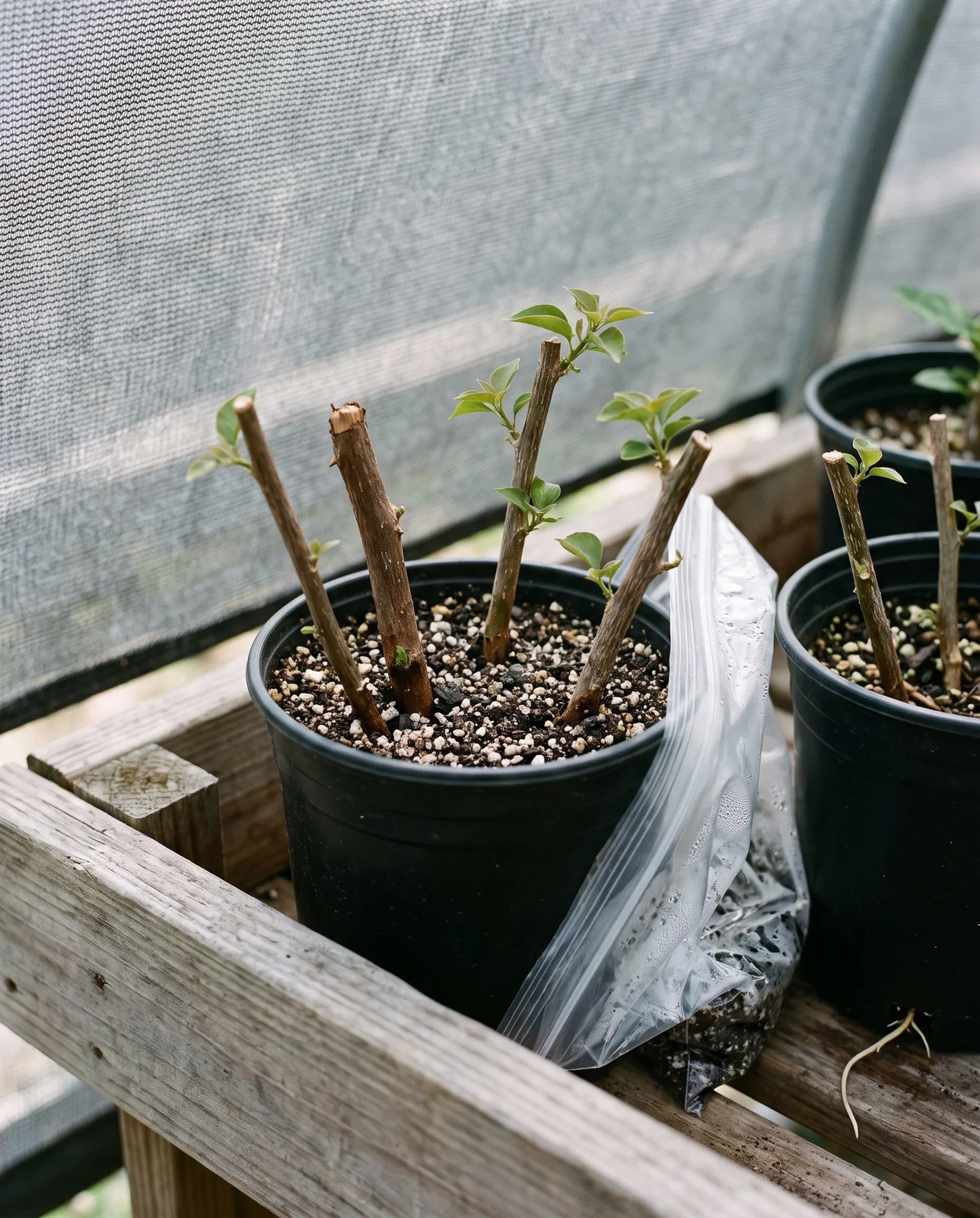
Bougainvillea is grown from cuttings. In cultivation the plant is sterile, which leaves stem cuttings as the only practical route and explains why every named variety on the market is a piece of one original plant. Take semi-hardwood cuttings five to nine nodes long. They root in four to six weeks, quicker over bottom heat at 15 C, about 50 F, and can take up to twelve weeks by other methods. Layering in late winter or early spring works better still, and a layered plant flowers in two to three years.
Pests and diseases
Bougainvillea is generally disease free, troubled mainly by whitefly, mealybug, aphid, and red spider mite. Fungal and bacterial leaf spots do occur, and scales join the insect list, mainly under glass. Mealybug and scale are the indoor problems, aphids the common outdoor one. Slugs and snails turn up in a mild garden, and hand removal is the first control, with a labeled neem oil as the next option.
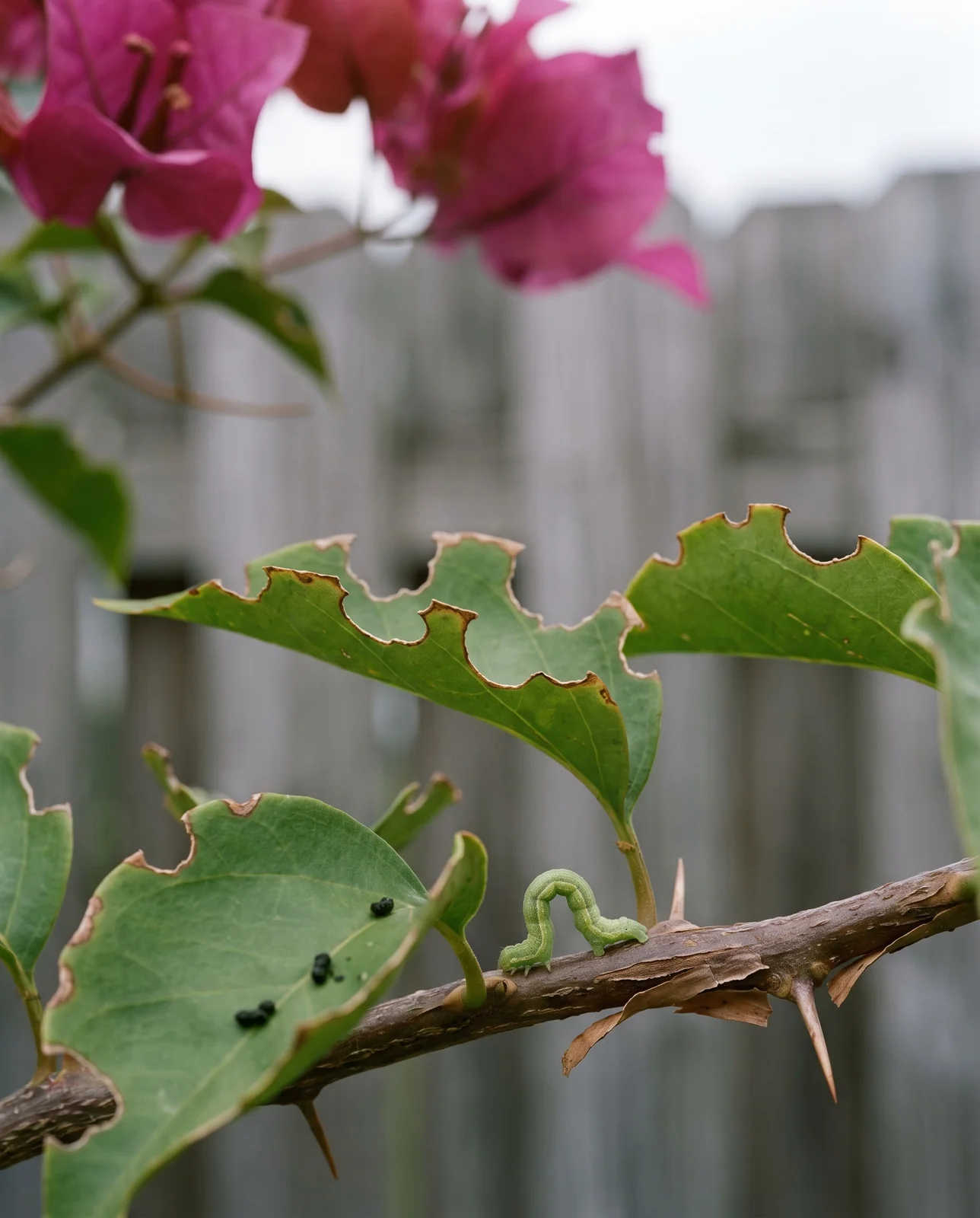
One pest carries the plant's name. The bougainvillea looper is a smooth-skinned caterpillar, yellowish or green to brown, up to an inch long, that moves the way an inchworm does. Young larvae feed on tender shoots and along leaf edges, leaving them scalloped, older larvae work on mature leaves, and a heavy infestation can strip a plant. Catching one in the act takes effort, since the larvae and the fast-flying gray to brown moths, wingspan about an inch, are all active at night. Bacillus thuringiensis controls young loopers and may do little against mature ones, while spinosad works on both.
What actually goes wrong, ranked
Ordered by how often each one comes up, symptom first and the fix after it.
Symptoms: a plant brought inside sheds its leaves and sits bare for months. Cause: it is semi-deciduous, and a cool winter is a rest. Fix: pick cool rest or bright growth, hold it all season, and scratch a stem for green wood before giving up.
Symptoms: leaves yellow and fall on a potted plant, often weeks after a move indoors. Cause: overwatering, underwatering, low light, and cold all look the same here. Fix: read the mix and the window before you treat anything.
Symptoms: a dark green plant with no color, on careful watering and regular feeding. Cause: comfort. Fix: let it droop before you water again, and leave the pot alone, because a bigger one buys a season of stems.
Symptoms: after a freeze, a bundle of gray sticks with no visible green. Cause: the top froze and the roots usually did not. Fix: scratch the bark, cut nothing yet, and wait for the base to push.
Symptoms: leaf edges chewed into scallops overnight, nothing visible by day. Cause: the looper feeds after dark. Fix: hunt with a flashlight at night, since a daytime search finds nothing.
Symptoms: a plant over the gutter and into the eaves, and an owner unsure how far back is safe. Cause: nerve. Fix: cut hard, since hard cuts are what hold the size.
Symptoms: a puncture through a cloth gardening glove, then a finger stiff, red, and sore for days. Cause: the prick can raise a rash on top of the wound. Fix: clean it like any puncture, and wear leather gloves.
Meaning and culture
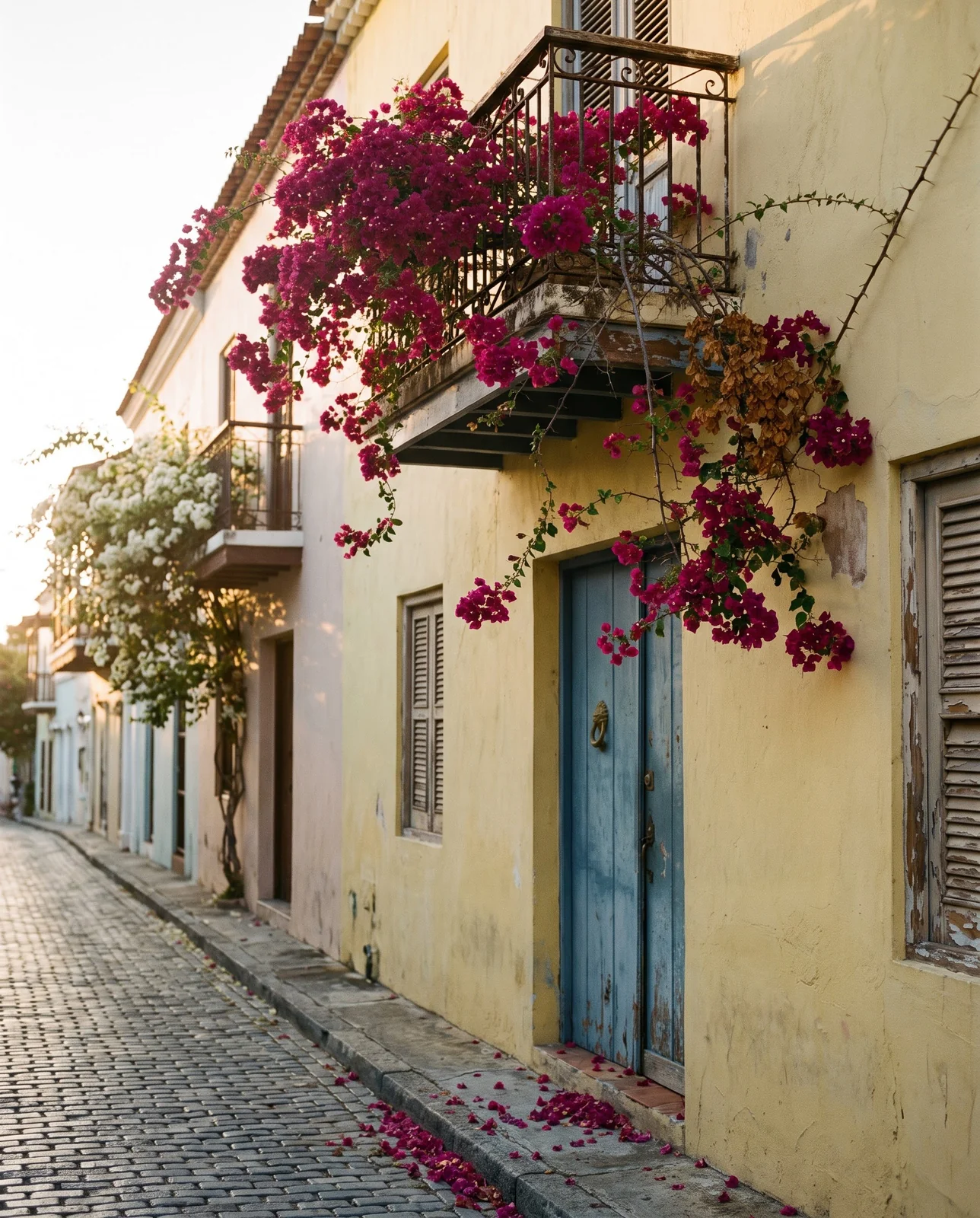
Bougainvillea is the national flower of Grenada. The crest on that country's coat of arms, seven roses for its seven parishes, is set between two sprays of the plant. In the American trade it sells on sheer output, marketed as a flowering machine for the amount of color it turns out in a season. Everywhere else its meaning is associative: magenta over whitewashed stucco is shorthand for heat and coastline. That is where most Americans first meet one.
Myths about bougainvillea
This plant attracts more folklore than most, because the care that works on it looks like neglect.
The myth: Epsom salt makes it bloom.
The reality: The one documented use of Epsom salt here is a magnesium drench, one to two teaspoons per gallon, for yellowing on old growth. That is a chlorosis treatment, with nothing to do with flowering.
The myth: In a heat wave it needs more water to keep the color coming.
The reality: Extra water on a potted plant shows up as fewer flowers and fewer colorful bracts.
The myth: It is a houseplant that flowers on the windowsill all winter.
The reality: Winter is a rest period in every zone, with no feeding, and a plant held above freezing on fairly dry compost will drop its leaves.
The myth: Cutting it back hard will kill it.
The reality: Bougainvillea responds well to hard pruning. Only a very old, worn-out plant is better replaced than renovated.
What to expect, year by year
A bougainvillea does not arrive at full strength, and the first season is the one people misread.
Year one is roots and stems. A plant set in the ground holds its flowers back for a couple of seasons while it settles in; a container plant, roots confined, starts sooner. Pinch the tips early to build a branched framework, and expect a light, uneven show the first summer.
By the second and third seasons the plant has enough wood to run on a cycle, with a cut after each flush setting up the next. This is when a borderline-zone plant earns its margin: past the first winter or two it is big enough to take most winter damage and recover.
A mature plant blooms over a longer stretch of the year than a young one, and the work turns from coaxing to restraint. Cut hard to hold the size, leave the roots crowded, and the year settles into flush, cut, flush.
In the vase
Bougainvillea is barely a cut flower. Stems of bracts wilt and the floral axis bends within a few days, because vascular occlusion blocks the water reaching the flowers. The figures below come from bracts held in chilled laboratory storage.
Flower photos
FAQ
Why does my bougainvillea have leaves but no flowers?
Water first: too much of it, or roots sitting wet, stops bloom completely. Then light, since part shade gives leaves and few flowers or none, then the fertilizer bag, since high nitrogen buys foliage.
What should I feed a bougainvillea to make it bloom?
Less than you think. A balanced formula at half strength, when growth begins and again in early summer, is the container standard. Overfeeding adds growth and inhibits blooming.
Does Epsom salt make a bougainvillea bloom?
No. Its one documented use on this plant is a magnesium drench for chlorosis on old growth.
What month does bougainvillea bloom?
There is no single month. Outdoors the season runs spring through fall, year-round in some places, heaviest from spring to early summer and again from late summer to fall.
Can I leave a potted bougainvillea outside all winter?
Only where frost does not reach it, since the plant is frost sensitive and is grown in a container or as an annual everywhere else. Indoors, a resting plant wants a night minimum near 50 F.
How far back can I cut a bougainvillea?
Hard. Plants respond well to hard pruning, with a very old, worn one the exception. The routine cut takes long spent growth back by half once the bracts fall.
Is bougainvillea poisonous to dogs or cats?
It has no entry on the ASPCA lists for dogs or cats, so no rating exists either way. The hazard is the thorns.
Is it better to grow bougainvillea in a pot or in the ground?
A pot brings flowers sooner, because crowded roots discourage rampant growth and encourage flowering. In the ground it grows rampantly and stays reluctant to bloom for a couple of years.
What is eating my bougainvillea leaves at night?
Most likely the bougainvillea looper, a caterpillar up to an inch long whose larvae and adult moths are both active after dark. Leaf edges chewed into scallops are its signature.
How do you grow bougainvillea from a cutting?
Take semi-hardwood cuttings five to nine nodes long. They root in four to six weeks, quicker over bottom heat at 15 C, about 50 F.
Is bougainvillea a vine, a bush, or a tree?
All three, depending on how it is cut. Untrained it is a woody climber that has to be tied to a fence, wall, or pergola. In a container it is trained shrubbier, and as a standard it is spur-pruned to the size of a small tree.
Interesting tips
- A container plant can go into the ground without its roots being touched at all. Cut the bottom out of the pot, set plant and container together in the hole, then slide the container up over the leaves while you backfill around the root ball.
- Bougainvillea glabra has working uses beyond the wall it covers: it serves as a botanical insecticide, and in Mexico an infusion of it is taken for gastrointestinal and respiratory complaints.
- Bougainvillea spectabilis contains pinitol, a compound with an insulin-like effect that has been studied for development as a diabetes treatment.
Related Guides & Flowers
Hibiscus
The other tropical that carries a Sun Belt garden through the heat, with big single flowers where bougainvillea has bracts.
Pink flowers
Where the magenta and rose shades of bougainvillea sit among the other pink garden plants.
Purple flowers
The purple end of the range, from deep-bracted bougainvillea to the purples on other garden plants.
Types of flowers
The full catalog of flowers grouped by kind, for readers browsing beyond the tropics.
Enjoying our flower guides? Add YourFlowersGuide as a preferred source on Google. It helps more readers find us.
Add to Preferred Sources