What Indian paintbrush actually is
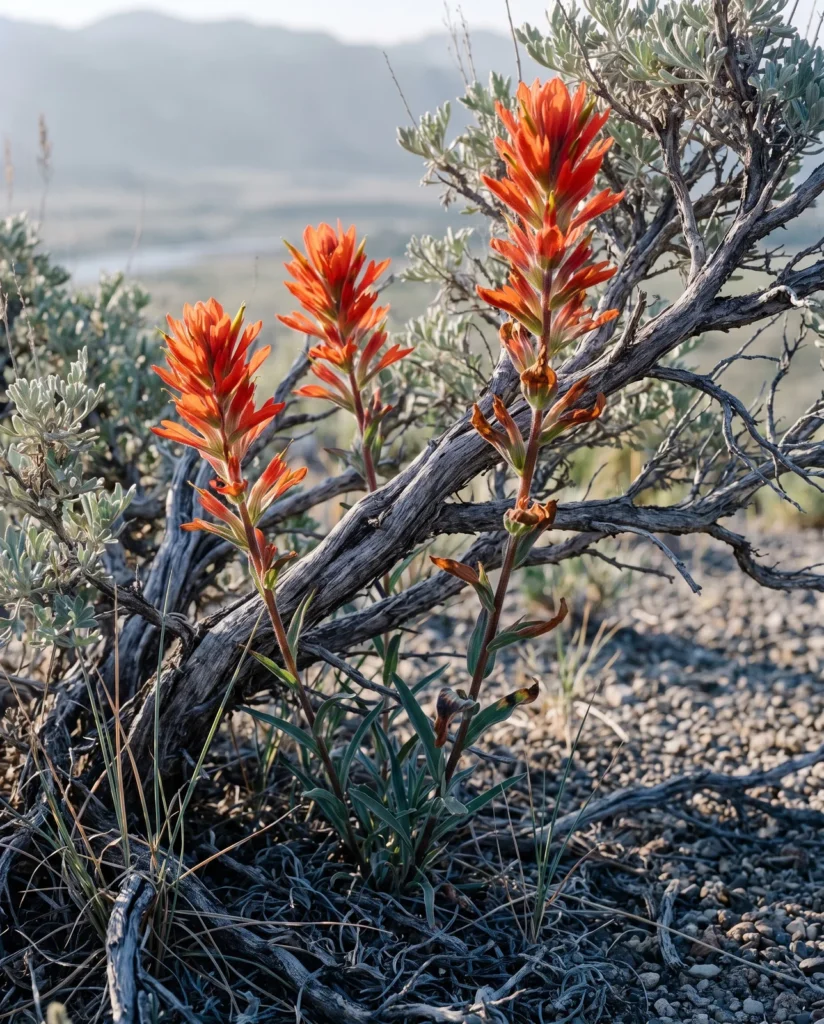
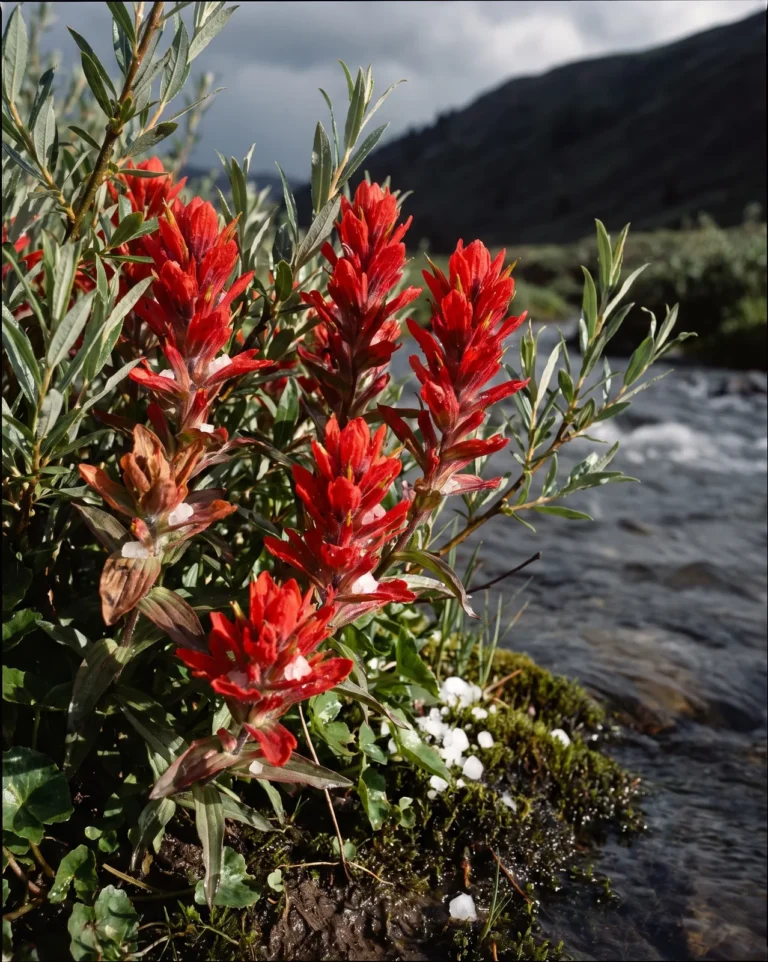
Indian paintbrush is the common name for Castilleja, a genus of about 200 species of annual and perennial, mostly herbaceous plants. The showy red and orange structures are bracts, a type of modified leaf, and the true flowers hide inside them as small greenish-yellow tubes in dense spikes. Check that detail first if you are naming something seen from a car window in red flowers. The genus also answers to painted cup, for the cup shape of the bracts, and to prairie-fire. The eastern scarlet species collected more: bloody warrior, election posies, and scarlet painted cup.
The genus has changed families, and the move explains the plant. Castilleja sits in Orobanchaceae, the broomrape family, after rearrangements of the order Lamiales that began around 2001, and older sources still place it in Scrophulariaceae, the figwort family. Broomrape is where the root parasites sit, and that is the company Castilleja keeps. The name honors the Spanish botanist Domingo Castillejo, and coccinea, the species name of the eastern scarlet paintbrush, means red.
Size and range depend on the species. The Texas one grows 6 to 16 inches high and the eastern scarlet one reaches 1 to 2 feet on an upright hairy stem. Between them the genus covers most of the western and central United States. The range runs from Alaska and Ontario down to New Mexico, across ten western states, and along the Great Plains into northern Mexico.
How it feeds off its neighbors
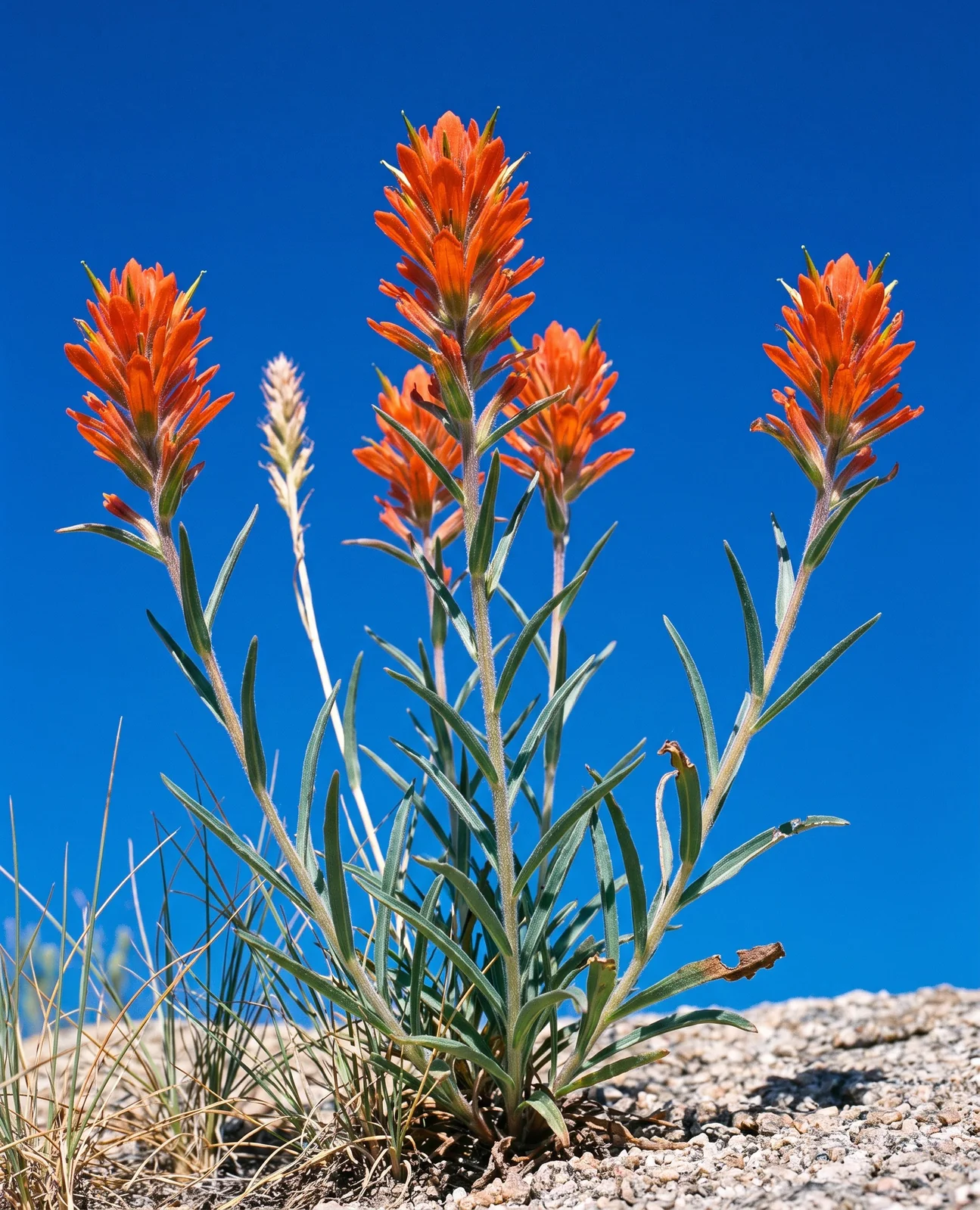
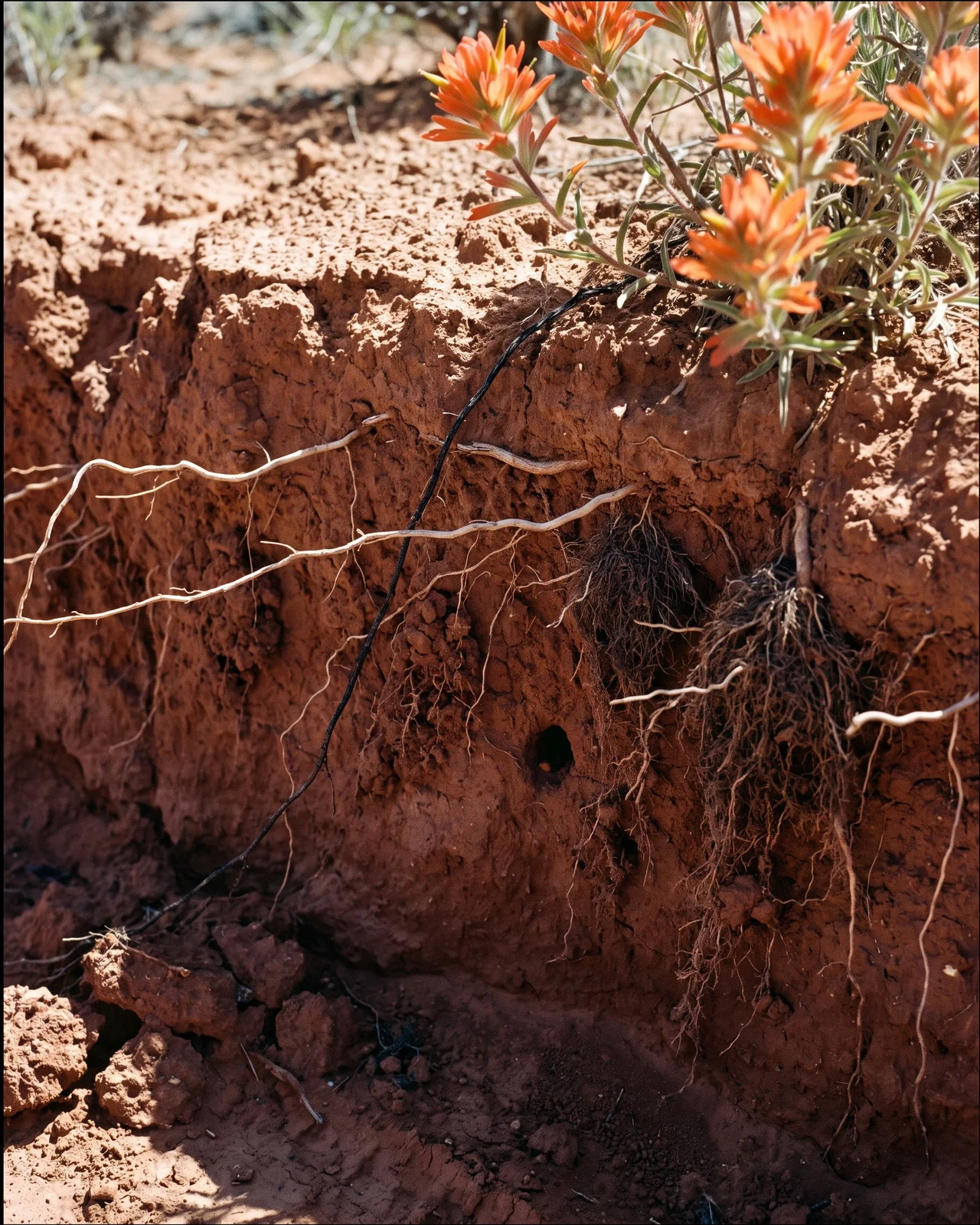
Indian paintbrush is a hemiparasite: it feeds itself and also feeds off other plants. It is green and photosynthesizes normally, and it also draws nutrients from the roots of neighbors, frequently perennial grasses. The connection is physical: paintbrush roots grow haustoria, couplings that pierce a host root and siphon off the water and nutrients moving through it. The share is partial. Others in the broomrape family are holoparasites, living entirely on another plant, while desert paintbrush on big sagebrush took about 10 percent of its sugar energy from its host.
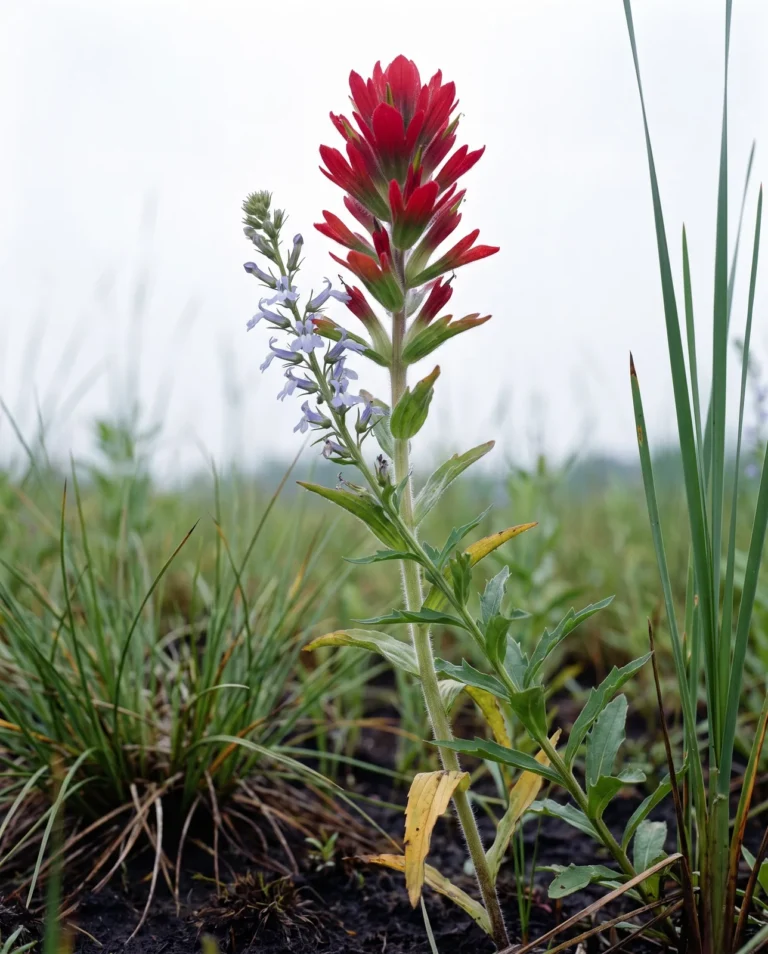
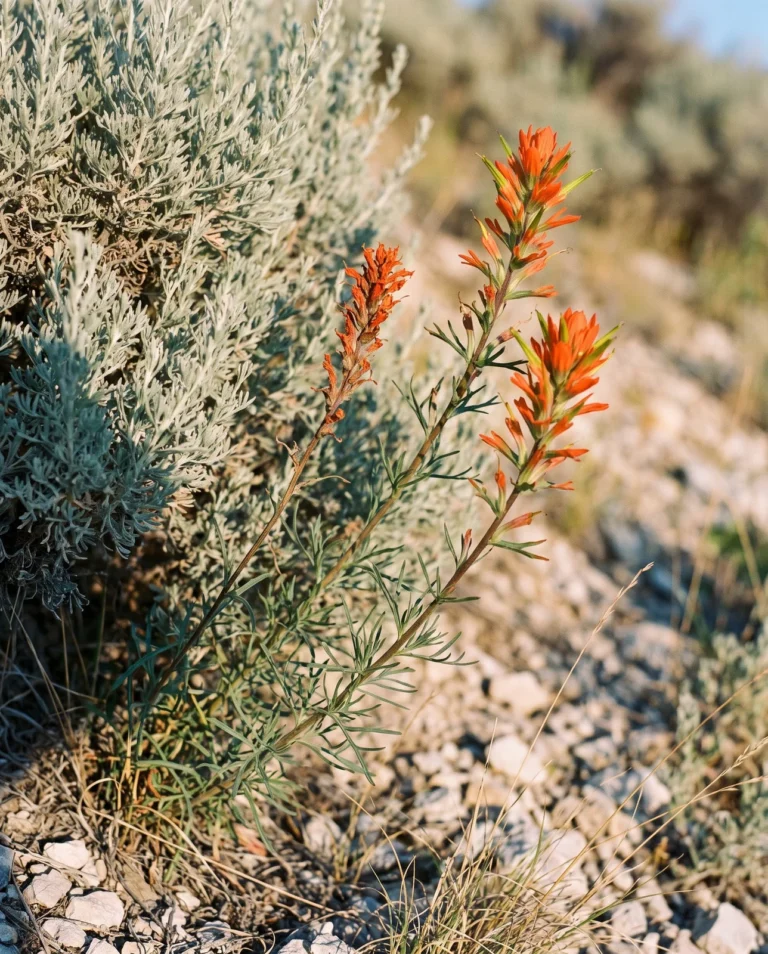
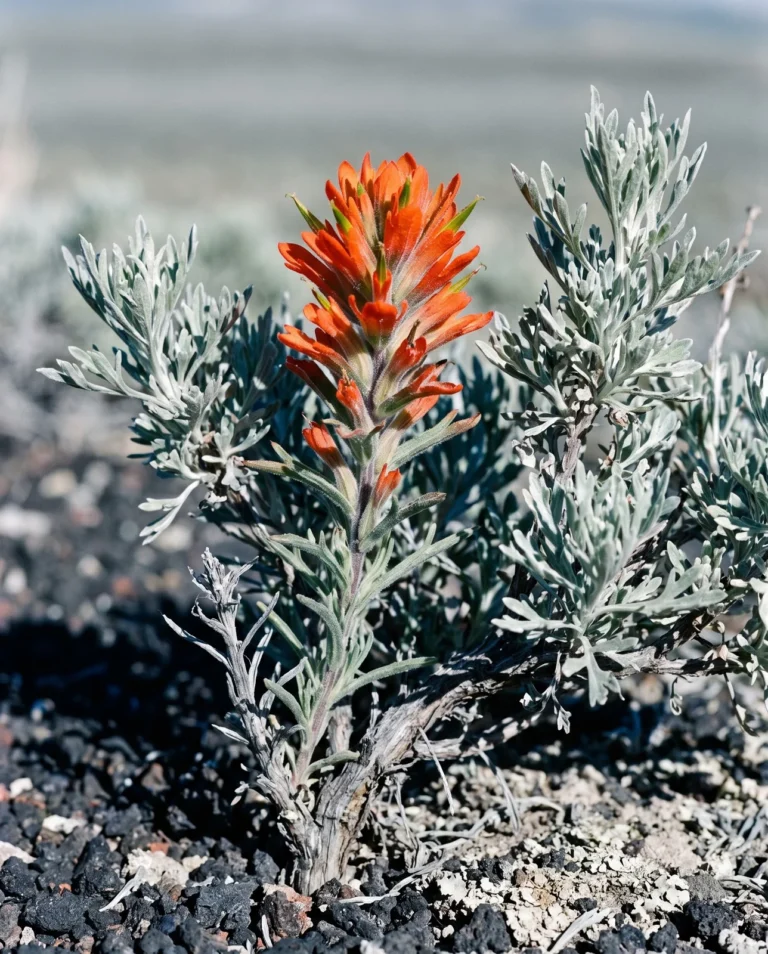
Which plant it taps is a species-by-species question. Pale spiked lobelia, Lobelia spicata, hosts the eastern scarlet species. Desert paintbrush takes big sagebrush and other plants in the aster family. Applegate's paintbrush feeds off sagebrush and its kin, and the ones that find a host grow larger. Downy paintbrush parasitizes eastern redcedar and oldfield juniper, and giant red paintbrush uses willow. For the two showy species people actually try to grow, the partner is grass.
The host pays for it. On pale spiked lobelia, parasitism cut the host's shoot growth at every fertilizer level. Across the genus it reduces host growth and reproductive success and can cause nutritional deficiencies. The host also changes the paintbrush: plants that tap nitrogen-fixing legumes such as lupines set more seed and draw more pollinators than plants tapping grasses.
Why it fails from a seed packet
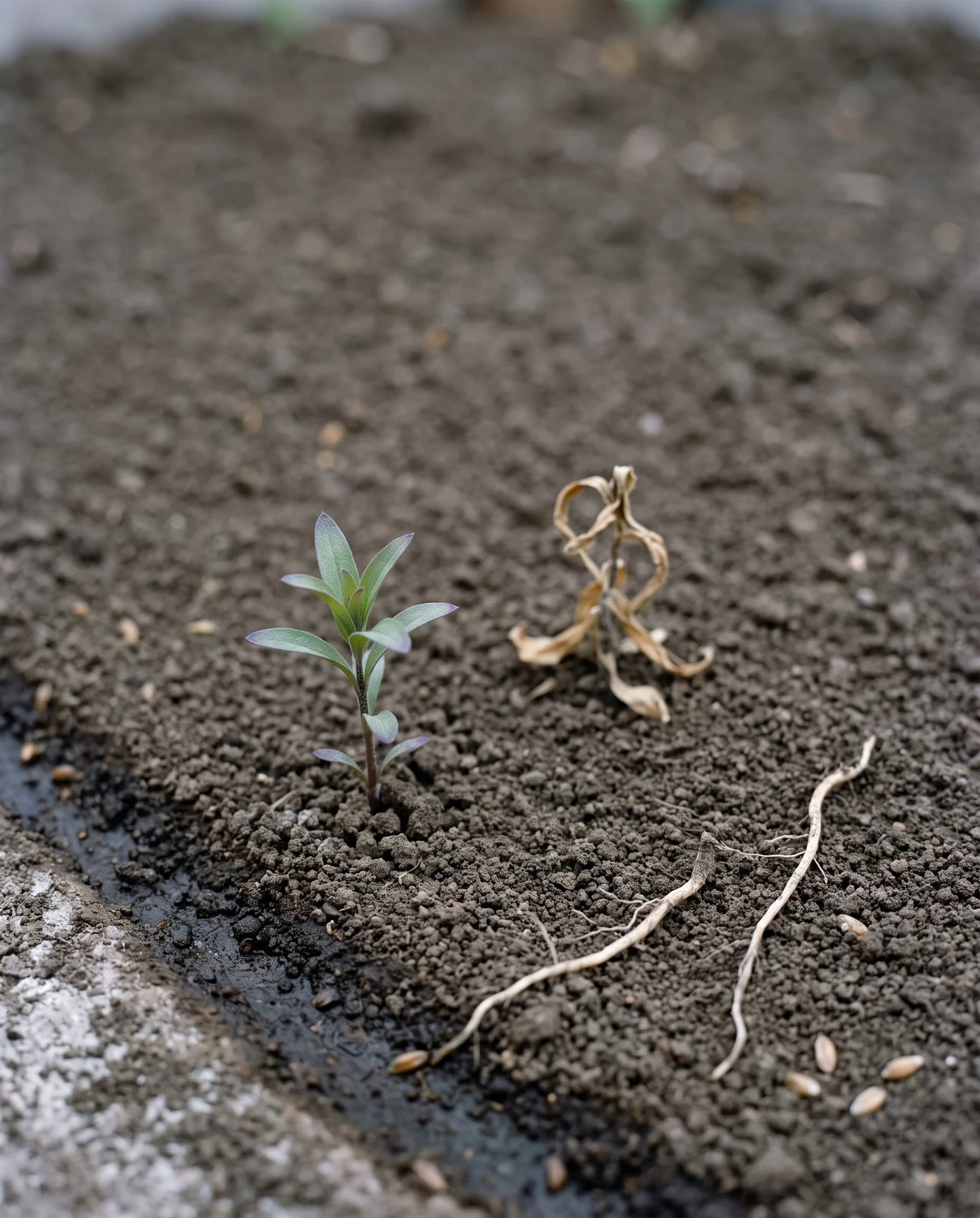
A seed packet fails because the seedling comes up alone. The eastern scarlet species germinates on its own, and it is not known to reach full maturity without a host. Desert paintbrush and two relatives went without one only for short periods. Put the seed in an open bed with no compatible root within reach and the plant stays small and then goes. Gardeners report the same ending: nothing came up, or it grew a while and died out.
Sow paintbrush and a host together and let them meet underground. For the eastern species use low-growing grasses and sedges: blue grama, buffalo grass, Pennsylvania sedge, sweet grass, June grass, and rushes in the Juncus genus. It performs best in cultivation with the plants it parasitizes in the wild, among them little bluestem, penstemon, and blue-eyed grass. Oxeye daisy suits it too, on a similar habit and bloom time. Direct-sow the paintbrush seed and the host seed together in late October or November.
Expect a low strike rate even so. The seed is tiny, about 4 million to the pound in the Texas species, so a packet holds far more seeds than a bed will use. Every root makes its own connection where it lands, and a plant that has made one usually dies when it is moved. Paintbrush does poorly in ordinary garden conditions without those grasses beside it, and for most gardeners it is a wildflower to meet where it already grows.
Does the seed need a cold treatment?
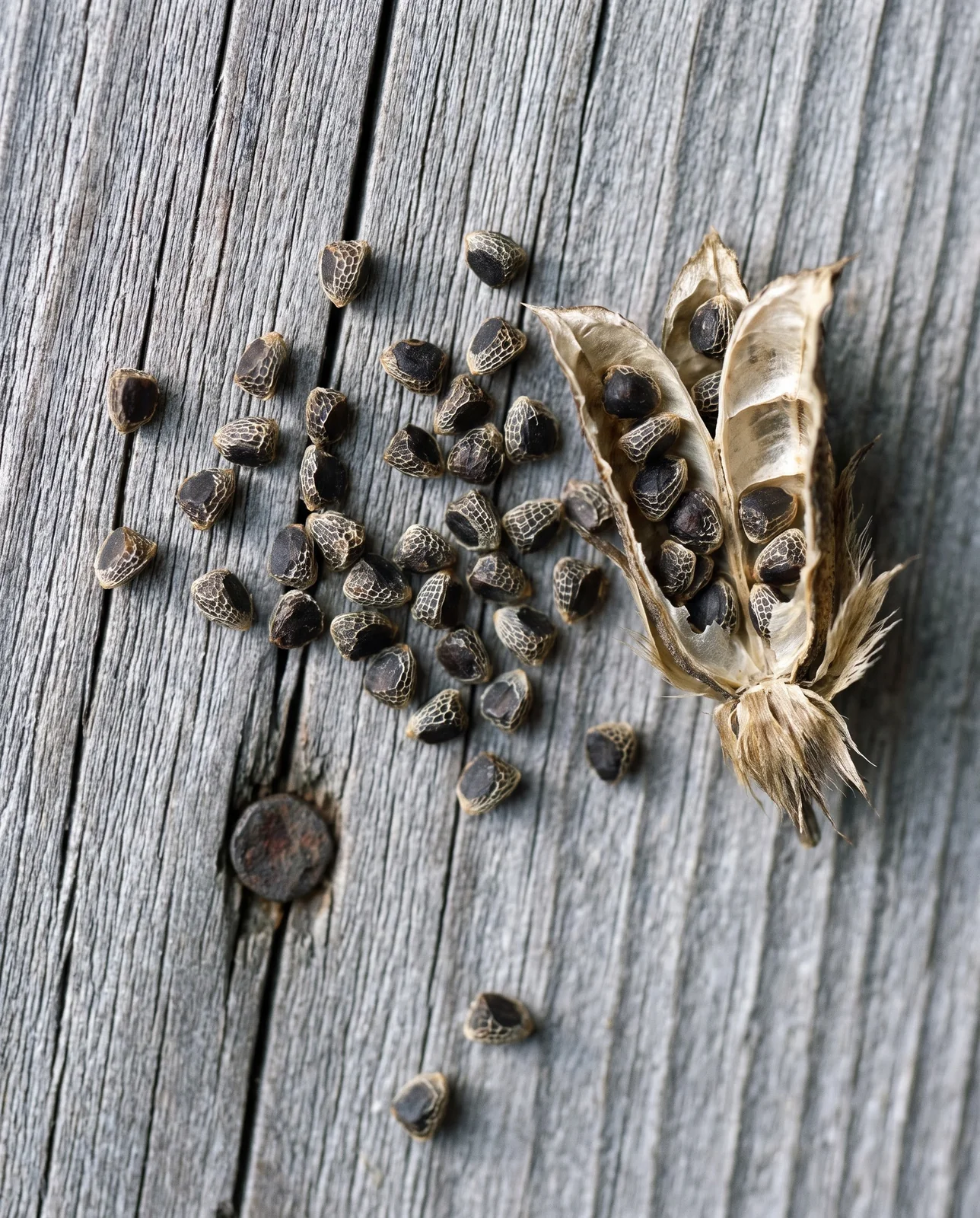
Two universities give opposite answers, and the answer decides whether you chill the seed. New Mexico State University says it germinates in fall and blooms the next spring with no pre-treatment. The University of Arkansas says it needs a two-month cold treatment, so nothing comes up until the soil warms in early spring. A fall planting raked into loose topsoil covers either case, since the seed may want a cold wet period over winter.
An autumn sowing outdoors settles the question, because a winter in the ground applies whatever treatment the seed needs. Damp seed can be refrigerated to break dormancy, though a dormant surface sowing lets the weather do it. The plant splits the same way. New seed germinates in early fall, and it also germinates the following spring and spends that season as a basal rosette.
Where it grows and what it needs
Sun and sharp drainage cover most of it, and light is a species question first. The eastern scarlet species wants sun and the Wyoming species takes part shade. Soil is broad. The Texas species grows in sandy soil, sandy loam, medium loam, clay loam, and clay, and the eastern species takes medium water.
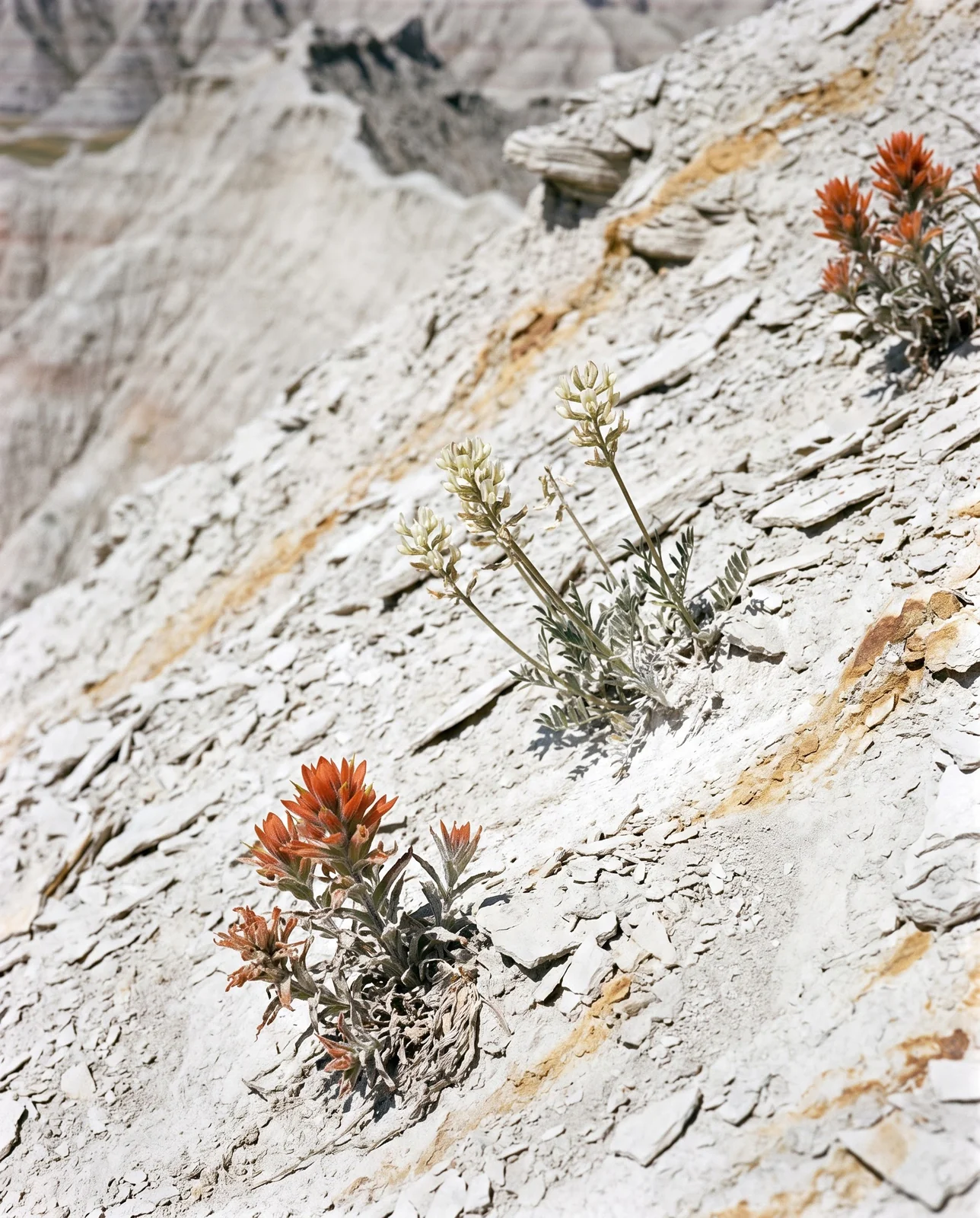
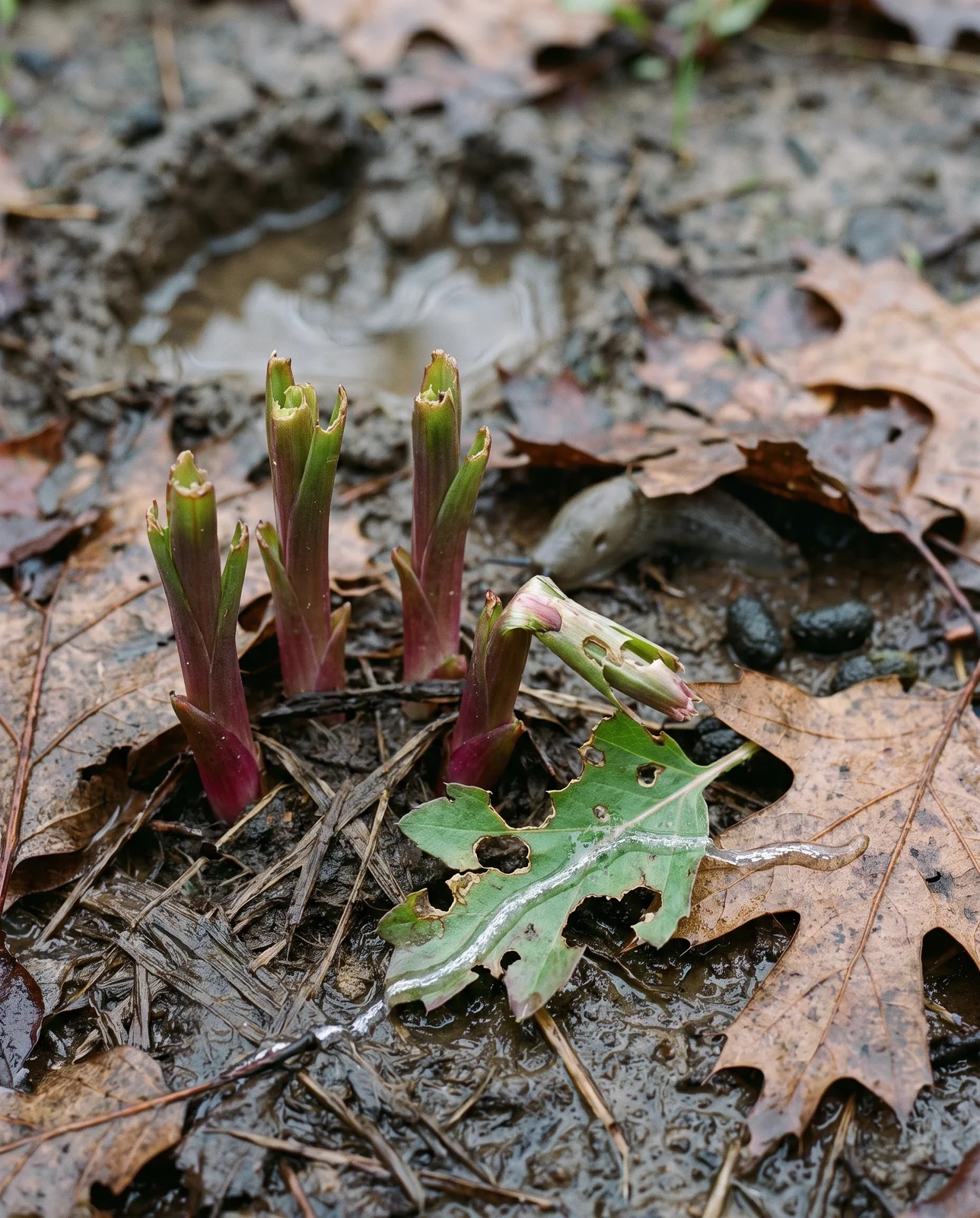
Hardiness listings run 3 to 9, 4 to 8, and 3 to 8, overlapping far more than they differ. In the mountains elevation decides more than the zone does, and giant red paintbrush grows in wet meadows and on stream banks below 11,000 feet. At the hard end of the range paintbrush can grow in serpentine soils, which defeat most plants on magnesium and heavy metal content. Slugs take the shoots as they first emerge, so slug protection and drainage are what to get right in a wet winter.
Annual or perennial, and how to tell
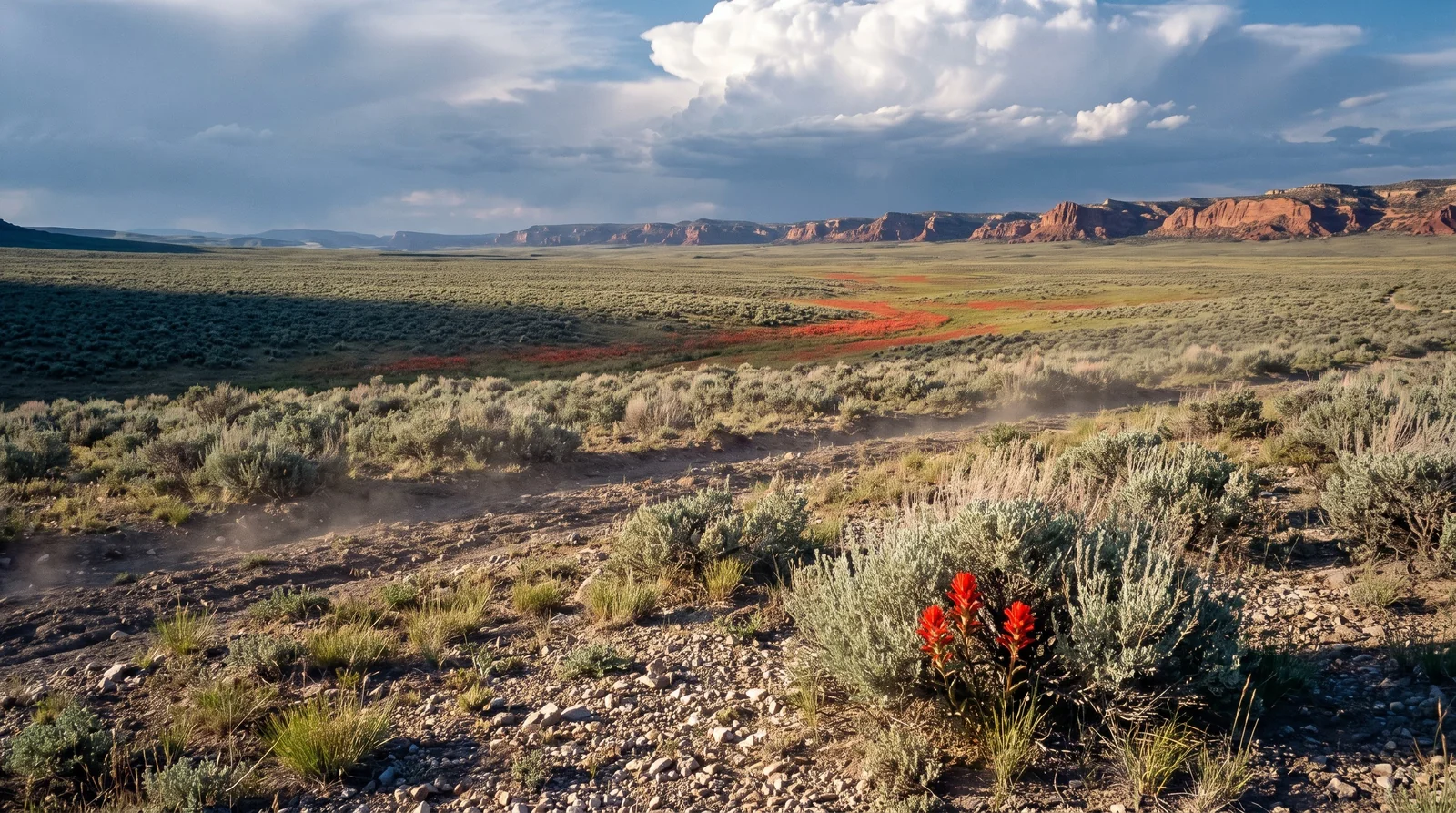
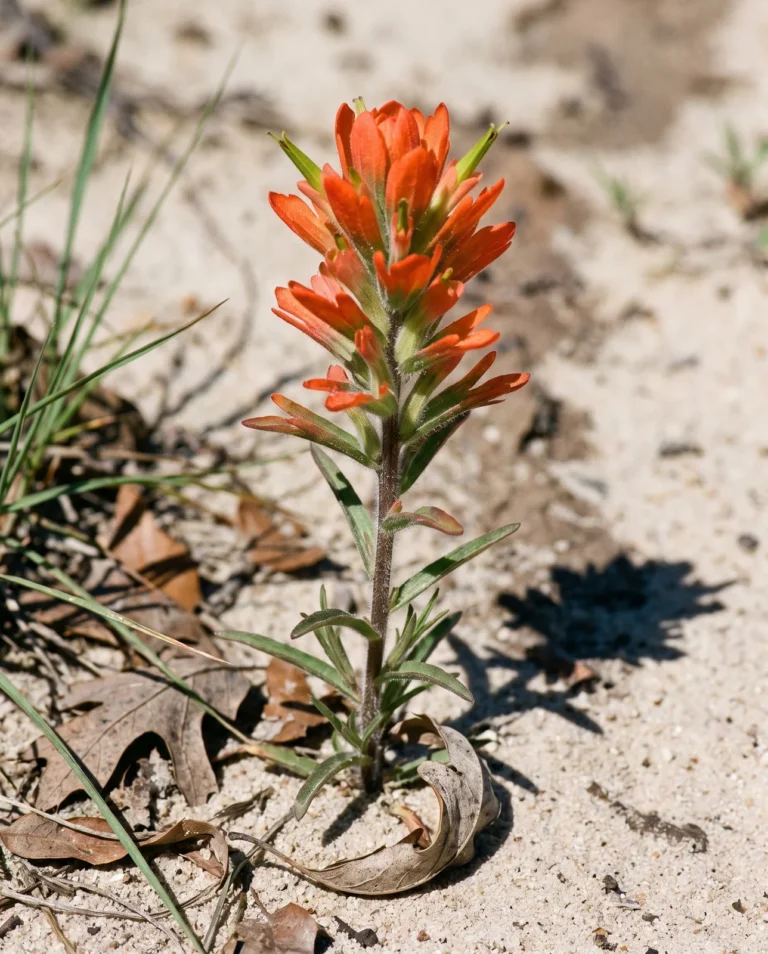
Both, and it depends entirely on the species. The eastern scarlet paintbrush is biennial: seed makes a basal rosette the first year, and the plant flowers, sets seed, and dies in the second. It rises on a leafy unbranched spike about 18 inches tall. It also runs as an annual, and a stand can still be in bloom as late as October. The Texas species is annual, and purple owl's clover is an annual herb roughly 4 to 18 inches tall.
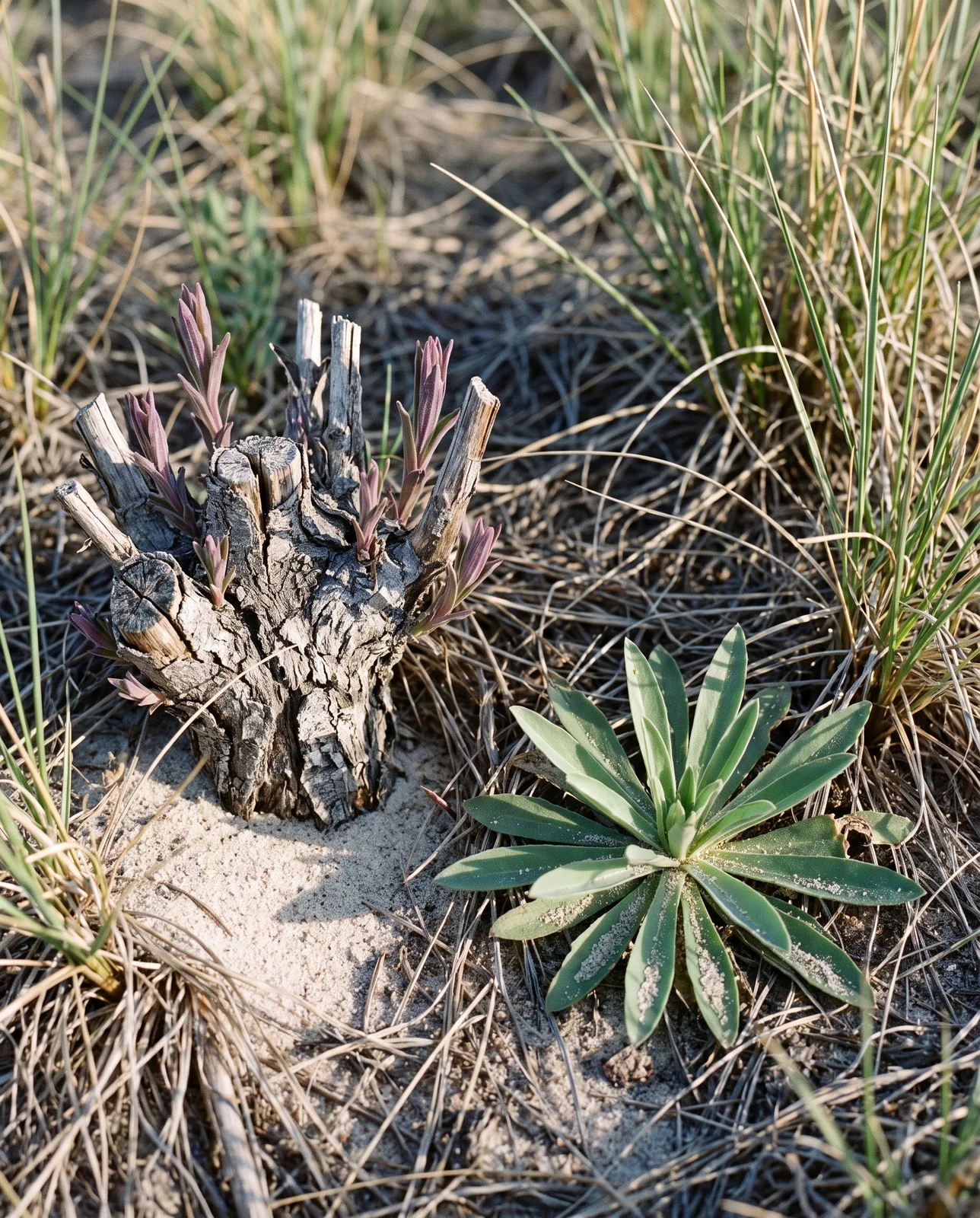
The perennials are mostly western and mountain plants. Wyoming's paintbrush and deer Indian paintbrush are both perennial. Desert paintbrush is a gray-green perennial, at times a subshrub, and downy paintbrush throws its stems from a woody root crown. Giant red paintbrush runs 12 to 80 centimeters, occasionally a meter. The base of the stem is the test: a perennial carries a woody crown or partly woody lower stems, and a first-year rosette has nothing like it. Geography helps a little, because the showy paintbrushes of Texas and midwestern prairies are annual and biennial, though perennial species reach the same ground.
Is it illegal to pick Indian paintbrush?
The land you are standing on decides. On national forest ground, collecting plants generally needs a permit, and a district office decides whether one is required. The permit is a license for removal that would be illegal without it, and a small personal-use permit costs $20 at minimum. National park units are stricter, and the rule is federal regulation. Possessing, destroying, injuring, defacing, removing, digging, or disturbing a plant from its natural state is prohibited. Gathering undesignated natural products is prohibited too, and only what a superintendent designates may be taken by hand. On other federal public land the rule loosens: small amounts may be taken for personal use, never a federally threatened or endangered species. The local office holds the maps and the rules for a particular place.
Wyoming does not forbid picking its state flower, though the claim travels widely. Wyoming Statutes Section 8-3-104 names Castilleja linariaefolia as the state flower and carries no language prohibiting picking it. That silence is not permission. Whose land the plant stands on still governs, the federal rules above still apply on federal ground, and trespass law does not care which species is involved.
State law adds a second layer, and it rarely names paintbrush. Idaho makes it the duty of all citizens to protect the state's wild flowers from needless destruction and waste. It is also unlawful there to cut, dig up, trim, pick, or remove any plant growing on a public highway right of way. Its named-genus ban on transporting and selling reaches fifteen genera, among them tiger lily and trillium, and Castilleja is absent. Landowners are exempt on their own land, as are government employees doing supervised road work. Alabama makes it unlawful to destroy, deface, collect, or remove any wildflower or natural object in a state park.
Texas is the one place where the plant is named in a law, and that law is gone. A 1933 statute barred picking flowers on enclosed or state park land without permission, and named bluebonnets and Indian paintbrushes in its bans on transporting and selling. It was repealed when the Penal Code was recodified in 1973. Nothing replaced it. State law librarians have not found a law on the topic, and a 2015 state public safety release says there is no law against picking the state flower. Transporting and selling is a different act from picking a handful, and that gap is why the story travels. Permission decides on private ground. And a paintbrush picked or dug will not last, because its roots are joined into another plant's roots.
Where the picking rules differ
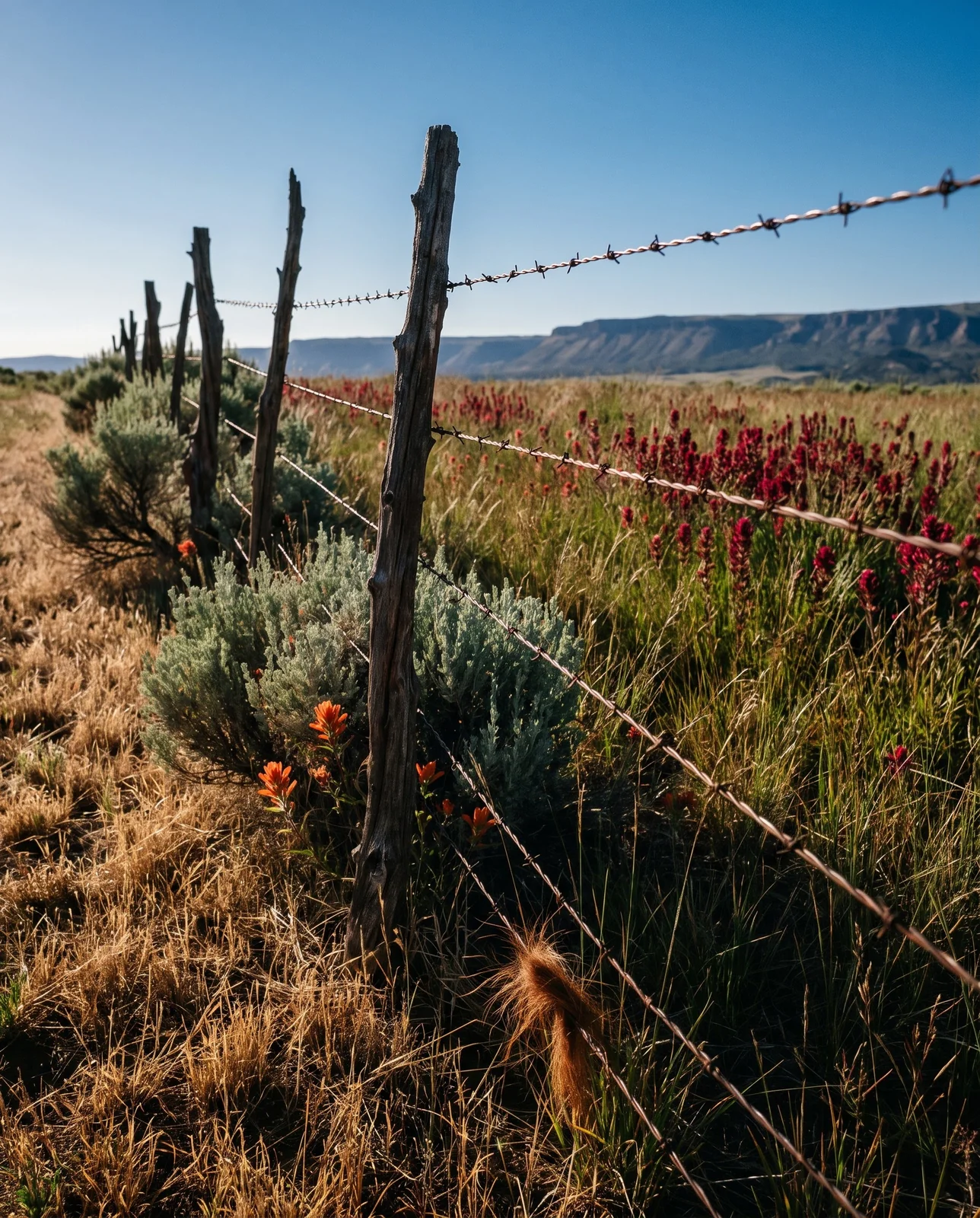
Four kinds of law reach this plant, and casual claims blend them together. Each card gives the rule, where it comes from, and the detail that decides a close call.
Why you should never dig one up
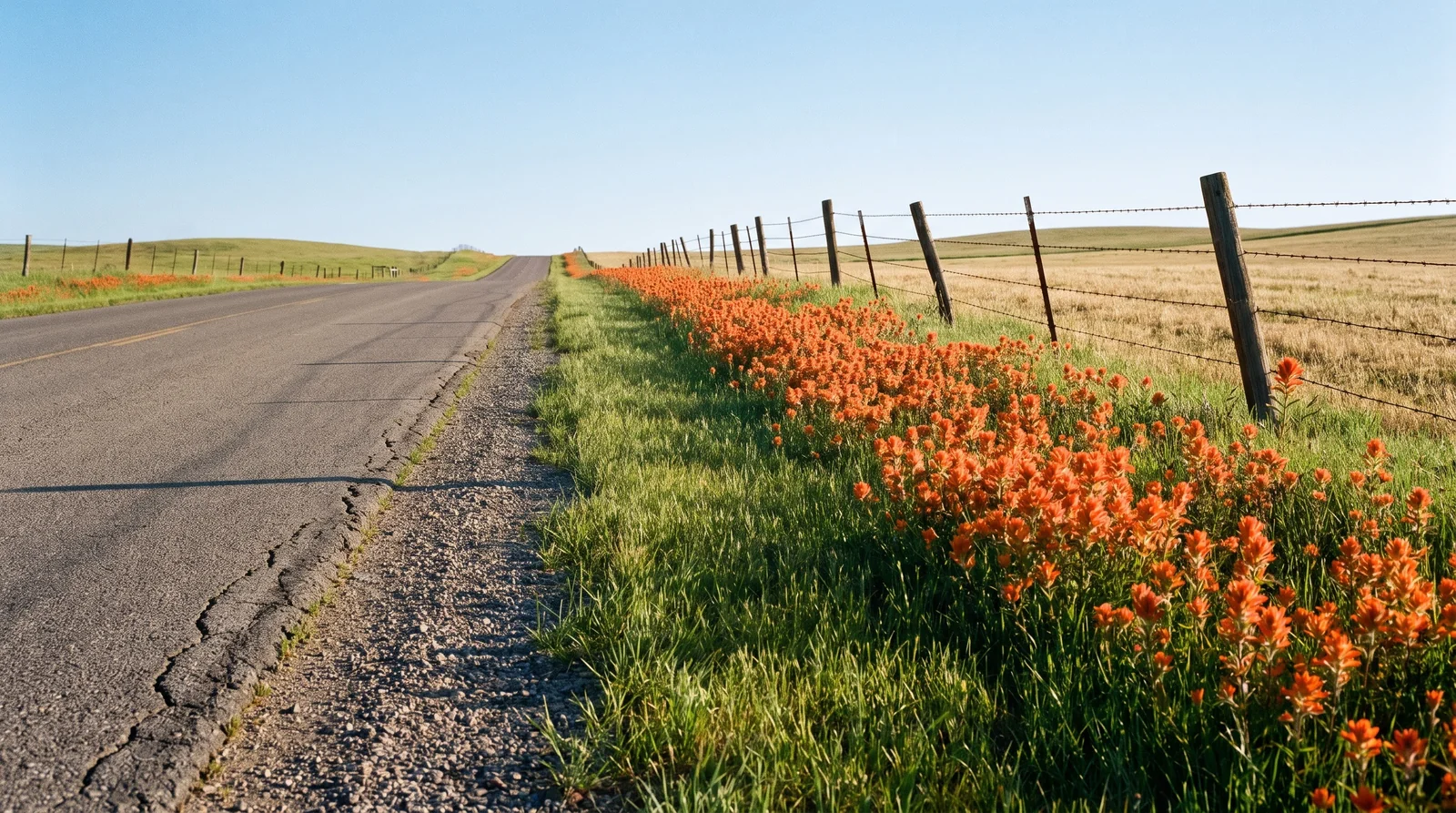
A paintbrush dug from a roadside almost never survives the move, because half of what keeps it alive stays in the ground. Its roots are joined into the roots of a host, and lifting the plant breaks that joint. Transplanting usually kills the eastern species and may kill the Texas one. The mountain species cannot in most cases be transplanted at all, since its roots form networks with the roots of other species. Digging one costs a wild plant and gains a dead one.
Seed is the only form of this plant that makes its own connection where it lands, since its roots grow until they touch another plant's roots and then penetrate them. Buy it, sow it in place with a host grass in late October or November, and leave the roadside plant standing.
Paintbrush species worth telling apart
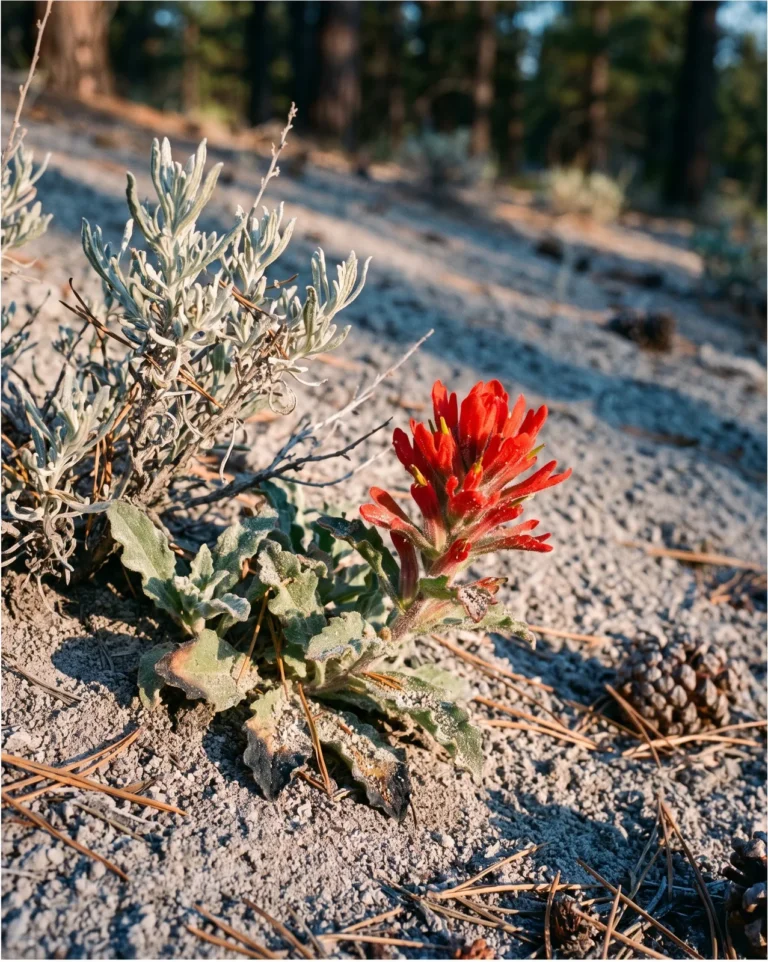
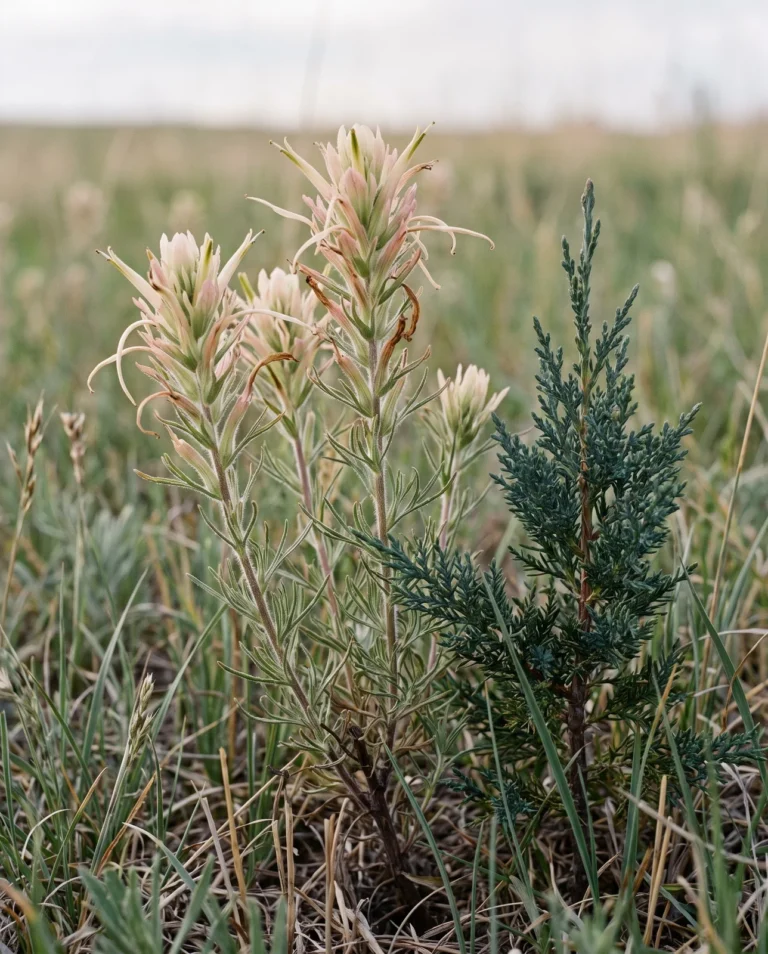
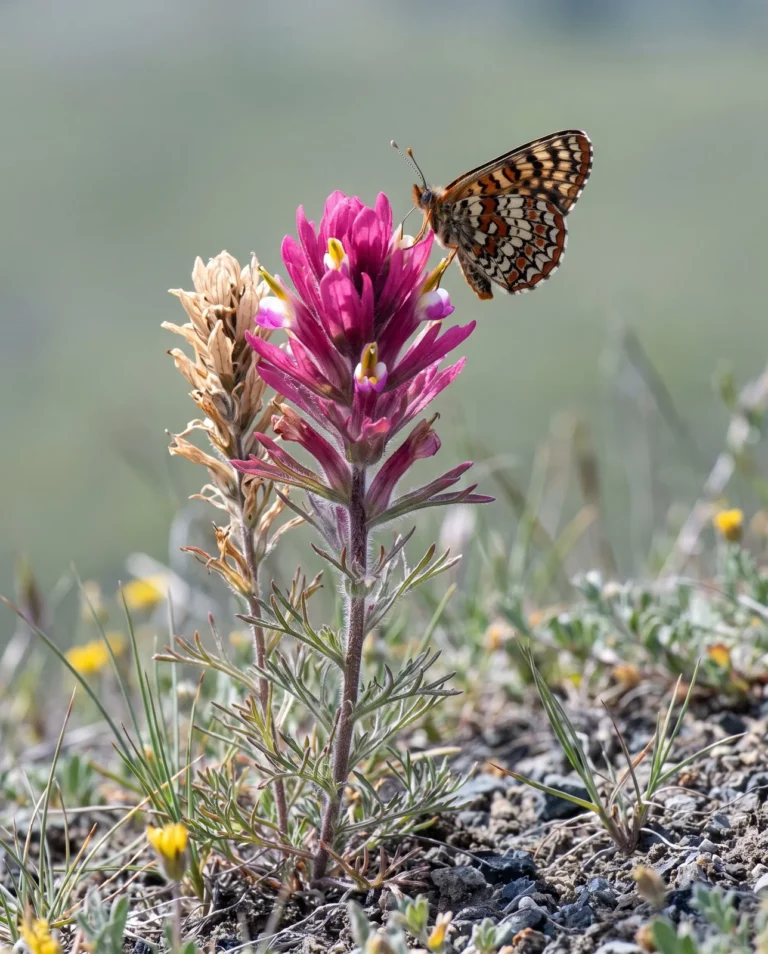
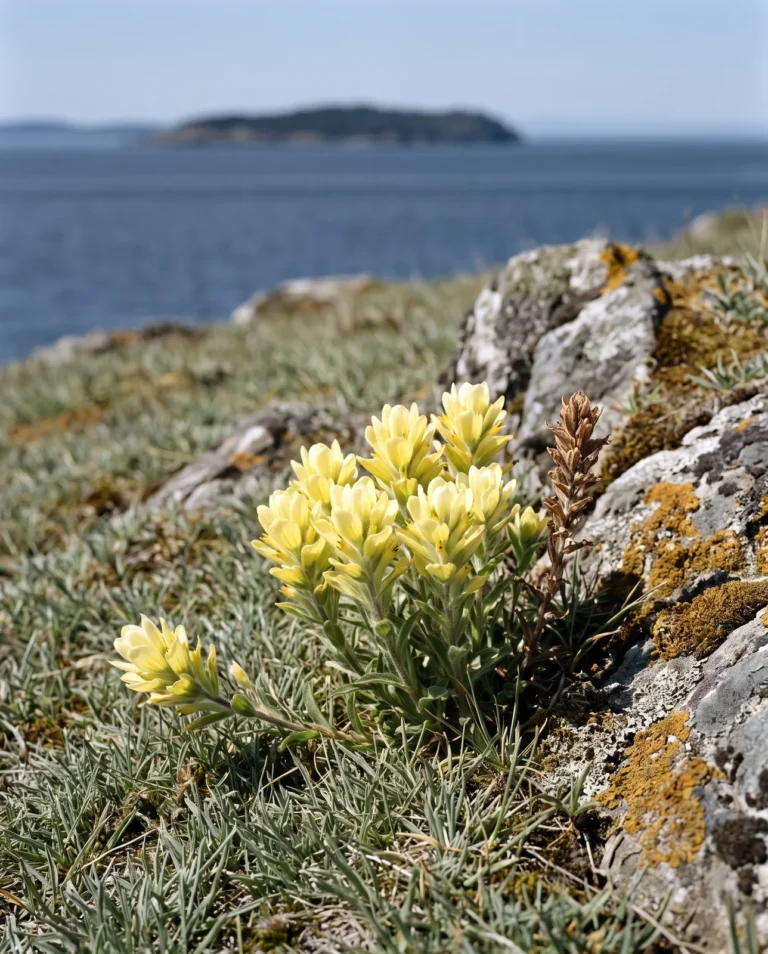
Nine species carry the name, and color is the weakest way to tell them apart. The bracts run red to orange red on most of them, the shade that puts paintbrush among the orange flowers, while purple owl's clover carries its color in its name. Size, life cycle, region, and host are what differ.
Is Indian paintbrush rare or protected?
Rarity and legal protection are two different things, and one paintbrush has carried both. Golden paintbrush grows on the prairies of Washington, Oregon, and southern British Columbia, and it went rare as those prairies broke up under development and fire suppression. It was listed as threatened under federal law in 1997, when fewer than 20,000 plants remained at just 10 sites. Recovery work turned that around, and hundreds of thousands of plants stood at 48 sites by 2018. The rule taking it off the federal list took effect on August 18, 2023.
The common name carries none of that with it. Paintbrush covers about 200 species, so a roadside stand and a protected population can answer to the same two words. That difference bites the moment somebody reaches for a plant, because a federally threatened or endangered species, or one a state protects, may never be taken. Knowing which paintbrush is in front of you is the part a visitor cannot skip.
Growing it in a garden anyway
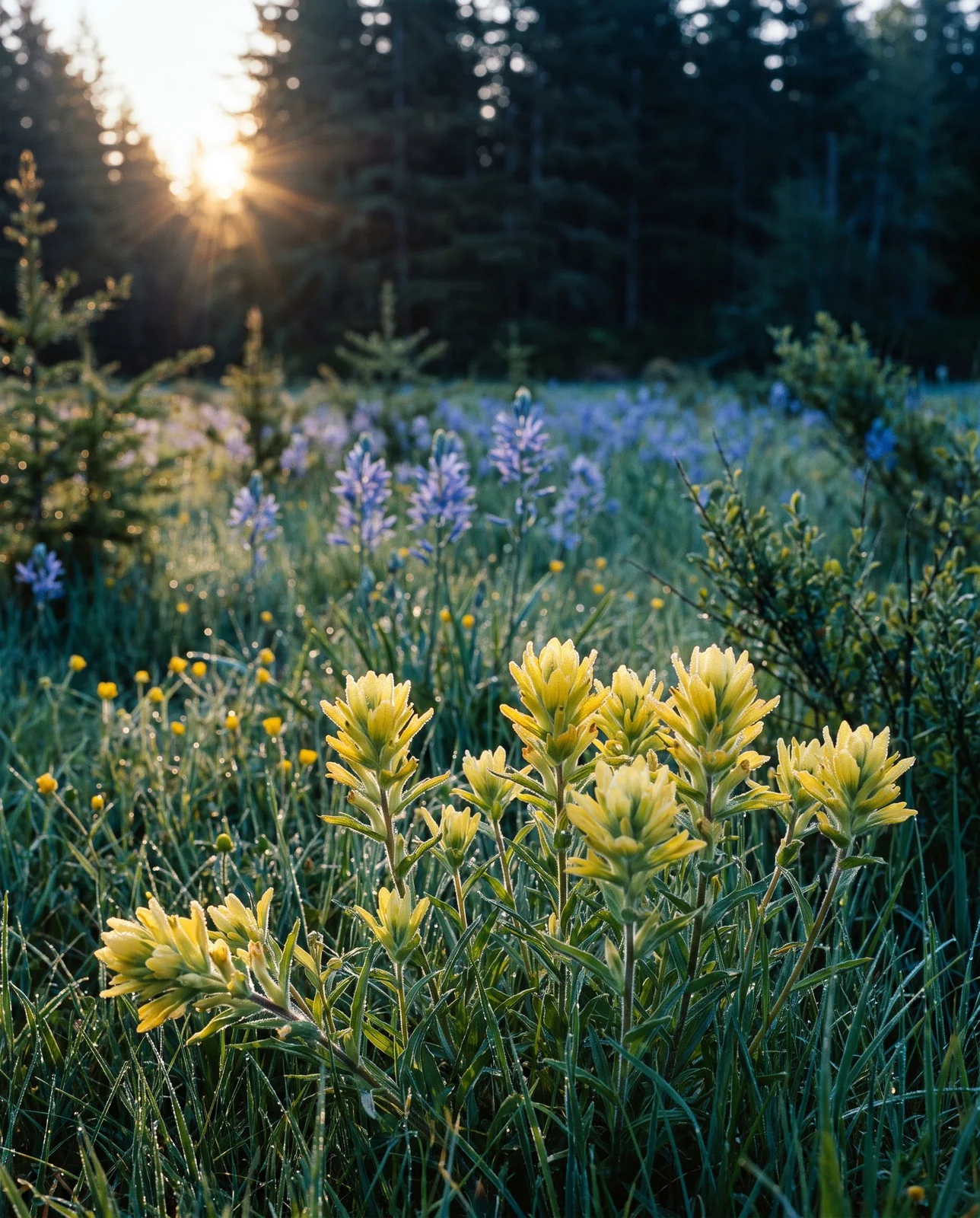
Sow it into a planting that already exists, because the seedling has to reach a living root in its first weeks. Paintbrush does best grown with the plants it parasitizes in the wild, which means standing grass or an established perennial bed. Clean cultivated ground offers nothing underground to join, and a paintbrush sowing behaves nothing like a scattering of poppies over a raked bed. Sow in fall, raked lightly into loose topsoil, or surface sown while the ground is dormant so winter does the stratifying.
After that the work is restraint. Nothing gets dug, divided, or lifted, since the root joint keeps the plant alive and a moved plant usually dies. The first season shows leaves at ground level and the second carries the flower, so judge the bed on its second spring. Some seedlings still fail, because one that finds no host is not known to reach full maturity.
Hummingbirds, bees, and one threatened butterfly
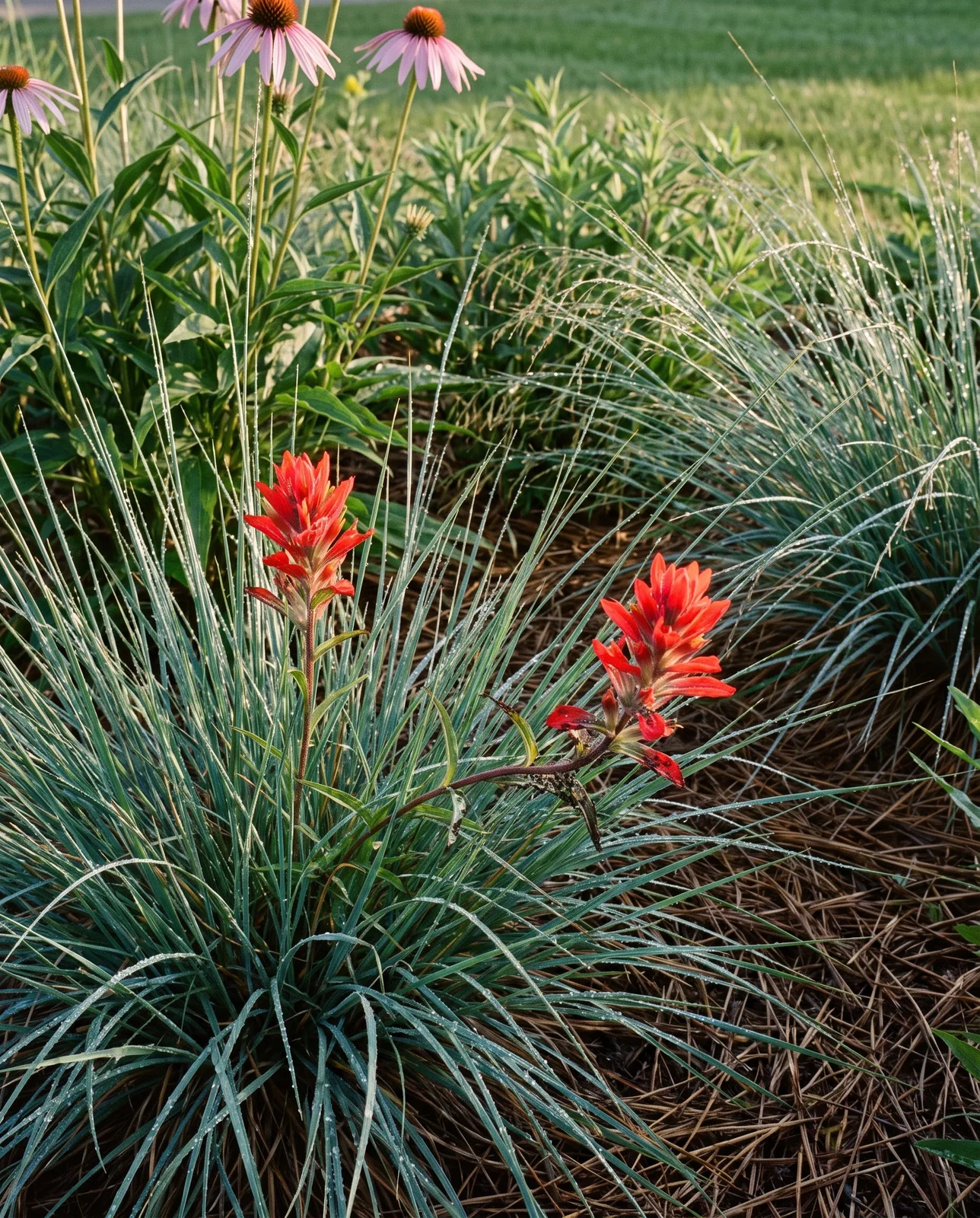
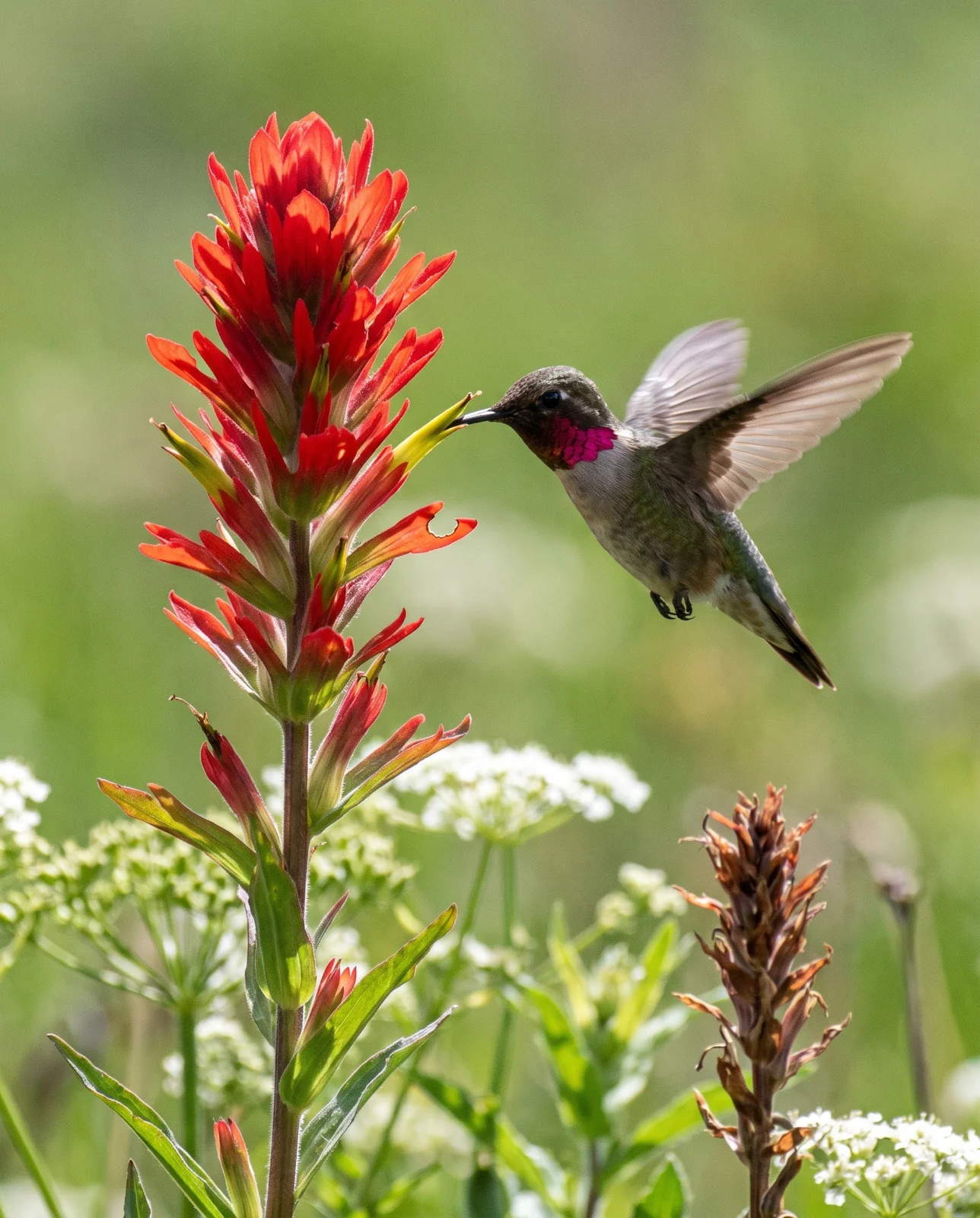
Hummingbirds are the pollinator the flower is shaped for. The nectar sits at the far end of long tubular flowers where a hummingbird bill reaches it, and no lower petal lip gives an insect anywhere to stand. Insects work the plant anyway, bees especially, though red is a color most of them see poorly. Purple owl's clover is the host plant of the Bay checkerspot, a threatened butterfly endemic to the San Francisco Bay region. Paintbrush also shapes the ground it stands in. Taking growth and seed from whichever neighbor it taps holds back the strongest competitor in a stand, which can raise the diversity around it.
Traditional use, selenium, and pet safety
The US Forest Service records the eastern scarlet species used by Native Americans as a love charm in food and as a poison against enemies, given the plant's toxic properties. Recorded uses also run to a weak flower tea for rheumatism and for what is written down as female diseases. That is the whole of it: no dose, no season, no safety limit.
One caution belongs to the wider group. Castilleja is among the genera that take selenium up out of the soil, alongside Astragalus, Stanleya, and Atriplex. That is genus level, with no figure for a paintbrush itself. Accumulation turns toxic where soils are naturally high in selenium, mostly in the Dakotas, Montana, Wyoming, Colorado, and Utah. There every part of such a plant should be treated as potentially toxic. Selenium is a required dietary nutrient in small amounts. Large amounts can cause selenosis in horses, sheep, cattle, pigs, and poultry, with abdominal pain, diarrhea, liver and lung hemorrhages, and an abnormal gait in an acute case. The ASPCA plant database holds no entry for paintbrush or Castilleja, so nothing there clears it for a dog, a cat, or a horse.
Is the name Indian paintbrush offensive?
Indian paintbrush is the name in official use. Wyoming's statute names the plant as the state flower, and federal plant profiles file it under Indian paintbrush while using painted cup for the same plants. Paintbrush and prairie-fire are in general use for the genus. In Wyoming the full name is the only one anybody uses. Both names are current, and neither reads as a correction of the other. The question of offense is live elsewhere, and official naming has not moved away from Indian paintbrush.
What goes wrong, most reported first
Most paintbrush failures come back to a root connection that never formed, or to a life cycle that was always going to end.
The seedling found no host root within reach, and it is not known to reach full maturity without one. Sow paintbrush seed with low-growing grasses and sedges such as blue grama or buffalo grass, so the two root systems meet where they land.
This is the life cycle. The eastern scarlet species dies after it sets seed in its second season and the Texas species is annual. A patch holds only where new seedlings replace the old, so let the plants finish seeding before you touch that ground.
A dug plant leaves its host connection behind in the soil. Transplanting usually kills the eastern species and may kill the Texas one. Sow seed where you want the plant, with a host beside it, in late October or November.
The common name lands on more than one plant in the trade. Read the Latin name on the packet, since that is the part that identifies the species.
Slugs take the shoots as they first emerge, and they are the one pest named for paintbrush. Bait or barrier the crowns as growth starts, and keep the site sharply drained.
What people get wrong about paintbrush
Each of these sends somebody to do something to a wild plant.
The myth: It is illegal to pick Indian paintbrush anywhere in the United States.
The reality: No single national rule covers this plant. The rules are about land. A permit covers national forest ground, a federal regulation forbids removing or digging a plant in national park units, and Wyoming's statute carries no picking language at all. The ground under the plant decides.
The myth: The red parts are the petals.
The reality: The color is carried by bracts, a type of modified leaf. The true flowers are the small greenish-yellow tubes standing inside the colored spike, largely hidden by it.
The myth: It is a full parasite and it kills whatever it grows on.
The reality: Paintbrush is green and photosynthesizes for itself while drawing part of its water and nutrients through a neighbor's roots. The full parasites, the ones living entirely on another plant, sit elsewhere in the same family. The host does pay: in a controlled study its shoot growth fell at every fertilizer level.
The myth: A plant dug from a roadside will settle into a garden bed.
The reality: Its roots are joined into another plant's roots, and transplanting may kill the Texas species. The mountain species cannot in most cases be transplanted at all.
What to expect, season by season
The first autumn and the empty first spring. Seed and host grass go down together in late October or November, and what follows looks like nothing. Germination comes in early fall or the following spring. The first year produces low leaves at ground level, easy to weed out by mistake.
The second spring, which is the one that pays. The rosette sends up a leafy unbranched spike about 18 inches tall, the bracts color at the top, and the plant flowers, sets seed, and dies. A stand can still be in bloom as late as October. Height depends on what you sowed, from 6 to 16 inches in the Texas species to 30 inches in the Wyoming one.
An established patch. What holds is a self-sowing population inside somebody else's planting, since every seedling has to find its own host root. Leave the plants until the capsules open, and do not cultivate around them, because digging breaks the joint they live on.
FAQ
Is it illegal to pick an Indian paintbrush flower?
It depends on the ground it stands on. National forest land needs a permit, and national park rules prohibit removing or digging a plant. On other federal public land small amounts may be taken for personal use, never a threatened or endangered species. Wyoming's flower statute carries no picking ban.
Is Indian paintbrush a parasitic plant?
It is a hemiparasite. The plant is green and feeds itself, and it also takes water and nutrients through haustoria that pierce a neighbor's root. Desert paintbrush on sagebrush took about 10 percent of its energy from the host.
What is the best host plant for Indian paintbrush?
There is no single best one. The pairings differ by species. Pale spiked lobelia hosts the eastern scarlet one, grasses the two showy species people grow, sagebrush desert paintbrush, and willow the giant red.
Can Indian paintbrush be grown from seed?
Yes, if a host goes in with it. Direct-sow paintbrush and host grass seed together in late October or November, and leave both where they land, since transplanting may kill a plant already joined to a host.
Does Indian paintbrush come back every year?
That depends on the species. The eastern scarlet paintbrush is biennial and dies after flowering in its second year, the Texas species is annual, and Wyoming's and the western mountain species are perennial.
Do hummingbirds like Indian paintbrush flowers?
The flower is built for them. Long tubes hold the nectar where only a hummingbird bill reaches, and the missing lower lip leaves an insect nowhere to land. Bees visit as well.
What are the best growing zones for Indian paintbrush?
Listings run from 3 to 9. In the mountains elevation decides more than the number does, and giant red paintbrush grows in wet meadows and along stream banks below 11,000 feet.
What are Indian paintbrushes called now?
The genus is Castilleja. It sits in Orobanchaceae, the broomrape family, after rearrangements of the order Lamiales that began around 2001. Paintbrush, painted cup, and prairie-fire are all in use.
Is Indian paintbrush toxic to pets?
Nothing clears it. Castilleja is among the genera that accumulate selenium out of the soil. On seleniferous ground every part should be treated as potentially toxic, and selenium poisoning is documented in horses, sheep, cattle, pigs, and poultry.
Is the name Indian paintbrush offensive?
The name is in official use, from Wyoming's state flower statute to federal plant profiles, where paintbrush and painted cup appear alongside it. Neither form corrects the other.
Interesting tips
- If you find paintbrush filed under Scrophulariaceae, the figwort family, you are looking at an older entry. The rearrangements of the order Lamiales that began around 2001 moved the genus into the broomrape family. Both entries point at the same plant.
- Leave one flowering plant standing and it reseeds better than any packet you can buy. The capsule is chambered with two divisions and scatters up to three hundred seeds once ripe, and new seed germinates in early fall right where it falls.
Related Guides & Flowers

Types of flowers
The main index, for placing a wildflower like this one beside the garden plants it will never behave like.
Yellow flowers
The color shelf next door, for a reader who came in on bract color and wants the rest of that range.
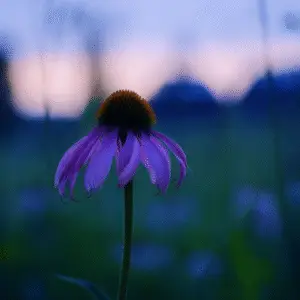
Purple flowers
Where purple owl's clover, the annual that carries the paintbrush name in purple, sits by color.
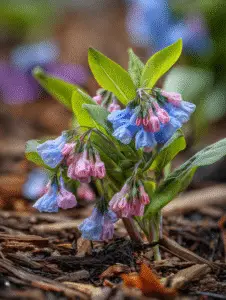
Virginia bluebells
Another native spring wildflower that belongs to a place, for a reader building a native planting.
Enjoying our flower guides? Add YourFlowersGuide as a preferred source on Google. It helps more readers find us.
Add to Preferred Sources