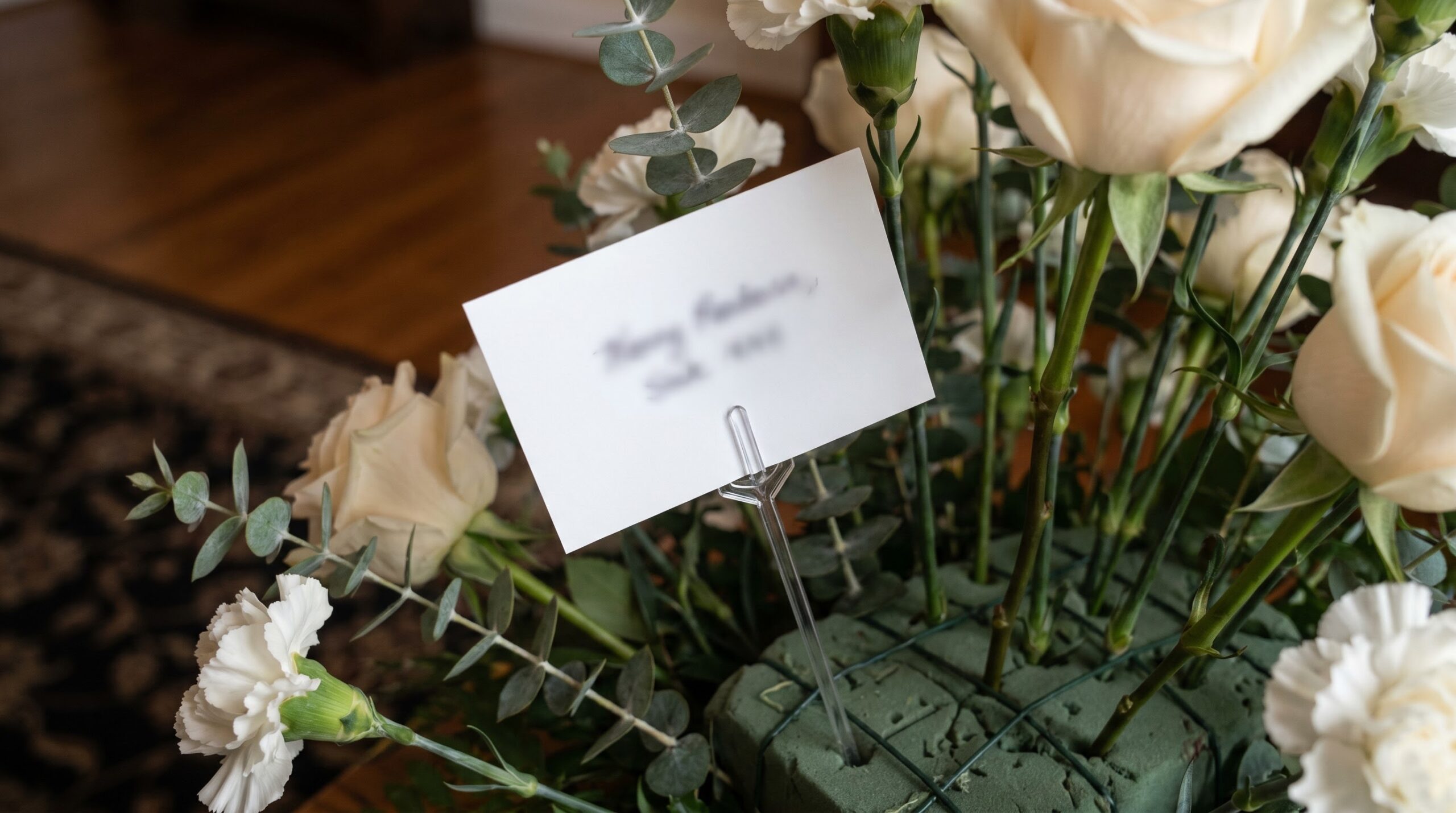
The blank card at the florist's counter is the hardest part of the whole order. If you're staring at it right now, write "With deepest sympathy" and move on. That's a complete, appropriate line on its own, and it works whether you knew the person for forty years or only through their daughter at work. Whether to sign it is a separate question, and the answer is no. Florists and funeral homes see plenty of cards that read only "with sympathy," no name attached, and nobody treats that as a lapse. One Redditor summed up the whole permission in seven words when someone asked about sending flowers without knowing the family well: "you don't even have to sign it." If the arrangement is already ordered and this blank field is the only thing standing between you and hitting submit, that line covers it. Everything below covers situations where a plain "with sympathy" doesn't quite fit, in case you want to say more. And if you haven't actually chosen the arrangement yet, choosing the right piece before you write the card walks through casket sprays, standing sprays and baskets side by side, before you get to the wording at all.
A few more lines, if plain sympathy doesn't feel like enough
Most funeral home cards fall into one of three registers, and picking the right one has less to do with how close you were and more to do with who else might read it. A neutral line works almost anywhere: "Thinking of you and your family" or "With deepest sympathy" cover a coworker's father, a friend's grandmother, or someone you respected without knowing well. A warmer line suits immediate family or someone you were genuinely close to: "So sorry for your loss, sending love and strength to you all," or a short specific memory if you have one, does more work than any generic phrase ever will. A more formal line fits a boss, a client relationship, or anyone you'd never normally address by first name: "Please accept our deepest condolences during this difficult time" reads appropriately distant without going cold. Emily Post's guidance on writing sympathy notes makes the underlying point directly: a single sincere line is genuinely all a card needs, and its own sample note closes with almost the exact phrase most people reach for on instinct, "with deepest sympathy." You don't need a longer message to sound like you meant it. You need a specific one if you have the material, and a short honest one if you don't.
Card, ribbon or banner: the wording changes with where it lands
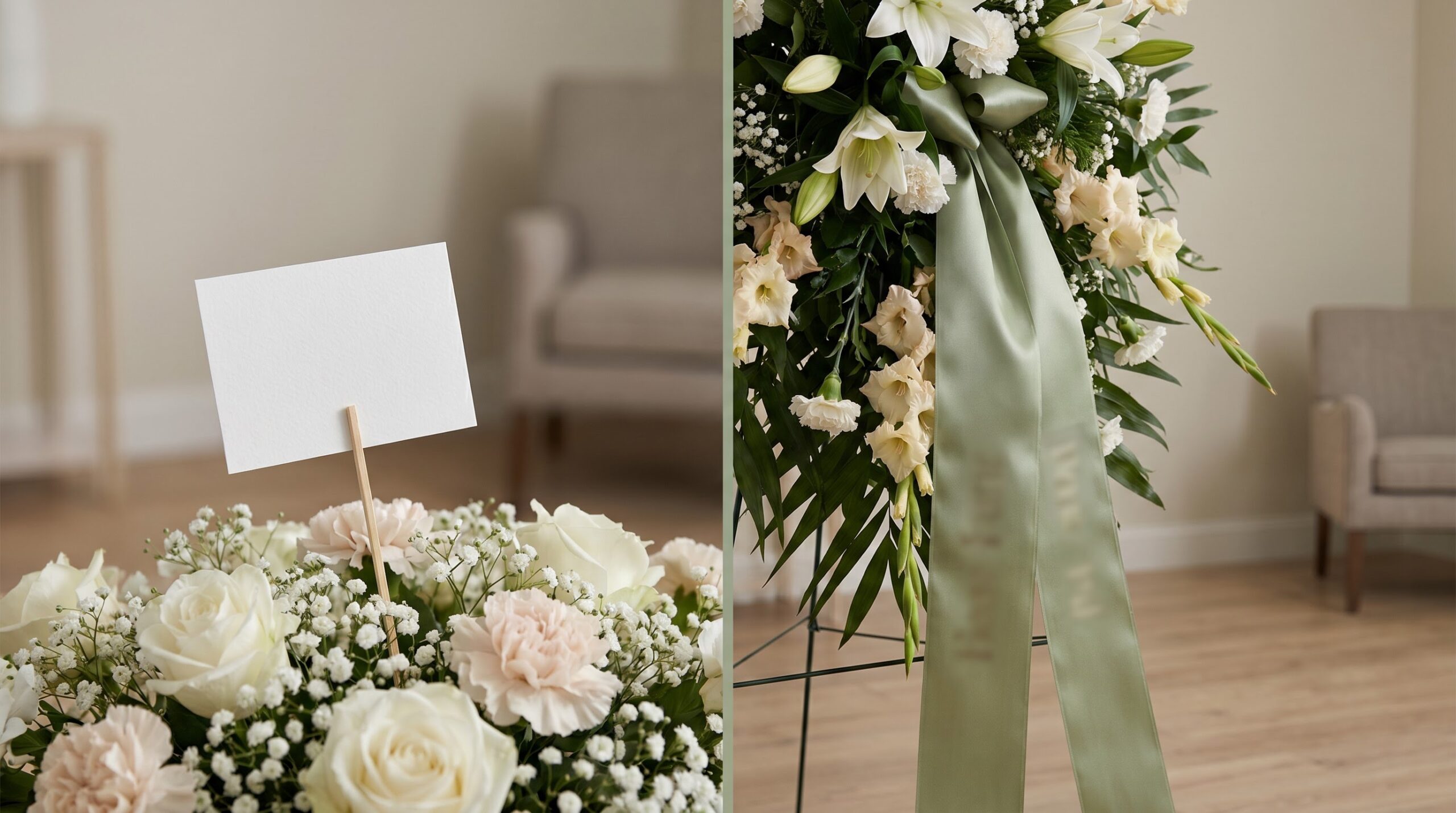
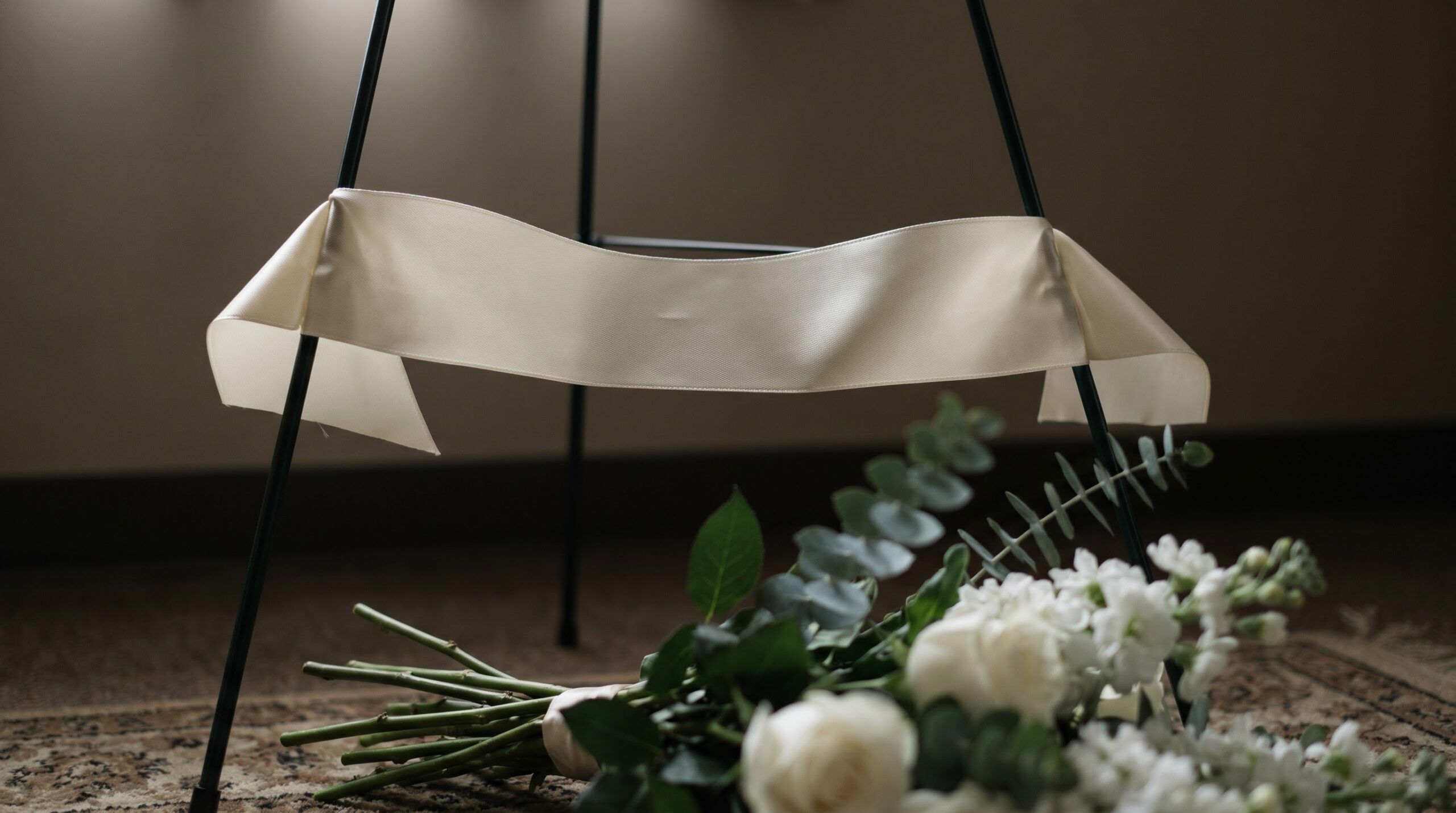
A card message and a ribbon script are two different assignments, even though people use "card" loosely to cover both. The card sits at the base of the arrangement and gets read up close by whoever picks up the flowers at the funeral home; it can run a full sentence, sometimes two, the way any of the lines above would. A ribbon prints across the sash of a standing spray and gets read from several feet away by a room full of people filing past, so it has to register at a glance. Funeral.com's wording guide, one of the only funeral-industry sites that actually separates the two, keeps ribbon copy to two or three short lines of print, sometimes nothing more than a single relationship term like beloved grandma, with no additional message attached. A banner spanning an easel-mounted arrangement follows roughly the same rule as a ribbon: short enough to read from across a room, usually a name, a relationship, or a line like "In Loving Memory," never the fuller sentence a card can carry. If you're not sure which one the piece you ordered actually has, ask the florist when you place the order. Standing sprays and wreaths typically take a ribbon or banner; smaller arrangements and baskets resting on a stand take a card.
What to write, matched to who you are to the family
Relationship decides the register more than anything else does, and it's the one variable most wording lists skip past. The table below matches who's sending the flowers to what actually fits on a card, a ribbon and a banner, since the same relationship can call for different words depending on which of the three you're filling in.

| Who's sending | Card at the base | Ribbon on a standing spray | Banner on an easel |
|---|---|---|---|
| Immediate family (spouse, child, sibling) | "With all our love, always" | "Beloved Husband" / "Our Dear Mother" | "In Loving Memory of [Name]" |
| Extended family (aunt, cousin, in-law) | "Thinking of you and your family" | The relationship term alone, e.g. "Loving Uncle" | "The [Surname] Family" |
| Coworkers or an office collection | "The whole team is thinking of you" | "From Your Work Family" | "[Company or Department Name]" |
| A church or community group | "Your [group] family surrounds you in prayer" | "With Sympathy, [Group Name]" | "[Congregation or Group Name]" |
| A friend | "So sorry for your loss, sending love" | Rarely ordered by a single individual | Not typical for a one-person gift |
| Unsure whether to sign at all | Leave it blank, or "With deepest sympathy" | Always attributed to whoever placed the order | Not applicable |
Swipe →
Group gifts get their own row because the math works differently. When an office or a team pools money, the card doesn't need every name attached, and it usually shouldn't. A single line signed by the group, "The Marketing Team at [Company]" or simply "Your Coworkers," covers everyone who contributed. One nurse described her whole unit pooling money and sending flowers to the funeral home together, one gesture standing in for a dozen individual ones. The same logic covers a church group or a club: a single group name is enough, and the funeral home's own records will sort out who gets thanked later. How families reply to flowers like these is worth a look too, if you're wondering whether a note comes back to you eventually.
One more thing worth settling before you order: if you don't know the family's faith, keep the wording secular. "With deepest sympathy" and "thinking of you and your family" cross every tradition safely, while a specific religious phrase, a verse, a reference to heaven, can land wrong for a family whose beliefs you're only guessing at. Keeping the wording appropriate for the family's faith goes deeper into which phrases fit which tradition, if you know enough about the service to want to match it.
Personalizing it for dad, mom, a grandparent or a sibling
A card written for a specific person lands differently than a generic relationship category, and the difference is usually just specificity. For a father, "Dad, you taught us everything that mattered, we love you always" says more than any stock line, and even a shorter version, "For the best dad we could have asked for," carries a name-shaped weight the generic options don't. For a mother, the same idea holds: "Mom, we will carry your love with us always" or "In loving memory of the best mother a family could have" both work as card lines, and both trim down to ribbon copy almost as-is, "Beloved Mother" or "Our Dear Mom." A grandfather's card can lean into the role itself, "Grandad, thank you for a lifetime of memories," while a brother's or sister's tends to read rawer and less formal: "I'll miss you every day" needs no embellishment and shouldn't get any. None of this has to be perfect. A funeral home receives cards in every register, from a single line to a full paragraph, and nobody reads a shorter one as less sincere.
Once you've settled on the line, the mechanics are simple. Tell the florist what you want on the card, ribbon or banner when you place the order, or write it yourself if you're delivering an arrangement you already have on hand. How and when to send it to the funeral home covers what comes next, timing the delivery, confirming the right recipient, getting it there before the visitation starts, if you haven't worked those out yet. And if this particular card is headed to the funeral home rather than the family's house, know that the two aren't interchangeable: the card that goes home with sympathy flowers carries a slightly different job, since it's read privately by the family rather than by a room of guests filing past a spray. Our full occasion flowers guide rounds up the rest of the funeral and sympathy questions this page doesn't answer.
Common questions about funeral flower wording
Do you have to sign a funeral flower card? No. A card that reads only "with sympathy" or "with deepest sympathy," no name attached, is common and never read as a mistake. Signing helps if the family might not immediately place who sent it, especially from someone outside their inner circle, but nobody expects it.
What's the difference between a card message and a ribbon script? A card sits at the base of the arrangement and gets read up close, so it can run a full sentence or two. A ribbon prints across a standing spray's sash and needs to register from across a room, so florists keep it to two or three short lines, often just a name or a relationship term.
What do coworkers write when the office pools money for flowers? One line signed by the group beats a list of names: "Your Coworkers," "The Marketing Team at [Company]," or just the department name. It covers everyone who contributed without turning the card into a roster, and it matches how most funeral homes log group gifts anyway.
Enjoying our flower guides? Add YourFlowersGuide as a preferred source on Google. It helps more readers find us.
Add to Preferred Sources