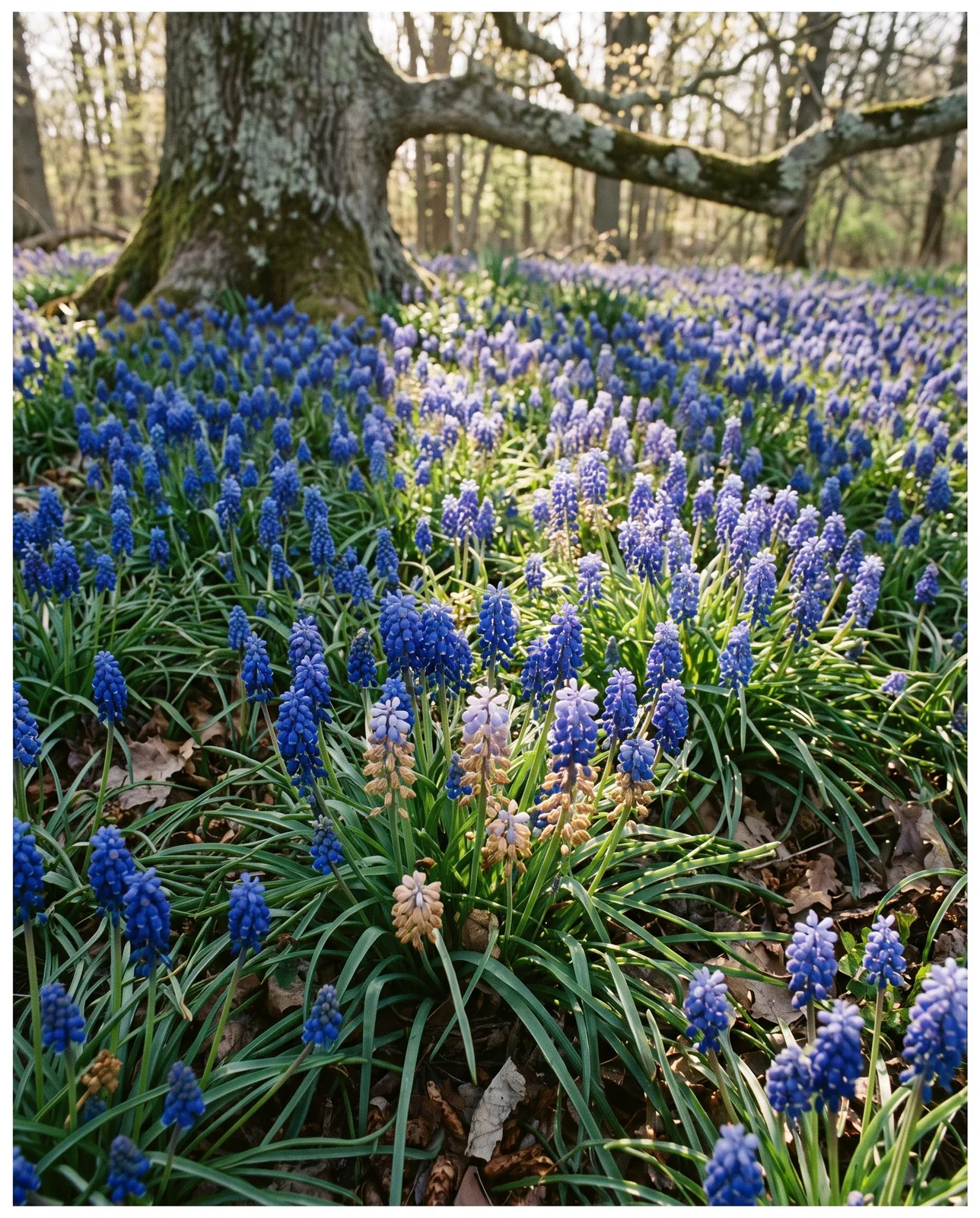
Grape hyacinth (Muscari armeniacum) is a small fall-planted bulb that opens dense spikes of cobalt florets in early spring, each spike packed tight enough to look like a miniature bunch of grapes. Despite the name, it is not a true hyacinth and does not belong to the same genus. That one distinction settles the two questions most people arrive with: whether the bulbs are safe around a dog or a cat, and whether a small planting will end up spreading through the lawn.
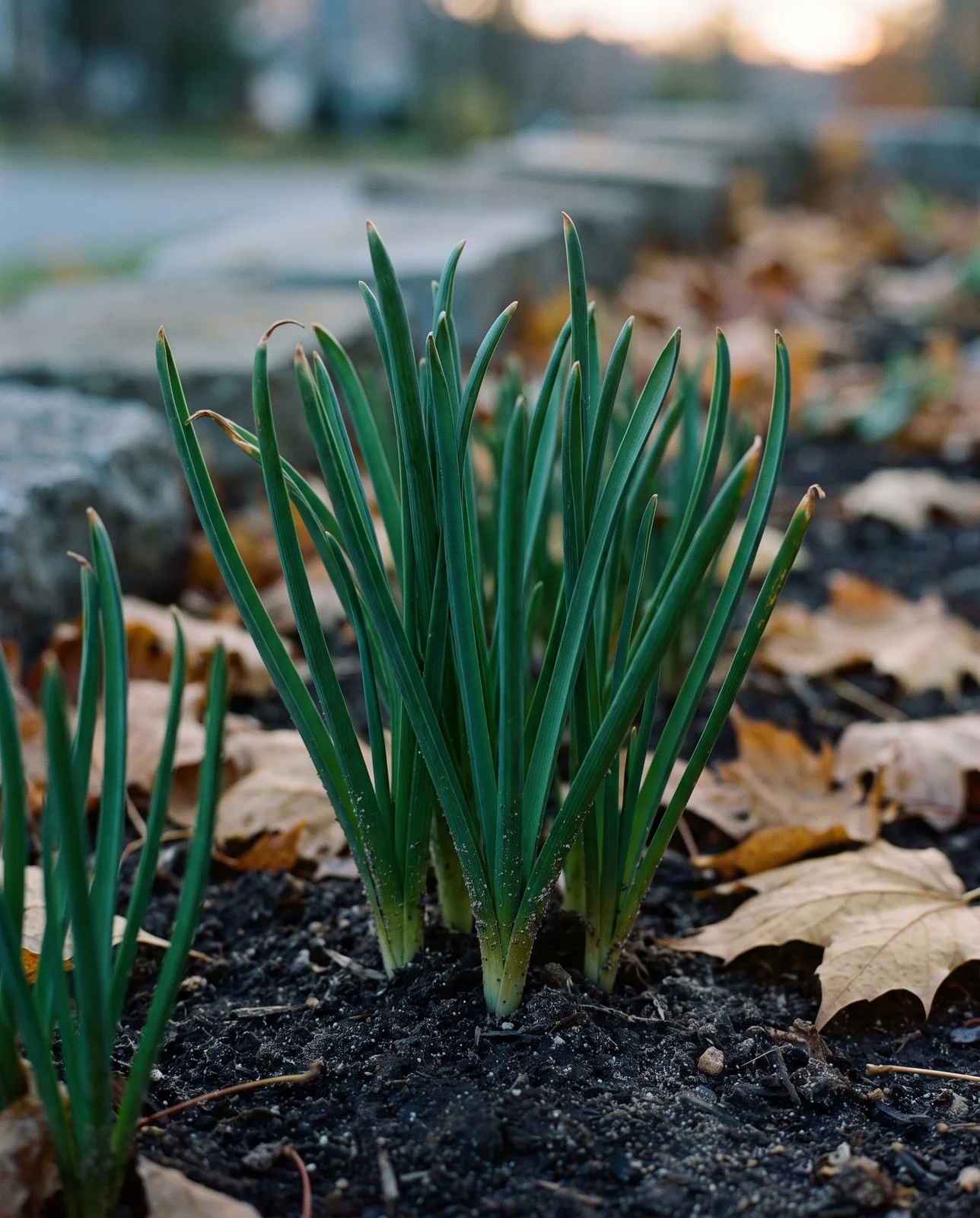
Grape hyacinth also keeps an unusual calendar for a spring bulb. The foliage dies back in early summer, the bulb rests dry through the heat, and then thin, grass-like leaves push up again in mid-fall, months ahead of any flower, and stay green through the winter. Gardeners who see that autumn growth usually assume something has gone wrong. Nothing has, and cutting the leaves off is the one move that costs you flowers. What follows covers how muscari differs from the true hyacinth it borrows its name from, when and how deep to set the bulbs, how fast it spreads and how to slow it, forcing pots indoors, year-to-year care, pet safety, and what deer and rodents do to it.
On this page 9 sections
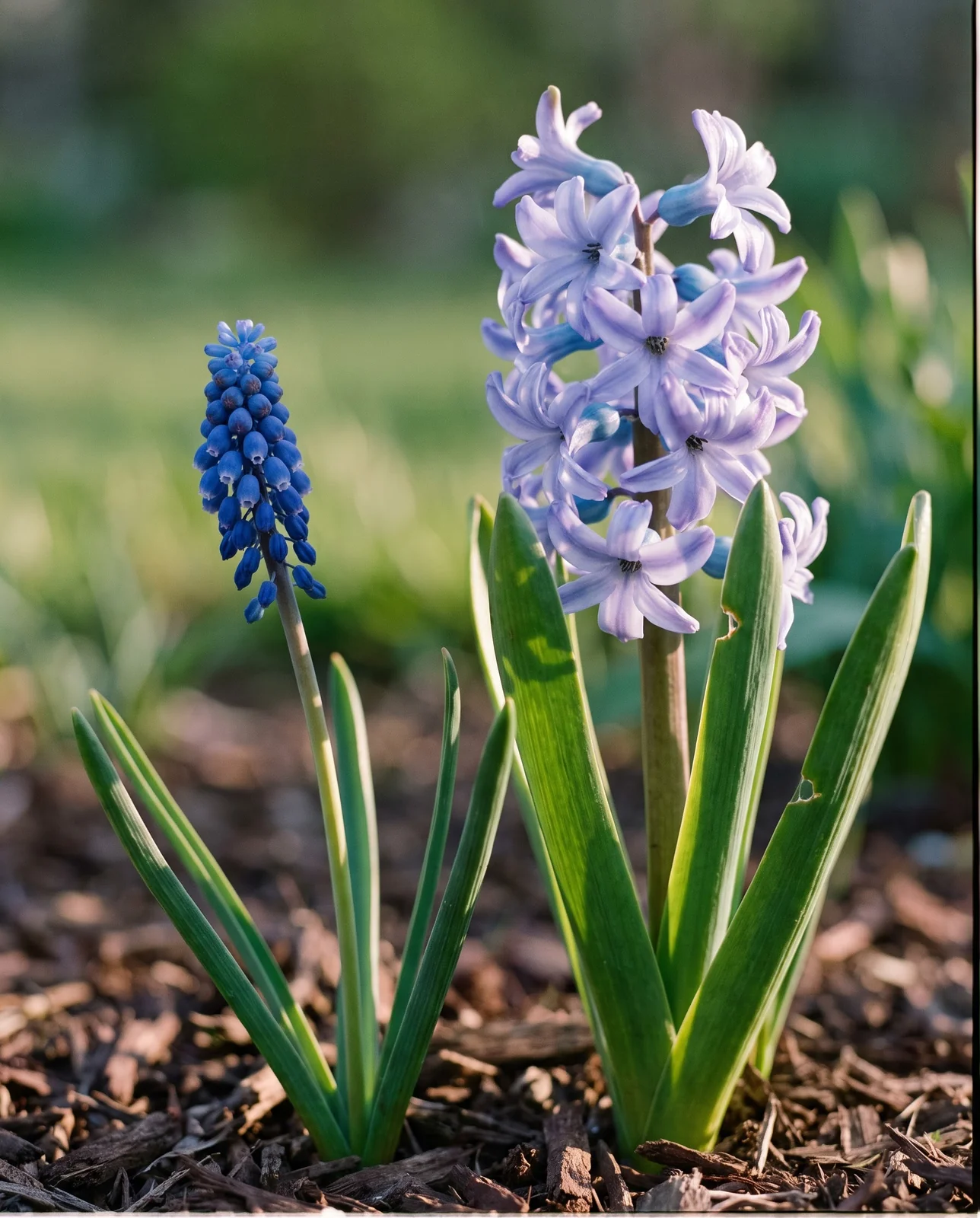
Muscari vs true hyacinth
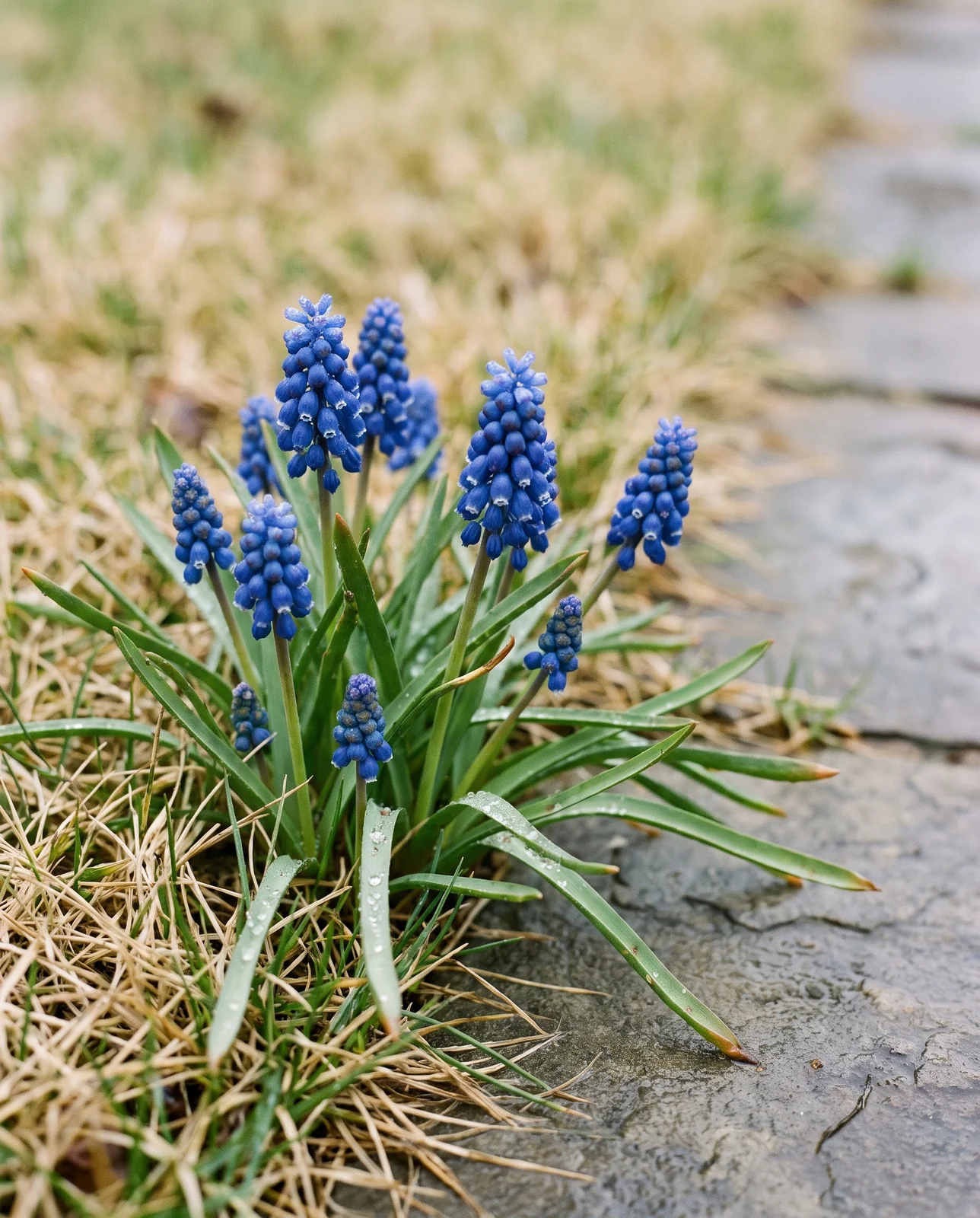
Grape hyacinth is a bulbous perennial in the Asparagaceae family, native to southeastern Europe, Armenia, and Asia Minor, and, as Wisconsin Horticulture Extension takes care to point out, it is not a true hyacinth. The Dutch bulbs sold under that name belong to the genus Hyacinthus, a separate plant that happens to share half a common name. Muscari itself comes from the Greek word for musk, a reference to the scent carried by the flowers of many species in the genus. A true hyacinth throws one large stalk of open, star-shaped florets. Muscari armeniacum forms a compact clump instead, sending up one to three flower stalks 4 to 8 inches high, each carrying 20 to 40 tightly packed bells that open from the bottom of the spike upward, the lowest ones withering while the ones above them are still opening.
The genus runs wider than the one blue species most gardens grow. Wisconsin Horticulture Extension notes that Muscari latifolium, a native of Turkish pine forests, sends up a single broad leaf from each bulb, and the armeniacum cultivars differ mostly in vigor and timing: ‘Album’ is fragrant and white but less vigorous than the standard blue, ‘Saffier’ holds its deep blue longer because the flowers are sterile and never set seed, and ‘Christmas Pearl’ opens soft violet-blue in March. Settling the genus question also settles the one pet owners ask, because the two plants part company on toxicity as well. ASPCA Animal Poison Control lists Muscari armeniacum as non-toxic to dogs and cats, and NC State Extension extends that clearance to horses. Readers after the true hyacinth itself, its colors and symbolism, will find it in the hyacinth flower meaning guide.
What is true about grape hyacinth, checked against extension sources
The myth: Grape hyacinth is a dwarf cultivar of true garden hyacinth.
The reality: Muscari sits in the Asparagaceae family, while true hyacinths belong to the genus Hyacinthus. They are separate genera with different growth habits, flower structures, and chemistry.
The myth: Grape hyacinth bulbs contain toxic oxalate crystals that will poison domestic pets.
The reality: ASPCA Animal Poison Control and NC State Extension classify Muscari armeniacum as non-toxic to dogs, cats, and horses, unlike true Hyacinthus bulbs, which are toxic.
The myth: Green leaves emerging in autumn mean the bulb is confused and dying from cold exposure.
The reality: Wisconsin Horticulture Extension describes mid-fall grass-like foliage as the normal growth cycle for Muscari armeniacum. Those leaves carry through winter before the spring flower spikes appear.
Planting
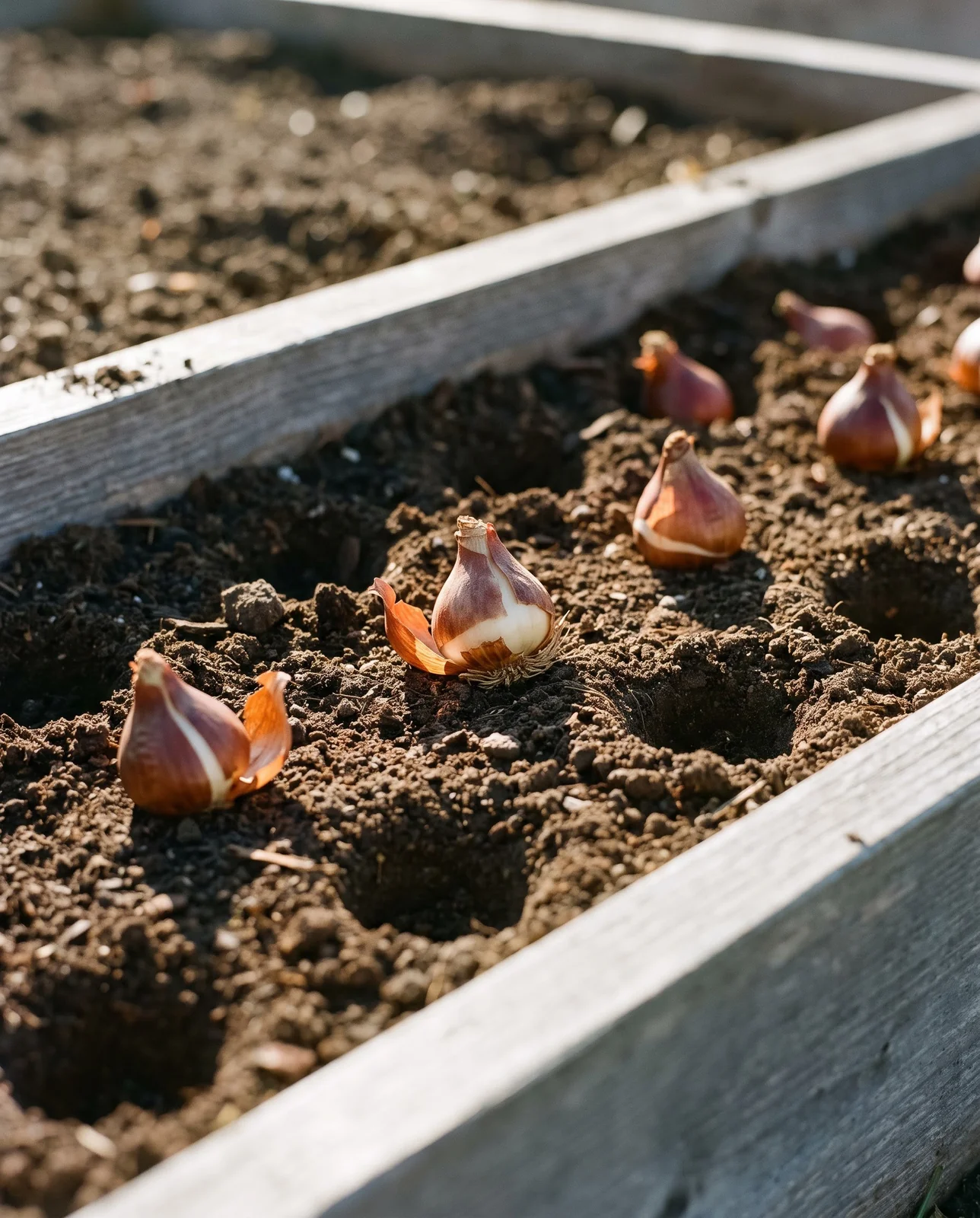
Set grape hyacinth bulbs in fall, several weeks before the ground freezes solid, so they root while the soil is still workable. Depth is where the sources stop agreeing. Wisconsin Horticulture Extension puts the bulbs 3 to 4 inches deep and 2 inches apart, Missouri Botanical Garden says roughly 3 inches deep and 3 inches apart, NC State Extension calls for 5 inches deep and 3 to 4 inches apart, and Arkansas Cooperative Extension lands on 4 to 5 inches deep and 4 inches apart. Treat 3 to 5 inches as the working range and let the soil pick the number: 3 inches in heavier, moisture-holding ground, 4 to 5 inches in lighter sandy beds where winter cold reaches further down. Spacing across the same sources runs 2 to 4 inches.
The site matters more than the exact depth. NC State Extension puts grape hyacinth in full sun to partial shade, in average, well-drained soil, under cool and moist conditions, and the bulb is more forgiving of a wet winter than most: Arkansas Cooperative Extension notes it tolerates wetter wintertime soils than other bulb species, though a boggy site still rots it. Bone meal worked into the hole at planting and scattered again after bloom feeds bulb development, a Wisconsin Horticulture Extension recommendation. Gardeners building a mixed spring bed often pair grape hyacinth with larger fall-planted tulips, which carry taller color above the low blue drift.
Grape hyacinth calendar, from fall planting to the following autumn
Six stages carry grape hyacinth from a September planting through indoor forcing, spring bloom, summer dieback and division, and back to new leaves the following autumn.
Naturalizing and lawn spread
Grape hyacinth multiplies two ways at once, by bulb offsets underground and by seed above it, and the sources disagree about how much trouble that causes. Missouri Botanical Garden describes plants that naturalize by offsets, but not aggressively. NC State Extension and Wisconsin Horticulture Extension are blunter: because it naturalizes so readily, grape hyacinth can turn weedy and crowd out its neighbors. Both readings hold, and the difference is where the bulbs sit. Once it has drifted into mowed turf it is hard to get rid of, because a waxy coating on the leaves shrugs off the broadleaf weed killers used on lawns. Arkansas Cooperative Extension names that waxy coat as the reason drifted patches survive spraying.
Control starts with the seed rather than the bulb. Arkansas Cooperative Extension finds most of the spread comes from reseeding, so pinching off spent flower scapes before the capsules ripen closes the main route. Seedlings that do get away are slow. A bulb raised from seed usually waits until its fourth year to flower, a figure NC State Extension and Arkansas Cooperative Extension both report, and that lag explains the odd experience of a patch that seems to double overnight. What surfaces in one spring is years of buried seedling bulbs reaching flowering size together. Where zero spread is the goal, NC State Extension suggests a container, whose walls stop offsets entirely. In a woodland border the opposite instinct applies, and muscari drifts well alongside snowdrops for early color at ground level.
Should you let grape hyacinth naturalize, or contain it?
Fall foliage: is this normal?
Thin green blades coming up in September or October look like a mistake to anyone who expects a spring bulb to stay underground until late winter. They are the normal cycle. Wisconsin Horticulture Extension describes it plainly: the foliage dies back after flowering in early summer, then, unlike many other spring-blooming bulbs, starts growing actively again in mid-fall and persists through mild winters. Missouri Botanical Garden reports the same behavior, with leaves that come through cold winters alive, often looking unkempt by the end of them, before the plant bursts into flower in early spring. Nothing in it signals a bulb tricked by unusual weather into emerging early.
Those autumn leaves are doing work. Through cool, bright weather they act as solar collectors, and the carbohydrates they build move down into the bulb to pay for the spring flower spike. Cold does not interrupt that: Wisconsin Horticulture Extension rates grape hyacinth hardy in zones 3 through 9, and NC State Extension places its strongest performance in zones 4a through 8b. So leave the foliage alone. Cutting it back or running a mower over a naturalized patch strips the bulb of the energy that next spring’s flower is made from.
Forcing muscari indoors
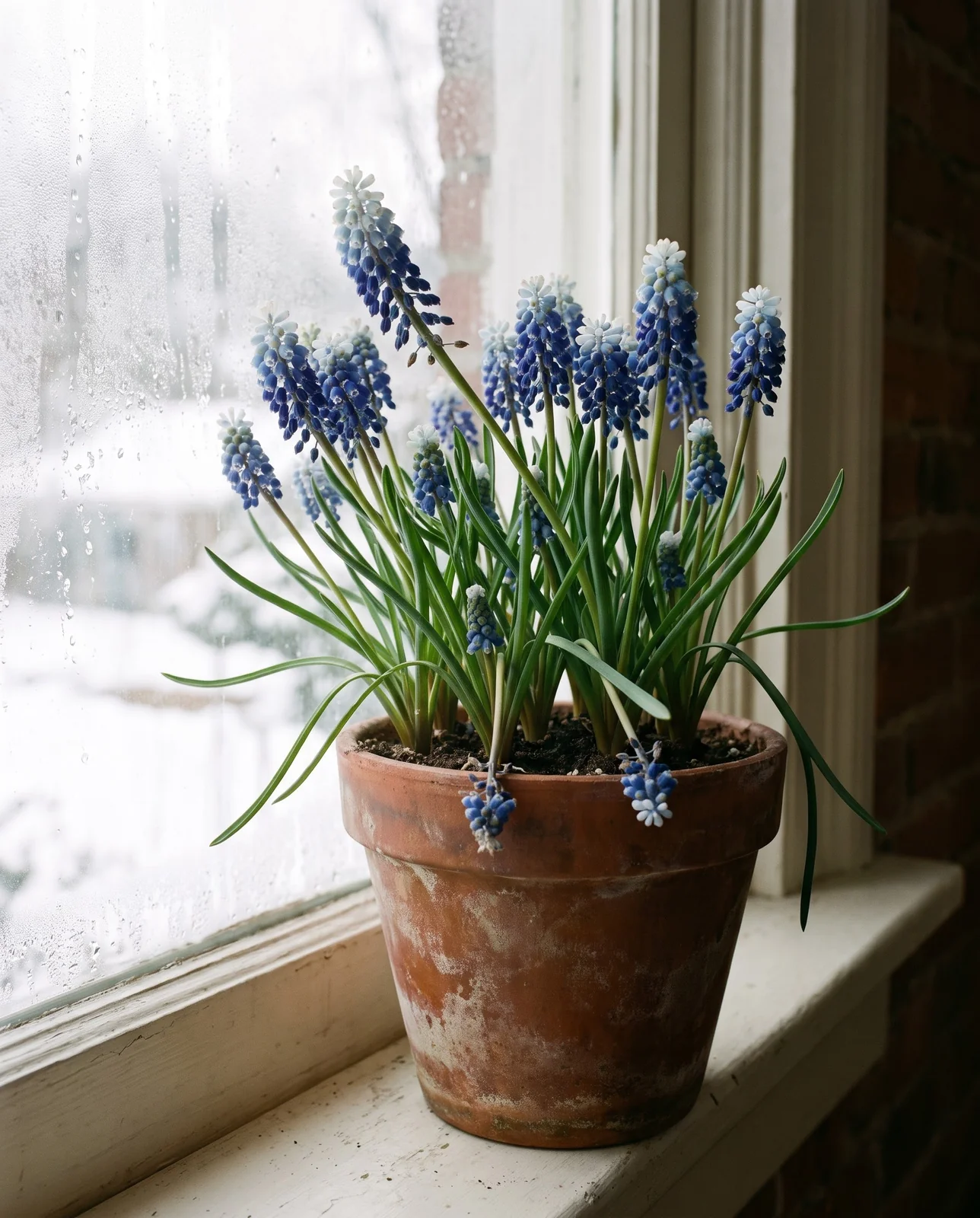
A pot of muscari can be in flower on a windowsill weeks ahead of anything in the garden, and the protocol Mississippi State University Extension gives for cold-hardy bulbs is the one to follow. Pot the bulbs in a container with bottom drainage holes; bulbs this small can be covered completely by the potting mix. Keep the medium lightly moist and hold the pot between 35°F and 50°F for 8 to 12 weeks, in a refrigerator or a cold room, and do not let it drop below 25°F. One storage rule catches people out. Mississippi State University Extension warns that ethylene gas given off by ripening fruits and vegetables does severe damage to the developing flower buds, so a refrigerator stocked with produce is the wrong place to park the pot. When the chilling period ends, move the pot into a warm room with bright, indirect light. Flowering follows in an average of 3 to 4 weeks.
Growing conditions and yearly care
Once the bulbs are in and draining, the yearly job is small. NC State Extension describes the plant as doing best in full sun to partial shade under cool, moist conditions in average, well-drained soil, and that moisture matters mainly in early spring while the leaves and flowers are working. After that the demand falls away. Dormancy runs from late spring until autumn, and watering should drop as soon as the foliage starts to yellow, because a bulb sitting in wet summer soil is the one that rots.
Flowering fades in old clumps. The bulbs crowd each other, the spikes come up shorter and fewer, and the answer is division. Arkansas Cooperative Extension advises lifting and splitting the clump as the foliage begins to wither, replanting only the largest bulbs, while NC State Extension puts the routine on a four- to five-year cycle. Gardeners planning a longer bulb season often follow the blue with alliums, which pick up where muscari stops and carry the sequence into early summer.
Toxicity and pet safety
Grape hyacinth comes through the pet question well. ASPCA Animal Poison Control lists Muscari armeniacum as non-toxic to dogs and non-toxic to cats, and NC State Extension carries the clearance further, to horses. True garden hyacinth (Hyacinthus orientalis) is the opposite case: its bulbs are toxic to pets. Two plants with nearly the same common name, two very different risks. Muscari carries no systemic toxin dangerous to household pets or livestock, so the worst realistic outcome is the mild, passing stomach upset any animal gets from a mouthful of raw fibrous plant material, and the bulbs can go into border beds and containers that companion animals reach.
Pests and animals
Very little eats grape hyacinth and very little makes it sick. NC State Extension’s wording is the honest version: occasionally damaged by deer, otherwise generally pest and disease free. Missouri Botanical Garden records no serious insect or disease problems in home garden plantings. Bulb suppliers shorten that to deer-proof, which overstates it, and occasional browsing is the realistic garden standard. Disease pressure comes down to drainage. Bulbs in soil that drains do not rot, and a planting runs for years without a spray of anything.
FAQ
Is grape hyacinth the same plant as a true hyacinth?
No. Grape hyacinth belongs to the genus Muscari in the Asparagaceae family, while true hyacinths belong to the genus Hyacinthus. They differ in bloom structure, mature size, and chemistry.
When should you plant grape hyacinth bulbs and how deep?
Plant in fall, before the ground freezes. Set the bulbs 3 to 5 inches deep and 2 to 4 inches apart, going toward the deeper end of that range in loose, sandy soil and the shallower end in heavy ground.
Why is my grape hyacinth growing green leaves in the fall?
Mid-fall foliage is the normal growth cycle for Muscari armeniacum, not a sign of stress. The grass-like leaves survive winter cold and gather the energy that the bulb spends on early-spring flowers, so leave them uncut.
Will grape hyacinth take over my lawn?
It can. Grape hyacinth spreads into turf by seed and by bulb offsets, and its waxy leaf coating resists standard broadleaf weed killers, so spraying rarely clears it. Deadheading the spent flower stalks before the seed capsules ripen is what actually slows the spread.
Are grape hyacinths deer resistant?
Mostly. NC State Extension puts it as occasionally damaged by deer, otherwise generally pest and disease free, which is less absolute than the deer-proof label on bulb packaging. Deer and rodents bother muscari far less than they bother tulips, but a browsed patch is not a surprise.
Is grape hyacinth poisonous to dogs, cats, or horses?
No. ASPCA Animal Poison Control classifies Muscari armeniacum as non-toxic to dogs and cats, and NC State Extension confirms it is non-toxic to horses.
How long does it take to force grape hyacinths indoors?
Potted bulbs need 8 to 12 weeks of chilling between 35°F and 50°F. Once brought into a warm room, the flowers open in an average of 3 to 4 weeks.
Enjoying our flower guides? Add YourFlowersGuide as a preferred source on Google. It helps more readers find us.
Add to Preferred Sources