
Yes. Giving a friend or coworker flowers for her birthday is normal, and it lands better than you'd guess. Ask around and you'll find adults who have never once been handed flowers, which is why a birthday bouquet from a friend so often becomes the gift she's still mentioning a week later. The worry that brought you here is specific, though. A man on r/Gifts, planning flowers for a coworker's birthday, wrote that roses felt way too romantic, a big bouquet felt like pressure, and he didn't want the card "to sound like a confession." Eighty-two people answered him, and the consensus was to go ahead. The romantic signal he feared doesn't live in flowers as a category; it lives in a handful of specific choices. Red roses. A dozen matching long stems. An arrangement so large she has to explain it. A card that gushes. Swap those out and a birthday bouquet says exactly what you meant: a friend remembered your day.
The top reply in that thread offered a test worth keeping: "What would a friend do?" A friend picks something bright and modest, writes two cheerful lines, signs a name, and gets on with the party. Every judgment call below runs on that one question.
Where the romantic signal actually lives
Most Americans carry the same short list of romance markers, and florist forums repeat it almost word for word: sure, just skip red roses and anything else coded for romantic love. Red roses top the list by a wide margin. After that comes the uniform dozen, the single long-stemmed rose, and sheer scale, since an oversized arrangement implies an oversized feeling. Deep red anything, in high enough concentration, drifts the same direction.
Everything else is open. Gerbera daisies, sunflowers, tulips, ranunculus, a mixed seasonal bunch in loud colors: none of it carries a romantic charge on its own. Yellow roses are the classic friendly move. The plant reference Gardenia keeps a full guide to yellow roses, and its reading is the modern one: friendship, joy, optimism, with the old Victorian jealousy meaning long dead. People who love them tend to describe them in those exact words, joy and friendship.
Size and delivery do as much signaling as the flower does. A small hand-tied bunch passed over with a "happy birthday!" comes across as friendly with any flower short of red roses. The same stems in a towering vase, couriered in with a sealed card, look like a statement. When in doubt, shrink it and hand it over yourself.
The coworker, the boss, and someone you just started dating
Office birthdays run on one rule: keep it small enough that she never has to answer for it. Women in these threads return to the same two discomforts. A big arrangement can embarrass the recipient in front of everyone, because flowers feel showy at a desk even when the bouquet itself is modest. And it hands her a job you didn't intend to give her, explaining to curious coworkers what it means. One commenter called that move selfish, and the word stuck because it's accurate: the giver gets the warm moment, the recipient gets the questions.
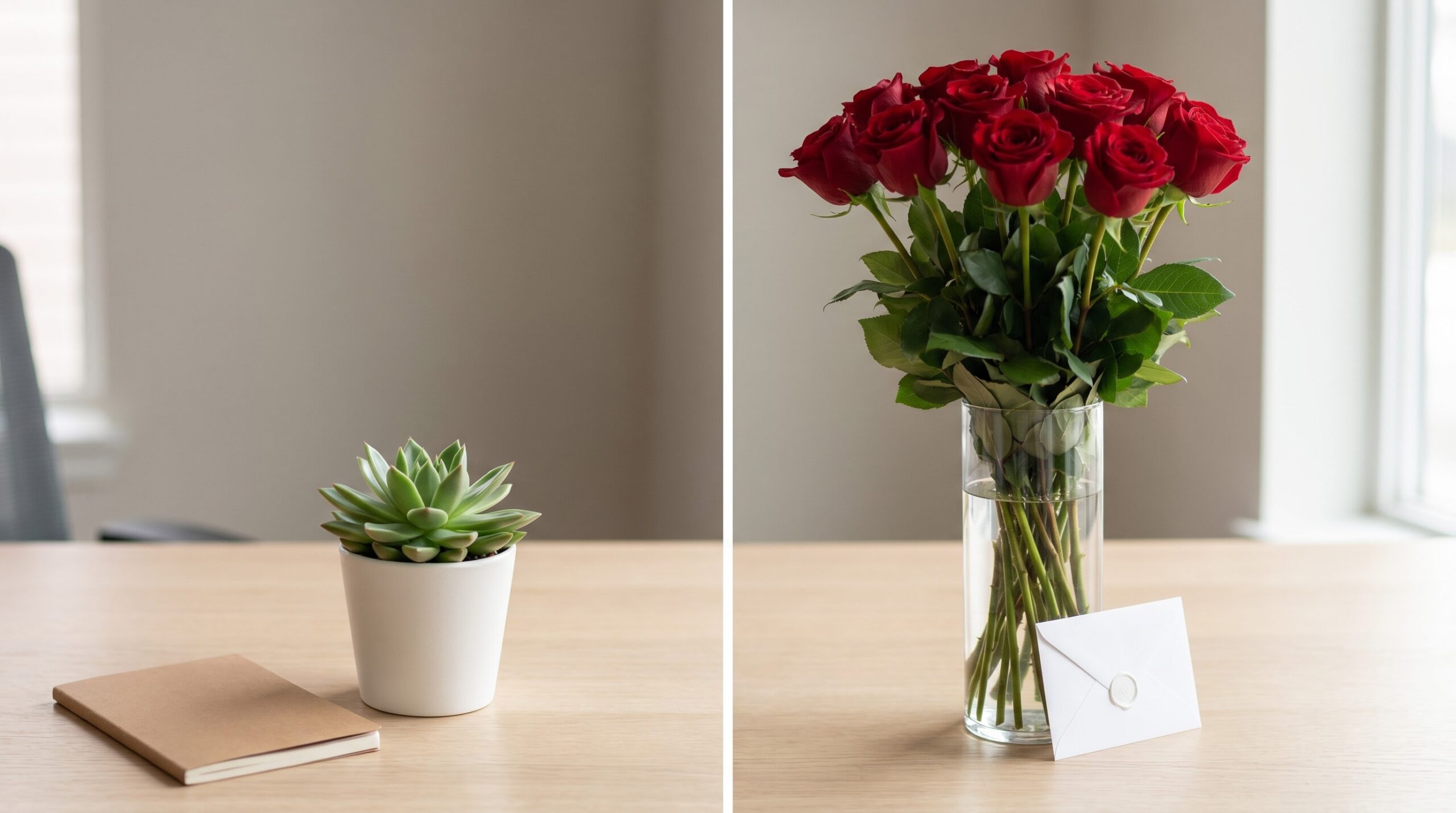
So think small, and think practical. The single most repeated suggestion across these discussions is a small potted plant instead of a bouquet, because a plant on a desk feels far less romantically coded and needs no vase, no wrapping, no water on hour one. Logistics count too. One woman recalled a boss who gave her birthday flowers while knowing full well she rides a bicycle to work. Picture the trip home before you pick the size. If you want full cover, make it a group gift; "from all of us on the team" removes the signal question entirely.
The boss case has its own asymmetry. Flowers from one employee to a boss, or from a boss to one employee, sit oddly because of the power gap in both directions. Route it through the team card and the shared bouquet, every time.
Early dating is the one context where the answer flips. A month in, sending flowers to her workplace is too much. Women asked about exactly this scenario say it plainly: she may not want her personal life walking into her professional one yet. Hand her the flowers at the birthday dinner instead. Same flowers, same money, opposite result. Workplace delivery only becomes a good idea once the relationship is established, and then it works beautifully, a surprise she gets to enjoy at her desk all day while everyone asks about it happily.
And if you're reading this because you forgot the birthday entirely, flowers to her desk are the classic forgiven save. Get the timing right with how early to order and when birthday flowers should arrive.
Does her background change the rules?
For most US-raised recipients, nothing below applies. There is no American rule about stem counts, no color taboo, no timing superstition; the classic American arrangement is a dozen roses, an even number, sold by the million every February. But if your friend grew up elsewhere, or her family did, a few rules are real and current, and they take five seconds to check.
| Recipient's background | Stem count | White flowers | Chrysanthemums | Yellow flowers | Timing |
|---|---|---|---|---|---|
| US, no strong family tradition | No rule; the classic dozen is even | Fine; clean and elegant | Fine; an autumn porch flower | The friendliest choice on the list | Day before is fine, often practical |
| Russian, Ukrainian, Eastern European | Odd numbers only; even counts are for funerals | Fine in a mixed bouquet | Fine; no birthday taboo | Fine for a friend; folklore makes them a breakup sign from a partner | Not early; greet her on the day itself |
| Chinese, Japanese, Korean | No stem-count rule | Avoid all-white; white is the mourning color | Avoid; a funeral flower | Fine | Fine |
| German | No rule | Fine | Fine | Fine | Never early; friends wait and celebrate into the day at midnight |
| French, Italian | No rule | Fine | Avoid; reserved for graves | Fine | Fine |
Swipe →
The two entries that surprise Americans most are the count and the calendar. In Russia and Ukraine the odd-number rule is alive and enforced by grandmothers: an even count of stems belongs at a funeral, so a bouquet of twelve lands as a small horror. A US florist won't warn you. Count the stems yourself.
The calendar rule runs through both Germany and Russia. The U.S. Army's guide for families stationed in Germany explains that celebrating a birthday early is considered bad luck there, and describes the workaround Germans invented, reinfeiern: guests gather the evening before and hold every congratulation until the stroke of midnight. Russian custom points the other way; a party that can't happen on the day moves later, never earlier. So the day-before delivery that's pure convenience for an American recipient can land wrong for both backgrounds. German or Eastern European roots? Deliver on the day.
The yellow-rose caveat is narrower than the internet makes it sound. For an American friend, yellow roses are the safest flowers you can buy. For a partner with Russian or Eastern European roots, yellow flowers drag in old folklore about separation, so keep them for friendship and pick another color for romance.
When you don't know the background, or it's mixed, the insurance costs nothing: an odd count, color in the mix, no chrysanthemums, delivery on the day. No recipient anywhere is offended by that combination.
Can you give white flowers for a birthday?
For most recipients, yes. White flowers read clean and a little formal, and nobody US-raised will see mourning in a bunch of white tulips. Two cautions deserve real weight, though. In Chinese tradition, and broadly across East Asia, white is the color of mourning, and cultural guides for florists are blunt about it: no white flowers unless the occasion is a funeral. If the birthday person has Chinese, Japanese, or Korean roots, keep white to an accent and let the bouquet lead with color.
The second caution applies everywhere. An all-white arrangement carries ceremony; weddings and sympathy own that look, and even for a recipient with no cultural stake in it, all-white can feel oddly solemn next to a birthday cake. White plus bright is the easy fix, white ranunculus in with orange tulips, and the question disappears.
Chrysanthemums deserve their own line, because the taboo depends entirely on who is receiving them. In France and Italy, chrysanthemums are grave flowers, laid out by the millions on All Saints' Day, and they carry the same funeral weight in China, Japan, and Korea. A US-raised recipient sees a hardy fall porch plant and thinks nothing of it. Mums for your friend from Lyon: bad idea. For your friend from Ohio: entirely fine.
What to write on the card
The card is where accidental confessions actually happen, so give it the same test the flowers got: read it back and ask whether a friend would write it. Two lines is the right length. "Happy birthday! The office would fall apart without you." "Happy birthday to a great friend. Eat cake for me." Signed with your name, no initials-and-mystery. Specific and short.
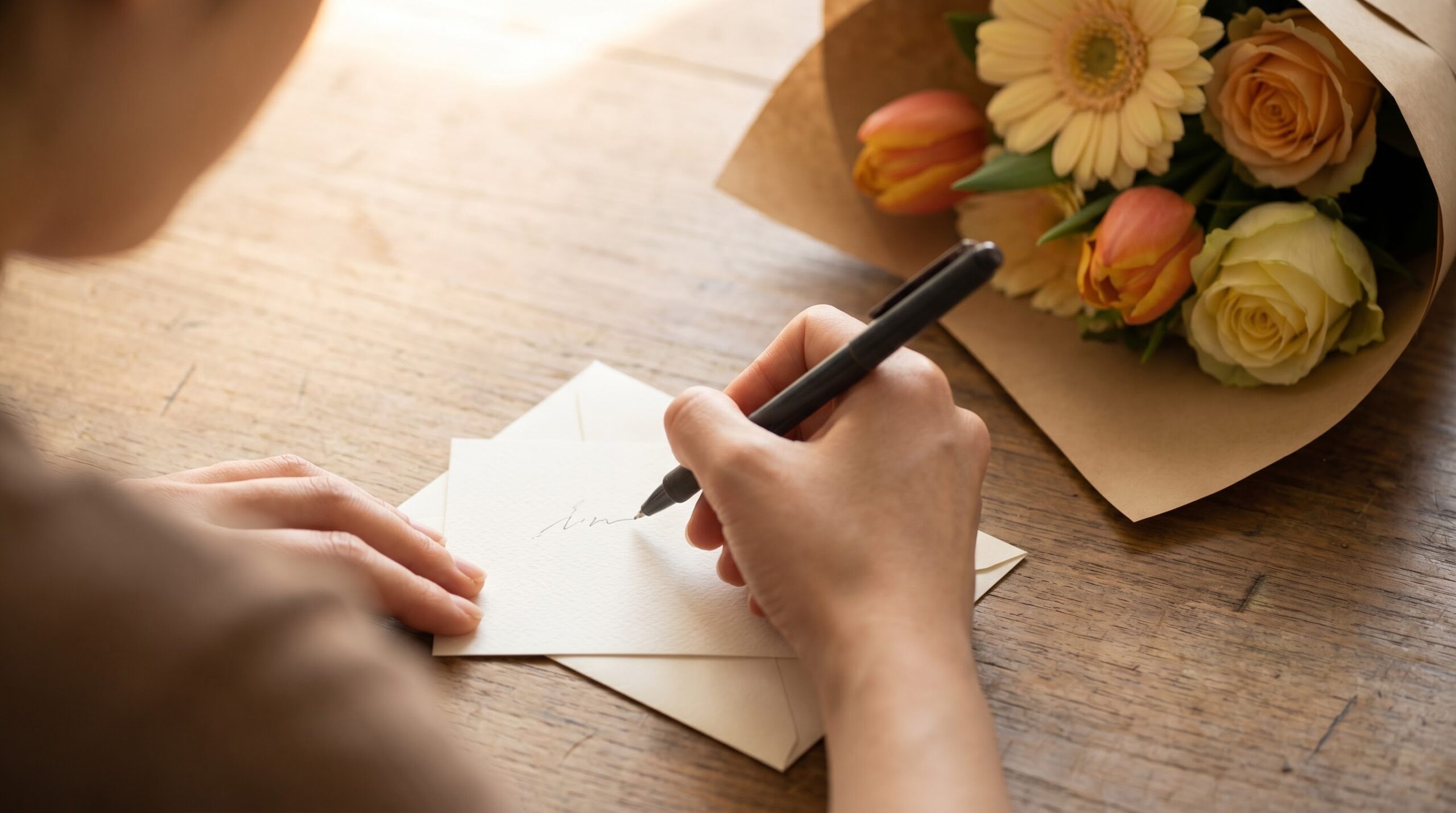
What tips a card over the line is intensity. Skip "always," skip "beautiful," skip anything describing how you feel when you see her. Those are confession words. If you want the card personal without warming it up, add one concrete detail instead: an inside joke, a nod to her actual birthday plans, or her birth month flower, which hands you a line like "sweet peas, apparently April's flower" that is charming and completely unromantic.
For the office version, the card writes itself: "Happy birthday from all of us!" and every name on the team.
So what do you actually buy?
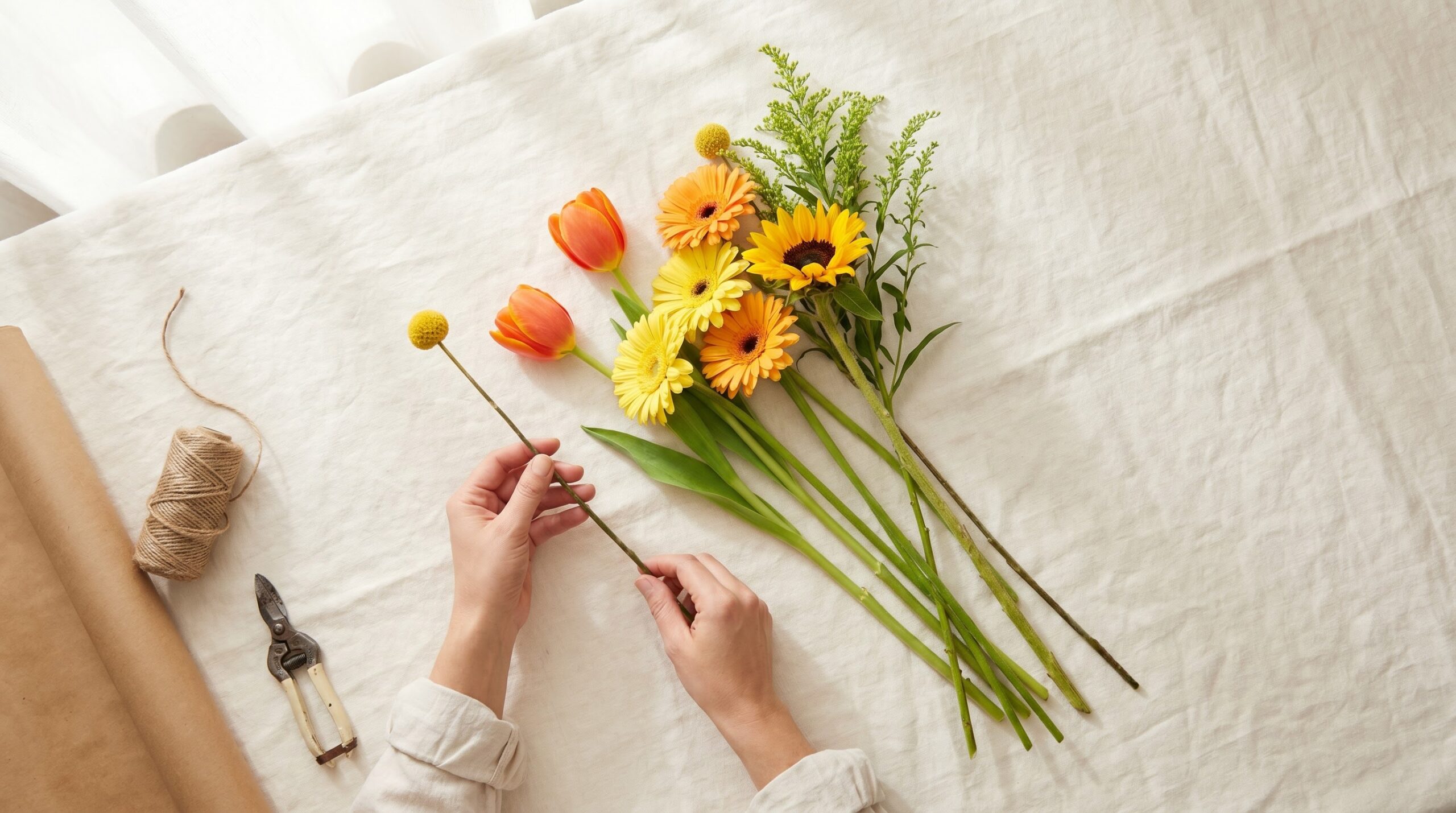
A small, bright, mixed arrangement: gerberas, sunflowers, tulips, yellow roses, whatever looks cheerful at the shop that morning. Modest size, odd count if her background calls for it, handed over in person with the two-line card. Skip red roses, skip all-white, and skip heavily scented lilies for a desk, since a workplace bouquet shouldn't announce itself from thirty feet. For an office birthday, the potted plant stays the quiet winner. If you want more depth than "bright and mixed," the full guide to which flowers to actually pick for a birthday walks through colors, budgets, and rose meanings one by one, and if the birthday person is a man, giving flowers to a man for his birthday has its own playbook. If this page has quietly talked you out of flowers for this particular person, that's a fine outcome too; here's whether flowers are even the right call, and what to send instead.
Then stop deliberating. Buy the cheerful bouquet, write the friendly card, and hand it over like it's no big deal. Handled this way, it isn't, and she gets to be a person somebody bought flowers for. That's a good birthday.
Enjoying our flower guides? Add YourFlowersGuide as a preferred source on Google. It helps more readers find us.
Add to Preferred Sources