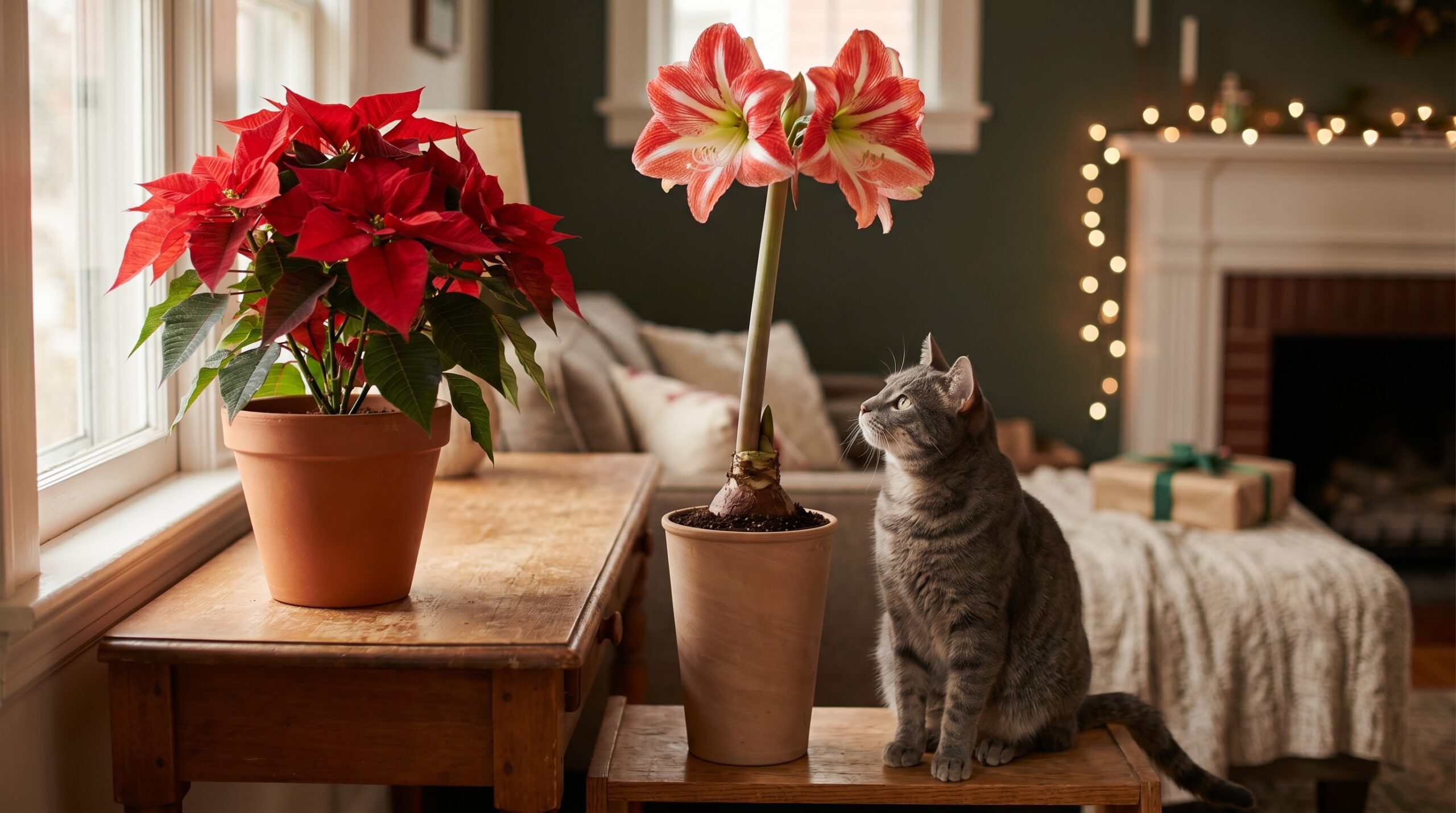
A poinsettia is already sitting on the side table, and a cat is pacing underneath it. That is the exact moment behind most searches like this one, and the good news comes first: that particular plant is very unlikely to seriously hurt her. A widely upvoted verdict in one Reddit thread calls poinsettia owners bad cat owners for having the plant in a house with a cat at all, and just as many replies in the same thread push back hard. One commenter put it more simply: "the dangers of poinsettias have been way overblown." Both camps are half right, which is the actual problem. The plant that deserves real caution this season sits one pot over, in the amaryllis nobody thinks to worry about, and in a true lily that has no business anywhere near a cat. Sorted by plant, before any of the myth history, here is where the danger actually sits.
| Plant | Real risk level | What actually happens | What to do |
|---|---|---|---|
| Poinsettia | Mild irritant | Drooling or an upset stomach if a cat chews a leaf; most reported cases show no symptoms at all | Leave it where it is, just up on a shelf a cat can't easily reach |
| Amaryllis | Bulb-toxic, a real step up from poinsettia | Vomiting, drooling, tremors, abdominal pain; the bulb itself carries the highest concentration | Keep the bulb and any cut stems out of reach of a cat that chews plants |
| True lily (Easter, Asiatic, tiger, Stargazer) | Deadly | Acute kidney failure in cats, sometimes triggered by pollen or vase water alone | Get it out of the house today; don't wait to see if she's interested |
| Christmas cactus | Non-toxic, not the same as harmless | ASPCA lists no toxic principle, but fiber, pesticide residue or glitter can still upset a stomach | One of the safest flowering gifts; rinse off any glitter first |
| Orchid | Non-toxic, same caveat as Christmas cactus | Same fiber and residue caution as above | Good pet-safe swap for a gift |
| Mistletoe (American) | Classified toxic, real-world outcomes mild | Vomiting or diarrhea in most documented cases; rare cardiovascular signs possible | Hang it out of paw's reach as routine caution, not panic |
| Holly | Classified toxic, more common in practice | Vomiting, diarrhea and general malaise if enough is eaten | Sweep up dropped berries more diligently than you'd bother with mistletoe |
Swipe →
The poinsettia everyone panics about
The ASPCA lists poinsettia as toxic to cats and dogs, and that classification is accurate but easy to misread. The plant's milky sap is an irritant. Most people picture something closer to rat poison; what actually happens is drooling or an upset stomach if a cat chews into a leaf. Purdue Extension puts the same point plainly: poinsettia isn't harmful to pets unless the leaves and bracts are eaten in genuinely large quantities, and a cat that just nibbles usually shows nothing at all. Pet Poison Helpline goes further, calling the plant's reputation a bad rap it never earned, mild toxicity at worst, rarely anything a vet visit is needed for.
That reputation traces back further than any cat owner posting in a panic today. University of Utah Health's poison control center has traced where the fear started: a single, unconfirmed report of a child's death in Hawaii in 1919, a case that was never verified and has been repeated for over a century anyway. The center's broader point about holiday plants generally fits here too, that most reported exposures cause minor irritation, well short of the medical emergency the folklore promises.
Reddit is full of the lived version of that data. One cat owner described two cats that ate poinsettia leaves every December for years and lived to seventeen, unbothered. Another compared the poinsettia scare to the old warning about cherry pits, technically true, functionally irrelevant at any amount a cat would realistically eat. That doesn't mean quantity stops mattering entirely. One dog owner switched to fake poinsettias after a real one sent their dog to the vet for a week, and a whole plant eaten by a determined dog is a different event than a single chewed leaf from a cat who loses interest fast. The plant's full backstory, the 1919 legend and the 22,793-case study that finally put it to rest, lives on the full poinsettia myth, the 1919 legend and the 22,793-case study behind it, along with the separate question of why hospitals sometimes turn poinsettias away at the door, which has nothing to do with cats. Here, the point stands on its own: don't return a poinsettia or feel shamed out of owning one over a myth with this little behind it. Set it on a shelf your cat can't easily reach, and move on.
The plants nobody warns you about
Move past the poinsettia and the real risk in a lot of households is already sitting in a box under the tree: an amaryllis bulb kit, gifted every December by the thousands. The ASPCA classifies amaryllis as toxic to cats and dogs, with lycorine as the toxic principle, and the clinical picture is a real step up from poinsettia: vomiting, drooling, tremors, abdominal pain, sometimes hypersalivation. The bulb itself carries the highest concentration, more than the leaves or the flower, which matters because amaryllis is one of the few holiday plants where a curious cat could plausibly get at the bulb directly, especially while it's being forced into bloom on a counter or windowsill. Once the flower fades, keeping that same bulb going for next year is its own small project, and worth doing since it's the part you'd otherwise just discard.
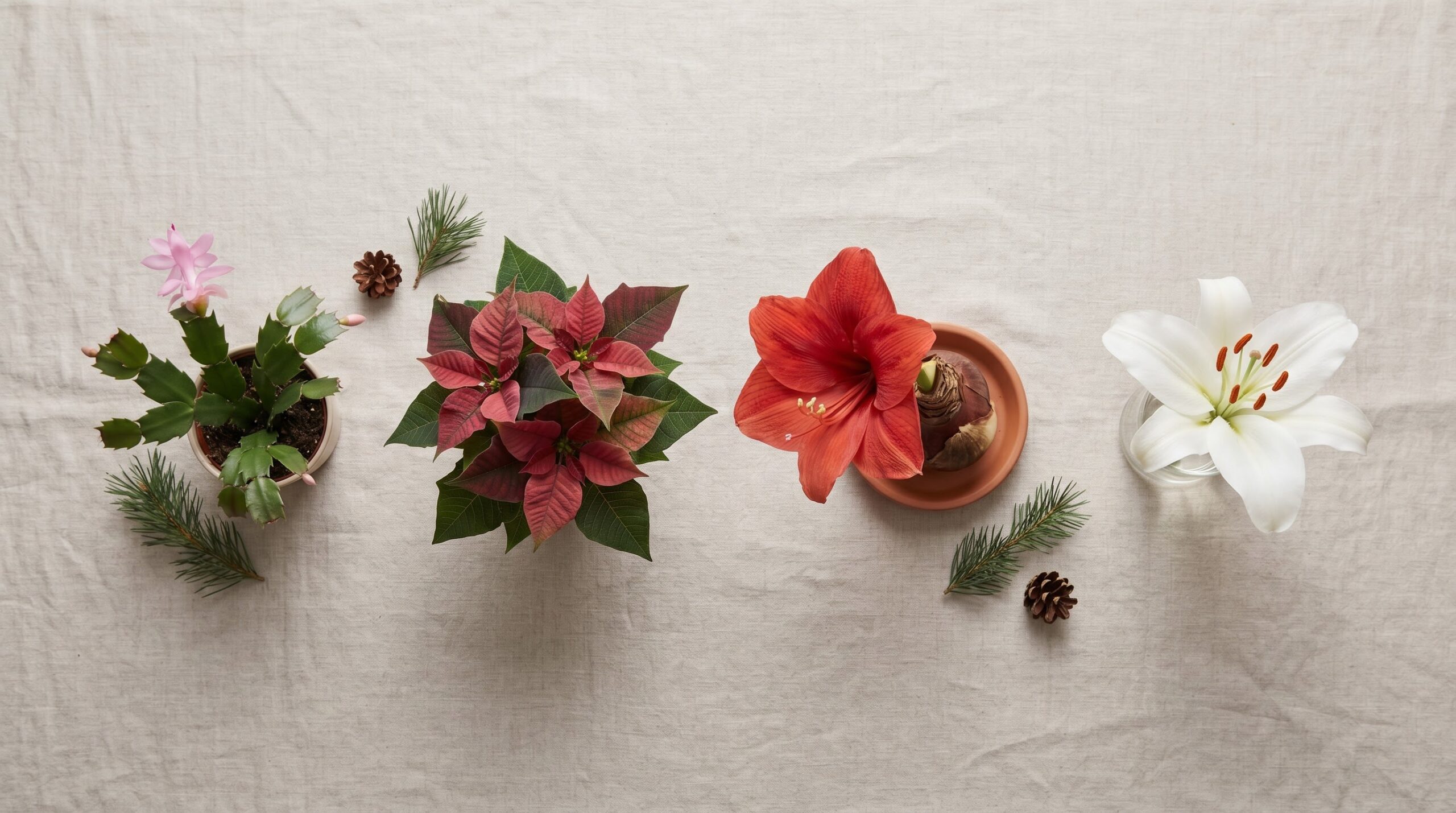
Then there is the plant that makes amaryllis look mild. A true lily, Easter, Asiatic, tiger, Stargazer, or the daylily tucked into a mixed arrangement, rarely counts as a traditional Christmas flower on its own, though it shows up constantly in winter gift bouquets and centerpieces this time of year. The ASPCA lists cats as the only species known to be affected, and the damage is acute kidney failure, sometimes fatal, sometimes triggered by nothing more than pollen brushed off a bloom or water a cat drank from the vase. One Reddit thread about an Easter lily incident captured the contrast well: the poster already knew poinsettia was overhyped and got blindsided by how much smaller the margin is with a lily nearby. That same species carries the reputation most people associate with funeral arrangements, a separate association entirely, but the reason to remember it here has nothing to do with sympathy flowers and everything to do with how fast kidney failure moves. If a true lily is anywhere in a home with a cat, the move is simple: get it out of the house today.
The safer picks, with one catch
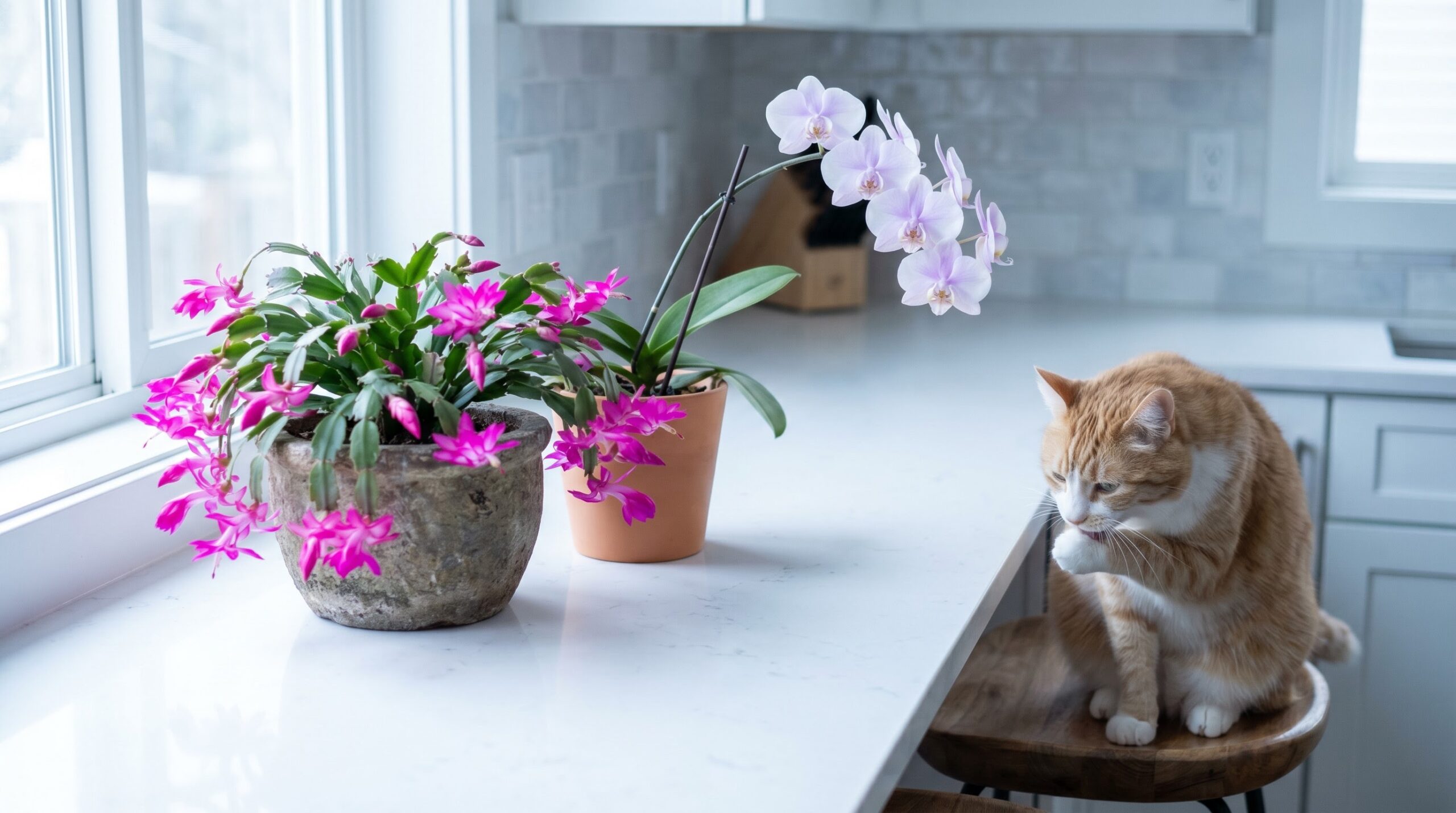
Christmas cactus and orchid are the two flowering gifts that actually clear the bar. The ASPCA lists Schlumbergera, the true Christmas cactus, as non-toxic to cats, dogs and horses, and orchids carry the same clean classification. Non-toxic is not the same as harmless, though. A cat that eats enough of any plant fiber can still end up with a sore stomach or mild vomiting that has nothing to do with poison, and a store-bought plant can carry pesticide residue or, increasingly, a light coat of glitter sprayed onto the pot or the blooms for the season. Rinse it off before it comes inside. Both remain the safest realistic flowering gift for a home with a cat, even though letting her graze on either one at will can still bring on a mild stomachache.
Swapping to a fake version can seem like the obvious workaround, and sometimes it's the right call, but it comes with its own catch. A cat that swallows part of an artificial plant can't digest any of it, and vets see impaction from fake foliage more often than people expect, especially once you factor in how much of it comes coated in glitter now. A live Christmas cactus or orchid beats a fake substitute on both counts: nothing indigestible, and nothing sprayed on for sparkle.
Mistletoe and holly, sorted correctly
Mistletoe carries the scarier reputation of the two, hung overhead with a warning look every December. The ASPCA does list American mistletoe as toxic to cats, capable in rare cases of affecting blood pressure and heart rate, and that classification is real. The largest real-world review of actual mistletoe exposures, compiled by researchers and published in the Western Journal of Emergency Medicine, tracked 1,754 cases and recorded zero deaths, with the overwhelming majority of patients never developing a single symptom. That data comes from human poison control calls, mostly involving children, rather than a dedicated study of cats, but it remains the best outcome evidence available for the plant, and it lines up with what most veterinarians actually see: a cat that mouths a mistletoe leaf usually just walks away.
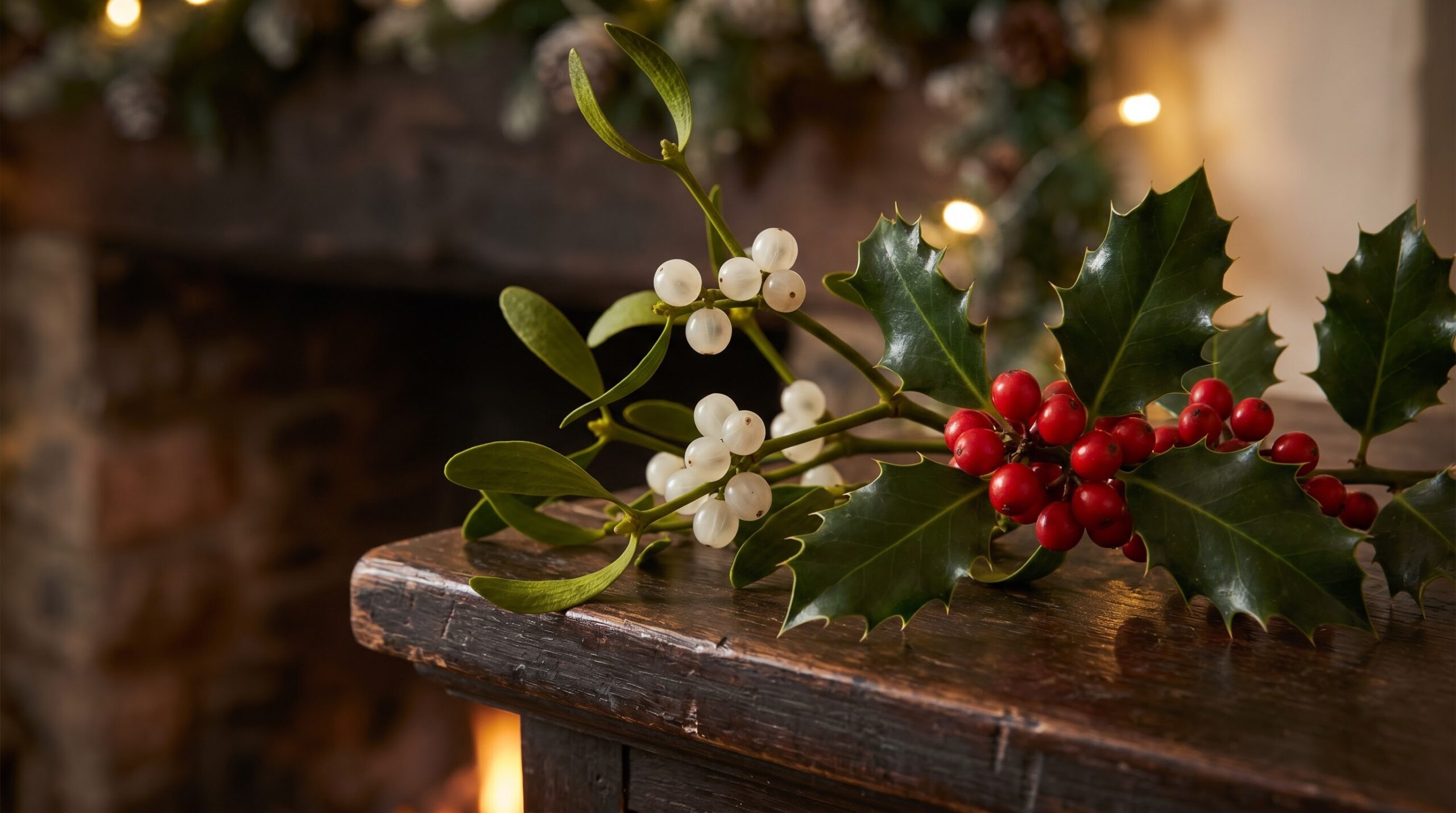
Holly gets treated as the harmless one by comparison, and that gets the practical risk backwards. The ASPCA lists English holly as toxic to cats too, with saponins as the toxic principle, causing vomiting, diarrhea and general malaise if enough is eaten, though its own materials describe the leaves and berries as low toxicity even so. What actually makes holly the bigger everyday nuisance comes down to how often it gets eaten. The same emergency-medicine review found holly generating far more poison control calls than most other holiday plants, almost certainly because red, round berries sitting in a centerpiece at nose height get eaten far more often than a sprig of mistletoe hung near the ceiling. Sweep up any dropped berries the way you'd sweep up anything else a cat might swallow off the floor, more diligently than you'd ever bother with mistletoe.
None of this calls for panic, and none of it calls for waving away every warning either. Check whatever is actually in the house against what it is: a poinsettia stays put on a high shelf, an amaryllis bulb gets tucked somewhere a paw can't reach, a Christmas cactus or orchid can sit out with barely a second thought, and a true lily gets removed the same day it's noticed. Skip the research and just take it out. If flowers are headed to someone else's home this season, ask about pets before choosing, since the same reordering that applies here, amaryllis over poinsettia, lily over everything, applies just as much to a gift as to a plant already on the mantel. And if flowers are even the right call this year is its own question, one worth answering before the pet-safety question comes up; whether flowers are even the right Christmas gift to bring covers that side of it. For the rest of what the season traditionally brings into the house, the full lineup of traditional Christmas flowers has the fuller rundown.
Enjoying our flower guides? Add YourFlowersGuide as a preferred source on Google. It helps more readers find us.
Add to Preferred Sources