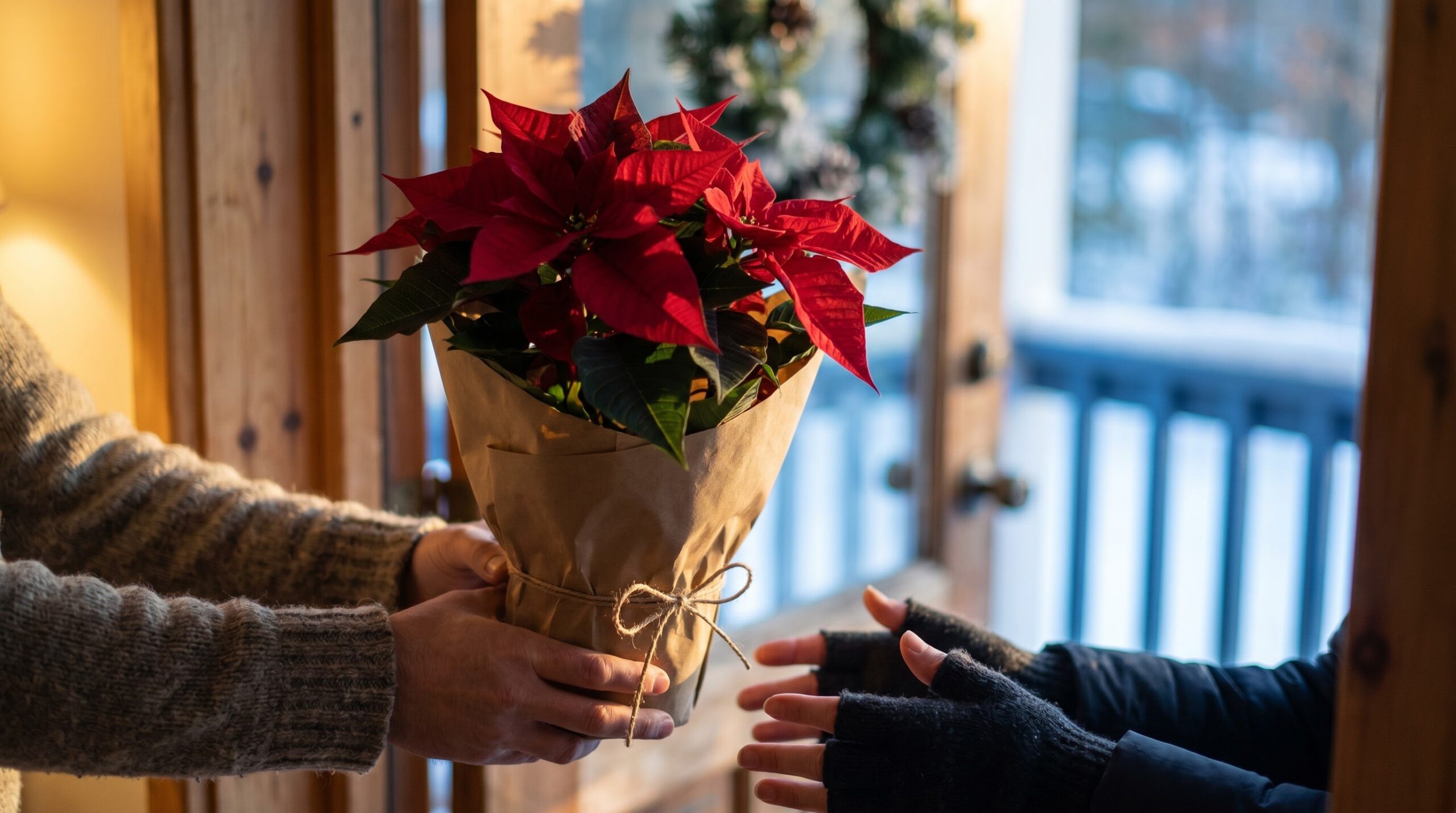
"Yes, you are a bad cat owner. YTA." That was the verdict from a Reddit thread with eighty upvotes behind it, aimed at someone who had just brought a poinsettia into a house with a cat in it. A reply further down the same thread pushed back, insisting the danger has been badly overstated. Both are describing the same red plant sitting on a kitchen table somewhere right now, and only one side of that argument has the numbers. In 1996, researchers pulled every poinsettia case out of 849,575 plant-related calls logged by US poison control centers: 22,793 of them. Zero deaths. More than 92 percent of the people who called never developed a single symptom, and more than 96 percent never needed a health care facility at all. That is a specific, checkable number, the kind that should end the argument before someone returns a perfectly fine plant out of guilt.
The 1919 story versus the study that settled it
The fear has a real birthplace. In 1919, at a military post in Hawaii, a story spread that a child had died after eating a poinsettia leaf. It got picked up in a 1944 book and repeated for decades. Then someone checked the paperwork: no first-hand account of the death, no hospital record, nothing beyond hearsay. The original author who told the story later walked the conclusion back himself, according to University of Utah Health Poison Control Center, which still fields calls about holiday plants every December. By the time the myth had circled the culture for seventy years, "poinsettias are deadly" had become the kind of thing everyone's mother said, the sort of fact nobody thinks to question because it sounds like the kind of thing a mother would know. The 1996 study is what finally tested that claim against a poison control center's actual call log instead of a rumor from 1919, and the log said something close to the opposite: 92.4 percent of poinsettia exposures produced no toxicity at all, 96.1 percent of people never needed treatment, and not one call ended in a death. Ohio State University researchers, working backward from an earlier laboratory study, put the number at hundreds of leaves, several hundred by some estimates, before a fifty-pound child would even approach a dose that mattered. Nobody eats hundreds of leaves of anything by accident.
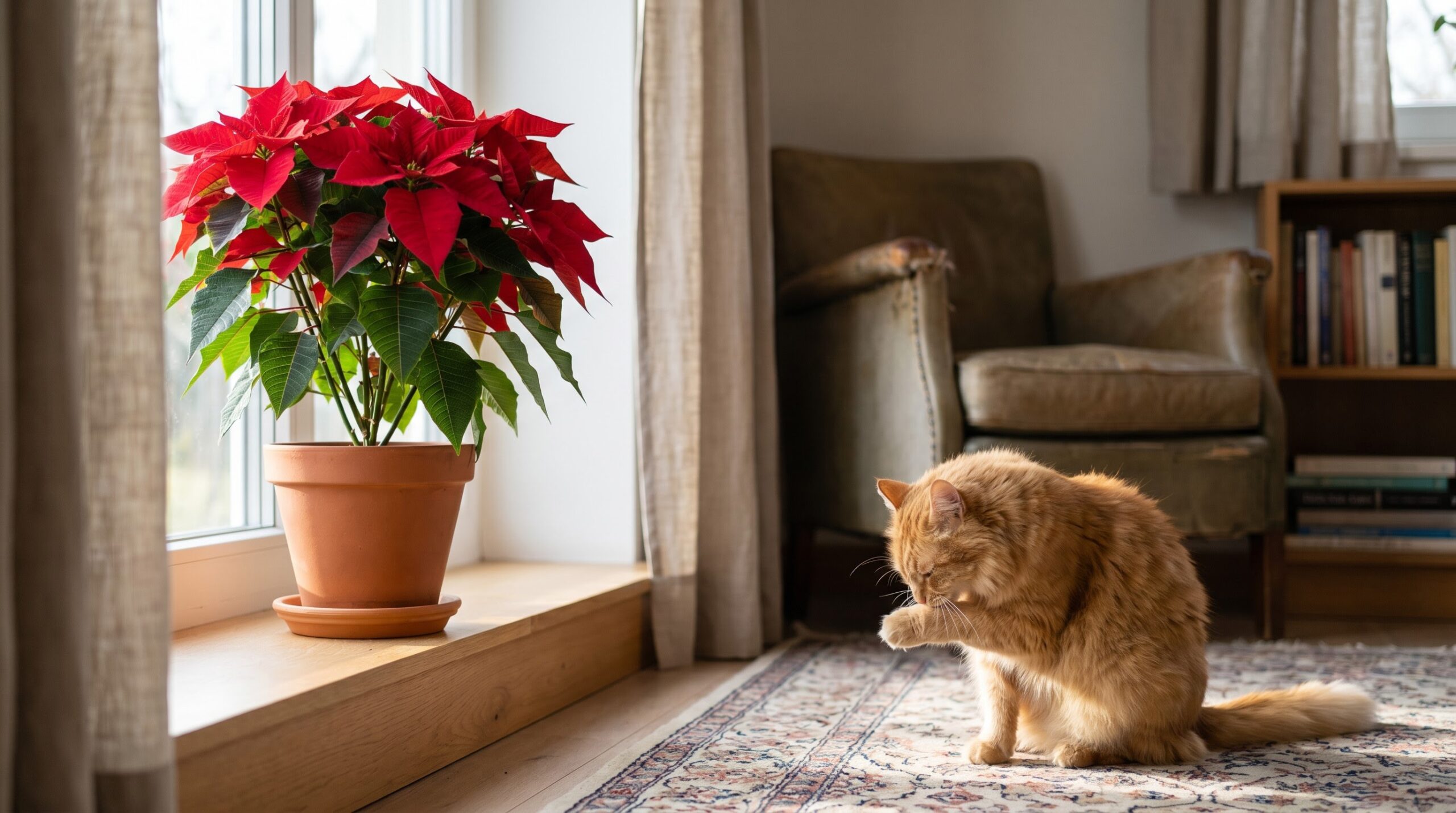
For pets, the picture sits closer to the middle than either side of that Reddit thread wants to admit. The ASPCA lists poinsettia as toxic, then describes something that reads more like a stomach ache than a poisoning: mild irritation to the mouth and stomach, some drooling, occasional vomiting that typically clears up on its own without a vet visit. Mild still means possible, so a cat that treats every houseplant like a salad bar is still worth keeping out of easy reach. The plant belongs in a different category entirely from something genuinely dangerous, and it is worth being precise about that distinction: true lilies, Lilium and Hemerocallis species, are a real, fast-acting kidney threat to cats, one of the few common houseplants capable of killing within days, and folding that risk into the same sentence as a poinsettia's mild stomach upset does a disservice to both plants. That same thread that produced the bad-cat-owner verdict argued the poinsettia half of this out in real time. One reply pointed out that a cat would have to eat multiple plants' worth of leaves to get seriously sick, then added, almost as an aside, that the plant just isn't very attractive anyway. Another reply went further, accusing the thread of spreading misinformation and calling the whole scare wildly overblown. The debunkers are closer to the poison control data than the accusers, but the accusers aren't inventing something from nothing. They're repeating a story that has circulated, uncorrected, since before their grandparents were born.
| What people fear | What the record shows |
|---|---|
| A child who eats a leaf can die | The 1919 Fort Shafter story never had first-hand confirmation, and the original account was later retracted |
| Poinsettia poisoning is common and severe | 22,793 poison control cases studied, zero deaths, over 92 percent with no symptoms at all |
| One leaf is dangerous for a small child | Researchers estimate a fifty-pound child would need to eat hundreds of leaves to approach a toxic dose |
| "Poisonous," full stop, for cats and dogs | The ASPCA classifies it as an irritant: usually mild, self-limiting mouth and stomach upset |
| Hospitals ban it because it's deadly poison | The real reasons are a leftover myth, a rare latex cross-reactivity, and policy that outlived the evidence |
Swipe →
Why hospitals still keep them out
The strongest single question behind this whole topic comes up on the way into a hospital room or a nursing home lobby: why are poinsettias not allowed here? Policy varies by hospital, by ward, and sometimes by department within the same building, so "not allowed here" is never a universal rule, only a local one worth confirming. Where a ban does exist, the answer has three separate parts, and none of them is "because they're deadly," even though that's the reason most people have been given. Reddit shows the myth still running institutions today. In a thread about a company gifting a poinsettia to a shared workspace, one commenter matter-of-factly explained that most nursing homes don't allow them because they're poisonous, stating the myth as settled fact to a room full of people who mostly believed it. That belief, inherited and rarely checked, is reason one.
Reason two is real, just much narrower than the rumor. Poinsettia belongs to the spurge family, Euphorbiaceae, the same family as the rubber tree that natural latex comes from, and the plant's milky sap carries proteins that can cross-react with a true latex allergy. The American Latex Allergy Association and the Allergy and Asthma Network both describe laboratory testing that finds meaningful cross-sensitivity in a substantial share of latex-allergic patients. Documented cases exist too, of people with known latex allergies developing a skin rash after direct contact with a poinsettia's broken stem or leaf. That's a genuine clinical reason for caution, much smaller in scale than the poisoning myth, but real enough that some facilities reasonably ask visitors to check first before bringing one in.
Reason three is the plainest one: policy tends to outlive the evidence that justified it. A rule written when "poinsettias are toxic" was accepted as fact doesn't automatically get revisited once poison control data says otherwise. Nobody's job description includes updating decades-old visitor and gift-shop policies against a 1996 journal article, so the rule just keeps running, restated as "they're poisonous" by whoever answers the question next. All three reasons point the same direction for a gift-giver. If you're bringing something into a hospital or care facility, call ahead and ask what the actual policy is, rather than assuming either that poinsettias are catastrophically dangerous or that the rule couldn't possibly apply to you. It's a real rule, for real if incomplete reasons, and it's worth respecting even after the myth underneath it has been debunked.
Whether it's actually a meaningful gift
Once the safety question is settled, the plant itself deserves a better story than "the one that might be poisonous." The Aztecs called it cuetlaxochitl, a name that translates roughly to a flower that withers and perishes like all things pure, and they used its red bracts for dye and its sap in traditional medicine long before the plant had anything to do with Christmas. The Christmas association came later, through a Mexican legend about a girl too poor to bring a gift to a Christmas Eve nativity service. Told that even a humble gift given in love would be accepted, she gathered a handful of roadside weeds on her way to church, and when she laid them at the manger, the bundle burst into brilliant red blooms, according to the history preserved by University of Illinois Extension. Mexicans still call the plant Flor de Nochebuena, the flower of the Holy Night, and the Star of Bethlehem imagery that shows up in a lot of gift-tag symbolism traces straight back to that manger story, not to the plant's biology. Joel Roberts Poinsett, the US ambassador to Mexico who gave the plant its English name, sent cuttings home to South Carolina in the 1820s, and everything that followed, the tens of millions of pots sold every December, the color-coordinated end caps at every grocery store, grew out of a diplomat's houseplant hobby and a story about a girl with nothing to give but weeds.

Whether that history makes it a good gift for a specific person depends more on plain etiquette instinct than on symbolism. The teacher-gift and hostess-gift cases are about as uncontroversial as gift-giving gets. In one etiquette thread, a commenter suggested a poinsettia specifically because, being Christmas, it arrives already dressed for the occasion and ready to display, no vase, no arranging, no water to change. The lonely-neighbor case runs the same way: asked what to bring an elderly neighbor with no family nearby, the top answer on an Irish community board was simply that you can never go wrong with flowers or a poinsettia. Sending one to a partner's family carries a slightly higher bar, and Reddit answers that one with equal confidence, one commenter recommending a potted poinsettia over a cut arrangement specifically because it's simple, festive, and lasts far longer than a bouquet would. Sympathy flowers carry their own strict color rules in our funeral flowers guide, mostly white and mostly formal. A poinsettia's gift register sits nowhere near that. It reads as festive and low-effort in the complimentary sense, a different occasion entirely from a funeral spray or a hospital bouquet.
The backlash case is just as real, and just as consistent. Office poinsettias, the ones a vendor or building management drops off at a shared reception desk, generate a specific, repeated complaint: nobody asked to inherit a living thing they now have to water, relocate for the cleaning crew, and eventually decide whether to feel guilty about discarding. The plant did nothing wrong. The obligation to keep something alive that nobody asked for is the actual complaint. If someone in your life has said, in any form, that they don't want a plant they're now responsible for, that objection is worth taking at face value rather than overriding with a gesture you think should land as thoughtful. A poinsettia is a wonderful answer to the wish for something simple that will be enjoyed for a few weeks. It is a poor answer to the wish for a low-maintenance gift, because low-maintenance and alive are not the same category, and anyone who has ever inherited an office poinsettia already knows it. It's one of several judgment calls our occasion flower guides try to answer honestly, gift by gift, and the fuller lineup of traditional Christmas flowers beyond just the poinsettia has its own guide too.
What to do with it once the season ends
The guilt that shows up in January is its own small epidemic, and Reddit has a cure for it that shows up in thread after thread: stop treating a poinsettia like a houseplant commitment and start treating it like a bouquet with an unusually long vase life. Enjoy it until you're done enjoying it, more than one commenter has put it, then throw it out or leave it by the curb for a plant lover to grab, exactly the way you'd retire a bouquet of cut flowers once it wilts. Another version of the same permission shows up from someone describing an office poinsettia: most people don't keep them alive past the holidays, so enjoy it through the season and discard it, problem solved. Getting a poinsettia to rebloom the following Christmas is genuinely possible. It takes weeks of managed darkness starting in early autumn to trigger the color change, and it's a real project for someone who wants one, separate from any obligation attached to the gift itself. Most recipients, by their own account, never attempt it, and the plant was never asking them to.
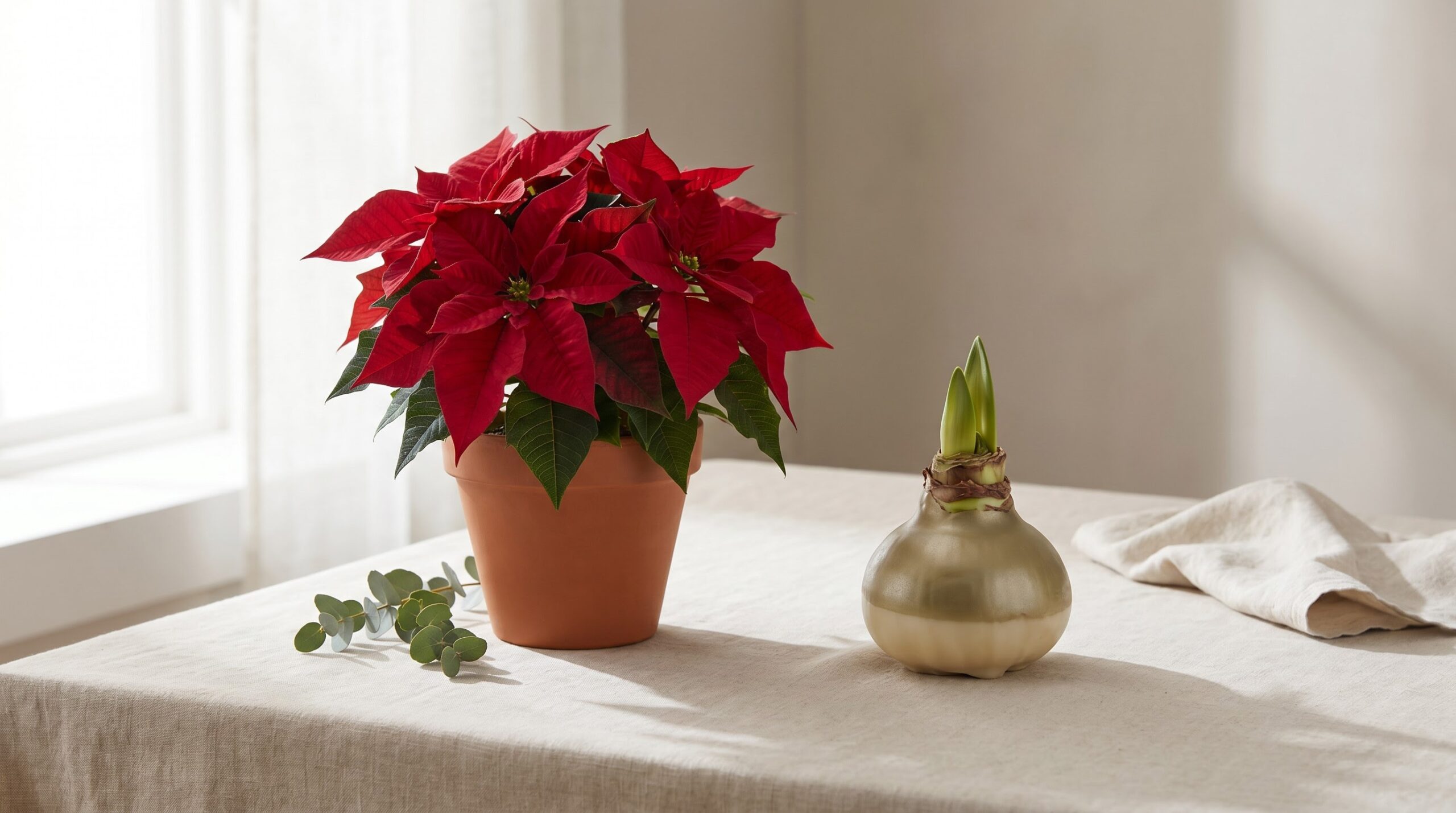
The twist nobody expects is that the other classic December gift-plant, the waxed amaryllis bulb sitting in a bowl of decorative rocks, is both more confusing to receive and more genuinely dangerous to a curious pet than the poinsettia everyone worried about. One Reddit thread described a waxed amaryllis bulb as a gift that looks decorative but is secretly alive, the wax coating essentially putting the bulb on autopilot so it can bloom without any care at all. A reply in the same thread confirmed the whole point: one season of bloom, and it won't likely take root if you try planting it afterward. Unlike the poinsettia, amaryllis carries lycorine, concentrated most heavily in the bulb itself. The ASPCA lists it as toxic to cats, dogs, and horses, with real clinical signs: vomiting, drooling, abdominal pain, and in serious cases, tremors. That's a different category entirely from the mild stomach upset poinsettia produces. The plant everyone photographs next to a worried cat with a caption about danger is, gram for gram, the safer of the two December houseplant gifts. The one nobody warns anyone about is the one with an actual toxin concentrated in a part a curious dog can dig out of the rocks.
Those red petals aren't actually the flower
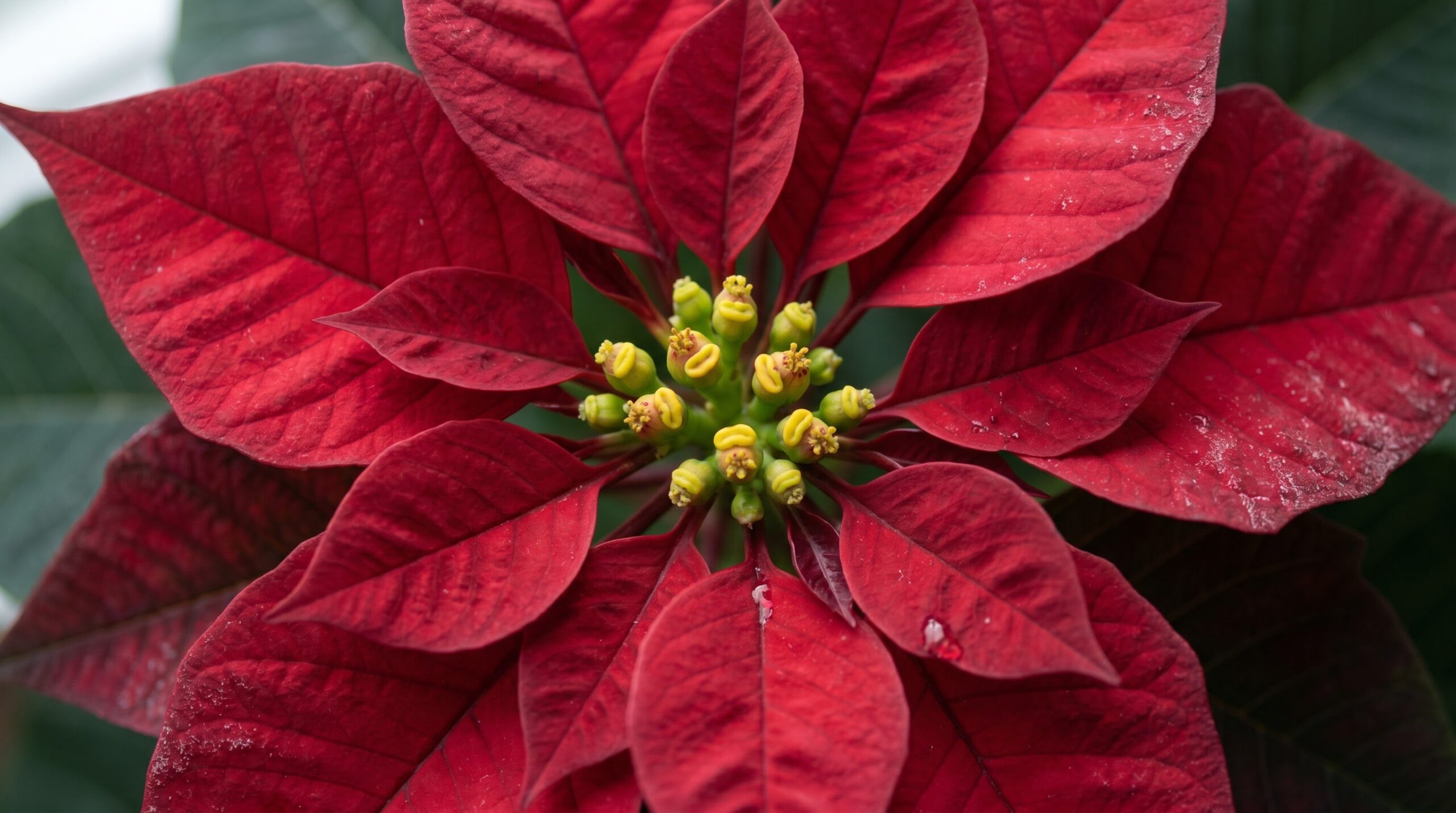
There is one more fact worth knowing before you look at a poinsettia the same way again, and it quietly explains why the whole leaves-are-poison framing has always been a little confused about anatomy. What looks like a giant red flower is not a flower at all. Those broad red, or sometimes white or pink, structures are bracts, specialized leaves that change color to attract pollinators, doing the visual job a petal usually does. The actual flowers are the small yellow, almost bead-like clusters at the center of each rosette of bracts, called cyathia, and they are easy to miss entirely if nobody points them out. Every debate about whether the leaves or the flower of a poinsettia are dangerous has, this whole time, been arguing about the wrong plant part. The red pieces getting blamed are colored leaves; the actual flowers sit quietly in the middle, unbothered by seventy years of an argument that was never really about them.
Keep the plant. Enjoy the color through the season, and if anyone repeats the poisoning story at you, you now have a specific answer ready: 22,793 cases, zero deaths, and a hospital rule that has more to do with latex and outdated policy than with the plant itself. Whether you let it go without guilt in January or try for a rebloom next December is entirely your call, and either one is the right answer. If the question on your mind is whether flowers belong at a Christmas gift exchange at all, that etiquette question, and the specific rule about vases and hostess gifts, gets its own full answer in our Christmas flower etiquette guide. And if the worry was never really about the poinsettia specifically but about which Christmas plants are safe for a curious pet, the complete room-by-room rundown lives in our pet-safe Christmas flowers guide, covering everything from mistletoe to holly to the Christmas cactus on the windowsill.
Quick answers
Is a poinsettia a good Christmas gift? For most recipients, yes. It needs no vase, survives the trip in a car, and lasts weeks longer than cut flowers. The one exception: don't give a potted plant to someone who has said, in any form, that they don't want the ongoing responsibility of keeping something alive.
Why are poinsettias not allowed in hospitals? Three reasons, not one: a leftover myth that the plant is seriously toxic, a real but narrow latex cross-reactivity risk for patients with a true latex allergy, and hospital policy written when the toxicity myth was accepted as fact, never since updated.
Are poinsettias poisonous to cats? Mildly, not seriously. The ASPCA classifies poinsettia as an irritant: sap that can cause mouth and stomach upset, occasional vomiting, usually resolving without treatment. That's a different category from true lilies, which are genuinely lethal to cats in small amounts.
Enjoying our flower guides? Add YourFlowersGuide as a preferred source on Google. It helps more readers find us.
Add to Preferred Sources