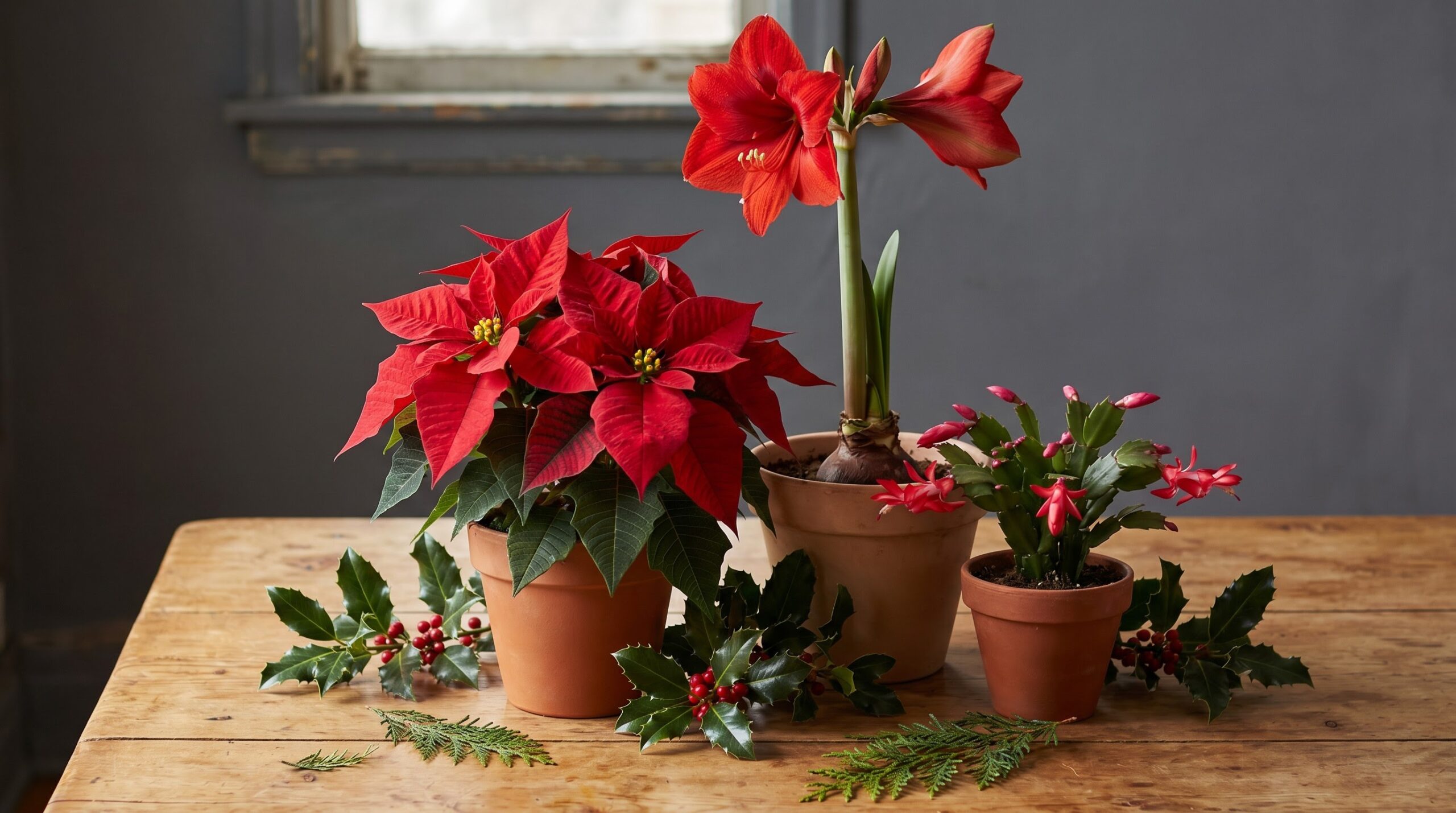
Poinsettia, amaryllis, Christmas cactus, holly, hellebore, paperwhite and mistletoe: those are the plants that actually earn the name traditional Christmas flowers, the ones that keep turning up on porches, mantels and store entrances every December whether or not anyone bothers to name them. Some are true cut flowers you put in water. Others are potted plants people treat like flowers because they bloom on cue for the season and nobody has invented a better word for them. None of them need a history lesson before you can use them, but a few honest facts about each one will keep you from picking the wrong plant for a hospital room, a coworker's desk, or a house with a curious dog.
The traditional Christmas flowers, named plainly
Poinsettia carries the reputation and most of the confusion. It is the plant most people mean when they say Christmas flower, sold by the pallet-load from October through December, and it is almost always potted rather than cut, since the color holds far longer on the living plant than it ever would in a vase. It travels well as a gift to a house or an office desk. A hospital room is a different story, and the reasons for that, along with the exaggerated toxicity myth still floating around every holiday season, get the full treatment on the full story behind giving a poinsettia, including the 22,793-case myth about it.
Amaryllis is the more flexible pick of the two big red names, because it exists both as a genuine cut flower and as a potted bulb kit. The trumpet-shaped blooms open on a bare stalk, sometimes two or three to a stem, and a forcing kit under the tree has become its own small tradition. Christmas cactus is the gentler choice for a household with pets, since it is one of the few plants on this list the ASPCA lists as non-toxic to cats and dogs, though a pet that eats a large amount can still get an upset stomach. Holly rarely shows up as a bouquet on its own; it earns its place in wreaths, mantel greenery and the occasional accent stem, and the berries that make it recognizable are also the part to keep away from toddlers and pets, even though poison-center data says most exposures cause nothing worse than mild stomach upset. Hellebore, sometimes sold as the Christmas rose, blooms outdoors in the dead of winter and is more often given as a potted or garden plant than cut for a vase; it is genuinely toxic if eaten, so it belongs on a shelf rather than a low table in a pet household. Paperwhite narcissus is the fragrant, fast bulb kit that blooms in a few weeks with no soil at all, prized for its speed as much as its scent; the bulb carries the same toxic alkaloid as amaryllis, and handling a lot of stems at once can leave gardeners with an itchy rash they call daffodil itch. Mistletoe is the odd one out on this list, since almost nobody buys it as a bouquet. It hangs, in a small sprig or a kissing ball, and it is genuinely toxic, so it needs to stay out of reach of kids and pets rather than sit in a vase on the table.
| Flower | Giftable | Pet-safety flag | Potted or cut |
|---|---|---|---|
| Poinsettia | Yes, for a home or desk; skip it for a hospital room | Irritant, not the horror story; poison-center review of 22,793 cases found no fatalities | Almost always potted |
| Amaryllis | Yes, and a strong choice as a boxed bulb kit | Bulb contains the irritant lycorine; keep bulbs from pets and small children | Either, often a potted kit |
| Christmas cactus | Yes, especially for pet-owning households | Listed non-toxic to cats and dogs, though a large mouthful can still upset a stomach | Potted |
| Holly | As greenery or an accent, rarely a bouquet on its own | Berries cause mostly mild stomach upset in poison-center data, not the worst case | Cut sprigs or a potted shrub |
| Hellebore (Christmas rose) | Yes, as a potted or garden gift | Genuinely toxic if eaten; keep it off low tables in pet households | Potted |
| Paperwhite (narcissus) | Yes, especially as a fast-blooming bulb kit | Bulb toxic like amaryllis's; handling many stems can irritate skin | Either, often forced in water |
| Mistletoe | As a hanging sprig or kissing ball, not a bouquet | Genuinely toxic; hang it out of reach of kids and pets | Cut sprigs |
Swipe →
The full pet-by-pet breakdown, including dosage and what to do if a pet actually eats one of these, lives on the full pet-safe Christmas flower matrix; this table is the one-line version to keep you from making an obviously bad call while you shop.
What is that red one actually called
The red parts of a poinsettia are not petals. They are bracts, specialized leaves that turn color the way autumn leaves do, and the actual flowers are the tiny yellow structures clustered at the center of each leaf bunch, called cyathia. Wikipedia's entry on the plant lays out the botany plainly: what looks like one big red bloom is really a ring of colored leaves surrounding a handful of flowers too small to notice. That single fact solves most of the "what is that red one" confusion on its own, but it does not solve all of it, because three different plants get called the same thing every December.
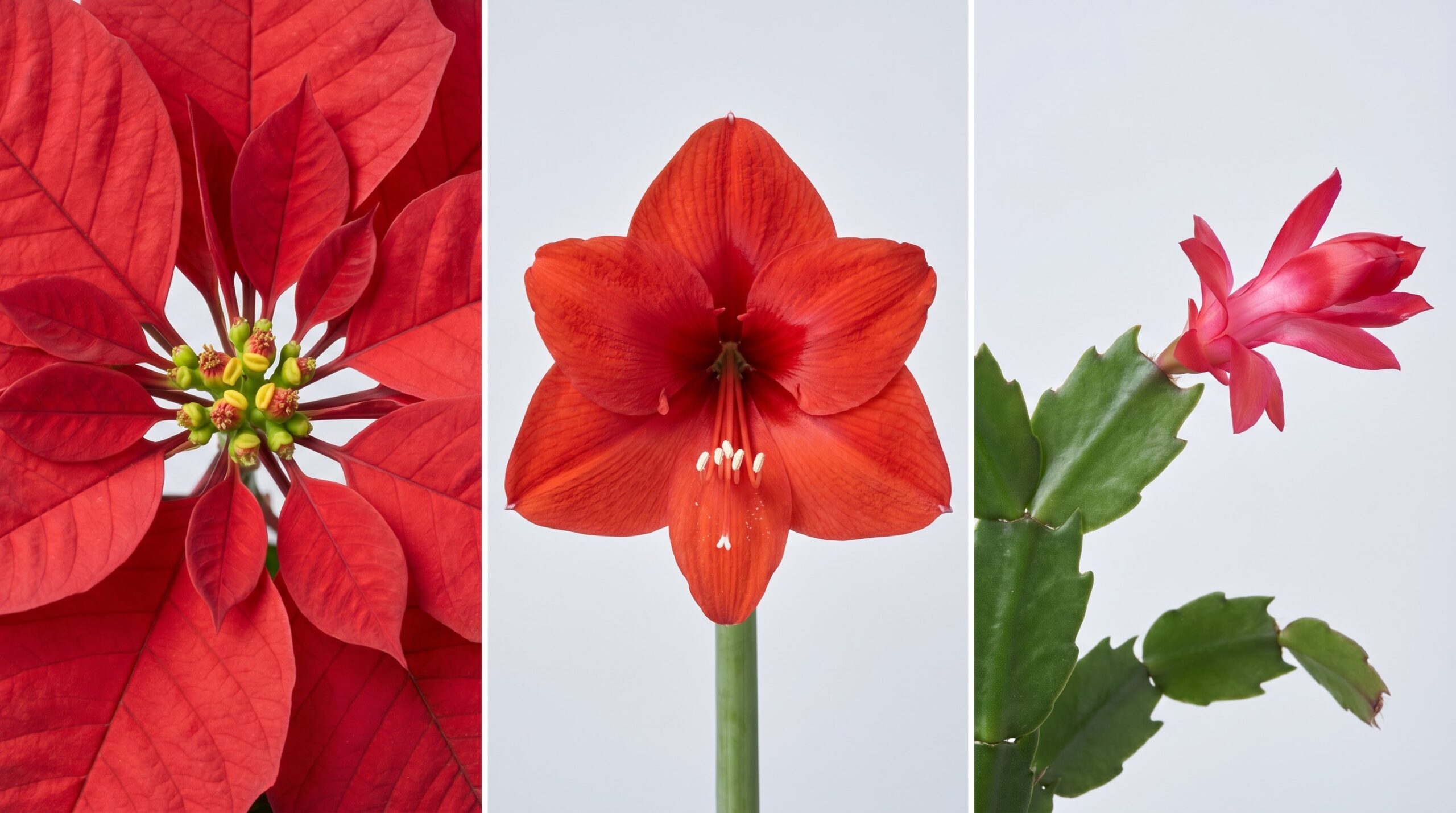
If the red parts are broad, flat and leaf-shaped with tiny yellow centers, it is a poinsettia. If the red bloom is a large trumpet on a tall, bare, leafless stalk coming straight out of a bulb, it is an amaryllis. If the red flowers are tubular and appear at the tips of flat, segmented, leaf-like stems that look almost like a chain of green paddles, it is a Christmas cactus. Once you know to look at the stem and the leaf shape instead of just the color, the three stop being interchangeable. For red flowers beyond this trio, including the ones people search for by color rather than name, the wider guide to red flowers covers the full range across seasons.
Christmas flowers that aren't poinsettias
Plenty of people search for an alternative every year, tired of the same plant on every porch. The rest of the traditional list already covers that ground. Amaryllis and paperwhite both bring saturated color and a bulb-kit gift format that skips the poinsettia altogether. Christmas cactus is the pick for a household that wants a plant, not a cut flower, and doesn't want to worry about a curious cat. Hellebore brings a cooler, more muted palette, blooming white, pink or deep plum rather than red, which makes it the closest thing on this list to an actual winter rose. None of these require abandoning the season's colors; they just spread the tradition across more than one plant, which is closer to what "traditional" actually meant before poinsettia marketing took over most of the shelf space.
The supermarket bouquet counts too
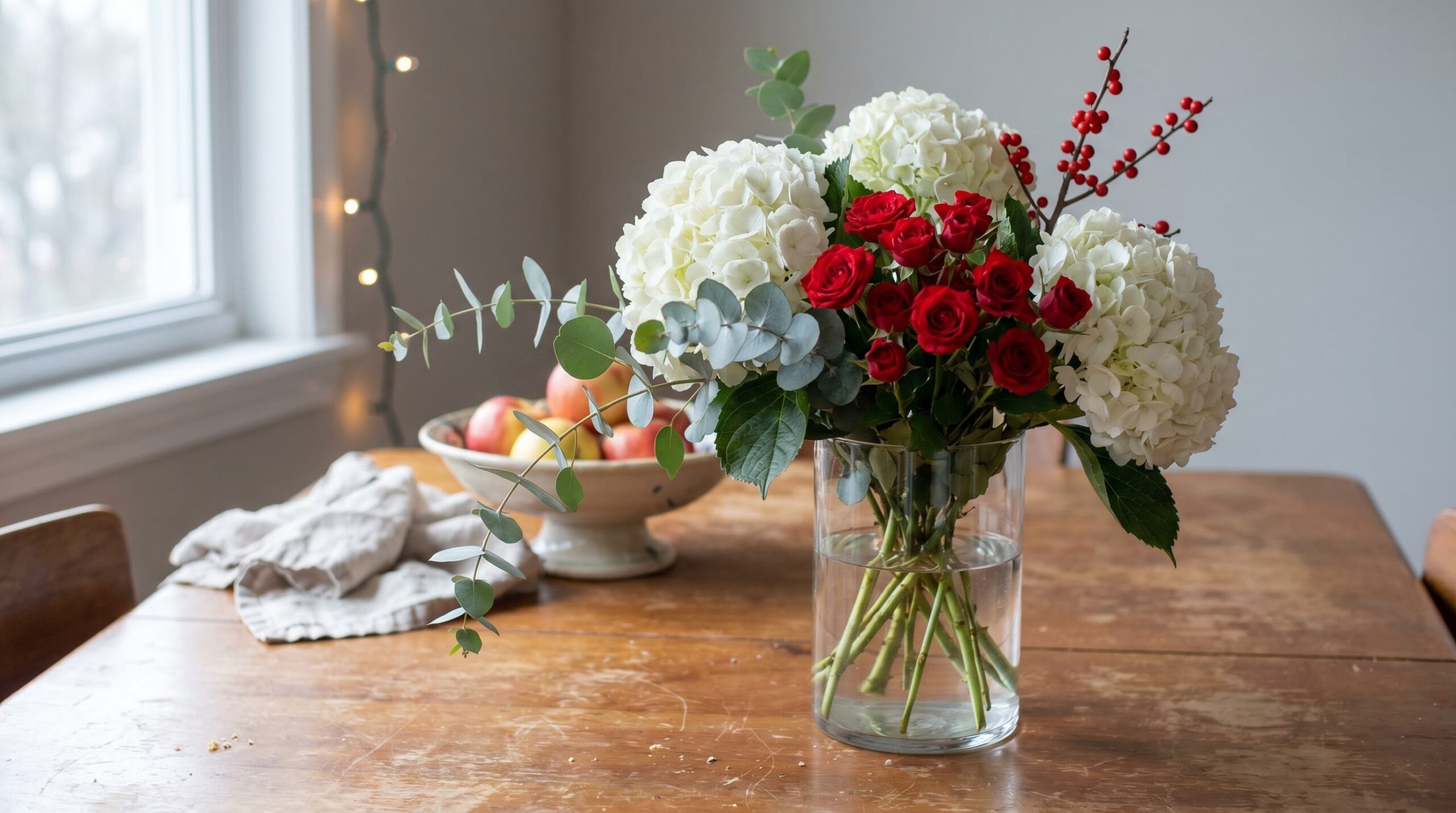
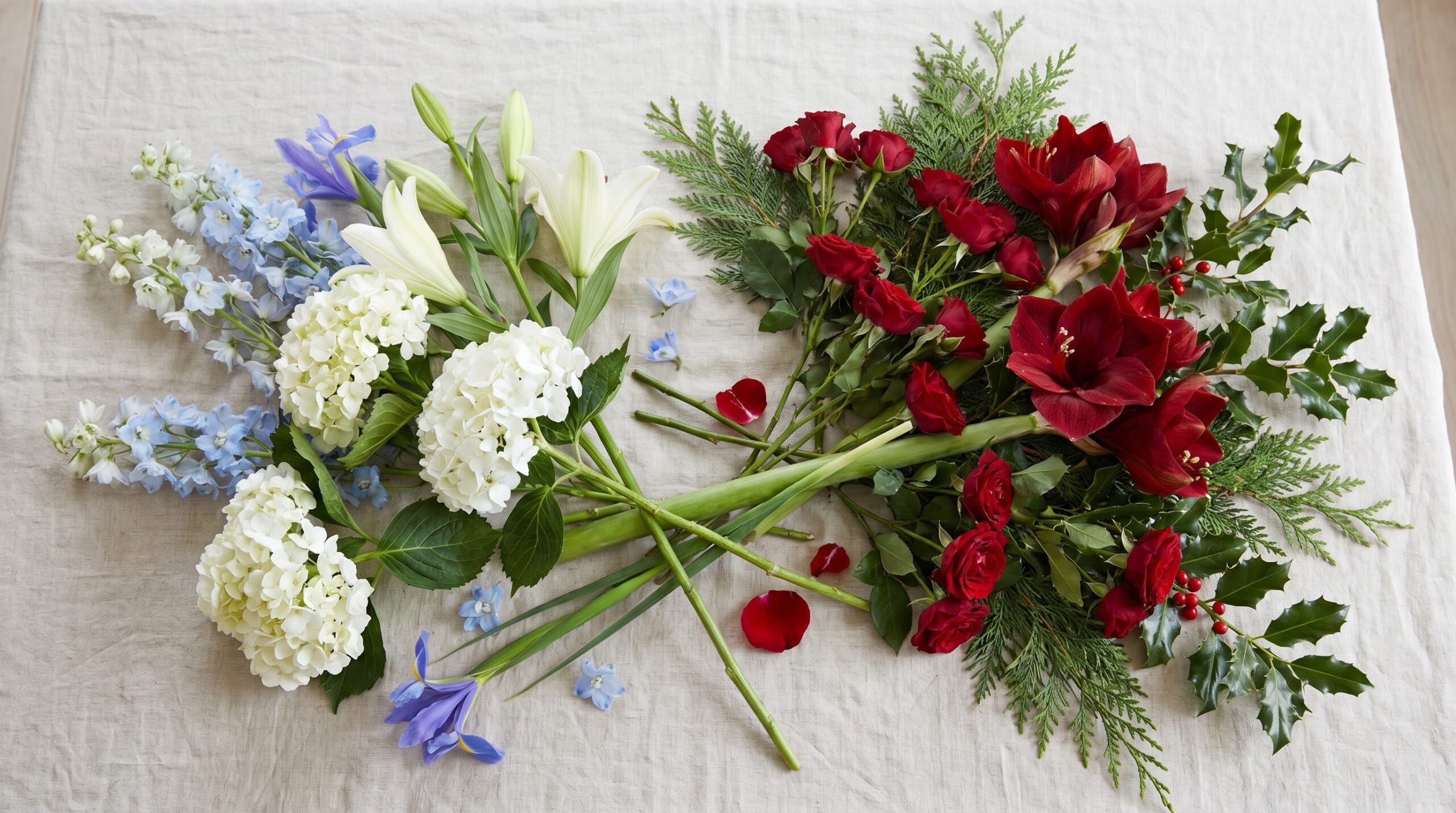
A mixed bouquet from the regular grocery run is a real Christmas flower source, not a lesser substitute for a florist order. On r/traderjoes, the same combination gets named again and again by people who clearly love it: white hydrangeas, red spray roses, eucalyptus and red berry branches, all for a grocery-store price. That kind of loyalty, repeated across more than a few threads, is not nothing. If white is what you want, whether from that supermarket mix or on its own, the guide to white flowers includes several December-blooming options built for exactly this kind of arrangement. And if you are unsure whether flowers belong in your hand at all when you walk into someone else's house for the holiday, whether flowers are even an appropriate Christmas gift, and the hostess-in-a-vase rule is worth a look before you decide.
A DIY arrangement at supermarket-bouquet cost
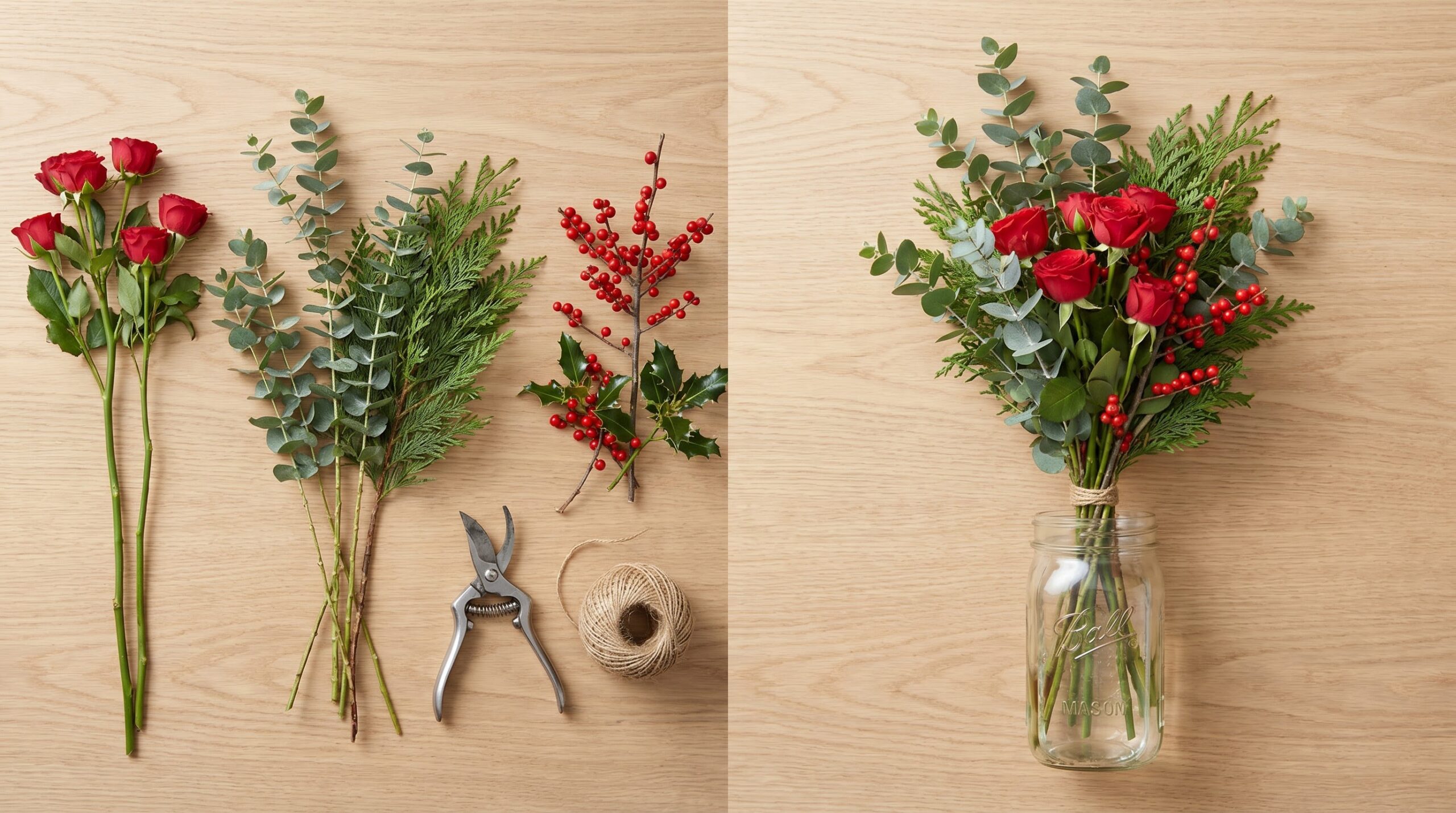
The cheapest route to something that looks intentional is stems, greens and berries, in that order. Start with three to five focal stems (a spray rose, a carnation, or a few amaryllis blooms if you're working with a taller vase), add a handful of greenery for volume (eucalyptus, cedar or pine picked up alongside the flowers), and finish with a few berry branches or a stem of holly for texture and that unmistakable Christmas note. Florists sometimes call this a 3-5-8 shorthand, roughly three focal flowers, five greenery stems and eight smaller filler pieces, though the exact numbers matter less than the idea behind them: odd counts and uneven groupings read as natural, while even, matched pairs read as stiff. Trim every stem at an angle before it goes in water, strip any leaves that would sit below the waterline, and the whole thing holds up for the better part of a week.
Rounding out the season
Christmas is not the only flower-adjacent holiday on the December calendar, and a mixed household or a mixed office often wants something that nods to more than one of them. Hanukkah's traditional palette is blue and white, echoing the colors of the Israeli flag, so a bouquet built around white hydrangeas or lilies (skip the lilies in a house with cats, since true lilies are lethal to them) with a few blue accents reads correctly to anyone who knows the holiday. Kwanzaa runs on red, black and green, the colors tied to African heritage, ancestry and the land, and a bouquet leaning into deep reds and greens rather than the brighter Christmas palette can honor both holidays in the same arrangement without much extra effort.
Flowers also show up on graves this time of year, and the vocabulary is worth knowing even if the grief itself isn't something this page is built to cover. A grave saddle is a horizontal arrangement built to sit across the top of a headstone; a grave blanket is a larger, flatter arrangement, traditionally woven from evergreen boughs, that lies over the grave itself. Rules vary by cemetery, and some, especially national cemeteries, only allow seasonal decorations during set windows, so it's worth a call before buying anything. For anyone facing a first Christmas without someone, flowers for a first Christmas without someone covers that specific and harder version of the season.
For December's own birth flowers, narcissus (the paperwhite's cousin) and holly both carry the month, and December's birth flowers, narcissus and holly goes into what each one means for someone born that month, separate from their role as holiday plants.
Is there an official Christmas flower?
No single flower holds that title officially. Poinsettia is the closest thing to a default because of decades of marketing and its wide availability, but amaryllis, holly, Christmas cactus and the rest all have genuine claims to the tradition, and florists and gardeners have used all of them for generations without treating poinsettia as mandatory.
Why do some hospitals turn poinsettias away at the door?
Many hospitals restrict live plants and cut flowers in certain units, poinsettias included, mostly over infection control, allergy risk and clutter around medical equipment rather than any real toxicity concern. Policies vary by hospital and even by floor, so a quick call to the unit before you show up saves a wasted trip.
What's a good flower for the five-gift rule?
If your household uses the five-gift rule (something they want, need, wear, read, plus one extra), a living plant fills the "want" or the bonus slot cleanly. An amaryllis bulb kit or a small potted Christmas cactus works as a gift that outlasts the holiday, rather than one more thing to unwrap and set aside.
Do I need to worry about poinsettia sap or leaves if I have a cat?
Not the way older stories suggest. Poison-center data shows the plant causes mild irritation at worst in the overwhelming majority of cases, a far cry from the fatal reaction the 1919 story implied. Still, keeping any plant out of a determined cat's reach is simpler than testing how mild "mild" really is.
Enjoying our flower guides? Add YourFlowersGuide as a preferred source on Google. It helps more readers find us.
Add to Preferred Sources