Every wedding flower order sorts into three groups. Personals are the flowers people carry or wear: bouquets, boutonnieres, corsages, a flower crown if you want one. Ceremony flowers dress the spot where you say your vows: an arch or altar piece, aisle markers, the welcome sign. Reception flowers fill the party: centerpieces, the head table, the cake, bud vases on the bar. Across those three groups sit about eighteen positions a florist can quote you for, and every one of them is listed below. Two are genuine musts. The rest get sorted must, nice or skip at three budget levels, with the ordering dates that hold the whole plan together and a printable version you can mark up and carry into your florist meeting.
The sorting is the point, because the two fears behind this list pull against each other. The first is forgetting something that only surfaces on the day itself: grandmother's corsage, the officiant's boutonniere, the cake flowers nobody claimed. The second is being upsold, that quiet suspicion a template is talking you into arrangements no guest will ever register. The fix for both is the same document. See every position once, then cross off deliberately instead of discovering the gaps at the rehearsal.
Every flower position, group by group
Florists call the first group personals, and it is the group with names attached. The bridal bouquet anchors it. Then bridesmaids' bouquets, usually smaller versions in the same palette. The groom's boutonniere, one for each groomsman, and boutonnieres for fathers and grandfathers. Corsages, small arrangements pinned at the shoulder or tied at the wrist, go to mothers and grandmothers. The flower girl rounds the group out with petals, a tiny bouquet or a crown. Personals are the emotional core of the order and the part families actually keep track of.
Ceremony flowers are fewer but bigger. The arch or altar arrangement is the main event. Florists file large built pieces like this under installs, which is why they carry labor charges on top of the stems. Aisle markers hang on chair ends or line the walkway. A welcome sign might get a corner cluster of blooms. Some couples add a petal toss for the exit. That is the whole category.
Reception flowers are where quotes swell. Centerpieces for every guest table. A larger piece for the sweetheart or head table. Cake flowers, if your baker agrees to place them. Bud vases, single-stem bottles that scatter across the bar, the cocktail tables and the gift table. Some templates go further and put arrangements in the restrooms. Plenty of florists now sell personals a la carte, boxed and delivered with no installs at all, which is worth knowing before you assume you need a full-service package. What each of these positions costs, and who traditionally pays is its own article. This one is about deciding which rows deserve to exist.
The checklist: must, nice or skip
The three budget columns below are pinned to real spending data. The Knot's Real Weddings Study puts the national average for wedding flowers at $2,800, with the lower quarter of couples spending around $900, the median near $1,900 and the upper quarter around $4,800. Those three figures became the three columns. One honest wrinkle: WeddingWire's cost guide puts the average closer to $1,500, roughly half The Knot's number, and the gap says a lot about how survey averages get built. The cost article unpicks that dispute. For sorting purposes, the quartiles work fine.
| Flower position | Around $900 | Around $1,900 | $4,800 and up | Why it earns its row |
|---|---|---|---|---|
| Bridal bouquet | Must | Must | Must | In your hands through the ceremony, the portraits and half the reception; the most photographed flowers of the day |
| Groom's boutonniere | Must | Must | Must | Pinned into every couple photo; costs less than lunch |
| Bridesmaids' bouquets | Skip | Nice | Must | Carried down the aisle and through photos, then set down; the first thing real brides cut |
| Groomsmen's boutonnieres | Skip | Nice | Must | Visible in wedding party photos only; cut or simplify alongside the bouquets |
| Mothers' and grandmothers' corsages | Nice | Must | Must | Small cost, big feelings; the item families notice missing |
| Fathers' and grandfathers' boutonnieres | Nice | Must | Must | Same logic as the corsages; order them together |
| Officiant, readers, ushers | Skip | Nice | Nice | Pure etiquette; almost nobody expects these anymore |
| Flower girl petals or crown | Skip | Nice | Nice | About forty seconds of aisle time; a basket of petals does the job |
| Ceremony arch or altar piece | Nice | Must | Must | The backdrop of your vows and ceremony photos; moves to the reception afterward |
| Aisle markers | Skip | Skip | Nice | Seen while guests wait; the first cut florists themselves suggest |
| Welcome sign flowers | Skip | Nice | Nice | One small cluster reads as styled; a bare sign reads fine too |
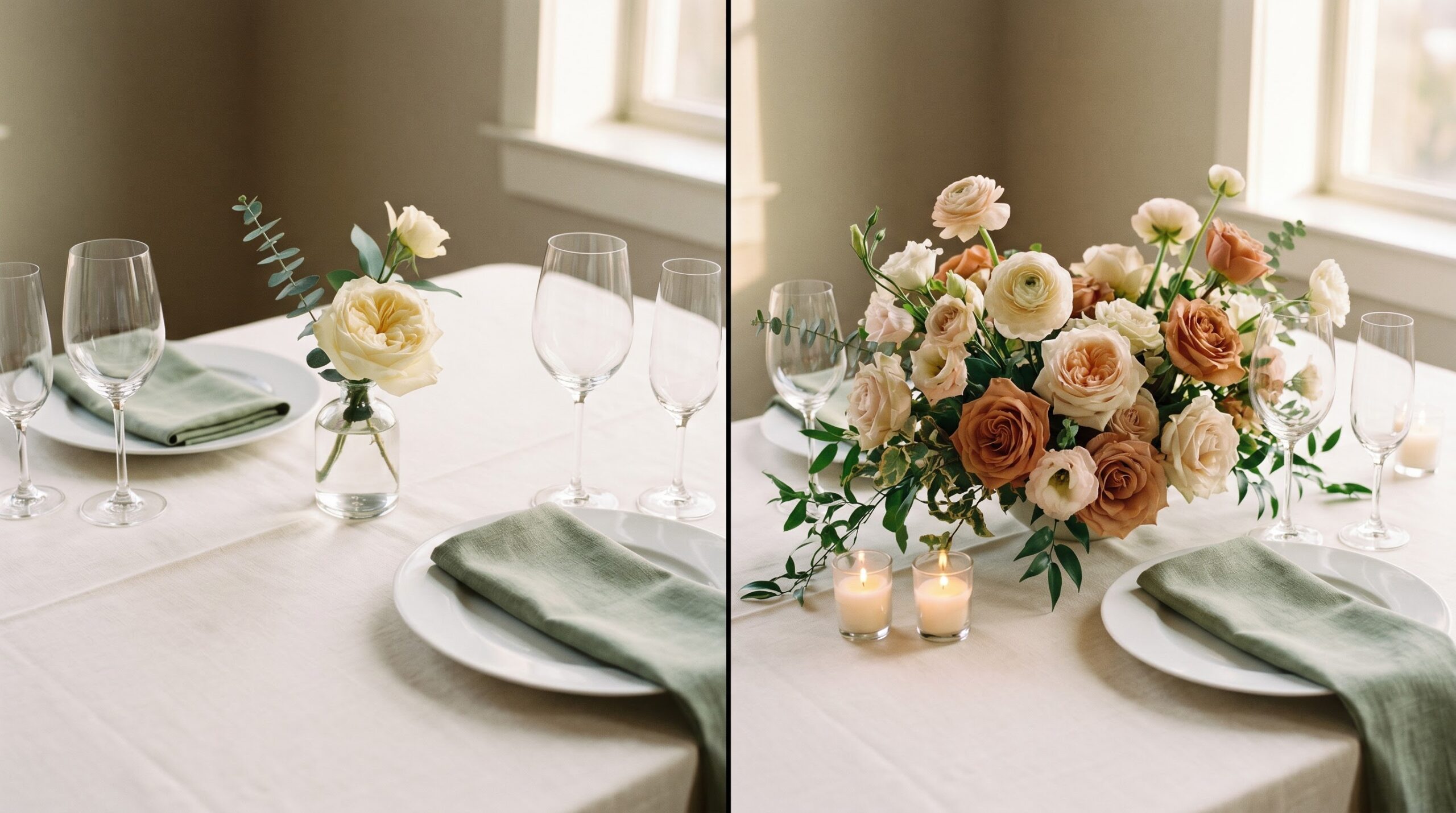
| Reception centerpieces | Nice | Must | Must | The flowers guests actually sit with for four hours |
| Sweetheart or head table piece | Nice | Nice | Must | Behind you in every toast photo; bridesmaids' bouquets can fill this row for free |
| Cake flowers | Skip | Nice | Nice | A few stems; confirm the baker will place food-safe blooms |
| Bud vases for bar and cocktail hour | Skip | Skip | Nice | Cheap singles; the easiest DIY on the whole list |
| Gift and place card table | Skip | Skip | Nice | Guests pass it once |
| Restroom arrangements | Skip | Skip | Nice | The line item that pads a quote; cut without guilt |
| Petal toss or exit flowers | Skip | Skip | Nice | Confirm the venue allows it before you pay |
Swipe →
Read the lean column as a strategy. At around $900 the plan is personals plus one statement: bouquet, boutonniere, flowers for the mothers and grandmothers if the budget stretches, then either an arch piece or centerpieces, whichever room your photos will live in. At the middle tier the musts widen to the full family set, the arch and the guest tables. The top tier is the only place where aisle markers, bud vases and restroom arrangements stop being padding, because at that spend you are styling a whole environment and thin corners show.
Before cutting anything, make each arrangement work twice. The arch piece can walk to the reception during cocktail hour and stand behind the head table. Bridesmaids' bouquets drop into waiting vases and become the head table flowers, which zeroes out that row entirely. Aisle arrangements regroup around the cake. Florists do this on request, and DIY couples just need to assign a carrier. Every double-duty piece is one fewer line on the quote.
The skip column has real voices behind it. A wedding DJ with years of receptions behind him wrote that in all his time working weddings, he has never heard anyone say, "There weren't enough flowers." A bride planning her own wedding put the bridal party math plainly: "$50 a bouquet? I love all my girls, but that's just an unnecessary expense." WeddingWire's per-item averages back her instinct, around $75 for a bridesmaid bouquet against roughly $160 for a bridal one, so a party of six runs about $450, nearly three bridal bouquets' worth. And one guest recalled that her sister's wedding had only the bouquets and boutonnieres, nothing else, "and I say she had to tell me because I genuinely did not notice." Guests register light, music and dinner. They remember the bouquet because it appears in every photo. The rest is texture.
If your number is fixed rather than flexible, what $500, $1,500 and $3,000 actually cover sorts this same list against three hard caps.
Who gets flowers
The recipient list is the part that surfaces during the final week if nobody writes it down early. Worn or carried flowers traditionally go to:
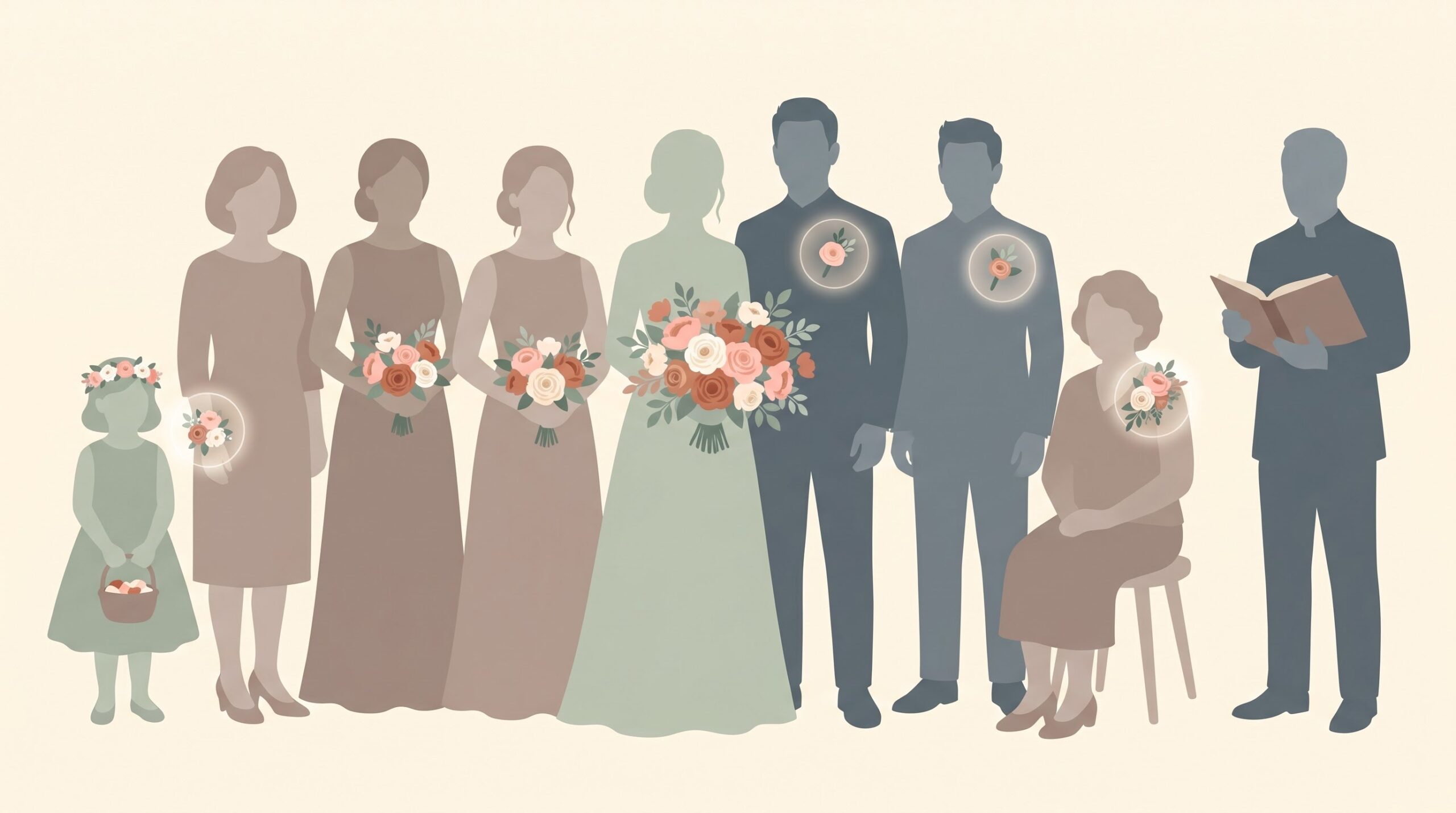
- the couple: a bouquet and a boutonniere, or two of either - bridesmaids and groomsmen - both mothers and both fathers - grandmothers and grandfathers - the flower girl and ring bearer, petals or a miniature boutonniere - optionally: the officiant, readers, ushers and stepparents
The stepparent line deserves a decision in month one, when it costs a calm conversation, because a corsage costs a few dollars and an overlooked stepmother costs considerably more. Officiants and readers are genuinely optional now; a boutonniere for a beloved uncle performing the ceremony is a kindness, and a paid officiant will not expect one. Order every personal from the same maker so the palette holds across photos, and ask about magnetic fastenings for grandmothers, which many florists offer because pins and delicate fabrics argue. Old etiquette, as The Knot's guidance lays it out, has the groom's side paying for the bridal bouquet and the corsages while the bride's side covers most of the rest. Treat that as trivia unless your families still keep score; the cost article covers the modern version.
The dates that decide everything
A checklist with no dates on it is just a shopping list. Three anchors turn it into a plan.
Book the florist the moment the date and venue exist. A working florist on a floristry forum put the stakes bluntly: "I can't even begin to tell you the number of brides/couples I've turned away because they wait until the last minute." One caller wanted full wedding flowers for the following weekend. She did not get them. Popular Saturdays go to whoever asked first, and full-service florists take a limited number of weddings per weekend.
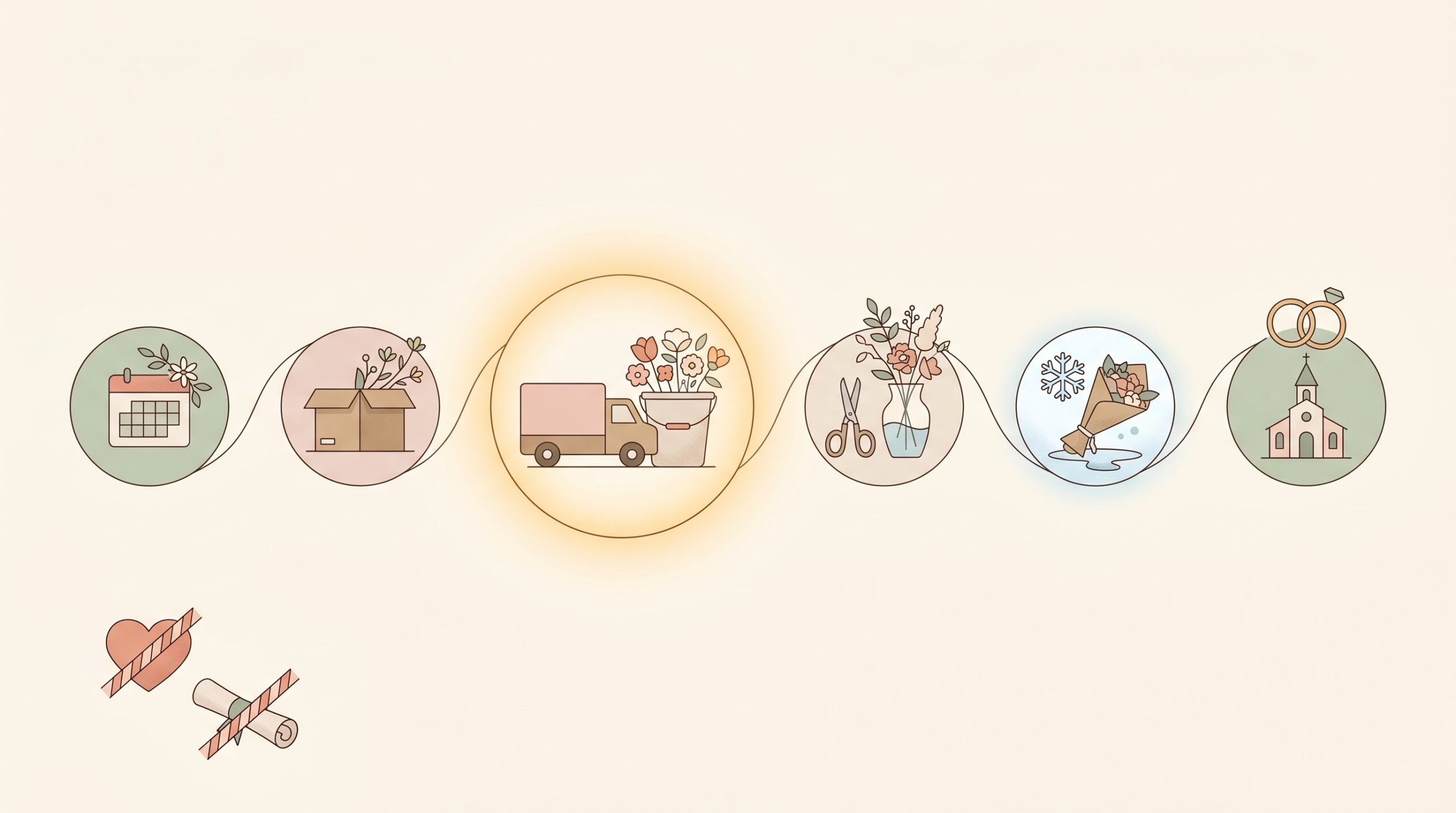
For DIY orders, the most useful anchor comes from a couple who did their own flowers and wrote up the playbook afterward: "The gamechanger for us was finding out we should target Wednesday delivery for a Saturday wedding, with Thursday for putting the arrangements together." Wednesday delivery leaves a full day of buffer if a box arrives bruised and needs replacing. Thursday arranging keeps Friday clear for the rehearsal. Nothing floral happens on the wedding morning except distribution.
| When | What happens |
|---|---|
| Date and venue booked | Book the florist, or commit to DIY; peak Saturdays fill far ahead |
| About a month out | Confirm final counts with the florist, or place the wholesale bulk order; every supplier posts an order cutoff, find yours before you count on them |
| Wednesday | Flower delivery for a Saturday wedding |
| Thursday | Arranging day |
| Friday | Personals labeled and kept cool; rehearsal, and nothing else |
| Saturday morning | Someone who is not you hands out flowers from the recipient list above |
Swipe →
Then check the calendar for collisions. Valentine's week and Mother's Day weekend are the flower industry's peak; wholesale prices climb and florists' books close early. Graduation season quietly empties shelves too. One DIY bride visited five stores hunting baby's breath and ended up crying in a grocery store when the florist told her she needed it for graduation bouquets. If your date sits near any of those, order earlier than the table says and hold your flower choices loosely.
Print it, mark it, take it with you
The printable version of this checklist repeats the table above with an empty must, nice or skip column and a blank date column, so you can sort against your own number instead of the national quartiles. Print two copies. One goes on the fridge. The other goes to the consultation, and what the florist will ask when you bring this list to the consultation is worth ten minutes before you walk in; florists quote faster and kinder from a prioritized list than from a folder of inspiration photos. If there is no florist in the plan at all, doing the list yourself, the honest decision and the last-week plan takes this same checklist and turns it into a bulk order and a Thursday.
Questions that keep coming up
Do you need flowers at a wedding at all?
No. Courthouse and civil weddings happen every day with a single bouquet or none. If flowers do nothing for you, spend on what does; guests genuinely track food, music and the bar line. One bouquet for the photos is the entire floral plan plenty of couples ever need.
Do the bouquets have to match the centerpieces?
No. They should share a palette so the photos hang together, but stem-for-stem matching is a convention florists themselves have dropped. Repeating two or three blooms across the personals and the tables reads as designed. Exact duplication just spends more on tables nobody photographs up close.
How many flowers do you need for a wedding?
That depends on which rows survive your cut, then on stems per item. A bouquet, a boutonniere and ten centerpieces is a very different order from all eighteen positions. How many stems each item on this list actually takes does that math item by item.