Taxonomy and origin
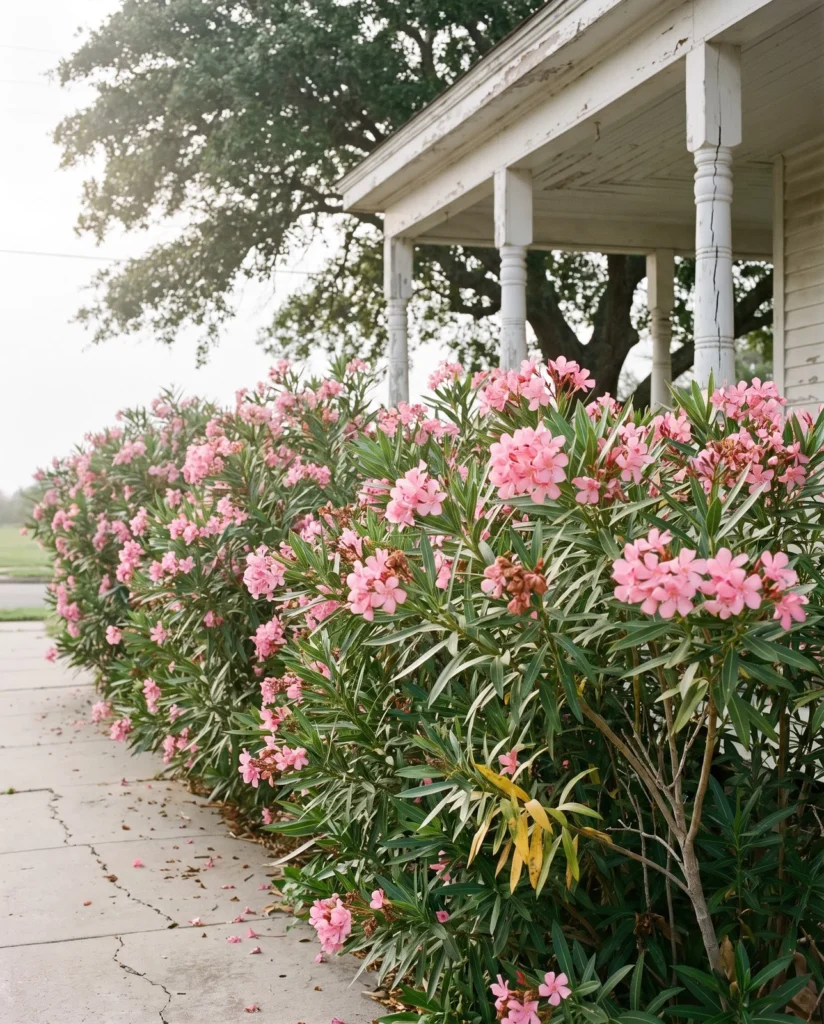
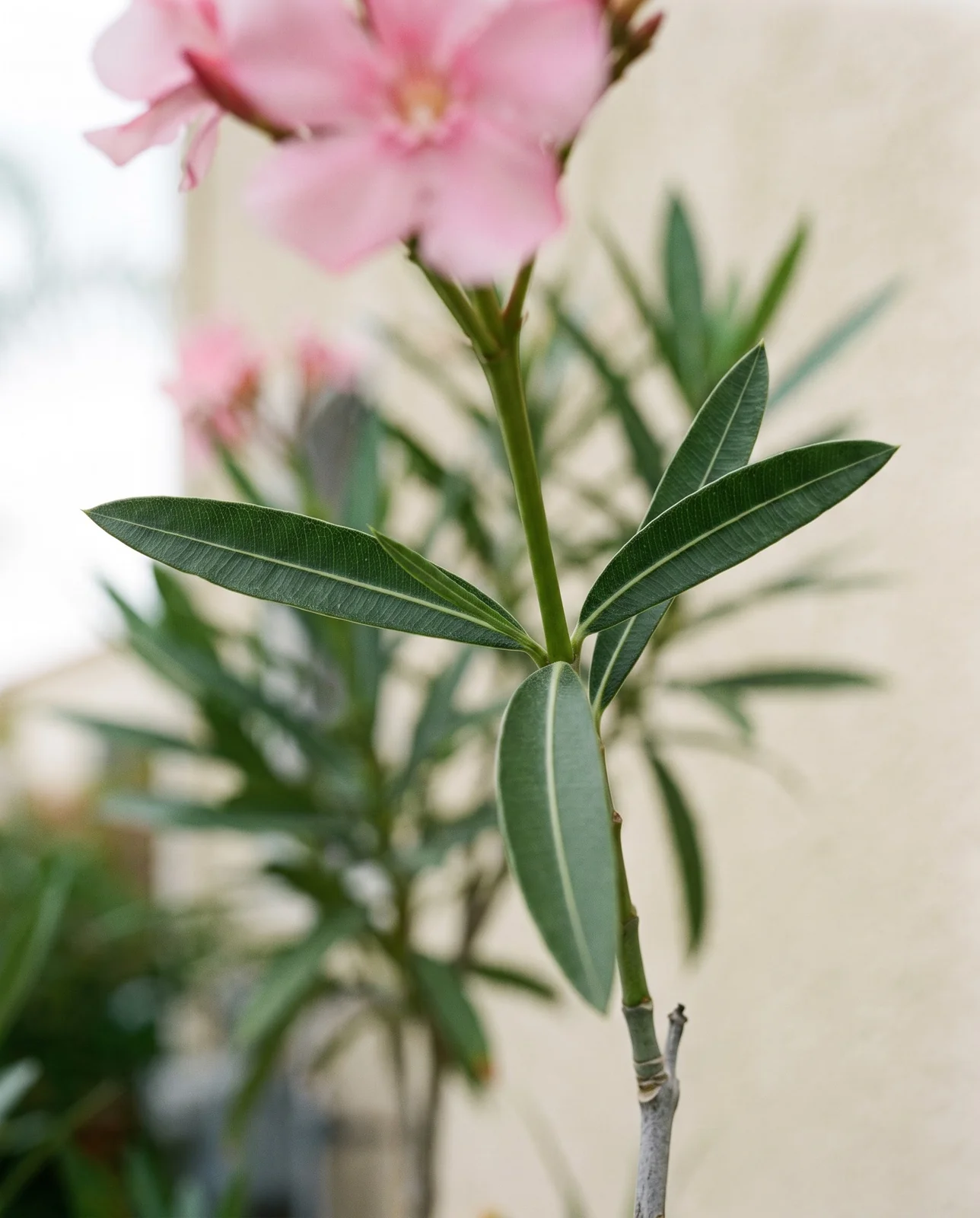
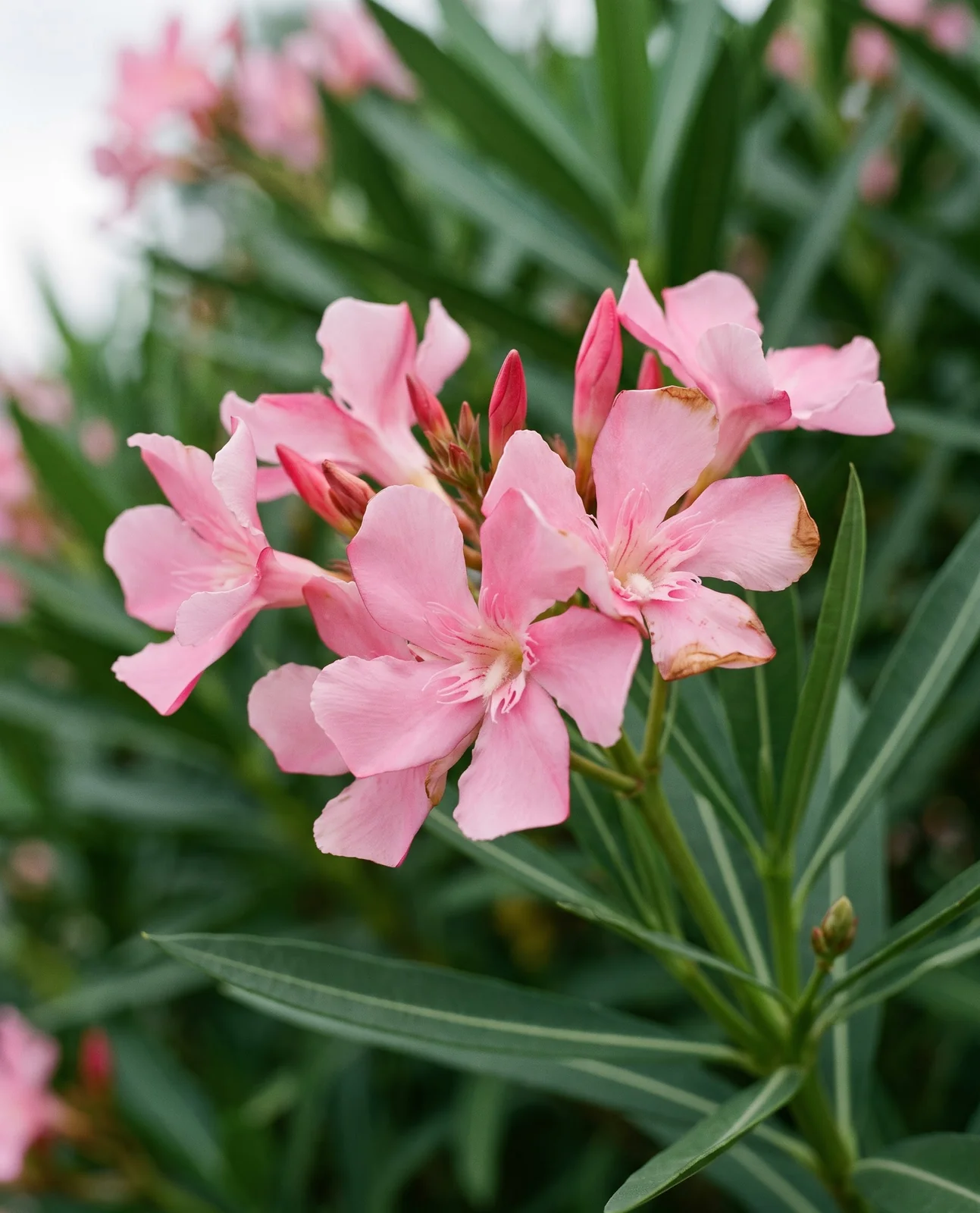
Oleander is a broadleaf evergreen shrub or small tree in the dogbane family, Apocynaceae, and the only species in the genus Nerium. Linnaeus named it in 1753. The second half comes from the Italian oleandro, for leaves like an olive's: narrow, leathery, stiff enough to hold their shape in wind. The flowers are five-petaled and about 1 to 1.5 inches across, carried in clusters at the tips of the shoots. Wild oleander grows in dry country with water underneath, along watercourses, gravelly ground, and damp ravines in northern Africa and the eastern Mediterranean, east into southern Asia.
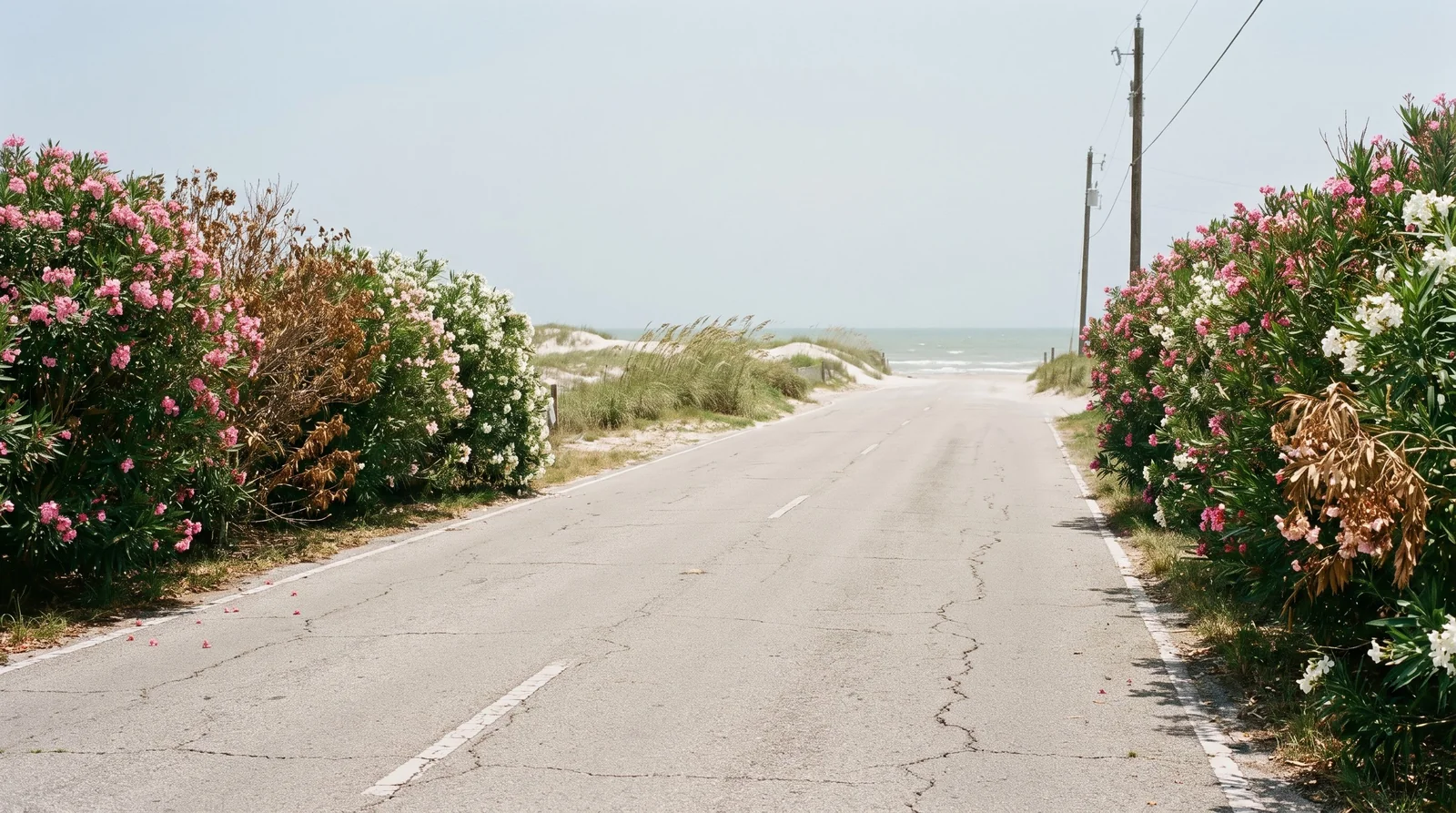
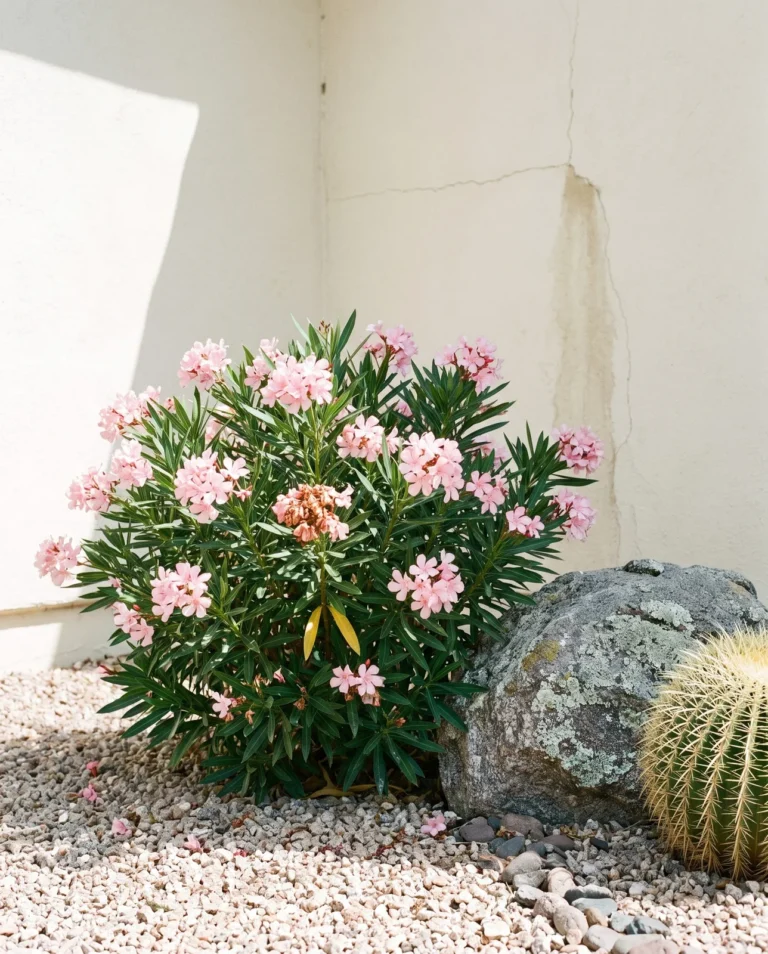
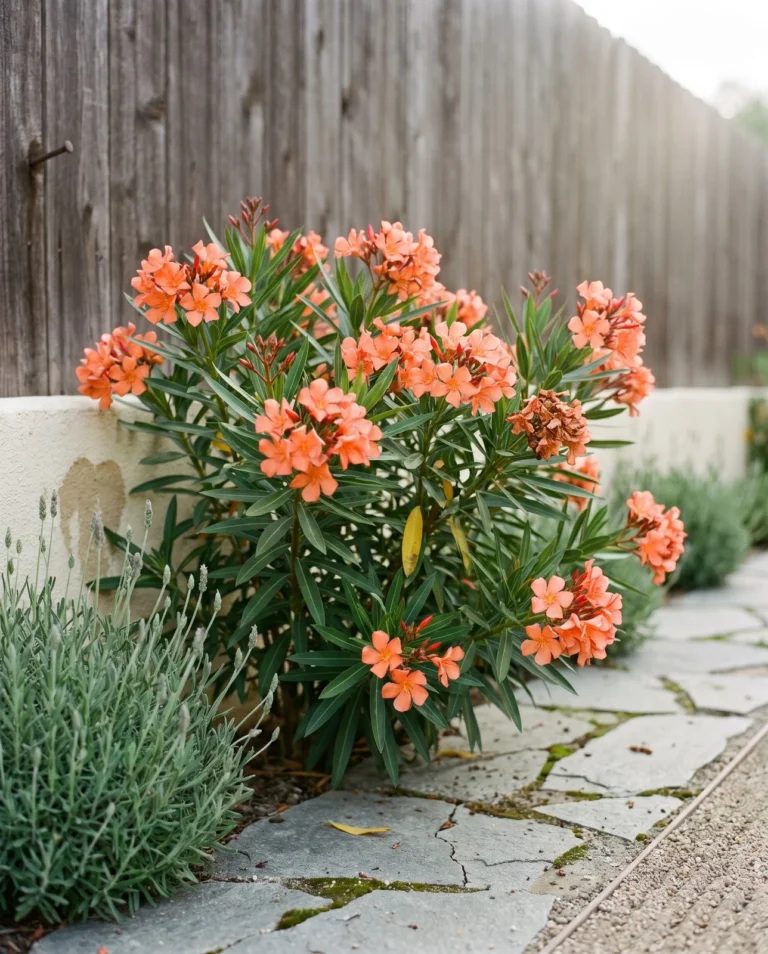
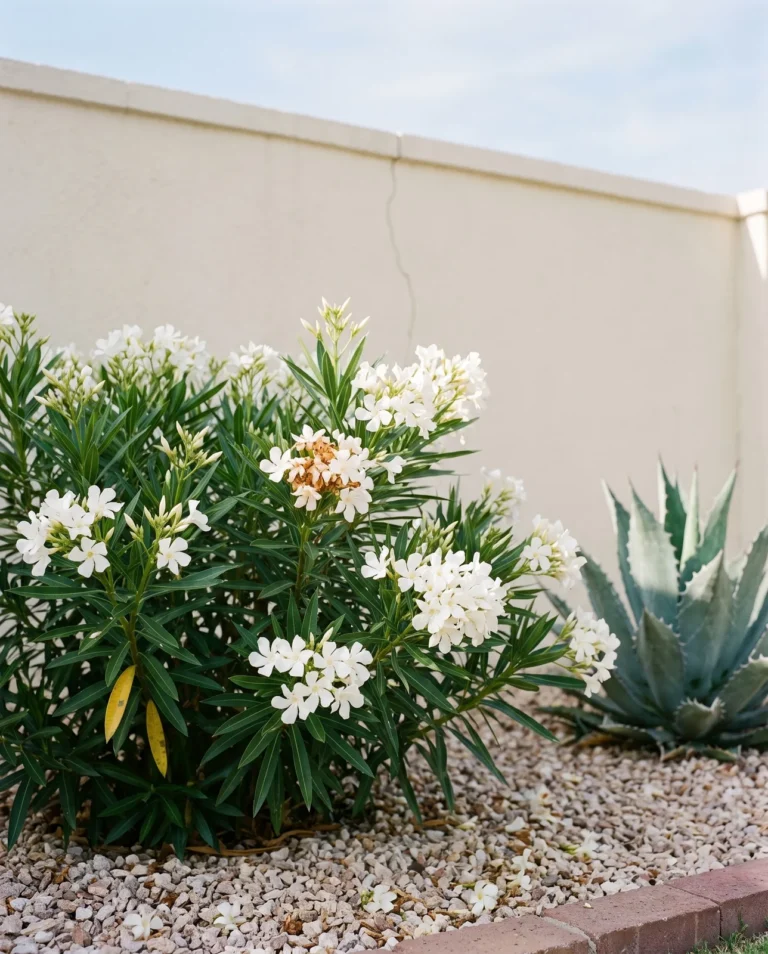
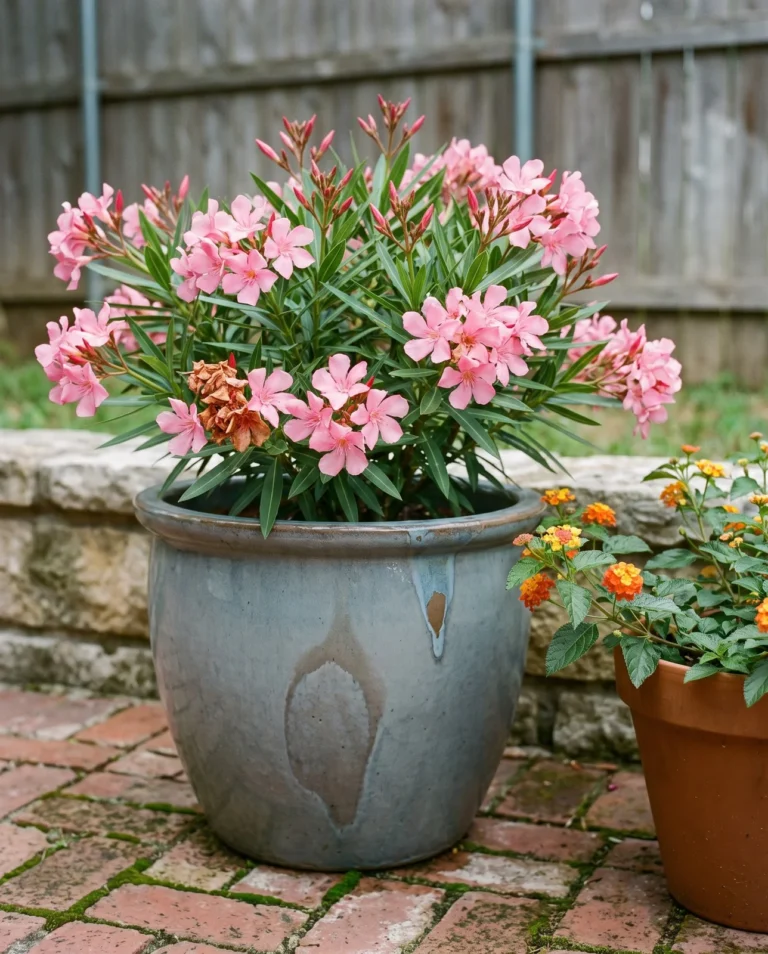
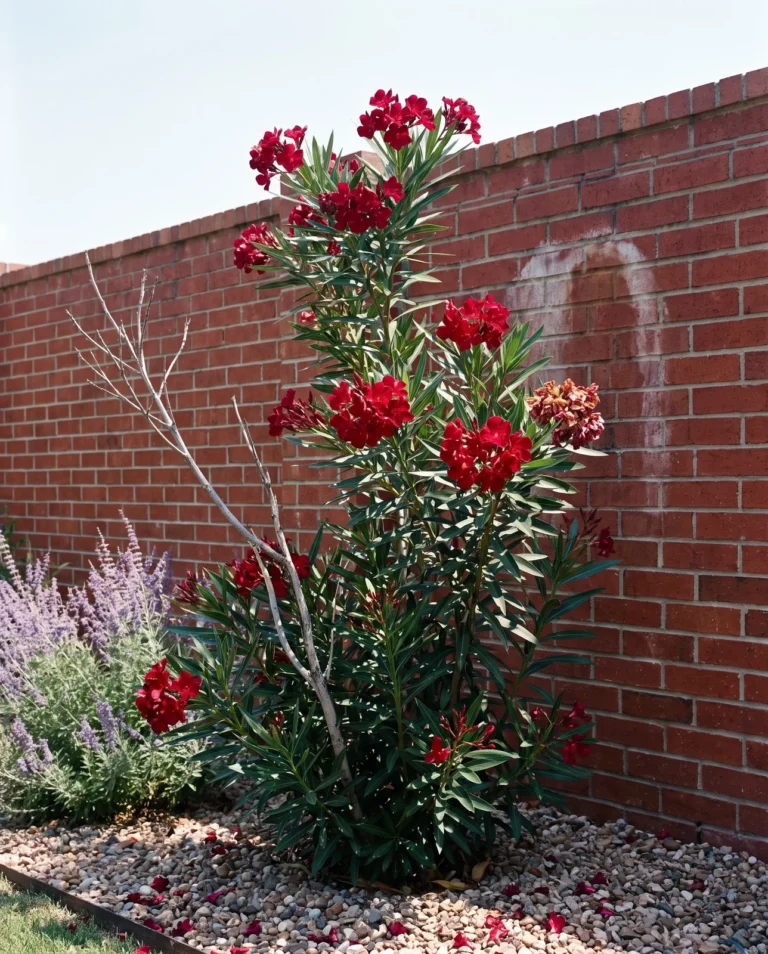
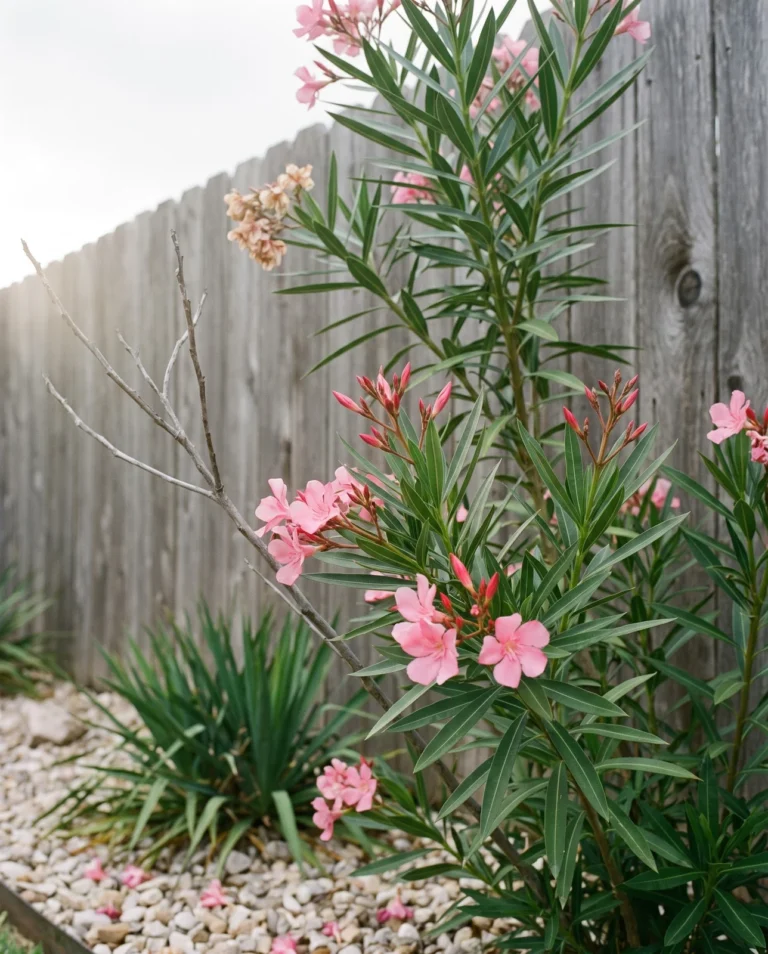
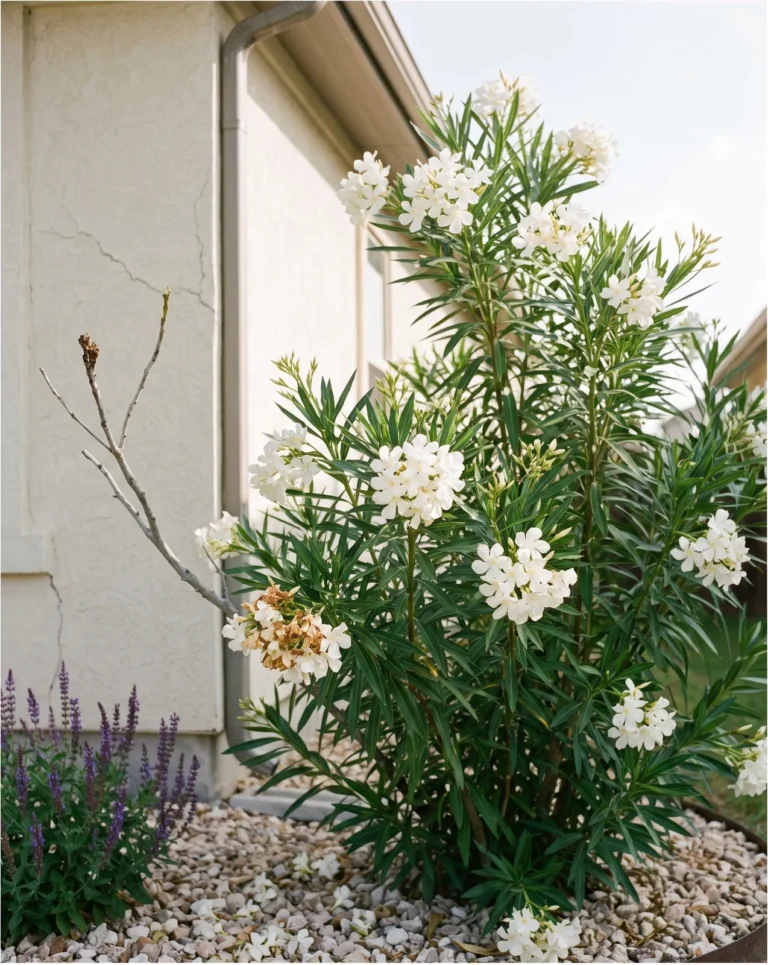
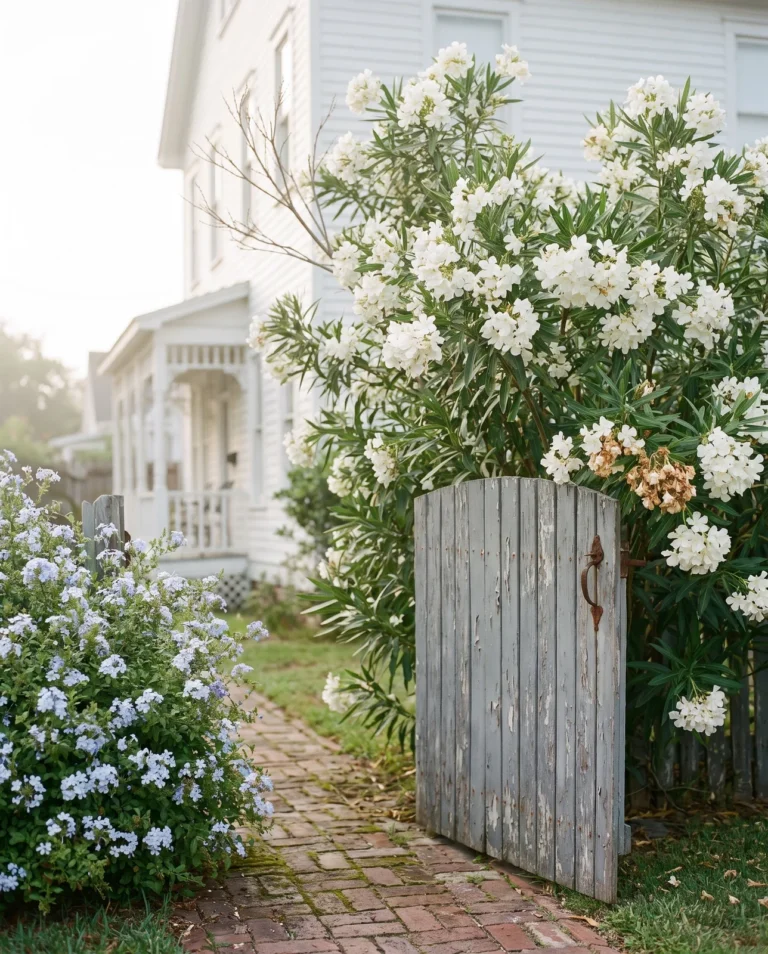
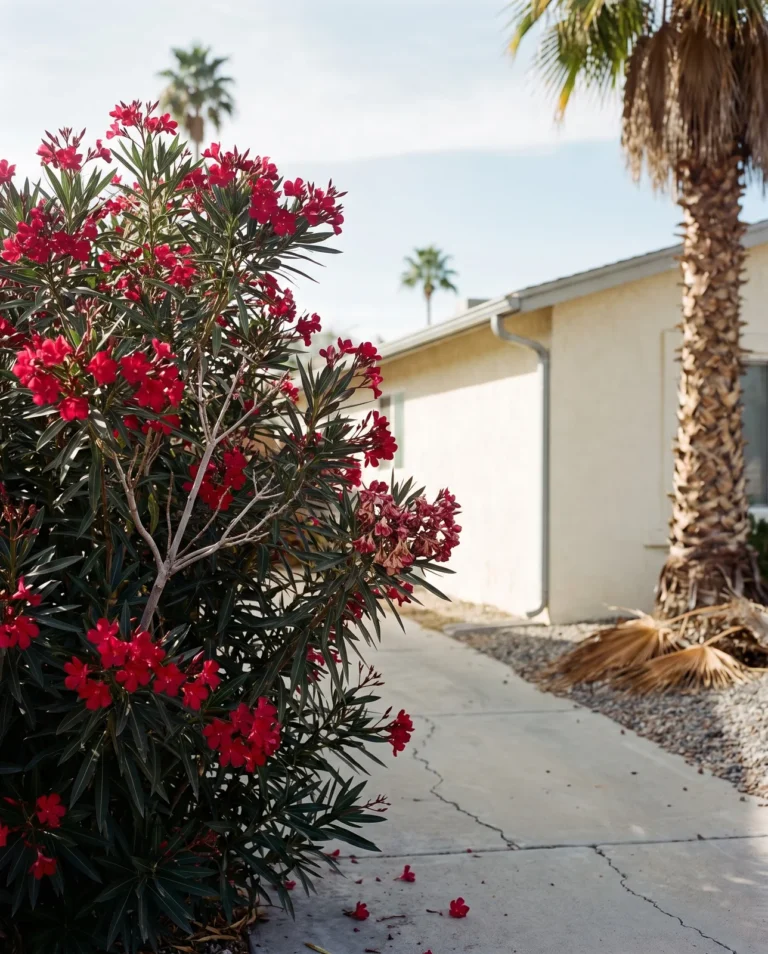
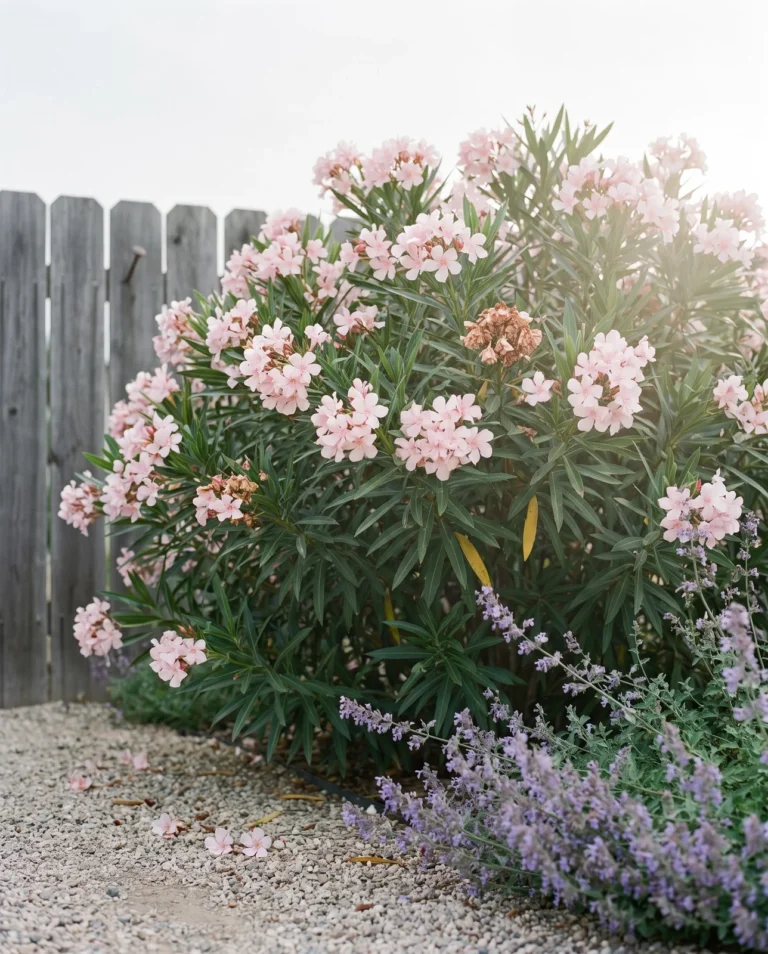
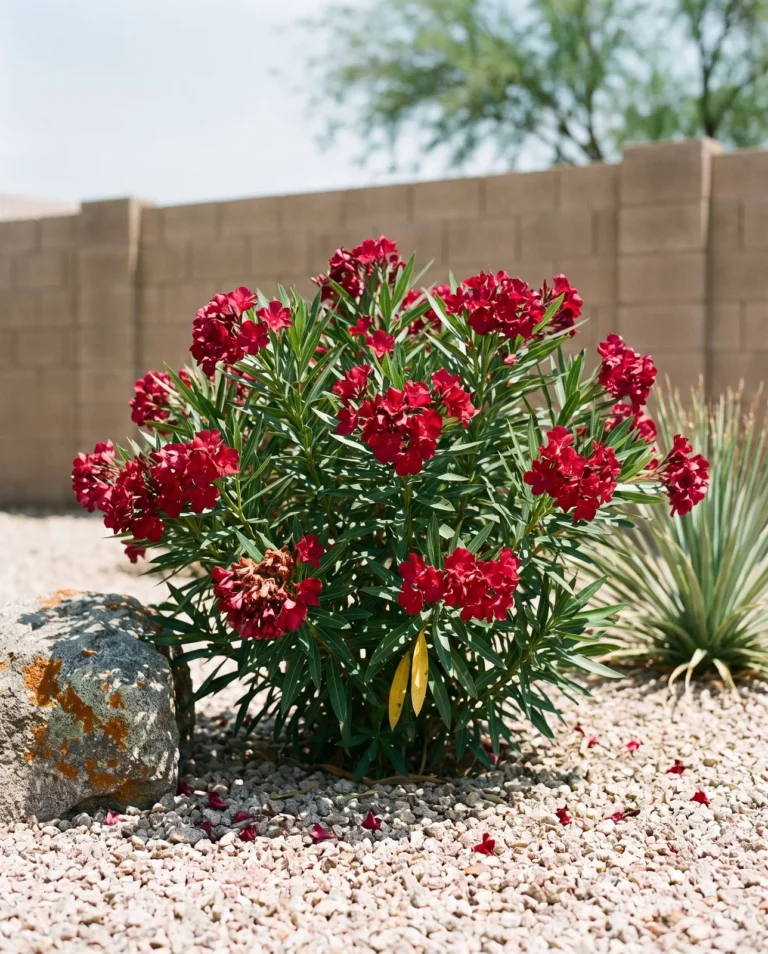
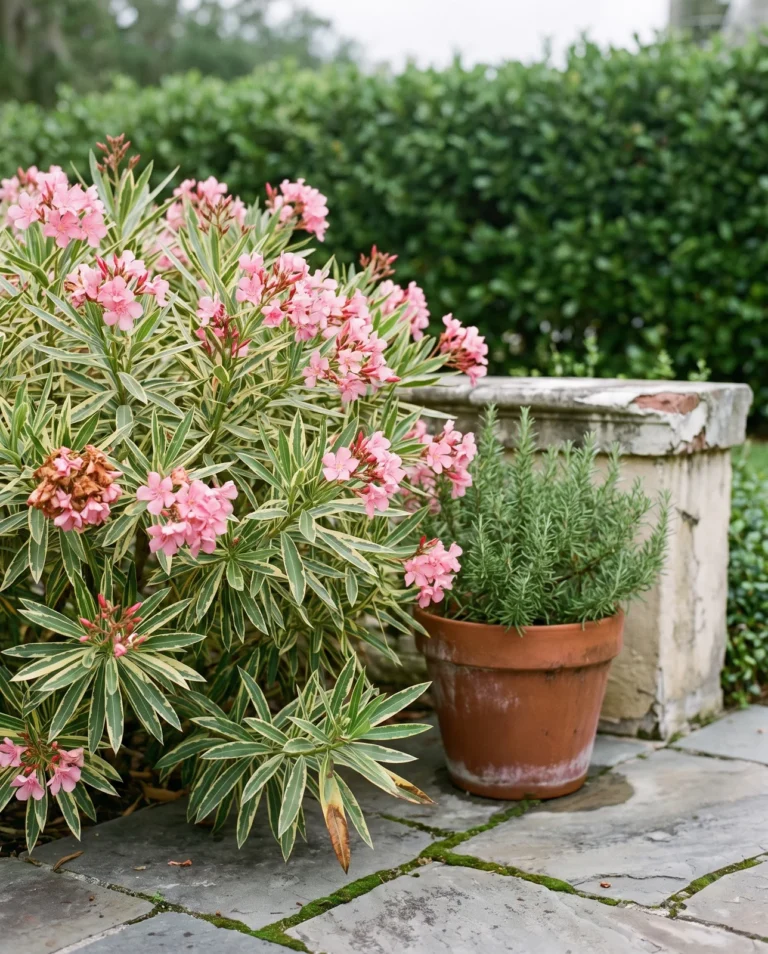
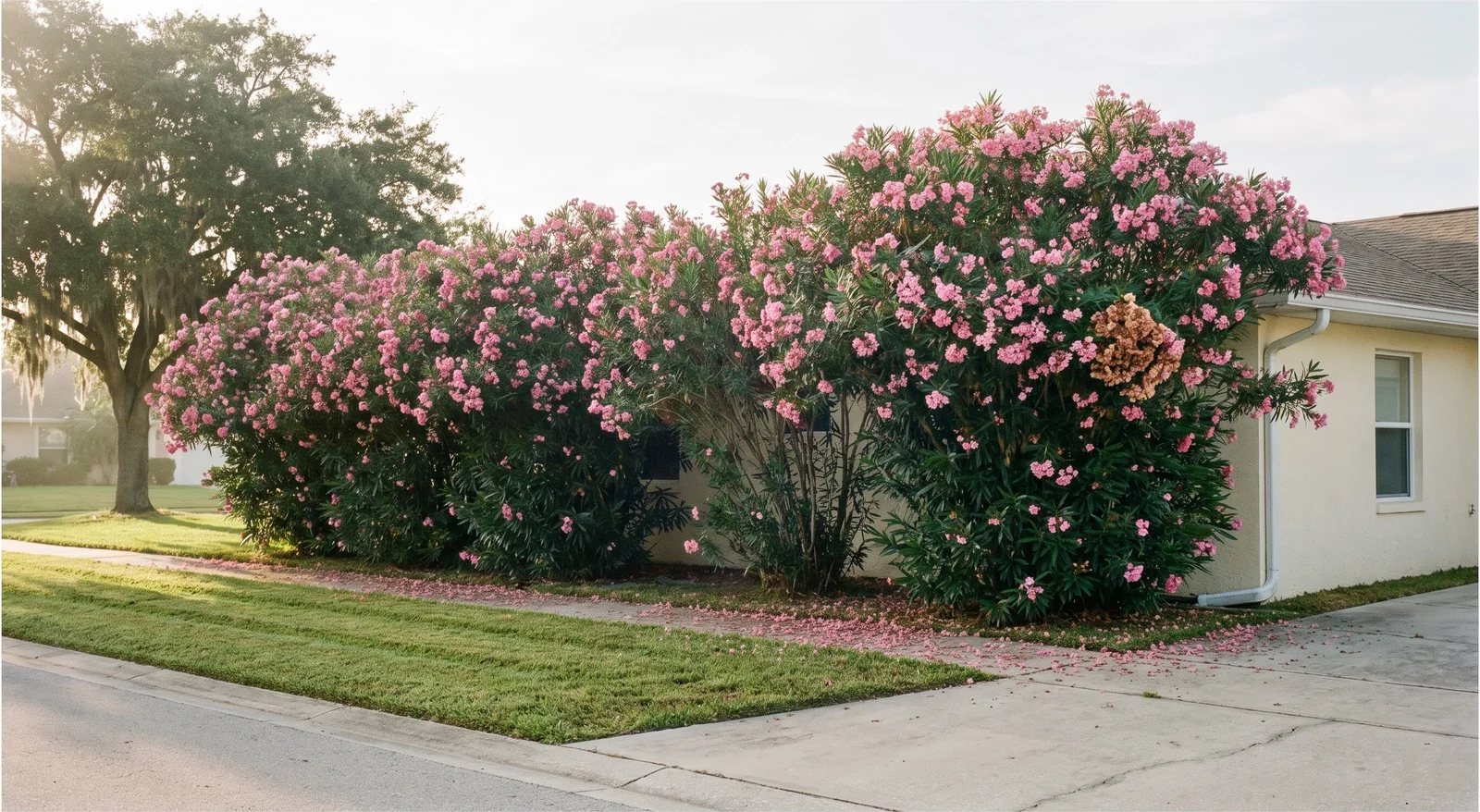
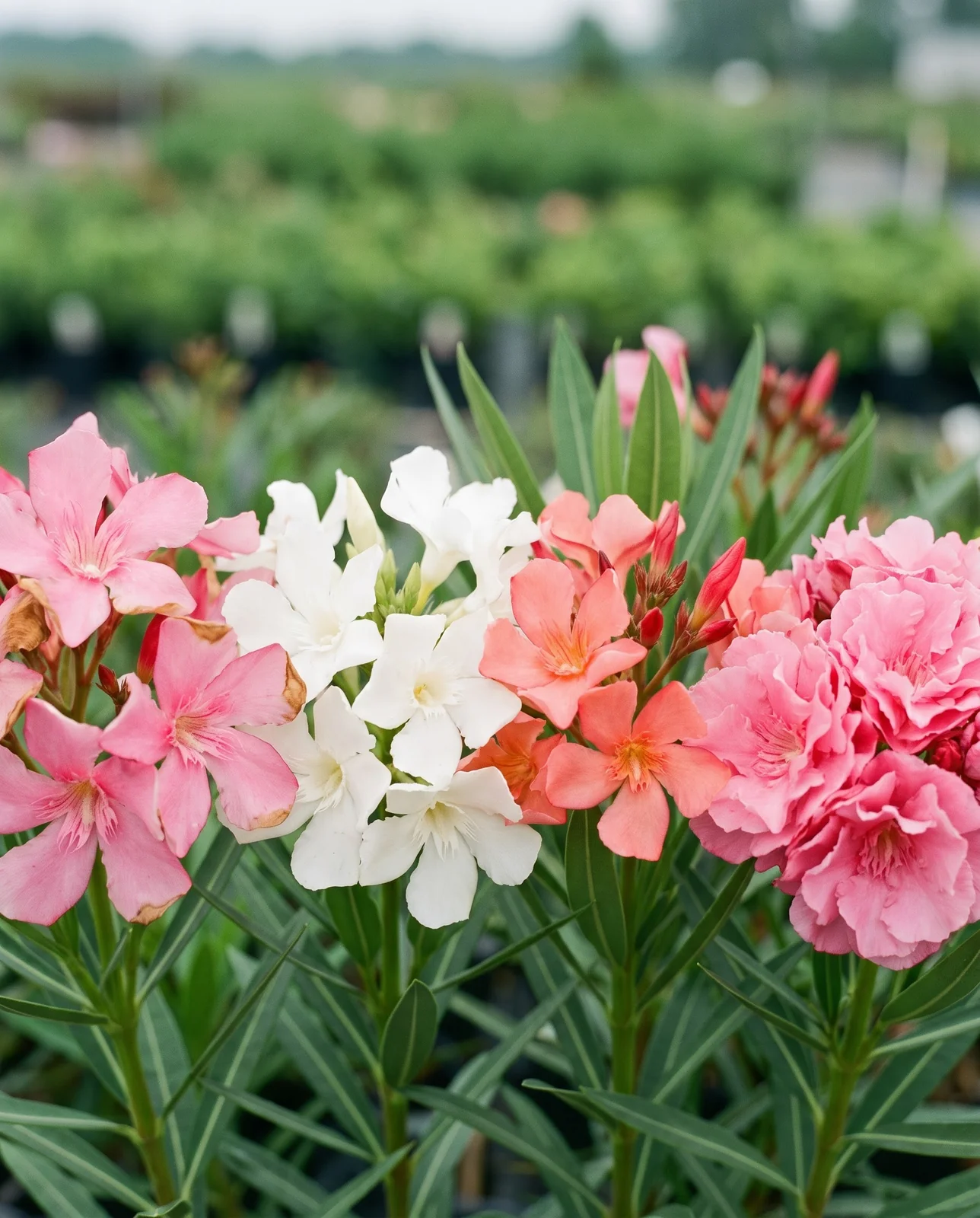
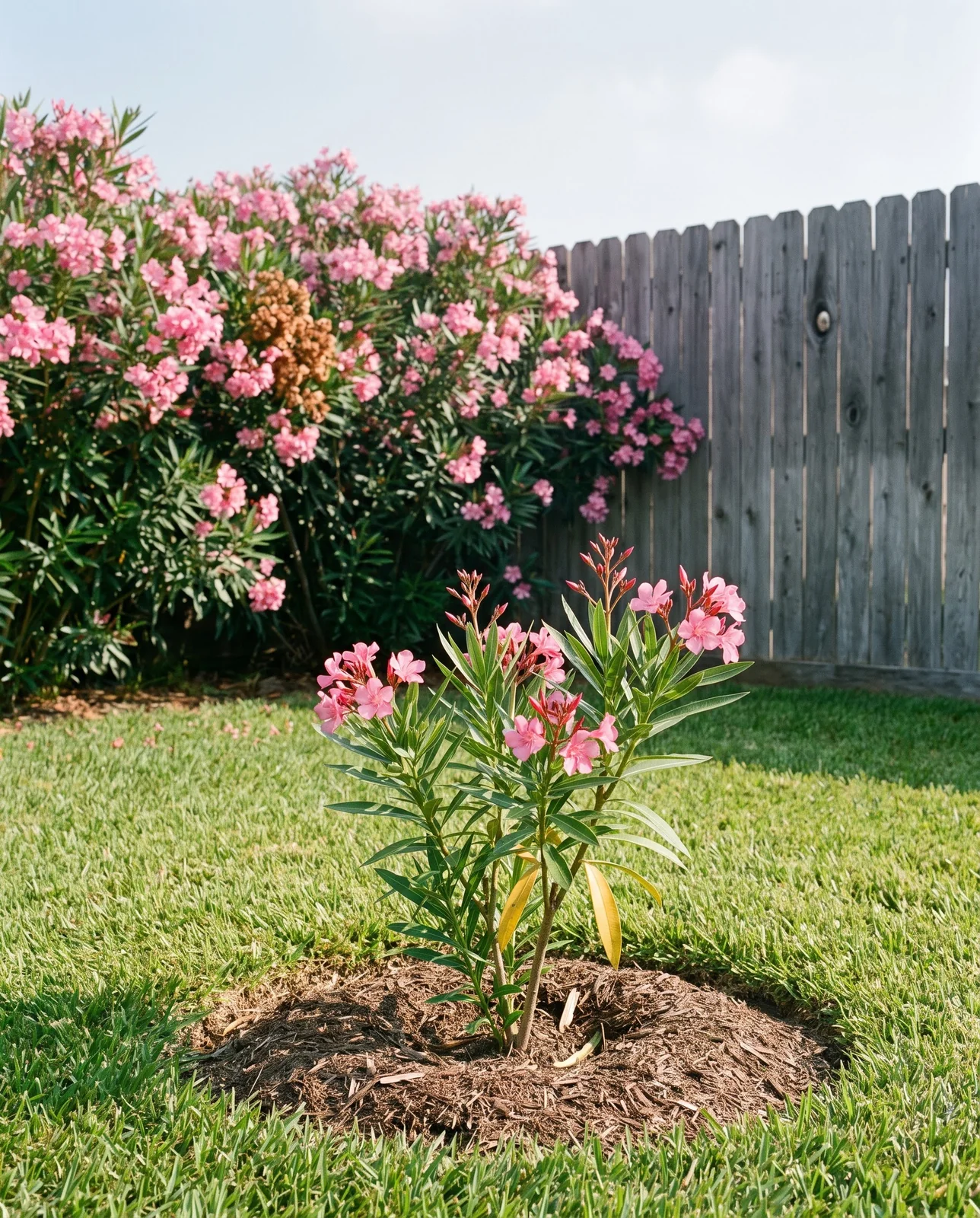
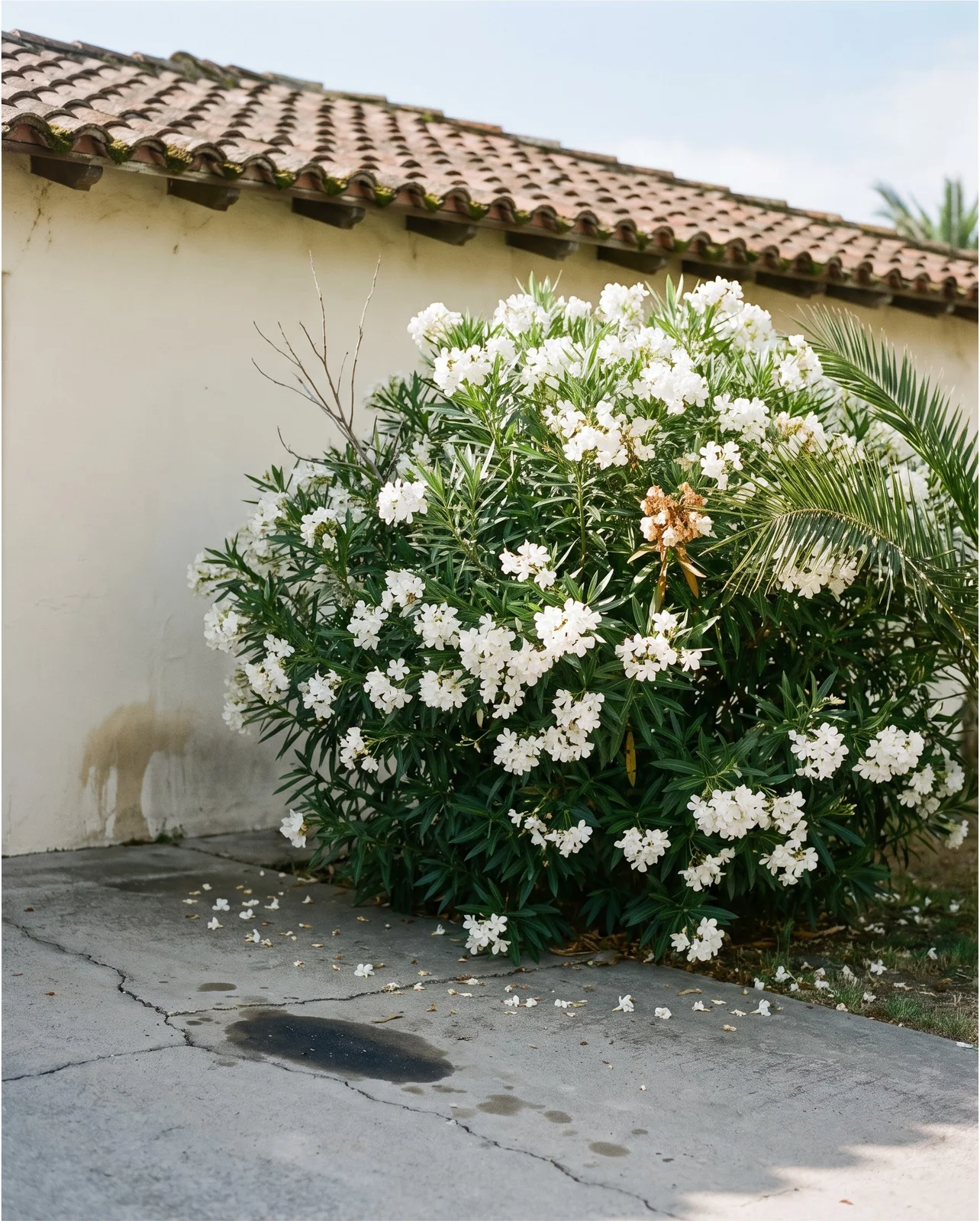
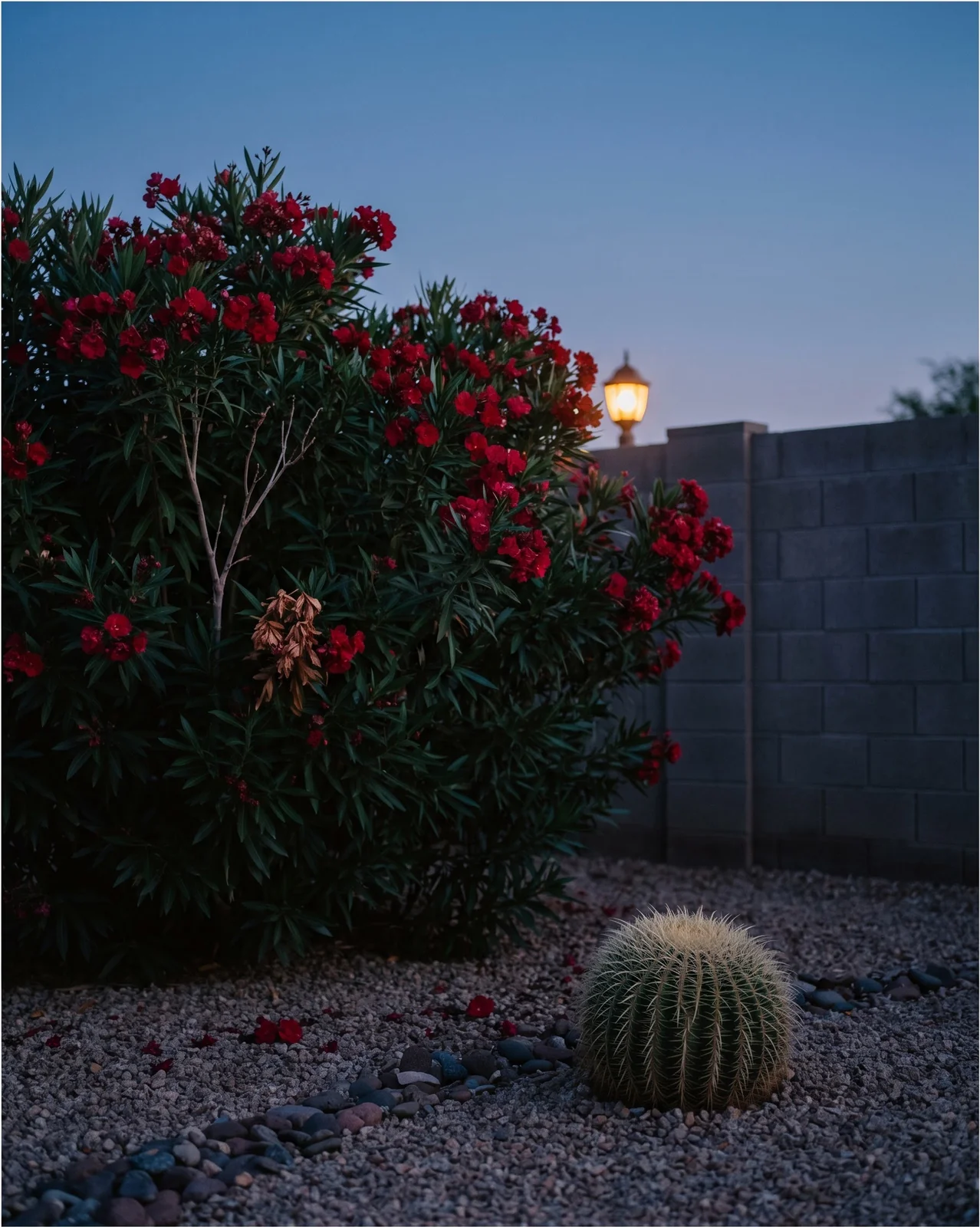
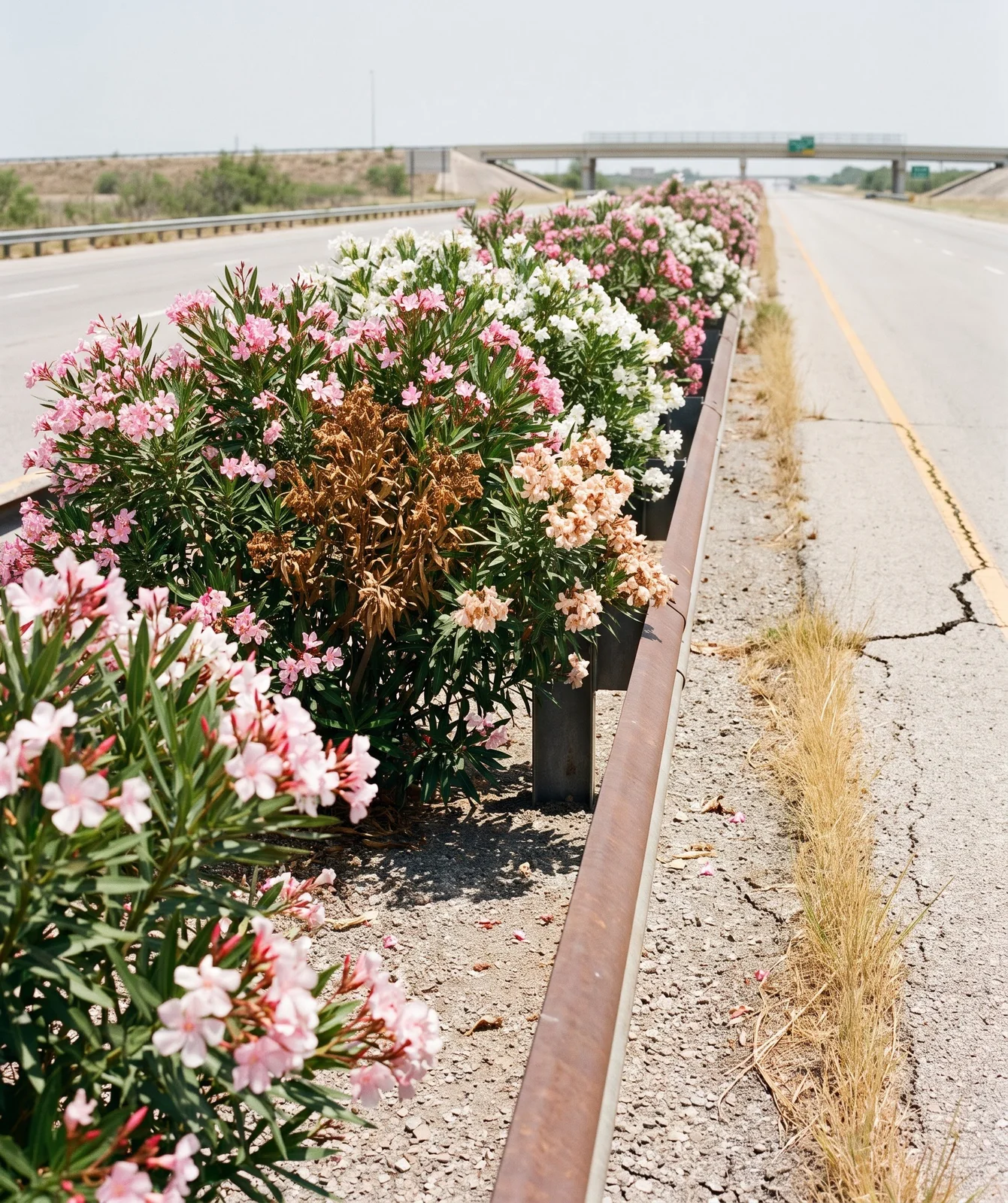
Growth rate explains how completely this shrub took over the American Sun Belt. An established plant puts on 1 to 2 feet or more a year. It lines Florida highways and interstates, where it takes heat and car exhaust, and it holds up in coastal gardens. Breeding kept pace: about 400 cultivars carry names, in colors from pale and deep pink through lilac, carmine, purple, salmon, apricot, copper, orange, and white.
Toxicity and pet safety
Every part of oleander is poisonous, and drying does not weaken it. The poisons are oleandrin and neriine, cardiac glycosides carried throughout the plant. They act like digitalis, blocking the sodium-potassium pump that keeps a heartbeat regular. Chewing a leaf or a twig once or twice can send a person to the hospital. Colorado State University's guide to poisonous plants states that a single leaf can be lethal to a child, though human mortality is generally very low. Red-flowered varieties appear to be the more toxic ones. Poisoning starts in the gut and moves to the heart: nausea, vomiting, stomach pain, dizziness, a slowed pulse, irregular heartbeat, dilated pupils, bloody diarrhea, and drowsiness. If any part has been swallowed, call poison control immediately.
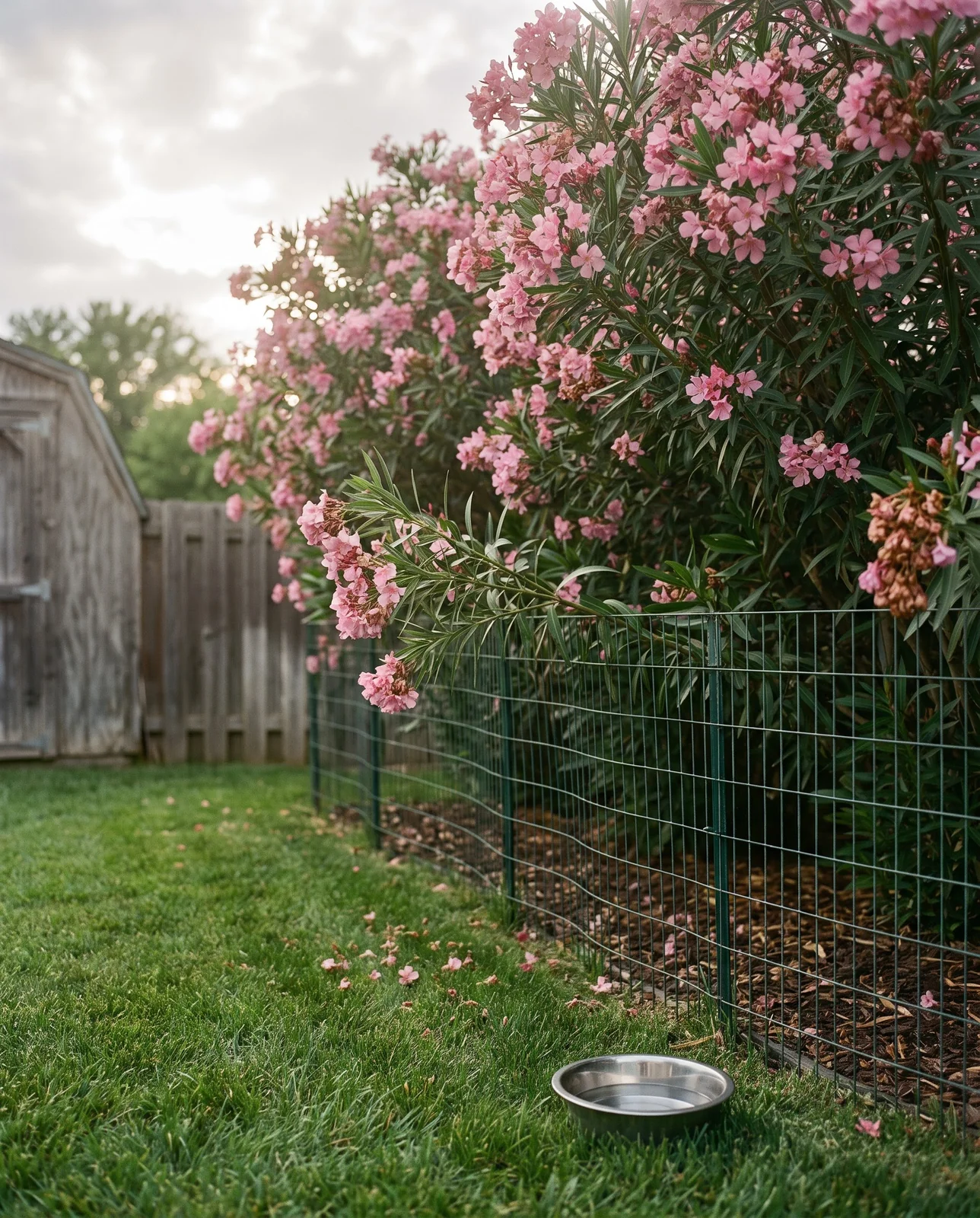
For animals the risk runs higher. Oleander is toxic to dogs, cats, and horses. An animal that eats it shows gut trouble first, then an irregular heart rate and rhythm, then weakness and collapse. Grazing animals are the classic victims because of how little it takes. The lethal dose of green leaves for cattle and horses is 0.005 percent of body weight, and horses given 40 milligrams per kilogram developed severe gut and cardiac poisoning. Livestock are poisoned by grazing where oleander grows thickly and by eating prunings tossed over a fence into a pen. Keep the shrub out of enclosures and off their fence lines.
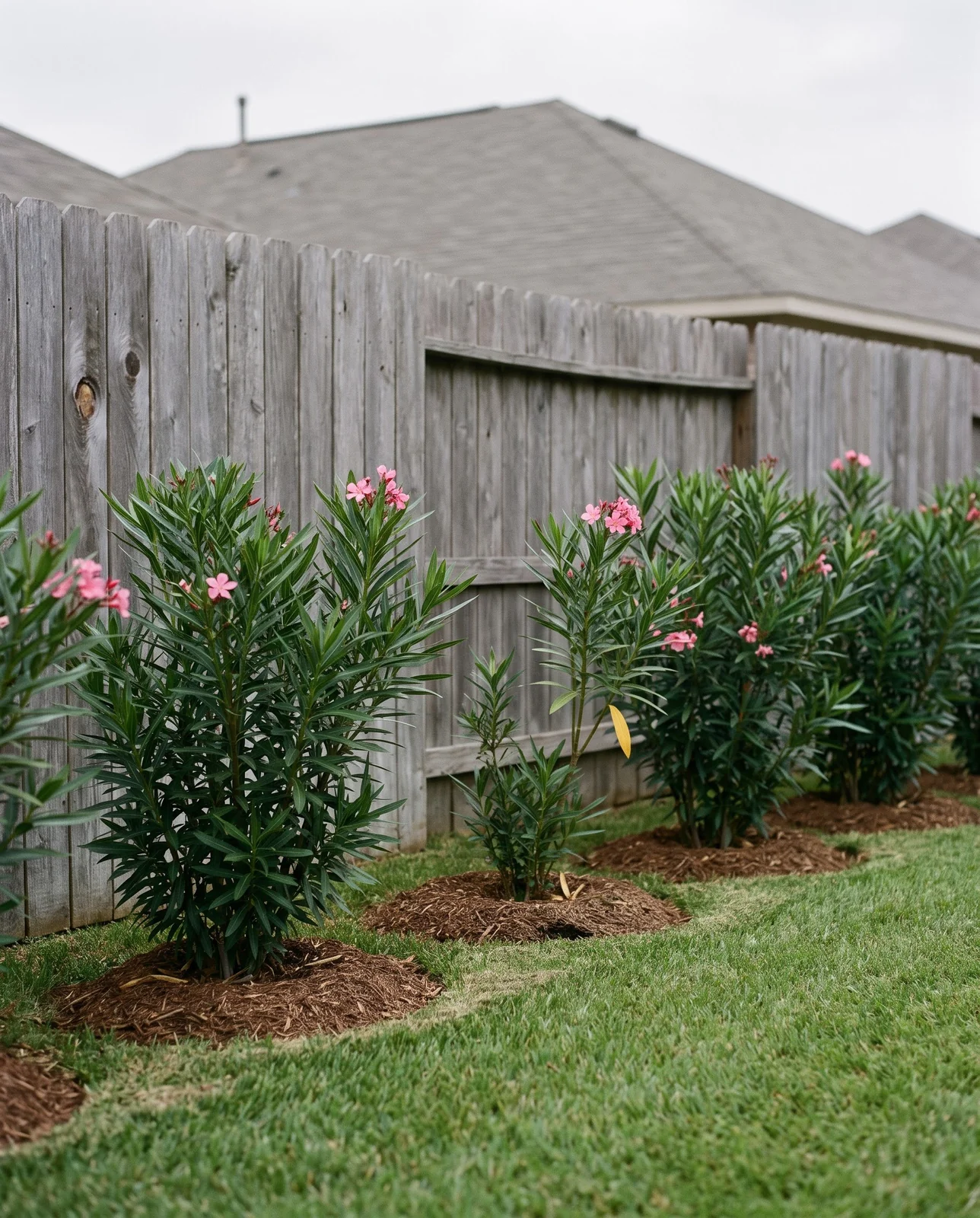
Touching oleander is a different problem from eating it. The sap irritates skin and eyes and causes contact dermatitis, so wash up after brushing past a hedge. Burning is the exposure people underestimate. The smoke carries the toxins, and breathing it can cause respiratory difficulty, so clippings never go on a brush pile or into a fire pit. Keeping the shrub at all is a question about placement rather than removal. The plant needs care near areas small children use, and children and livestock are the two groups at increased risk. A hedge along a back fence or a pot on a balcony is low risk. A shrub over a sandbox, a paddock fence, or a dog run is worth taking out, and the replacement comes off a list of flowers that are safe around cats and dogs.
Bloom time
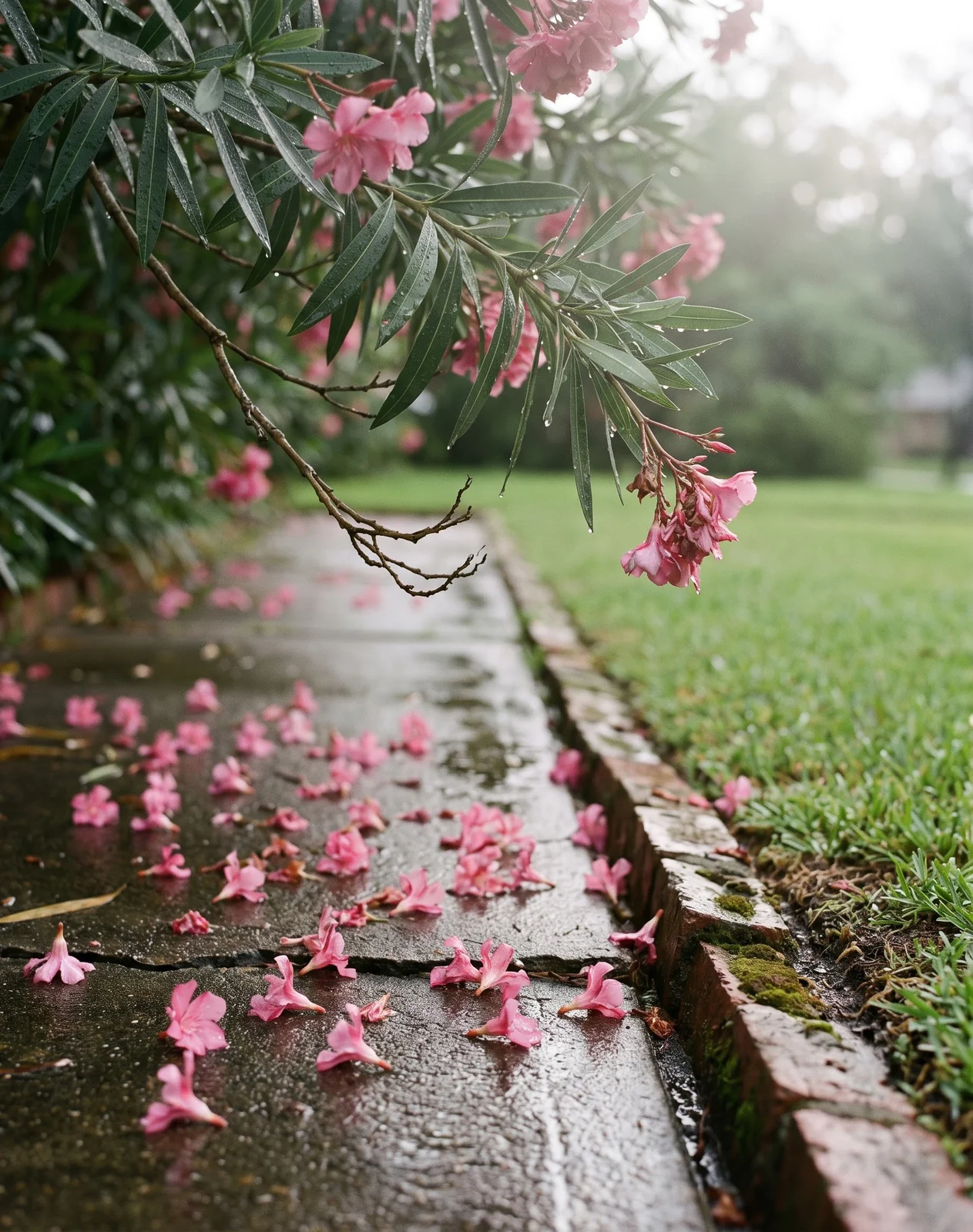
Oleander blooms through the warm half of the year. Across most of its American range the flowers open in late spring and carry into late summer, and where autumn stays warm they run to mid-autumn. Farther south the season stops being a season: from zone 9b upward an established plant flowers year-round, and only in zone 9a does bloom fall off over winter. The flowers form at the tips of shoots grown that same season, and that fact drives every pruning decision. Spent clusters turn into long seed pods, so deadhead promptly and the plant never builds them.
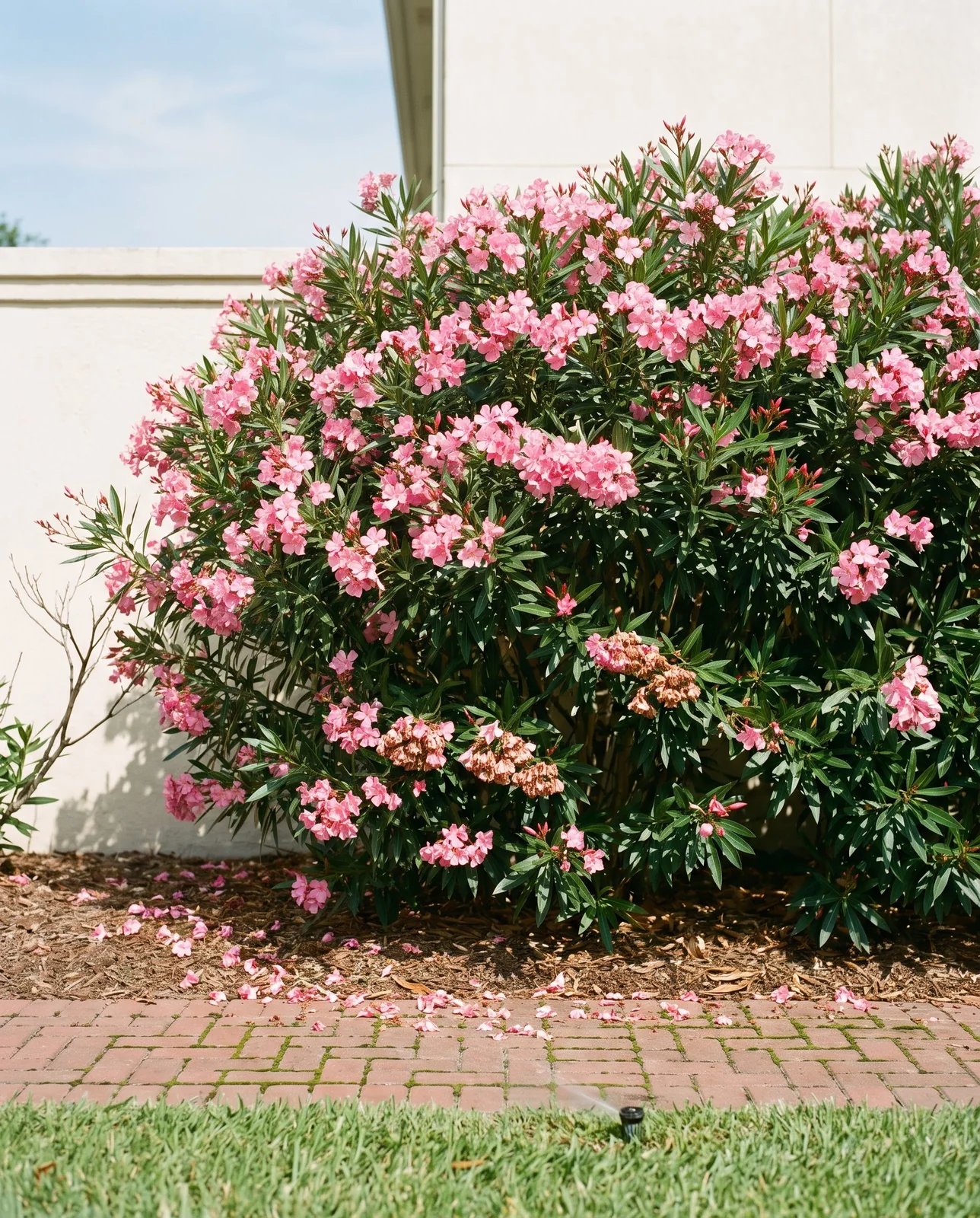
Why oleander stops blooming
Light is the first thing to check. An oleander in partial shade flowers little and turns lanky with it, and full sun for this shrub means 6 or more hours of direct light a day. Shade arrives gradually, from a tree that filled out or a fence on the sunny side, so a plant that bloomed for years may now be standing in a different garden. It says so before the flower count does: stems stretch, gaps open, and what bloom there is sits at the top. Cutting back whatever casts the shade is usually cheaper than moving a mature shrub. Timing is the other common cause. Every cut made after early fall carries off the buds for the coming year, so a shrub kept on a hedge-trimming schedule stays green and healthy for years without flowering. Suckers are the quieter version of the same drain: shoots around the base siphon off too much energy and flowering is inhibited. They hide under the plant's own foliage and pull away easily the week they appear.
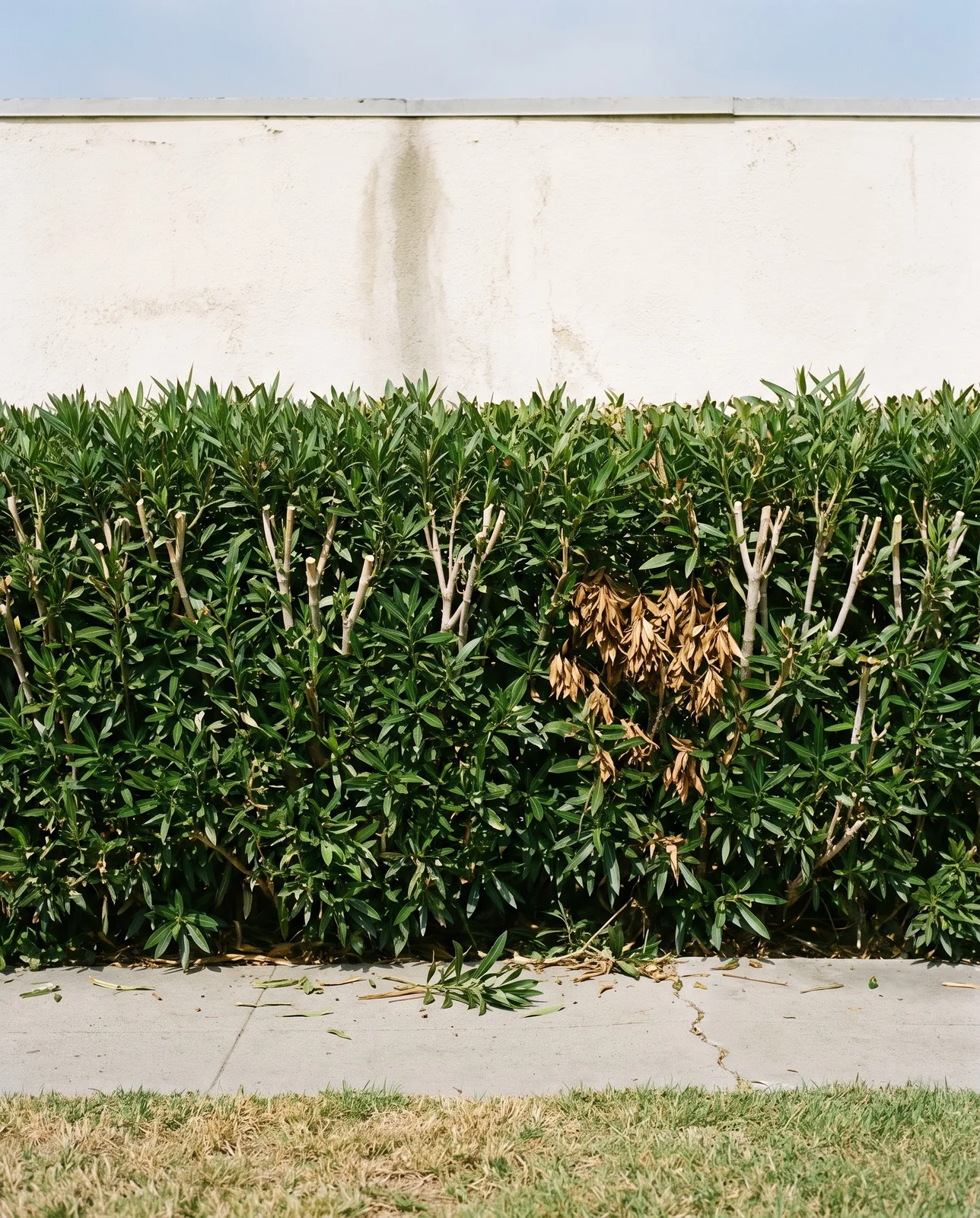
Working out why an oleander is not blooming
A green, healthy oleander with no flowers has usually failed one of these checks. Run them in order: the cheapest fixes sit at the top.
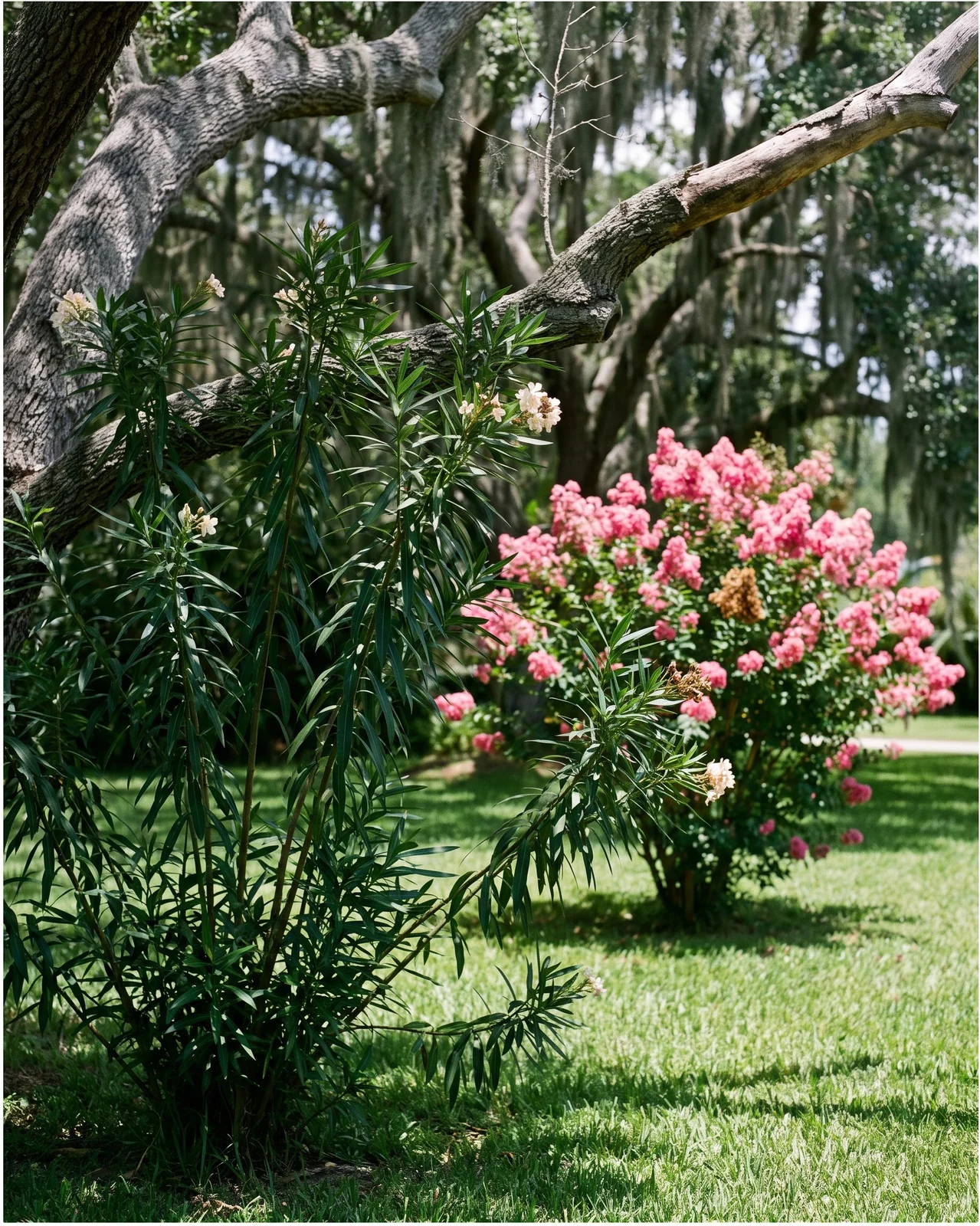
When to prune and how far back
Prune oleander in late winter or early spring, before growth starts. The shrub flowers in summer on new growth, so early spring cuts are replaced by flowering wood the same year, and late winter works for the same reason. Cuts made after early fall do the opposite. A hard cut in early to late fall does stimulate new growth, but no pruning has to happen then. Where winter reaches the plant, spring wins on a second count: oleander tolerates quite hard spring pruning to take out cold-damaged or overgrown wood. One session handles the freeze damage and the shape together.
How far back you can cut runs further than most owners expect. Oleander reaches 10 to 15 feet and is usually trimmed to stand at 6 to 9. Suckers come off easiest when you pull them while they are young and succulent. Handling matters as much as timing. Wear disposable gloves, or wash your hands the moment you finish touching cuttings. Bag the prunings for the trash: they do not go on a burn pile and they do not go over a fence into a pen.
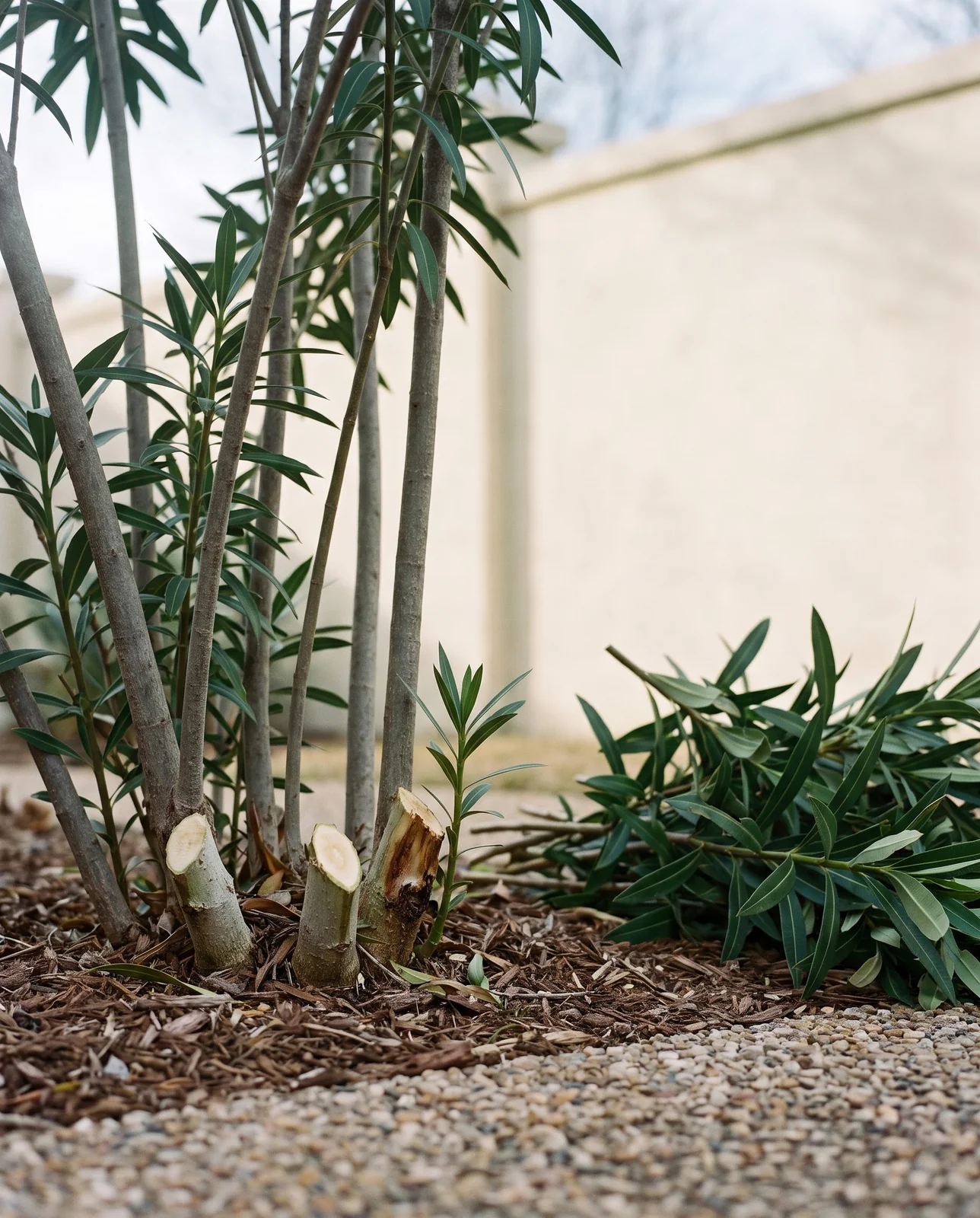
The pruning year at a glance
Oleander's pruning year is short, because the plant flowers on the growth it makes that season. One main window, one repair window, and a stretch when cutting costs flowers.
Oleander varieties worth telling apart
Cultivar settles final height, the winter cold the plant takes, and whether the flowers carry scent. Dwarf sizes below assume light pruning.
USDA hardiness and cold damage
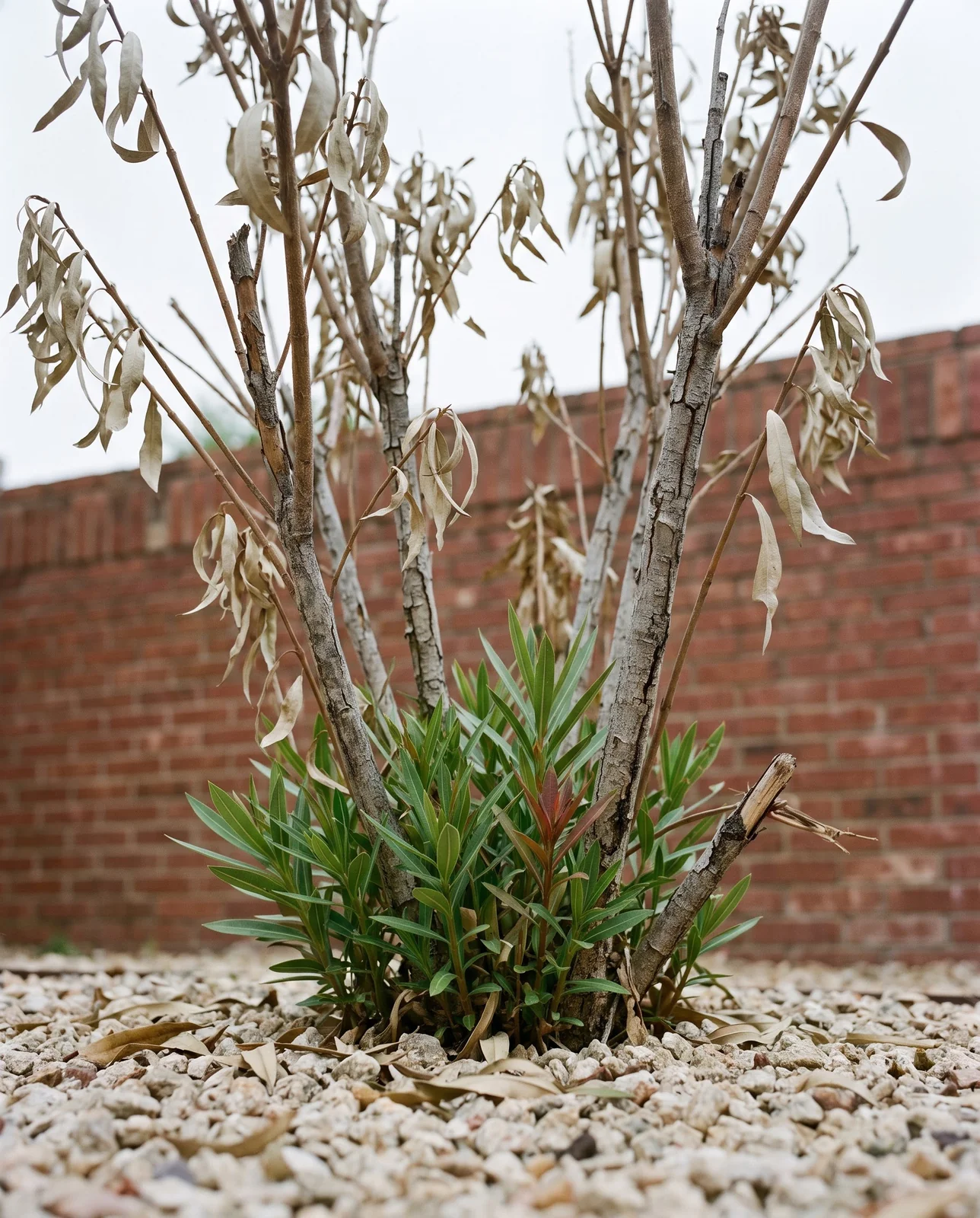
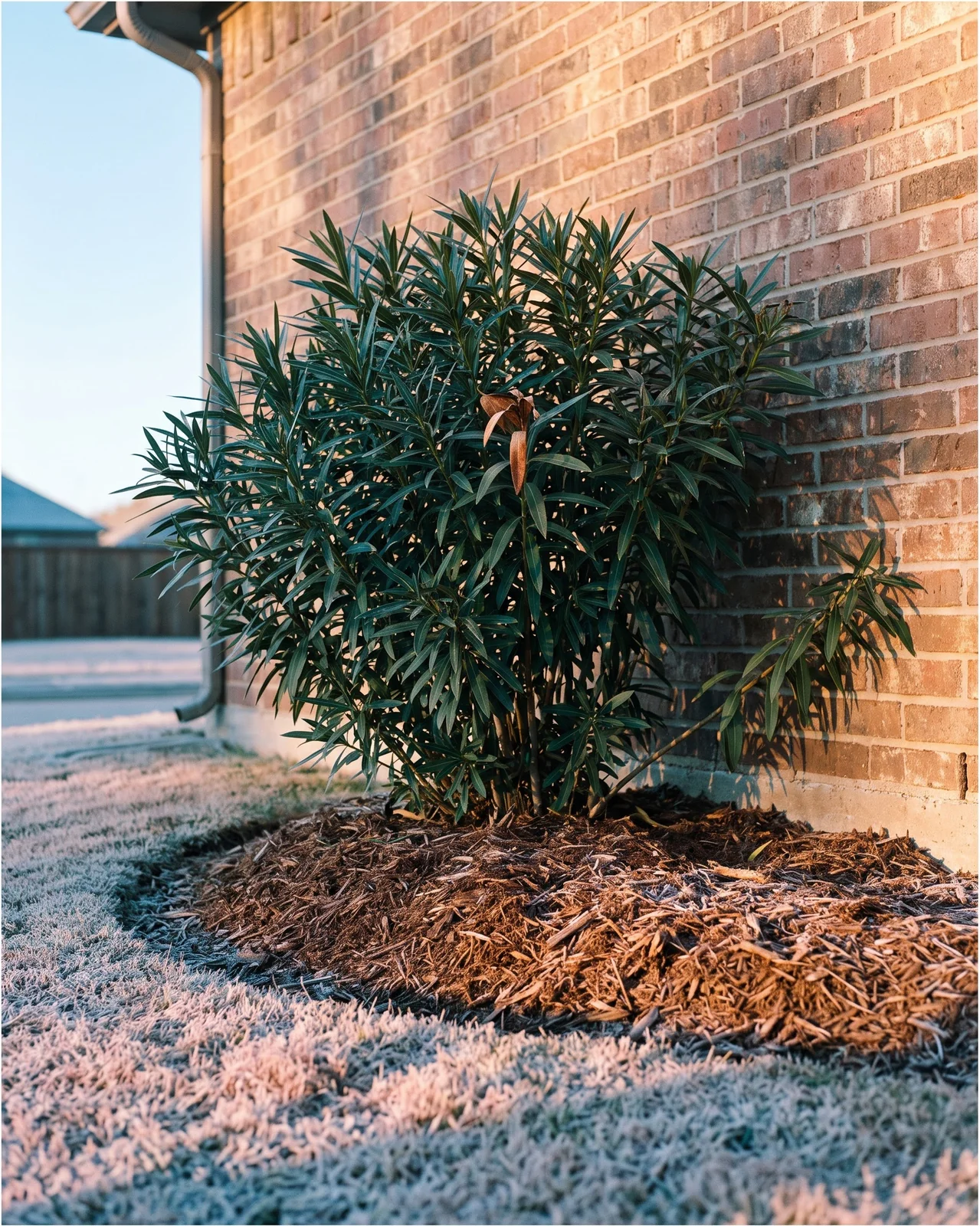
Oleander is hardy from zone 8 to zone 11, and both edges are disputed. NC State gives 8a through 10b and calls the shrub intolerant of temperatures at or below freezing; UF/IFAS gives 9a through 11. Most oleanders survive down to 15 to 20 degrees Fahrenheit, with the foliage damaged at that point. Below that the top of the plant goes: a severe freeze in Galveston in 1989 killed many plants back to the ground. That is survivable. Plants whose tops are killed recover quickly the following spring if the roots were not damaged. An oleander at the cold edge is an evergreen shrub after a mild winter and a cut-back perennial after a hard one.
The argument sharpens one zone down. 'Hardy Red' may tolerate zone 7b, but in Dallas trial plots it and 'Hardy Pink' took leaf burn and some shoot dieback in winters that reached 13 degrees Fahrenheit. A North Texas breeding program worked toward cultivars tolerant of temperatures to 10 degrees. In the same plots the two Galveston control cultivars were freeze damaged every year, dying to the ground in the colder ones.
What winter does, zone by zone
Oleander has no single failure temperature. It has a sliding scale, and the zone decides whether a freeze costs leaves, a season, or the plant.
Growing oleander in pots
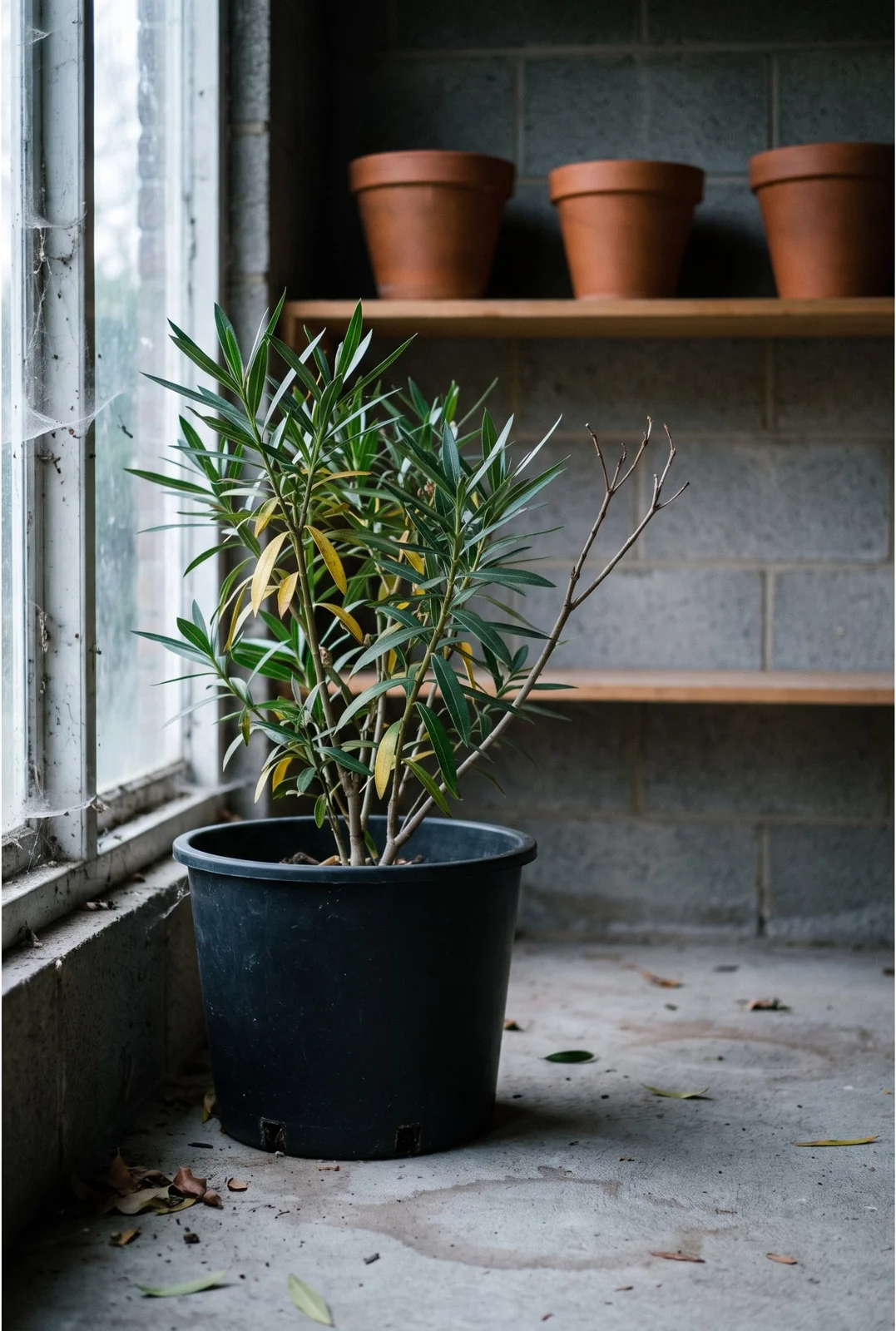
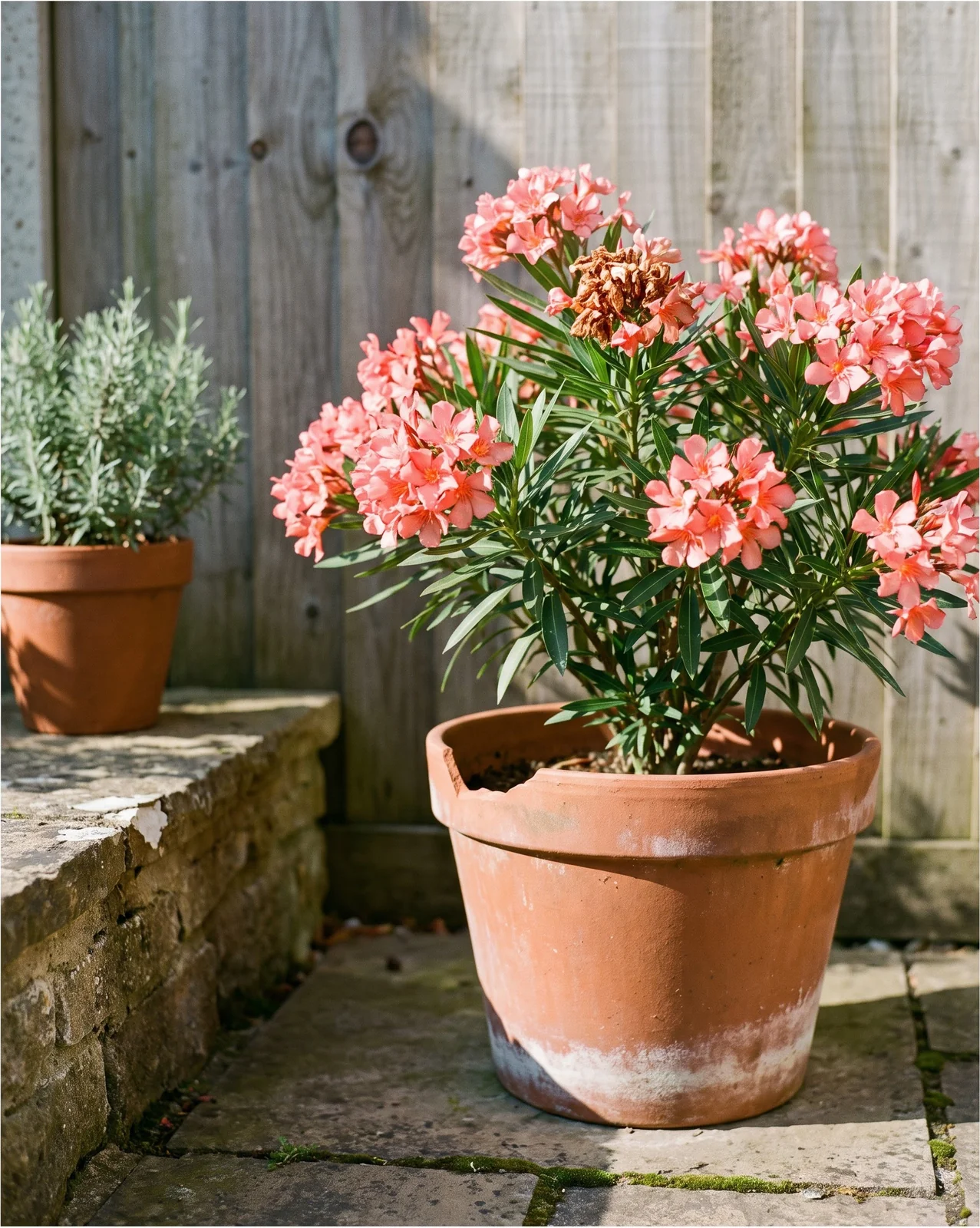
North of its hardy range oleander is a container plant, moved indoors for the winter or kept as a houseplant year-round. Dwarf cultivars suit that life, since they stay as low as 3 to 5 feet and hold that size with light pruning. The move indoors can wait: pots are fine outside through fall until temperatures dip below 20 degrees Fahrenheit. Inside, the plant wants storage conditions, a cool spot in the 40s with moderate light and very little water until spring. An unheated garage with a window beats a warm living room. Keep that stretch short, because oleanders grow best when the overwintering period is short. The winter routine is the one a potted hibiscus needs in a cold climate. Bring the plant back out when nights hold above freezing, cut it to a size the pot can carry, and the new shoots take over.
How much sun oleander needs
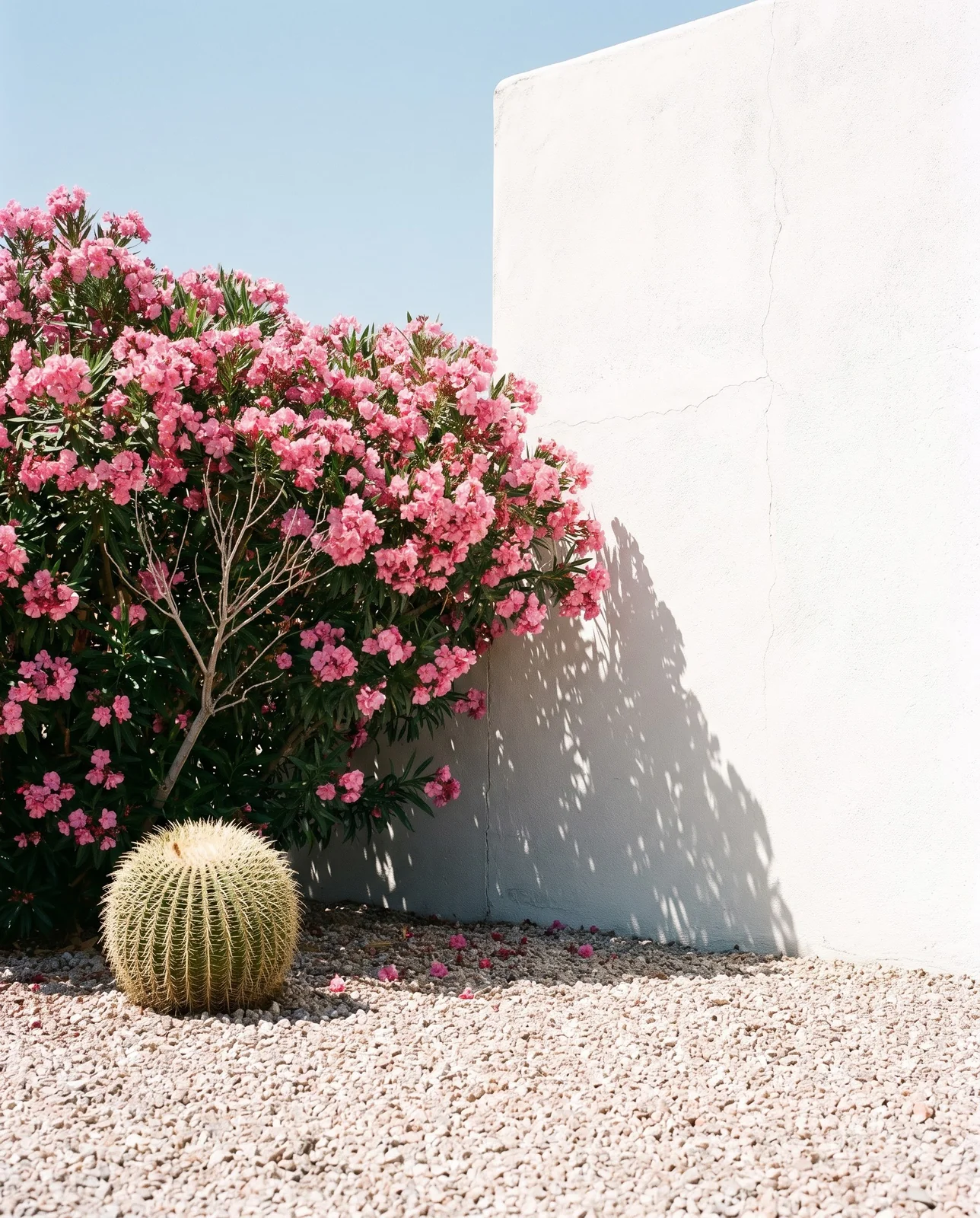
Oleander wants as much direct sun as the site can give it. It takes anything from full sun to partial shade, and those two ends produce different shrubs. It grows best in full sun and takes even reflected heat off a south or west wall, the exposure that cooks a foundation bed by two in the afternoon. Too little light gives it a leggy, open look. A plant released from shade answers on its new growth, so the payoff arrives a season after the tree comes down.
Soil, water, and salt
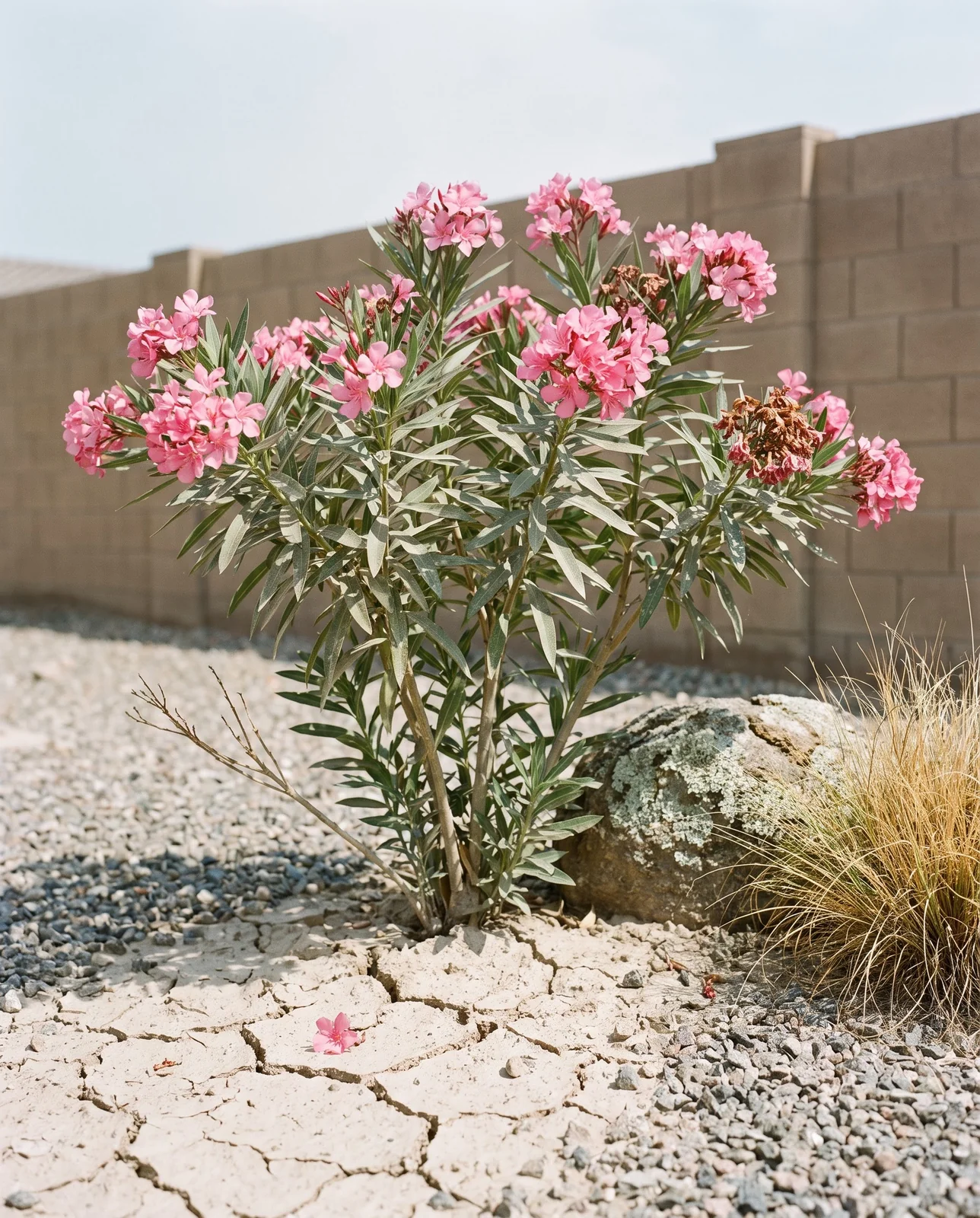
Drainage is the only soil condition oleander insists on. It grows in sand, loam, or clay, acid or alkaline, so long as water moves through. Established plants are killed with kindness more often than with neglect. Water regularly, then let the soil dry out between waterings, and keep the hose at the roots and off the leaves. Drought tolerance on a settled plant is high, so a mature shrub in ordinary ground can go through a dry summer on rainfall alone. Tolerance of airborne salt is only moderate, so a garden a few streets back from the water is an easier posting than a dune front.
How much feeding it actually needs
Oleander barely needs feeding. It grows well on one yearly fertilization paired with a spring pruning, and it does well in poor soil with no fertilizer at all. One spring application on a young plant in thin ground is the most the shrub ever asks for. Fertilizer is also the wrong answer to a plant that grows well and flowers badly. That problem sits in the light and in the pruning calendar, and no feed reaches it.
Height and spread
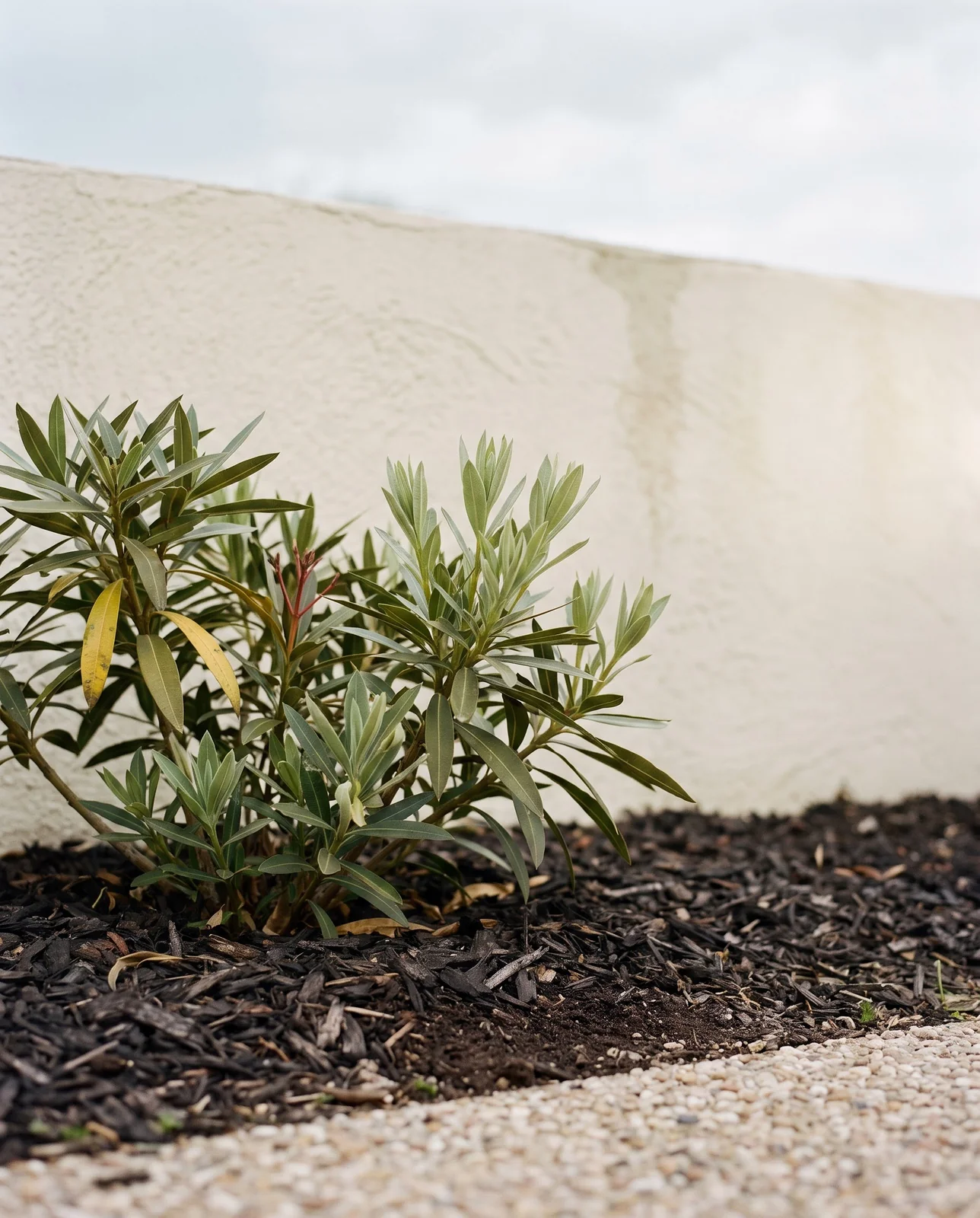
Most oleander cultivars grow 8 to 12 feet tall and almost as wide, and in protected spots mature plants may reach up to 20 feet. Published sizes scatter more than for almost any common shrub, from 4 to 8 feet up to 10 to 18. Height is a pruning decision as much as a plant fact: the shrub reaches whatever ceiling you set within a few seasons, and holds it only as long as you keep cutting.
Where to plant it and what it is good for
Oleander earns its place as a screen. It is highly deer tolerant, which removes the animal problem that ends most unfenced hedge projects. It holds its leaves through winter in its own zones and closes a boundary faster than a slower evergreen. Clipped tight it reads as a wall; left loose it reads as a thicket. Placement follows the toxicity. A back boundary, a driveway strip, a courtyard bed, or a pot on a paved terrace keep the foliage out of daily traffic.
Pests and diseases
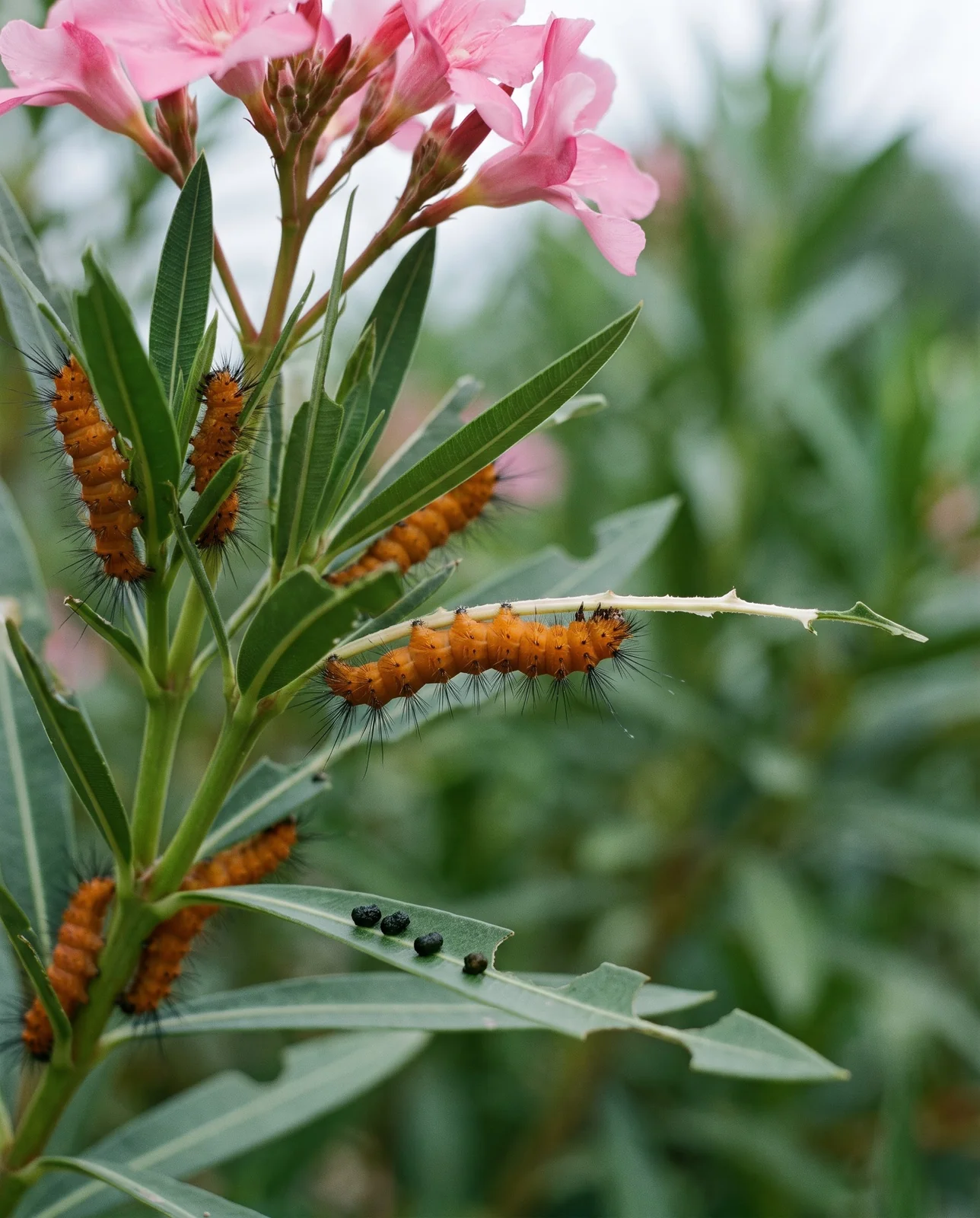
Oleander's insect list is short and mostly cosmetic. The oleander caterpillar is the one that gets photographed, common across Florida and southern Georgia. It lays egg masses of 12 to 75 eggs that hatch in two to six days depending on temperature. It strips a plant fast enough to look fatal, and total defoliation will not kill it. The control that works without spraying is mechanical: cut out the infested growth, bag it, and freeze it for 24 hours. Everything else on the list feeds on sap. Oleander aphid, milkweed bug, spinose scale, and the sooty molds that follow them are the standard set, with black scale and mealybugs added on California plants. Scale and the caterpillar do most of the visible damage when they go unchecked.
Two diseases carry real consequences. Oleander leaf scorch comes from a bacterium spread by insects, primarily sharpshooters. The University of California's statewide pest management program reports that infected plants decline and die within 3 to 5 years and that there is no known cure. It is regularly misread as drought damage. The vector changes with the region: the glassy-winged sharpshooter in southern coastal California, the smoke tree sharpshooter in the low desert around Phoenix and Tucson. The oleander strain does not infect grape. Pruning tools get blamed for spreading it, and no controlled experiment has shown that they do. Cultivar is the only lever left, since some selections show milder symptoms and live longer once infected. The second disease is Sphaeropsis gall, the infection behind oleander's witches' broom, and pruners are the whole treatment.
Telling oleander's leaf problems apart
Several problems make an oleander look sick in much the same way, and each one carries a visual tell that rules the others out.
What owners run into most
The questions owners actually bring about oleander, in the order they come up.
Hedges at the cold margin, and pots kept far north of anywhere oleander grows outdoors. Pick a named cold-hardy cultivar, put it against a wall, and expect a hard winter to take the top.
Usually an inherited shrub, sheared into a block or collapsing under its own weight. Cut it hard in early spring and let it rebuild on new wood.
The fear is rarely a branch eaten whole but incidental contact with a shrub that carries the toxin throughout. Wash hands after handling, and keep the plant out of daily traffic.
Owners want a specific selection and cannot find it locally, so cuttings get traded instead. Cuttings may be taken in late summer.
Buds fall before they open. No single cause explains it, so run the bloom checks in order, sun first.
Yellowing and shedding with nothing obvious behind it. Read the pattern before watering harder: it separates a dry plant from an infected one.
Taking cuttings
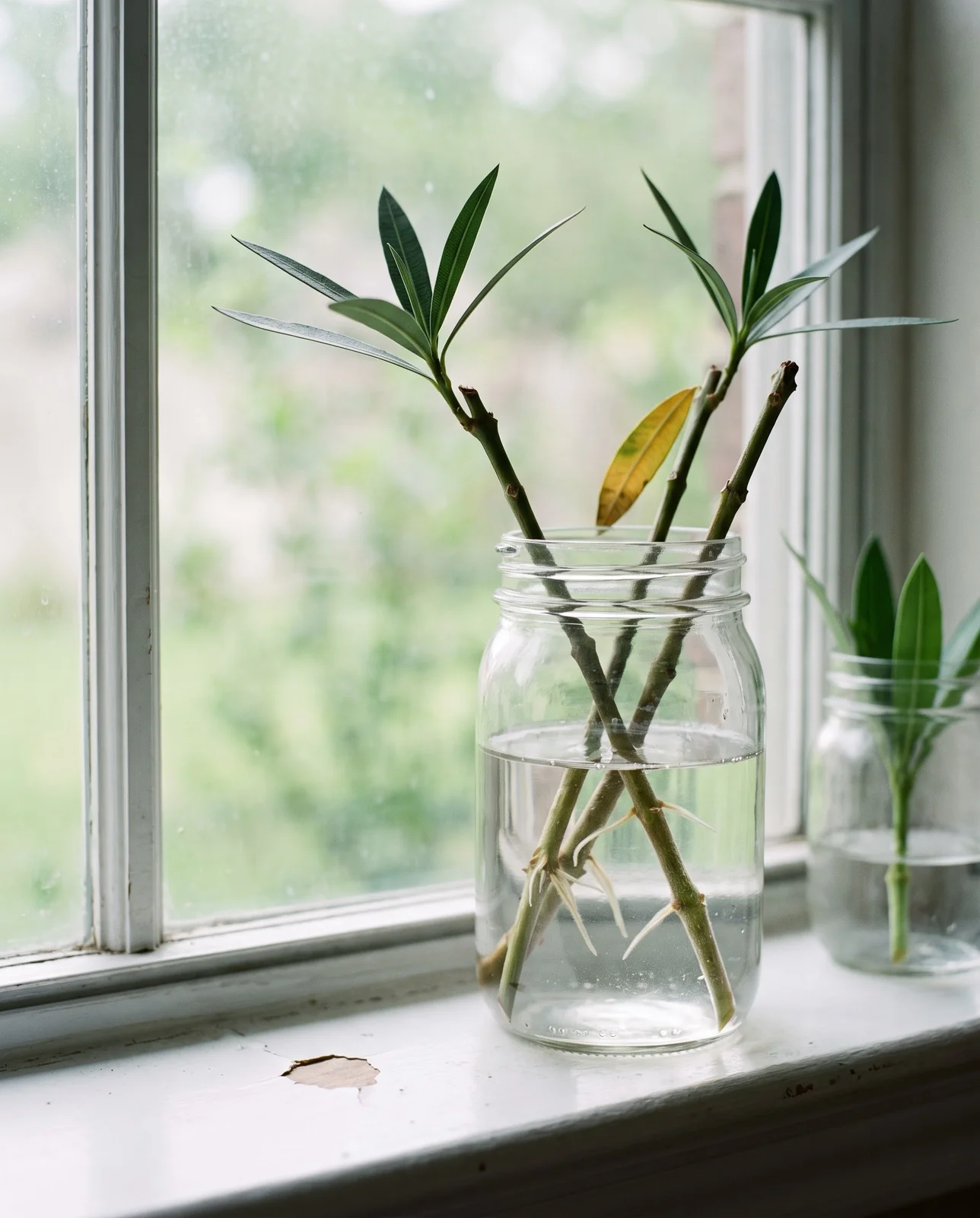
Oleander grows from stem cuttings and from seed, and cuttings keep a named cultivar true to the plant it came from. They root readily from softwood or semi-hardwood taken in spring or summer, which is also when a shrub is being shaped, so the wood is already lying in the pile. Gloves stay on for the whole job, because every cut end runs sap.
Fragrance and flower color
Whether an oleander smells of anything comes down to the cultivar. The flowers are sometimes fragrant, and the scented ones fall into one group: the double-flowered oleanders tend to carry the fragrance. That puts flower form on the shopping list, since single and double blossoms arrive in the same large clusters. Color runs from pale pink through deep red and white, and the throat often carries a second color, as in 'Hawaii', with single salmon-pink flowers and yellow throats. Buying in bloom settles both: the label gives the cultivar, the flower gives the scent.
What oleander stands for
Oleander's reputation runs in two directions at once. In American garden writing it is the shrub with a bad-girl reputation that keeps getting planted anyway, because it grows fast, tolerates conditions other shrubs will not, and flowers for months. Its strongest single association comes from Japan. Oleander is the official flower of Hiroshima, the first plant to bloom after the atomic bombing of the city in 1945. That fixed it as an emblem of return after devastation.
What people get wrong about oleander
Oleander attracts more folklore than any other common garden shrub, and the version told with the most confidence usually falls apart.
The myth: A dead or dried branch is harmless.
The reality: Oleander remains toxic when dry, so a brown branch on the burn pile is the same plant it was in June.
The myth: Honey made from oleander flowers can kill you.
The reality: Oleander flowers are nectarless and offer no reward to pollinators, which leaves fears of contaminated honey unsubstantiated.
The myth: A whole family died from hot dogs roasted on oleander sticks.
The reality: An urban legend, documented on several continents, in which a family or a group of scouts dies after eating food roasted on oleander sticks.
The myth: Dwarf oleander is a different, safer plant.
The reality: The dwarfs are the same species in a compact form, and eating small amounts of any part can make a person or an animal severely ill or cause death.
What to expect in the first years
An oleander is slow to impress and then hard to stop, and knowing which year does what saves unnecessary intervention.
Year one is roots. A plant set out in spring flowers lightly through its first summer or skips flowering altogether, and the sun the site gets that season decides the second summer. Water it through dry spells the way you would any new shrub, because the drought tolerance oleander is bought for belongs to an established plant.
Years two and three are the fast ones. The shrub earns its reputation as a screen now, putting on about 2 feet of height a season. The pruning habit gets set in the same years. One cut in late winter or early spring and nothing later keeps the flowers coming. A plant sheared whenever it looks untidy turns into a green box flowering only at the top; one never touched opens at the base and forces a hard renewal cut later.
After that the plant is on maintenance, and the risk changes with the map. At the northern edge winters alternate, evergreen after a mild one and rebuilding from the base after a hard one, which the roots survive. In California and the Arizona low desert the limit is oleander leaf scorch, which has no cure.
Flower photos
FAQ
How poisonous is oleander to humans?
Swallowing plant material is what poisons people: larger amounts bring nausea, vomiting, abdominal pain, bloody diarrhea, and an irregular heart rhythm. Recorded human mortality is generally very low, even where the plant was eaten deliberately.
Is oleander toxic to dogs and cats?
Yes. The clinical signs in pets are drooling, abdominal pain, diarrhea, colic, depression, and death. Any suspected mouthful is a same-day call to a veterinarian.
What happens if I touch an oleander?
Brushing past a plant does not poison you. Prolonged contact with the sap may cause skin irritation, eye inflammation, and dermatitis.
Is smoke from burning oleander really toxic?
Yes. Burning the trimmings produces toxic fumes, and the smoke can cause severe reactions. Prunings go into a bag for the trash.
How much oleander does it take to poison livestock?
The minimum lethal dose recorded for cattle is 50 milligrams per kilogram of body weight. Treatment uses adsorbents such as activated charcoal at 2 to 5 grams per kilogram, which is veterinary work.
Why would anyone plant a shrub this poisonous?
For months of bloom through heat and drought that stop other shrubs, on a care list of sun, drainage, and one cut a year. Placement handles the risk.
Is there a dwarf oleander, and how big does it get?
Yes, the dwarfs are the same species held to a smaller frame. Dwarf red types grow to just 5 or 6 feet tall and spread 3 feet wide.
Will an oleander survive zone 7?
It depends on the cultivar and on what counts as surviving. 'Hardy Red' may tolerate zone 7b, while the North Texas trial recorded leaf burn and shoot dieback on that same plant.
Do oleanders do well in pots?
They do, and a pot makes a shrub this size workable in a cold climate. Pick a dwarf, use a mix that drains hard, and plan the cool, dry winter rest before you buy.
What is the poison in oleander called?
The toxic compounds are cardenolide-type cardiac glycosides: oleandrin, odorosiside, and adigoside.
Interesting tips
- Oleander's native range is written both as Europe and Asia and as North Africa with southwest Asia, so two plant labels can name different continents for the same shrub.
- Fire-prone country adds a criterion nobody shops for: 'Calypso' has low flammability, worth checking against local rules on what may be planted close to a house.
- The oleander caterpillar follows the plant across its American range with one gap, since it is not found in California. A stripped plant in Los Angeles and a stripped plant in Orlando are two different problems.
Related Guides & Flowers
Gardenia
The evergreen shrub southern gardeners buy when the scent matters more than the toughness.
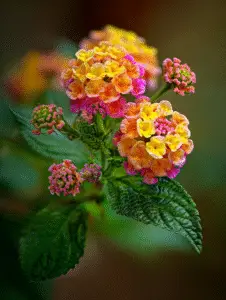
Lantana
A much lower filler for the same hot, dry, rarely watered ground oleander is planted in.
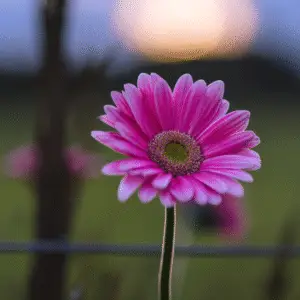
Pink flowers
Where oleander's most common color sits among the other pinks worth planting.
Types of flowers
The full catalog of flower guides on the site, sorted by plant.
Enjoying our flower guides? Add YourFlowersGuide as a preferred source on Google. It helps more readers find us.
Add to Preferred Sources