Home › Wisteria

Wisteria

Wisteria sinensis, W. floribunda, W. frutescens, W. macrostachya

V Written by Editorial Team Edited by Vladimir· Updated August 2026

Wisteria is the woody climbing vine that drapes long clusters of purple, blue, pink, or white flowers over pergolas and porch roofs in mid spring. People plant it for the scent, for the size of the display, and because an old vine reads as part of the house. It is also the plant that grows a trunk as thick as a fence post, pries apart gutters and siding, and can go years without a single flower.

Here you will find why a healthy vine grows leaves and no flowers, how and when to prune it so the cuts do not cost next spring's flowers, how to tell Chinese, Japanese, American, and Kentucky wisteria apart, which kinds are invasive across the eastern states and which native ones to plant instead, how toxic the pods and seeds are around dogs and children, and what support holds a mature vine.

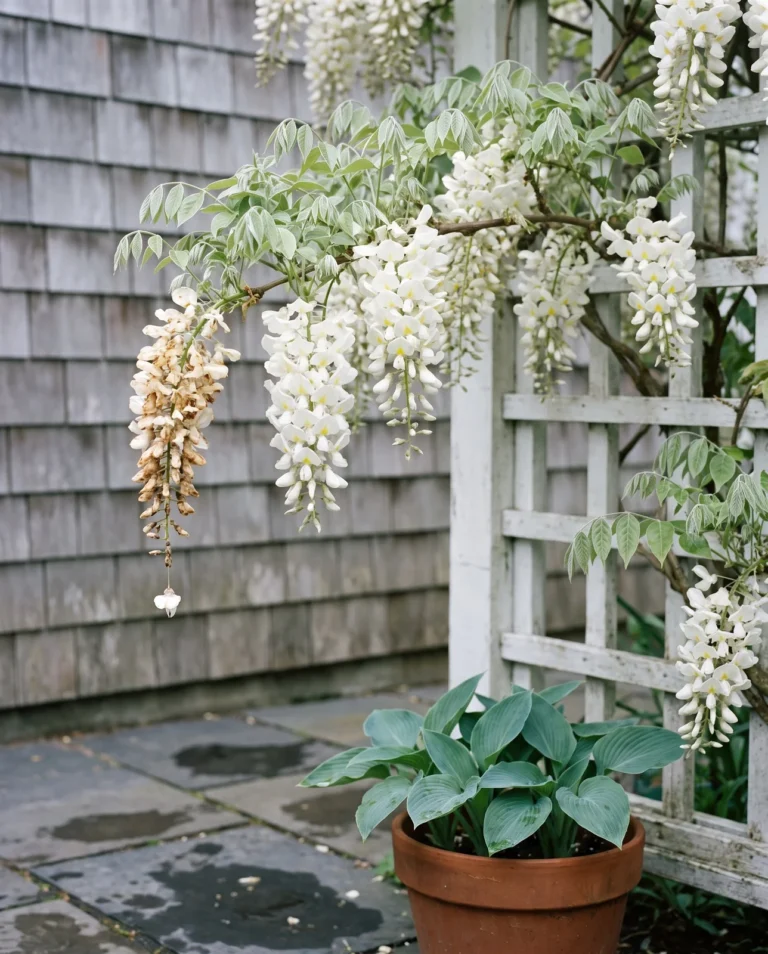
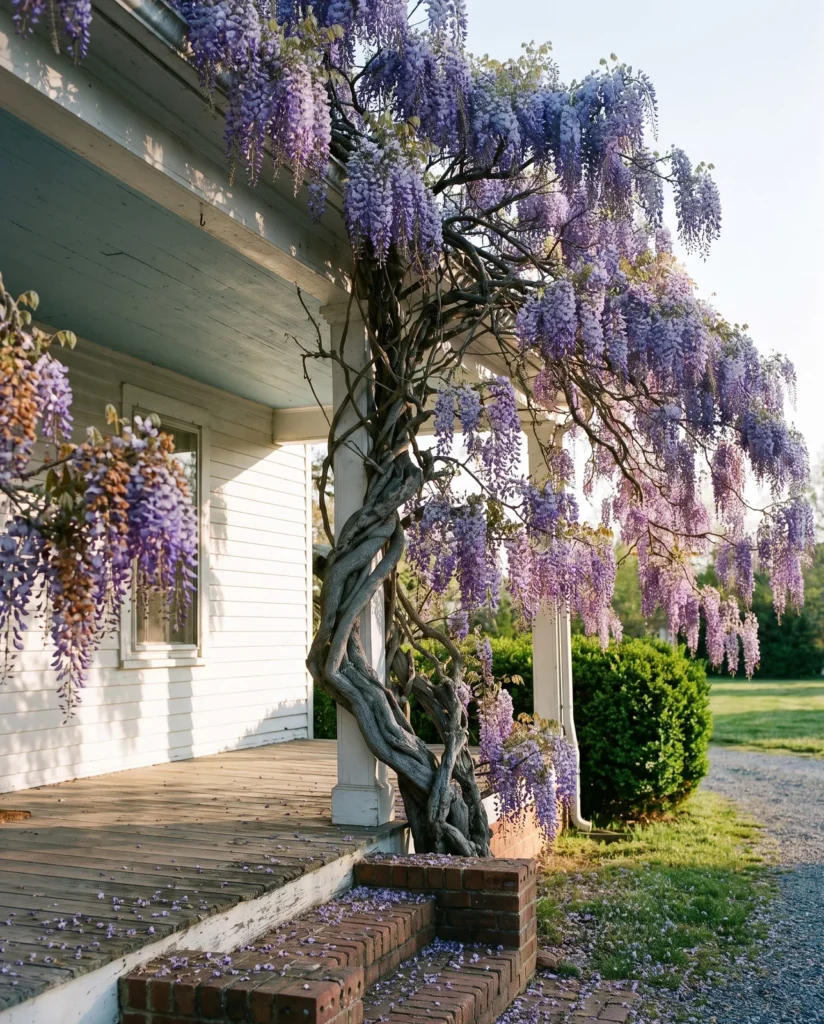
Old Chinese wisteria in full violet bloom draped over a white farmhouse porch in morning light
returns in
222
days
Bloom calendar

Wisteria

Wisteria sinensis, W. floribunda, W. frutescens, W. macrostachya
Woody twining vine that hangs long clusters of purple, blue, pink or white flowers in mid spring.
Blooms
Apr to May
USDA zones
5 to 9, Kentucky 3 to 9
Colorstap a color to see more flowers in it
PurpleBluePinkWhite
At a glance
LightFull sun, 6+ hours
WaterDeep soaks in summer dry spells
SoilWell drained, slightly acid
Height10 to 25 ft on its support
Spread4 to 8 ft, to 30 on a wall
Years to bloom2 to 3 years, often longer
PruneTwice: July-Aug, Jan-Feb
Support6x6 posts or steel beams
ToxicitySeeds and pods poisonous
DeerMildly resistant
Pet safety
๐ŸฑCatsToxic
๐ŸถDogsToxic
๐ŸดHorsesToxic
Toxic to dogs, cats and horses; seeds and pods worst (ASPCA)
General guidance, not veterinary advice.
Data NC State ยท Missouri BG ยท RHS ยท Utah State ยท Oregon State ยท ASPCA
* figures vary by variety and region.
yourflowersguide.com
On this page 27 sections
01

Taxonomy and origin

Wisteria is a woody twining vine in the legume family, grown for the long hanging flower clusters it opens in mid spring. It climbs by wrapping its own stems around whatever it can reach, the way morning glories do, and the direction of that wrap is one of the ways gardeners separate the species. Growth is rapid and the genus is rated high maintenance. Four species are grown across the United States: Chinese wisteria, Japanese wisteria, American wisteria, and Kentucky wisteria. Published species counts for the genus run from four to ten. The genus name honors Caspar Wistar, an anatomy professor at the University of Pennsylvania who lived from 1761 to 1818. The vine is long lived and adds wood every season it is left alone, which is where the long wait for flowers, the twice-a-year pruning and the weight on a pergola all come from.

Chinese wisteria was brought into the United States in 1816 as an ornamental. American wisteria went the other way earlier, reaching European gardens ahead of the Asian species. It grows wild from Virginia to Illinois and south to Florida and Texas, in moist thickets, swampy woods, pond edges and stream borders. Kentucky wisteria belongs to the south-central states, from Louisiana and Texas north to Kentucky, Illinois, Missouri and Oklahoma, and its stems twine counterclockwise over leaves of about nine leaflets. Across the Southeast the two Asian species have crossed often enough to produce fertile hybrids, Wisteria x formosa, so separating Chinese from Japanese in an old planting is not always possible. Chinese wisteria has spread as far south as Louisiana and as far west as Wisconsin, while Japanese wisteria concentrates in the mid-Atlantic and mid-south states. The wisteria tree sold at garden centers is this same vine trained onto a single upright stem.
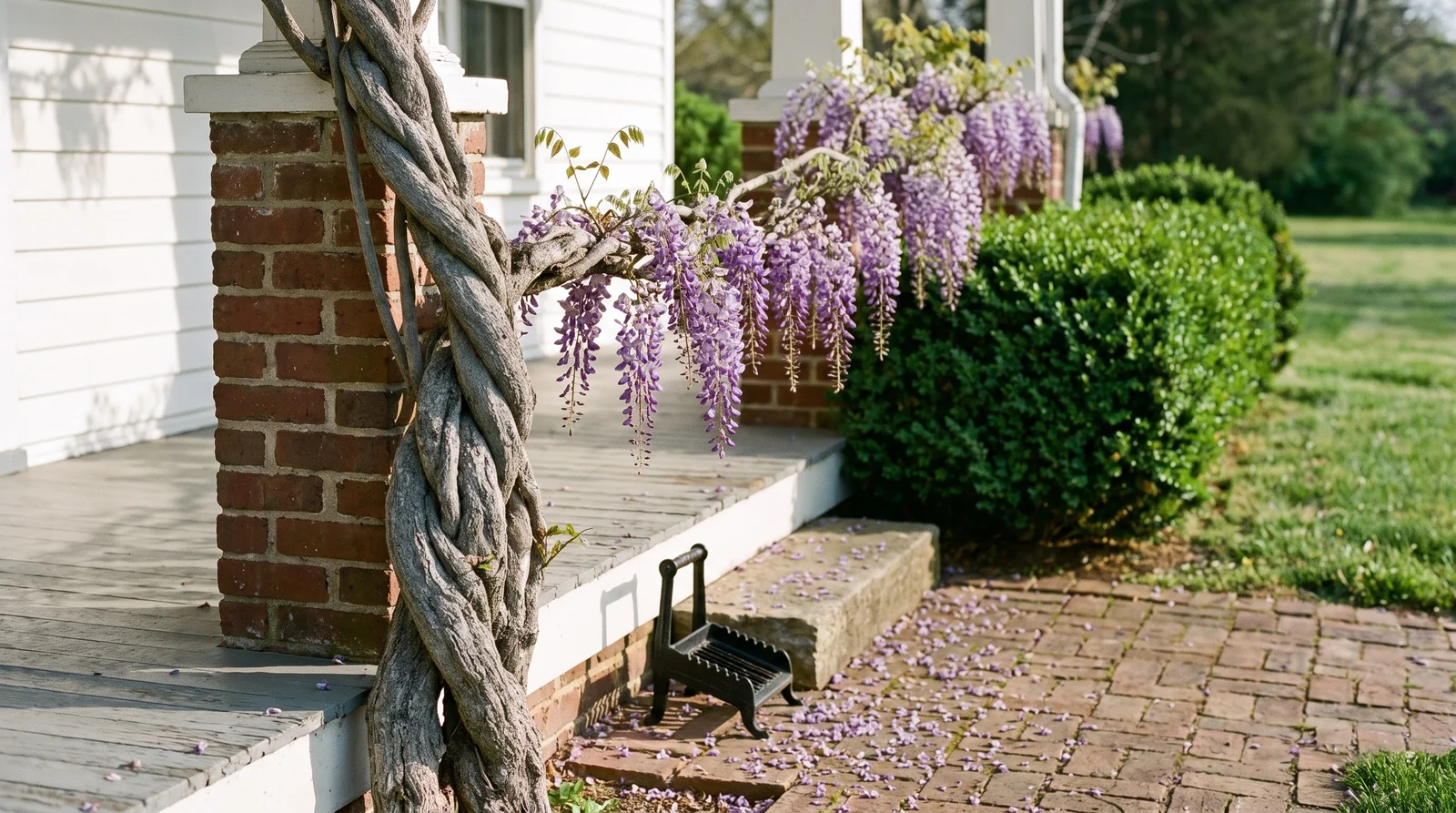
Wide view of an ancient wisteria trunk twisted like rope climbing a historic house porch in bloom
02

Bloom time

Wisteria blooms in mid spring, and across most of the country that means April and May. Chinese wisteria opens in May as the foliage is just beginning to expand, with a bloom period listed as May into June. American wisteria flowers in April and May, after the leaves emerge but before they fully develop, about three weeks behind the Asian types in the same garden, and limited extra bloom can follow in summer. Kentucky wisteria is the latest of the four, carrying blue racemes in June, and the cultivar 'Blue Moon' may bloom up to three times in a growing season once it is established. After the flowers come flattened velvety pods, which ripen from mid summer into fall and sometimes hang on the vine into winter.

How the flowers open differs by species, and it changes what the display looks like from the street. Chinese wisteria opens the whole raceme at once, on branches still bare as the foliage begins to expand, which makes a short, heavy show. Japanese wisteria opens gradually from the base of each cluster to the tip as the leaves come out, so the plant carries color longer but never all at once. The North American species bloom after the plant has leafed out, so their flowers hang against green foliage. Occasional summer flowers follow the spring flush on some plants, and 'Amethyst Falls' reblooms with more vigor than the species in mid and late summer.

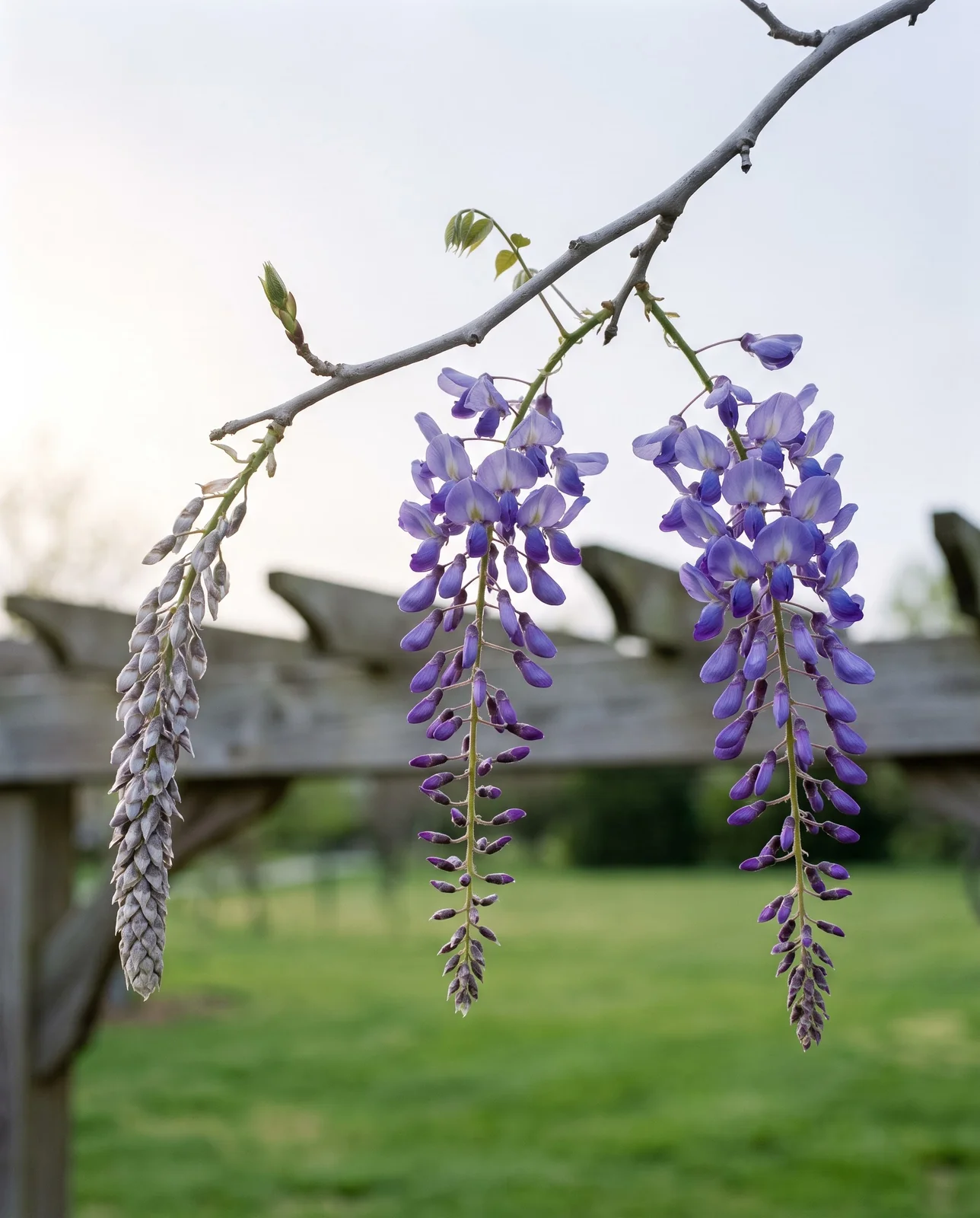
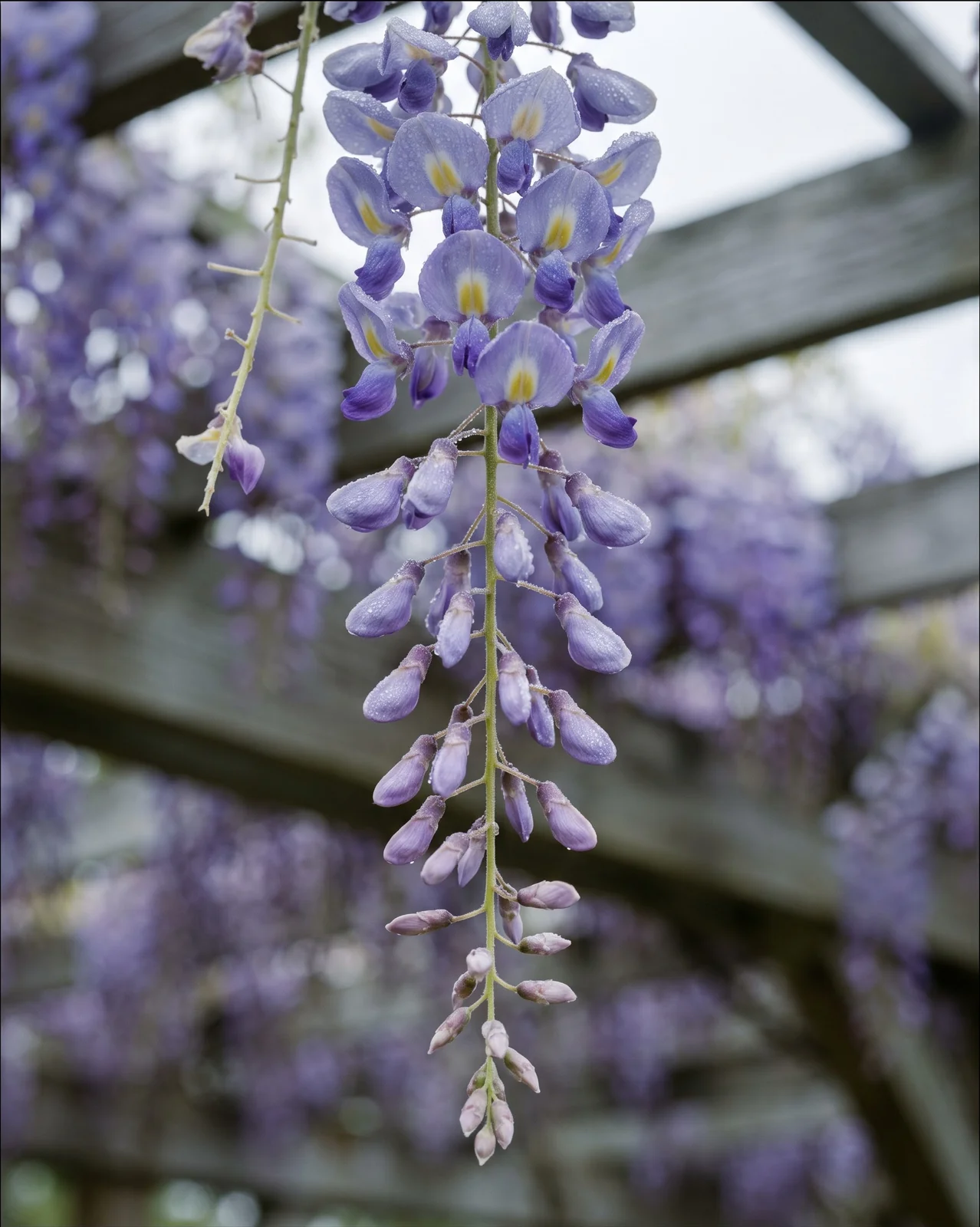
Wisteria racemes at three stages from tight buds to full bloom hanging from one branch
03

Wisteria types and cultivars to know

Four species and a short list of cultivars cover nearly everything sold in the United States. Raceme length, scent, cold hardiness, and whether a type is native or invasive where you garden decide the choice.
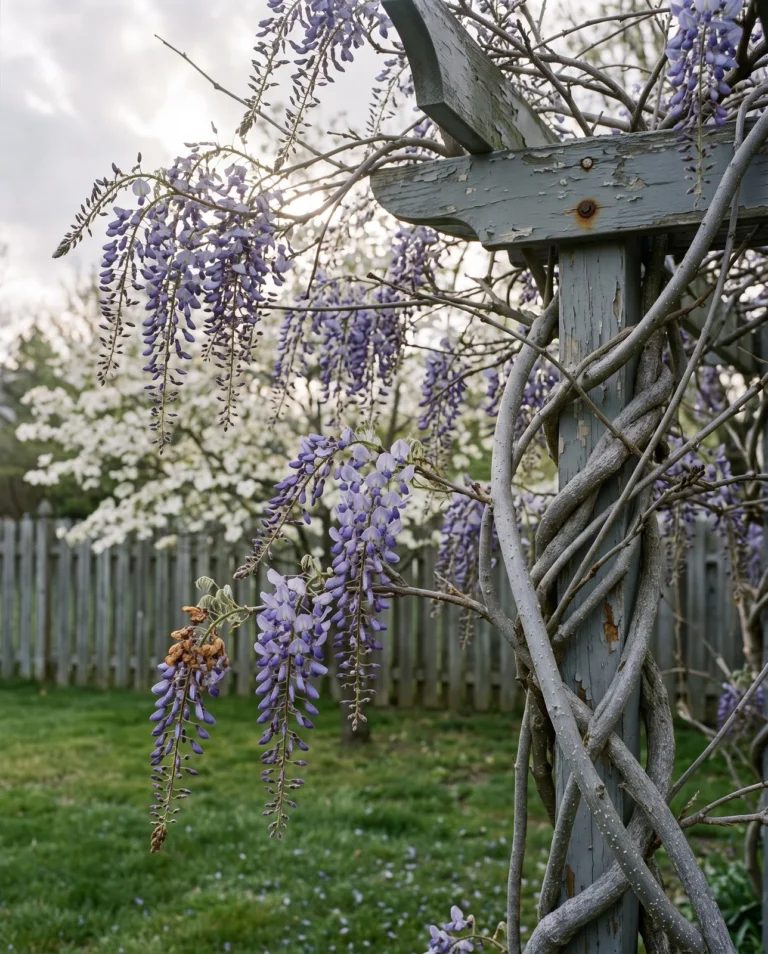
Chinese wisteria with violet-blue racemes opening on bare wood over a garden arbor in April
Chinese wisteria (W. sinensis)
Invasive species in North Carolina
Racemes 6 to 12 inches, blue violet
Mildly fragrant, opens all at once
Zones 5a to 8b
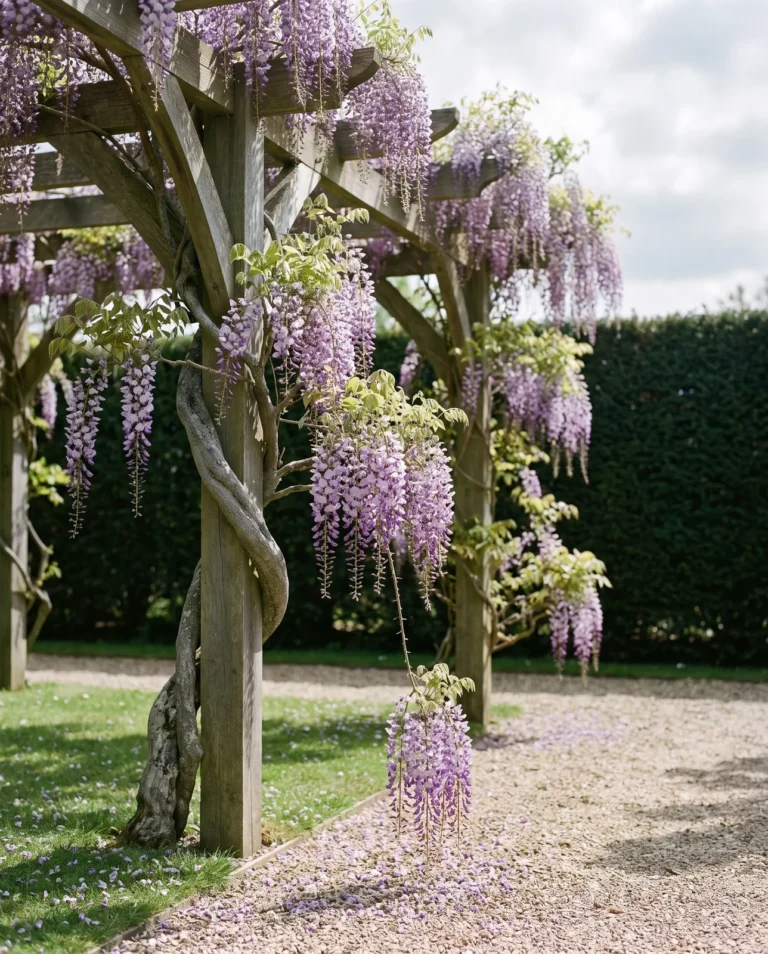
Japanese wisteria with very long lilac racemes hanging among leaves from a tall pergola in May
Japanese wisteria (W. floribunda)
Aggressive and invasive in North Carolina
Clusters 12 to 18 inches, pink to purple
Very fragrant, opens base to tip
Zones 4a to 9b
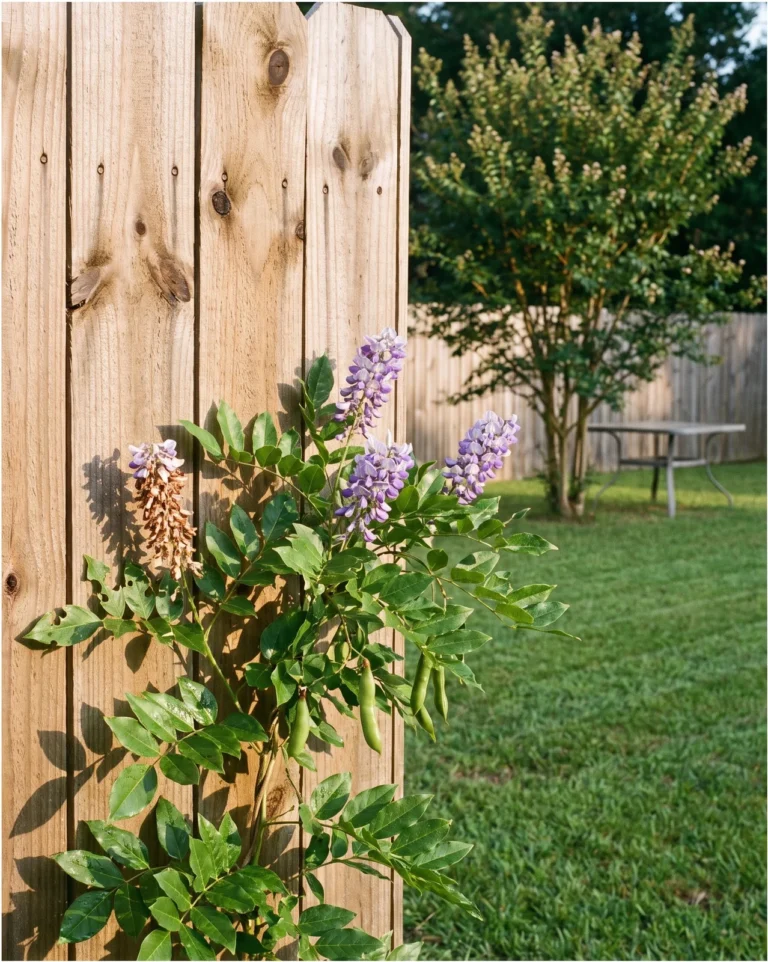
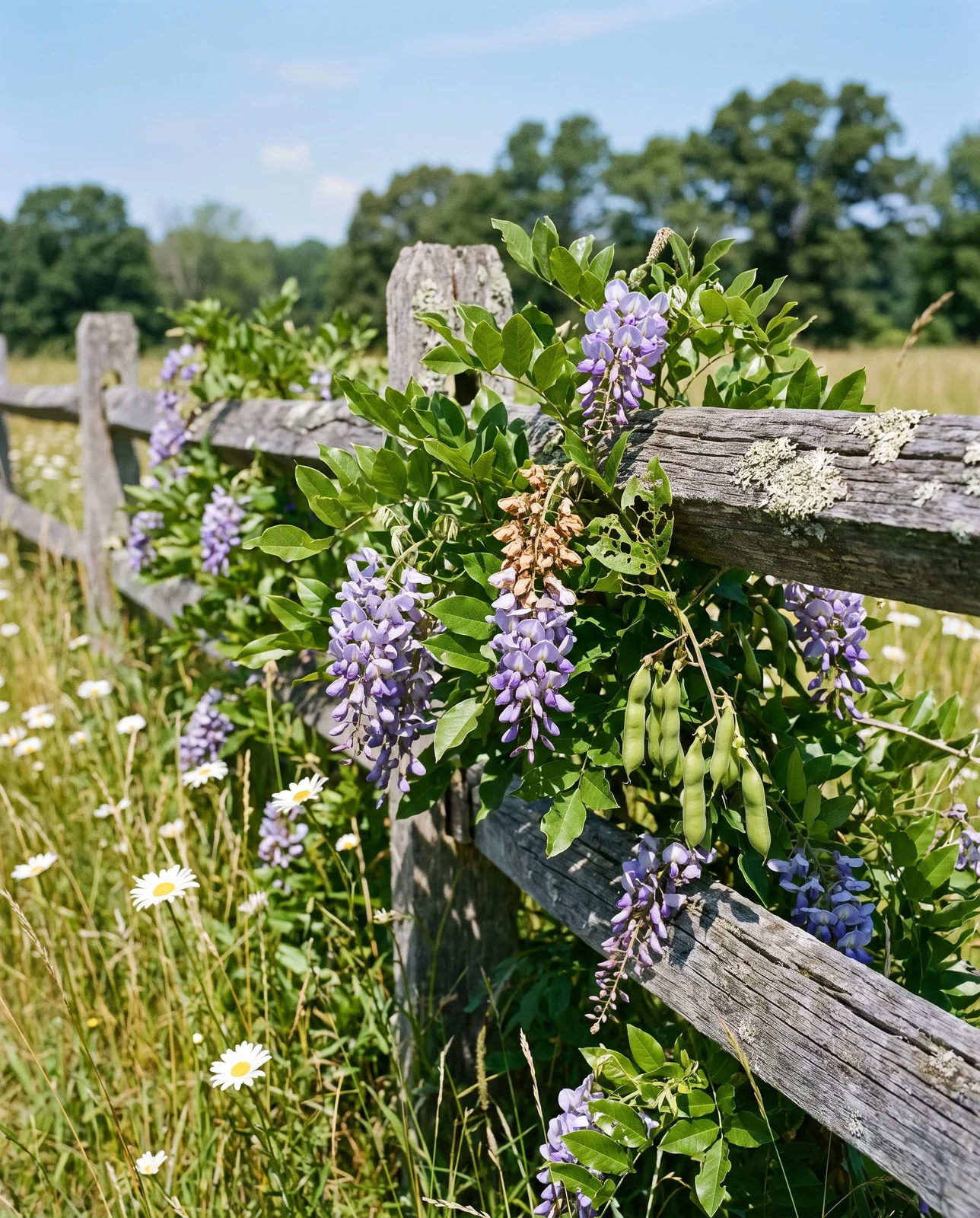
American wisteria with compact lilac-blue racemes and glossy leaves on a wooden fence in June
American wisteria (W. frutescens)
Native alternative
Native from Virginia to Florida and Texas
Racemes to 6 inches, lilac purple
Blooms after the leaves, zones 5 to 9
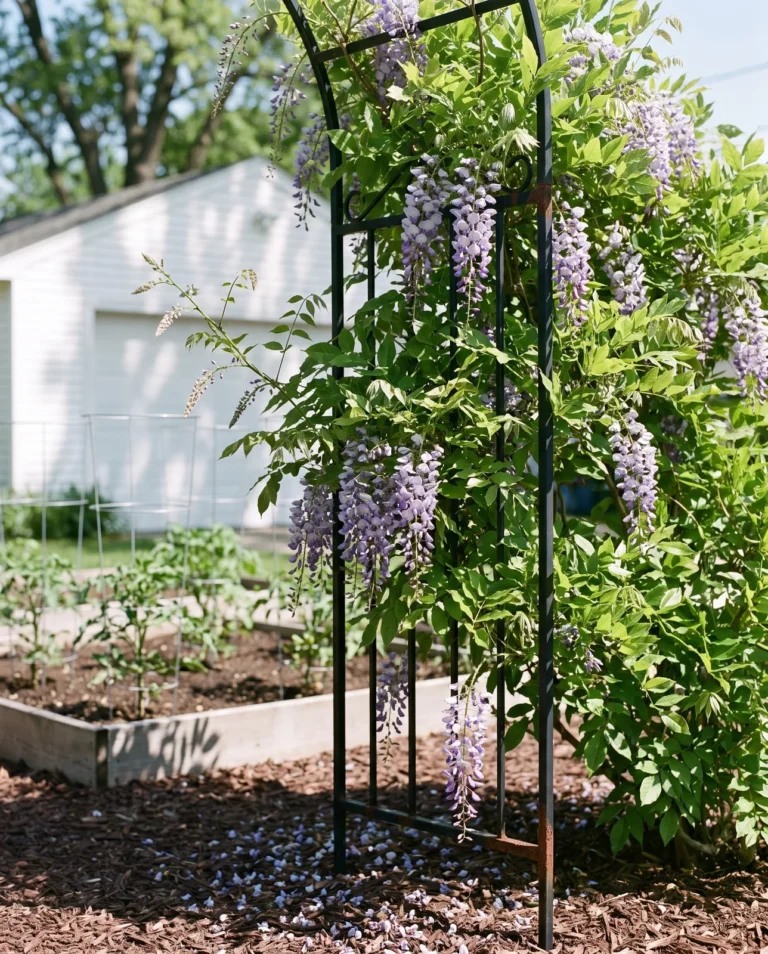
Kentucky wisteria with lilac racemes and leaves on a metal arbor in a Midwest garden in June
Kentucky wisteria (W. macrostachya)
Excellent winter hardiness
15 to 25 ft, racemes 6 to 12 inches
Fragrant blue flowers in June
Flowers in zones 3 and 4
Silky wisteria Shiro-kapitan with short white racemes of large flowers on a trellis in soft light
Silky wisteria 'Shiro-kapitan'
Highly scented
White with central yellow markings
Short sprays, 4 to 6 inches
Downy leaves, walls or pergolas
Japanese wisteria Macrobotrys with extremely long lilac racemes hanging through a high pergola
'Macrobotrys' (Japanese)
Aggressive and invasive in North Carolina
Racemes 2 to 4 feet long
Red violet and fragrant
Japanese wisteria, invasive in the Southeast
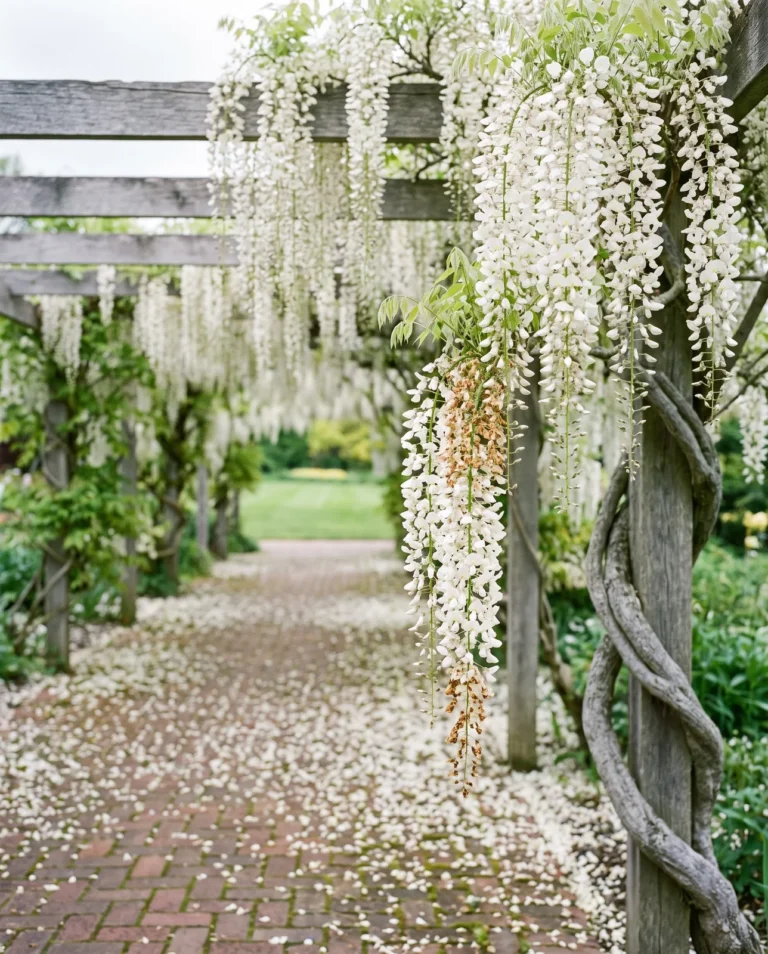
White Japanese wisteria Alba with long white racemes on a pergola walk in bright overcast light
'Alba' (Japanese)
Aggressive and invasive in North Carolina
White flowers, very fragrant
Opens with the leaves, base to tip
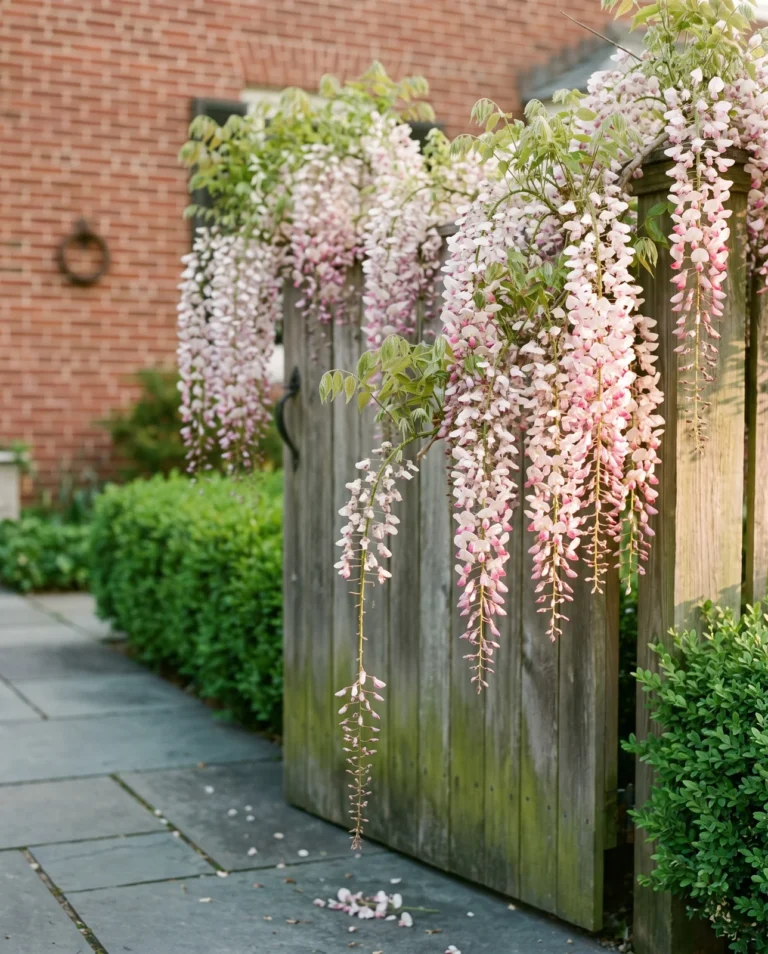
Japanese wisteria Kuchibeni with white racemes tipped pink hanging over a garden gate
'Kuchibeni' (Japanese)
Aggressive and invasive in North Carolina
White with pinkish tips
Also sold as 'Carnea'
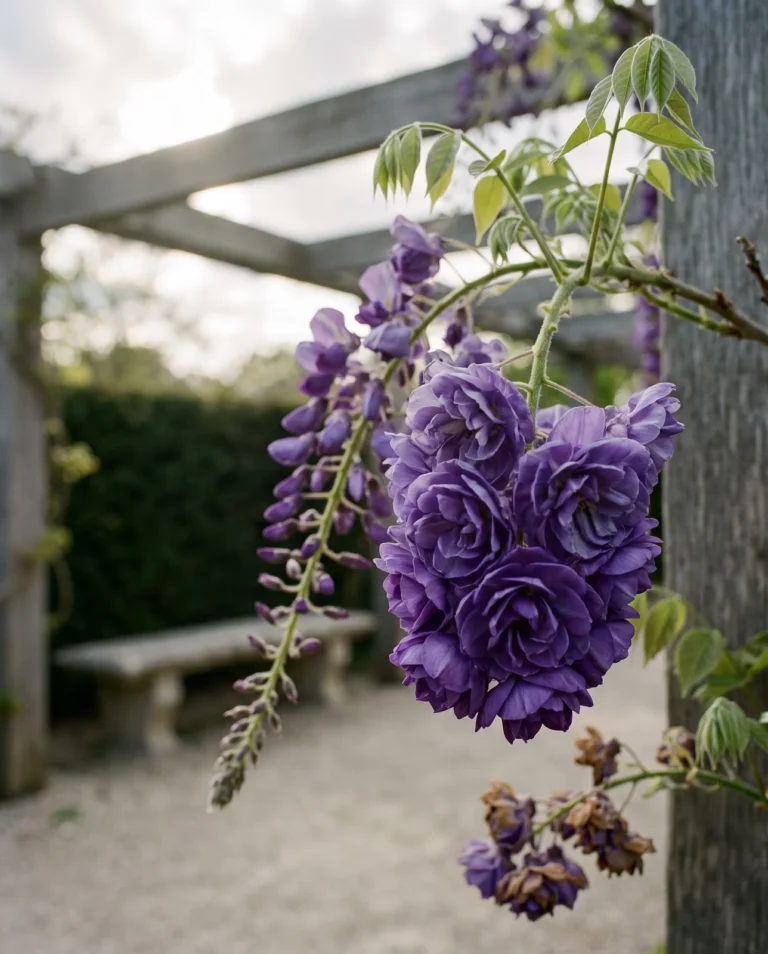
Double-flowered Japanese wisteria Violaccea Plena with rosette-like violet flowers on a pergola
'Violaccea Plena' (Japanese)
Aggressive and invasive in North Carolina
Violet blue double flowers, very fragrant
Clusters under 1 foot
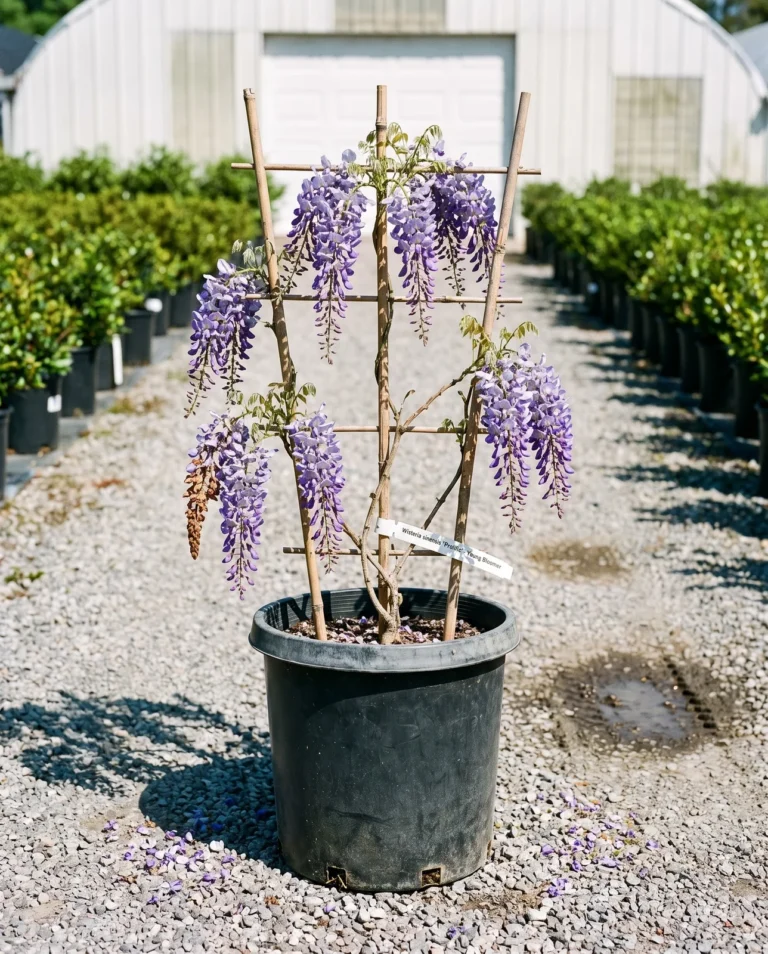
Young Chinese wisteria Prolific blooming in a nursery container with violet racemes on a short trellis
'Prolific' (Chinese)
Invasive species in North Carolina
Flowers at an earlier age than other varieties
Blue violet racemes 6 to 12 inches
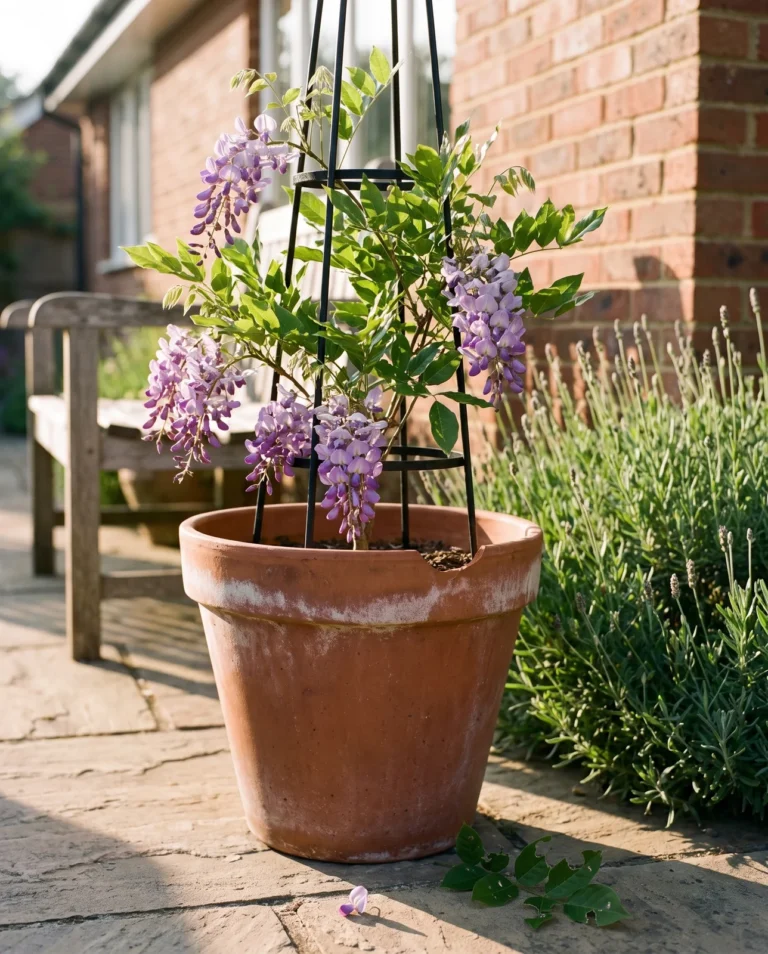
Compact American wisteria Amethyst Falls blooming on a patio obelisk in a large terracotta pot
'Amethyst Falls' (American)
Native
Clusters 4 to 6 inches, April and May
Reblooms in mid and late summer
Compact enough for a large container
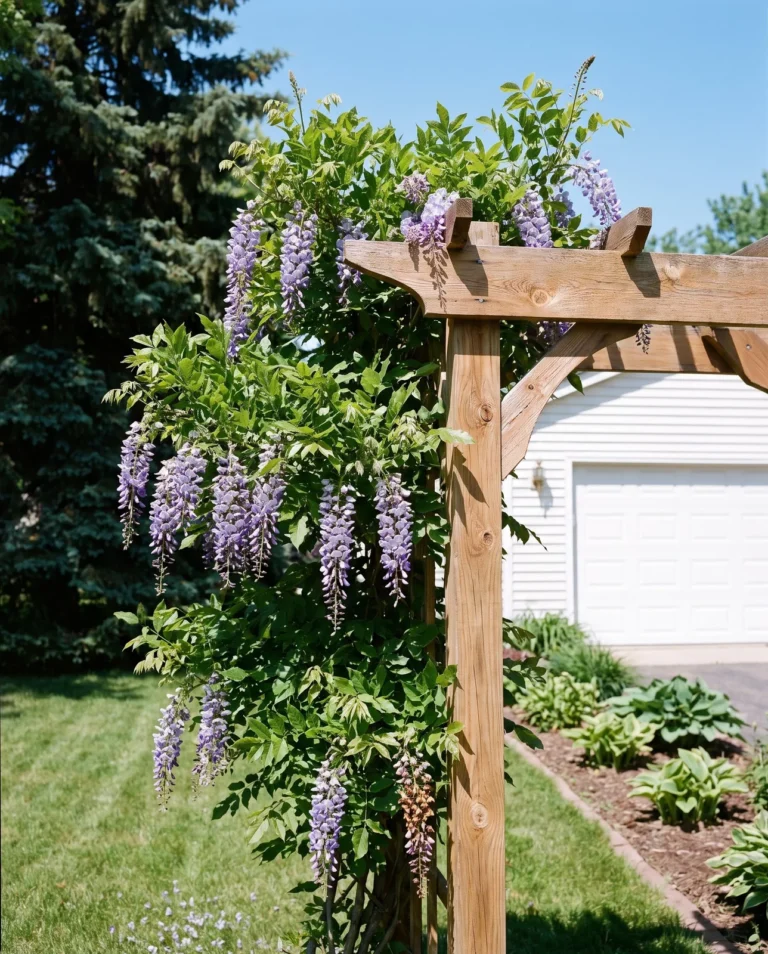
Kentucky wisteria Blue Moon with lilac-blue racemes on a sturdy arbor in a cold-climate garden
'Blue Moon' (Kentucky)
Rated to zone 3
Foot-long lavender blue racemes
May bloom up to three times a season
Zones 3 to 9, also rated 5a to 9b
04

Which wisteria is in your yard

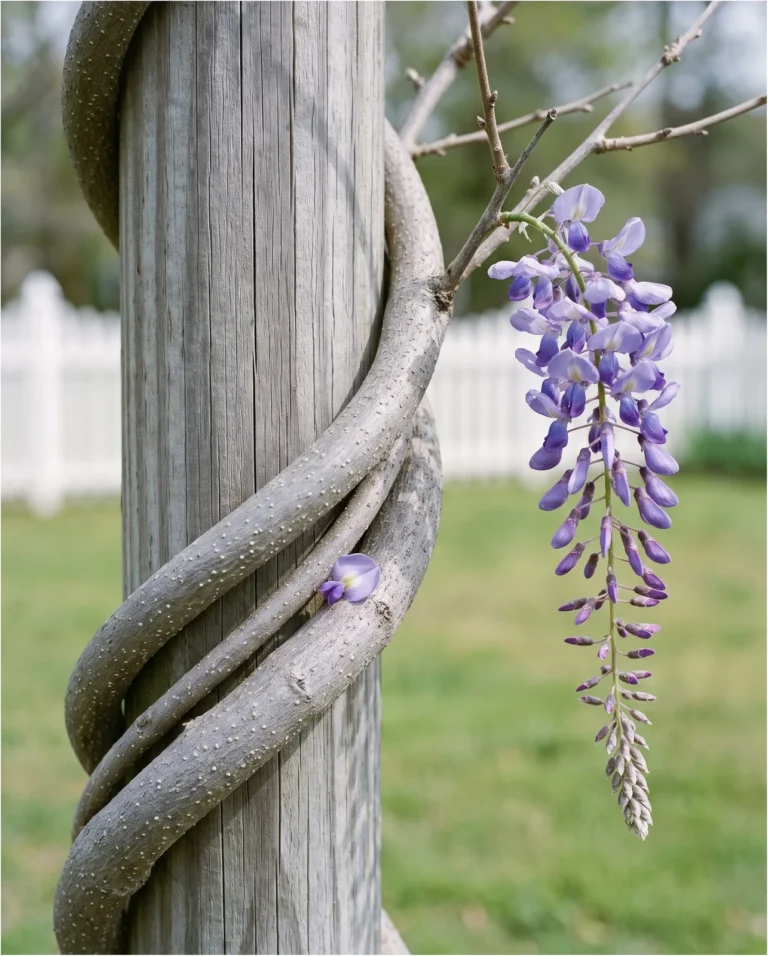
Three details settle it in the yard: which way the stems wrap, how many leaflets a leaf carries, and whether the flowers came before or after the leaves. Chinese and American wisteria wrap counterclockwise and Japanese wraps clockwise, and published descriptions disagree often enough that a leaf count is worth doing before you decide.

Chinese wisteria stem twining counterclockwise up a post with racemes open on bare wood
Chinese wisteria
Stems wrap counterclockwise, leaves carry 7 to 13 leaflets, and the whole raceme of 6 to 12 inches opens at once on branches still bare as the foliage begins to expand.
Japanese wisteria stem twining clockwise on a post with a long raceme opening top-down among leaves
Japanese wisteria
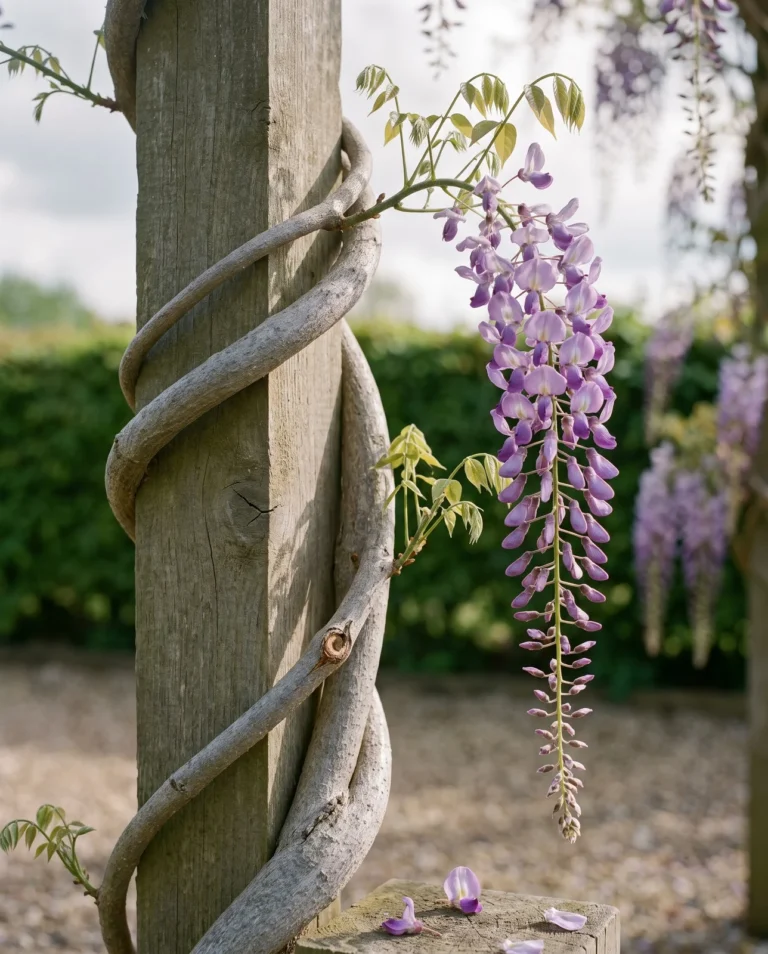
Stems wrap clockwise, leaves carry 13 to 19 leaflets, and clusters of 12 to 18 inches open from the base outward as the leaves emerge.
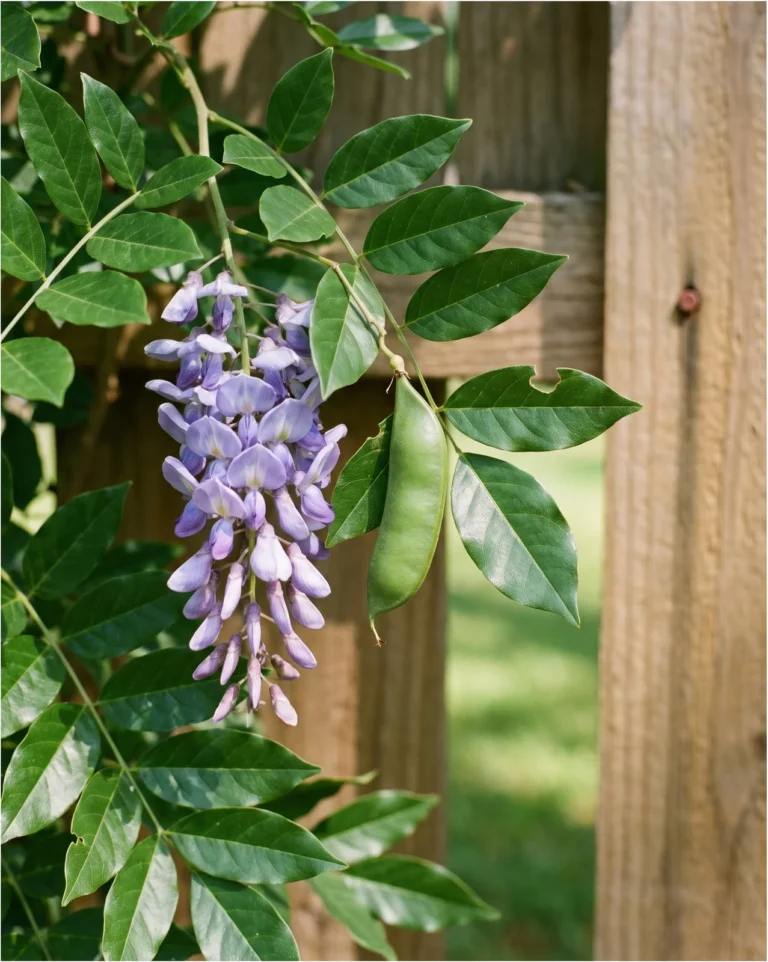
American wisteria short dense lilac raceme beside glossy leaves and a smooth green seed pod
American wisteria
Flowers open after the plant has leafed out, on racemes to 6 inches over leaves of 9 to 15 leaflets, and the seed pods are smooth and 2 to 4 inches long against the velvety 4 to 6 inch pods of the Asian species.
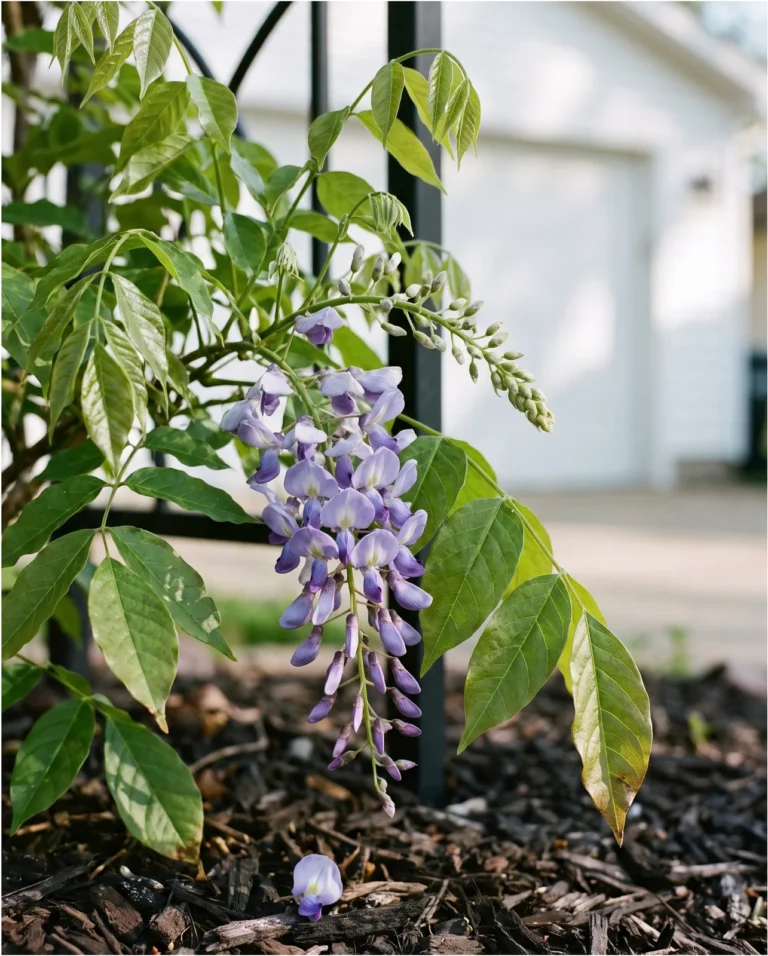
Kentucky wisteria raceme of medium length among leaves with a second flush of buds in June
Kentucky wisteria
Counterclockwise stems and leaves of about nine leaflets, with fragrant blue racemes that wait until June to open.
05

Why wisteria will not bloom

A wisteria that grows hard and never flowers is almost always one of five things: a plant too young or grown from seed, too much shade, the wrong pruning, overfeeding, or flower buds killed in winter. Age comes first, because it is both the most common cause and the one nothing fixes except time. A named cultivar bought at a nursery is usually grafted. Published waits for a first flower run from three or four years after planting to twenty years for a seed-grown plant, which can disappoint even then. A grafted or cutting-grown vine may flower in its second or third year and may take fifteen, while a seedling may take fifteen to twenty years. Two or three years, or longer, is the ordinary answer for a young vine that was not in bloom when it was bought. A grafted plant holding back for its first year or two after planting is behaving normally and will settle into flowering once its roots take hold.

Shade is the second check, and too much of it sits on the same short list of causes as age. Feeding is the third check and the one gardeners get backward. Wisteria fixes its own nitrogen and does not usually need more of it, so high-nitrogen feeding pushes leaf growth while overfertilization sits on the standard list of reasons a vine refuses to bloom. Feed lightly with a low-nitrogen product once a year, every other year, or not at all. Where a soil test shows phosphorus is short, superphosphate in early spring is one way to stimulate flowering. Pruning timing decides next spring before this summer is over. Cutting in early and midsummer disrupts the formation of flowers for the following year, and heavy pruning does the same, while regular timely cuts build the framework of flower spurs the plant blooms from.

Water is the quiet one. Flower buds start developing in late summer of the previous year, and dry soil between July and September makes those buds abort, which is why the Royal Horticultural Society tells gardeners to water a wisteria through dry spells in those months. A vine that flowered well for years and then went blank after one dry August is following that pattern exactly. Frost takes the buds at the other end of the cycle, damaging or distorting the developing flowers so they drop before opening, and a late spring frost is the single recognized problem on an otherwise trouble-free Chinese wisteria. Shredded flowers or teeth marks point to pigeons or mice instead. When everything else checks out, root pruning is the accepted last push: drive a shovel in a circle one to two feet from the trunk to stress the plant, done in fall, which may bring more flowers the following spring.

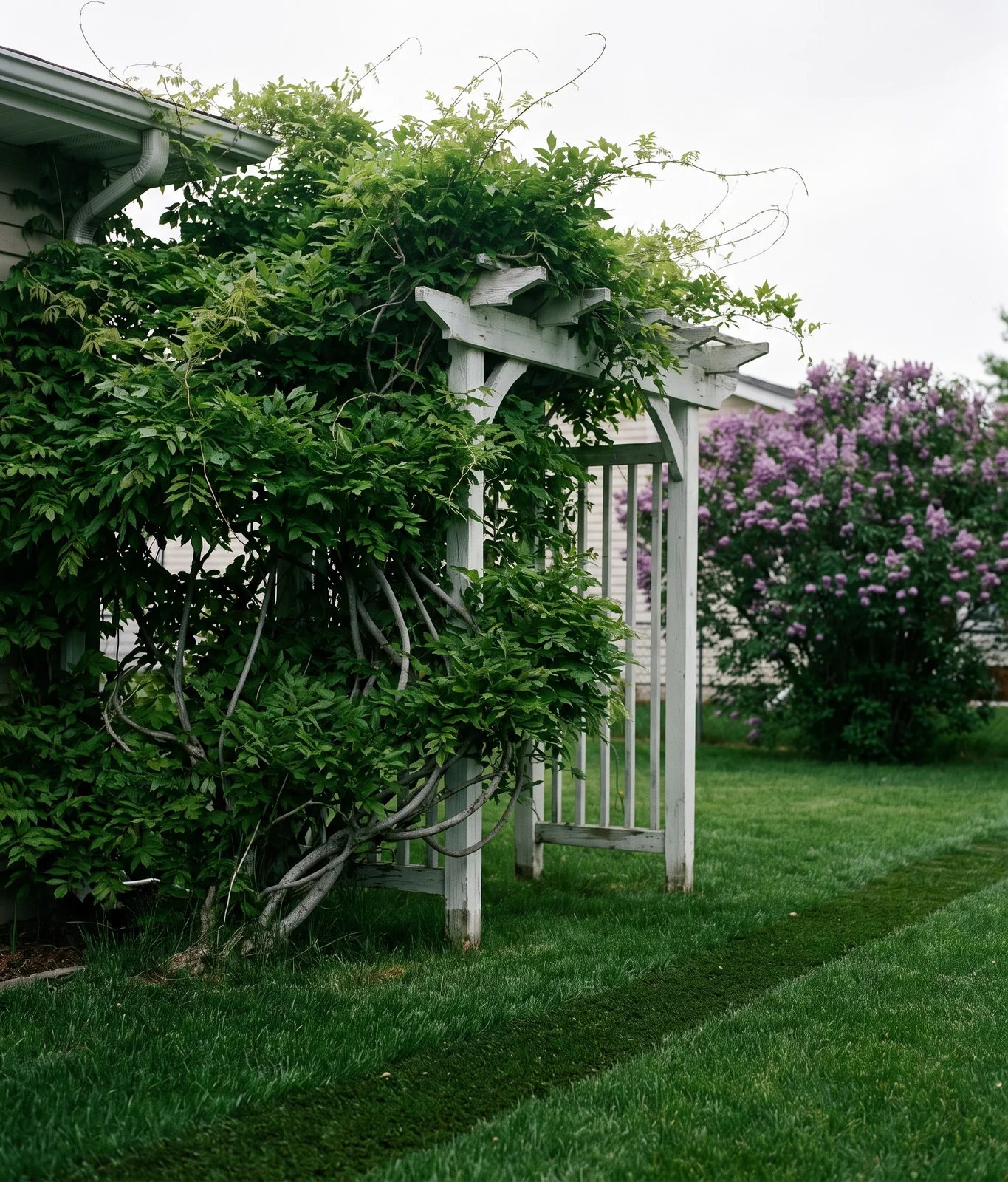
A big healthy wisteria vine covering an arbor in dense green leaves with no flowers in mid-May
06

The bloom checklist, in order

Work down the checks in this order and stop at the first one that describes your plant.

Why wisteria is not blooming
Work down in order
1
How old is it, and was it grown from seed?
Look for the graft union as a bulge near the base of the stem, since named cultivars are almost always grafted and species are not. A seedling can take up to twenty years, and a grafted plant holding back for its first year or two after planting is normal.
2
Does the spot still get six or more hours of direct sun?
Flowering falls off in even slight shade, so open the canopy above the vine or accept foliage.
3
What has been feeding it?
Stop high-nitrogen feeding. Overfertilization is a listed cause of failure to flower, and the standard is a low-nitrogen product once a year, every other year, or not at all.
4
When was it last pruned, and how hard?
Pruning in early and midsummer disrupts next year's flowers, and so does heavy pruning. Move the cuts to July or August and January or February.
5
Did the soil go dry between July and September?
Water through late summer dry spells. Next spring's buds form in that window, and dry soil aborts them.
6
Did buds form and then drop in spring?
Spring frosts damage or distort the developing flowers and make the buds drop before they open. With every other cause ruled out, root prune in fall, driving a shovel in a circle one to two feet from the trunk.
07

Pruning and aftercare

Wisteria is pruned twice a year, once after flowering in July or August and once in the middle of winter, in January or February, and both cuts land on the same shoots. The summer cut shortens the current season's whippy growth so the wood can ripen, which improves the chances of flower buds forming; the winter cut takes those same shoots back again to leave the buds close to the framework. Published lengths differ, from two or three buds, about 4 inches, up to 6 to 12 inches of last year's flowering wood, with about half of each new vine taken off after bloom. The cuts work because wisteria flowers on wood produced the previous growing season, thinner, lighter in color and more flexible than the older wood behind it. Take all of that off and a healthy vine has nothing to bloom from; take none of it off and the plant puts its energy into running.

The most common mistake with wisteria is not pruning at all, and the summer cut earns its place on top of the winter one because the vine is so vigorous. A young plant is a separate case: leave it unpruned until it has covered its wall or structure, and count on the first three to five years going into the permanent framework. Sucker sprouts at the base come off as soon as they show. Native wisteria needs less pruning than the Asian species, and 'Blue Moon' is kept to a minimum, tips cut back after bloom or in winter. On a pergola, thinning the racemes leaves the ones that remain room to hang and develop.

An overgrown vine can be brought back, slowly. Long branches are shortened hard, sections of older stem are removed to just above a strong young branch lower down, and where the tangle demands it a stem is cut back to a main branch or even to ground level, leaving a skeleton of well-spaced branches. Trace each twined branch before cutting it, because in a mature plant the stem being pulled is often the one worth keeping. Where the framework has gaps, suitably placed new growths are trained in as replacement branches, and flowering usually resumes in two or three years. Hard pruning stimulates strong new growth, so skip feeding in the first spring afterward. Cutting alone does not tame this plant: cut edges sprout, which is the same trait that makes an escaped vine so hard to remove.

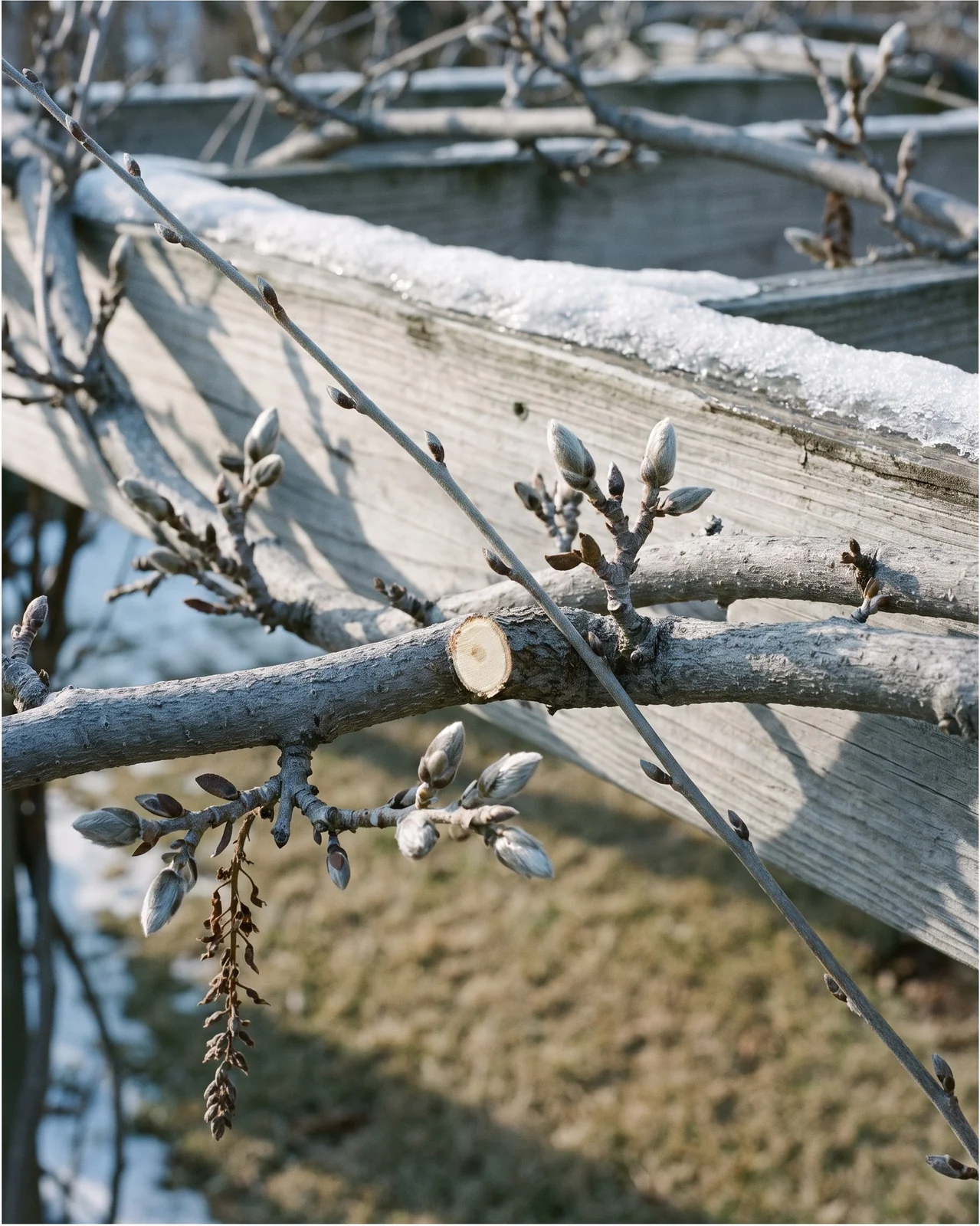
Bare wisteria framework in late winter with short flowering spurs and fat flower buds along the branches
08

What to cut, month by month

The two main cuts fall in the same weeks every year. Everything else on the calendar is upkeep.

January to February
Cut
Summer-pruned shoots to two or three buds, about 4 inches
Why
Tidies the plant before the growing season starts
April to May, in bloom
Cut
Thin the racemes on a pergola
Why
The clusters left behind have room to hang and develop
July to August
Cut
The current season's whippy green shoots to five or six leaves, about 1 foot
Why
Ripens the wood and improves the chances of flower buds forming
Any time in growth
Cut
Sucker sprouts at the base, as soon as they appear
Why
Young shoots can still be snapped off, older vines need cutting
Late fall
Cut
Roots, with a shovel driven in a circle 1 to 2 feet from the trunk
Why
Root pruning in fall may bring more flowers the next spring
First 3 to 5 years
Cut
Only what shapes the framework; leave a young plant until it covers its support
Why
These years develop the permanent structure of the vine
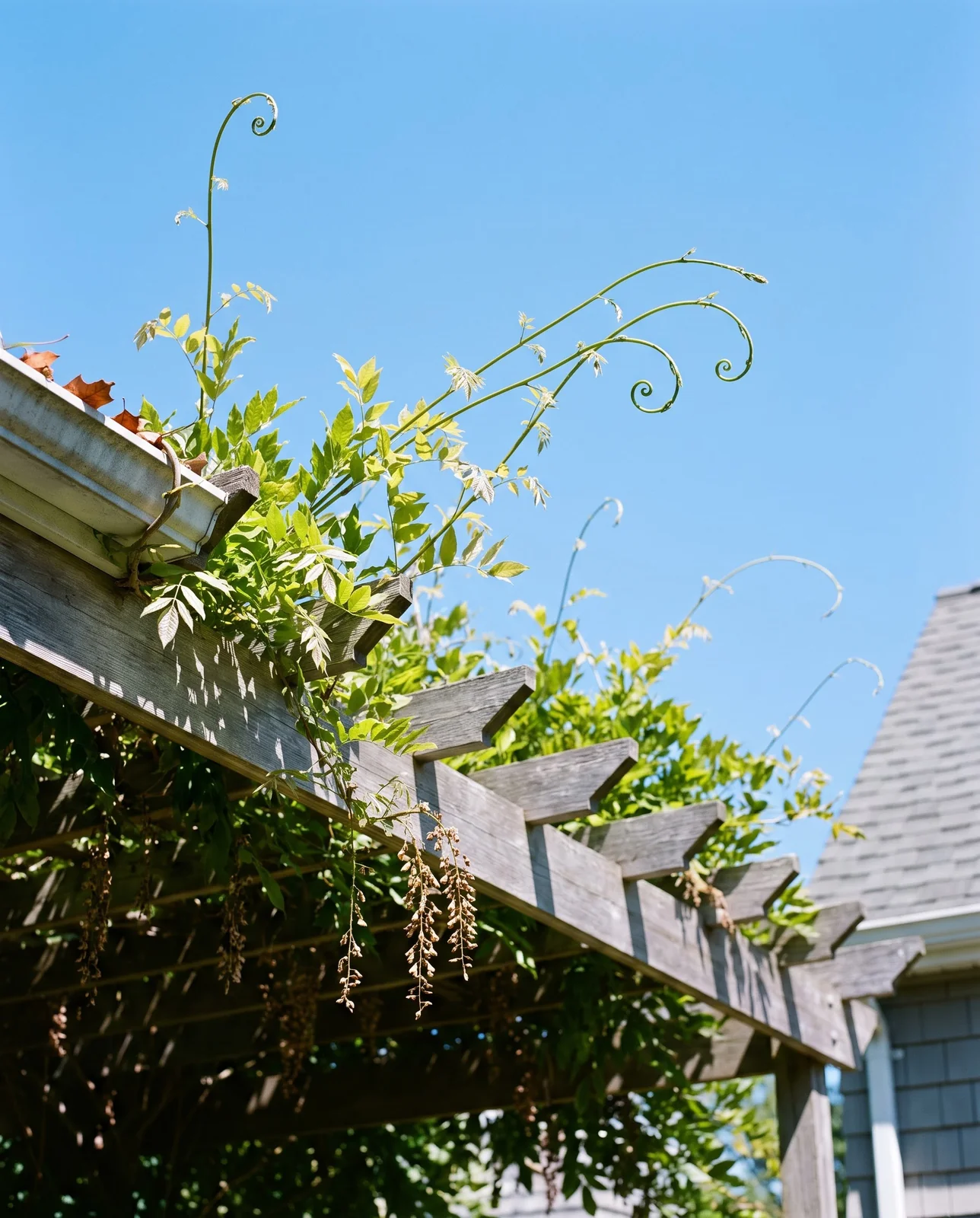
Long whippy green wisteria shoots reaching above a pergola in July sun against a blue sky
09

Support and planting

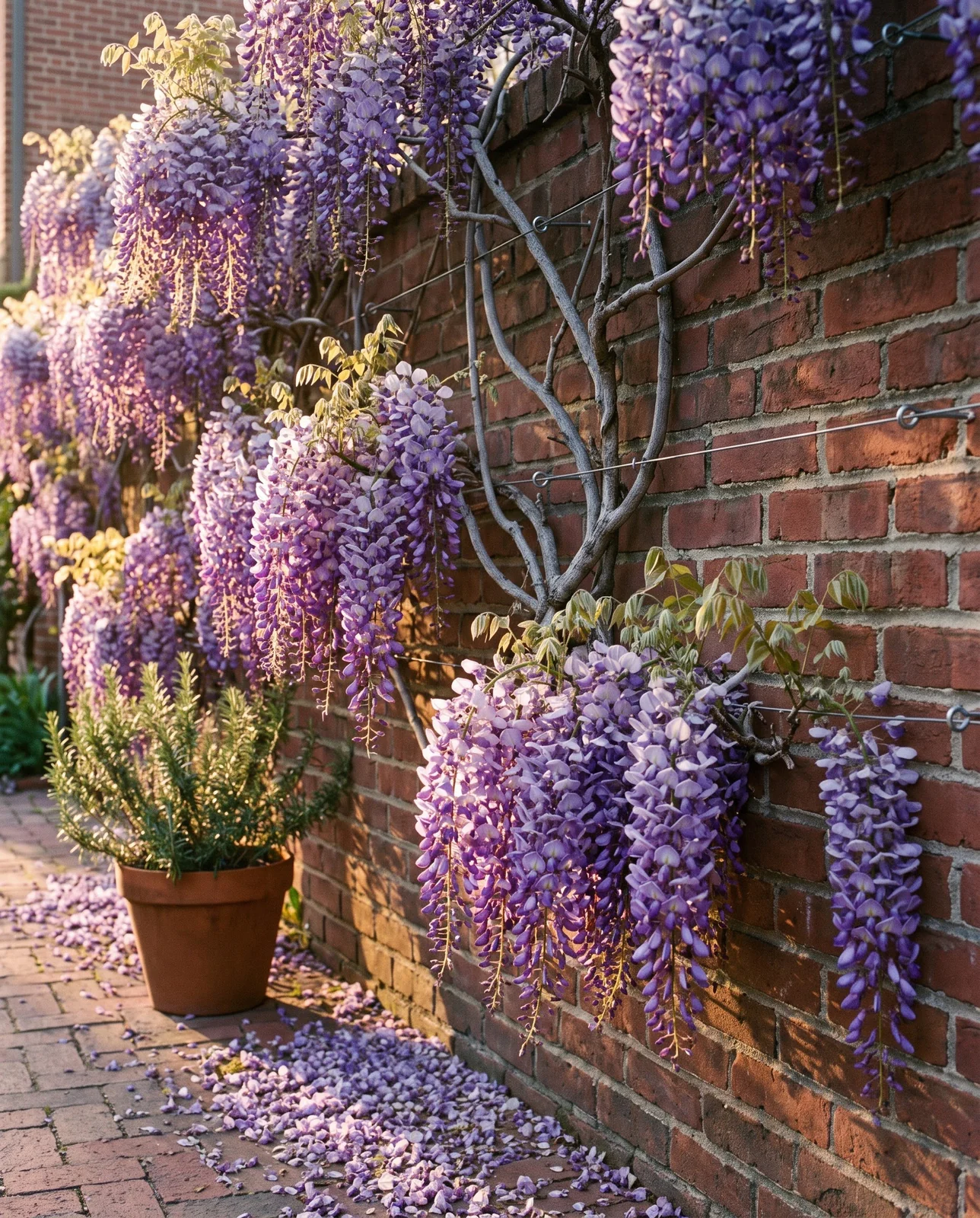
Wisteria needs a structure built for a heavy load. The vine is capable of destroying all but the strongest wooden or metal structures, through sheer weight and the constriction of its twining stems, and a mature plant strains whatever pergola is holding it. Posts of 6 by 6 lumber or larger, or steel beam construction, are what stands up to it. Keep it off the house: it grows into small spaces and pries them apart as it thickens, putting rain gutters, shutters and awnings at risk, and it should never be allowed under siding or into downspouts. On a wall the standard method is an espalier trained on horizontal wires of 3 mm galvanized steel set a foot apart. The support goes up before the vine does, because retrofitting a stronger frame under an established wisteria means cutting the plant back to reach it.

Plant between October and April; a container-grown wisteria can go in at any time of year, though it is easier to look after through autumn or winter. Pick the spot as if it were permanent, because an established plant does not take well to transplanting. Growing a wisteria into a living tree is possible, planted on the south side and three feet out from the trunk, with the warning attached that the tree may suffer for the arrangement. Lateral stems also run along the ground from the base and root as they go, so the ground around a young plant is worth walking each season while the shoots are still soft enough to snap off. For a lattice panel, a porch column, or anything else that cannot carry weight, plant a lighter twiner such as clematis and save the wisteria for the arbor.
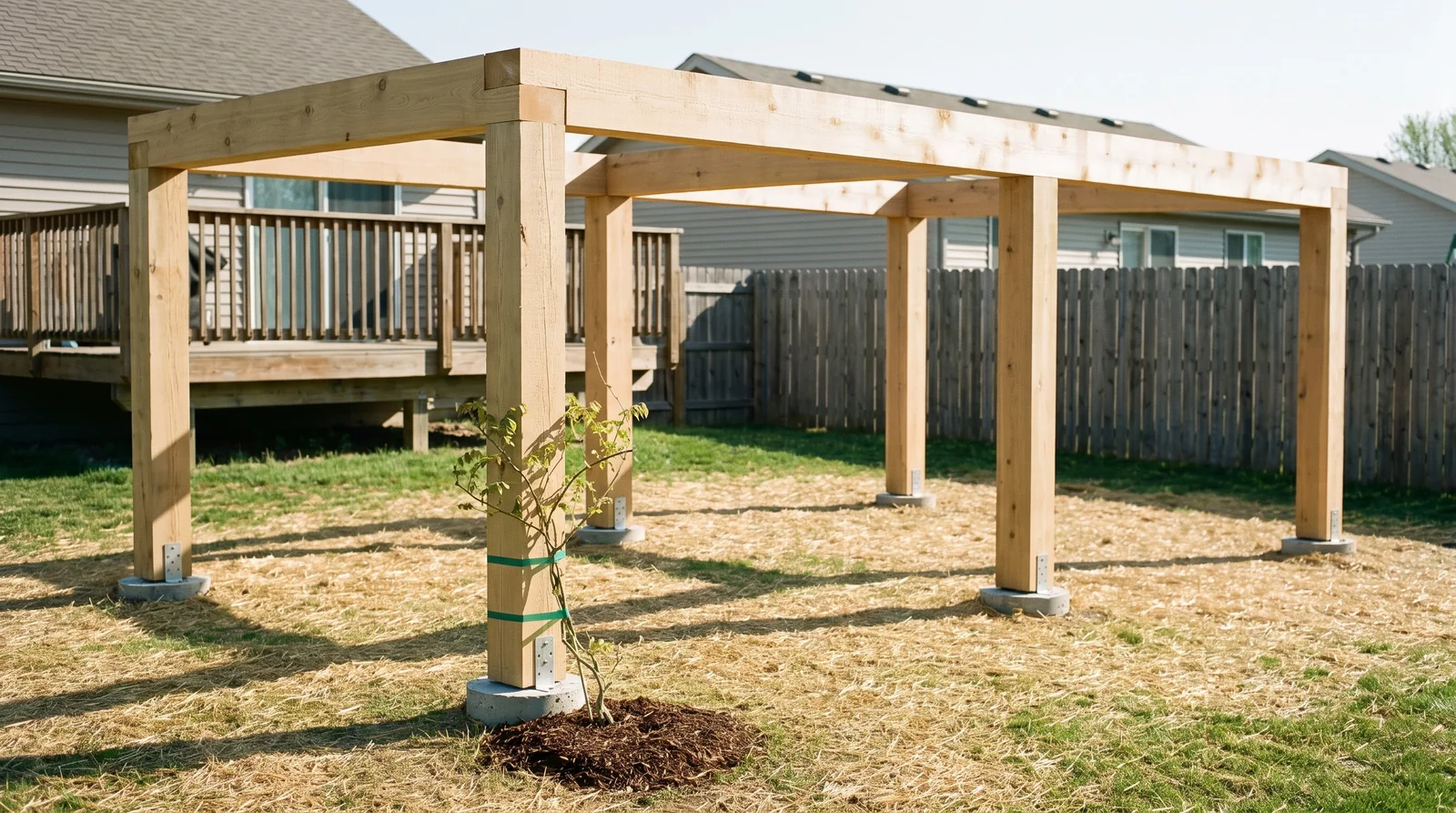
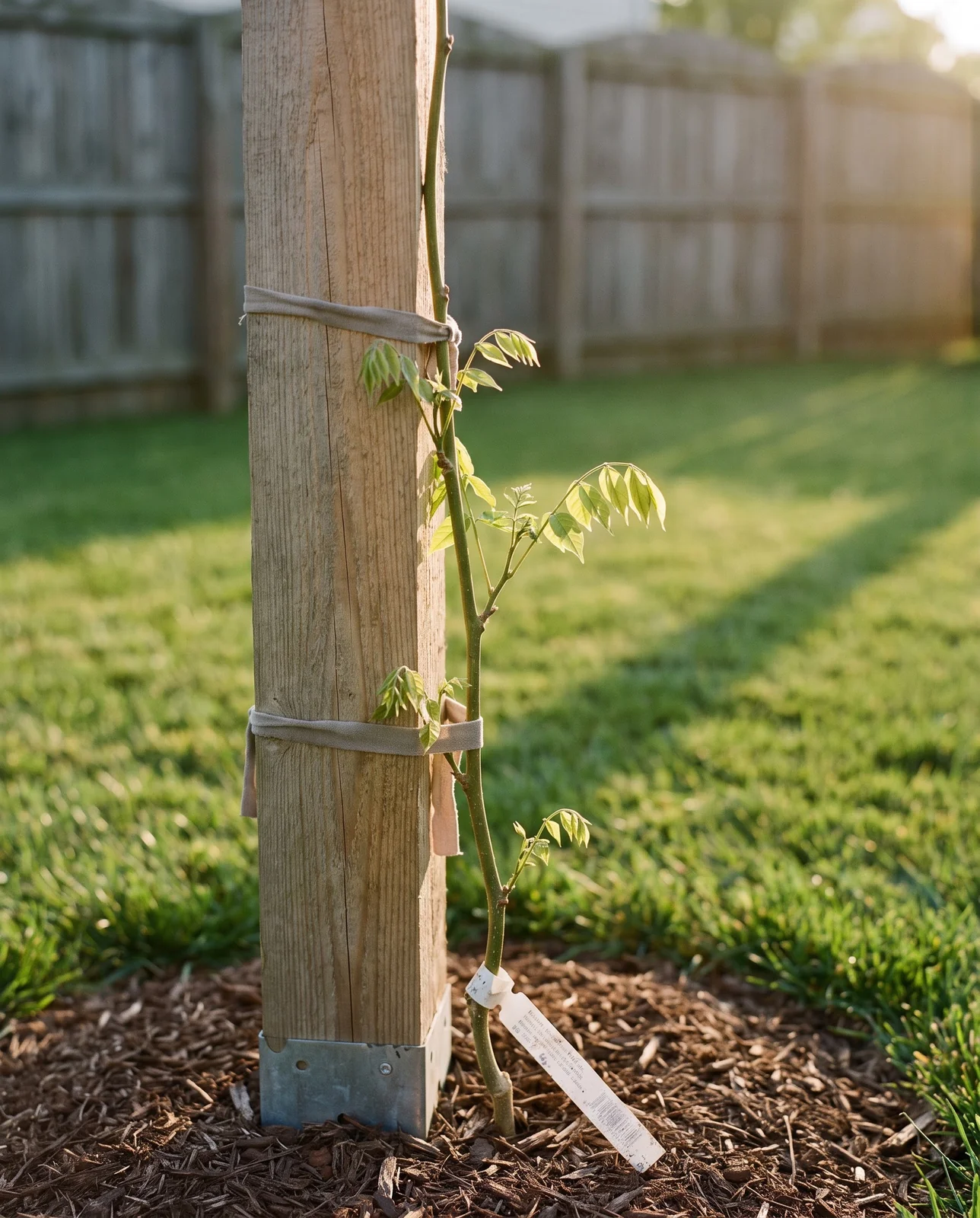
A sturdy new cedar pergola with heavy posts and a young wisteria tied to one post in spring
10

Height and spread

Wisteria grows 10 to 25 feet, and the real limit is the support it is given. On a garden structure, Chinese wisteria takes that full height on 4 to 8 feet of width, and spread reaches 30 feet where a wall gives it room, while American wisteria runs 15 to 30 feet tall on the same 4 to 8 feet of width. Left to climb, Chinese and Japanese wisteria reach upward of 70 to 80 feet, and the three most grown species manage about 33 feet in a tree or 66 feet of spread against a wall. The vine thickens while it climbs: old trunks reach 10 inches across and take on a fluted, muscle-like form.
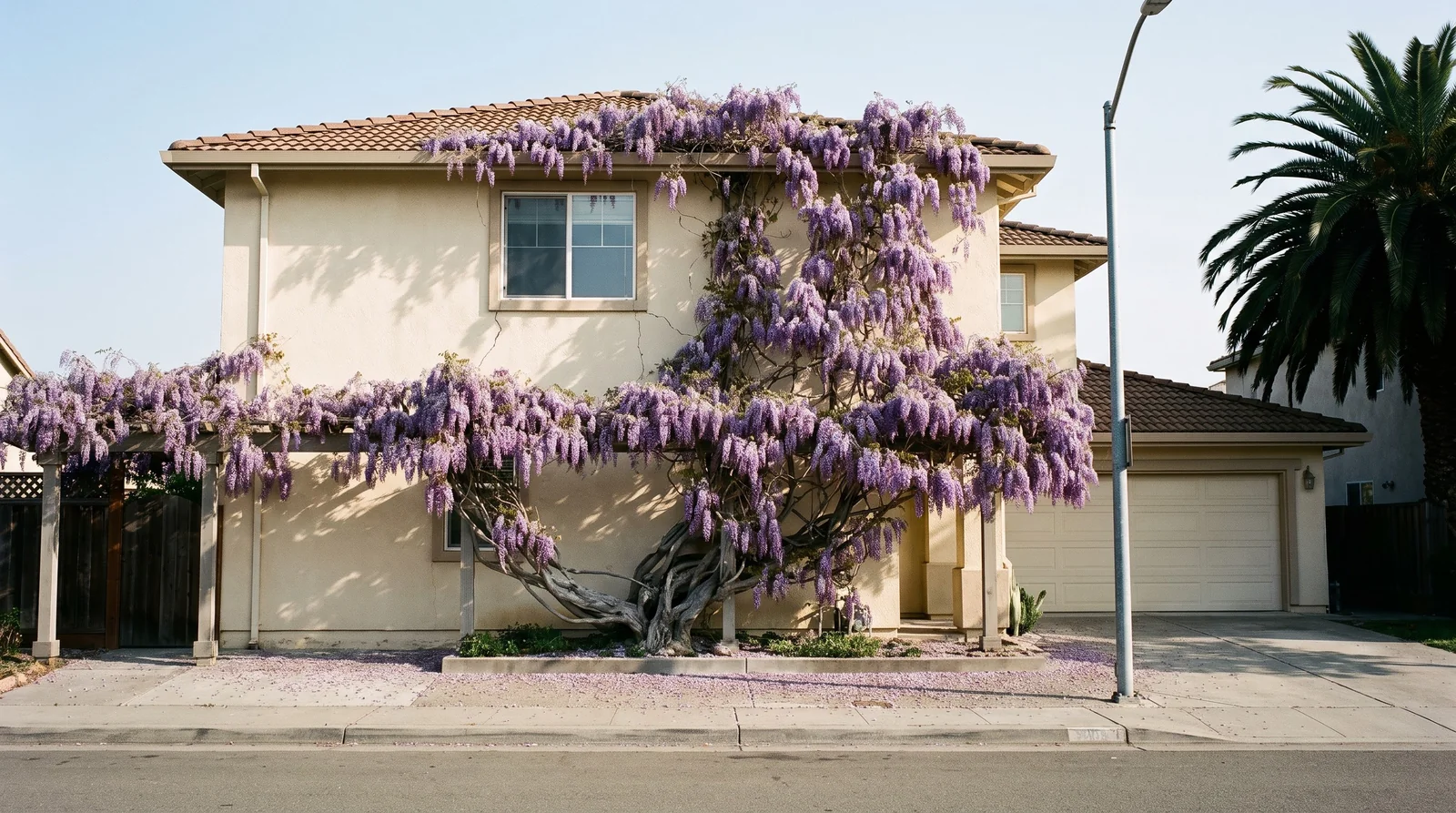
Wide view of a wisteria covering the entire side of a two-story house in full bloom
11

Light

Wisteria wants full sun, six or more hours of direct light a day, and full sun is what it needs for the best flowering. Slight shade does not kill the plant, it cuts the number of flowers, which is why a south or west facing wall or pergola is the standard position. Japanese wisteria is shade intolerant, and American wisteria cannot grow in full shade at all. The light problem in a settled yard arrives slowly and is easy to miss. Nothing about the vine changes, but the maples and oaks around it add canopy every season, and a plant that went in on an open lawn can be standing in half shade a decade later with its care unchanged. Count the hours the spot gets in June, with every tree overhead in full leaf; an April reading, taken while the canopy is still open, flatters the site.

12

Water

Wisteria is moderately drought tolerant once it is established, and the timing of the watering matters more than the amount. Keep the soil moist while the plant is in bloom and again while the flower buds form in August and September, and give it periodic deep watering through summer and fall. The late summer window is the one worth marking on a calendar: dry soil between July and September makes next spring's buds abort, so watering through dry spells in those months protects flowers that will not be seen for another year. Newly planted vines and plants on light or sandy soil dry out fastest and need the most attention. An established Chinese wisteria will grow on wet or dry sites. Standing water in heavy ground is the opposite risk: excessive watering causes root rot.

13

Soil and pH

Wisteria grows best in moderately fertile, well-drained soil that runs slightly acidic to neutral. The tolerated range is wide, from acid below 6.0 through neutral ground up to 8.0, and the plant takes a broad set of soil conditions, though at the alkaline end it becomes susceptible to iron chlorosis. Drainage counts for more than richness. Rich soil is the trap most gardeners fall into, since this is a legume that makes its own nitrogen and a general garden fertilizer buys leaf growth at the cost of flowers. On sandy ground low in potassium, sulfate of potash in spring at half an ounce per square yard covers the gap.

14

USDA hardiness

Wisteria is hardy through zones 5 to 9 as a genus, and the differences between the four species matter at both ends of that range. Chinese wisteria stops lower, at zones 5a to 8b. Japanese wisteria runs colder and wider, 4a through 9b, a full zone hardier than Chinese. American wisteria runs zone 5 to 9, hardy to zone 5, with 'Amethyst Falls' the cultivar usually stocked. Kentucky wisteria is the cold-climate answer: it is rated to zone 3, and 'Blue Moon' is listed at zone 3 to 9 and noted for flowering in zones 3 and 4. Zone ratings for the Kentucky types differ between 3 to 9 and 5a to 9b, because some records fold the species into American wisteria. Surviving the winter and flowering are separate questions: a vine can come through a hard winter with every stem alive and still show nothing at bloom time, because spring frost damages or distorts the developing flowers and makes the buds drop before they open. Where late frosts are routine, the Kentucky types carry the advantage twice over, noted for winter hardiness and opening in June, well after the frost window has closed.
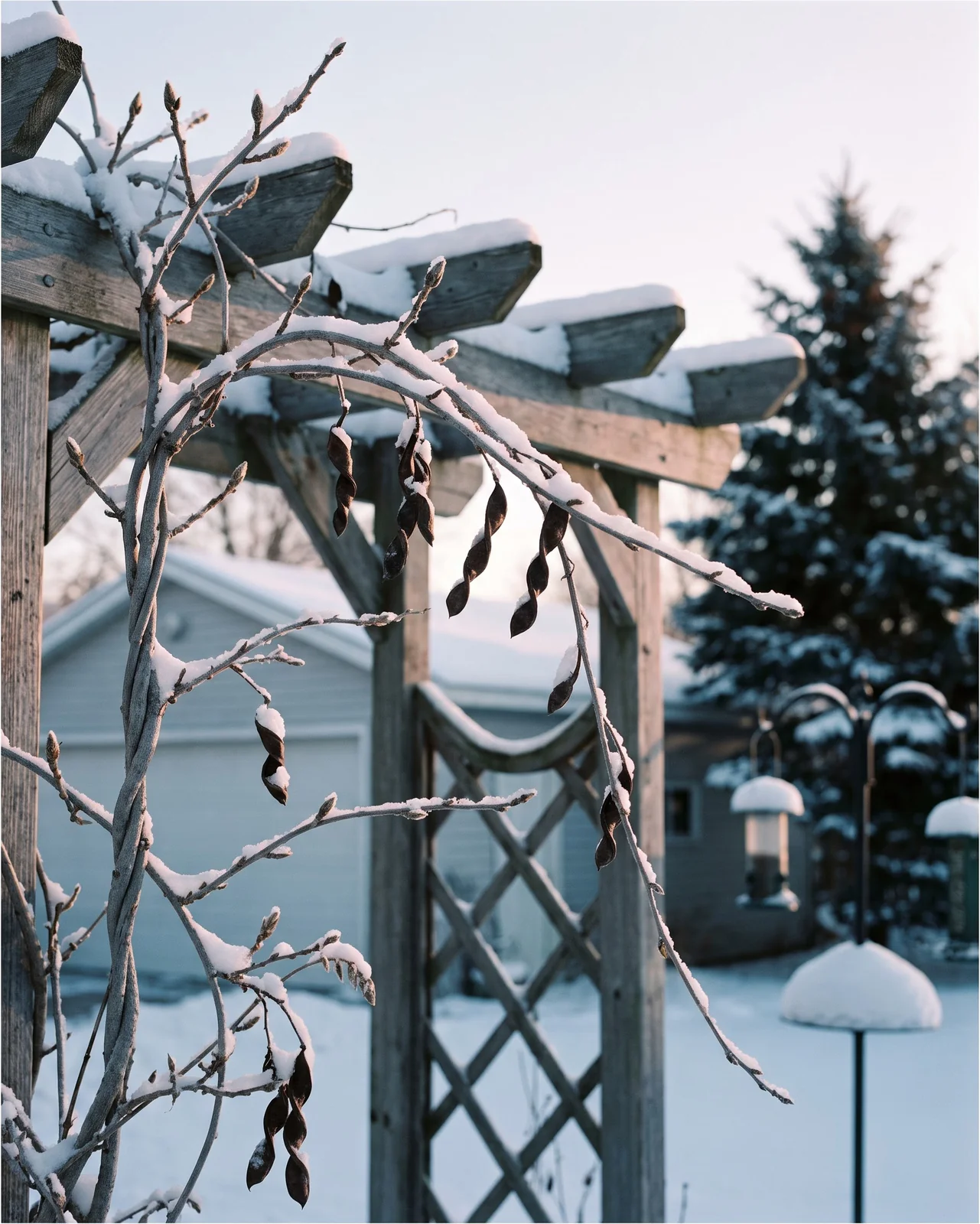
A dormant wisteria vine on an arbor under fresh snow in a northern garden at sunrise
15

Invasive or native: which wisteria to plant

Chinese and Japanese wisteria and their hybrids are invasive across much of the eastern United States, while the North American species are not. Chinese wisteria is flagged as an invasive species in North Carolina, and Japanese wisteria is called aggressive and invasive there for its rampant growth and rooting surface runners. Chinese wisteria is also listed as a noxious weed in one or more Midwestern states, with a warning against growing it where it can spread. In Maryland, gardeners are told not to plant Chinese, Japanese or hybrid wisteria and to replace existing plants where possible. Maryland's own guidance goes two ways on what that means at the register: on one page the three Asian species are prohibited under state law, on another they are Tier 2 plants that retailers may still sell behind a conspicuous warning sign. Nationally there is no restriction at all, since wisteria species and hybrids are not regulated in the United States or the Midsouth. A vine on the garden center bench can be entirely legal and still be the wrong plant for your county.

What makes it invasive is mechanical. The vines shade out the foliage of mature trees and strangle their trunks with constricting, heavy stems, displacing native plants, girdling trees and shrubs, and changing how much light reaches the forest floor. In the Southeast the escaped Asian vines strangle trees and occasionally bring them down under their own weight. Lateral stems run out along the ground from the base of the climbing stems and root as they travel, while almost no wildlife touches the seed, which is large enough that animals ignore it and water carries it instead. Removal is a campaign rather than an afternoon. Cutting a vine on a tree makes it sprout from the cut edge, so the cutting has to be repeated, and early detection matters more than any single treatment. Root fragments left in the ground sprout as well, and once established the plant is difficult to eradicate and persists for years. Young shoots snap off by hand; older vines have to be cut.

If the point is the flower, the native species does the same job with less trouble: American wisteria is the native alternative, needs less pruning than the Asian pair and is less damaging to buildings. 'Amethyst Falls' and 'Blue Moon' are the two cultivars usually on offer. Named replacements outside the genus include trumpet vine, trumpet honeysuckle, virgin's-bower clematis and crossvine, with the caveat that most are not fragrant and flower later than early spring. An existing Asian vine has a middle course between keeping it and killing it: keep it off trees and off the property line, cut every ground-running stem before it roots, and hold to the twice-a-year pruning so it never gets away.

16

Growing wisteria in a pot or as a tree

A wisteria will grow in a container, and what it takes is a big pot and a compact type. Use a container of at least 18 inches filled with a loam-based potting mix. 'Amethyst Falls' is the cultivar named for the job, a compact habit carrying dense clusters of lilac-blue flowers. Training the plant as a standard is the other half of the answer, since holding it in that shape restricts its vigor and is what makes a border or a container planting possible in the first place. A potted plant dries out faster than one in open ground, so watering is closer work. Pruning does not ease off either: a wisteria on a single stem needs a large amount of cutting to stay in that shape.

Building the tree form takes several seasons of training. Start with a young single-stemmed plant and put a stout support of 4 to 5 feet next to it at planting, then tip the leader the following February to force sideshoots. Shorten those sideshoots to 6 inches or a foot each winter to build up a head, and in August cut off any shoot not needed to extend that head above its seventh leaf. A metal post serves as well as a wooden one: train a single shoot up it through the first season, cut the main stem just above the top of the support the next year to form the head, then prune hard every year after that. The hard cutting does not cost the display: even after strong cuts, a tree-form wisteria still blooms.

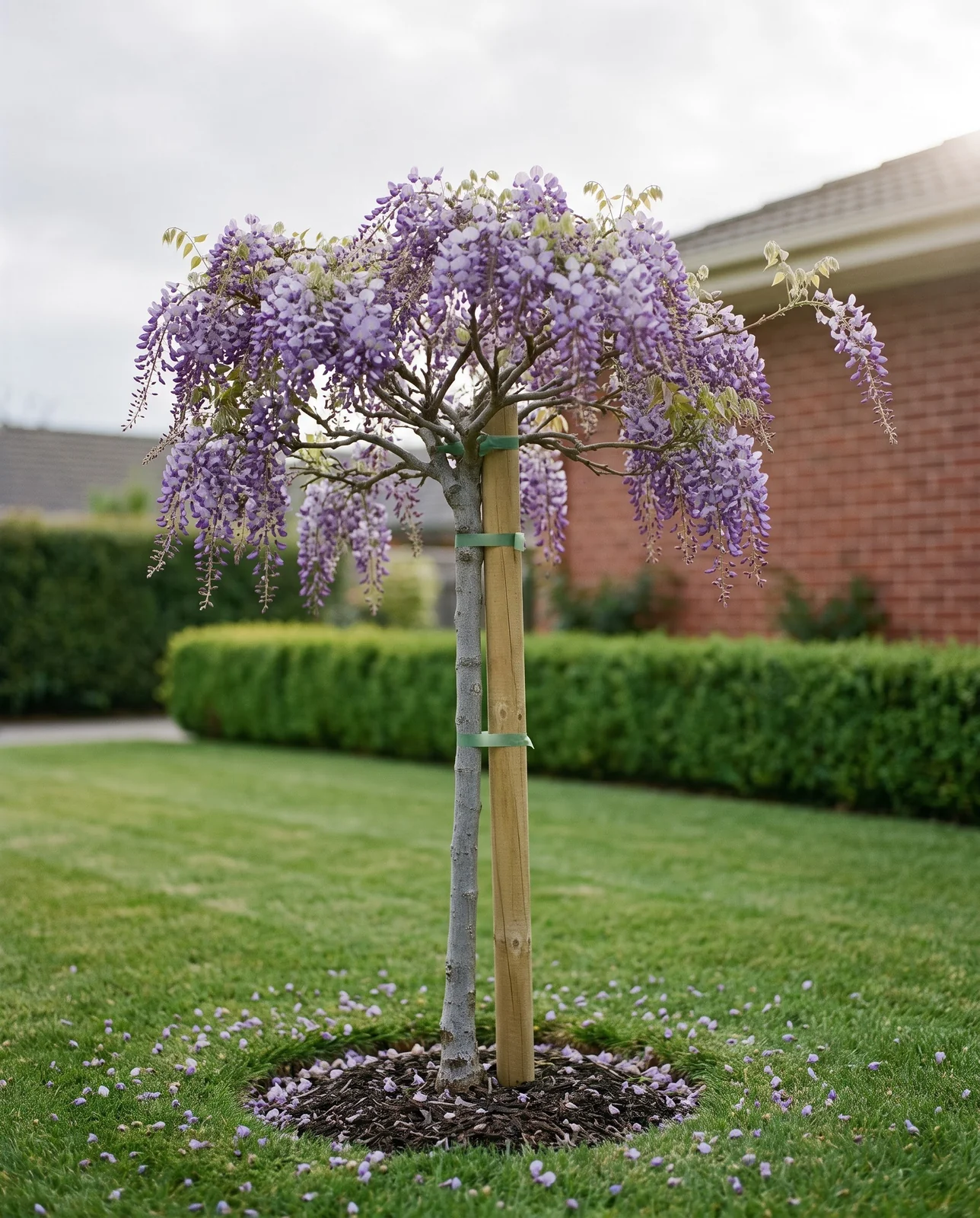
A wisteria trained as a small standard tree with a single trunk and a rounded head of racemes on a lawn
17

Propagation and longevity

Wisteria is propagated by layering, by cuttings or by grafting, and the method decides how long the wait for flowers runs. Layering in summer is the easiest and most reliable route for a home gardener, while professional nurseries graft. Softwood cuttings are taken from spring to midsummer, hardwood cuttings in winter. Seed is the slow road: propagation from seed is measured in years while shoots and cuttings are much faster, and a seed-grown plant may not flower for fifteen to twenty years. Anyone who wants to try it collects the pods after leaf fall, ripens them in an open tray, and sows fresh seed three quarters of an inch deep, soaking dry seed for 24 hours first. If the point is flowers, buy a plant grown from cuttings. Wisteria is long lived, which is the argument for putting the work into the permanent framework in the first years.
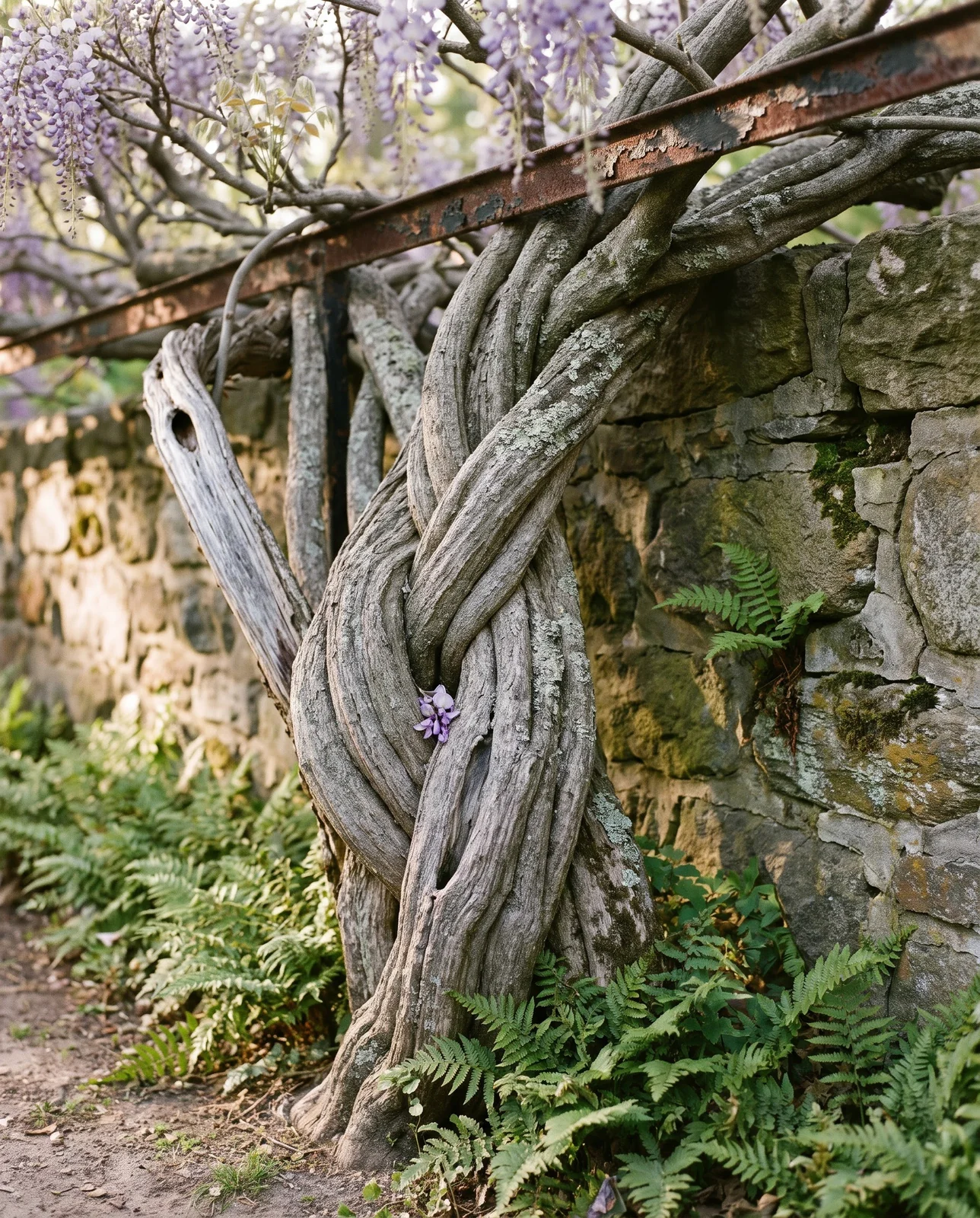
Century-old wisteria trunk thick as a tree braided against a stone wall with racemes above
18

Pests and diseases

Wisteria has few serious pests. The insects recorded on it are Japanese beetles, aphids, leaf miners, scale insects and mealybugs, and the diseases are dieback, crown gall and leaf spot, none of them significant. Brown limpet-like bumps on the bark are scale insects, most often brown scale. Leaf trouble is where this plant misleads people. Irregular dark brown blotches with a yellow margin are powdery mildew, which on wisteria shows almost none of the white growth that gives the disease away on everything else, and the pale green or yellowish mottling it produces in early summer is routinely mistaken for a virus. Yellowing with bright green veins is a different problem, iron chlorosis, brought on by high soil pH or by root disease, so a pH test comes before any treatment. Deer are a minor concern, since the plant is mildly resistant to deer damage and deer tend to avoid the American species.

The failures that kill a plant are at the roots and at the graft. Sudden wilting and dieback in an established vine can come from honey fungus, phytophthora root rot, waterlogging, or vine weevil grubs in a container, and American wisteria is susceptible to honey fungus as well. When the top of a healthy plant dies back and new shoots come up from below ground level, the usual cause is graft failure, and those shoots belong to the rootstock. Graft failure is commonest on young plants, though it has been reported on mature ones 20 years old and more. The native species pays for itself beyond the flowers: it tolerates heat, drought and soil compaction, hosts Zarucco Duskywing and Long-Tailed Skipper butterflies, and feeds butterflies at the blooms.

19

What actually goes wrong, most common first

These are counted from a sample of 50 gardener forum threads read across Houzz, Garden.org, Dave's Garden and smaller boards, most common first.

Grows hard, never flowers

Fourteen of the fifty threads, including vines that flowered for years and then stopped. Age, shade, a mistimed cut, overfeeding and winter bud kill are the causes, and the age question is settled at the base of the stem, where a grafted plant shows a bulge and a seedling does not.

Out of control, and it will not stay removed

Nine of the fifty threads, most of them about getting rid of it. Lateral stems run along the ground from the base and root as they travel, so the plant is wider underground than it looks, and cut edges and root fragments both resprout, so removal takes repeated cutting.

Yellow leaves

Seven of the fifty threads. Yellowing with bright green veins is iron chlorosis from high soil pH or root disease, so the soil test comes before any spray, and excessive watering brings root rot with it. Pale green or yellowish mottling in early summer is more often powdery mildew than a virus.

Looks dead, will not leaf out

Six of the fifty threads. New shoots from below ground while the top stays bare point to graft failure, commonest on young plants but reported on plants 20 years old and more. Root disease, waterlogging and vine weevil grubs in pots give the same picture, so dig to the roots before writing the plant off.

Which type to plant, and whether it is invasive here

Six of the fifty threads, asked by people about to buy. Chinese wisteria is flagged invasive and Japanese aggressive and invasive in North Carolina, while nationally the genus is not regulated at all, so the answer is a local one and the native species is the way around it.

Wrecks the structure it was planted on

Four of the fifty threads, and the discovery usually comes late, after the vine is in the gutter or under the siding. Trunks that thicken to 10 inches pry apart the small spaces they have grown into, and nothing lighter than 6 by 6 posts or steel holds a mature plant.

20

Toxicity and pet safety

Wisteria is poisonous, and the seeds and pods are the dangerous end of the plant, with the leaves and fruit toxic as well. The ASPCA lists wisteria as toxic to dogs, cats and horses, names lectin and wisterin glycoside as the toxic principles, and gives the clinical signs as vomiting, sometimes with blood, along with diarrhea and depression. The genus is rated low severity for poisoning, the seeds are named as the poison part, a glycoside and a toxic resin join the same two principles, and the signs listed for pets are nausea, vomiting, stomach pain, diarrhea and depression. The native species is rated higher, at medium severity, and the quantity behind that rating is small: eating one or two seed pods can bring on nausea, repeated vomiting, abdominal pain and diarrhea. Its roots, bark, branches, fruits and seeds carry triterpene-based saponins, and the seeds also hold canavanine.

The pods are the part to plan around, because of when and where they hang. Flowers develop into densely hairy pods holding one to four seeds, 2.5 to 6 inches long on Japanese wisteria and holding as many as eight, ripening from midsummer into fall and sometimes staying on the vine into winter. That leaves hard, rattling pods within reach of children and dogs months after the flowers are gone, on a plant whose fruit is rarely carried off by wildlife. Sweeping up what falls under an arbor is the practical answer. Whether any part is edible is published both ways, sometimes on the same page: the flowers of Chinese wisteria appear as edible and as a poison part in the same record, the native species carries a warning that ingestion of any part can cause discomfort, and the note on Japanese wisteria adds that its supposedly edible parts still carry risk because the species resembles the poisonous ones. Treat the whole plant as a hazard and none of it as food.
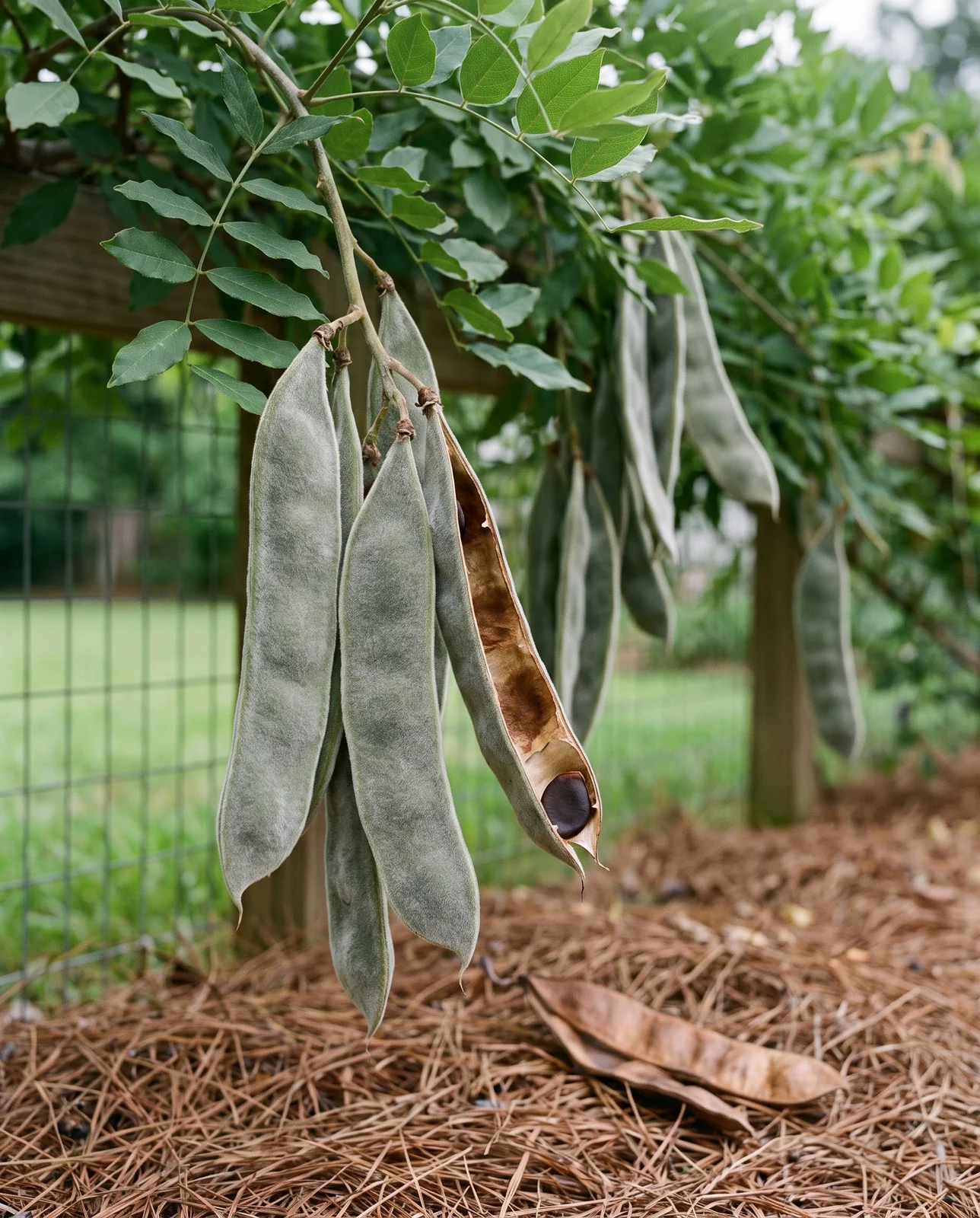
Velvety green wisteria seed pods hanging from a vine in late summer among leaves
21

Fragrance and colors

Wisteria flowers are fragrant, and the color range runs from blue and purple through pink to white. Scent is why it goes near a porch at all, the same reason lilacs do, and how strong it is depends on which plant you are standing under: Chinese wisteria is only mildly fragrant, the Asian group as a whole runs from mild to strong, and among cultivars the white silky wisteria 'Shiro-kapitan' is described as highly scented while the native 'Amethyst Falls' is lightly fragrant. Color is more varied than the standard purple photograph suggests. Asian wisterias run from lavender-blue through pastel pinkish-purple to white, the native species adds dark burgundy and flowers with hints of yellow or green to the usual lilac-purple, blue and white, and cultivars are sold in lilac, white, purple and blue. Cluster length carries as much of the effect as color does, from 6 inches to a foot and a half on cultivated plants.

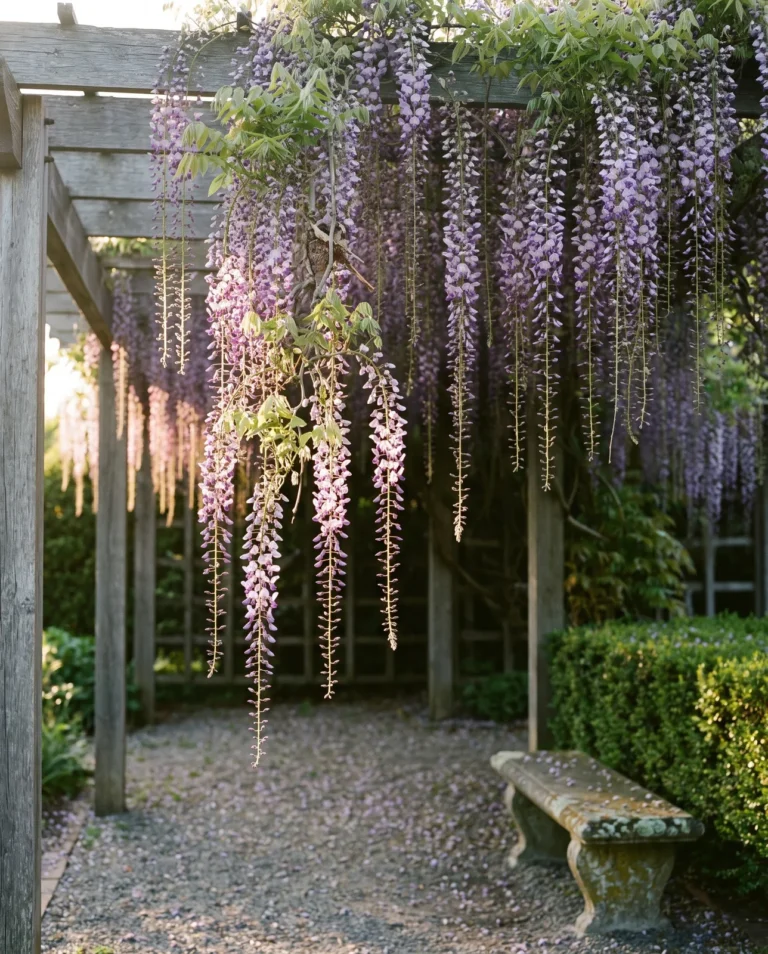
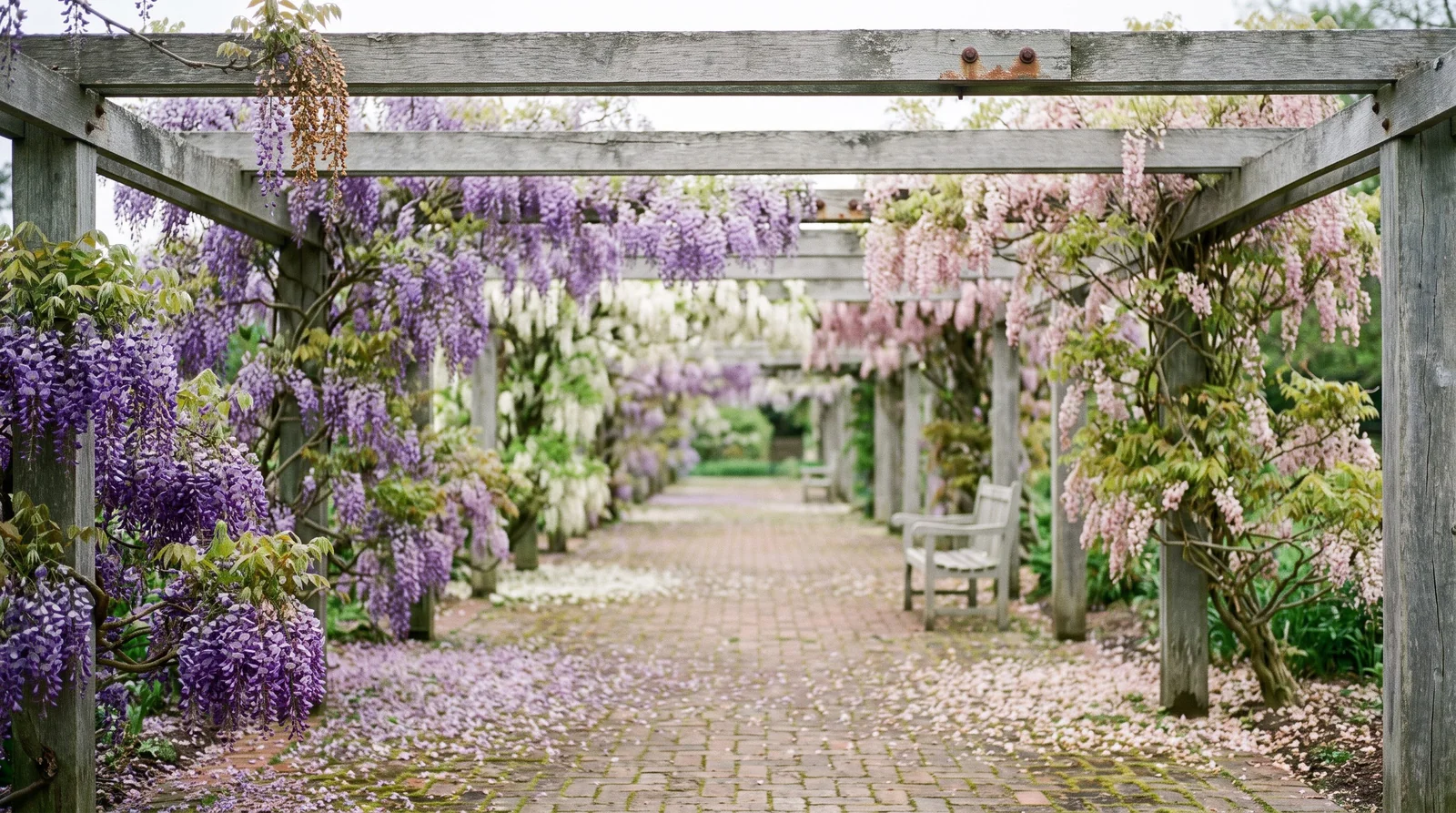
Wide view of a long pergola with wisteria in lilac, violet, white and pink racemes hanging side by side
22

Meaning and symbolism

What wisteria stands for in a garden comes out of how long it lasts: this is a vigorous, cold hardy, long lived vine. The Chinese wisteria planted in Sierra Madre, California in 1892 is the largest blossoming plant in cultivation, with a stem length of over 450 feet and around 1.5 million flower clusters a year. Purple and lavender lead the color list for the genus, and the meanings attached to that color sit with purple flowers generally.

23

Wisteria myths worth dropping

Five ideas that keep circulating in gardening threads, and what the horticultural sources actually say.

The myth: Pruning is what puts the flowers at risk.

The reality: Not pruning at all is the most common mistake made with this plant, and the summer cut is worth doing on top of the winter one because the vine is so vigorous.

The myth: Wisteria is banned from sale, so it cannot be planted here.

The reality: The species and hybrids are not regulated in the United States or the Midsouth, and the rules that do exist are state rules: Maryland calls the three Asian species prohibited on one page and Tier 2, sellable behind a conspicuous warning sign, on another.

The myth: The wisteria tree at the garden center is a different plant.

The reality: It is the same vine trained onto a single upright stem, and holding it in that shape takes a large amount of pruning.

The myth: Native wisteria is dull and has no scent.

The reality: 'Amethyst Falls' carries lightly fragrant lavender-purple clusters 4 to 6 inches long in April and May, and reblooms with more vigor than the species in mid and late summer.

The myth: You cannot kill a wisteria.

The reality: It can be killed, but not in one pass: cut edges sprout, root fragments left in the ground sprout, and an established plant persists for years, so removal means repeated cutting.

24

What to expect, year by year

A wisteria runs on a longer clock than almost anything else sold as a flowering vine.

Years one and two go to roots and framework. A young vine is left unpruned until it has covered its wall or structure, and the first three to five years of cutting build the permanent structure. A named cultivar that holds back through its first year or two after planting is doing what it is supposed to do while its roots establish. Nothing in this stage looks like progress, and the plant does not take well to being moved once it is in.

Years three to five bring the first flowers on a grafted or cutting-grown plant. Blooms may not appear until the second or third year after planting, and sometimes much longer; two or three years, or longer, is the ordinary answer for a vine that was not in flower when it was bought. A seedling is on a different clock entirely, 15 to 20 years by the published figures, with results that can still disappoint. Once the plant covers its support, the twice-a-year cut begins and the framework of flower spurs starts to build.

After that the vine becomes a structural object as much as a flowering one, and the rapid growth and high maintenance never ease off. Sucker sprouts keep appearing at the base and come off as they show. When the framework finally gets away, the plant takes a hard renovation, cut back to a main branch or even to ground level and retrained from well-placed new growths, with flowering usually back in two or three years and no feeding in the first spring afterward.

A young wisteria in its second year with a single trained leader on a pergola post and a few leaves
25

Flower photos

26

FAQ

What are the downsides of wisteria?

It flowers late in life, it has to be cut twice a year, and it grows heavy enough to destroy all but the strongest wooden or metal structures. The Chinese and Japanese species have also escaped into the Southeast, where they strangle trees, and the seeds and pods are poisonous.

Is wisteria poisonous to humans?

The leaves, fruit and seeds are toxic, and eating one or two seed pods can bring on nausea, repeated vomiting, abdominal pain and diarrhea. The pods ripen from midsummer into fall and sometimes hang into winter, which is when they sit within reach of children.

How many years does it take for a wisteria to flower?

A grafted or cutting-grown plant may flower in the second or third year after planting, though it can take much longer, sometimes fifteen years. A seedling runs to fifteen or twenty years by the published figures, which is the argument for buying a named cultivar.

Where does wisteria grow the best?

In full sun, six or more hours of direct light a day, on a support built to carry the weight. The genus is hardy through zones 5 to 9, the Japanese species runs 4a to 9b, and Kentucky wisteria flowers in zones 3 and 4, so the cold edge belongs to the Kentucky types.

Should wisteria be cut back each year?

Prune it twice a year. After flowering, in July or August, the season's whippy green shoots come back to five or six leaves, and in January or February those same shoots go to two or three buds. A young plant is the exception: leave it unpruned until it has covered its support.

What can I feed wisteria to make it flower?

Nothing high in nitrogen. Feeding buys leaf growth at the cost of flowers, and overfertilization is one of the standard causes of failure to bloom, so use a low-nitrogen product once a year, every other year, or not at all. Where a soil test shows phosphorus is short, superphosphate in early spring is one way to push bloom.

What month does wisteria bloom?

April and May across most of the country. Chinese wisteria opens in May as the foliage begins to expand and can run into June, American wisteria flowers about three weeks behind the Asian types, and Kentucky wisteria waits for June.

How do you pronounce wisteria?

It is said wis-TEER-ee-ah, with the weight on the middle syllable.

What is the best type of wisteria to plant?

In the eastern states the native species avoids the invasive problem: 'Amethyst Falls' for a compact plant or a large container, and 'Blue Moon' where winters are hard, since it is rated to zone 3 and can bloom up to three times a season. For the longest clusters, the Japanese 'Macrobotrys' carries racemes 2 to 4 feet long.

How do I know which wisteria I have?

Start with the timing: the North American species flower after the plant has leafed out, the Asian ones before. Then count leaflets, 7 to 13 on Chinese and 13 to 19 on Japanese, and look at the pods, smooth on the native plant and fuzzy on the Asian ones.

27

Interesting tips

  1. Buy a wisteria in flower. A plant blooming on the bench is old enough to bloom, which no label can promise.
  2. On an overgrown vine, cut in two moves: take the excess growth back to the trunk first, then shorten what is left, and use the same order again after flowering.
  3. For the longest clusters, look past the two common species. Wisteria floribunda f. multijuga carries lilac blue racemes up to 4 feet long in early summer, and clusters that size need a pergola tall enough to let them hang clear of the table underneath.

Related Guides & Flowers

V

Written by: Your Flowers Guide editorial team
We are a small independent group of flower lovers who research and review each guide using trusted horticultural and educational sources. Learn more about us