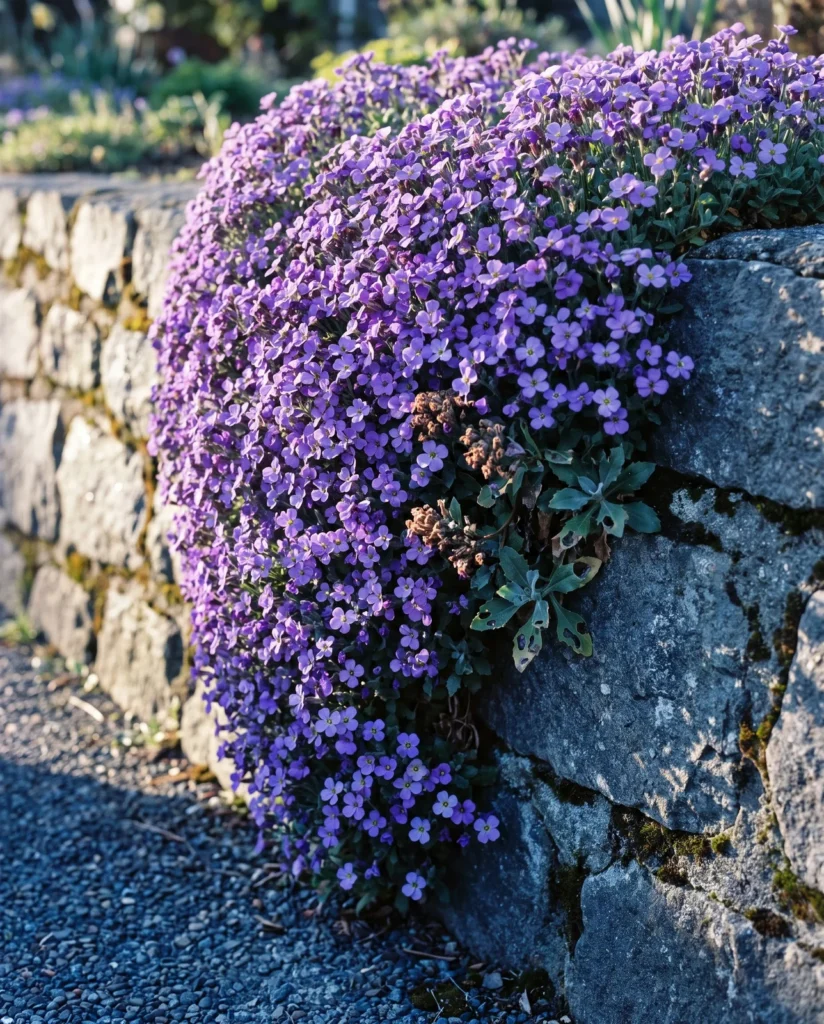
Aubrieta or aubretia, and the other names
The plant is Aubrieta. Aubretia, the spelling almost everyone reaches for, is a misspelling common enough to be flagged wherever the plant is defined, and a third form, Aubrietia, redirects to a disambiguation entry with no plant on it. The name honors Claude Aubriet, a French flower painter, and the genus was named in 1763. Labels and catalogs pile on more names: false wall cress, purple chickweed, purple rock cress and rainbow rock cress all belong to this one genus. Any of them lands on the same plant, a mat-forming evergreen perennial that carries short sprays of four-petaled flowers in pink and purple in spring.
Aubrieta and creeping phlox, side by side
Creeping phlox and aubrieta cover the same wall in the same weeks of spring, and they get mistaken for each other constantly. They are unrelated plants, and the leaf, the petal count and the soil under them tell them apart without a hand lens.
What aubrieta is
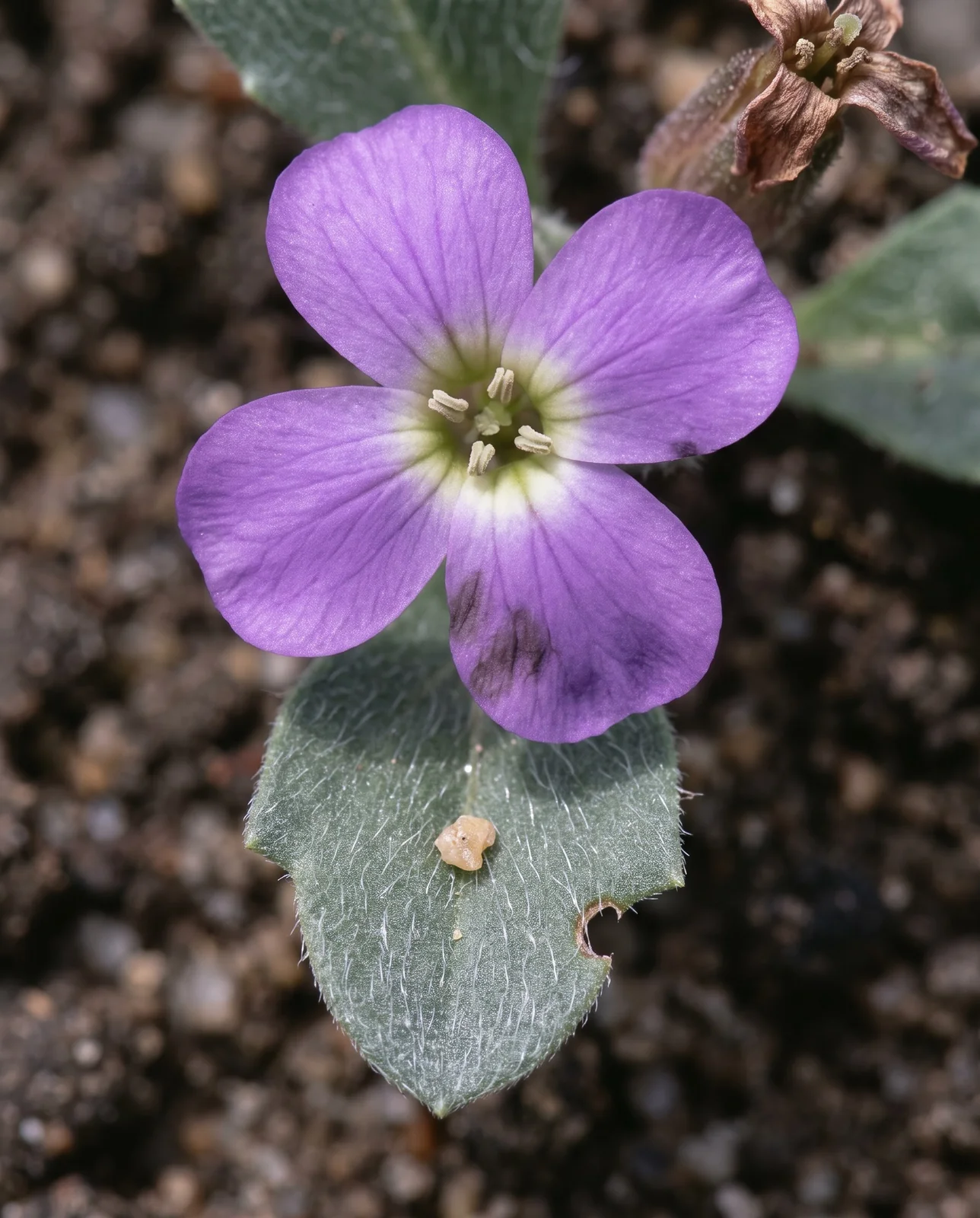
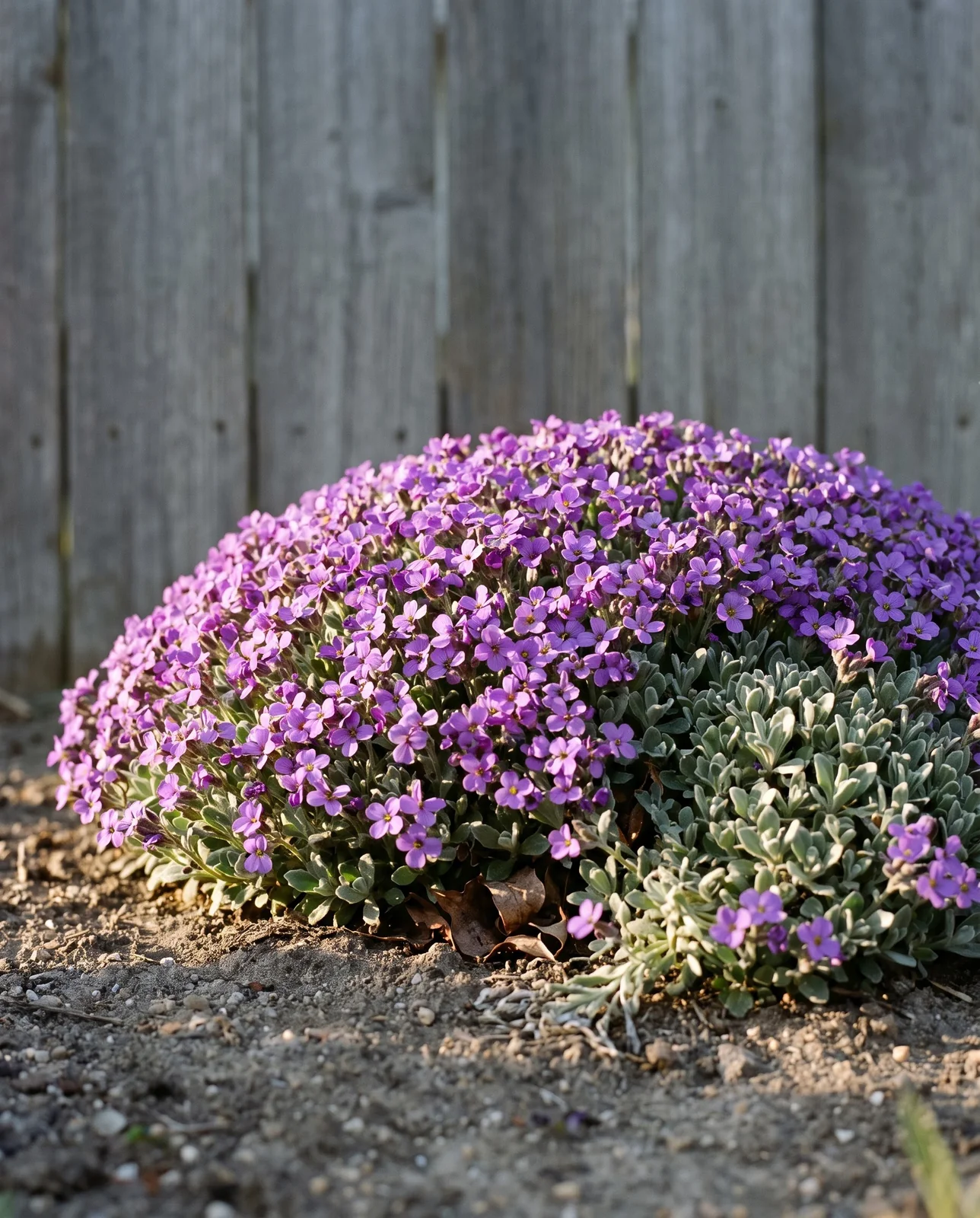
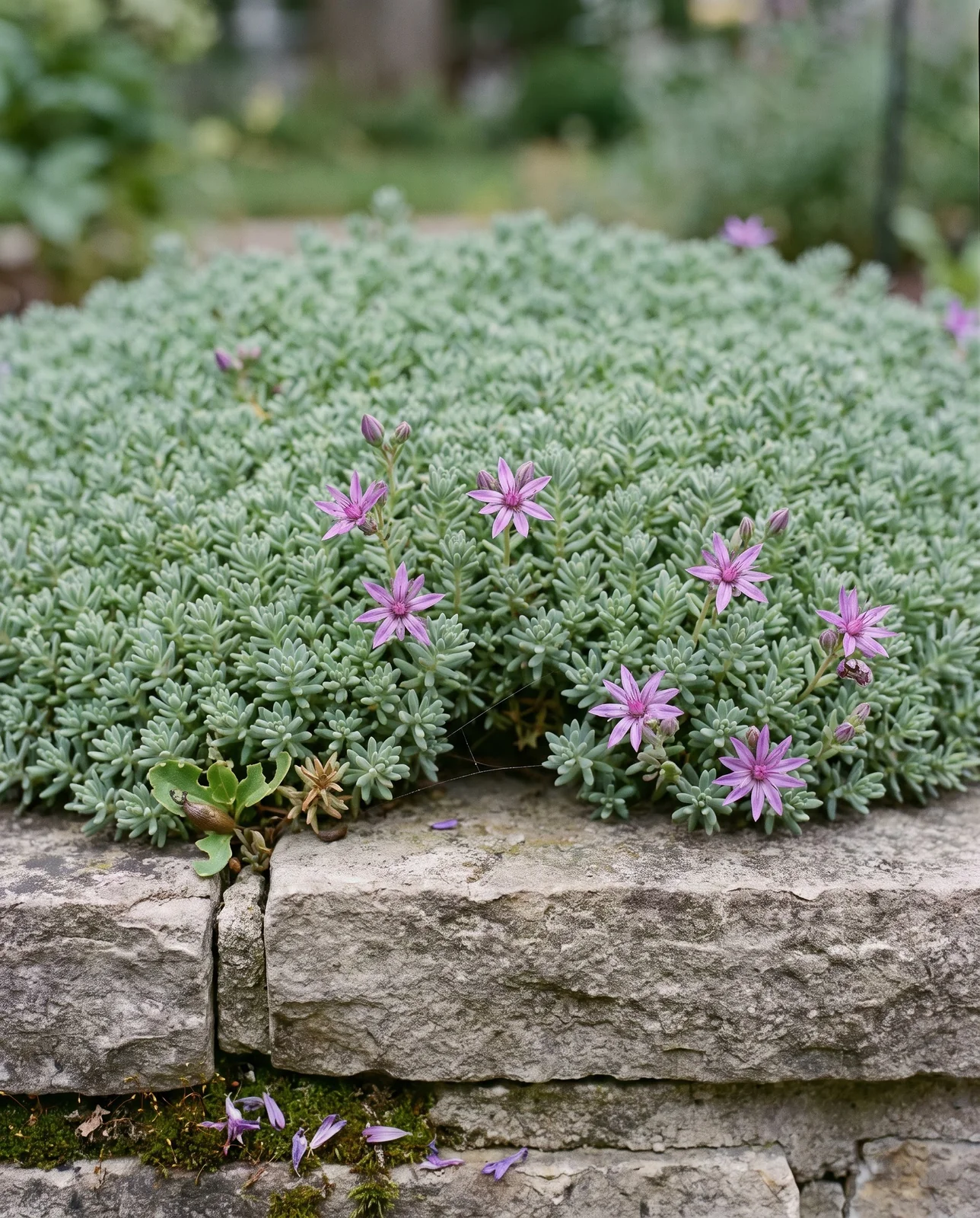
Aubrieta is a low, spreading, evergreen perennial in the cabbage family. It grows as a cushion of small leaves that vanishes under flower for a few weeks each spring, and on the wild species the flowers almost cover the gray-green foliage below them. Those leaves are spoon-shaped to oval, some of them lobed, and the flowers are small, with four plain petals in lavender through deep pink. Bloom runs April into May, with seed ripe in June. The flowers carry both sexes and are worked by bees, and the pod behind them is inflated and hairy, up to two centimeters long. The wild species stands 4 to 9 inches tall and spreads 1 to 2 feet.
The genus is Mediterranean and Near Eastern, over 20 species from southeastern Europe and western Asia. Aubrieta deltoidea, the species behind most garden plants, is native to the East Aegean islands, Greece, Crete and Turkey. Its wild habitat is the part you can copy: among rocks, mainly in hilly country. That is close to the whole specification for a garden position, rock, slope, thin soil, light, and the drainage a stone face gives for nothing.
Where aubrieta belongs
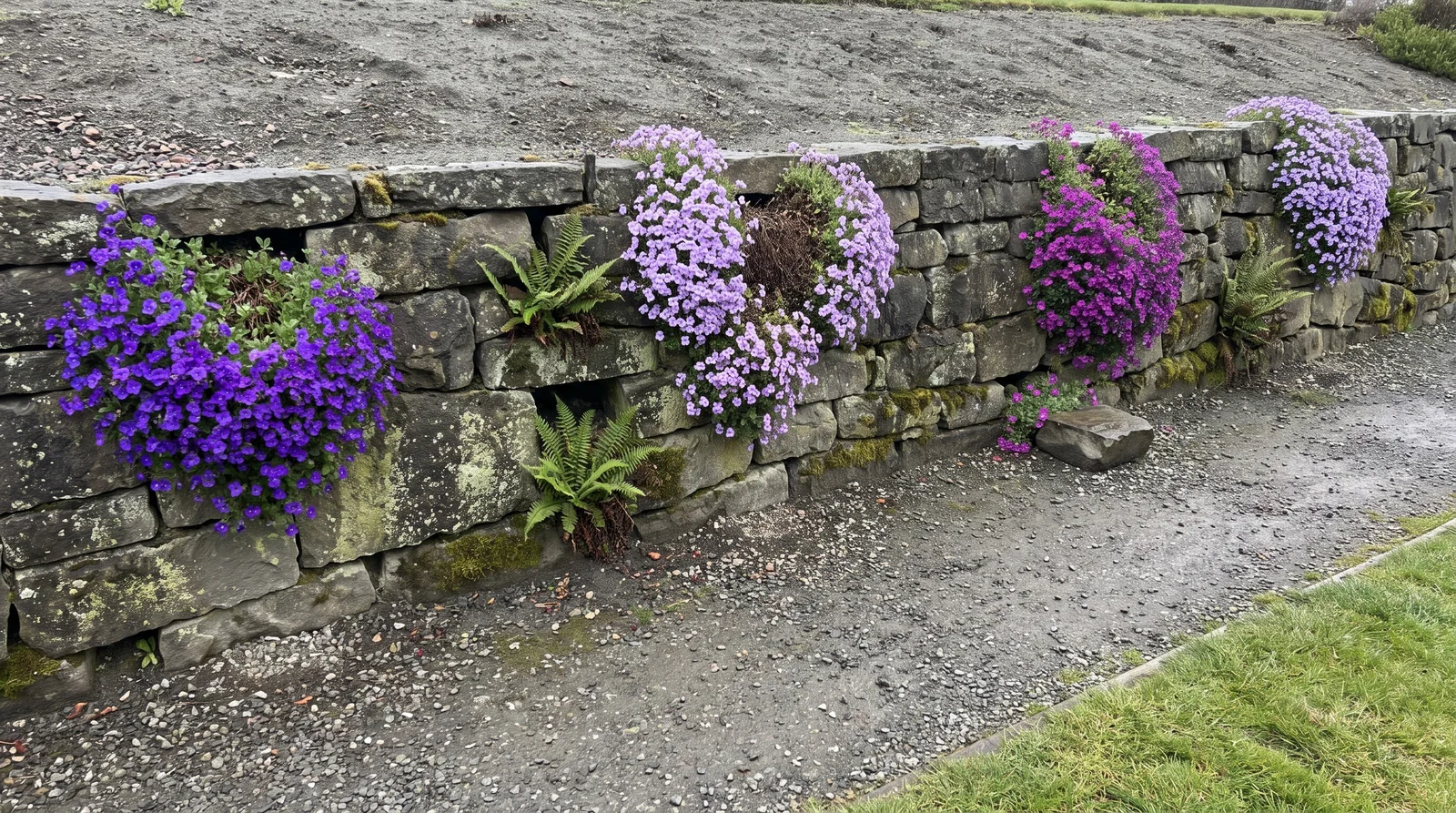
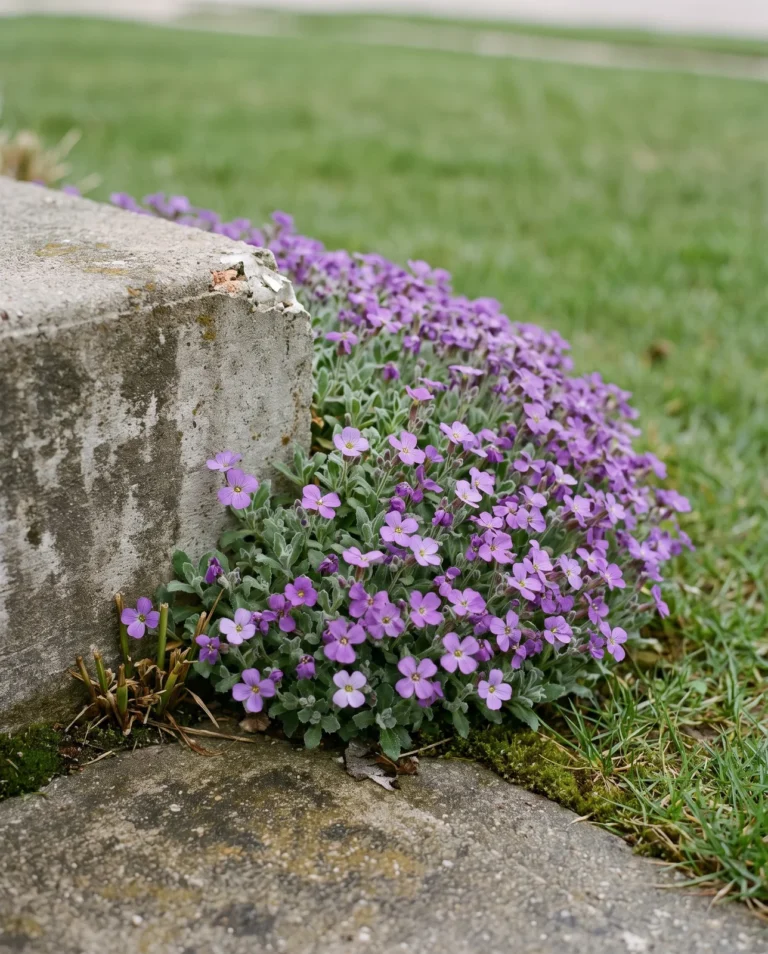
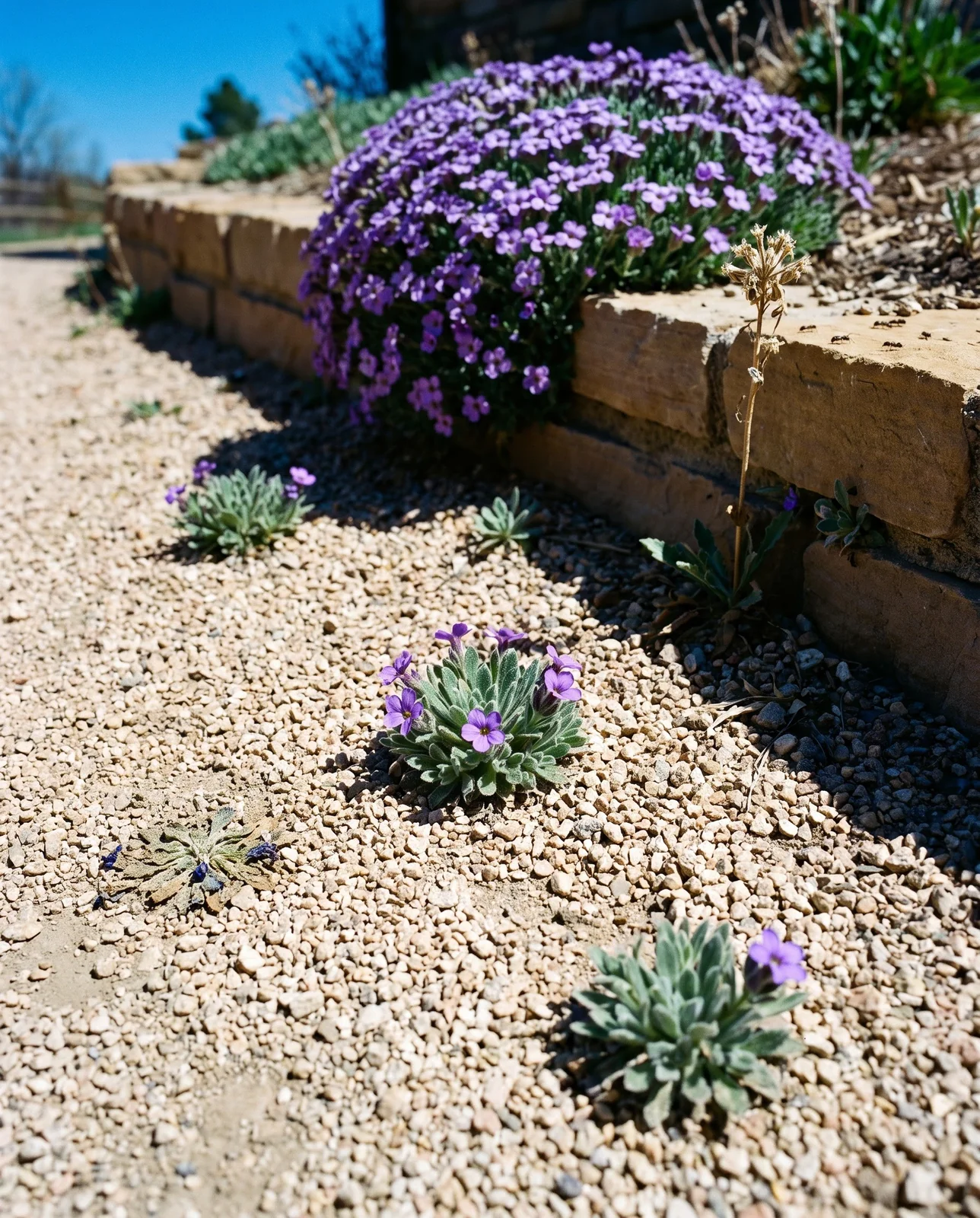
Aubrieta belongs where it can spill over an edge in sun: the top of a retaining wall, the shoulder of a rockery, a gap between paving, the front lip of a gravel path. It is grown in alpine gardens, in containers, as ground cover and in rock gardens, and all four share one property, water leaves them fast. The same plant set flat in a bed of garden soil sits in whatever rain the bed holds. Aubrieta shares those positions with sedum, and the two often run along one wall together.
Wet ground is the risk. Plants are apt to die out in heavy or damp soils, and the trouble concentrates where the soil is clay or the drainage is poor. Amend the ground and watch how fast a test hole drains before anything goes in. Soil chemistry is the smaller argument. The genus takes a wide pH range, and lime-rich ground suits it. The argument is over how strict that preference is, and neither side of it wants wet clay.
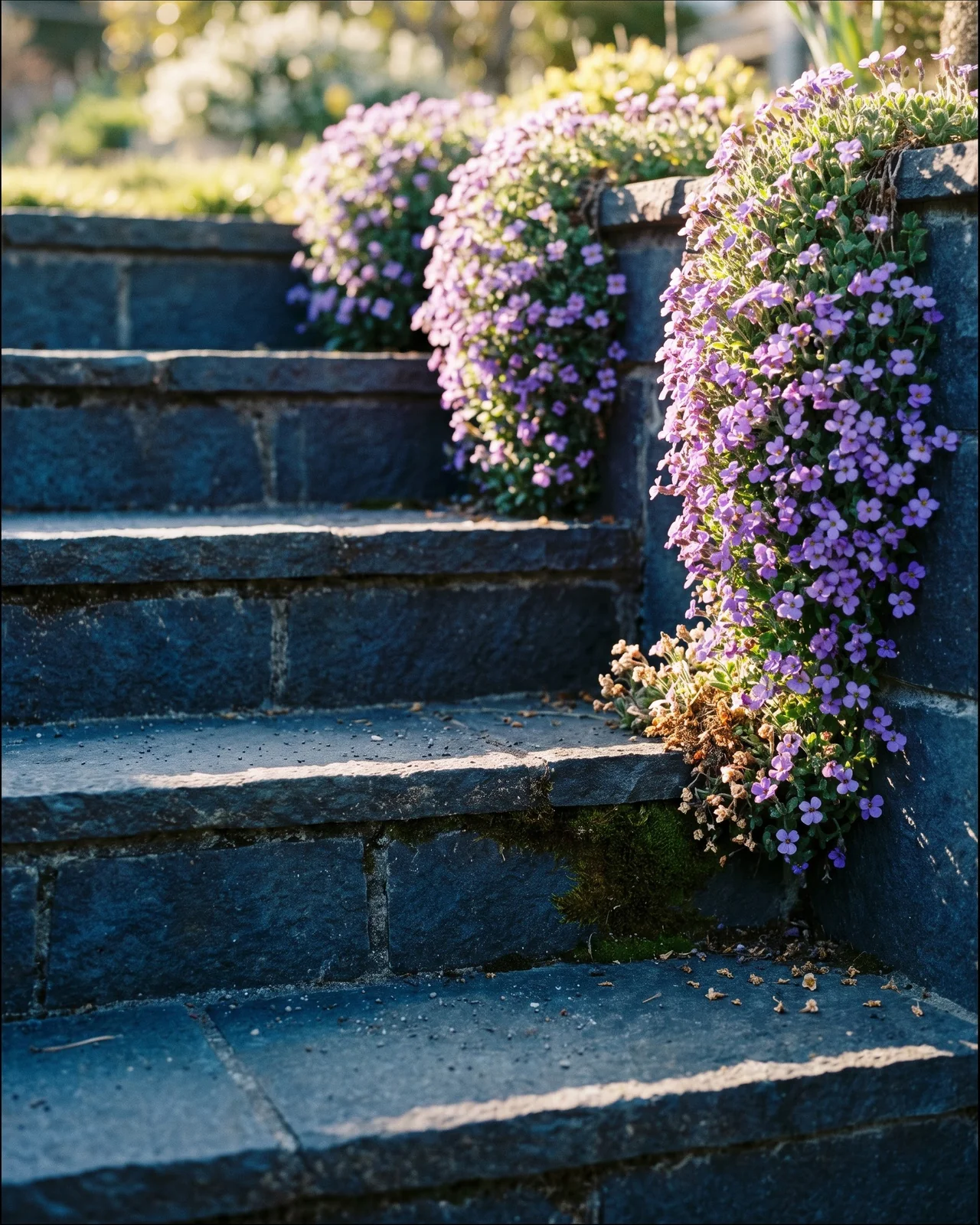
Sun or shade
Full sun is what makes the sheet of flowers, and part shade costs some of them. Aubrieta is adapted to partial shade, though some blooms may be sacrificed there. Shade gives leaves and few blooms, so full sun or very bright light is what it takes to flower well. Give it 6 to 8 hours of sun a day, in well draining loamy or sandy soil. One exception ties the light answer to the temperature answer: the species dislikes shade except where summers are hot. Shade that costs flowers in a cool garden can be cover in a hot one.
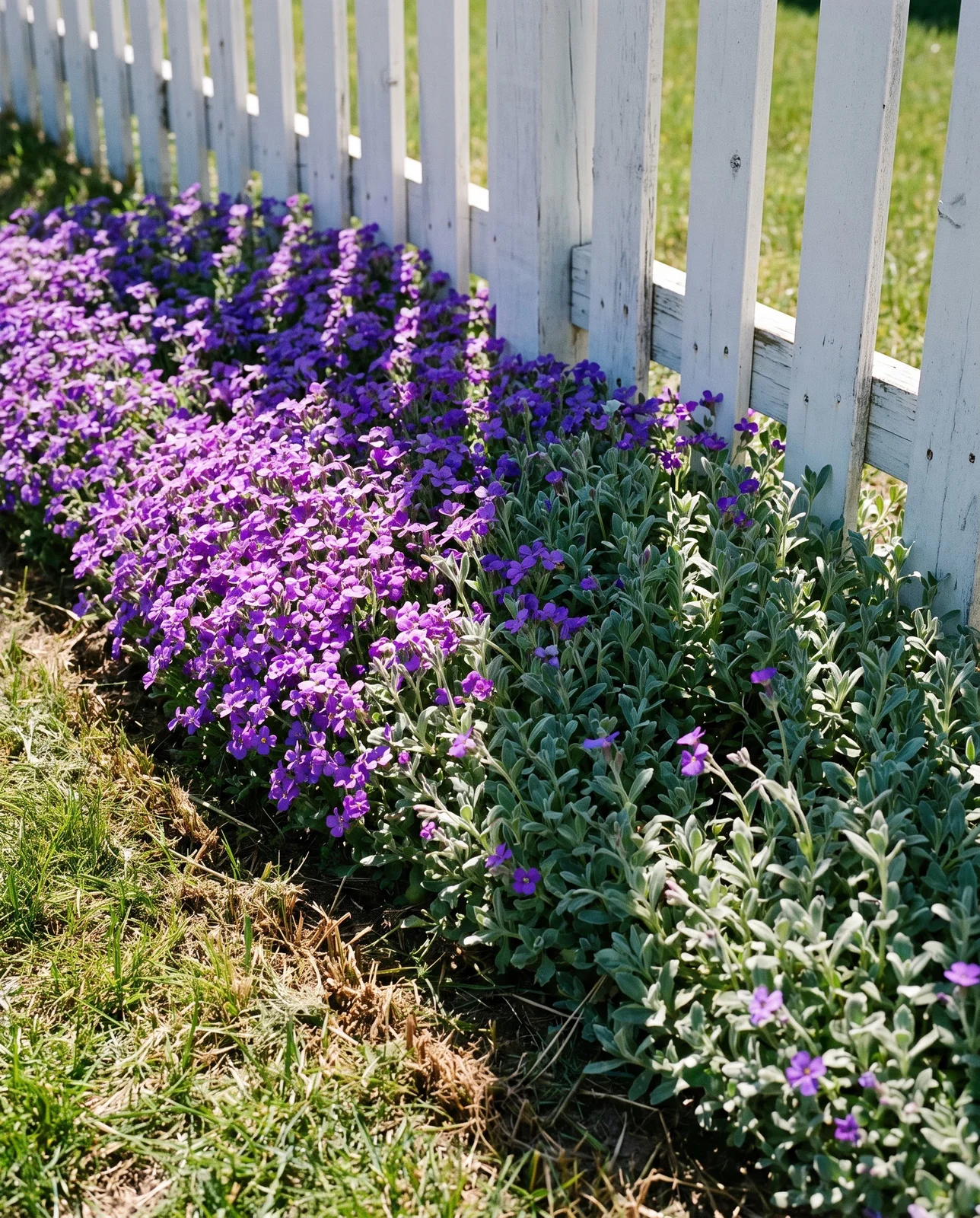
Zones, and a disagreement worth knowing about
There is no single zone number for aubrieta, and the spread is wide enough to change a buying decision. Zone 4 through 9 is the widest band in common use, cold to moderate winter country. Others stop a zone short, at 4 through 8. The Axcent series of Aubrieta hybrida is sold for zones 4 through 7. Every figure shares the same floor of zone 4. They separate at the warm end.
That warm end is a genuine argument. Aubrieta grows best where summers are cool, mirroring its alpine climate, and high humidity does not bother it as long as the temperature stays down. Against that stands a flat claim that established plants are drought tolerant and heat tolerant. Heat short of killing thins the mat once full summer arrives, and in cooler climates much of the foliage disappears by fall. If you garden at the warm end of the range, treat the first planting as a trial.
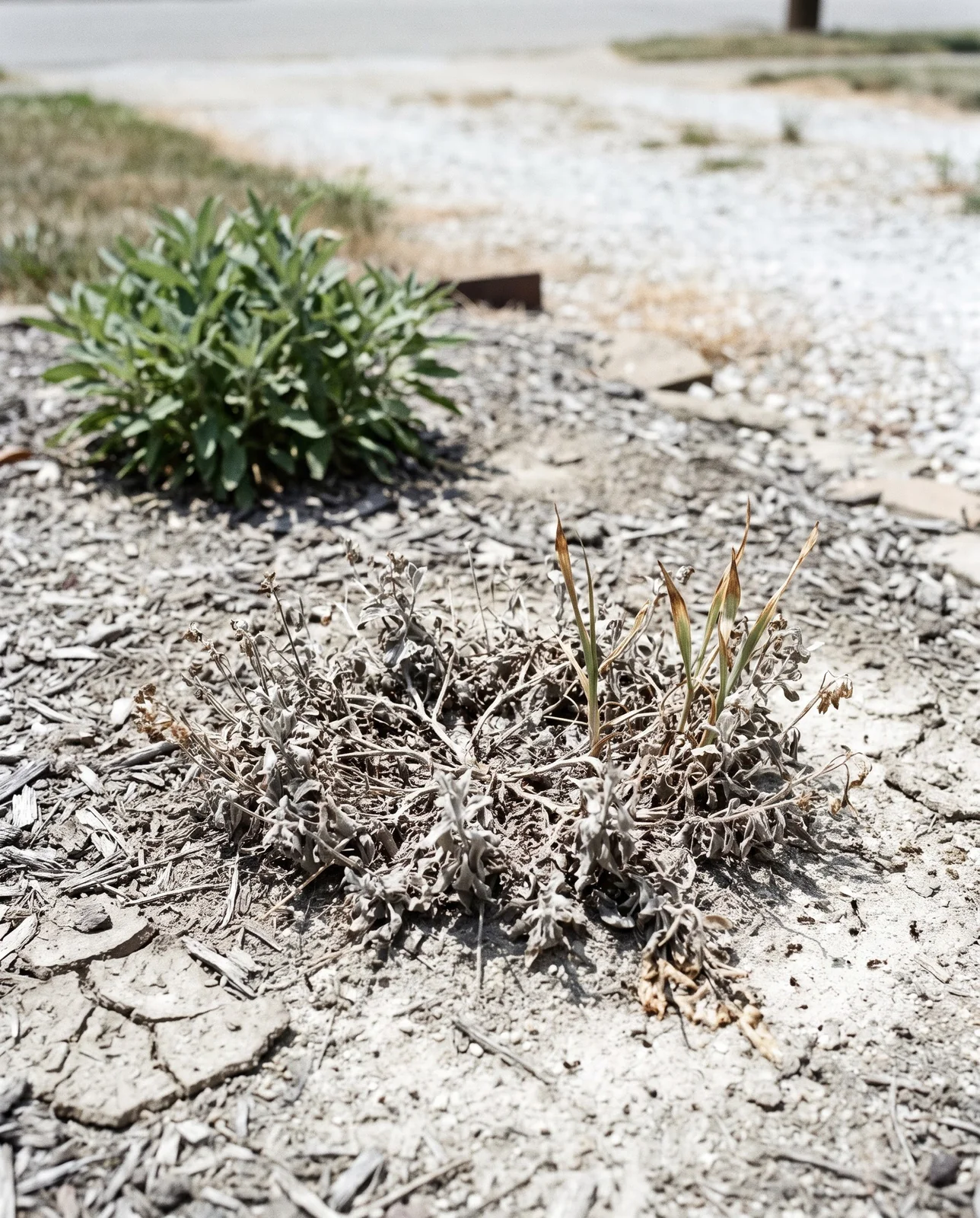
Cut it back after flowering
Shear the whole mat back hard as soon as the flowers finish. A hard cut immediately after flowering keeps the plant dense and bushy, and sometimes prompts a light second bloom. Midsummer works too, once the plant turns scraggly and the foliage begins to die back. Shearing in fall is the third option. The rule with no season attached is simply to cut back after flowering, before the plant becomes straggly. Every version cuts. They differ on the week.
The cut is the difference between a mat that holds and one that opens up. Cutting back after bloom can discourage self-seeding and keep the plants compact and tight, and at the least it tidies the shape. The condition it heads off is woody, open growth. Nobody puts a number of inches on it. The whole mat goes over at once, and the timing hangs on the end of bloom.
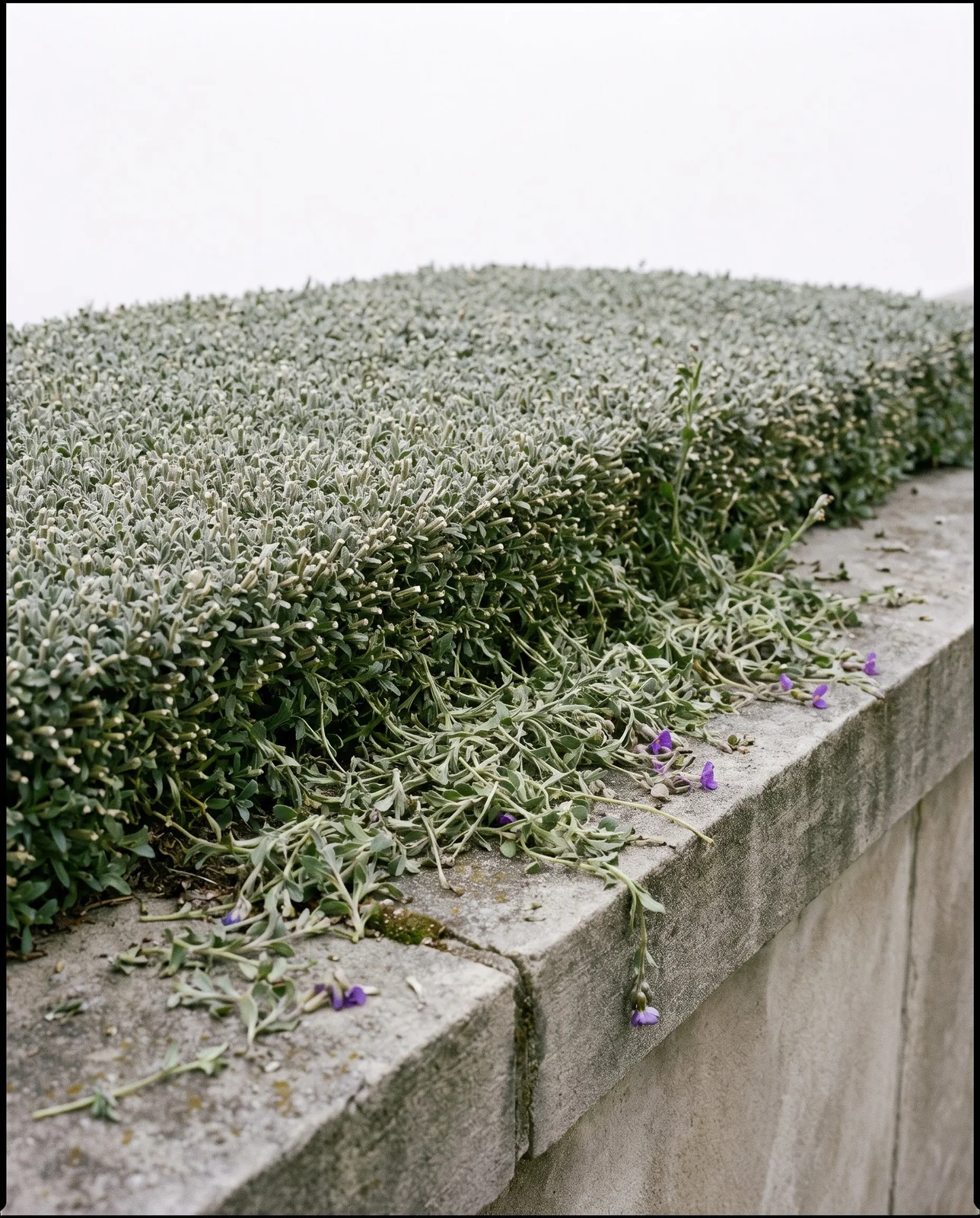
Why it will not flower
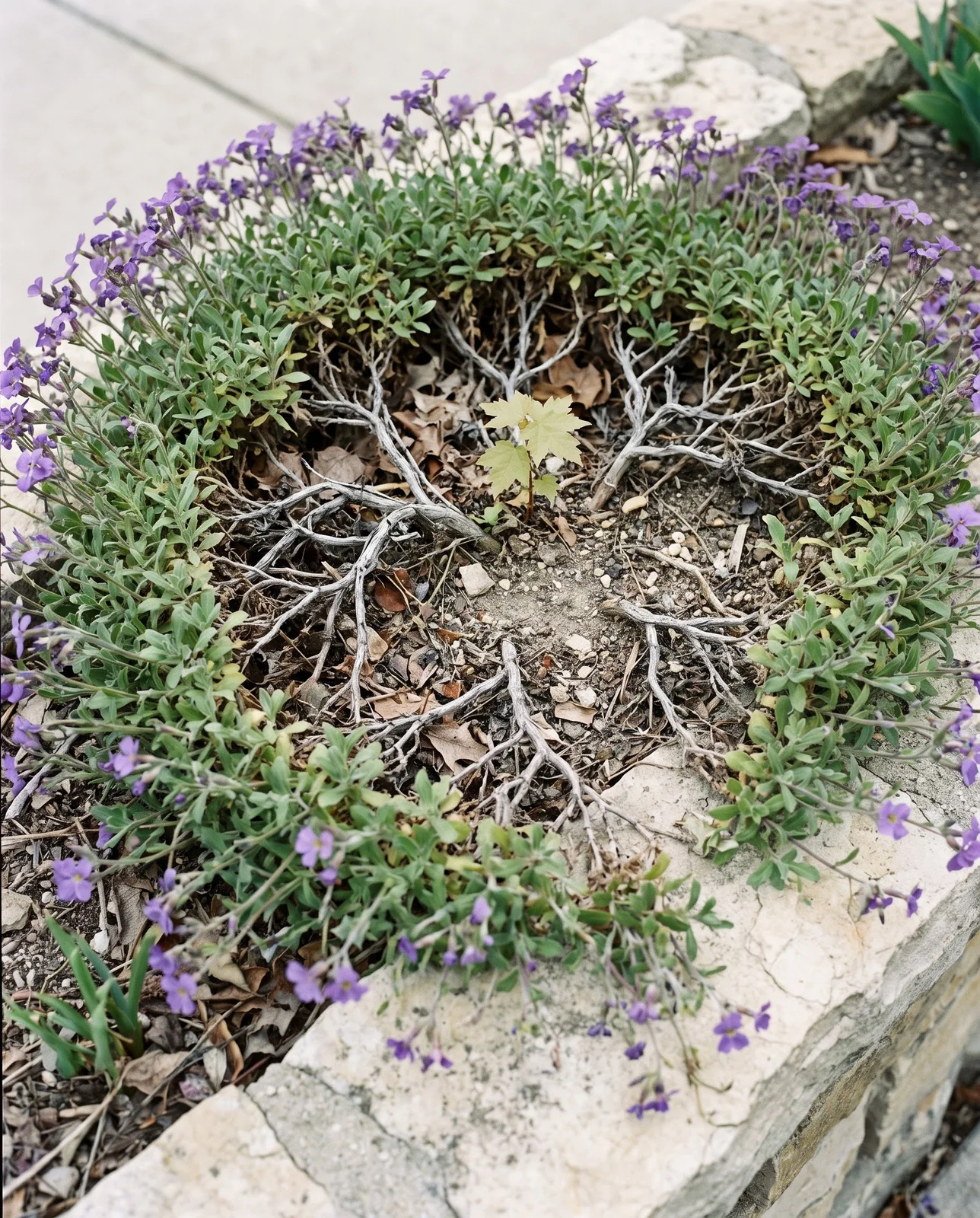
Sun and feeding come first, and the plant's age accounts for the rest. Sparse flowering is usually caused by too little sun or overly fertile soil, and the fix is a sunnier, more open position and no nitrogen-rich feed. A nutrient shortage looks different from a distance: pale, yellow or reddish leaves, though stunted growth and poor flowering can point at the same shortage on their own. Age matters at both ends of a plant's life. Plants grown from seed will not bloom fully in their first year, and the full flush arrives the year after. At the other end sits the mat nobody sheared, gone woody and open in the middle.
Yellow leaves, normal or not
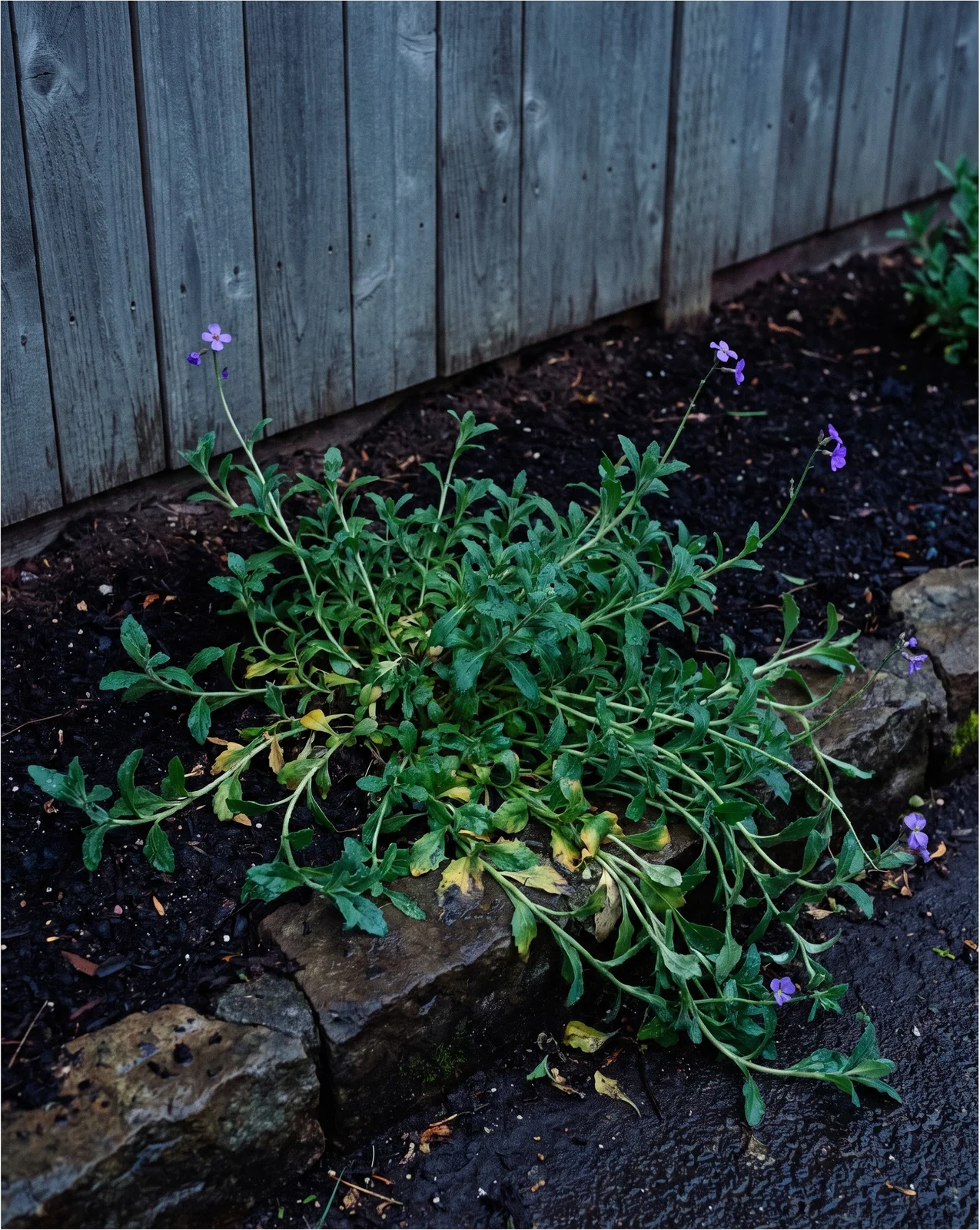
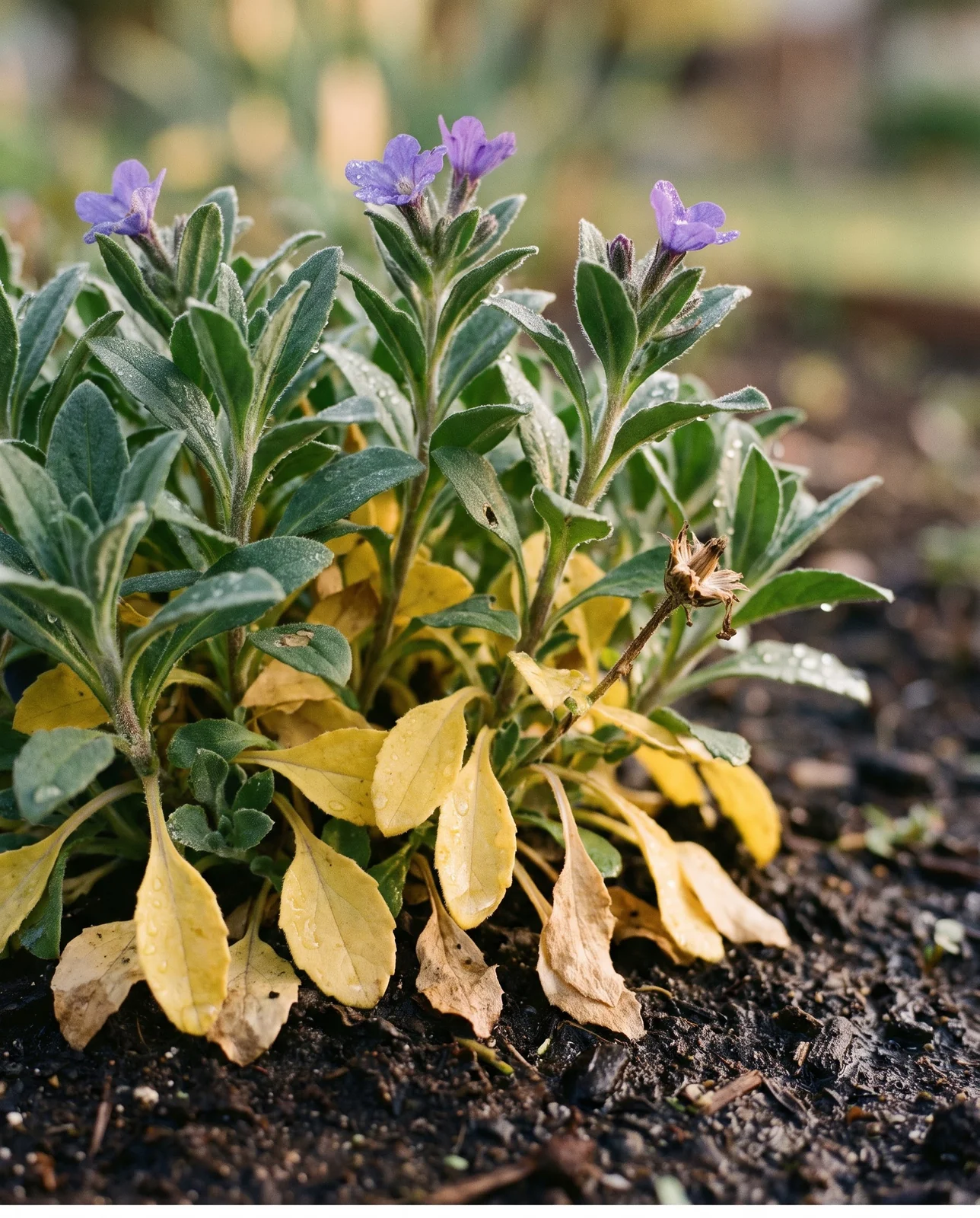
Yellowing at the base of the mat right after flowering is the plant finishing its year. The leaves at the bottom die off, and that is normal once aubrieta has stopped flowering. Evergreens shed old leaves regularly, and those leaves often turn yellow before they fall. The ordinary case sits low in the plant, arrives after the flowers, and leaves the growth above it green.
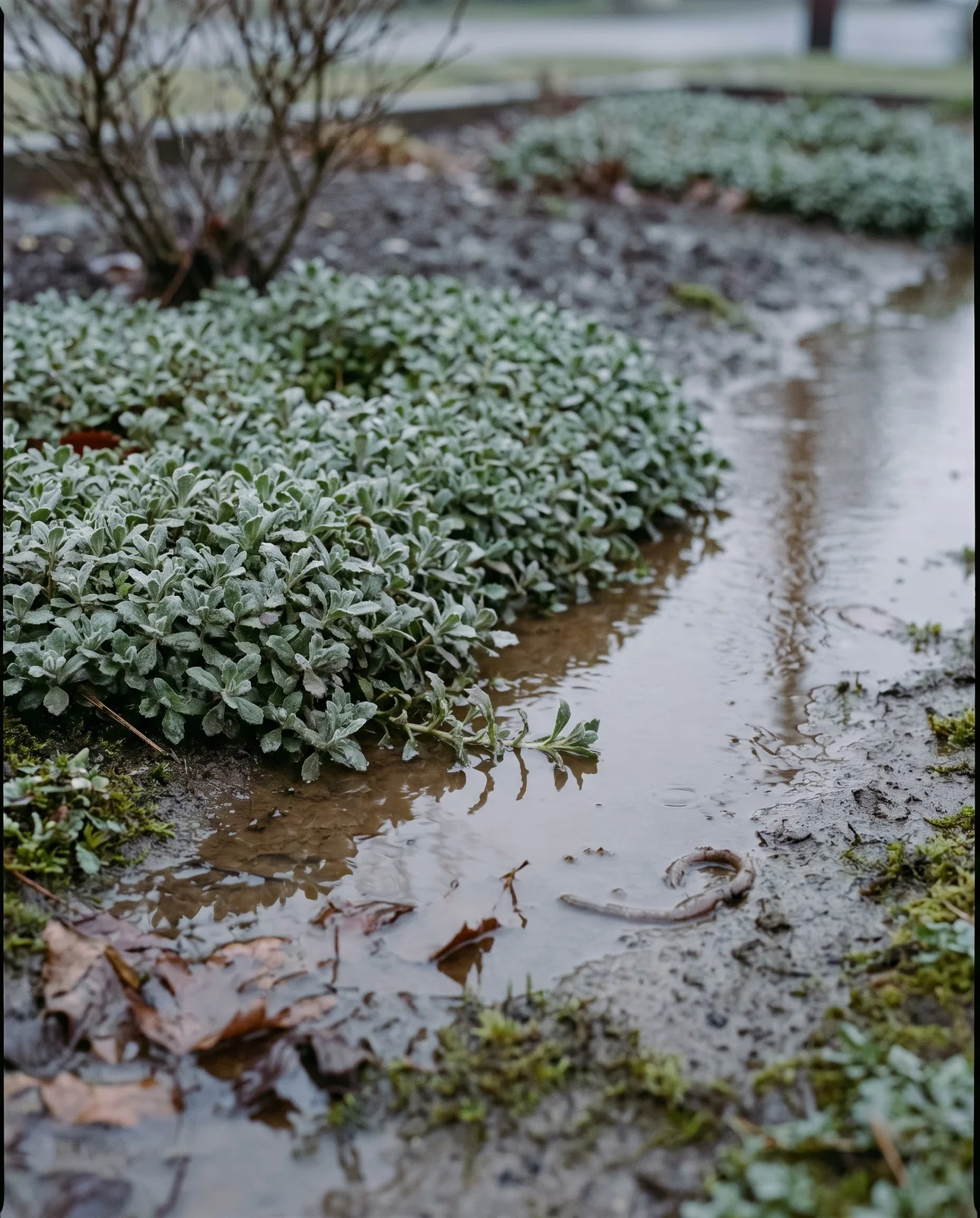
The first branch that matters is water at the crown. Leaf yellowing can appear under waterlogged or compacted conditions on its own, and where waterlogging persists, leaf loss and dieback may follow. Root and crown rot heads the three common problems on the Royal Blue selection, most of them traced back to a mismatch between watering, light or humidity and what the plant wants. Yellow leaf edges on purple rock cress come down chiefly to improper watering, so correct the watering first and reach for a fungicide only if the plant does not recover. The tell is timing. This yellowing does not wait for the end of bloom.
The third branch is nutrition, and the pattern on the leaf points at the shortage. Yellowing between the veins usually means manganese, iron or magnesium, with iron showing on the youngest leaves first while manganese and magnesium tend to start on the older ones. A more general yellowing or reddening that begins in the older leaves, often with a lack of vigor, reads as nitrogen shortage. There is a trap in this for a plant recommended for lime. On chalky, alkaline soils, poor growth and yellow leaves come from roots that cannot take up iron and manganese, so the ground that suits aubrieta is also the ground where an iron problem surfaces.
What actually goes wrong
Ordered by how often the complaint comes up. Each one runs symptom, cause, then what to do about it.
Symptoms: yellowing that does not wait for the end of bloom, on plants in heavy, damp or compacted ground; where waterlogging persists, leaf loss and dieback may follow. Cause: water standing at the crown. Fix the drainage before anything else, since these plants are apt to die out in heavy or damp ground, and root and crown rot heads the three common problems on the Royal Blue selection.
Symptoms: the low leaves go yellow and limp once flowering ends, with the growth above them still green. Cause: normal die-back at the bottom of a plant that has finished flowering. Nothing to do.
Symptoms: bare, woody stems in the center of an old mat. Cause: the woody, open growth that sits among those same three common problems. Shear after bloom, which can keep the plants compact and tight and stops the plant becoming straggly.
Symptoms: a full green mat carrying a thin scatter of bloom. Cause: usually too little sun or overly fertile soil. Move it somewhere sunnier and more open, and stop the nitrogen-rich feeds.
Symptoms: mildew on the leaves, second of the three common problems on the Royal Blue selection. No spray and no schedule come with it, and the advice stops at growing conditions.
Symptoms: the mat tends to thin in the hottest weeks, and in cooler climates much of the foliage disappears by fall. Cause: full summer heat, which the plant sits out. Shear a scraggly plant, after bloom or in fall.
Growing aubrieta from seed
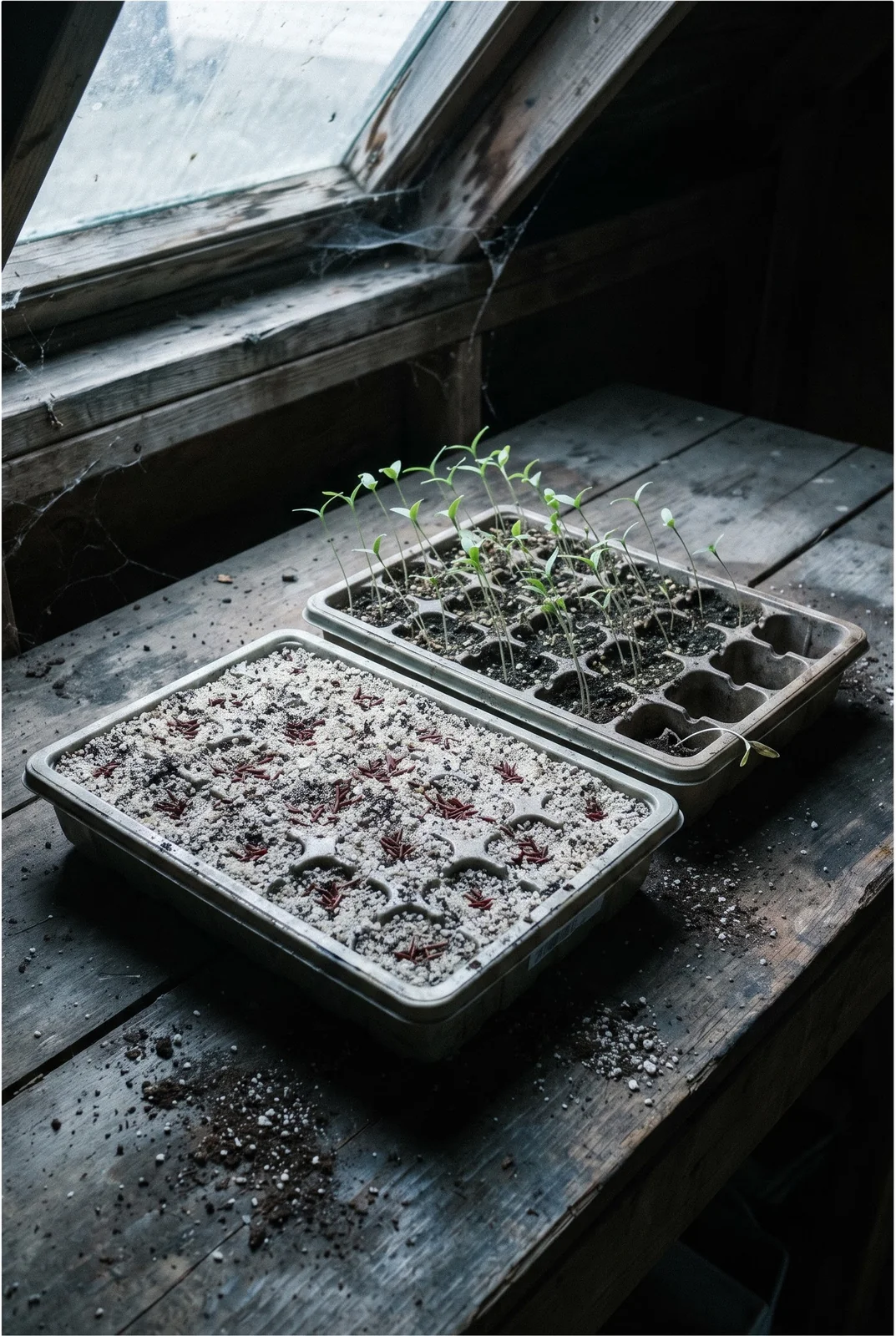
Aubrieta grows readily from seed, and one detail decides whether it works: the seed needs light, so it goes on the surface. Press it lightly into surface soil and leave it uncovered. How much cover it will tolerate is unsettled. One instruction is to sow no deeper than 1/8 inch and then lightly cover the seed, another to press the seeds in and cover them very lightly. Till the ground to a depth of 6 inches first, then scatter seed across the surface. Somewhere between bare surface and the thinnest dusting is where you are safe.
Timing splits by method. Start seed indoors 6 to 10 weeks before the last frost, or sow outdoors once frost is done. Thin the seedlings to stand about 10 to 12 inches apart. What a first-year plant does not do is flower like the photographs: a few spotty flowers at most, with the full flush due the following year. That is the trade for a packet that costs a few dollars. If you want color that first summer, sweet alyssum takes the same shallow sowing along the same dry edge and flowers in one season.
Cuttings and division
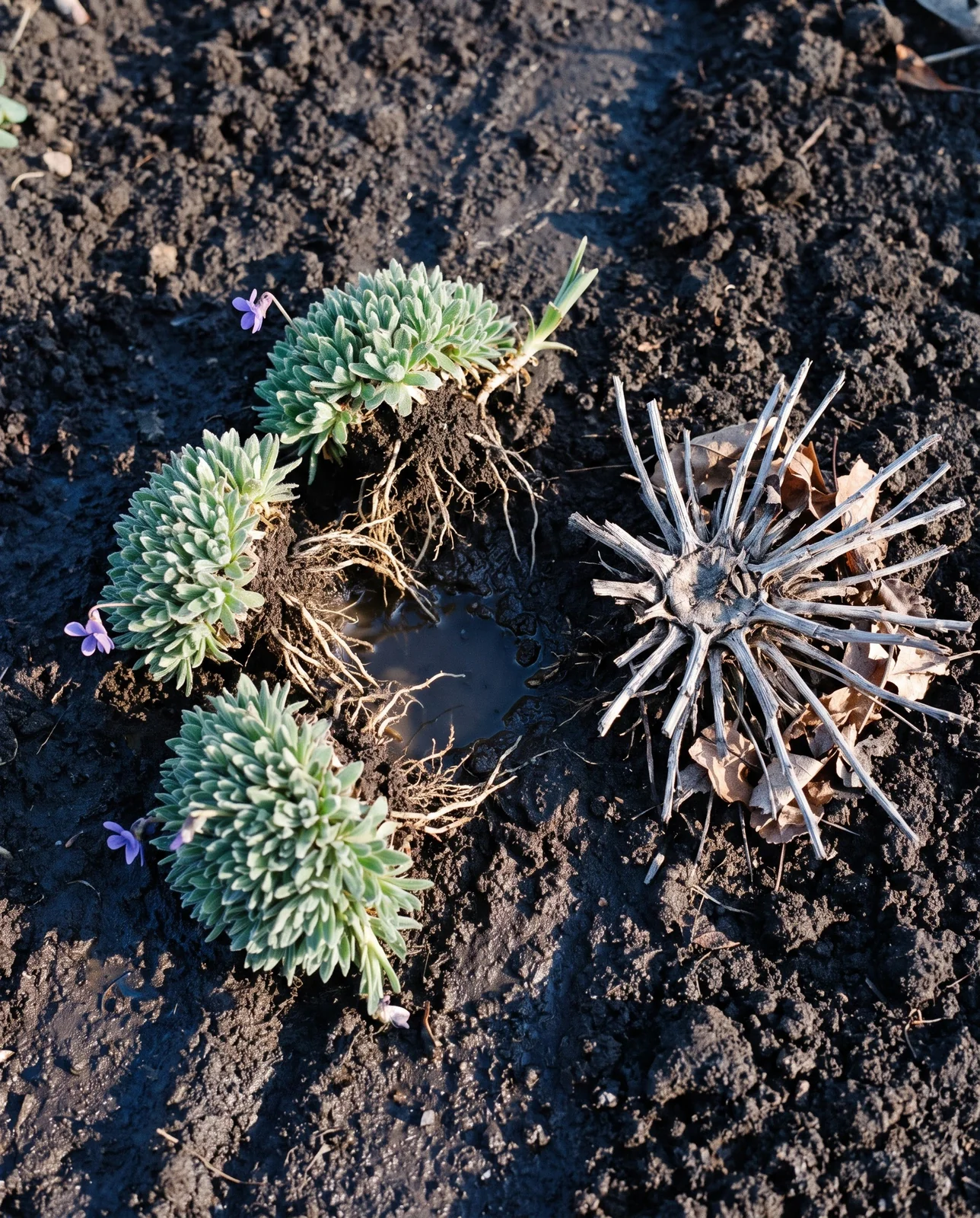
Cuttings and division are how a particular plant gets copied, and both are ordinary operations here. Later plantings can be taken as cuttings from a plant already established in the garden, and cuttings sit beside seed as the standard route. Color is the usual reason to bother with either. Cultivated aubrietas, sometimes carried under the hybrid name Aubrieta x cultorum, come in lavender, rose and lilac and are often sold as a seed mixture, and Aubrieta deltoidea is the parent behind the many named varieties. Division doubles as maintenance on an older clump: split it every few years, before the center dies out. That dying middle is the part being divided away.
Planting aubrieta in a wall
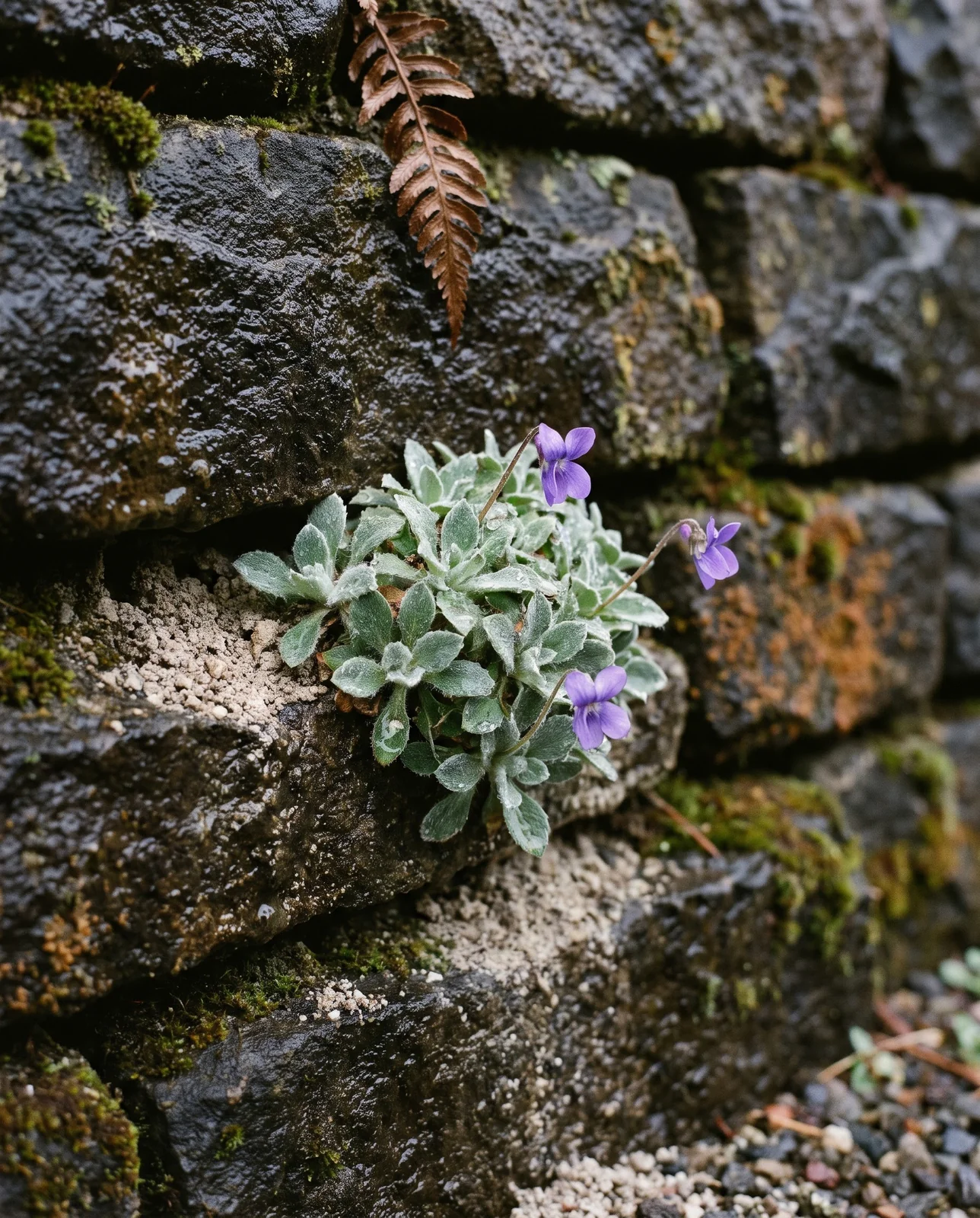
The wall itself is a position that works. Aubrieta can be grown in old walls, and dry stone wall crevices sit alongside rock gardens, tumbling over a retaining wall and edging a path among its uses. Drainage is why a joint works at all. Winter wet rot is the main killer in cultivation, and the answer to it is a vertical crevice or a raised alpine bed with a gritty substrate. The instruction stops at the position and the substrate: a crevice that runs down the face of the wall, grit around the roots, and no pocket where water can stand.
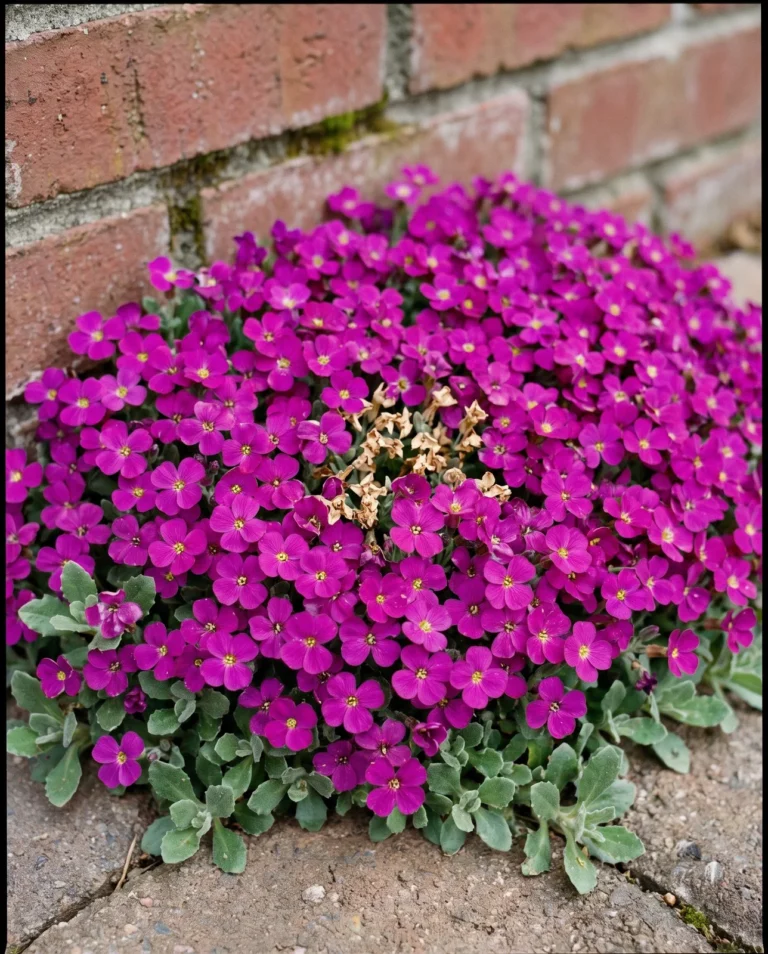
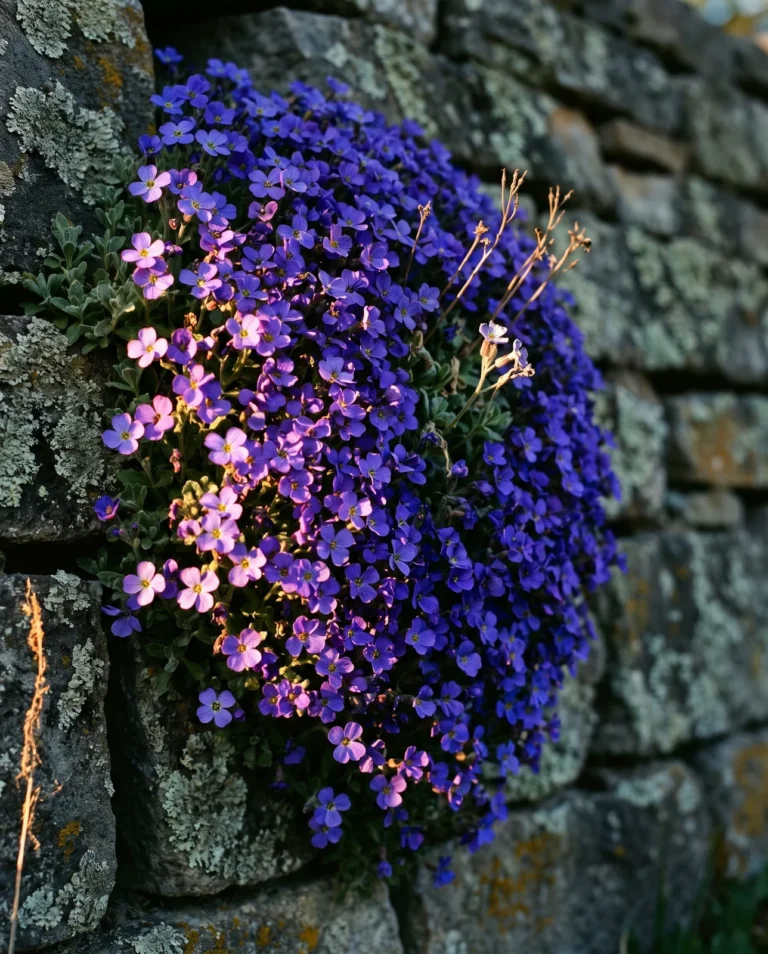
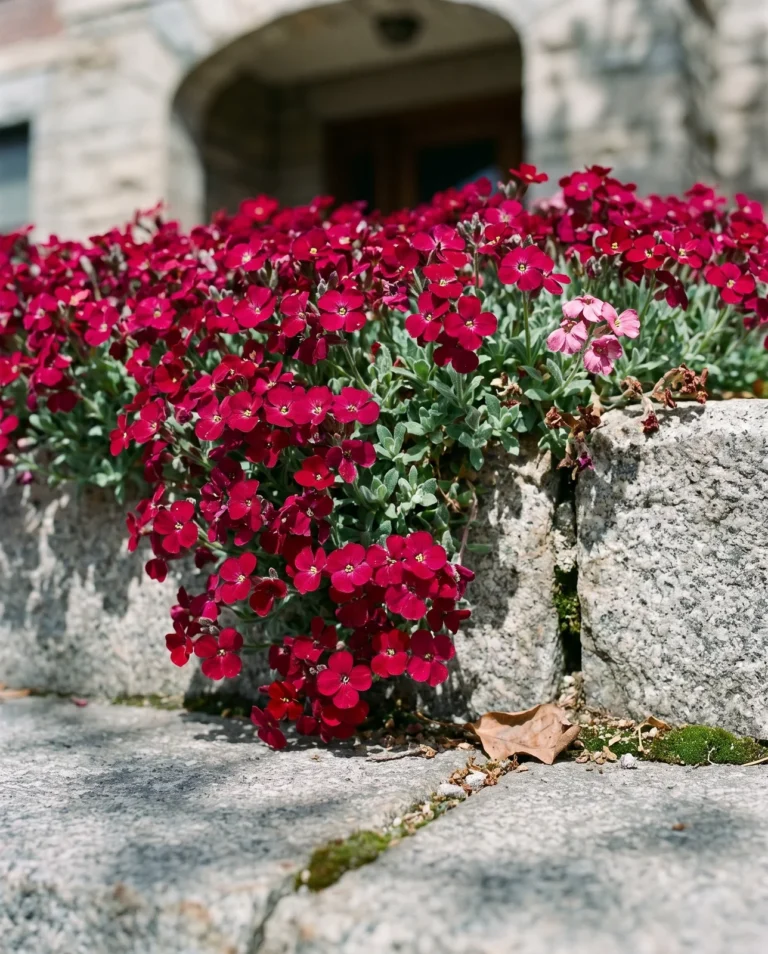
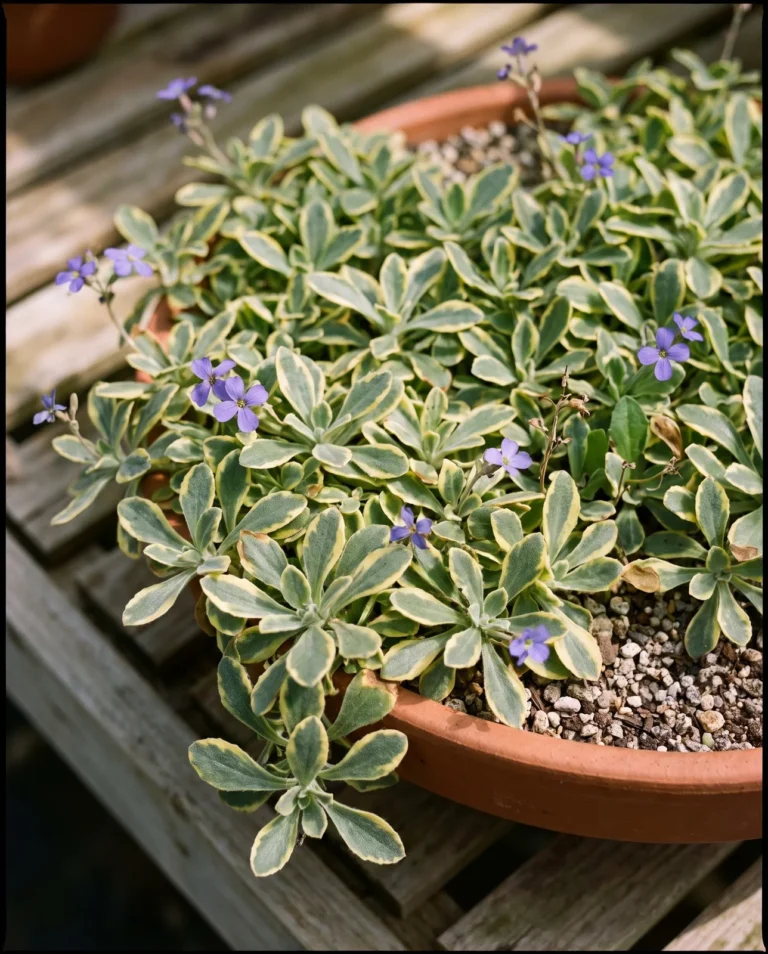
Named aubrietas worth telling apart
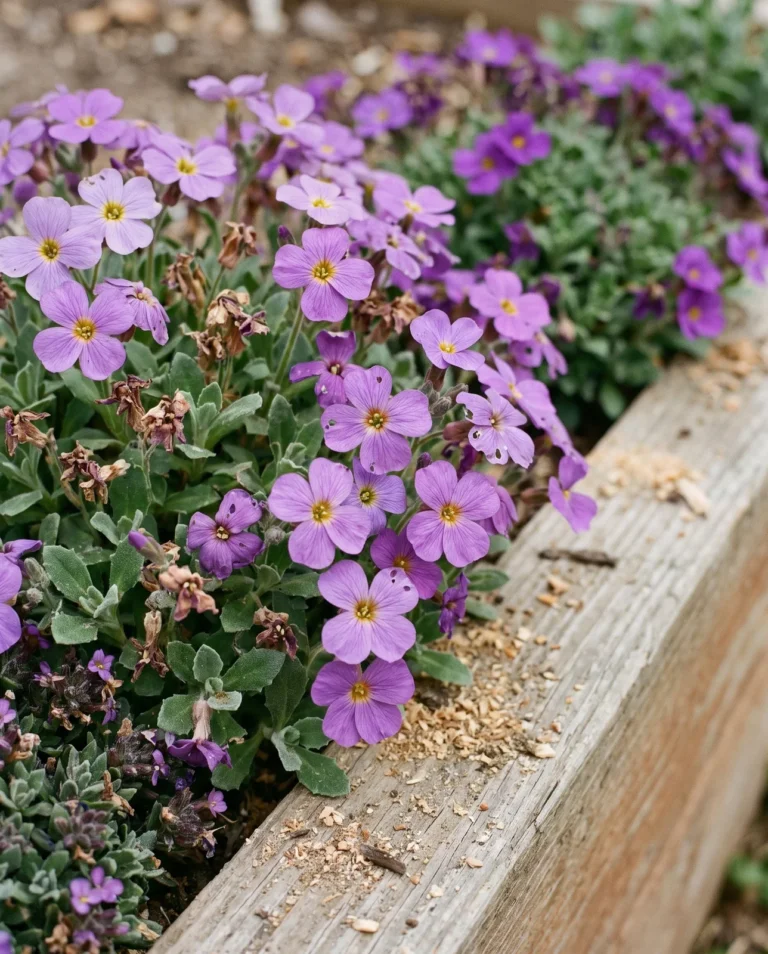
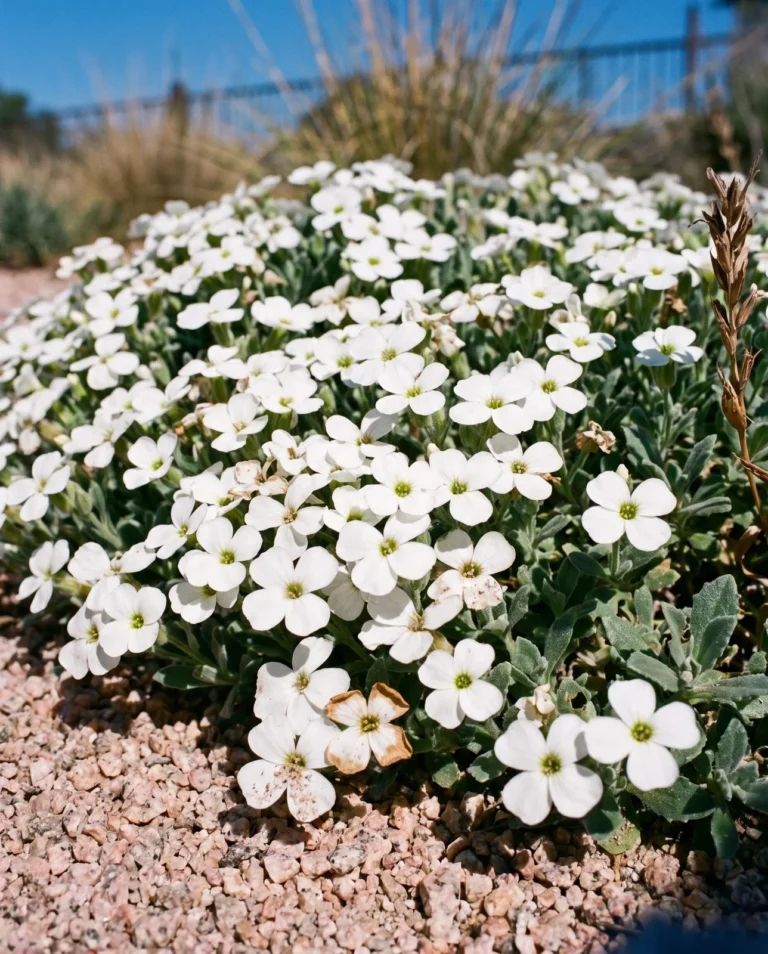
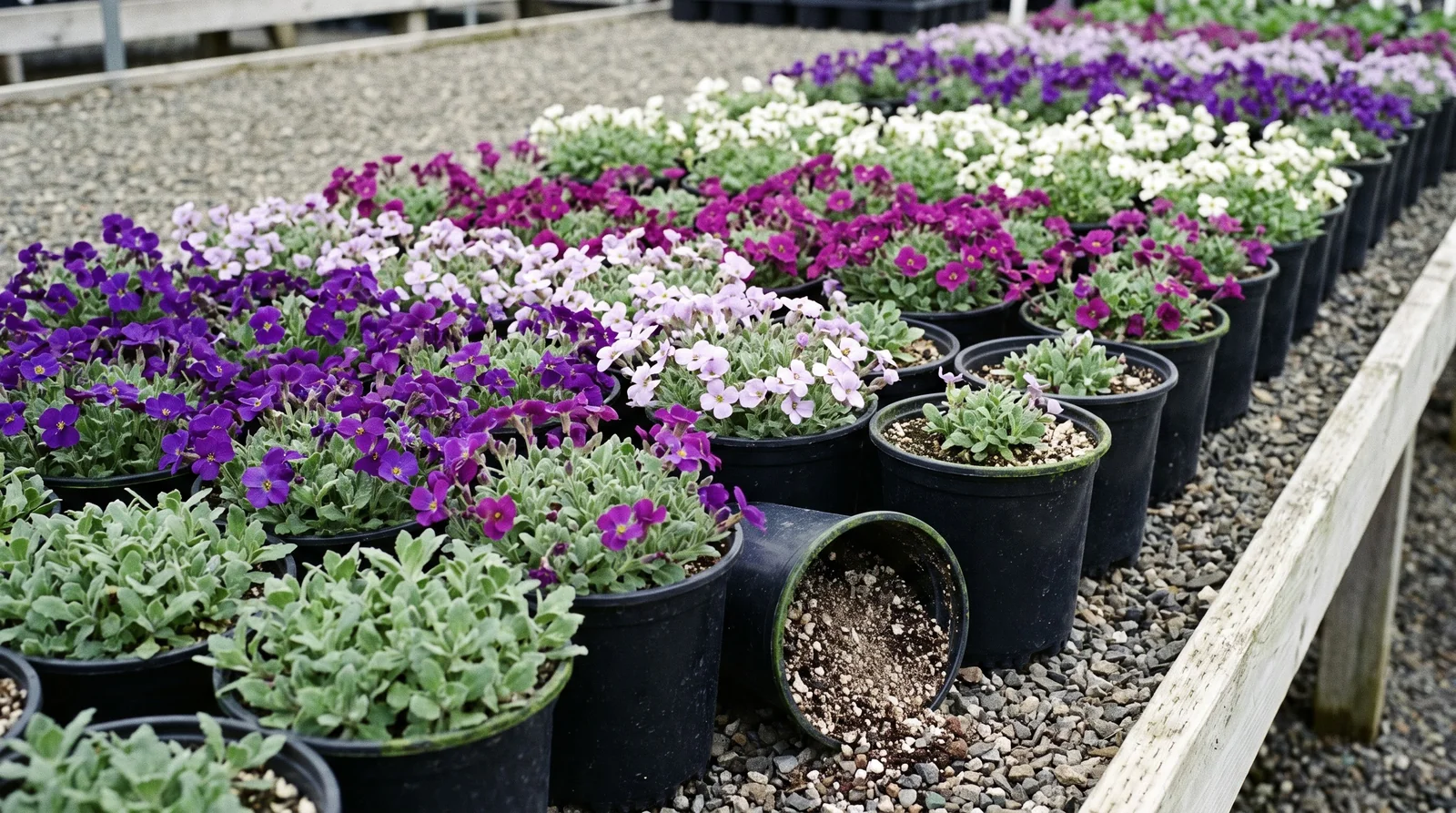
Most of what separates one named aubrieta from another is flower color, and four cultivars of mixed or uncertain parentage hold the Award of Garden Merit. The sizes below describe the selection they are attached to, and only that selection.
Soil and lime
Ground that drains fast and sits at the neutral to slightly alkaline end of the scale is what aubrieta wants. Light, alkaline to neutral, very well drained soil suits it, and standing water and heavy wet clay are what it hates. The one number on the chemistry is an optimal range of 6.5 to 7.5, and the lime recommendation behind it only makes the soil slightly less acidic. Read against that number, the lime reputation is modest: the top of the range is barely alkaline and the bottom sits on the acid side of neutral. On ordinary garden loam you have less to correct than the word lime suggests. On heavy clay you have a drainage problem that no amount of lime touches.
Water
Water low to moderate once the plant has settled in, and let the soil dry slightly between waterings. Aubrieta is drought tolerant once established and deer resistant, and the mustard family it sits in is a notoriously tough group. The failures run the other way, toward ground that stays wet. In practice the watering question for aubrieta is mostly a drainage question.
Height and spread
Aubrieta stands 2 to 9 inches tall and spreads 1 to 2 feet, cascading wherever there is an edge to fall over. The range is wide because the figures describe different cultivars. Most named ones reach 4 inches, a few of them 6. One purple strain runs 3 to 6 inches tall with a spread of 1 to 1.5 feet. Sideways the mat reaches up to 24 inches over time. Read the label on the plant you are buying, because a mixed seed packet carries no such figure at all.
How fast it spreads, and whether it seeds around
Nobody has measured how fast aubrieta spreads by the season. What exists is an end point: up to 24 inches over time, forming carpets of color in spring, or up to two feet around, on a plant not known for being invasive. Aubrieta is non-invasive and self-sufficient for the most part. Spread by the crown is only half the question. These plants often self-sow in gardens, so seedlings turn up away from the parent mat.
Whether that counts against the plant is a real disagreement. Weed potential rates a plain no, alongside a known hazards rating of none known. The Global Compendium of Weeds sits on the other side, classifying Aubrieta deltoidea as a naturalized, casual alien, cultivation escape, garden thug and weed across several national floras, and the same phrase, garden thug, turns up in two standard works on the plants of Britain and Ireland. Federal naturalized-species data lists it as introduced in the United States. Naturalized and invasive are different words, and aubrieta appears on no noxious weed list.
Winter
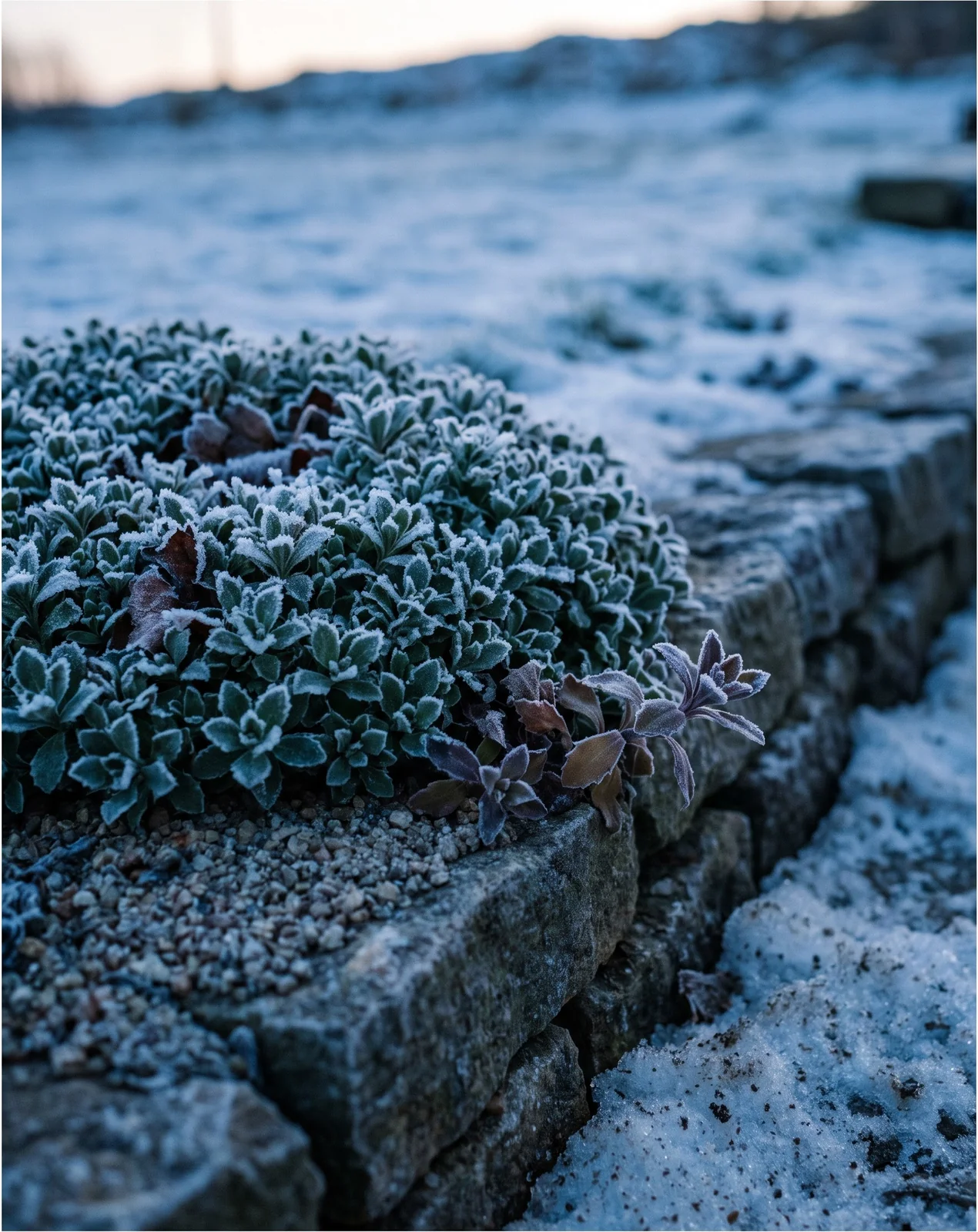
Aubrieta goes through winter with its leaves on, and the winter risk is water at the crown. The species is not frost tender, though one hardiness rating limits it to UK zone 7. In cooler climates much of the foliage disappears by fall, so the mat that goes into winter is thinner than the one that flowered, and what stays green is why the planting still reads as an edge in the weeks when crocus and the other spring bulbs are still underground. The damage comes from the ground. These plants are apt to die out in heavy or damp soils, and that carries particular force in winter, when cold wet ground holds water for weeks. Winter wet rot is the main killer in cultivation.
Aubrieta and pets
The list most people check has no entry for aubrieta at all. The ASPCA toxic and non-toxic plants tool returns nothing for it and drops you on the general list page, and that list covers the plants most frequently encountered, not everything that grows. What exists on either side of the question is thin. Known hazards for the main species read none known, while one plant-care claim puts 67 percent of cataloged aubrieta species in the pet-safe column and the rest as toxic or mildly toxic to cats and dogs, without saying which fall on which side. Nothing on the page rules aubrieta either safe or poisonous, so keep it away from an animal that chews.
What to expect, year by year
Three points where you can check the plant against what it is supposed to be doing.
The first year belongs to the roots. A plant raised from seed may show a few spotty flowers in its first season, with the full flush of bloom due the year after, so the opening spring is mainly a test of whether the ground drains. A plant bought in flower gives its display at once and then faces that same test through its first summer and winter.
The second spring is when a seed-grown plant finally does the thing it was grown for, covering a wall top or a path edge with flower for a few weeks. How wide the mat is by then is not something anybody dates. The end points come with no year attached: up to 24 inches over time, up to two feet around. Seedlings turning up away from the parent belong to no particular year either, since self-sowing in gardens is common. Shearing after flowering is what separates a mat that holds its shape from one that begins to open.
An old mat can go woody and open in the middle, one of the three common problems on the Royal Blue selection. Division is the repair once the middle goes, and it comes round every few years.
Three things repeated about aubrieta
Each of these turns up in searches and garden threads, and each one has a plain answer behind it.
The myth: The correct spelling is aubretia.
The reality: The plant is Aubrieta, named for Claude Aubriet, a French flower painter. Aubretia is common enough to be flagged wherever the plant is defined, and a third form, Aubrietia, redirects to a disambiguation entry with no plant on it.
The myth: It is invasive.
The reality: This one is genuinely unsettled. Weed potential rates a plain no, while the Global Compendium of Weeds tags Aubrieta deltoidea a cultivation escape and a garden thug across several national floras. What is documented for a garden is self-sowing, and that is common.
The myth: It hates lime.
The reality: The recommendation runs the other way. Aubrieta does best in soil rich in lime, with an optimal range of 6.5 to 7.5, and the genus also takes a wide pH range. The argument is over how strict the requirement is, and both sides ask for drainage.
FAQ
Is creeping phlox the same plant as aubrieta?
No. Aubrieta sits in the cabbage family and comes from southeastern Europe and western Asia, while creeping phlox sits in the Polemoniaceae and is native to the eastern and central United States. Count the petals: four plain ones on aubrieta, five notched lobes on creeping phlox.
Does aubrieta come back every year?
Yes. It is a hardy evergreen perennial that keeps its leaves through the winter, though in cooler climates much of the foliage disappears by fall.
Where is the best place to plant aubrieta?
Somewhere sunny with an edge to fall over: dry stone wall crevices, rock gardens, the top of a retaining wall, the lip of a path. Full sun to partial shade both work, and full sun gives the most flowers.
How quickly does aubrieta spread?
Nobody publishes a rate by the year. The end point is up to 24 inches over time, or up to two feet around, on a plant not known for being invasive.
Is aubrieta easy to grow from seed?
It is one of the easy ones, and the seed is sown on the surface because it needs light to germinate. The catch is patience: a full flush of flower is a second-year event, with a few spotty blooms at most in the first year.
Is aubrieta cheaper from seed or as a plant?
Seed, by a wide margin. One seed strain runs from $5.99 to $34.49 depending on quantity, a potted white selection sells at $14.99, and a wholesale plug tray is $60.48.
Does aubrieta flower twice?
Sometimes. A hard cut immediately after flowering keeps the plant dense and sometimes prompts a light second bloom, though the same cut may buy nothing more than a tidier shape.
Do the yellow leaves on aubrieta need cutting off?
If the yellowing is at the base and the flowers have just finished, it is normal die-back and nothing to treat. Yellowing that arrives before bloom is over, on a plant in wet or compacted ground, is the case that goes on to leaf loss and dieback.
Is aubrieta safe for cats and dogs?
Nobody says clearly either way. The ASPCA plant list carries no entry for it and covers only the plants most frequently encountered. Known hazards for the main species read none known, while one claim puts 67 percent of cataloged species in the pet-safe column and the rest as toxic or mildly toxic.
Does aubrieta have to be cut back?
It is the one job everything agrees on. Cut after flowering to stop the plant becoming straggly, hard and immediately for a dense mat, or in fall. Woody, open growth is what an unsheared mat turns into.
Interesting tips
- Water surface-sown seed through a diffuser. A plain stream can push the seed down under the soil, and this seed needs light on it to germinate.
- In a wet winter, a pane of glass propped over the plant is the cover on offer, and only in high-rainfall areas.
- Check that a zone number you find is actually about aubrieta. One big brand carries no aubrieta at all in its plant search, and the zone text on its pages names three climate types with no figure for this plant.
Related Guides & Flowers
Creeping phlox as ground cover
The look-alike in full, on the slopes and walls where the two plants get mistaken for each other.
Campanulas for rock gardens
The next plants along the same wall, and the ones that take a crevice the way aubrieta does.
Deer resistant flowers
Where the rest of the bed gets checked against the same records that call aubrieta deer resistant.
Flowers for zone 4
The zone floor nearly every aubrieta figure starts from, and what else holds ground there.
Enjoying our flower guides? Add YourFlowersGuide as a preferred source on Google. It helps more readers find us.
Add to Preferred Sources