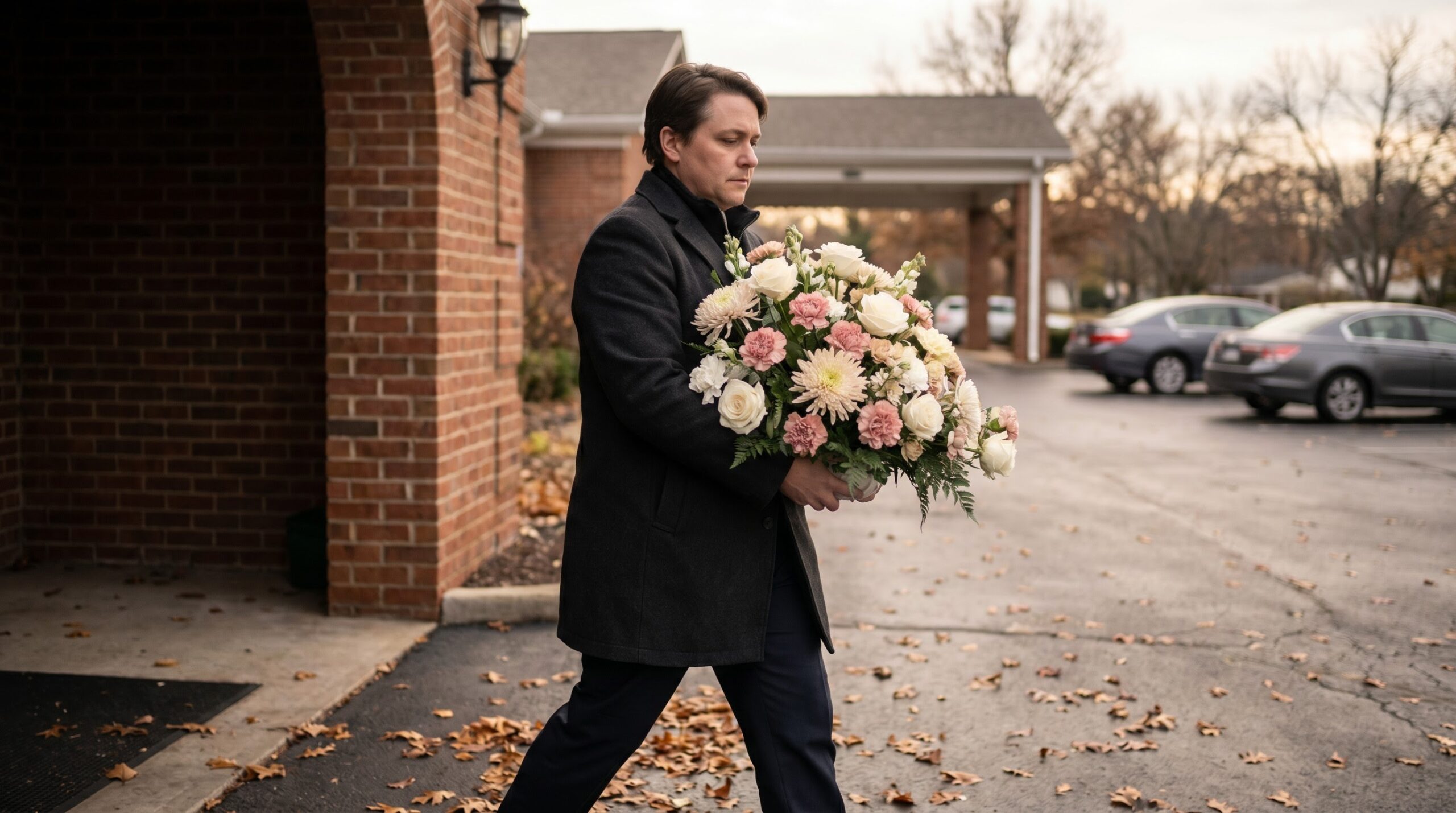
The service is over, everyone has gone home, and the flowers are still exactly where they were an hour ago, propped against the casket, crowding the back seat of your car, or taking up half the kitchen table. Somebody has to decide what happens to them next, and that somebody is probably you. Here's the part nobody explains beforehand: there is no required next step. Taking everything home is fine. Leaving the standing spray at the grave is fine. Handing the whole load to the front desk of a hospice on your way home is fine. So is putting it all in the trash that same afternoon, because you are exhausted, the service is done, and you don't owe a bouquet anything more than you've already given it. One person described exactly that after their mother's funeral: they'd ordered a large arrangement and flowers for the casket, and afterward they simply threw them away. "No one had the bandwidth to donate them to a nursing home or smth," they wrote. That's a completely normal outcome, not a failure of etiquette, and it's exactly where this page starts.
Take them home, leave them, donate them, or let them go
Not every arrangement has to take the same path. A funeral typically produces a mix of pieces: a few small vase arrangements sent by coworkers, maybe a standing spray meant for the sanctuary, and usually one casket spray that sat on or near the casket itself. Knowing the different types of funeral arrangements mostly determines where a piece makes sense afterward. A vase arrangement travels home in a cupholder without trouble. A six-foot standing spray is a two-person lift that most families leave for funeral home or cemetery staff to deal with. Reddit is full of the same confession in slightly different words: someone has to figure out what to do with all those flowers and take them from the funeral home and find a place to put them, and that someone is usually whoever hasn't already left for home. That person doesn't need a plan for every single piece. They need permission to sort them, quickly, into whichever of these fits.
| Path | Best if | What it takes | What it costs you |
|---|---|---|---|
| Take everything home | You have the space and don't mind the reminder | Nothing but the drive | Wilts within a week or two, so you'll be tossing them anyway, just later and at home |
| Leave the standing spray at the grave | Burial happens the same day or the next | Nothing | Cemetery staff usually clear it within a few days; ask ahead if you want a say in the timing |
| Donate what's still fresh | You have thirty minutes and a hospice, church, or nursing home nearby | One phone call, plus pulling off any cross or casket-style pieces first | Most families don't have this in them right after a service, and that's fine too |
| Dry or press one stem | You want a small keepsake rather than a whole preserved bouquet | A week with silica gel, or two to three weeks just hanging it | Saves only the one flower; the rest still needs a decision |
| Let it go | You're exhausted and nobody is asking you to be a hero about a bouquet | Nothing | None. Plenty of families end up right here |
Swipe →
If the bigger question on your mind is actually about money, whether what was spent on flowers factors into the estate, that's a separate calculation on our funeral flower cost breakdown. This page only covers what to do with the flowers themselves once they've arrived at your door.
Is it bad luck to bring funeral flowers into your house?
Somewhere between the funeral home parking lot and your own front door, a different worry tends to surface, usually not spoken out loud. No fixed rule settles it either way. Funeralwise, an online funeral planning guide, treats taking arrangements home as the default expectation: most funeral homes ask families to take flowers with them after the visitation, casket-side pieces included. LIVNOK, which catalogs death-related superstitions, reaches a similar conclusion from the other direction, describing the belief that funeral flowers bring bad luck into a house as something that varies by culture and functions more like regional folklore than a fixed rule. Some families, often shaped by a specific regional or religious background, treat funeral flowers as things that should stay at the site of mourning rather than follow the living home. Other families do the opposite without a second thought and keep the same vase on a shelf for a decade. Neither side is wrong, and neither needs correcting. If the tradition you grew up with says leave them, leave them. If nobody ever told you a rule, there isn't one waiting to catch you.
Do the flowers get buried or cremated with the person?
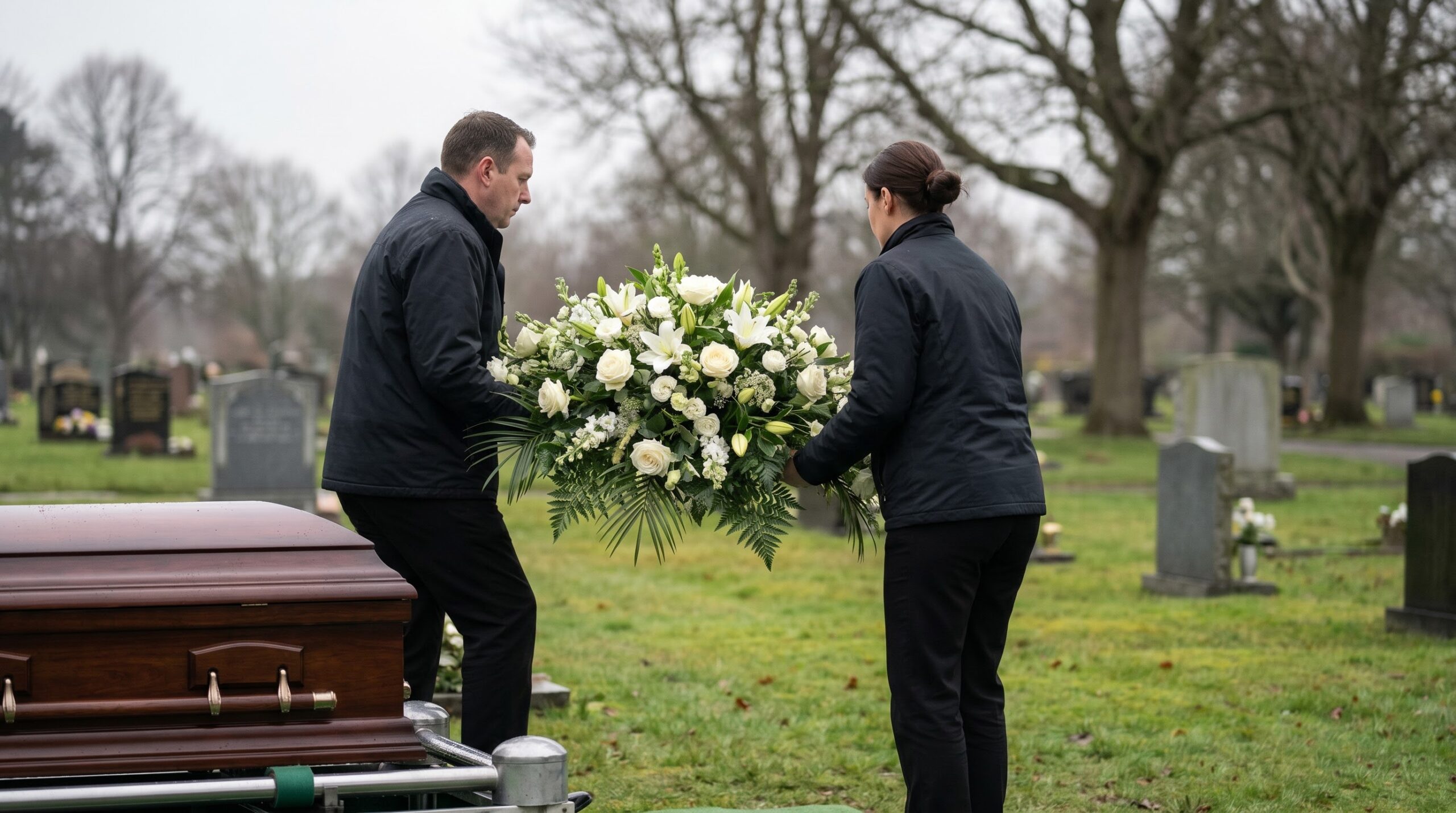
Two questions travel together here: whether the casket spray goes into the ground with the casket, and whether flowers survive a cremation. For a standard service, neither is typically true. Funeral home and cemetery staff usually lift the casket spray off before the casket is lowered, so the full arrangement itself isn't buried; family members who want a physical gesture at the graveside tend to toss in a single stem or a handful of loose petals instead. Cremation works similarly. Arrangements are generally moved out of the room before the process begins and either returned to the family or set aside by staff, a pattern that UK planning site farewill.com also describes for cremation cases, where arrangements are typically taken home by family within a day or two and last up to about two weeks before being discarded or composted. Exactly what happens to the casket spray at the graveside varies by venue and by staff, and it's worth reading in more detail if you're still planning a burial rather than cleaning up after one.
How to keep one flower without turning it into a project
You don't need to preserve the whole arrangement to keep something meaningful, and most families who try to save everything end up with a box of brittle petals nobody looks at again. One rose, one carnation, one lily, that's usually enough. Air-drying is the least fussy option: tie the stem, hang it upside down somewhere warm, dark, and dry, like a closet or an attic, and leave it alone for two to three weeks, per Iowa State University Extension's guidance on drying flowers at home. If you want a faster result with more of the original color intact, silica gel dries a flower fully in three to seven days, the same extension guide notes. If burial is happening days or weeks after the funeral itself, as sometimes happens when a family is waiting on travel or a burial plot, refrigerating the casket spray in the meantime can buy a little time, though it won't hold up as well as a fresh delivery.
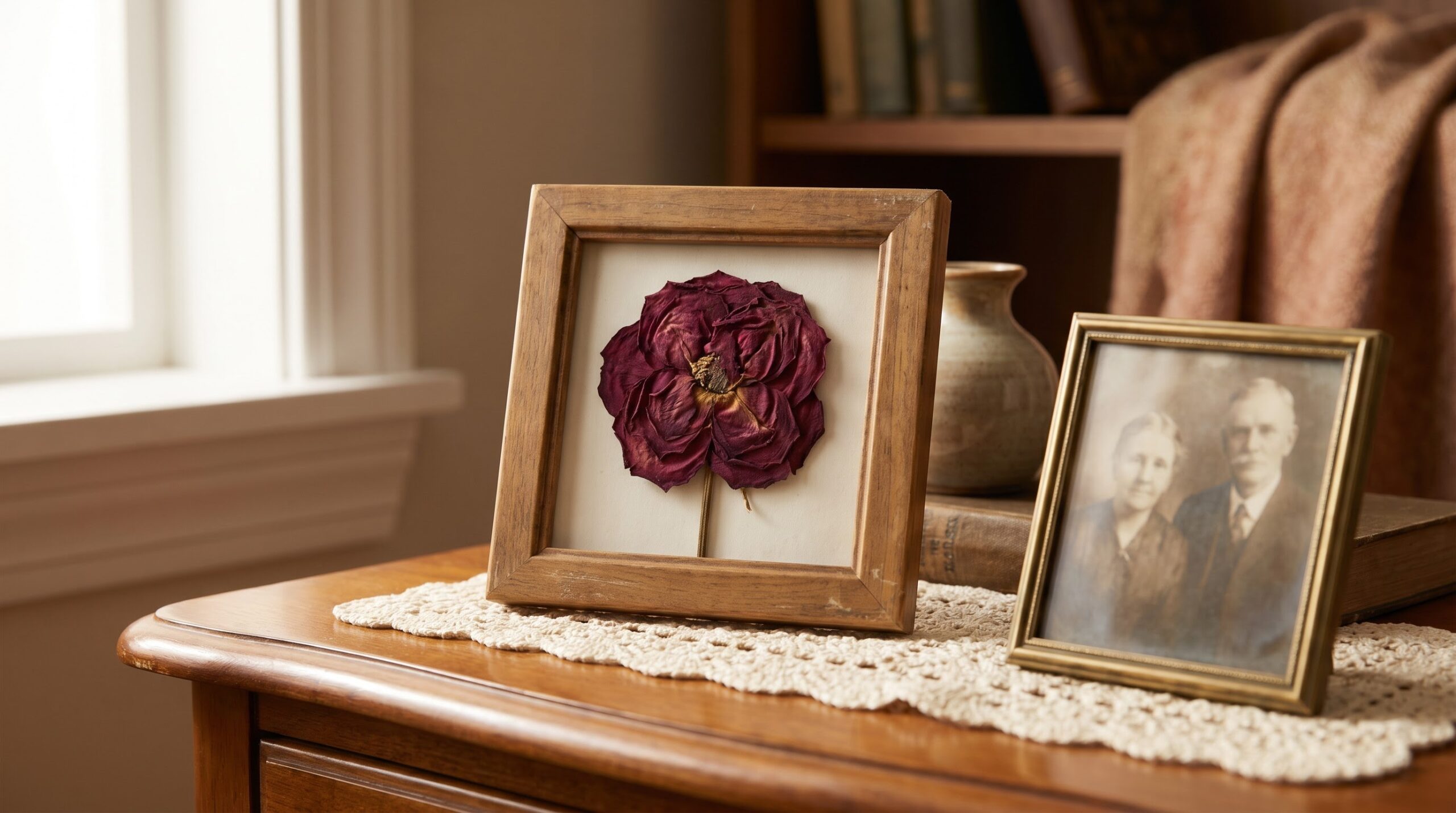
One person described doing almost exactly this after her mother's funeral: on her mother-in-law's advice, she took a single rose from the flowers and dried it carefully, and two months later it had kept its shape perfectly. From there it's mostly presentation. Press it flat inside a heavy book if you want it framed next to a photograph, the way one Reddit user preserved funeral flowers into a board alongside a picture of the person and, in some cases, the prayer card. Drying a rose and pressing chrysanthemum petals both hold up well to this treatment if either happens to be the flower in front of you; other blooms vary more. Some families skip the drying step entirely and mail a stem or two to a business that sets pressed petals into resin jewelry, a pendant or a bracelet instead of a pressed flower under glass. That's its own separate purchase and timeline, worth researching on its own whenever there's time for it.
These keepsakes matter enough that losing one actually hurts. One person still mentions the vase of preserved funeral flowers her stepbrother knocked over, the vase and the flowers gone in a single second. Wherever you land on drying or pressing, keep the result somewhere it won't get bumped off a shelf.
Where funeral flowers can actually be donated
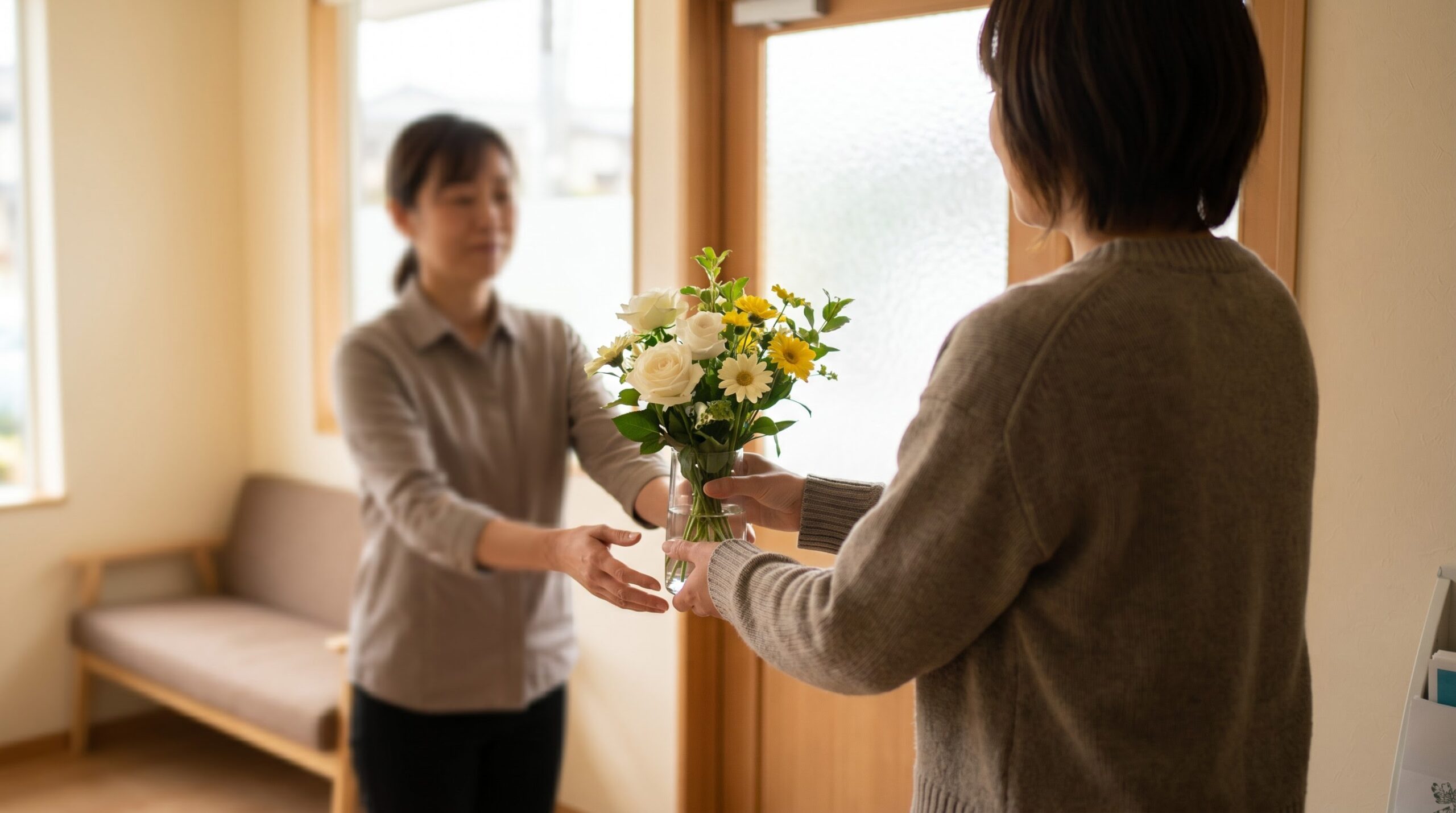
Donating whatever is still fresh genuinely helps somewhere, and it goes more smoothly with a plan than with a car full of wilting arrangements and no destination. Hospices, churches, and nursing homes are the most realistic recipients, and calling ahead matters more than people expect. Some facilities welcome flowers happily; others are managing allergies, fragrance sensitivity, or simply don't have vases on hand. Funeralwise's guidance is specific on one point worth repeating: pull off anything obviously funeral-shaped first, a cross, a casket spray, a sympathy ribbon, before dropping arrangements at a hospital or retirement home, so the flowers read as a gift rather than a reminder of someone else's funeral. Hold onto the card that came with each arrangement before it leaves your hands. You'll want it later for writing thank-you notes for the flowers you received, and it's much easier to track who sent what before the flowers are gone than after. Most families, per the same Reddit thread that keeps surfacing on this exact question, simply don't have it in them for an extra errand this soon after a funeral. That's allowed too.
A few more questions about funeral flowers after the service
What happens to funeral flowers if nobody takes them? Most funeral homes hold arrangements for a day or two after the service, then either donate them through their own contacts or discard whatever's left. If you want a say, tell the funeral director directly rather than assuming someone else will handle it. By default, unclaimed flowers become the venue's responsibility to handle, and you're not expected to intervene.
How long do funeral flowers actually last? Cut arrangements typically hold up for about one to two weeks before wilting, based on farewill.com's estimate for post-funeral flowers. That timeline is worth weighing before committing to a donation errand versus just enjoying them at home for a few days; either way, they won't outlast much more than two weeks no matter what you do with them.
Can I replant a potted funeral plant? Yes. Potted arrangements, peace lilies and mums are common choices, usually transplant fine into a garden bed or a larger pot at home. Check first that the whole plant is actually alive; some potted arrangements mix in a few silk stems for visual bulk, and those won't grow no matter how well you pot them.
Can funeral flowers be preserved into resin or jewelry? Yes. A number of small businesses and hobbyists press petals from funeral flowers into resin pendants, bracelets, or earrings as a lasting keepsake. It's a separate purchase and turnaround time from drying at home yourself, often a couple of weeks by mail, so treat it as something to look into later rather than sort out today.
Pick one path today rather than letting the arrangements wilt in the trunk while you decide. Take what you want home, leave the rest, make one donation call if you have it in you, or dry a single stem if there's one flower you can't part with. If notes are still owed for the flowers people sent, that's the next thing worth doing, whenever you're ready for it.
Enjoying our flower guides? Add YourFlowersGuide as a preferred source on Google. It helps more readers find us.
Add to Preferred Sources