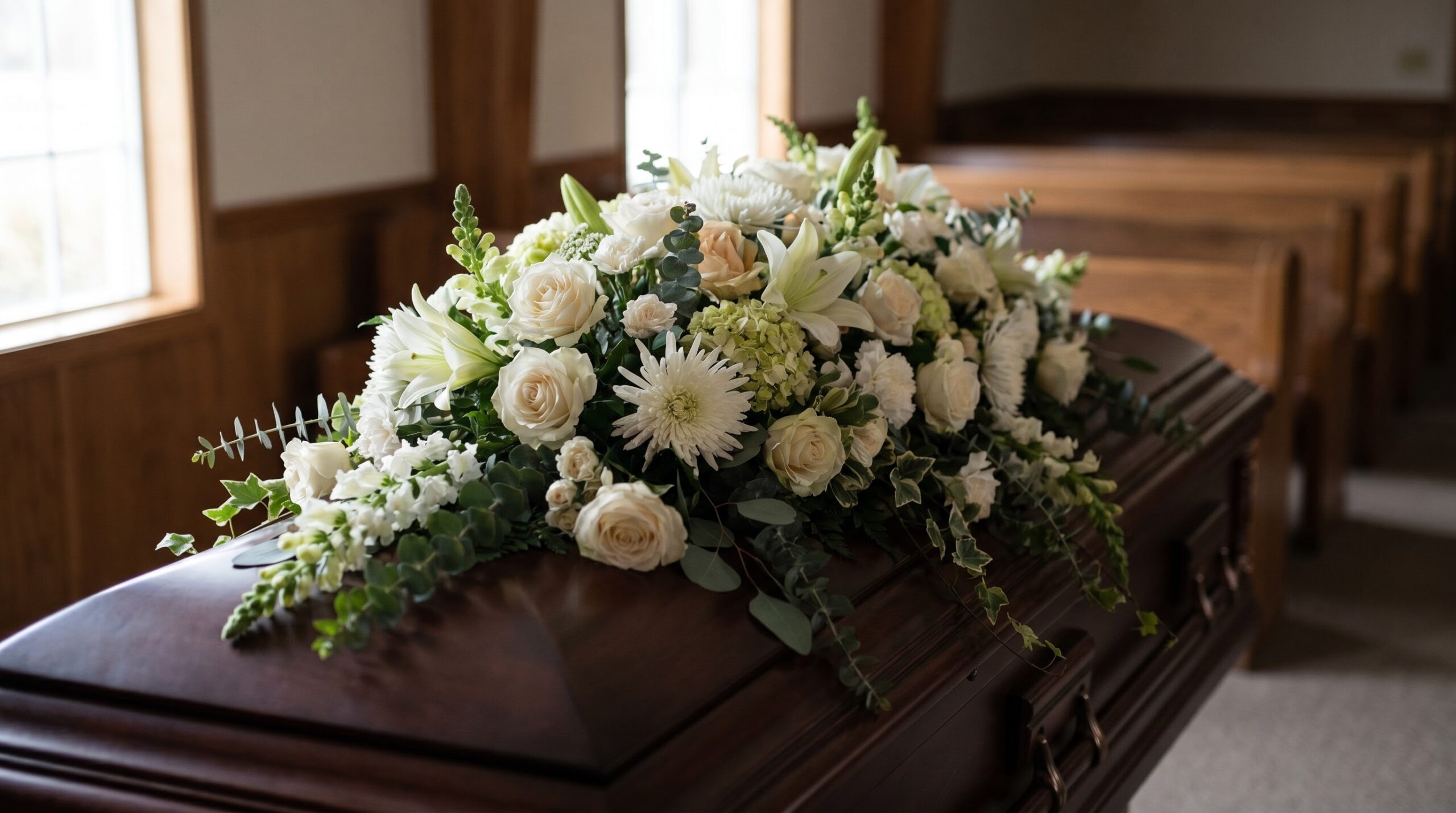
A casket spray is not a general sympathy gesture. It belongs to the deceased's immediate family: a surviving spouse first, then the children, and the parents or siblings if there's no spouse or children to carry it. If you're a coworker, a distant cousin, a neighbor, or a friend of the family rather than the family itself, the respectful move is to skip it entirely. Send a standing spray, a wreath, a sympathy basket, or a plant to the visitation, and let the one piece that lies directly on the casket stay with the people closest to the person who died. That single rule untangles most of the confusion that hits people the moment they land on a florist's site and see "casket spray" listed as an option among everything else, priced like any other product on the page, with nothing on the page telling them whether it's theirs to buy in the first place.
The ownership rule holds even when it complicates who actually pays. When there are several adult children, or a spouse plus siblings who all want to contribute, funeral etiquette guides consistently describe the casket spray as a shared cost among that immediate circle rather than any single person's job, and in practice families often work it out quietly among themselves, without ever raising it with in-laws or extended relatives. One widower, writing about arranging his wife's funeral, described exactly that kind of quiet handoff: her adult children and siblings covered the cost of the casket spray between themselves, and when he offered to pay his share, he was told there was no need, even though he had already covered the funeral itself. Money and grief tangle together in ways etiquette guides rarely admit, and if you're the one footing most of the bill while someone else quietly pays for the flowers, that's not a breach of etiquette. It's just what happens when several people who loved the same person all want to do something for them. Once you know who's ordering it, what to write on the spray's ribbon is the next decision, and it deserves a real answer rather than a guess at the florist's counter. It's one of several occasion flowers guides that walk through a specific moment start to finish.
Where those pieces sort out, for quick reference:
| Question | Quick answer |
|---|---|
| Who orders the casket spray? | Immediate family only: spouse, children, or parents. Siblings step in if there's no spouse or children. Everyone else sends something else. |
| Half-couch or full-couch? | Half-couch for an open casket, covering the lower half. Full-couch for a closed casket, covering the entire lid. |
| How big should it be? | Roughly 2 to 3 feet and 20 to 30 stems for half-couch. Roughly 4 to 6 feet and 40 to 60 stems for full-couch. |
| What about flowers inside the casket? | A floral rosary or casket insert is a smaller, separate piece, usually from children or grandchildren, placed alongside the spray, not instead of it. |
| Does it get buried with the body? | No. It moves to the top of the grave after the family leaves and gets cleared away days later. |
| What if the family skips flowers? | Personal items or garden cuttings are a common, welcomed alternative. Nobody expects a catalog purchase. |
Swipe →
Half-couch or full-couch: what the spray is, and how it lines up with an open or closed casket
A casket spray is the single large floral arrangement built to sit on top of the casket itself, distinct from a standing spray on an easel beside it or a wreath propped against the wall. Florists build it in two basic shapes, and which one gets ordered comes down to whether the casket will be open or closed at any point during the service, not a style preference. A half-couch spray covers roughly the lower half of the lid, leaving the upper half, where the face and shoulders would be visible, completely clear. That's the shape ordered for a viewing where mourners will see the person one last time. A full-couch spray covers the entire length of the lid, because there's no viewing window to protect: the casket stays closed through the service, so the flowers can run the whole length without covering anything anyone needs to see. Almost nobody explains this plainly before a person is standing in front of a florist's order form choosing between two options with no context attached, and it's the one distinction that actually decides which piece is right, ahead of size, flower type, or budget. Confirm with the funeral home whether the casket will be open at any point before ordering, because that single answer settles the couch question outright, and getting it backward means a spray built for the wrong situation arriving on the day itself.
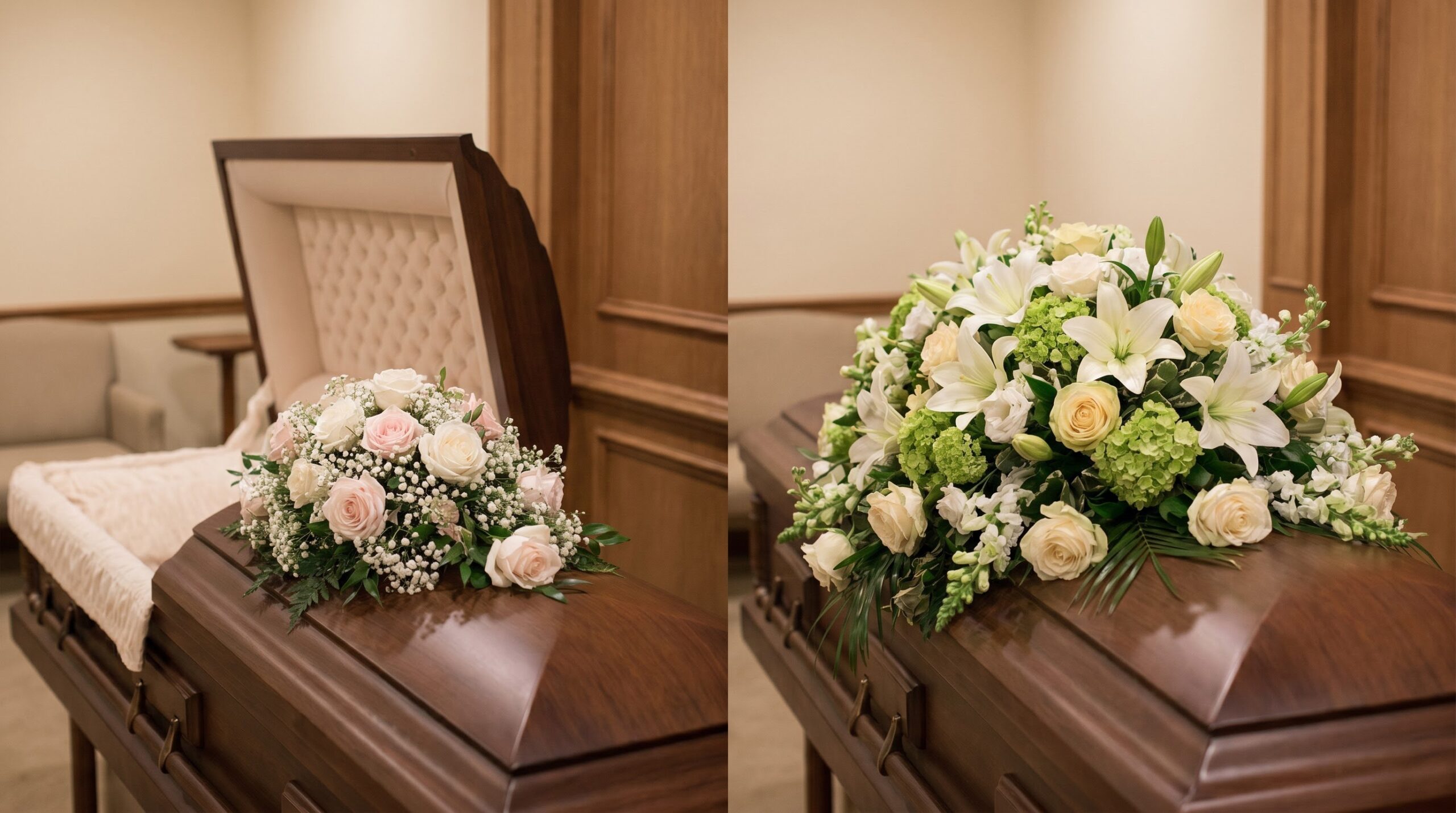
The terms sound technical, but the logic underneath is plain once someone says it out loud. Some funeral homes and casket makers also use "half couch" and "full couch" to describe the casket lid itself, which opens in one piece or two, and that's a related but separate fact from what the flowers cover. What matters for ordering flowers is simpler: open casket at any point, order half. Fully closed the entire time, order full. If a family isn't certain yet whether the casket will be open, the funeral director will know, and it's a completely normal question to ask them directly rather than guess.
How big should it be, and how many flowers does it take
There's no official size, and anyone promising an exact stem count is guessing past what any florist can actually know before they see the casket and the flowers together. But the ranges florists work within in practice are consistent enough to be useful. A half-couch spray typically runs 2 to 3 feet long and uses somewhere around 20 to 30 stems once the focal flowers, greenery, and filler are all counted together. A full-couch spray, covering the entire lid, typically runs 4 to 6 feet and uses closer to 40 to 60 stems to fill that length without looking sparse or patchy in the middle. Florists adjust both ranges for the casket's own dimensions, for the budget the family sets, and for how full or airy a look they want. Treat both ranges as a starting point for a conversation with whoever's building the piece, not a target to hit exactly, and a good florist will ask about the casket size and the open-or-closed question before quoting anything more specific.
Cost tracks size in roughly the same way. How much a casket spray typically costs depends mostly on which of the two you're ordering and what flowers fill it, and that number deserves its own honest answer rather than a single line buried here. What's worth knowing at this stage is only that full-couch runs meaningfully higher than half-couch, since it's covering roughly twice the length with roughly twice the flowers, and that difference is worth confirming before the family settles on a size out of instinct alone.
Rosary flowers, casket blankets, and what goes inside the lid
Everything so far covers what sits on top of the casket. Some families add something inside it instead, or in addition, and this is the part almost no etiquette page touches at all. A floral rosary is a small, spiritual piece built specifically for a Catholic service: a string of fresh flowers, most often spray roses, arranged to echo the shape of an actual rosary, sometimes with a small crucifix worked into the design, and placed inside the casket rather than on top of it. It's typically ordered by children or grandchildren as a personal gesture rather than the main tribute, and it exists alongside the casket spray, not instead of it, so a family isn't choosing one over the other. A related but separate tradition is the physical rosary beads placed in the deceased's own hands, which is a devotional object rather than a floral piece, and distinct again from the floral rosary described here, even though the two get confused constantly by people encountering both terms for the first time.

A casket blanket is a different thing altogether: a wider, denser floral covering, closer to a quilt of flowers than a spray, that drapes over more of the casket's surface and generally costs more than a spray of comparable quality simply because it uses more flowers to achieve that fuller coverage. Don't confuse either of these with a funeral pall, which isn't floral at all. In Catholic funerals, the pall is a plain white cloth placed over the casket as it's received at the church, and EWTN's explanation of Catholic funeral customs describes it as standing in for the white garment given at baptism, a sign that the person entering the church is entering it as an equal, regardless of the casket beneath the cloth. The parish supplies the pall and removes it before burial. It has nothing to do with what the family orders from a florist, and nobody needs to choose between a pall and a spray, since a Catholic funeral can involve both at once, one liturgical and one floral. Lilies and chrysanthemums turn up in almost all of these pieces, a pattern that goes back further than any modern florist catalog. Why lilies and chrysanthemums turn up on caskets so often traces that association across cultures, including places where the same flower reads as celebration rather than grief.
What happens to the flowers afterward, and what to do if you skip them
No, the flowers are not buried with the body. The casket spray travels with the casket from the funeral home to the hearse to the graveside, and florists and funeral directors have swapped tips for years on keeping it secured to the lid for that drive, since an unclipped spray can slide during transport and needs resetting before the service starts. Getting the spray to the funeral home on time covers the delivery side of that same logistics problem. At the cemetery, the spray sits on or near the casket through the graveside service, and once the family leaves, cemetery staff typically move it onto the mounded grave rather than lower it into the ground with the casket. It stays there, fading over the following days, until it's eventually cleared away by cemetery grounds staff. People who've been through it often land on the same blunt way of putting it: the flowers were never really for the person being buried. They did their job the moment they stood over the casket in front of everyone who came to say goodbye, and whatever ordinary thing happens to them afterward doesn't undo that. What happens to the flowers once the service is over goes further into preserving, donating, or taking a piece home, and that applies to a casket spray just as much as anything else sent for the day.
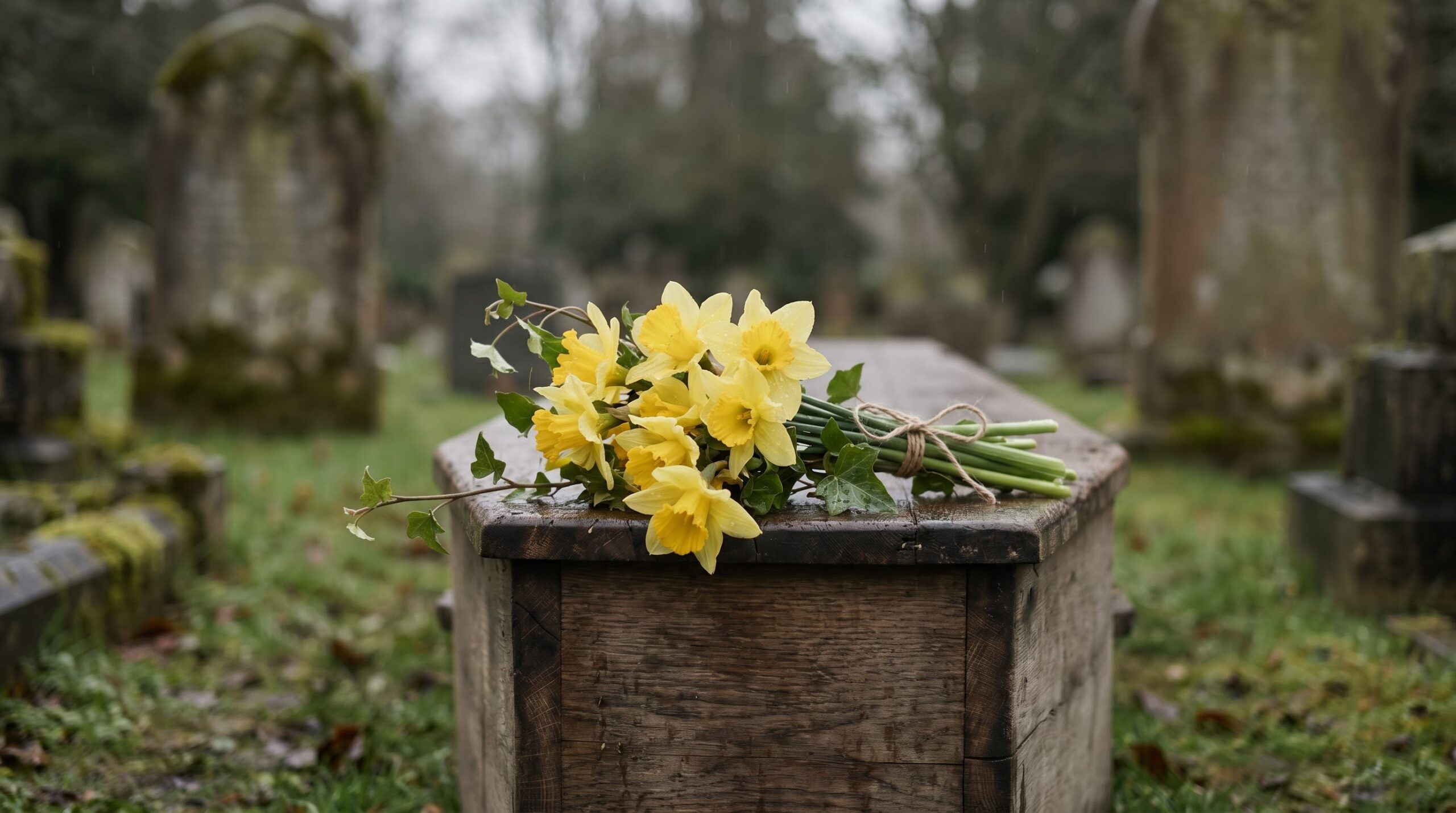
Some families skip a casket spray entirely, sometimes because the person who died asked for donations instead of flowers, sometimes because it simply feels more personal to bring something of their own. One family, after a service with no casket spray at all, gathered blooms from home instead and described cutting daffodils "to throw into the grave instead of buying flowers," because it felt more personal. Nobody at that funeral was wondering whether that was allowed. If it's still unclear whether ordering a casket spray is your place, that uncertainty is usually the answer on its own: send something else, or bring something that means more than a catalog item ever could. The full guide to funeral flower types and who sends what covers every other piece that's genuinely open to anyone who wants to send something, from standing sprays to a simple bouquet sent to the family's home.
Enjoying our flower guides? Add YourFlowersGuide as a preferred source on Google. It helps more readers find us.
Add to Preferred Sources