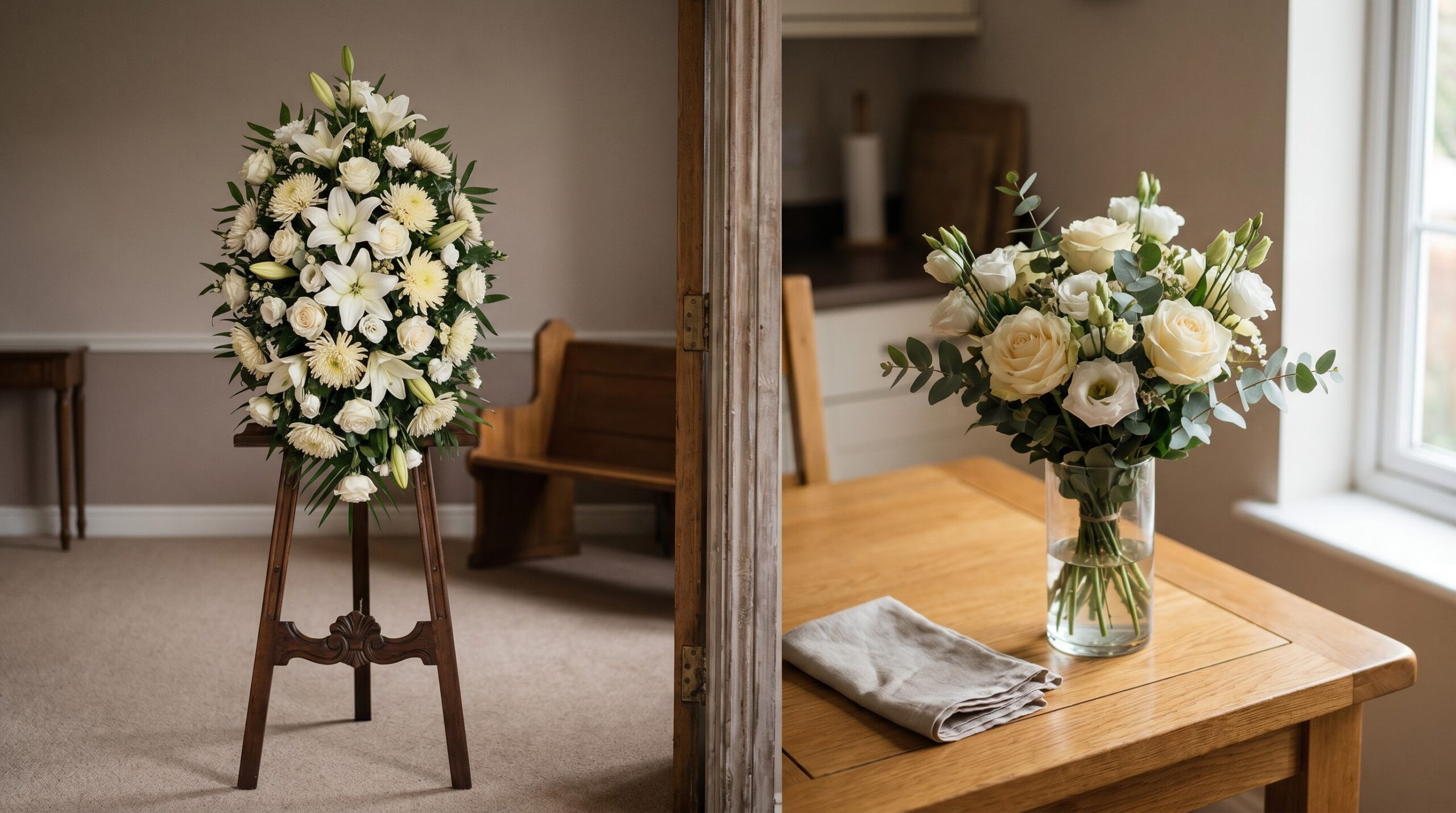
Sympathy flowers and funeral flowers are two different orders, sent to two different addresses, and the checkout page will file the same bouquet under both labels without ever explaining which one you need. Here is the split. Funeral flowers honor the person who died: they go to the funeral home or service venue, addressed to the family in care of the funeral home, and they have to arrive before the service begins. Sympathy flowers comfort the people left behind: they go to the family's home, and they can arrive whenever you choose. Both travel by florist delivery, every time. You do not bring flowers in hand to a viewing, funeral, or reception. The funeral home staff will have placed every arrangement that was sent ahead, and a bouquet arriving in someone's arms has nowhere to go.
Which of the two orders is yours comes down to two questions: where is the service, and who are you to this family. Those answers decide the arrangement, the address, and the delivery day. This page walks you through both, then gives you the exact words for the florist. For everything beyond the distinction itself, faith traditions, card wording, how much to spend, see our full guide to sympathy flowers etiquette.
Where the order goes decides everything else
If the service is still ahead, you can send flowers to it. The obituary usually names the funeral home. The arrangement is addressed to "The Family of [Full Name], c/o [Funeral Home Name]" at the funeral home's street address, with the service date and time in the delivery notes. A florist near the funeral home does this daily and will confirm the details on their own. One timing rule matters here: service pieces arrive before the visitation or service starts. An arrangement that shows up afterward decorates an empty room.
Home orders are simpler. They go to the family's home address, under a family member's name, on any day you choose. Legacy.com's sending guide draws the line the same way florists do: funeral flowers when sent to the funeral home, sympathy flowers when sent directly to the grieving family. You may also see "condolence flowers" in a shop menu; it is a retail synonym for sympathy flowers, so don't let a third label rattle you. And because grief outlasts the service, a home delivery in the quieter weeks after can mean more than one more arrangement in a crowded chapel.
Which arrangement is yours to send
Start with the one piece that is spoken for. The casket spray is the large arrangement lying on the casket lid, and it belongs to the immediate family. Legacy.com puts it plainly: casket flowers are generally chosen by immediate family, and anyone else should default to another type of arrangement. In practice, a spouse or the adult children choose it together and order through one florist, often the one the funeral home works with, and the cost is handled within the family's own funeral arrangements rather than by contributions from guests. If that family member is you, coordinate the spray with the funeral director rather than through an online checkout. Everyone else leaves the casket alone.
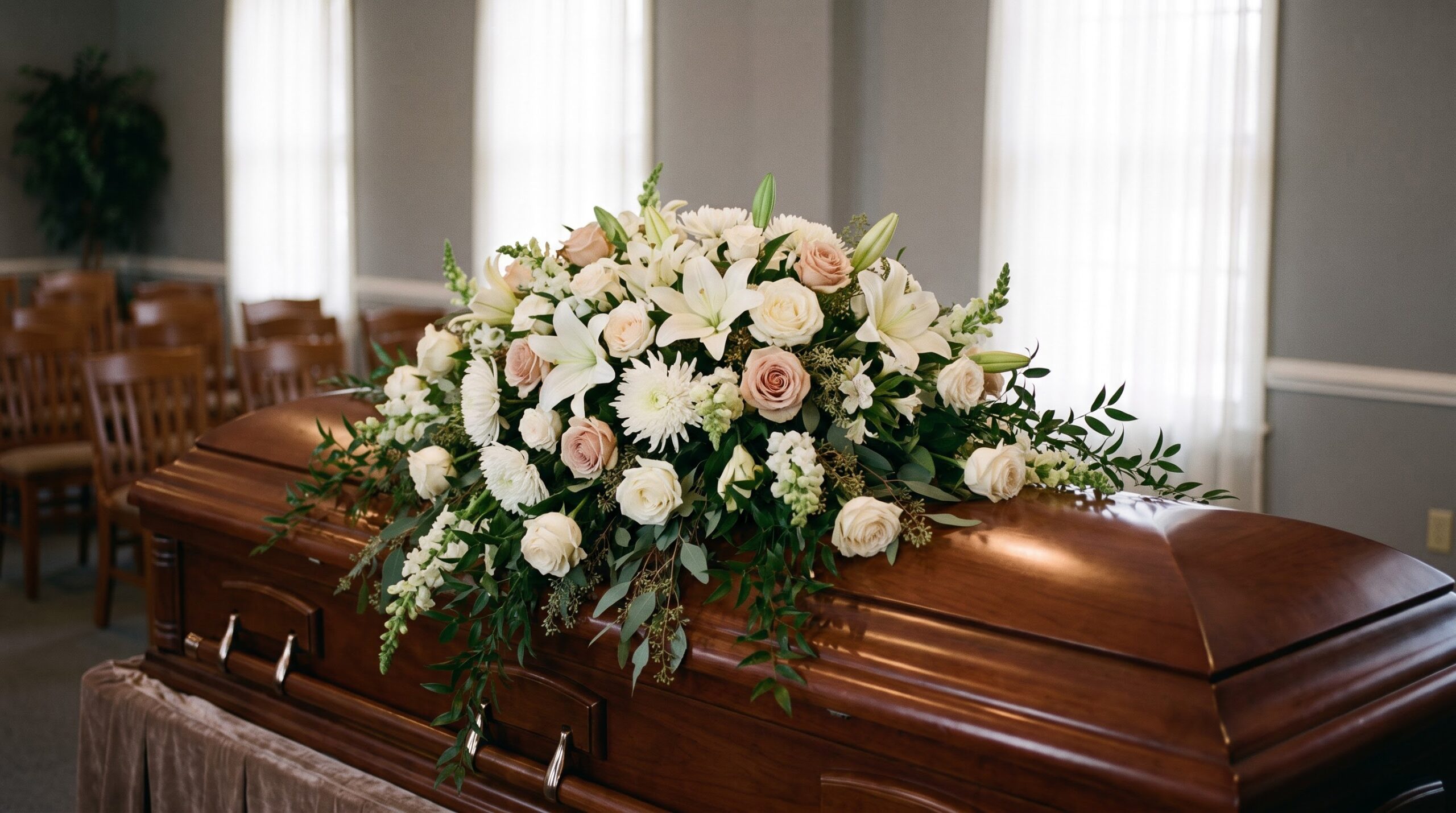
So what does everyone else send to a service? The Emily Post Institute maps senders to arrangements: friends, coworkers, and relatives may send virtually any flower or plant chosen to reflect the personality of the deceased, while wreaths, crosses, and standing sprays are the classic formats for groups, companies, and associations. The service family is worth naming out loud, because these are the words your florist expects: a standing spray (one-sided, displayed on an easel), a wreath, an easel or wall spray, a floor basket, and the dish garden, a basket of live plants the family can take home afterward. Service pieces share one design brief: they must be seen across a room. That is why they run large, face one direction, and lean formal, and it is part of why white lilies anchor so many service arrangements.
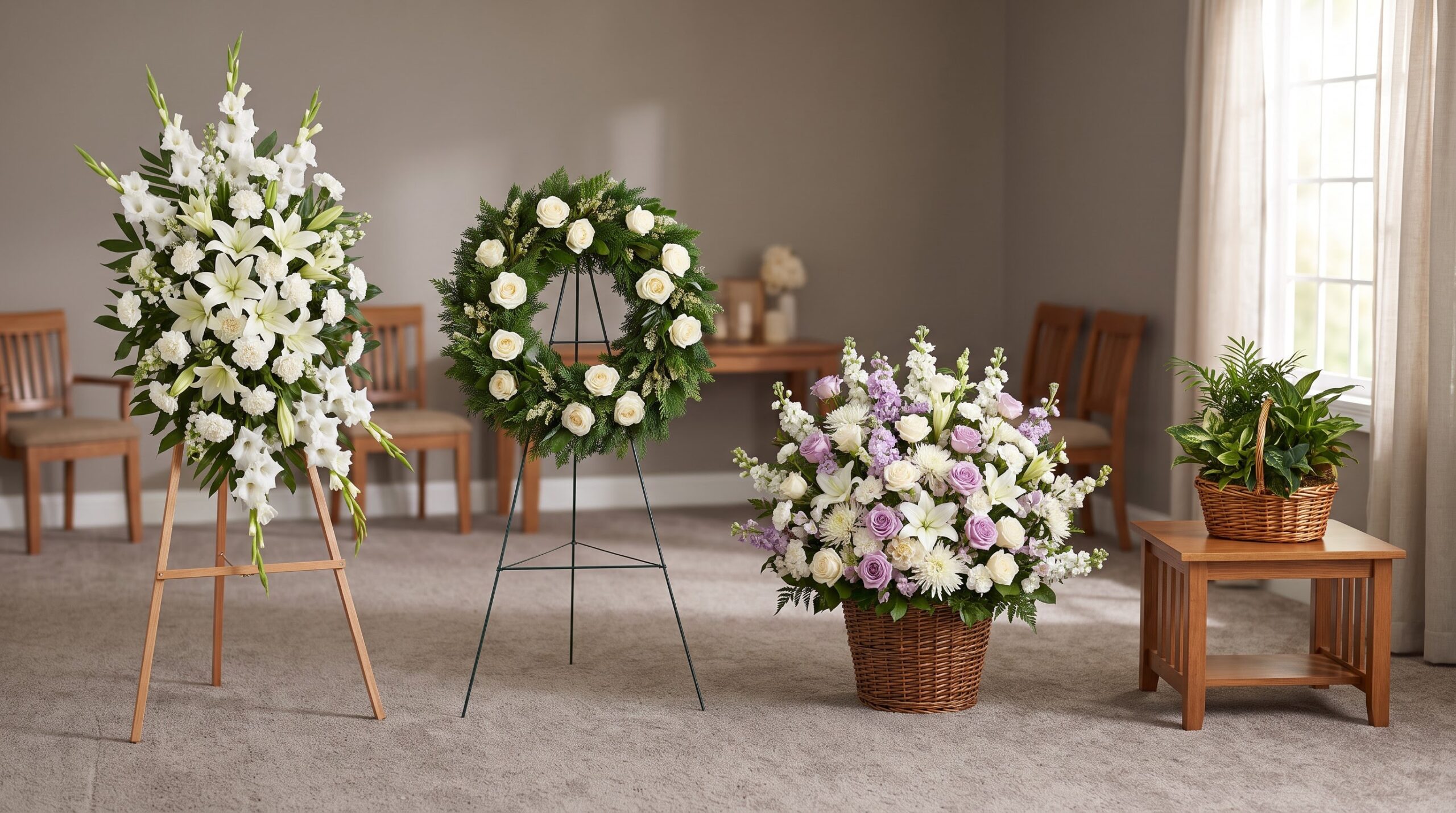
Scale cuts the other way too. A service-scale easel piece delivered to a small living room isn't generous, it's furniture. Match the piece to the space it will actually stand in.
Match your situation to the order
The checkout page will not ask where the service is or who you are to the family, so settle it yourself before you pay.
| Your situation | What to send | Where it goes | When it arrives |
|---|---|---|---|
| Friend, coworker, or neighbor attending the service | Standing spray, wreath, or floor basket | Funeral home: "The Family of [name], c/o [funeral home]" | Before the visitation or service begins |
| Office or group order | One larger standing spray or wreath, a single card naming everyone | Funeral home | Before the service |
| Close to the deceased, never met the family | A service piece under your own name; say how you knew them on the card | Funeral home | Before the service |
| Immediate family | Casket spray plus any inside pieces, chosen together | Arranged with the funeral director, usually through one florist | The funeral director handles timing |
| Can't attend the service | Sympathy flowers or a plant instead of a service piece | The family's home | Any time; the first quiet week after the funeral lands well |
| No casket: cremation, memorial, celebration of life | Wreath, standing spray, or an arrangement for the urn or photo table; ask the venue first | Memorial venue, or the home if the gathering is private | Before the gathering |
| Learned of the death after the funeral | Sympathy flowers to the home; weeks later is fine | The family's home | Whenever you learn of it |
| Obituary says "in lieu of flowers" | Honor it: give to the named cause and send a card; see how to handle an in-lieu-of request | n/a | n/a |
Swipe →
Two situations deserve a closer look. Memorials without a casket are increasingly the default, and venues vary: a church hall welcomes a standing spray, while a restaurant hosting a celebration of life may have no floor space at all, so one call to the venue saves the whole order. And group orders make sense because standing sprays are priced like what they are, large custom pieces; five coworkers pooling for one generous spray will outdo five small baskets scattered around the room.
Cut flowers or a plant at the family's home
Readers trade a folk rule for this decision: flowers if they're going to the funeral, plants if they're going to the family. It mostly holds, and the reason is blunt. Whatever reaches the house becomes the family's to look after. Grieving people say so in nearly those words; one woman, after her mother died, was "so pissed off at all the flowers she received, because it was another thing she had to keep alive." Others remember the opposite, that arrangements arriving at home brought a little happiness into the worst week of the year. Both camps are real. Read the household instead of picking a side.
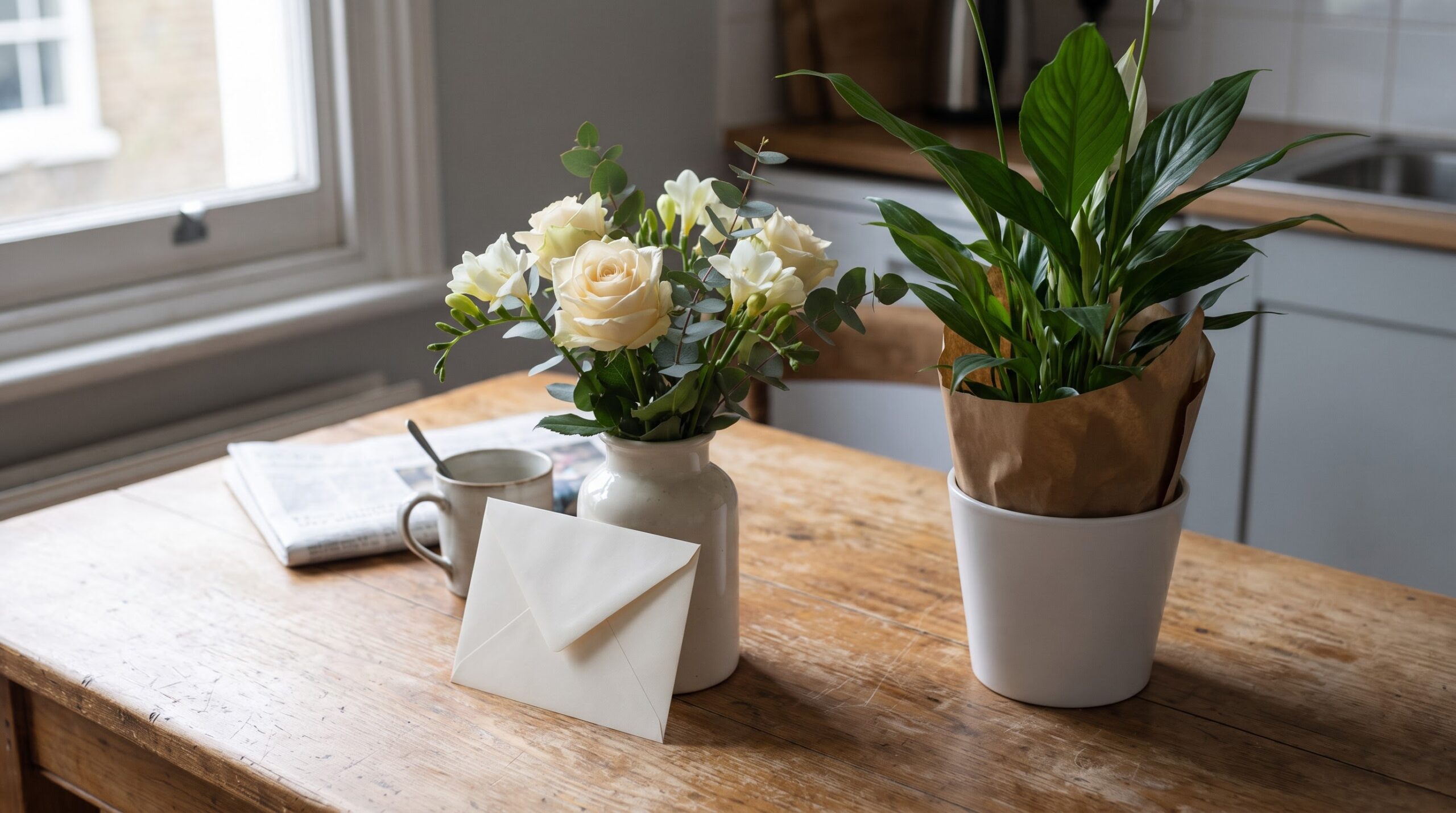
A vase-ready arrangement, one that arrives in its own container and asks for nothing but water, comforts without homework. A wrapped bouquet makes a grieving person hunt for a vase. A sturdy plant lasts months and becomes a living reminder, but it is also a small ongoing chore, which is precisely what the first camp resents. Pets tilt the choice further: the ASPCA lists the peace lily, one of the most common sympathy plants, as toxic to cats and dogs, and warns that true lilies can cause kidney failure in cats. Since so many lily-heavy service pieces travel home with the family after the funeral, a cat in the house is a reason to keep lilies out of your order entirely.
Remember, too, what the house will already hold. They will have a wall of flowers from the service, and that wall is why a home order means more when it comes later, once the service pieces have faded and the doorbell has gone quiet. If you're choosing blooms with intent, what individual flowers say in an arrangement is worth a skim; Funeral Basics reads lilies as renewal and notes that chrysanthemums signal encouragement to American eyes but mark graves in parts of Europe, worth knowing if the family has roots there. And when the situation argues against flowers altogether, a hospice stay, a tiny apartment, a request for donations, here is when flowers aren't the right gesture at all.
Placing the order
Give the florist the piece's proper name and the right address line; the rest is their trade. For a service piece: "a standing spray for the visitation on [date] at [funeral home], for the family of [full name]." For the home: "a sympathy arrangement, vase included, delivered to [name] at [address]." Expect service pieces to cost more than a bouquet of the same flowers would. Easels, foam frames, and sheer size are labor, and that is the price difference, honestly earned. If the total stings, a floor basket carries the same warmth as a spray, and pooling with coworkers is how the big formats have always been bought.
If you were close to the deceased, consider two orders instead of one: a service piece this week, then home flowers a few weeks out, when the house has emptied and the casseroles have stopped. Choosing that second moment well is its own question; when to send flowers to the home, and why later often lands harder, gets its own guide. For now, confirm the funeral home's name, spell the family's name right, put the service time in the delivery notes, and place the order. The van does the rest.
What senders still ask
Do sympathy flowers have to be white?
No. White and cream dominate service pieces because they show clearly across a big room, but color is welcome, especially at the home. The Emily Post Institute's advice is to choose flowers that reflect the personality of the deceased; a gardener's favorite blooms say more than a default white basket.
Do you send sympathy flowers to a man?
Yes. Men receive sympathy flowers, and always have. If a classic bouquet feels wrong for him, florists carry greener, structural options: an orchid, a dish garden, a bonsai-style planting. What matters is that something arrives with his name on the card, at the address where he is grieving.
What happens to funeral flowers after the service?
The family decides, usually with the funeral director's help. Legacy.com lists the common paths: arrangements go home with the family or with extended family and close friends, stay to adorn the grave, get pressed or dried as keepsakes, or are donated to nursing homes and hospitals.
Do family members send flowers too, or only people outside the family?
Family sends flowers as well. Immediate family, most often siblings, children, and grandchildren, traditionally supplies the casket spray and the small pieces placed inside, while more distant relatives often add a standing spray like any other mourner. Closeness decides only the casket; everything else is open to everyone.
Enjoying our flower guides? Add YourFlowersGuide as a preferred source on Google. It helps more readers find us.
Add to Preferred Sources