Flowers in a pumpkin is a real vase built out of a real pumpkin: hollow the shell, set a jar of water down inside it, and fill that with fall stems. Left alone, though, a carved shell can soften, slump, and start to smell in just two or three days. What carries one through a holiday gathering instead is two cheap habits: a bleach wash on the carved shell, and a rigid container inside it so the water never touches pumpkin flesh.
A carved pumpkin is a piece of fruit that has already begun to break down, and cut flowers are stems that need clean water, so the build runs on two clocks at once. Sanitizing the shell slows the first one, while a jar insert and real stem conditioning stretch the second, and handled together they run out at roughly the same time instead of leaving fresh flowers standing in a collapsing shell. The decisions that matter get made before a single stem goes in: real pumpkin or reusable ceramic, foam or plain water, and how far ahead of the meal to build. What follows covers picking the pumpkin and the method, the materials each method needs, the build step by step, three arrangements at three price points, how long each version lasts and how to stretch it, leaks and mold, pet safety, and when to start.
On this page 9 sections
Pick your pumpkin and your method
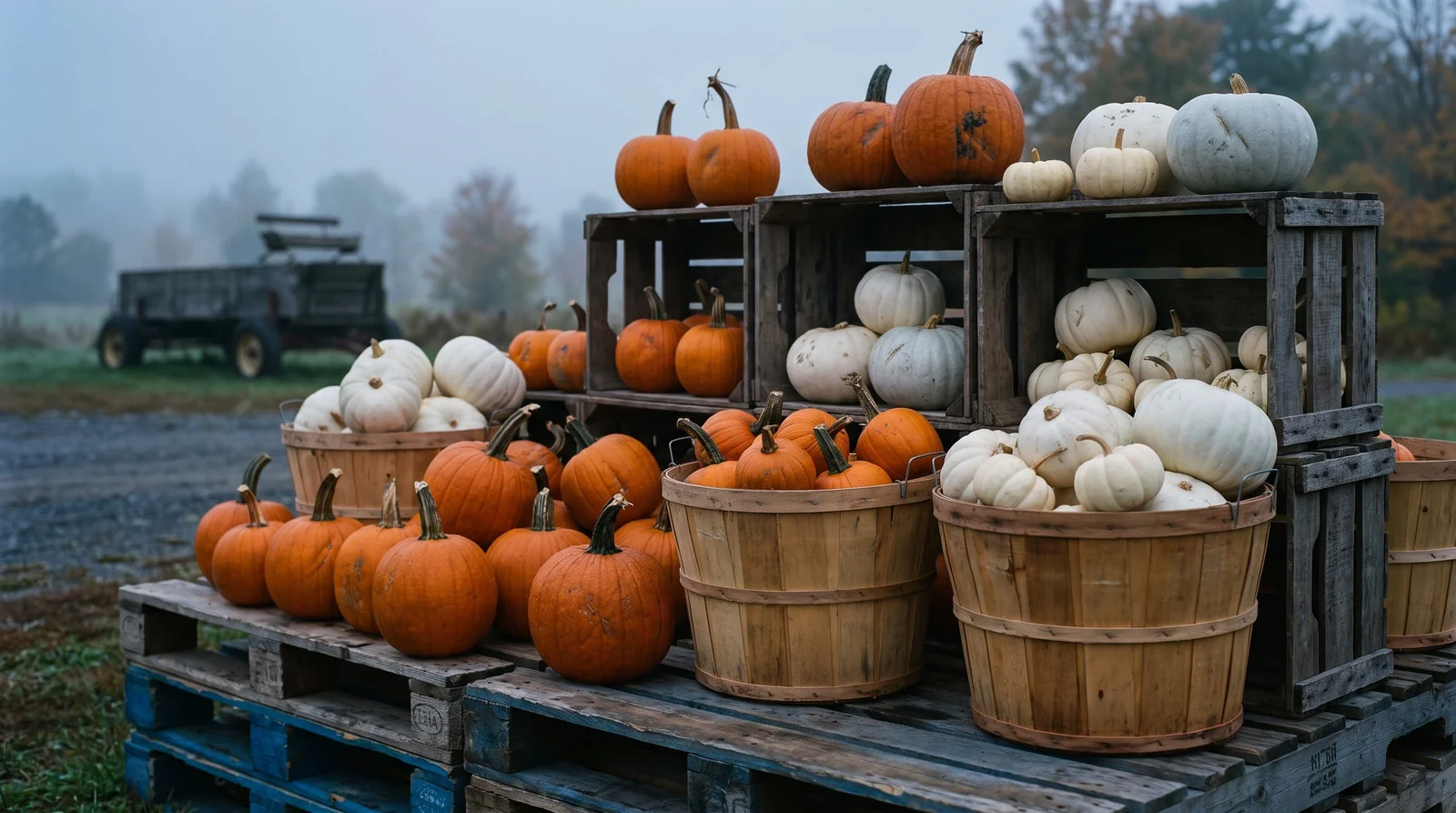
The container decision sets everything that follows: how long the arrangement holds, how much maintenance it asks for, and whether the thing goes in the bin after a week. A real pumpkin looks the part, but the moment a blade goes through the skin the exposed flesh becomes food for airborne microbes. If that is the route, pick a fruit with a flat base that will not rock on the table, unblemished skin, and a firm stem still attached. A ceramic or composite faux pumpkin is the opposite trade: no rot at all, no moisture damage to a wood surface, and you can assemble it well before the season starts. Once you have settled on a fresh pumpkin, the next fork is what actually holds the water inside it.
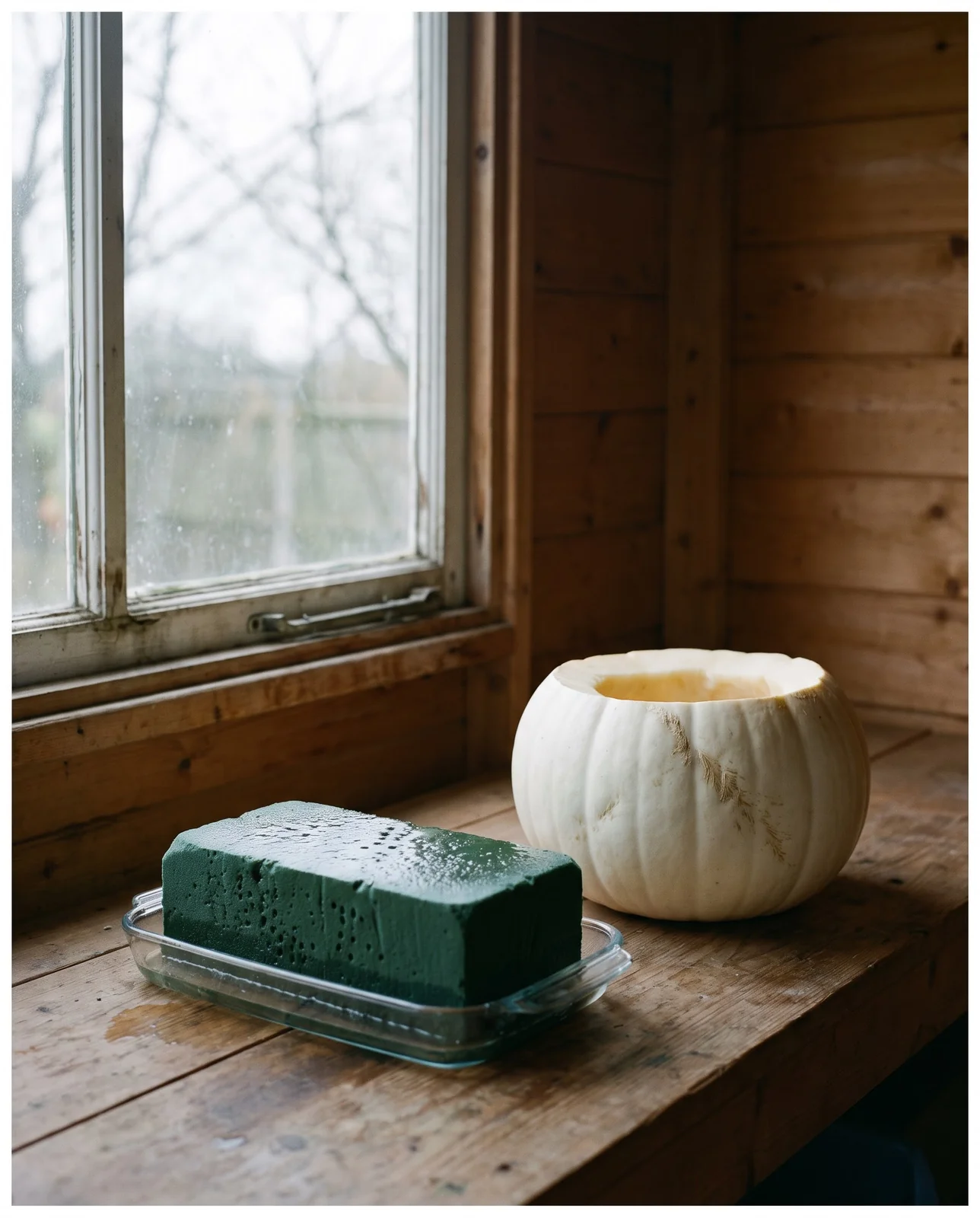
Most tutorials tell you to pack the cavity with soaked floral foam. That block is plastic. Research from RMIT University, published in Science of the Total Environment, found that floral foam breaks into fragments small enough for freshwater and marine animals to swallow, with consequences for their health, and ecotoxicology researcher Charlene Trestrail documented aquatic invertebrates across multiple feeding modes ingesting the particles and showing biological stress responses. The chemicals leaching out of those fragments proved more toxic to aquatic invertebrates than leachates from other plastic families. A single standard green block weighs about as much as 10 plastic shopping bags. Where it ends up matters as much as what it is made of: in a Sustainable Floristry Network survey of more than 1,200 florists, 72 percent of the foam users poured the wastewater down a sink or drain, and another 15 percent tipped it onto garden soil.
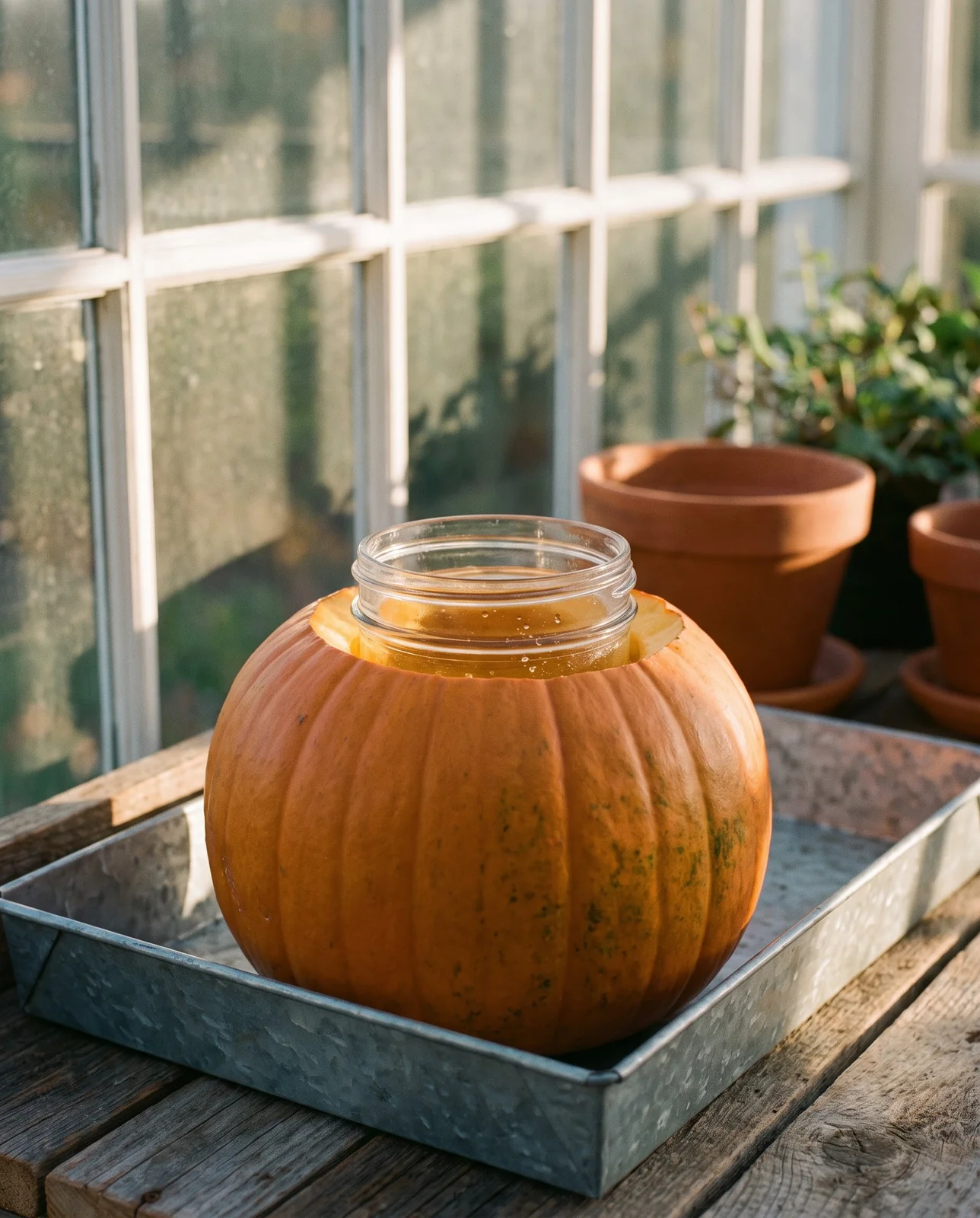
A glass jar, a rinsed deli container, or a drinking glass dropped into the hollow does the same job without any of that. A rigid liner holds clean water, keeps pumpkin juices out of the flower supply, and lifts straight out when the reservoir needs rinsing every few days. Pour water into the bare cavity instead and it sits against a decaying pumpkin wall, turning into a bacterial soup that plugs flower stems inside 48 hours.
Choosing the right pumpkin arrangement method
The right method follows from what you care about most: keeping the water off the furniture, placing stems at exact angles, or owning a centerpiece that comes back out next year.
What you need
The vessel side of the list is short. A pumpkin 6 to 10 inches across, a serrated kitchen knife or a small carving saw, a sturdy metal spoon for scraping, dish soap, household bleach for the 10 percent surface wash, and a jar of plain petroleum jelly for the cut edges. Then the liner that will actually hold the water: a wide-mouth glass jar or a clean plastic tub that nests inside the shell without its rim showing above the opening. Nothing on that list is specialty equipment, and a faux pumpkin drops the bleach and the petroleum jelly from it entirely.
For the flowers you need sharp floral shears or a clean bypass pruner, a bucket for conditioning the stems, fresh tap water, and unscented bleach to dose the vase water at one teaspoon per gallon. A clean towel and a waterproof tray or a flat ceramic coaster go under the finished piece. Then the flowers themselves: focal blooms, filler, and something with fall texture to break the rim. A supermarket bunch beside a grocery-store pumpkin costs almost nothing, while garden roses or heirloom dahlias from a local florist move that number considerably.
Step-by-step: build it
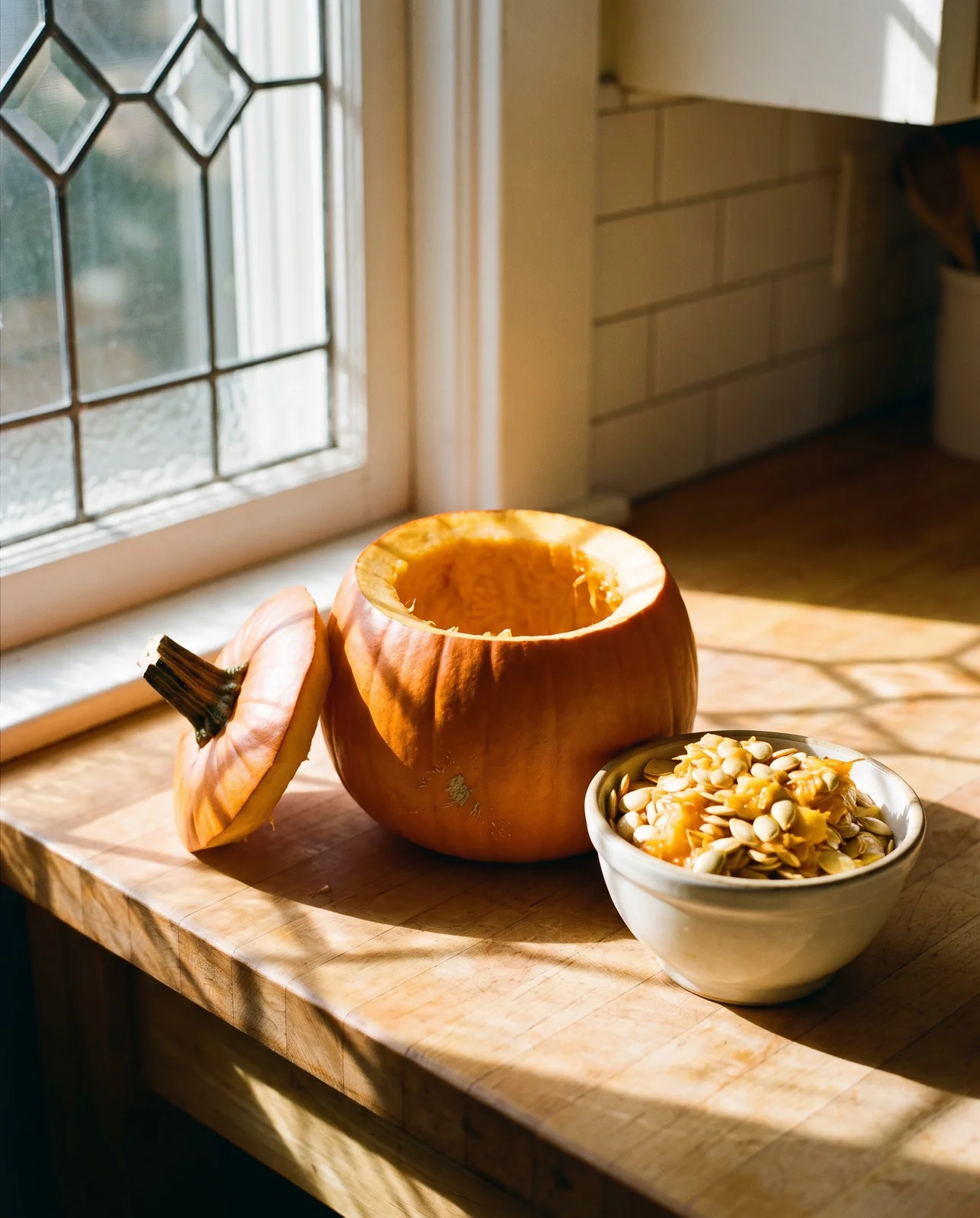
Wash the outside of the pumpkin with warm soapy water before any cut. Utah State University Extension puts this first for a reason: the soil and debris on the rind carry fungal and bacterial spores, and a blade drags them straight into clean flesh. Wipe the knife, saw, and spoon with rubbing alcohol or a disinfectant before they go in as well, which South Dakota State University Extension credits with holding down the transmission of rot-causing pathogens. Cut the opening in the top slightly wider than your jar, angling the blade in toward the center so the lip has something to rest on and the lid does not drop through.
Scrape the cavity down to a smooth wall. This is the step people rush, and South Dakota State University Extension is blunt about the cost: every strand of pulp and every seed left behind is more surface for fungal and bacterial pathogens to colonize. With the inside clean, dip, wash, or spray the whole carved shell with a 10 percent bleach solution to kill the surface organisms that start the decay. Let it air dry completely, then rub a thin film of petroleum jelly along every exposed cut edge, which locks moisture in and slows the drying that makes a shell sag.
Set the glass jar or plastic liner inside the prepared shell. Fill it with lukewarm water and 1 teaspoon of bleach per gallon, the dose North Carolina State University Extension gives for controlling bacteria and fungi without damaging plant cells. Skip the old trick of dropping a penny in the water: modern US pennies are made primarily from zinc rather than copper, so they carry no fungicidal benefit.
Condition the stems before they ever reach the pumpkin. North Carolina State University Extension has you recut each one at a 45 degree angle, taking at least half an inch off the bottom so the cut face sits clear of the container floor and can draw water. Strip away every leaf that would fall below the waterline, since submerged foliage rots and spoils the water for the rest of the bunch. Stand the stems in fresh lukewarm water in a cool, dark spot for one to two hours and let them drink to full. Then build: greenery first as a structural grid across the opening, focal flowers into the gaps it leaves, texture last, and every stem long enough to reach well down into the reservoir.
Three arrangements by price
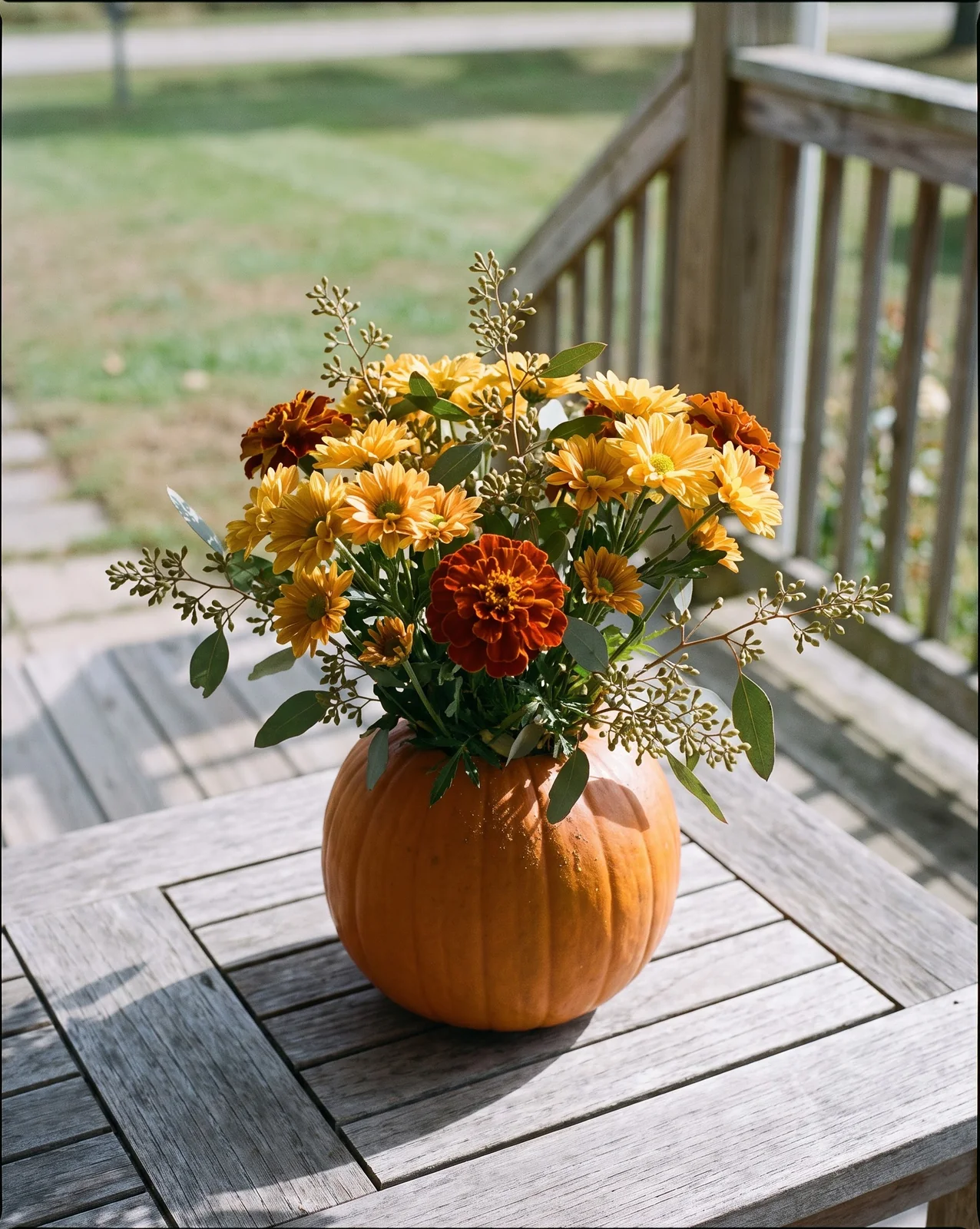
The budget version leans on whatever the supermarket floral counter stocks. Gold and rust marigolds with a few hardy orange flowers and trimmed foliage cut from the yard fill a small pie pumpkin and read as a deliberate fall palette rather than a cheap one. If the bunch you grabbed includes chrysanthemums, push those dense button heads toward the rim, where they hide the edge of the inner glass jar.
The mid tier means a trip to a local florist or a flower farm, and the reason is supply. Eighty percent of the cut flowers sold in the United States arrive from growers abroad, in countries such as Colombia, Ecuador, Kenya, and the Netherlands, according to North Carolina State University Extension, which is why the fragile stems that do not travel well over long distances (dahlias, ranunculus, zinnias) are local or nothing. Build this tier around velvety bronze dahlias, standard roses, and sprigs of seeded eucalyptus in a medium pumpkin. Choose roses with exactly one outer petal unfurled, the stage North Carolina State University Extension ties to longer display time.
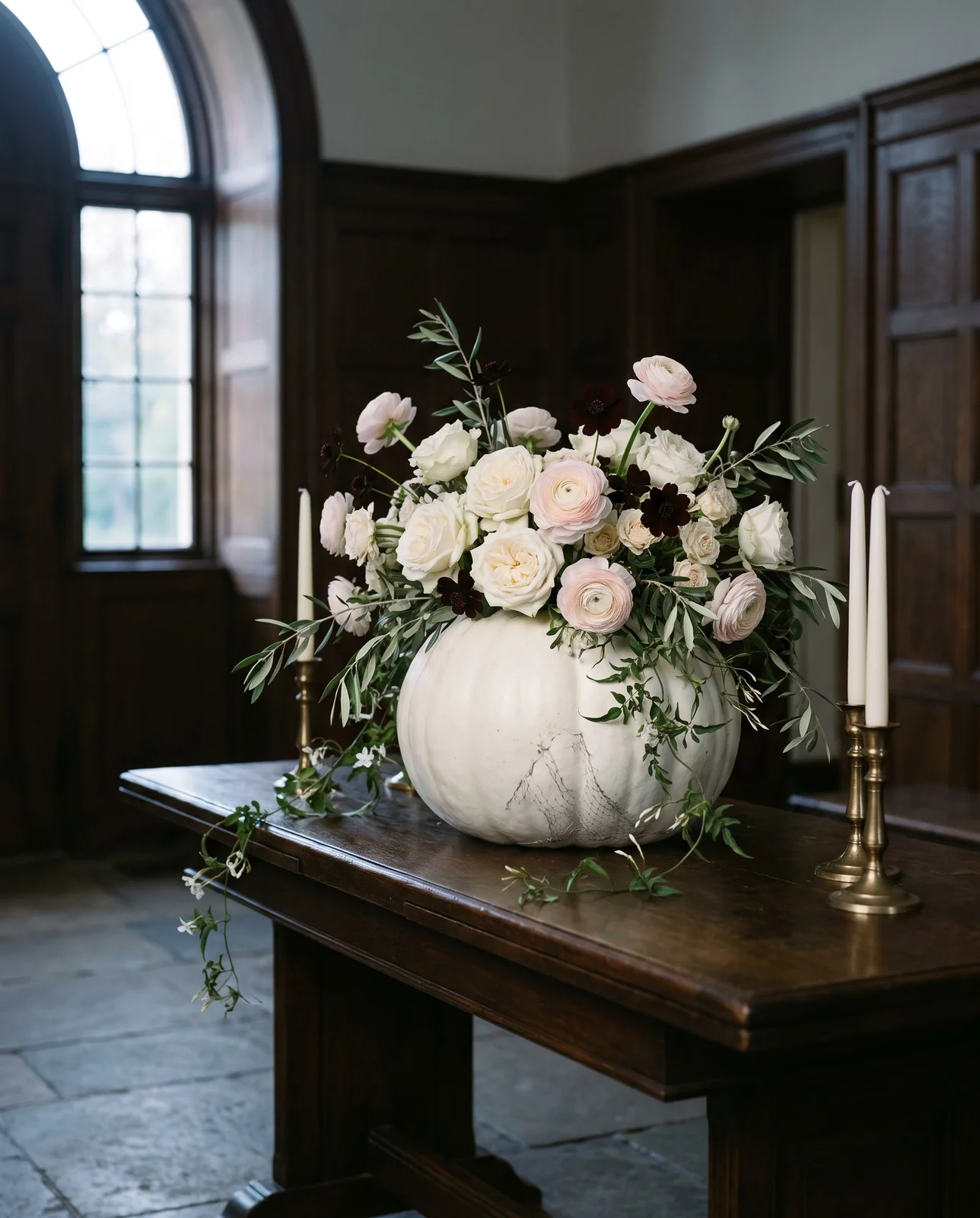
The splurge version trades stem count for texture: high-petal-count garden roses, ruffled ranunculus, and trailing berries inside a large white Luminary or an heirloom Cinderella pumpkin. Miniature sunflowers anchor the design, and the ones worth buying are the blooms whose center disks still look greenish, the stage North Carolina State University Extension rates for the most remaining vase life. Deep plum foliage, hypericum berries, and ivy trailing over the pumpkin ribs finish it off for a formal table.
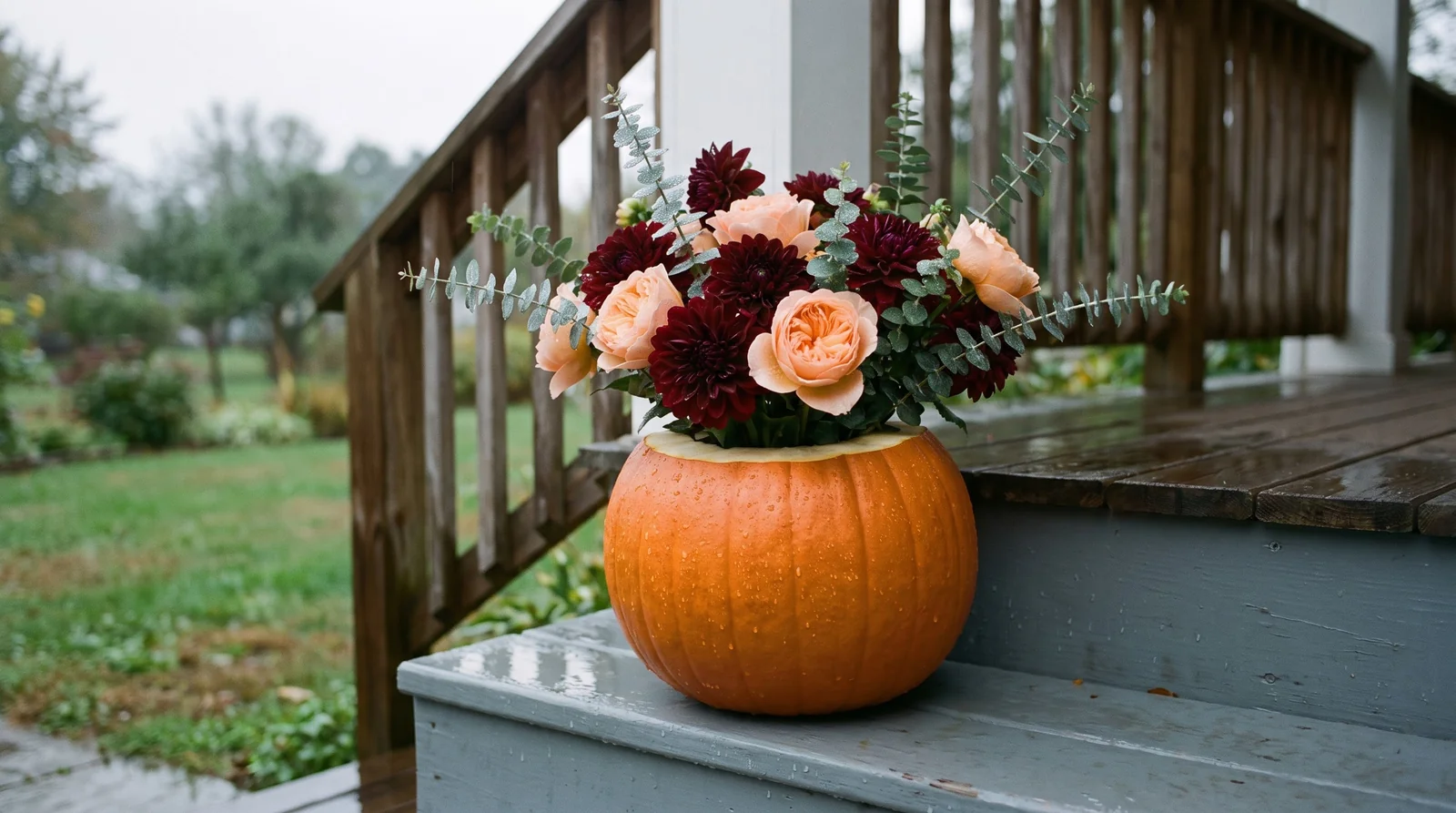
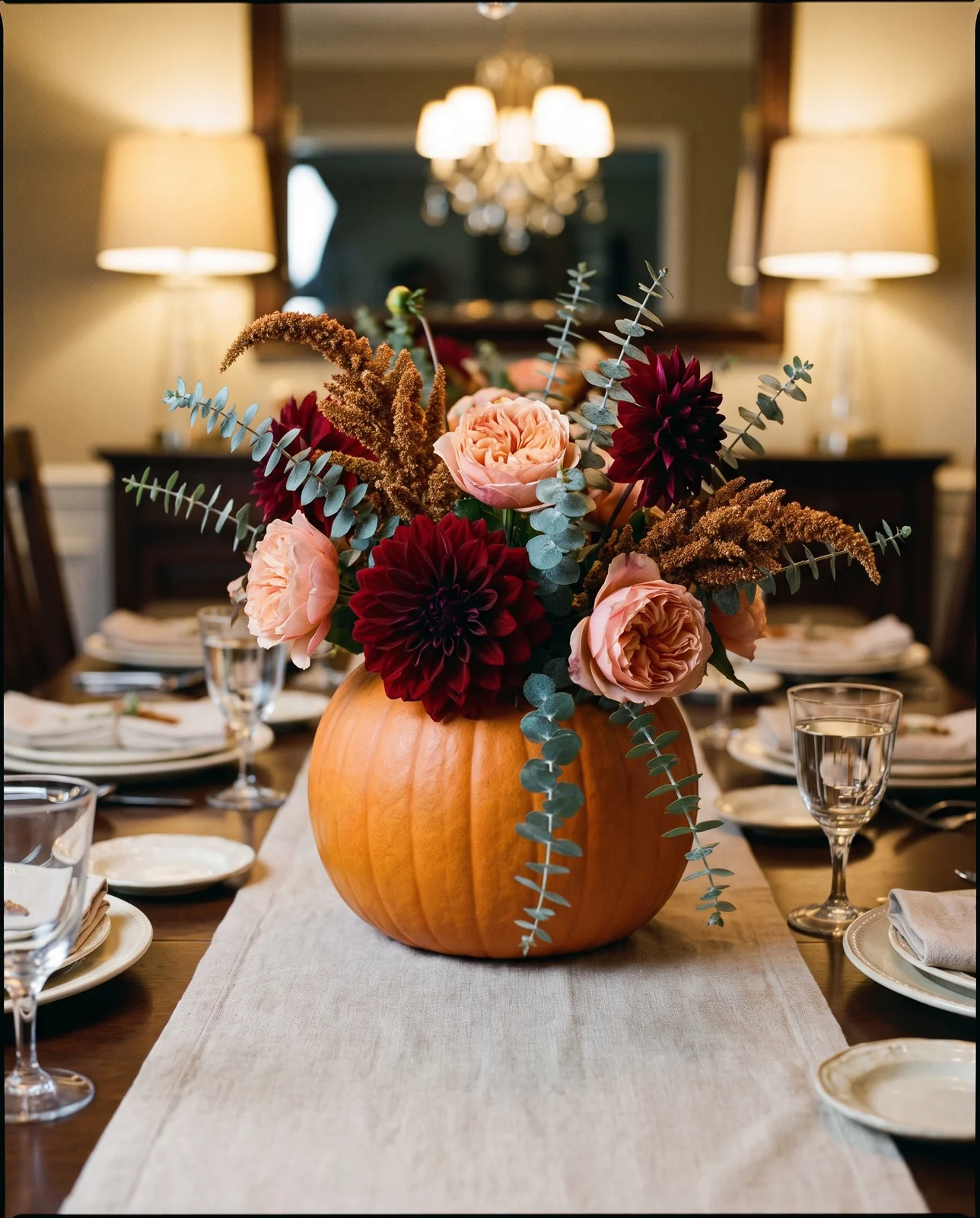
Three tiers of pumpkin flower arrangements, from budget to splurge
Vessel size, stem count and sourcing scale together across the three tiers, from a grocery bunch tucked into a sugar pie pumpkin to a specialty grower’s stems in a large heirloom shell.
How long it lasts, and how to make it last longer
How long the whole thing holds comes down to temperature, sanitation, and where the water sits. A pumpkin carved and filled directly with water usually gives 3 to 5 days before bacterial breakdown collapses the rind, and a dry glass container set inside that same untreated shell stretches the window to 5 to 7. Craft tutorials routinely promise two or three weeks outdoors in cool weather, but those numbers are anecdotal and make no allowance for a frost that ruptures the tissue or a heating vent that dries it out. What is actually tested is the treatment: South Dakota State University Extension has the 10 percent bleach solution killing the surface organisms that drive decay, and petroleum jelly on the cut edges holding internal moisture in. A shell prepared that way, with a separate glass liner doing the water duty, keeps its structure for a reliable 10 to 14 days under favorable indoor conditions.
Temperature decides more than anything else you do to it. South Dakota State University Extension puts the range that slows pathogen growth on a carved pumpkin at 50 to 60 degrees Fahrenheit. A warm room speeds the microbes up, while a night below 32 degrees outside damages the tissue outright, and the collapse shows up the moment the shell thaws. Keep the arrangement off a sunny sill, away from heating vents, and out of the draft by an exterior door.
The rot has names worth knowing, because the two kinds look different. Fuzzy surface patches are molds, and South Dakota State University Extension identifies Cladosporium, Penicillium, Aspergillus, Fusarium, and Alternaria as the ones behind them. The wet, slumping failure is bacterial soft rot from organisms such as Pectobacterium and Xanthomonas, which secrete enzymes that break down the fruit’s fibrous tissue from the inside. The flowers run on a separate schedule: North Carolina State University Extension puts the natural vase life of properly conditioned and cared-for cut flowers at 10 to 14 days, which is why washing the inner container and changing the water every 2 to 3 days, with a fresh drop of bleach each time, does more for how the arrangement looks on day eight than anything done to the pumpkin. That routine is what keeps bacterial slime from clogging the stems’ vascular channels.
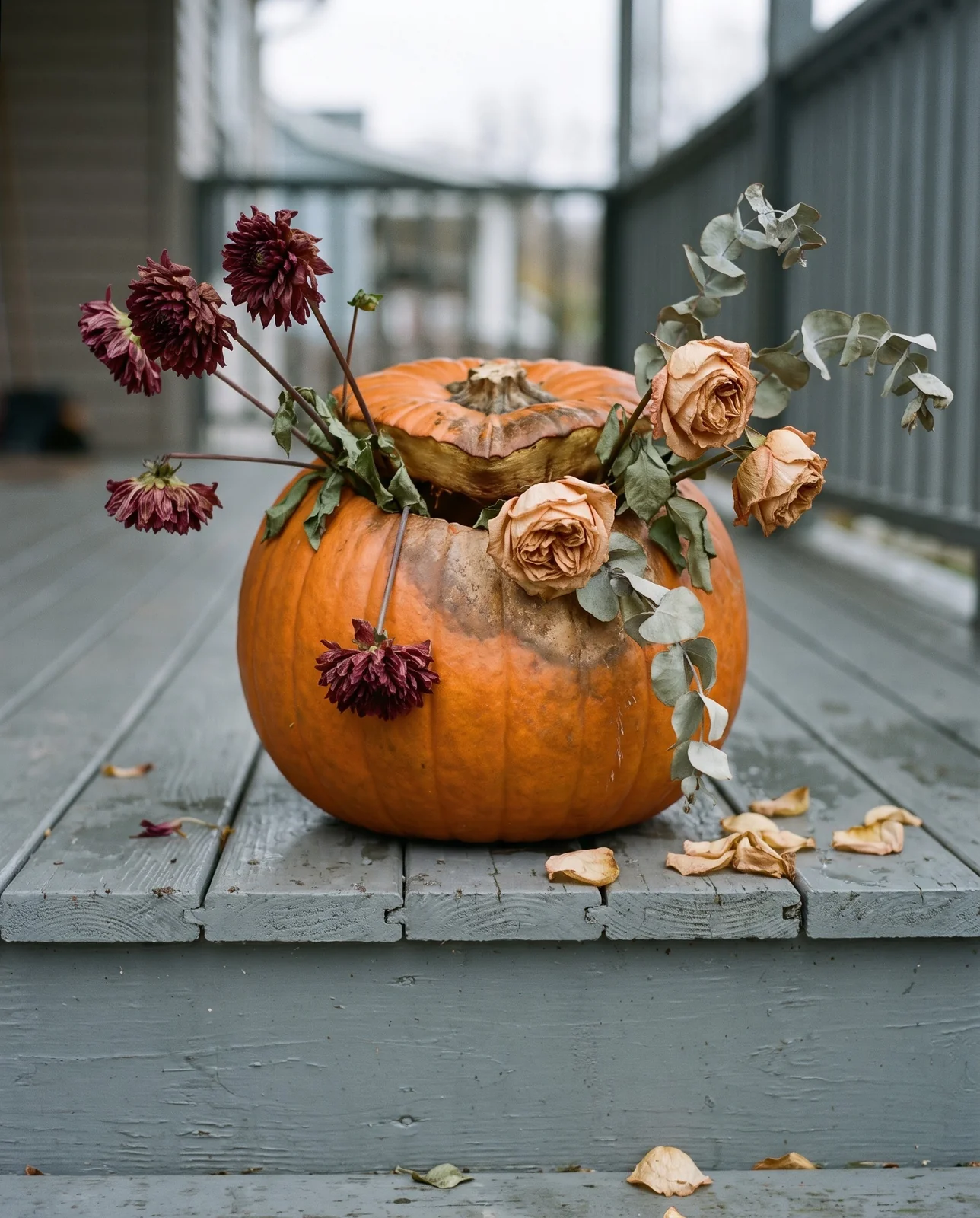
How long each pumpkin arrangement method lasts
Duration is set by what separates the water from the pumpkin flesh and by storage temperature, not by the flowers alone.
Will it leak, and other troubleshooting
The table is what most people end up damaging. A raw pumpkin shell gives off water vapor through its skin the entire time it sits there, and that condensation leaves rings on finished wood and damp patches on a linen cloth. Pour water straight into the cavity and it gets worse, because a natural fissure or a thinning spot in the wall will weep liquid onto the surface below without ever looking like a leak. Stand the finished arrangement on a shallow ceramic dish, a glass tray, or a decorative metal charger and the question stops mattering.
A foul smell or soft brown patches along the bottom mean bacterial soft rot is already through the cellulose wall. Lift the inner container out, throw the shell away, and drop the jar of flowers into a clean ceramic bowl or a backup vessel; the arrangement itself is usually still good. The reverse case, stems drooping while the shell is still firm, is a flower problem: bacteria have clogged the vascular bundles. Pull the stems, rinse them under cool running water, cut another half inch off each base at a 45 degree angle, wash the jar with soap, and refill with fresh water.
Is it safe around pets
Two separate questions live here: the pumpkin, and what goes into it. The ASPCA lists pumpkins, gourds, sunflowers, wheat, hay, and corn as non-toxic to dogs and cats, so a dog gnawing the rim of an untreated shell or a cat batting at sunflower petals is not a poisoning. Volume is the risk instead: a large quantity of tough rind, stringy pulp, or big seeds can lodge in the intestinal tract as a physical blockage that takes a vet to clear.
The filler flowers are where the real hazard sits. Chrysanthemums, sold everywhere in fall as mums, are mild to moderately toxic to dogs and cats according to the ASPCA, and a pet that eats some can end up vomiting, drooling, with diarrhea and unsteady on its feet. Autumn crocus (Colchicum autumnale) belongs nowhere near a centerpiece at all, since the ASPCA flags it as extremely toxic, with multi-organ failure or death possible. There is one more reason to throw a failing arrangement out rather than let it sit: the ASPCA notes that toxic molds grow on decomposing fruit, seeds, and grain, and the mycotoxins they produce can cause significant neurological side effects in a pet that swallows them. Keep the display up out of reach and clear it away as soon as it turns.
FAQ
How do you keep flowers fresh in a pumpkin?
Fit a glass jar or plastic container inside the hollowed shell so the water never touches pumpkin flesh. Recut the stems at a 45 degree angle, stand them in lukewarm water for 1 to 2 hours before arranging, and dose the jar with 1 teaspoon of bleach per gallon to hold bacteria down. Wash the jar and change the water every 2 to 3 days.
Do you need floral foam for a pumpkin vase?
No. A glass jar or plastic cup inside the hollowed shell holds the water and supports the stems on its own. Skipping the foam also keeps a shedding block of microplastic, and the aquatic toxicity that comes with it, out of the project.
How long will a pumpkin flower arrangement last?
An untreated shell goes soft in 3 to 7 days, depending on whether the water sits against the flesh or inside a jar. A shell washed with a 10 percent bleach solution and sealed along the cut edges with petroleum jelly holds 10 to 14 days when it is kept between 50 and 60 degrees Fahrenheit.
Will a pumpkin flower vase leak onto my table?
It can. An unlined pumpkin sweats moisture through its base and weeps water through any soft spot, so both the condensation and the water end up on the wood. Put a glass jar inside the shell to hold the water, and stand the pumpkin on a waterproof tray or a ceramic plate.
Is a pumpkin flower arrangement safe around cats and dogs?
The ASPCA lists pumpkins, gourds and sunflowers as non-toxic to dogs and cats. Chrysanthemums are the problem: they turn up in most fall filler bunches, and a pet that eats them can vomit, drool, get diarrhea, and go wobbly on its feet.
When to build it before your event
Work backward from the meal. An untreated pumpkin holding water directly should go together 24 to 48 hours before guests arrive and no earlier, or it will be soft at the base and smelling faintly sour by the time it reaches the table.
A shell that got the bleach wash, the petroleum jelly seal, and a glass jar inside can be built 4 to 5 days out. For a holiday dinner the cleanest split is to carve and sanitize the shell early, hold it somewhere cool at 50 to 60 degrees Fahrenheit such as a garage or a refrigerator, and set freshly conditioned stems into the inner jar 24 hours before guests arrive, so the flowers are at their first day when everyone sits down.
Enjoying our flower guides? Add YourFlowersGuide as a preferred source on Google. It helps more readers find us.
Add to Preferred Sources