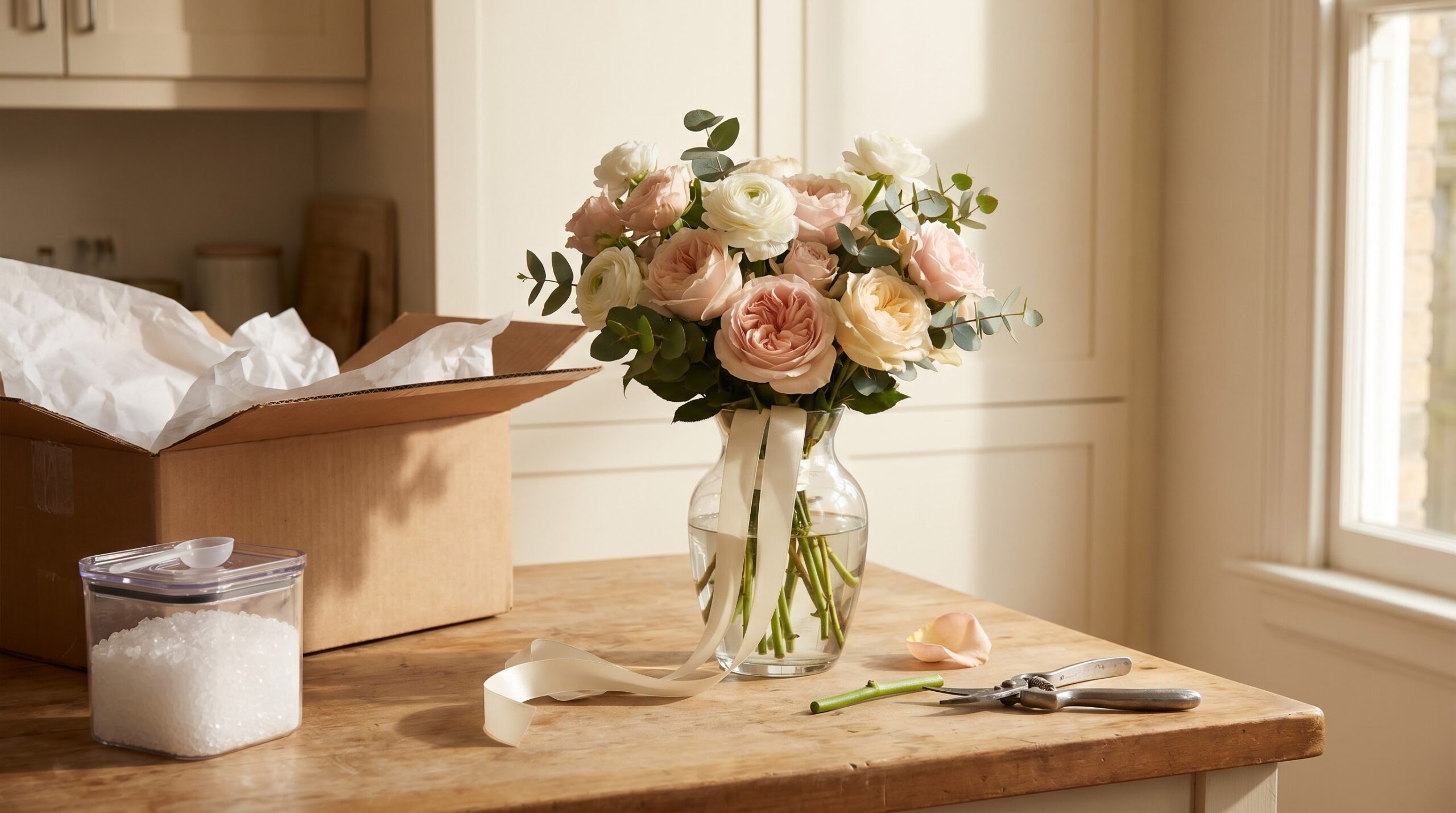
If your wedding was inside the last five days, your bouquet can almost certainly still be preserved. Before you read another word, give it one minute. Recut each stem at an angle, stand the bouquet in clean water, and move it to the coolest, darkest place you have. A fridge with the shelves pulled out is ideal. That minute slows the decline more than any method decision you'll make today. The studios warning that you should have booked months ago are half right: booking early is genuinely smart, and the freshest bouquets preserve best. The window, though, is wider than their sales pages suggest, and the studios themselves disagree about where it closes. One publishes a guide calling flowers past 48 hours too far gone for professional work. Another says about a week. A third accepts bouquets fourteen days out. All of them agree on the part that matters: day three gives a preservationist far more to work with than day nine. And even a bouquet that dried out on the counter weeks ago still has a route to your wall, through recreation rather than rescue. Below is the day-by-day map of what's still possible, every method with its real price, and how each one actually looks in five years.
Is it too late for your bouquet?
Poppy Flowers, a wedding floral company whose help center publishes an unusually precise timeline, maps the first two days hour by hour. Petals begin to soften within 12 hours out of water. Visible wilting arrives between hours 12 and 24, along with color loss on delicate blooms. By hour 48 some flowers are past the point of quality preservation, and beyond that the guide calls most flowers "too deteriorated for professional-quality results." Taken alone, that reads like a door slamming on every bride who spent Sunday driving home and Monday returning the suits.
Other studios draw the line later, and say so publicly. For Keeps Florals answers the too-late question with a condition test rather than a clock: unless the flowers are brown, wilting, moldy, broken, or lost, it probably isn't too late, with about one week as the practical limit for keeping colors healthy. The Olive Branch Studios goes further still. It accepts bouquets up to 14 days after the wedding, tells brides the night of the wedding is not too early to hand it over, and notes that a bouquet arriving on day three gives the studio far more to work with than one arriving on day nine.
So which studio do you trust? Each of them, about a different thing. The 48-hour warnings describe the window for the very best whole-bloom results, freeze-drying above all, which needs petals that still hold their structure. The one-week and two-week figures describe what a skilled studio can still turn into a beautiful piece, accepting that some blooms get swapped, pressed flat instead of mounted whole, or quietly worked around. Condition beats the calendar. A refrigerated bouquet on day five can be in better shape than one that spent day one in a hot car, which is exactly why the one-minute triage above matters more than the method debate. Here is what each stretch of time takes off the table, and what it leaves.
| Time since the wedding | What to expect | Still realistic | Slipping away |
|---|---|---|---|
| First 24 hours | Petals softening, little visible change | Everything: freeze-drying, silica, pressing, resin, professional or DIY | Nothing yet |
| Days 2-3 | Wilting shows on delicate blooms, colors dulling | Freeze-drying and silica still strong; pressing very forgiving | Ranunculus, sweet peas and anemones fade fastest |
| Days 4-5 | Petal edges browning, sturdy flowers still presentable | The stated ideal cutoff at several studios; silica and pressing for sturdy blooms | Top-quality freeze-drying; resin wants intact petals |
| Days 6-9 | Clear drying and color shift | Pressing; the studios that accept up to two weeks | Whole-bloom work on anything delicate |
| Days 10-14 | Mostly dried | The last acceptance windows; pressing whatever survived | Most professional whole-bloom preservation |
| Weeks to months | Fully air-dried | Recreation from preserved or new stems; pressing single petals as keepsakes | The original blooms as they stood |
Swipe →
What's in the bouquet moves these lines too. For Keeps Florals puts rough lifespans on common wedding flowers: roses last 5 to 7 days, lilies 7 to 10, carnations up to 14, and orchids can go 2 to 3 weeks. Poppy's guide sorts them by sturdiness instead. Roses, lavender, statice and baby's breath hold their shape deep into the window, while sweet peas, ranunculus and anemones lose structure early, and for peonies and other soft-petaled flowers it recommends freeze-drying specifically. A bouquet built on roses buys you slack. A June bouquet heavy with peonies is the one to move on today.
Which method should you pick?
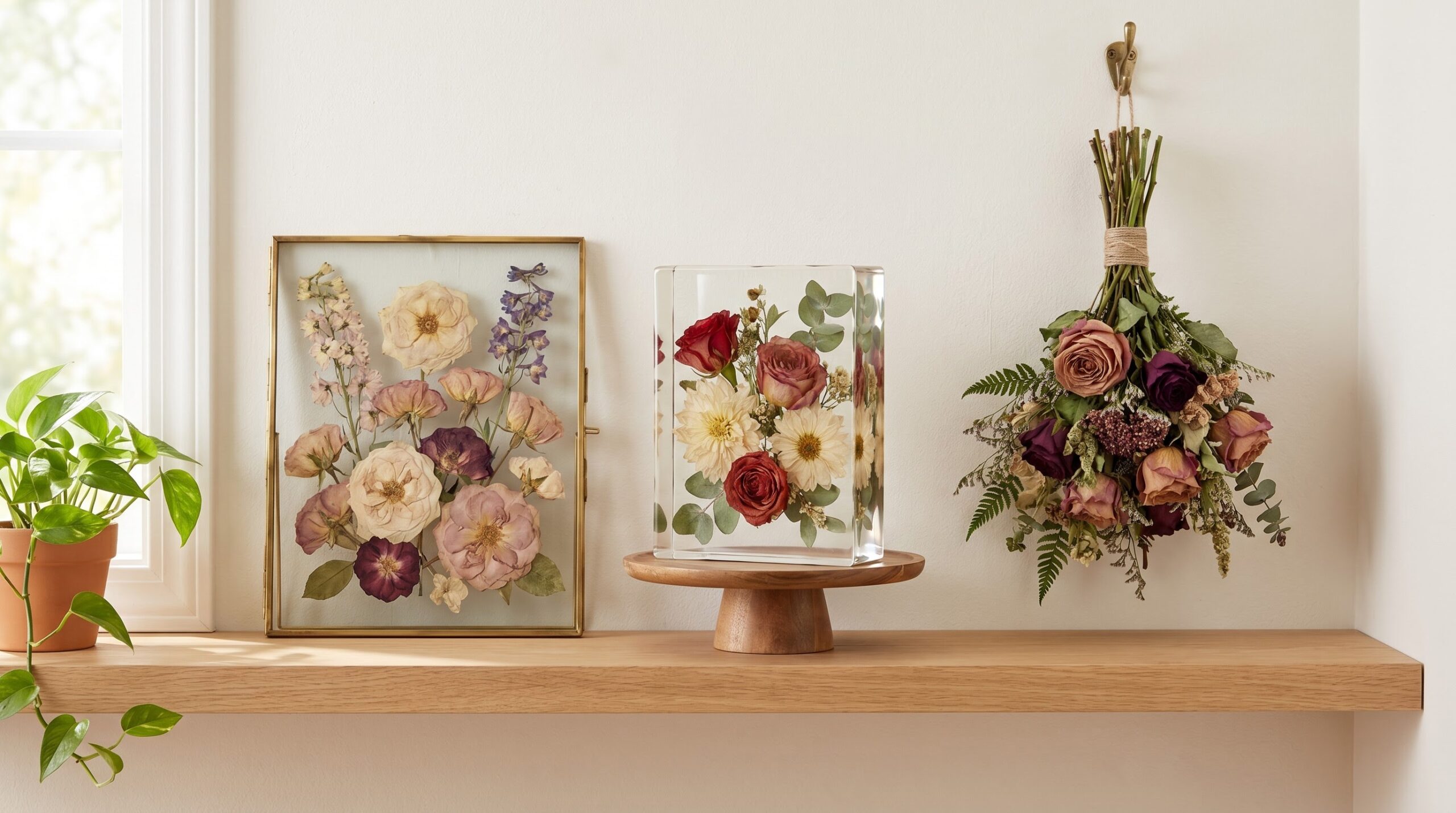
Brides who research this describe the same wall: dozens of companies, formats from bookmarks to coffee tables, and no way to compare any of it. "So many options, so little brain space," as one bride put it mid-search. Strip away the branding and there are six routes. They differ on five things: price, wait, how the piece ages, which flowers they suit, and whether you can do it yourself.
| Method | Typical cost | Wait | How it holds up | Best for | The catch |
|---|---|---|---|---|---|
| Air-drying | Free to $20 | 2-4 weeks | Muted colors, brittle stems, gathers dust | Roses, lavender, hydrangeas; rustic taste | Happens by accident, and dried blooms are the hardest material to work with later |
| Pressing, framed | $150 to $400 | 4-8 weeks | Colors soften gently; the longest-lived look | Nearly any bouquet, as flat botanical art | You give up the bouquet's three-dimensional shape |
| Silica gel, DIY | $30 to $80 | 1-2 weeks | True shape kept; fades if displayed in sun | Roses, zinnias, sturdy full blooms | Blooms come out paper-fragile and need a case |
| Resin | $200 to $600, large blocks to $750 | 4-12 weeks | Sealed from dust and touch; strong sun can slowly amber it | Dried blooms set in blocks, trays, jewelry | The worst first resin project imaginable is your one irreplaceable bouquet |
| Freeze-drying | $250 to $700+ | 4-12 weeks total | Closest to the day-of look; fragile, displayed in a case | Peonies, ranunculus, delicate flowers | Demands the freshest flowers, so the clock rules everything |
| Studio recreation | Custom quote | Varies | A new preserved piece, built to match | Bouquets that are dried out, lost, or long gone | It is a portrait of your bouquet rather than the bouquet itself |
Swipe →
The numbers deserve a note, because almost nobody prints them. Most magazine articles about preservation skip cost entirely, and most studios quote only after a form. Poppy's guide is one of the few that publishes ranges, and where studios do post prices they land inside them: The Olive Branch Studios lists pressed-flower frames from $400 to $675 depending on size, and Blossom & Rhyme sells a 10x10 resin block at $750. Size drives cost more than method. One bride pricing epoxy blocks put the sticker shock in a single line: "I'm looking at having it done, but the size I'd want (20x20cm) starts at €230!" Budget from the piece you actually want on the wall rather than from a method's minimum. And build the wait into your expectations. Blossom & Rhyme quotes 8 to 12 weeks for its process, and resin and freeze-dried pieces commonly take up to three months. The bouquet will miss your first months of marriage. It will be back on the wall long before the anniversary.
What to set up before the wedding
The version of this page every bride wishes she had read earlier is three moves long.
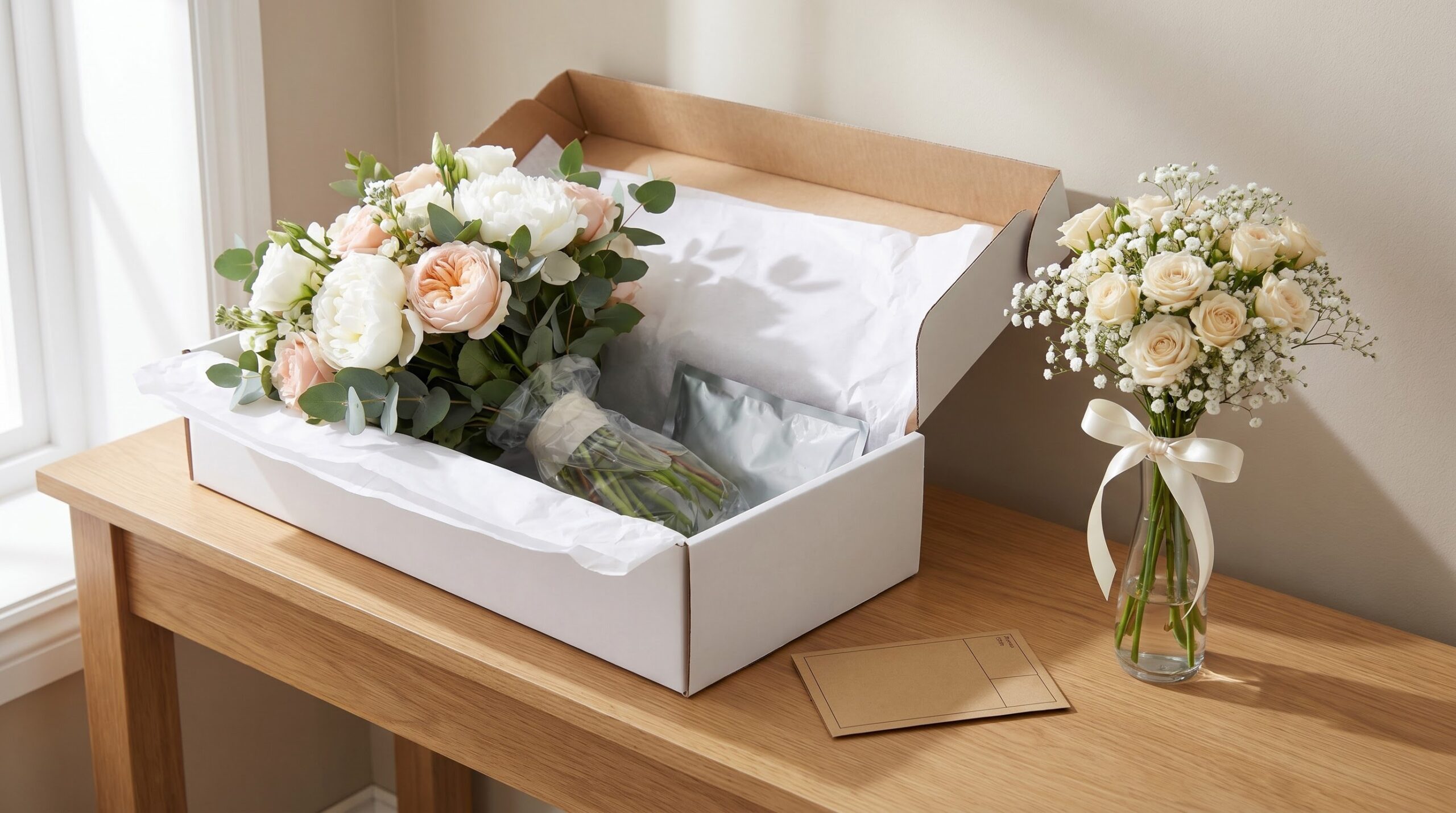
Book the studio before the wedding. Preservationists take limited bouquets per week, and demand runs high in season. Blossom & Rhyme tells couples plainly that the earlier they book the better, and Poppy suggests starting the search 2 to 3 months out. A bride who learned this the hard way wrote the warning that now circulates through every planning forum: "book early because most vendors on Etsy book several months out," and they "want the bouquet mailed within 48 hours of the wedding." She signed off as "a bride who didn't look it up and now has an air dried bouquet that's difficult to work with." The 48-hour mail window is real. For Keeps asks for shipment within 2 days of the event, and Blossom & Rhyme recommends overnight delivery.
Put one person in charge of the bouquet's exit, by name, before the reception starts. Bouquets get left on head tables, packed into random cars, and forgotten in venue fridges. Blossom & Rhyme's own advice includes designating a family member or bridesmaid to handle the packing and shipping, keeping the bouquet in water whenever it isn't being photographed, and keeping it away from heat and direct sun. Everything about protecting it during the day itself, water tubes, dress drips and the handoff between photos, lives in our guide to keeping the bouquet perfect through the wedding day itself.
Order a toss duplicate. If the bouquet's future is a frame, it cannot also fly over your shoulder at eleven at night. Florists handle this constantly: a smaller, cheaper toss version, often added for very little on top of the main order, so ask for it in the same breath as the bouquet. If you're doing your own stems, the same logic applies, and our guide to storing fresh flowers in the days before the wedding covers keeping everything alive until Saturday. And if all of this tips you toward silk bouquets that never need preserving at all, one bride made exactly that case for hers: "I'm glad that I won't have to figure out how to preserve it."
Can you really do it yourself?
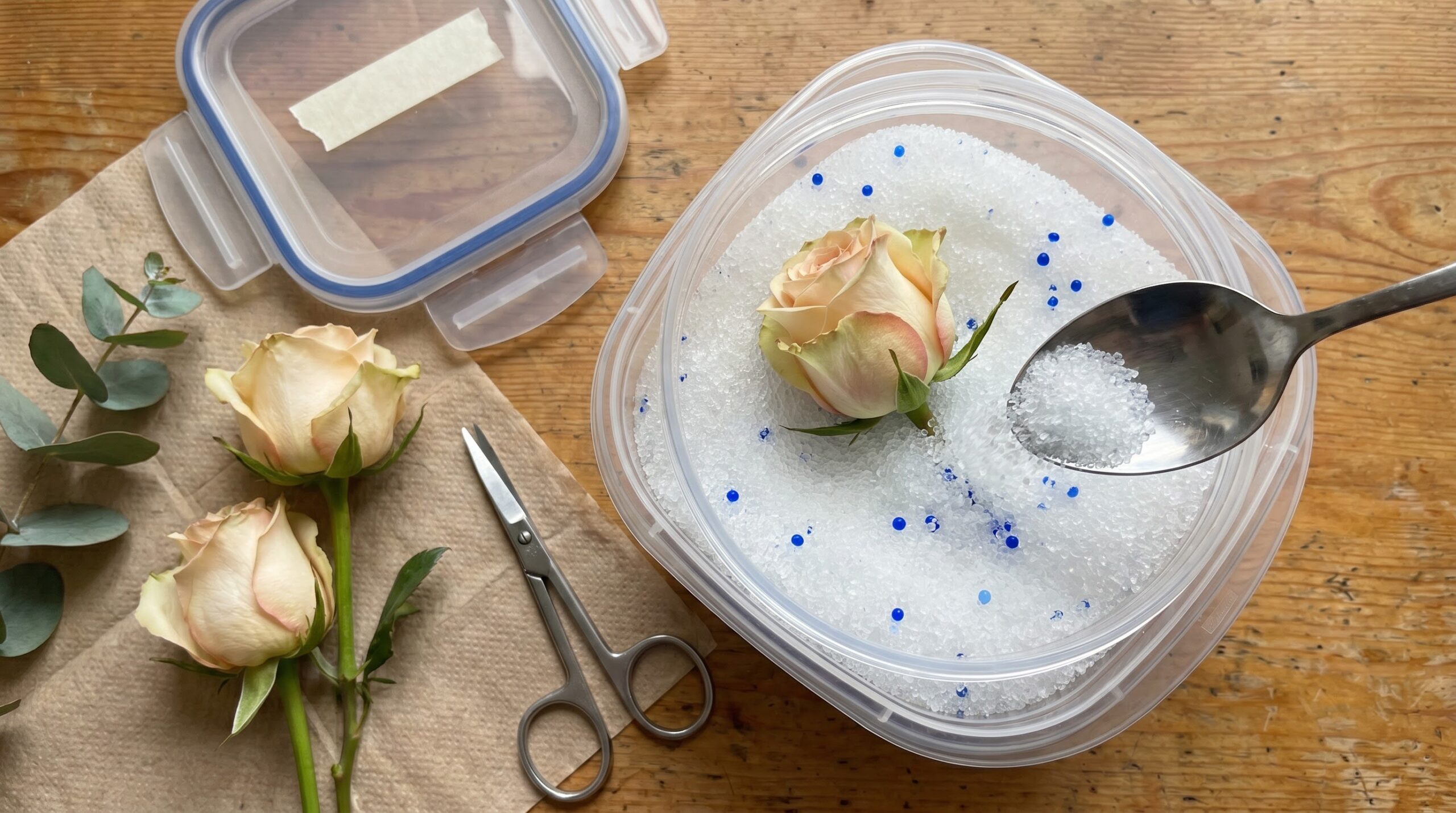
Sometimes, honestly, yes. The forums hold both endings. Silica gel has the best DIY record by far. A bride who ran a full test on practice flowers before committing her real bouquet reported that "the silica gel to preserve the flowers worked wonderfully." The process rewards patience more than skill. Cut each bloom with a short stem, bury it gently in silica crystals inside an airtight container, and wait one to two weeks. The flowers come out with their shape intact and their petals as fragile as old paper, ready for a shadow box or a glass dome, and the crystals cost tens of dollars instead of hundreds.
Resin is the opposite story, told by the same bride. After her test run she "decided to scrap the whole thing" and concluded she "would not recommend for someone not already used to this craft." The failure points are unforgiving. Any moisture left inside a bloom turns it brown or moldy inside the block, bubbles rise as the pour cures, and every mistake is permanent. The hand technique is genuinely better learned by watching than reading; the most-watched resin walkthroughs on YouTube show the drying, layering and pouring in real time, and they are worth an evening before you decide. If resin is the look you love, either practice for months on grocery-store roses first or hand the real bouquet to a studio and pay the $200 to $600.
Pressing sits in the middle. A heavy book, absorbent paper, and a few weeks of waiting will flatten and dry sturdy blooms at home, and professional pressing exists for a reason at the framing stage. Air-drying, finally, is what happens when nobody decides: the bouquet upside down in a closet. It genuinely works for a handful of flowers. Hydrangeas practically dry themselves, roses and lavender hold together, and most everything else turns faded and brittle. It is the method brides describe apologetically afterward, the "air dried bouquet that's difficult to work with" from the letter above. If that's where your bouquet already is, skip ahead to recreation.
How long will it actually last?
The comments under every preservation tutorial ask about what comes after. "Will the flowers change color over time?" Yes, all of them, under every method. Whites settle into cream and ivory, deep reds darken toward burgundy, greens go muted. Studios describe this shift as normal in their fine print, and the honest framing is that a preserved bouquet ages into an antique version of itself instead of staying wedding-day bright. Pressed and silica-dried pieces kept out of direct sun change slowest; anything displayed on a sunny wall changes fastest.
"How long do they last with silica gel?" Years, if they're kept sealed or cased and out of sunlight and humidity. The three enemies are the same for every method: sun, damp, and handling. "Won't they decompose in the jar?" Only if moisture went in with them. A fully dried bloom in a sealed container is stable for years, while any dampness trapped at sealing time shows up later as browning or mold. That is also the argument for cases and cloches over open display: dust on an air-dried bouquet cannot really be cleaned off, only moved around. Resin blocks never gather dust at all and only ask to be kept off the sunniest shelf. Freeze-dried blooms look the most alive on day one and are the most fragile afterward, which is why studios finish them behind glass.
What to do in the next hour
If the wedding already happened, today's list is short. Recut, water, cool and dark, now. Then message two or three preservation studios today with photos of the bouquet, your wedding date, and what's in it, and ask one question: given this condition, which method would you take on? Their answers will sort your case faster than any article can. If the quotes land high, or your hands itch to do it yourself, start silica or pressing tonight instead. The clock cares about action, not about which route you picked.
If the wedding is still ahead, make the three moves this week: book the studio, name the bouquet handler, order the toss duplicate.
And if your bouquet is already gone, dried stiff on a shelf or thrown to a cousin at the reception, recreation is a real door. Studios like The Olive Branch rebuild bouquets from your photos and memories, working from their own stock of preserved flowers or sourcing stems anew, and quote each piece individually. Some couples take the same idea further and use the rebuilt design for bringing your wedding flowers back for an anniversary, the same flowers, fresh again, years later. The bouquet on your counter gets one chance, so give it the water and the phone call today. The memory of it gets as many chances as you want.
Questions that come up next
What should you do with the rest of the wedding flowers?
Send centerpieces home with guests the same night; they rarely survive to a second use. Hold back a few favorite stems and press them alongside the bouquet, or dry petals for confetti, ornaments, or a keepsake jar. The same clock applies: anything you want to keep needs water and cool storage today.
Can a bouquet that has already air-dried still be preserved?
The whole-bloom methods are off the table, and studios warn that options narrow sharply once flowers have dried on their own. Intact dried petals can still be pressed or set in resin, with mixed results. For a piece that looks the way your bouquet did, recreation from photos is usually the better route.
Should the bouquet go in the fridge or the freezer?
The fridge, never the freezer; freezing wrecks petal structure and ruins the flowers for preservation. Stems in water, shelves out if you can manage it, and no fruit alongside, because ripening fruit releases ethylene that ages cut flowers. A genuinely cool, dark room is the runner-up if the fridge is full. One more caution if the bouquet has lilies in it and a cat in the house: true lilies are lethally toxic to cats, according to the ASPCA, with even pollen or vase water enough to cause kidney failure, so keep a lily-heavy bouquet somewhere the cat cannot reach while you sort out preservation.
How much does it cost to preserve a wedding bouquet in resin?
Professional resin work typically runs $200 to $600, with large statement blocks reaching $750 and beyond. Size moves the price more than anything else; one bride found 20x20cm blocks starting around €230. DIY kits cost far less but carry a real failure risk on a bouquet that cannot be replaced.