Home › African violets

African violets

Saintpaulia (Streptocarpus sect. Saintpaulia)

V Written by Editorial Team Edited by Vladimir· Updated September 2026

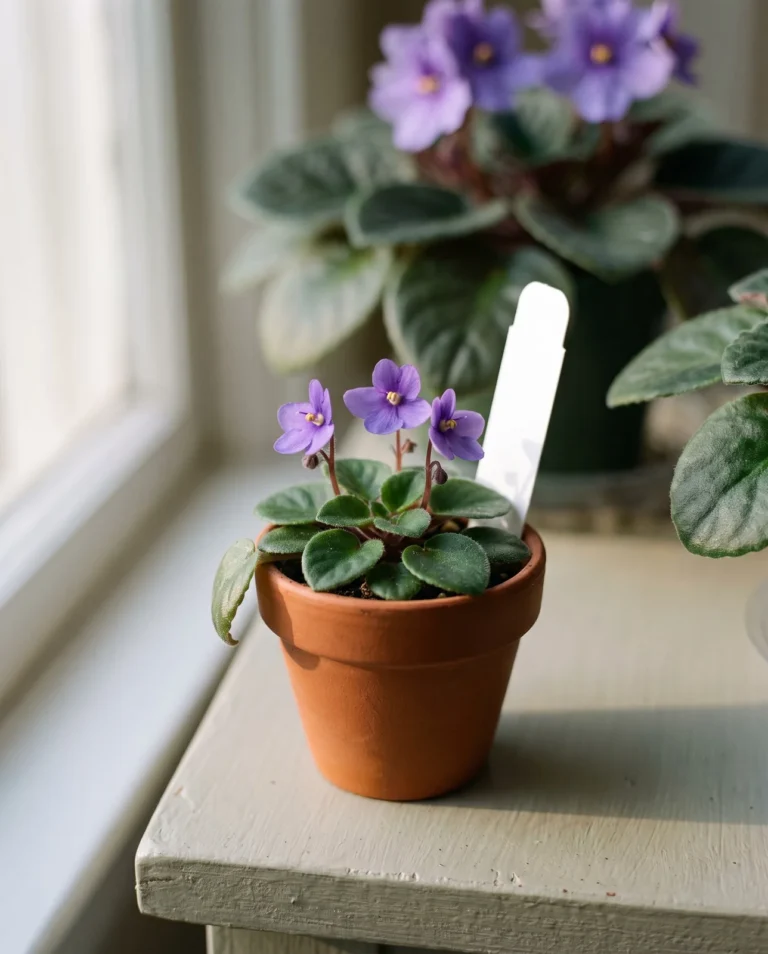
An African violet is a small houseplant that grows as a flat rosette of thick, velvety leaves with clusters of flowers held just above them, and in the right spot it flowers for most of the year. People keep them because one plant fits a kitchen windowsill, because they are safe to have around cats and dogs, and because a single leaf laid in damp mix grows into a whole new plant.

Here you will find why a drooping African violet is as likely to be drowning as thirsty and how to tell those apart before you reach for the watering can, how to water a plant that marks where the water touches it, how much light it really takes to set flowers, why the pot should stay small, what the mix should be made of, and what the leaves are saying when they curl, spot or stretch.

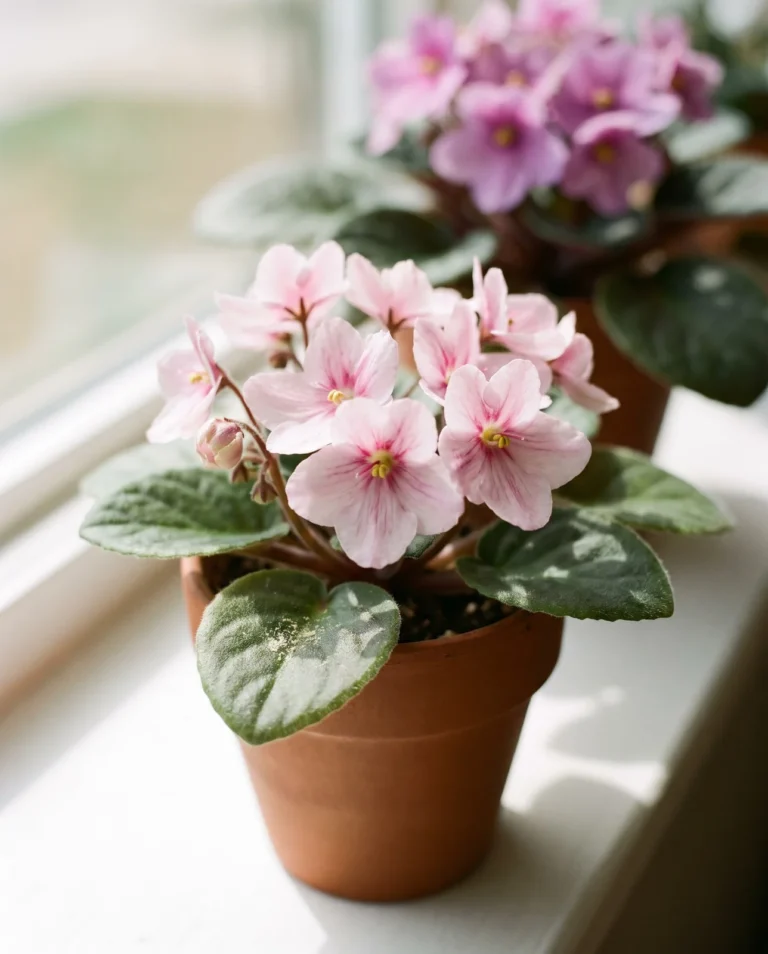
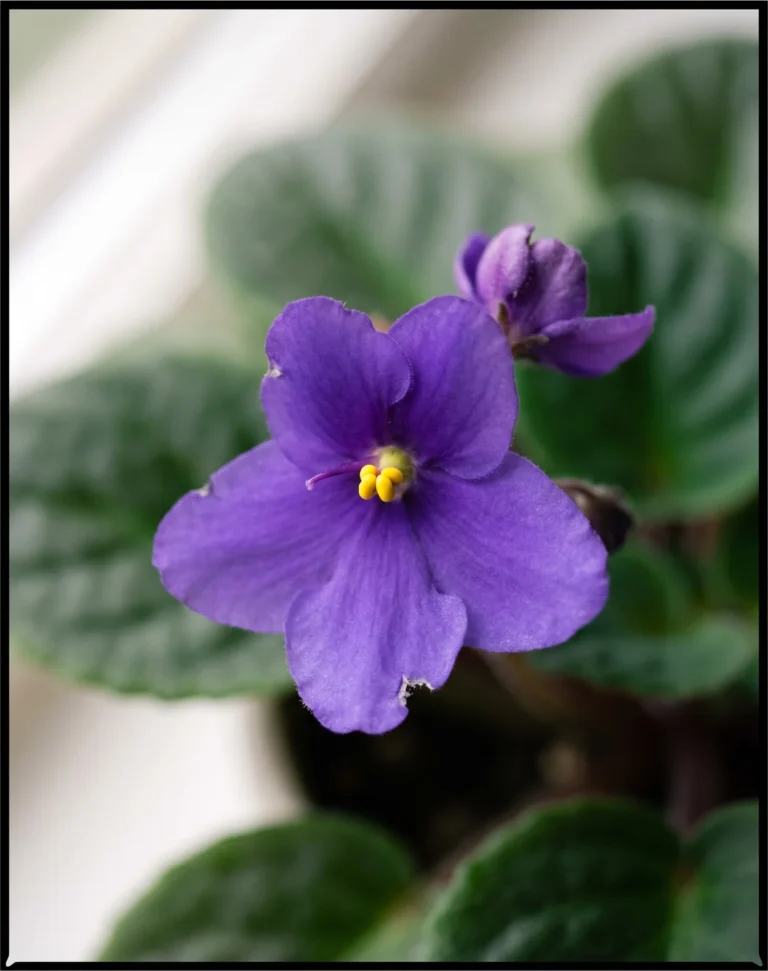
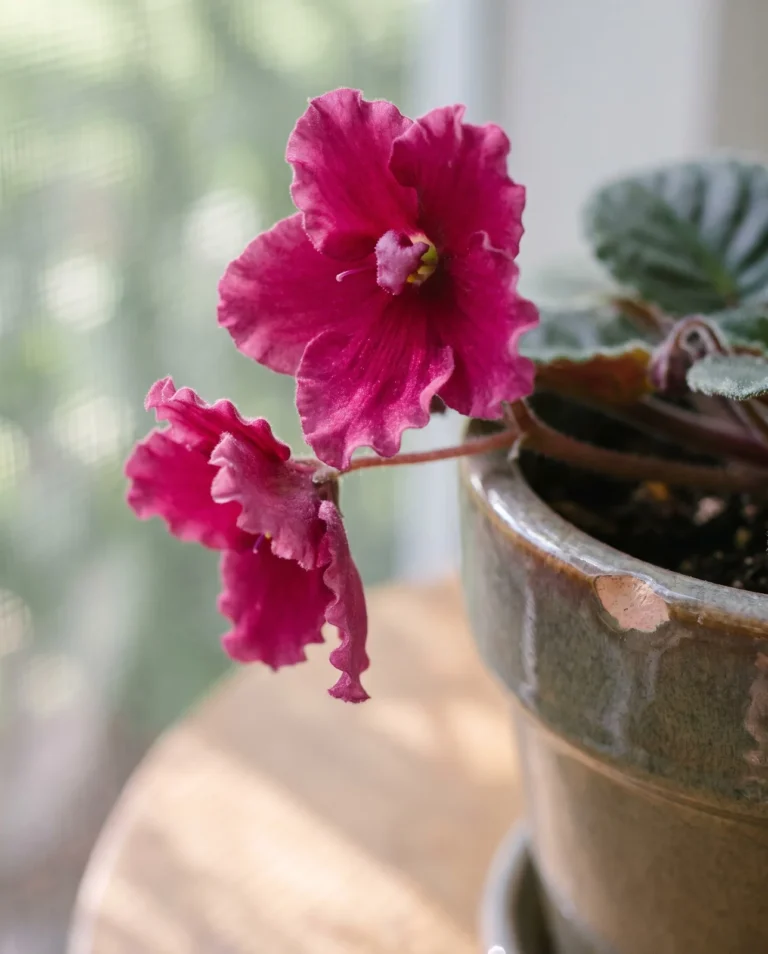
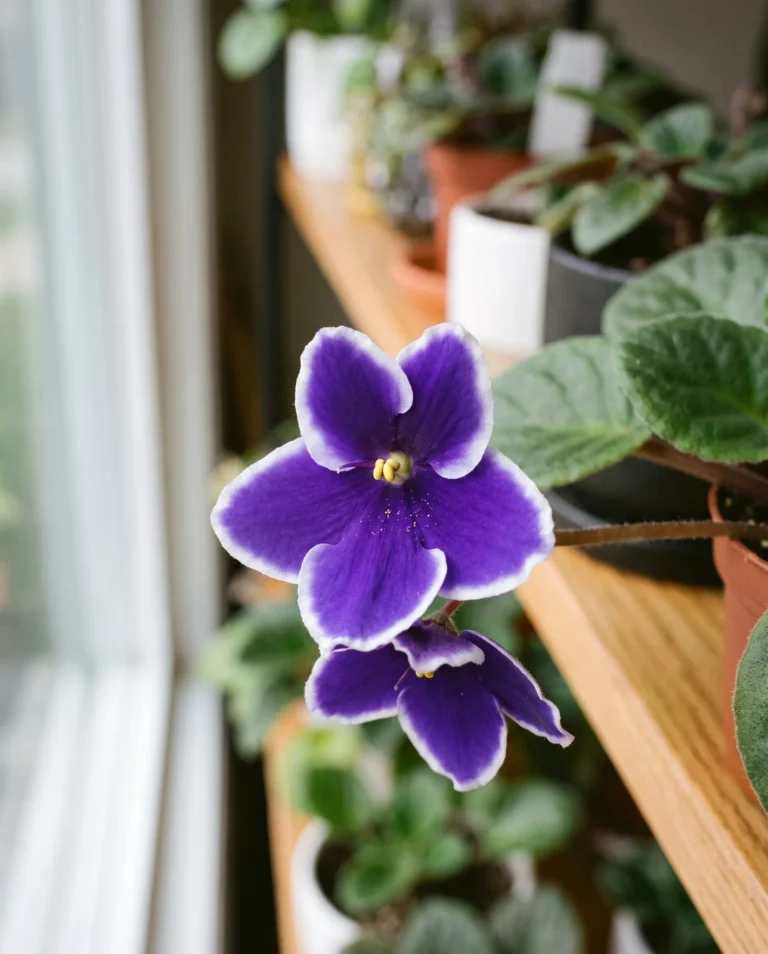
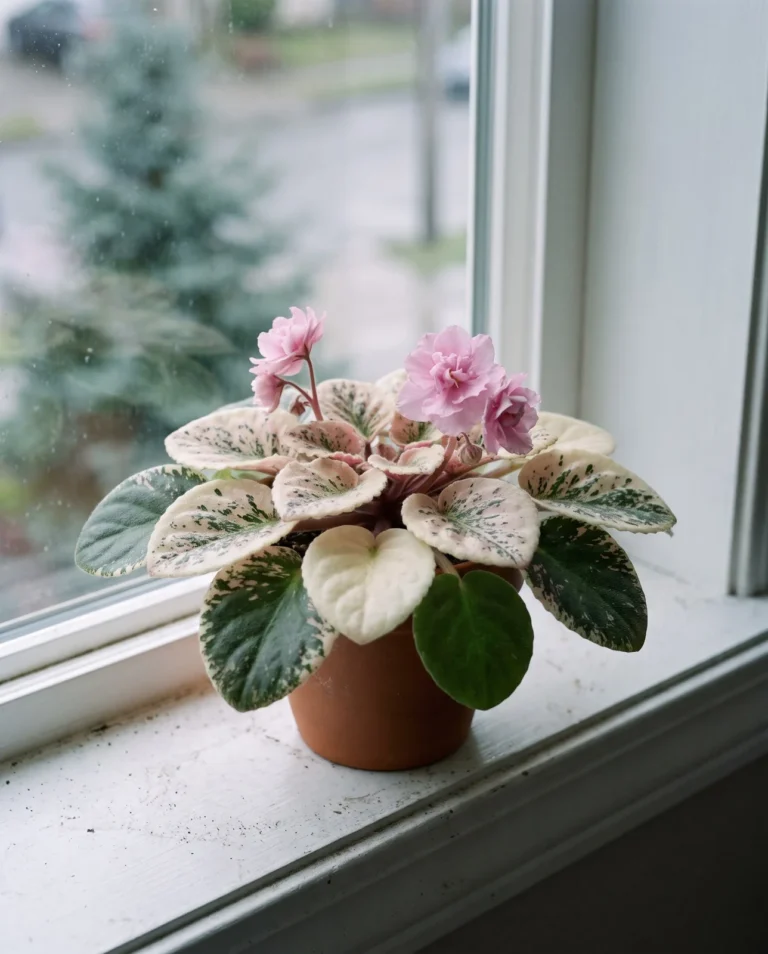
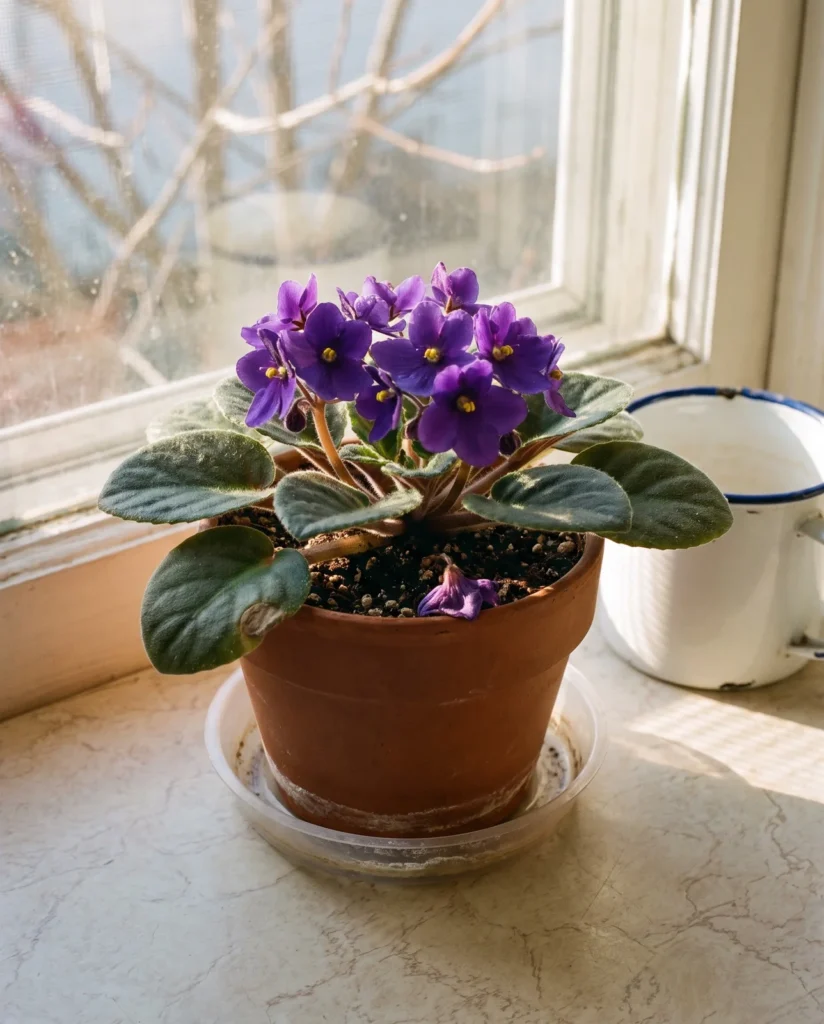
A mature African violet in full bloom as a flat symmetrical rosette on an Ohio kitchen windowsill in soft morning light
in bloom
now
through Dec
Bloom calendar

African violets

Saintpaulia (Streptocarpus sect. Saintpaulia)
A fuzzy-leaved windowsill plant that flowers most of the year in bright indirect light, and drowns about as easily as it dries out.
Blooms
Jan to Dec
USDA zones
11 to 12
Colorstap a color to see more flowers in it
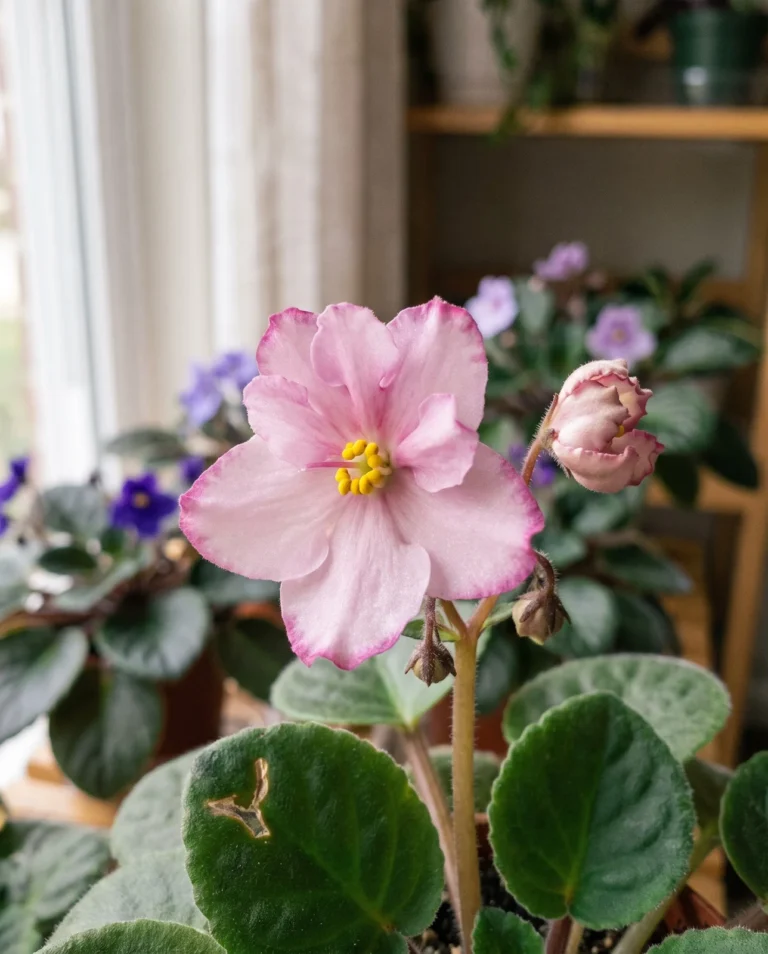
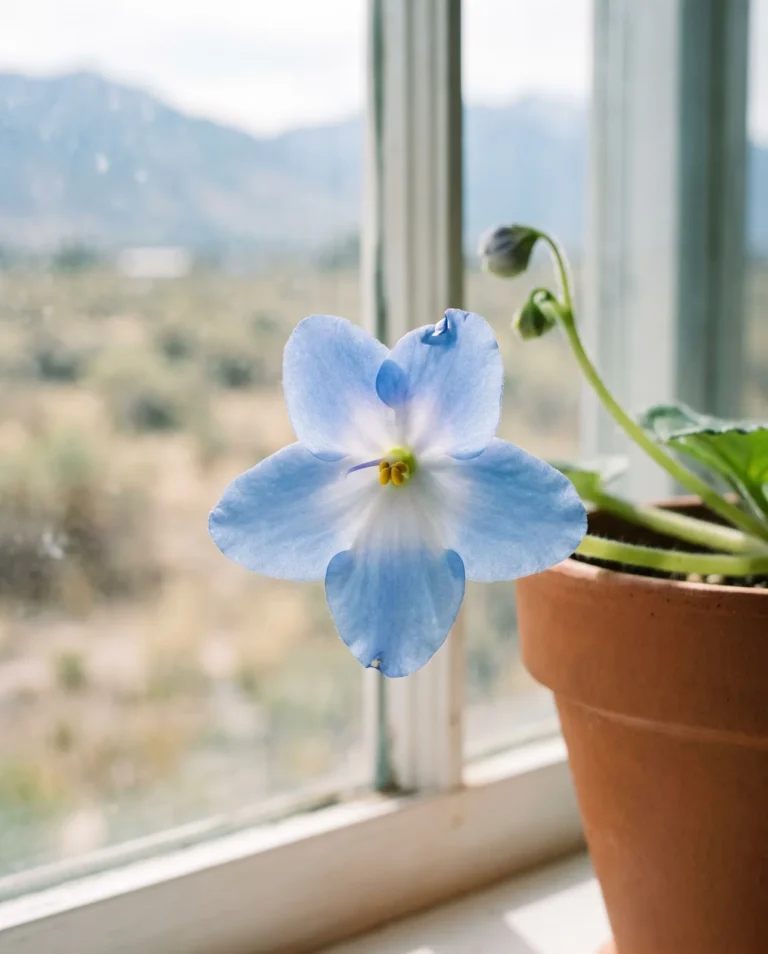
PurplePinkWhite
At a glance
Light1,000 fc for 8 to 12 hrs
WaterBottom water, room temp
SoilPeat, vermiculite, perlite
Height0.5 to 0.75 ft
Spread0.5 to 0.75 ft
Pot sizeA third of the leaf span
Temperature60 to 80 F, 70 ideal
Humidity30 to 60 percent
FeedQuarter strength, each water
ToxicityNon-toxic to cats, dogs, horses
Pet safety
๐ŸฑCatsSafe
๐ŸถDogsSafe
๐ŸดHorsesSafe
Listed non-toxic to dogs, cats and horses, with no toxic part named.
General guidance, not veterinary advice.
Data Iowa State Extension ยท Missouri Botanical Garden ยท Smithsonian Gardens ยท African Violet Society of America ยท ASPCA
* figures vary by variety and region.
yourflowersguide.com
On this page 21 sections
01

What an African violet is, and what it is not

An African violet is a gesneriad, a member of the family Gesneriaceae, which puts it beside gloxinia and streptocarpus and nowhere near the two plants its common name keeps pulling it toward. It is not a violet, and it is not a primrose: a major garden center's care page still puts African violets in the same family as primrose, and primroses are Primulaceae, a separate family altogether. The botanical name is unsettled in a way any search will show you. Saintpaulia was published as a genus in 1893, molecular work supported moving all of its species into Streptocarpus in 2012, and a study in 2015 confirmed that they sit deeply embedded inside that genus. The current placement is Streptocarpus section Saintpaulia, in subgenus Streptocarpella, and a treatment in 2006 had already cut the accepted species count to six, folding most of the former species into subspecies of Saintpaulia ionantha. Growers, sellers and the specialist societies still say Saintpaulia, so a plant tag and a herbarium sheet can disagree about the name and both be right.

The plant comes from Tanzania in East Africa, with the range given more precisely as eastern and southwestern Tanzania. Baron Walter von Saint Paul-Illaire, who lived from 1860 to 1910, collected the first one in 1892, and the genus carries his name. Where it grows wild explains more about its care than any list of preferences does: violets in nature sit in humidity between 30 and 60 percent at temperatures running from the low 60s into the 80s Fahrenheit, which is close to an ordinary heated house and nothing like a steam room. A mature plant stays under a foot in height and spread, and it is hardy outdoors only in zones 11 to 12, so across the United States it lives on a windowsill. What it gives back for that shelf space is a bloom period almost nothing else indoors matches, because given enough light a violet can flower for 10 to 12 months of the year.

02

Droopy leaves: the trap that kills most of them

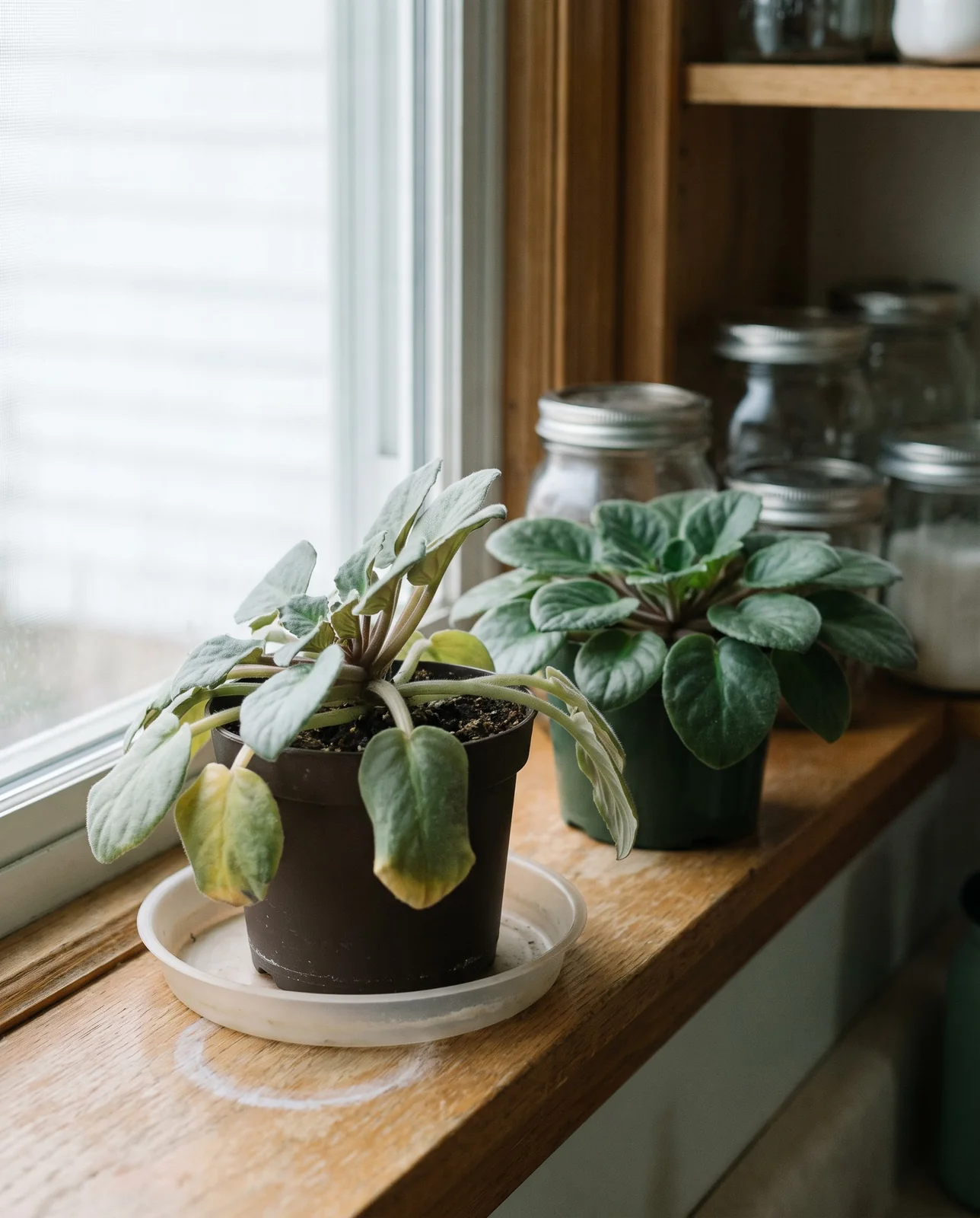
A drooping African violet is as likely to be drowning as thirsty, and watering it again is the mistake that can finish it off. Iowa State Extension puts the trap in the plainest words anyone has managed: because the first symptom of root and crown rot is droopy leaves, a natural reaction is to water the plant more because it seems to be wilted from lack of water, but watering can be a big mistake. The mechanism is not complicated. A root system kept constantly saturated loses the ability to absorb water and oxygen, so the roots and then the crown break down, and Pythium and Phytophthora take hold in mixes that stay wet, drain badly, or hold a crown planted too deep. This is not one service's observation. Virginia Tech states the same first sign from the other direction, that root disease caused by overwatering shows up first as a limp, unthrifty plant, with leaf symptoms sometimes waiting until severe root damage has already happened, and a Florida extension bulletin carries that sentence word for word. Overwatering is called the most common reason African violets die and the number one issue with the plant.

Telling drowning from thirst takes a check, because the leaves will not tell you. Growers report that African violets do not visibly wilt when the mix runs dry the way a peace lily does, so experienced growers stop reading the foliage and lift the pot or tip the plant out to look at the roots. Weight settles most cases, since a pot of dry mix is noticeably lighter than the same pot moist, and a finger pushed into the surface settles the rest. If the mix is wet and the plant is limp, that is the rot case, and the answer is the reverse of watering: get the plant out and stand it on paper towels straight away, because the center can pull through even when the outer leaves are lost. Rot leaves its own marks. The crown and roots turn soft and mushy, the older leaves droop first while the young leaves in the center stunt and blacken, the roots go brown, and a plant whose crown has decayed lifts loosely away from its pot. If the mix is dry, do not flood it: rewet gradually, a tablespoon at a time repeated hourly, because dry roots need time to plump up before they can take water again.

An African violet with limp, drooping leaves lifted from its saucer on a Wisconsin windowsill to check whether the mix is wet or dry
03

How to water an African violet

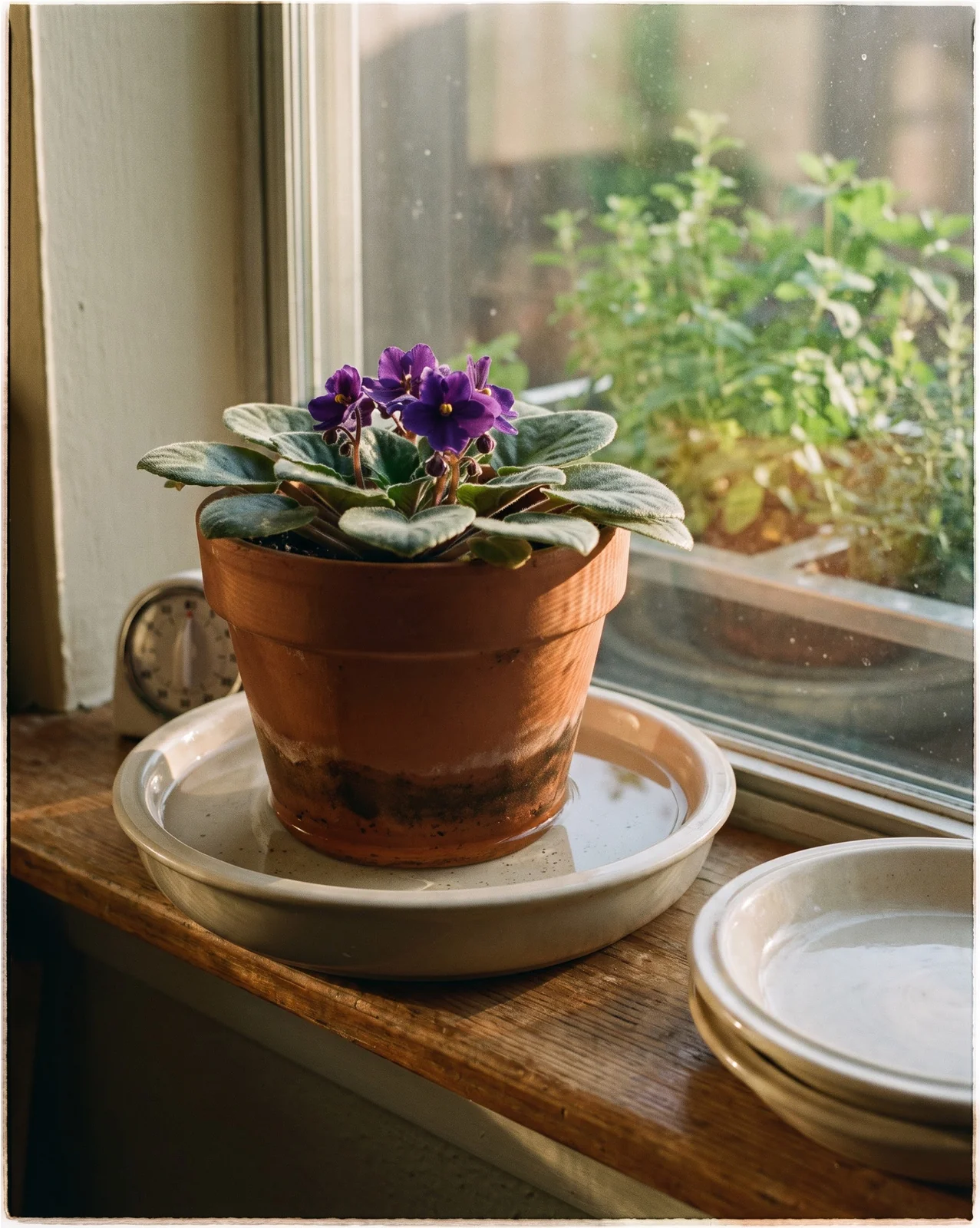
Water from the bottom, with water at room temperature, and take the pot back out once the surface is damp. The method is described the same way everywhere: stand the pot in a shallow bowl or saucer holding about an inch of room-temperature water and leave it until the surface of the mix feels moist, then lift it out as soon as the moisture reaches the top and pour the rest away. How long that takes is where the sources part company. One measured instruction caps the soak at 15 to 30 minutes and says never longer than 30, a second gives approximately 30 minutes before draining, a nursery says 15 to 20 minutes or until the surface feels damp, and the growers' own society says drawing water to the top of the pot can take a couple of hours. The surface of the mix is the better signal, and the saucer gets emptied whatever the number, because water left standing under the pot is the beginner mistake that starts the rot. Water when the mix feels dry to the touch, without letting it dry out completely, and let the plant go dry between waterings when it is not flowering.

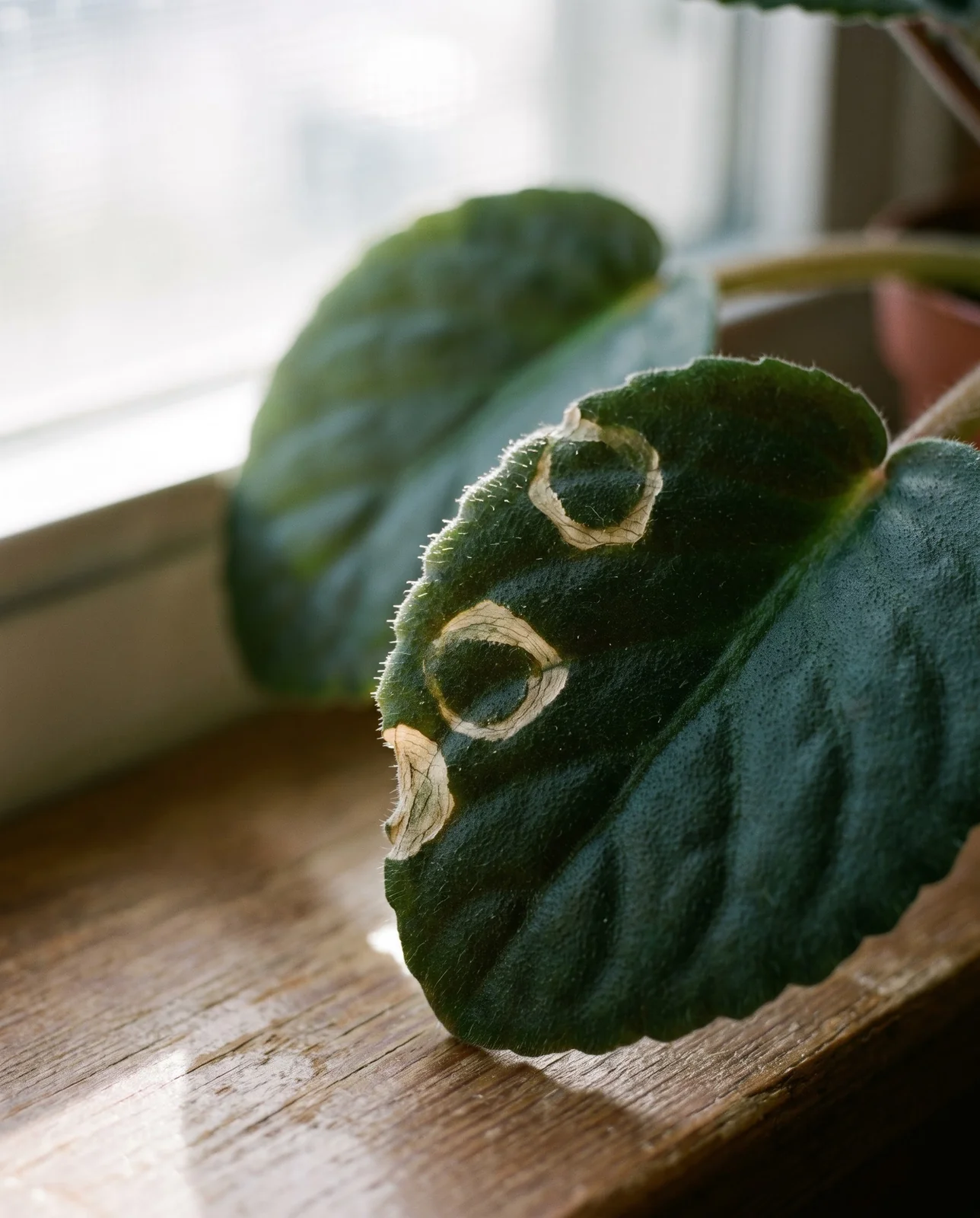
Keeping water off the leaves is the second half of the job, and the reason is narrower than the rule people repeat. Drops of water on the leaves cause disfiguring, light-colored spots or rings, and the mechanism named for that damage is a temperature difference: cold water touching a relatively warm leaf produces yellowish rings, spots or streaks on the upper surface, which is why the water should be at room temperature or slightly warmer. The two descriptions do not quite agree, since one set of sources treats any drop as a marker while the other pins the damage to cold water on a warm leaf, and the practical course covers both: bottom water, keep the leaves dry, and if water does land on them make sure it is not colder than the room. Water quality matters as well. Softened and chlorinated water are both ruled out, with room-temperature distilled water, rainwater or reverse-osmosis water named as the replacements, and the ideal water pH sits between 6.5 and 7.5. Wicking is the standing alternative to hand watering: a synthetic wick 6 to 8 inches long for a 4 inch pot, set in a mix that is at least half coarse perlite so the roots keep air around them even when the mix is wet.

An African violet pot standing in a shallow saucer of room-temperature water on an Austin, Texas kitchen windowsill, bottom watering in progress
04

How much light it actually needs

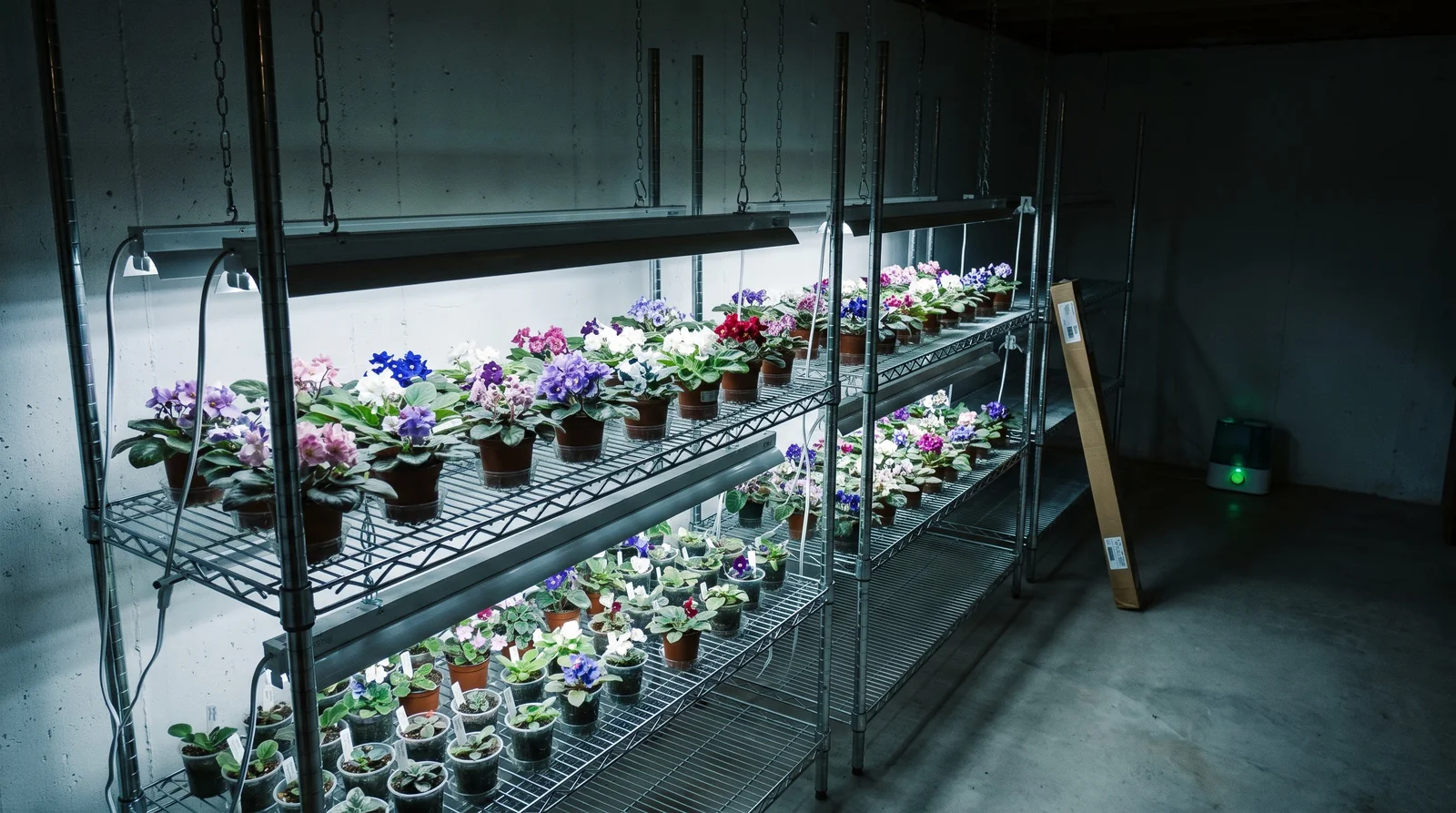
Bright indirect light at about 1,000 foot-candles is the measured target, and the plant wants it for 8 to 12 hours a day. The same intensity comes back independently from a second extension source, which turns the number into something you can find in a house: roughly the light within 3 feet of a southeast or west facing window, bright, with no direct sun falling on the leaves. The duration is where a widely shared figure goes wrong. A video benchmark of 1,000 foot-candles for four hours a day circulates online, while both extension sources that confirm the intensity give 8 to 12 hours at it, and one of them stretches the useful range to 16. Darkness belongs in the requirement too, and almost every care card leaves it out: 8 hours of dark a day sits alongside the 8 to 12 hours of light, with 8 to 10 hours of dark given elsewhere. A violet under a lamp that never switches off is not being helped. It will grow in low light and it will not flower there.

At the windowsill that means a plant kept close to the glass, within 12 inches of a bright window, or 10 to 30 inches from a fluorescent or LED fixture run 6 to 12 hours a day. The plant tells you which side of the line it is on, and this is the most useful thing to learn to read on a violet: one getting enough light grows as a flat horizontal wheel of leaves, while one that is short of light reaches upward, lifting its leaves on long petioles. Too much light can have its own tell, leaves turning pale or yellowish green, much lighter than normal. Under lamps the numbers shift, because a plant grown entirely under fluorescent tubes is worked at about 600 foot-candles for 12 to 16 hours a day, from tubes 12 to 15 inches above it. Published schedules for supplemental light run 10 to 12 hours with tubes 8 to 12 inches above the plants, 14 to 16 hours at that same height, and 12 to 14 hours under fluorescent or LED. Any of those schedules will do the work, and the flat wheel of leaves is what says the plant is getting enough.

A wide view of a hobbyist's basement grow-light rack in Colorado holding dozens of African violets on tiered shelves under rows of fluorescent tubes
05

Why a healthy plant stops blooming

Light is the first thing to check and it outweighs everything under it, because a violet grows perfectly well in a room too dim to flower in. A plant carrying leaves and no buds, standing well back from its window, has usually answered the question already. Its shape confirms it before you measure anything: leaves reaching upward on long petioles mean the light is short, and a flat horizontal wheel of leaves means it is enough. The second check is the one nobody makes, which is whether the plant gets a real night, since the flowering requirement covers a fixed span of darkness as well as a span of light. The third is the pot. A container larger than the plant needs holds water the roots cannot reach, and every sizing rule for this plant exists to prevent that; a correctly sized pot is described as one that should restrict growth when space is limited or stimulate flowering.

Below those, four things stall a violet that has the light. Crowns are the commonest: the plant is meant to run as a single rosette, and side crowns, called suckers, compete with it. Taken off while only four leaves are showing they are easy to control, so the habit is to check the plant often and remove them small, and the show rules make the same point from another angle, since only trailing types are allowed more than one crown. Feeding is next: an overfed plant gives itself away with a tight center and new leaves that take on a rusty look. Temperature and moving air come third: a cold night stunts the plant and the recovery afterward can be long, and air drier than the plant wants can make buds fail before they open, which a draft makes worse. Age is last. Plants mature over 2 to 5 years, and because new leaves only ever come from the top, an old violet builds up a bare stretch of stem below the rosette and becomes a candidate for restarting.

06

Work out why yours is not flowering

The blockers stack in a fixed order, and measured light beats everything under it. Work down and stop at the first check the plant fails.

Why this African violet is not blooming
Answer each in order and stop at the first one that fits
1
How much light is it getting, and how far is it from the glass?
The target is about 1,000 foot-candles for 8 to 12 hours a day, roughly the light within 3 feet of a southeast or west facing window with no direct sun on the leaves, or within 12 inches of any bright window. Leaves reaching upward on long petioles say the light is short; a flat horizontal wheel says it is enough.
2
Does it get a real night?
Flowering asks for 8 hours of darkness alongside the light, and 8 to 10 hours of it where the plant lives under lamps. A grow light left running around the clock blocks the thing it was bought to fix.
3
How wide is the pot against the leaf span?
The pot is sized at about a third of the leaf span, because the roots of a mature plant reach about that far, and a Wisconsin extension service sizes it at a half. Both are smaller than the pot a violet tends to arrive in, and anything wider holds water the roots never reach.
4
How many crowns are in the pot?
A violet should run as one rosette. Side crowns removed while only four leaves are showing are easy to control, and taking off secondary crowns is ordinary pruning, whether they are grown on as new plants or thrown away.
5
When did you last feed it, and how strong was it?
An overfed plant shows a tight center and new leaves with a rusty look, so the plant has to be read before anything is added.
6
How cold does the room get at night, and is there a draft?
Keep it between 60 and 80 degrees Fahrenheit. A night below 60 stunts the plant and the recovery is slow, and air drier than 40 to 60 percent humidity can make buds fail before they open, with a draft making it worse.
07

Why the pot should stay small

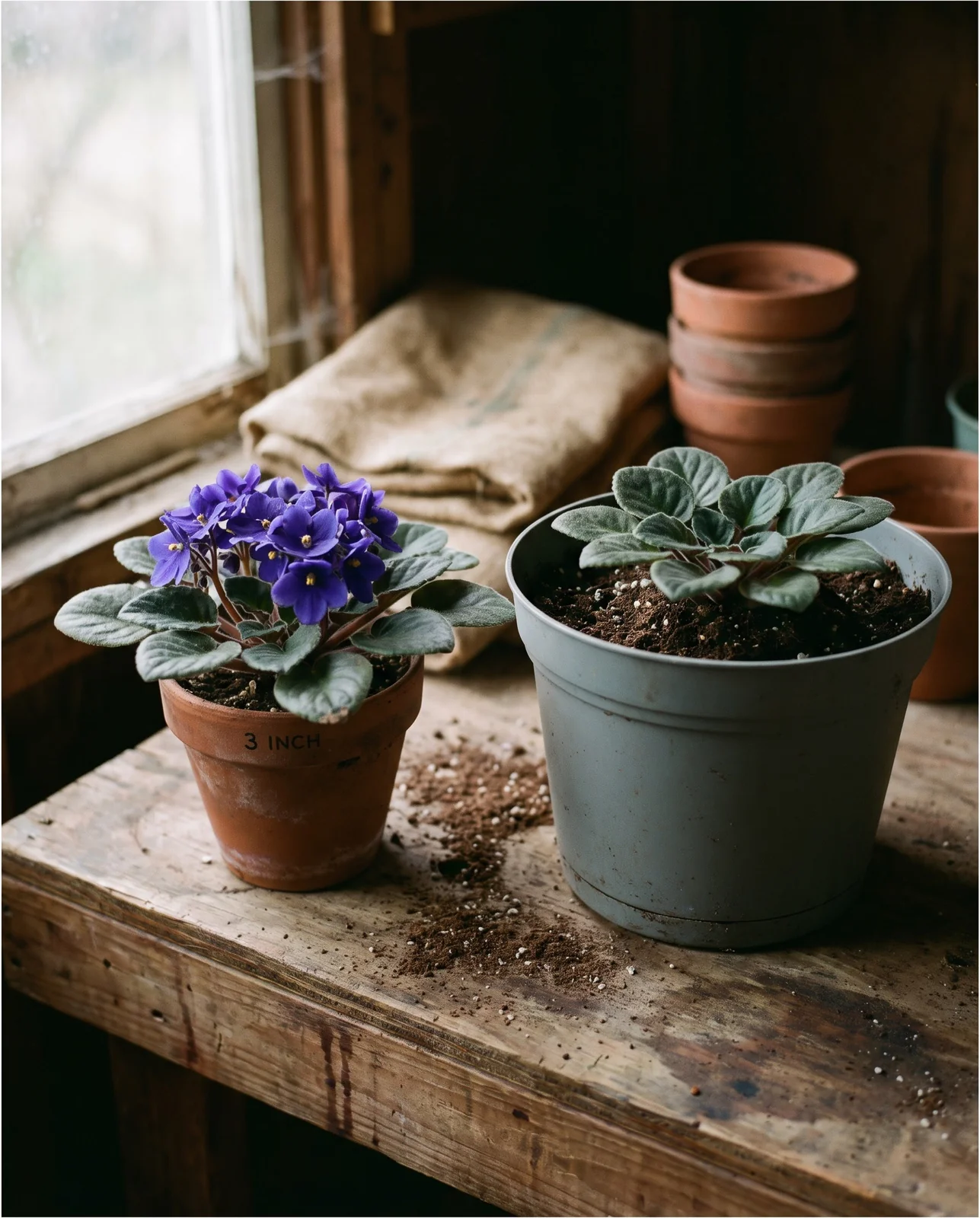
An African violet blooms best in a pot that looks too small for it, and the sources disagree about how small. The growers' own society sizes it at about one third of the leaf span, on the ground that the roots of a fully mature standard plant reach about a third of the way out under the leaves, and a museum garden care page and a specialist nursery give the same third, worked out as a 4 inch pot for a 12 inch leaf span and a 3 inch pot for a 9 inch plant. A Wisconsin extension service sizes it at approximately one half the width of the plant's spread, on the same reasoning of keeping the violet slightly pot-bound. Both numbers are smaller than the pot a plant tends to arrive in, and the gap between them matters when you are standing in a shop with the violet in one hand. Depth is less contested: shallow pots no deeper than four inches suit a plant whose roots are shallow. What people resist is the idea itself, since keeping a flowering houseplant deliberately crowded feels like neglect, and it is the same instruction they push back on with an orchid.

Repotting a violet means refreshing the mix while the pot stays the size it was. The advice is to repot roughly once a year to bring in new nutrients and clear salt buildup, and a nursery shortens that to every 6 to 12 months into fresh mix at the same pot size. Salt shows up on the plant itself: petioles touching the rim of a clay pot develop brown, sunken areas at the points of contact, which is salt accumulating there. Plant with the crown sitting above the soil surface, press the mix around it, and treat drainage as non-negotiable, because standing water can cause decay. The other repotting job arrives with age, when the bare stem below the rosette has grown into the long neck growers ask about. Two repairs are given for it: cut the plant off at soil level and re-root the old stem in the same medium used for leaf cuttings, or repot it deeper so the leafless stem sits below the soil line and grows new roots there.

A small African violet in a tight clay pot in full bloom beside the same size plant in an oversized nursery pot with no flowers, on an Oregon potting bench
08

What the potting mix should be made of

The mix is soilless, light and fast draining, built from peat or coir with vermiculite and perlite in it. Two published recipes are nearly identical: 3 parts sphagnum peat moss to 2 parts vermiculite to 1 part perlite, with some lime added to balance the acidity, and 2 or 3 parts peat to 2 parts vermiculite to 1 part perlite, with coir named as a more sustainable and near-neutral substitute for the peat. Violets have fine roots and want a well-drained soilless mix, which is why a bag of general potting soil does not do the job here. A wicking setup pushes the same idea further, calling for a mix at least half coarse perlite so there is air around the roots even when the mix is wet. Plant with the crown above the surface and the mix pressed around it, and treat good drainage as essential, since standing water causes decay.

Published pH targets sit in a narrow band and do not quite agree: about 6.2 to 6.5 for the mix, about 6.0 to 6.5 and slightly acid for best results, and an overall balance of 6.0 to 7.0 reached by adding dolomite lime to a general peat, perlite and vermiculite mix. Anything inside that band works. Lime turns up in the recipes because a peat-heavy mix runs acid on its own. Hygiene is the part most growers skip, and it belongs with the mix because the mix is where rot starts. Media being reused should be slightly moist, heated to 180 degrees Fahrenheit and held there for 30 minutes, and a pot that held a plant lost to rot should be scrubbed clean and then soaked for 30 minutes in a solution of 1 part household bleach to 9 parts water before it goes back into service. Violet pests and diseases move between plants kept together very easily, which makes that half hour cheap.

09

Feeding: two schedules that do not stack

Two feeding schedules circulate for this plant, and they are alternatives. The first is a heavily diluted feed given every time the plant is watered, and it carries three sources. The African Violet Society of America instructs feeding with every watering for a violet to thrive and bloom well, using a balanced houseplant fertilizer cut to one fourth of the strength printed for weekly use, and it works the arithmetic out in the open: where the directions call for a quarter teaspoon per gallon once a week, use an eighth of a teaspoon every time. A museum garden gives the same method at half or one quarter strength at every watering, and a Florida extension bulletin mixes fertilizer at one fourth the recommended rate and applies it each time the plant is watered. The second schedule comes from an almanac: a high-phosphorus plant food every two weeks through the active growing season, with no dilution given. Pick one of them. The every-watering method is safe only because the dose has been cut to a quarter or an eighth of what the bottle says, so taking the frequency from one schedule and the strength from the other puts a full label dose into the pot at every watering, which is neither method and is how a violet gets overfed.

What is in the bottle matters as much as the interval does. Violets are sensitive to fertilizer whose nitrogen comes from urea, and the society's guidance is to choose a product carrying at least two nitrogen formulations, such as ammoniacal and nitrate. Growers who feed on an interval split the schedule by whether the plant is in bloom: a violet-specific fertilizer once a month while it is flowering, a general indoor plant food at half the recommended strength every 3 to 6 weeks while it is not, and a European guide gives half a dose every 2 to 3 weeks through spring and summer, dropping to every 6 to 8 weeks in winter. Overfeeding announces itself on the plant before it shows anywhere else, in a center that pulls tight and new leaves that take on a rusty look. Fertilizer salts are part of why the mix gets renewed about once a year, a job that has nothing to do with moving the plant into a larger pot.

10

Temperature, humidity, and summering outdoors

Ordinary indoor room temperature suits an African violet, roughly 60 to 80 degrees Fahrenheit, with 70 given as the ideal point inside that range. The published ranges cluster tightly and differ at the edges: about 60 at night and up to 80 to 85 by day, best nights of 65 to 70 with 60 to 80 workable, 70 to 75 by day and 60 to 65 at night, and 70 to 80 with relative humidity above 30 percent. The number that matters most is the floor. A night that dips below 60 stunts the plant, and warmer days afterward do not undo it quickly, because the recovery is long. That is what makes a winter windowsill risky, since the air against cold glass at night runs well below the temperature of the room.

Humidity is where the sources genuinely split. Published targets run from about 80 percent, quoted alongside 65 to 80 degrees, through 40 to 60 percent, down to 30 to 60 percent for flower development, with violets said to tolerate air as dry as 10 percent although buds rarely survive to open in it. Nothing in the sources settles that spread, and the plant's own wild range sits at the lower end of it. There is a second reason not to chase the high figure. Cyclamen mites, the one pest that ruins a violet outright, develop fastest at 80 to 90 percent humidity and temperatures at or near 60 degrees Fahrenheit, which is close to what a grower creates by tenting a plant in a cool room. The symptom worth watching is buds that fail before they open, which happens when the air is drier than the plant wants and gets worse where there is a draft.

Summering the plant outside is disputed, and both positions are worth stating. American sources treat the violet as an indoor plant, rarely grown outdoors even in the tropics and kept as a pot plant in homes, greenhouses and offices because it does well under artificial light. A European growers' guide, working in Celsius, says violets can spend the summer outside as long as they have enough shade and come back in once the temperature drops below 16 degrees, and it puts the year-round range at 18 to 24 degrees, with growth and flower formation affected as low as 16. An Illinois extension source takes the same position, so the outdoor case is not only a European one. What tips it for most readers is that a bright indoor window already supplies what the plant asks for, so the trip outside stays optional.

11

Reading the leaves one symptom at a time

Distorted new growth is the one leaf symptom that is never a watering mistake. Leaves that come in cupped, curled, dwarfed and thickened, sometimes bronzed or discolored and stiff, on internodes so short that the center of the plant looks stunted or tufted, are the signature of mite feeding. No amount of light, water or fertilizer produces that combination. Mealybug damage is the other pest signal and it is easier to confirm, because the insect itself is visible: soft-bodied, about a quarter inch long, covered in a white waxy material that makes it look cottony, feeding on sap, leaving sticky honeydew behind and leaves that are stunted and distorted. The working difference between the two is where the trouble sits and whether you can see what caused it. Mite injury concentrates in the newest leaves at the crown while the animal stays invisible; mealybug injury turns up anywhere on the plant and arrives with cotton and stickiness you can find by looking.

Color read across the whole rosette is a light reading. Leaves that go pale or yellowish green, much lighter than normal, are getting more light than they want, and leaves that lift and reach upward on lengthening petioles are getting less. Both of those are judged from the shape and color of the entire plant, which is what separates them from damage that sits in one spot, and both are answered by moving the plant, which is the cheapest correction available for a violet.

Marks that sit in one spot have local causes. Light-colored spots and rings appear where drops of water sat on a leaf, and brown, sunken areas at the exact point where a petiole crosses the rim of a clay pot are salts collecting at that rim. Yellowing at the bottom of the rosette is usually the ordinary end of a leaf's life, and dead or yellowed leaves are taken off to keep the plant looking its best. None of those three is a whole-plant problem, and none of them is a reason to change how the plant is watered. The symptom that does send you back to the mix is the limp plant, which looks the same whichever direction it has gone in.

Macro of an African violet leaf marked with pale, light-colored ring spots where cold water once touched its velvet surface
12

What actually goes wrong, in the order it comes up

These are the complaints that fill African violet threads, ordered by how often each turns up across about fifty-five threads and post titles on Houzz, Dave's Garden, garden.org and houseplant groups, with Reddit not sampled. It is a count of thread titles and no substitute for a survey, so read the order as rough.

A plant that will not bloom

Thirteen threads, the largest single group in the sample. A violet grows perfectly well in light too dim to flower in, so a plant that looks healthy and sets nothing is the ordinary case behind these threads, and the light it stands in is the first thing to check on it.

Droopy, wilting or limp leaves

Eleven threads, and the pattern inside them is the dangerous one. Growers describe watering carefully, monthly or less, and losing the plant anyway; one of them dug the plant out and found the crown black and rotted. Careful watering does not protect a plant sitting in a mix that never dries out.

Leaves curling in the center

Nine threads, several of them about new leaves curling upward. The beginner mistake that recurs across the sample is a pot left standing in its saucer of water after bottom watering, and the shape of the newest leaves is what separates that from mite feeding, which leaves them cupped, curled, thickened and tufted on short internodes.

Cyclamen mite

Eight threads, several of them running for months of treatment before anything changes. The published position is blunter than the threads are, since an extension page calls the mites incurable outright.

A long bare neck

Seven threads, nearly all of them framed as an emergency. Growers describe it exactly as it looks, the stalk getting long and not compact, and the threads treat as a crisis what the growing sources treat as ordinary aging.

Mealybugs, including the ones in the soil

Six threads, and the soil-dwelling kind drives most of them, because it stays out of sight until a repot. Two root-dwelling species are positively identified from African violets, the root mealybug and the Pritchard mealybug. The visible kind is treated insect by insect with a cotton swab dipped in alcohol diluted with an equal amount of water.

Ring spots and pale marks on the leaves

Five threads. Water sitting on the foliage can spot a leaf permanently, so the marks do not clear on their own. It is the least serious item on this list, because the marks are cosmetic and the plant carrying them is not ill.

13

Growing a whole new plant from one leaf

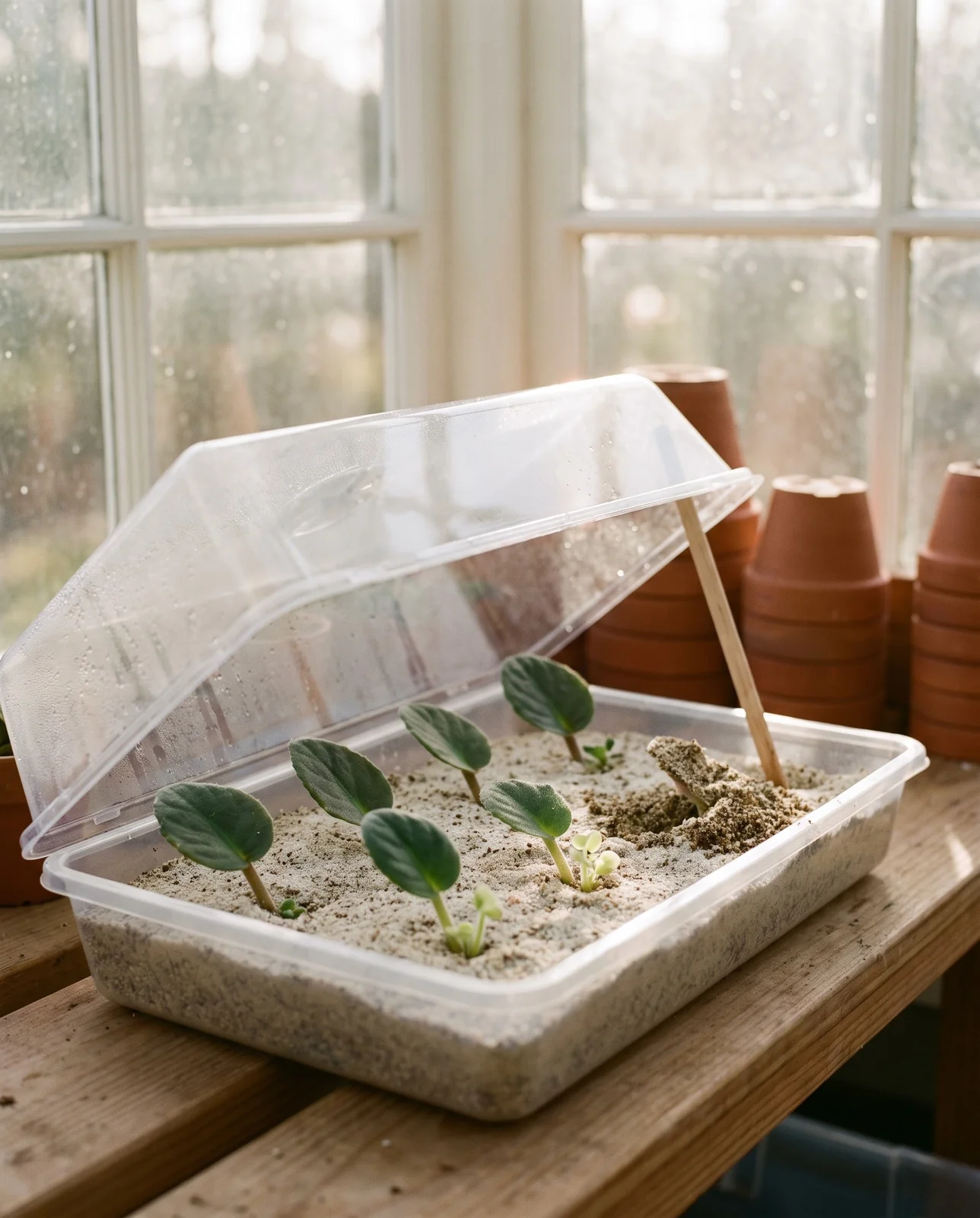
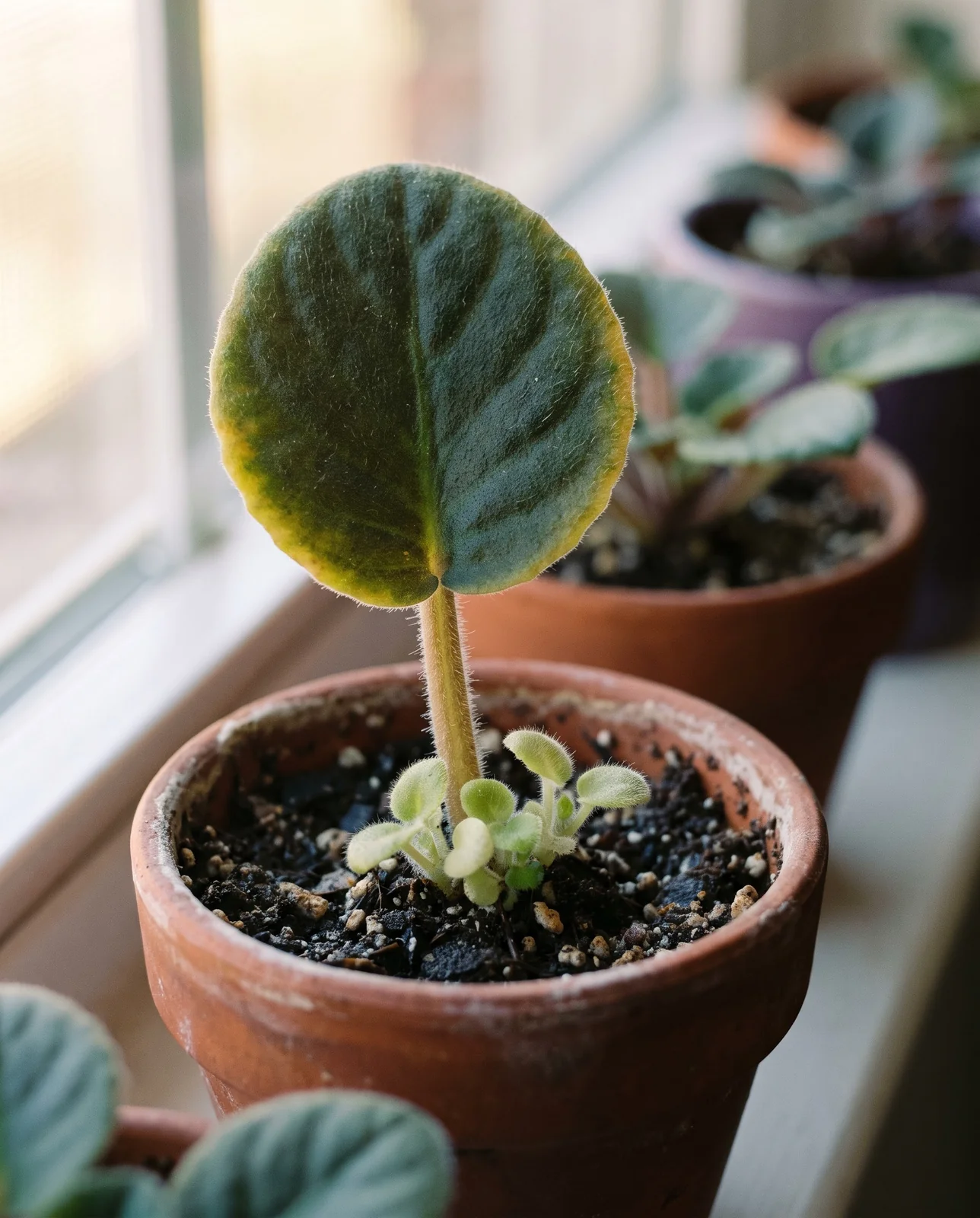
One leaf makes a whole new plant, and the method is settled. Take a healthy leaf from the parent with about an inch of leaf stalk attached, then bury the stalk and up to a quarter inch of the leaf blade itself in wet sand and vermiculite; a second published version trims the petiole to 1 to 1.5 inches and roots it in the same medium. After that the cutting runs on its own clock, and it is a slow one. Roots form at the base of the petiole in 3 to 4 weeks, and the leaves of the new plants push up 3 to 4 weeks after the roots appear. Plantlets show on the leaf within two to six months. Flowering plants take about 6 to 9 months from the day the cutting was started, which is the figure worth knowing before you cut anything, because it sets the real price of replacing a plant you already have.

Suckers are the second source of plants, and they come off the parent anyway. Pruning a violet includes taking away its secondary crowns, either to grow them on as new plants or to throw them out, and a secondary crown that has already matured is separated by dividing the plant. Timing decides how much of a job that is, since suckers taken while only four leaves are showing can be controlled easily, which is why growers look for them often and remove them small. The two techniques answer different problems. A leaf cutting replaces a plant; a sucker taken early protects the plant you have and hands you a spare at the same time.

African violet leaf cuttings rooting in a tray of damp vermiculite in a Kentucky sunroom, each leaf stalk buried at an angle under a clear humidity cover
Tiny African violet plantlets growing at the base of a parent leaf cutting on a Tennessee windowsill, several weeks into rooting
14

Size classes, flower forms and leaf types

Size class is the first thing a violet is sold by, and the four published size charts disagree about where each class ends, so the same plant can be labeled standard in one shop and large in the next. Measure across a single mature crown and read the label second. Flower form and leaf pattern are the next two choices, and the purple flowers the plant is best known for are only one of the colors it comes in.

A miniature African violet under six inches across in a two-inch pot on a Georgia collector's shelf, small enough to sit in the palm of a saucer
Miniature
Miniature
Up to 6 in across a single crown
One chart puts the class at 3 to 6 in
Folded into an under-8-in class elsewhere
A semi-miniature African violet spanning about seven inches across on an Indiana windowsill, midway in size between the miniature and standard classes
Semi-miniature
6 to 8 in across
Merged with the miniatures on two of the charts
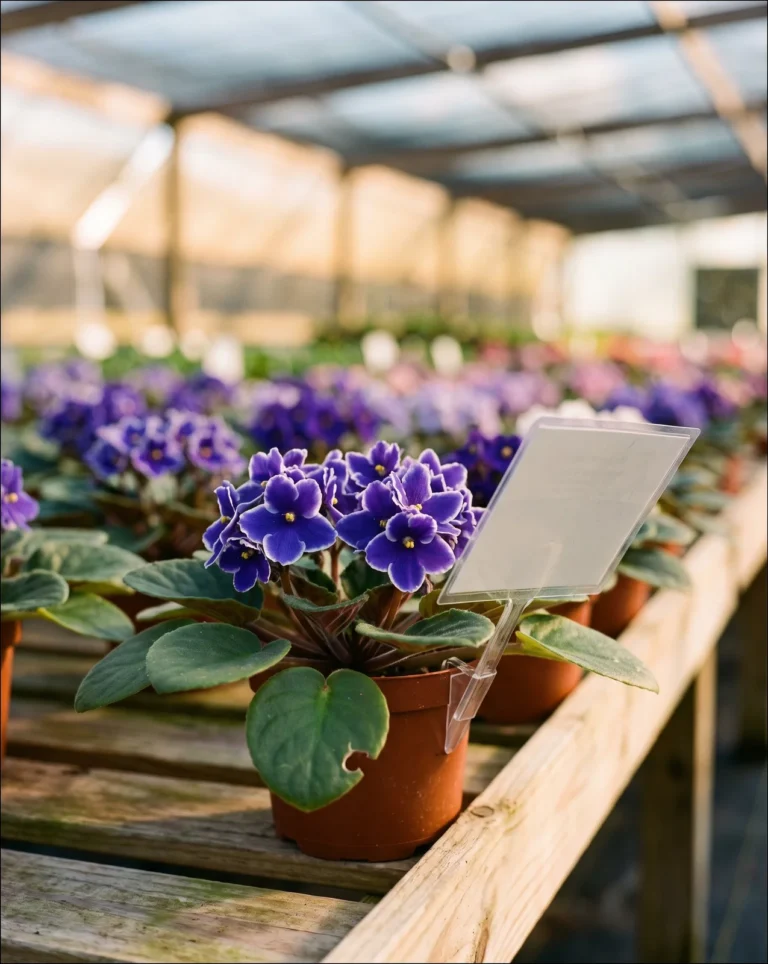
A standard-sized African violet in a four-inch pot at a Florida garden center bench, the size class most plants are sold at
Standard
8 to 16 in across
Given as 8 to 12 in and as 8 to 10 in elsewhere
The size most violets are sold at
A large African violet spanning well over sixteen inches across in a Sacramento sunroom, its rosette overflowing a wide clay pot
Large
16 in and up
One chart starts the class at 12 in
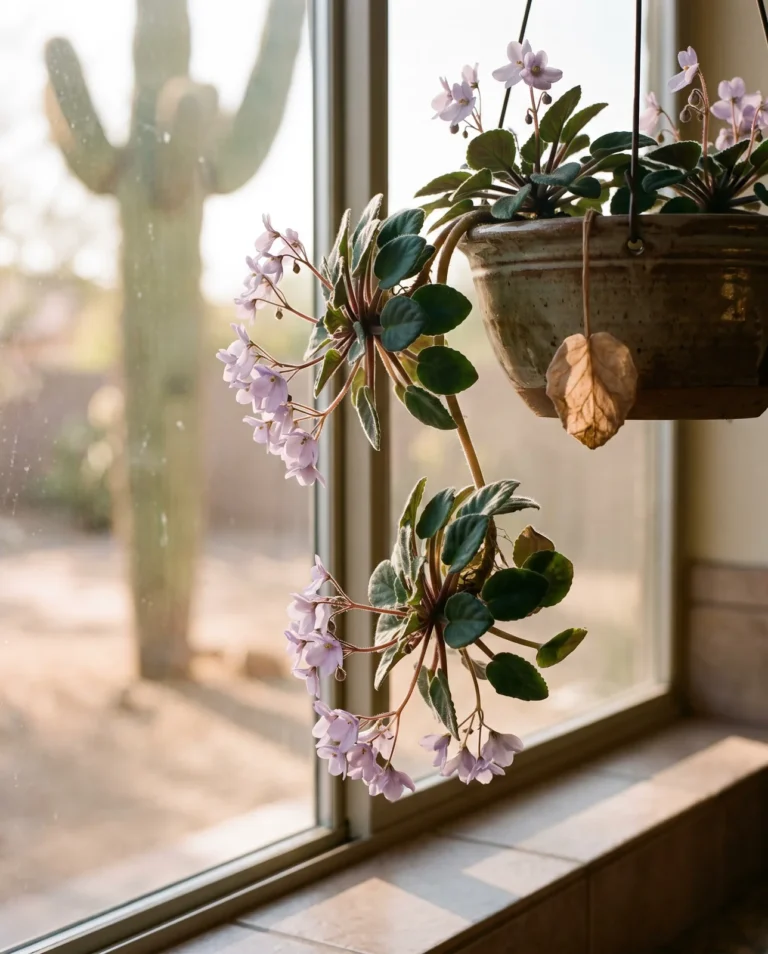
A trailing African violet with several crowns cascading from one pot on a Tucson, Arizona patio window, the only type shown with more than one rosette
Trailing
Trailing
Several crowns growing from one root system
The only type allowed more than one crown in show judging
Macro of a single-form African violet flower with one row of five petals and yellow stamens, photographed on a Virginia windowsill
Single flowers
One row of 5 petals
The top two petals smaller than the lower three
A semi-double African violet flower with extra petals but still-visible yellow stamens, on a New Jersey collector's shelf
Semi-double flowers
More than 5 petals with the yellow stamens still showing
A fully double African violet flower with ten or more layered petals hiding its stamens, photographed close on an Illinois show table
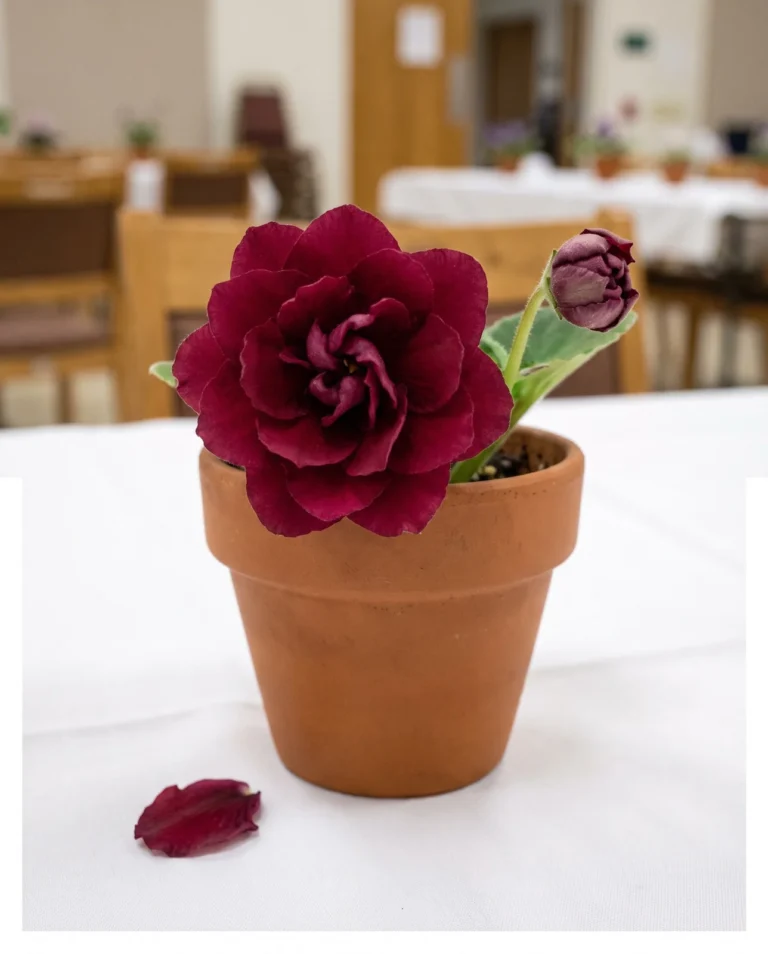
Double flowers
10 or more petals, the stamens usually hidden
A star-shaped African violet flower with evenly pointed petals, photographed on a Utah windowsill in bright indirect light
Star and wasp forms
Listed beside single, semi-double and double
Star-shaped turns up on the other form lists too
A ruffled African violet flower with wavy, fringed petal edges, photographed on a South Carolina porch table in soft afternoon light
Ruffled and fringed
Petals wavy along the edges
Fringed listed as a form of its own
A Geneva-edge African violet flower with a thin band of white along each petal's margin, photographed on a Missouri collector's shelf
Geneva edge
Petals edged in white
A fantasy-patterned African violet with variegated pink and white leaves beside pale pink double flowers, on a Seattle windowsill
Fantasy patterns and variegated leaves
Variegated
Purple freckles across a pink petal on 'First Kiss Blush'
'Champagne Pink' pairs light pink doubles with heavily variegated foliage
Leaves run solid green or variegated green and white
Sold as plain, quilted, spooned or fringed leaves as well
15

Pests and diseases worth knowing

Cyclamen mites are the one pest that ends a violet, and they are invisible on the plant. Full grown, the mite is about 1/100 of an inch long and almost impossible to detect without magnification, so the damage identifies it: severe stunting of the leaves in the center of the plant, sometimes with curling, hairy grayish new leaves, and flower buds that come out stunted or misshapen. The published answer is unusually blunt, since the mites are very difficult to control and the best strategy for an affected plant is usually to discard it. Mealybugs are the pest people actually see, and each insect and its cottony egg mass can be touched with a cotton swab dipped in alcohol diluted with an equal amount of water. Thrips are among the most annoying sucking pests of this plant, small and hard to find, with spilled pollen on the flowers often the first thing a grower notices. Fungus gnats arrive with mix that stays wet, and they are less of a threat than they look: more than 600 species live in North America and only a few of them have larvae that damage living plant tissue.

The disease list is short and rot heads it. Excessive watering leading to root or crown rot is named the major problem in African violet care, with botrytis blight, powdery mildew, cyclamen mites, mealybug, aphids and thrips filling out the list. Botrytis blight starts as small water-soaked lesions on the underside of a leaf, which turn dark brown to gray and pick up a fuzzy coating, and it often follows mite injury, so controlling the mites is part of controlling the blight. A plant that has gone over to root disease is usually discarded, which is the argument for taking a leaf off any violet you would be sorry to lose while it is still healthy.

16

Safe around cats, dogs and horses

African violets are non-toxic to dogs, cats and horses. The ASPCA record is specific and carries no qualifier: Saintpaulia spp., family Gesneriaceae, listed under the additional common name Cape Marigold, and non-toxic to all three animals. A second listing repeats the same three, non-toxic to cats, horses and dogs. No toxic part is named, no sap is flagged and no quantity is mentioned. That makes a violet one of the few plants of its kind that can stand on an open shelf in a house with a cat that chews on things. The record covers this plant only, so an anthurium standing next to it has to be looked up on its own.

17

How long one plant lasts

How long an African violet lasts is decided by whether it gets restarted. Plants mature in 2 to 5 years, and from there the same violet is carried forward on new roots, or replaced by a leaf taken off it while it was still healthy, which reaches flowering size in a matter of months. The violet on the windowsill years from now is either the original plant re-rooted or its own descendant, and neither outcome costs anything at a shop. The upkeep that keeps a plant worth carrying is small. Dead and yellowed leaves come off as they appear so the rosette holds its shape, the mix is renewed on schedule while the pot stays the size it was, and the plant is judged the whole time on the same two things it was judged on in its first month, which are the light it stands in and how wet its mix stays.

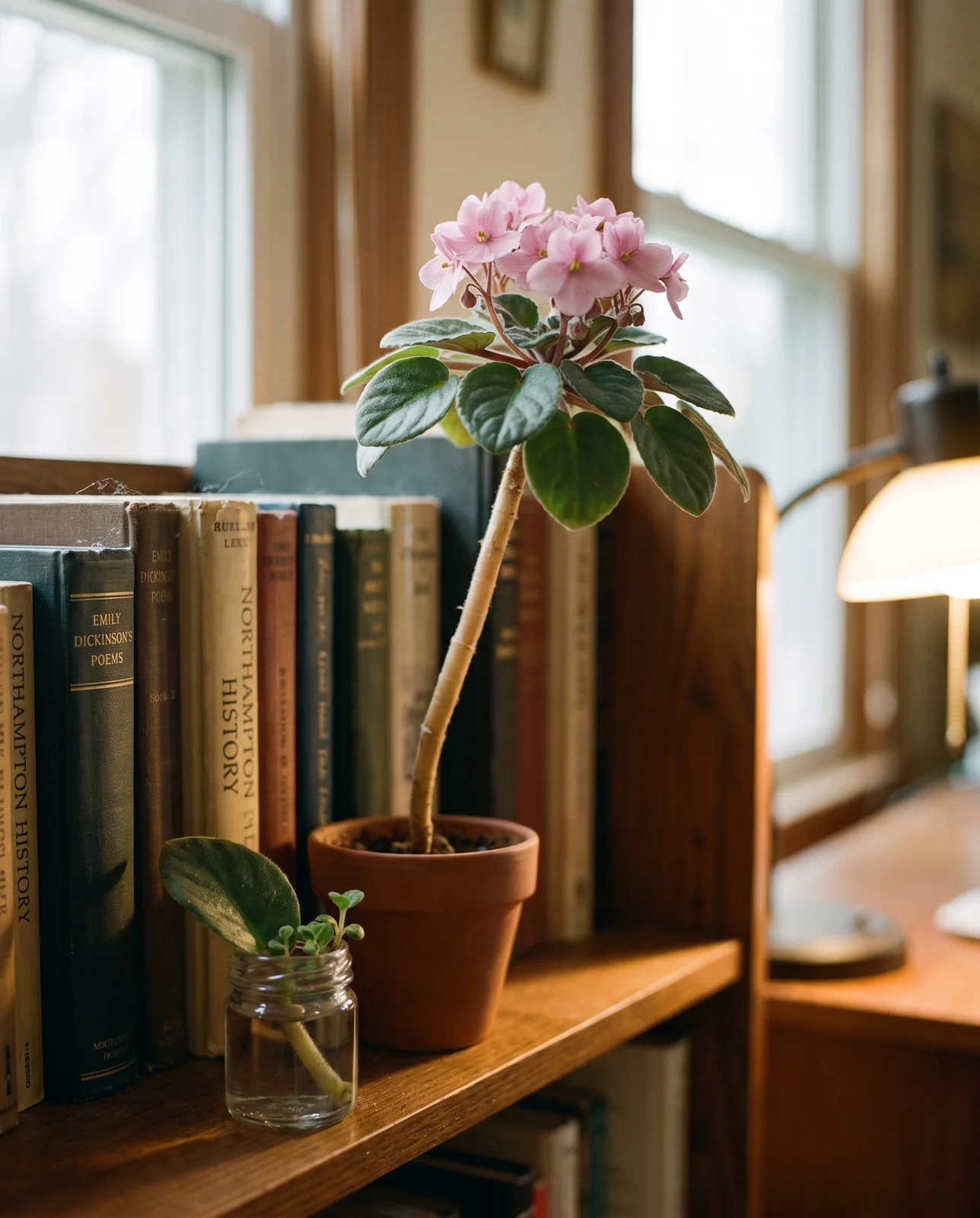
An aging African violet with a long bare stem below its rosette on a Massachusetts bookshelf, standing beside a fresh leaf cutting as its likely replacement
18

Five things people repeat about African violets

Each of these turns up in violet threads and on care cards, and each one is set here against what the growing sources say.

The myth: African violets are a kind of violet.

The reality: They are gesneriads, and their nearest houseplant relatives are gloxinia and streptocarpus. True violets belong to another family, and so do primroses, which are Primulaceae. The common name records where the plant was found and what its flowers look like, and nothing about its relatives.

The myth: Water touching the leaves kills the plant.

The reality: The damage the sources describe is cosmetic. Drops sitting on a leaf leave light-colored spots or rings, and the two published explanations differ over whether any drop does it or only cold water landing on a warmer leaf. What kills a violet is mix that stays wet, which is where Pythium and Phytophthora get in.

The myth: A struggling violet needs a bigger pot.

The reality: Pot sizing for this plant runs the other way, and the growers' society is careful about how far it takes the claim: a correctly sized pot should restrict growth when space is limited or stimulate flowering, which stops short of saying a violet has to be pot-bound to bloom at all. A pot larger than the plant needs holds water the roots never reach, and excessive watering leading to root or crown rot is named the major problem in this plant's care.

The myth: They need full sun to flower.

The reality: Direct sun on the leaves is what the sources warn against, and too much light shows up as foliage gone pale or yellowish green, much lighter than normal. The requirement is bright indirect light held for enough hours, and a violet in a dim room grows perfectly well and simply does not flower.

The myth: A drooping violet is thirsty.

The reality: Drooping is also the first symptom of root and crown rot, which is why a published troubleshooting chart lists wilting leaves against root rot and underwatering together, and why wilted leaves also appear as a sign that a plant needs repotting. The mix decides which of the three it is, and the leaves do not.

19

What to expect from a new plant

A violet does not run on the seasonal clock that sets the pace for most types of flowers, so its year is counted from the day it comes home.

The first six weeks are quarantine and observation. A new plant is examined for insects and disease and kept away from the rest of the collection, joining the others only if it still looks healthy after about 6 weeks, which is also about as long as it takes for trouble bought with the plant to become visible. The other first-week job is the pot. A violet usually arrives in a container wider than the published ratios allow, which put the pot at about a third of the leaf span, so the first repot is often a step down in size and into fresh mix at the same time.

The first bloom cycle is where the spot proves itself. Given the light it asks for, a violet can be in flower 10 to 12 months of the year, so a plant that has settled in and produced nothing has answered the light question already. This is also the point where the feeding decision gets made once and then left alone, since the two published schedules are alternatives to each other. A plant that flowered and then stopped has usually been moved, or the light around it has changed.

By year three the base of the plant has changed. New leaves only ever come from the top and the lowest ones die off, so a bare stretch of stem builds up under the rosette, and that neck is the normal end point of a healthy violet rather than a symptom. It is also where the plant gets restarted, cut off at soil level and re-rooted, or set deeper so the bare stem sits below the soil line and roots from there. A grower who kept a leaf down earlier has the other option waiting, and either way the plant in year four is the same plant.

20

FAQ

Do African violets like full sun or shade?

Neither, exactly. They want bright indirect light, about 1,000 foot-candles for 8 to 12 hours a day, with no direct sun landing on the leaves. Too much light bleaches the foliage to a pale yellowish green, and too little keeps an otherwise healthy plant from flowering at all.

Can African violets be left outside?

The sources split on this. American growing information treats it as an indoor plant, rarely grown outdoors even in the tropics and kept in homes, greenhouses and offices, while a European guide allows a summer outside in enough shade, with the plant brought back in once the temperature drops below 16 degrees Celsius.

Is an African violet hard to care for?

It is easy to grow and easy to kill in one specific way. Violets are described as easy plants that can bloom for 10 to 12 months of the year, and overwatering is called the most common reason they die. Get the watering method and the light right and the rest is light work.

Where is the best place to put an African violet?

Within 12 inches of a bright window, or 10 to 30 inches under a fluorescent or LED fixture run 6 to 12 hours a day. Keep it out of cold drafts and off a windowsill that drops below 60 degrees Fahrenheit at night, since a cold night stunts the plant and the recovery is slow.

How do you fix curling African violet leaves?

Look at the center of the plant first. Leaves that are cupped, curled and thickened with a tufted center point at mite feeding, which is very difficult to control and usually ends with the plant being discarded. Cold is the other thing to rule out, because a night below 60 degrees Fahrenheit stunts a violet and it recovers slowly.

What does an overwatered African violet look like?

Limp and unthrifty, with the older leaves drooping first while the young center leaves stunt and blacken. The roots turn brown and mushy, and a plant whose crown has decayed lifts loosely away from its pot. The mix will still be wet while all of that is happening.

What are the symptoms of crown rot in African violets?

The crown and roots turn soft and mushy, the older leaves droop and the younger center leaves stunt and blacken, and the plant separates easily from the pot once the crown has gone. Droopy leaves come first, before anything at the crown looks wrong.

How often should an African violet be watered?

When the mix feels dry to the touch, without letting it dry out completely, and with a longer gap between waterings while the plant is not flowering. Weight settles it faster than a schedule does, since a pot of dry mix is noticeably lighter than the same pot moist.

How often should you water African violets from the bottom?

Bottom watering is the method, not the schedule. The pot goes into about an inch of room-temperature water until the surface of the mix feels moist and comes out as soon as it does. How long that takes is disputed, from 15 to 30 minutes at one end to a couple of hours at the other.

How can you tell if an African violet is happy?

A flat horizontal wheel of leaves says the light is right, and leaves reaching upward on long petioles say it is short. Add buds that open cleanly, since dry air and drafts make them fail before they do, and new growth at the center that looks like the rest of the plant, since distorted center growth is the mite tell.

21

Interesting tips

  1. If you cannot tell whether a plant needs feeding at all, there is a published test for it: feed one or two plants and wait about 10 days to see whether growth and color improve before feeding the rest.
  2. A violet lost to cyclamen mites can still be replaced by its own leaf. Cuttings taken from an infested plant are kept enclosed until the plantlets are large enough to transplant, about 6 months, because the mites starve out before the new offspring are big enough to host them.
  3. There is a size class below the miniatures. Some varieties are sold as micro-minis, at 3 inches or less across a mature crown, against the 6 inches that marks the top of the miniature class.

Related Guides & Flowers
Enjoying our flower guides? Add YourFlowersGuide as a preferred source on Google — it helps more readers find us.

Add to Preferred Sources
V

Written by: Your Flowers Guide editorial team
We are a small independent group of flower lovers who research and review each guide using trusted horticultural and educational sources. Learn more about us