
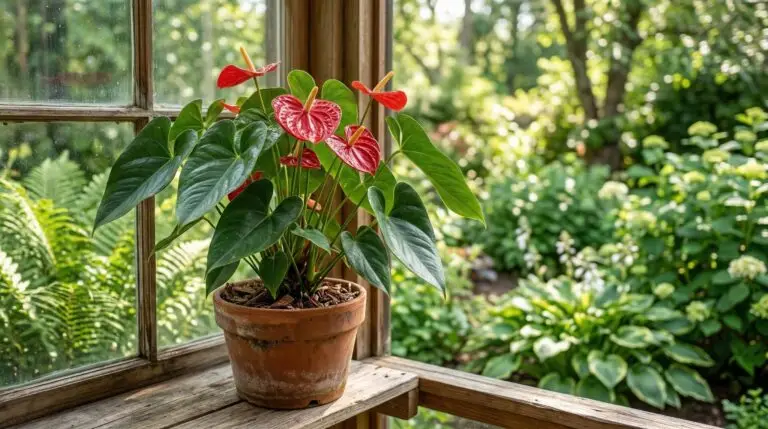
Taxonomy and origin
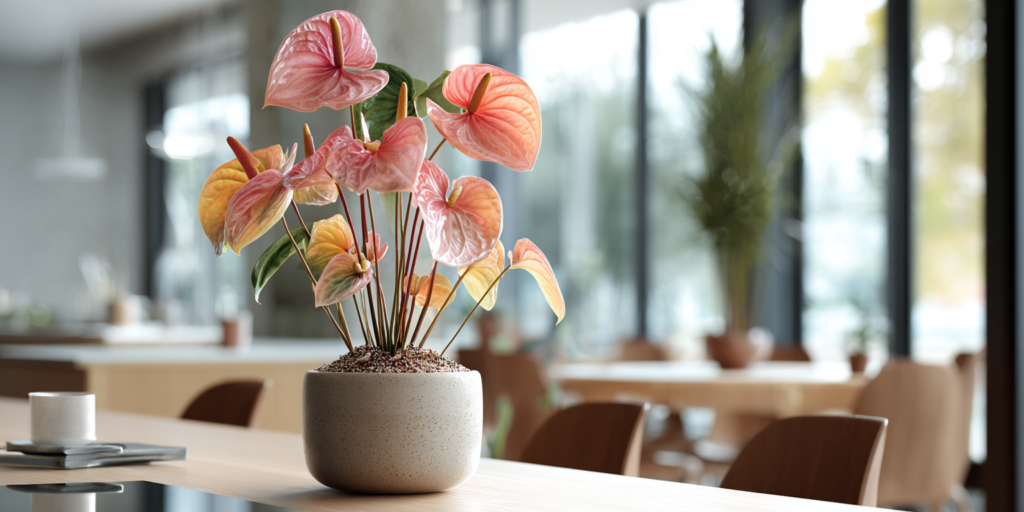
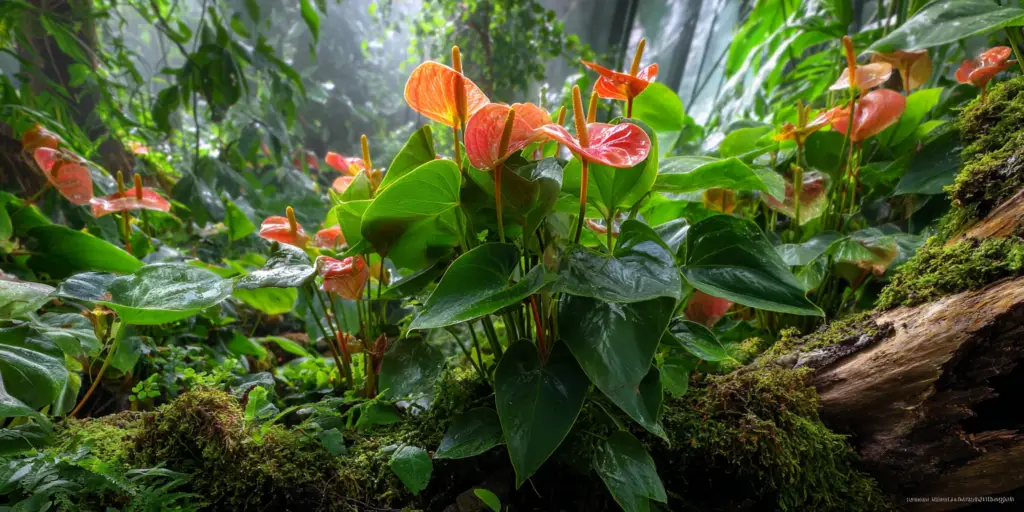
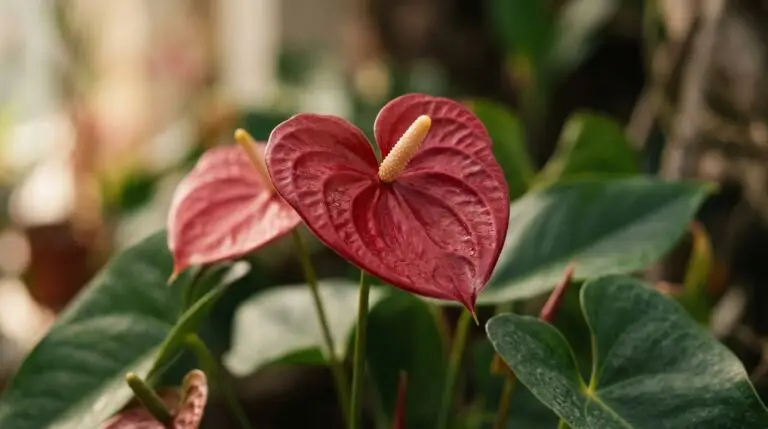
Anthurium belongs to Araceae, the arum family, alongside familiar houseplants such as the peace lily, philodendron, and the calla lily. It is the largest genus in that family, with roughly 1,000 species, native from northern Mexico down through Central America and much of South America into the Caribbean. Many grow as epiphytes, perched on tree branches in humid cloud forests, while others root in the ground, and that epiphytic habit is why the roots crave air as much as moisture. The name joins the Greek anthos, flower, with oura, tail, a nod to the tail-like spadix. The houseplants people actually buy trace mostly to Anthurium andraeanum, native to Colombia and Ecuador, and Anthurium scherzerianum, native to Costa Rica, and modern plants are largely hybrids bred for richer spathe color and sturdy, heart-shaped leaves.
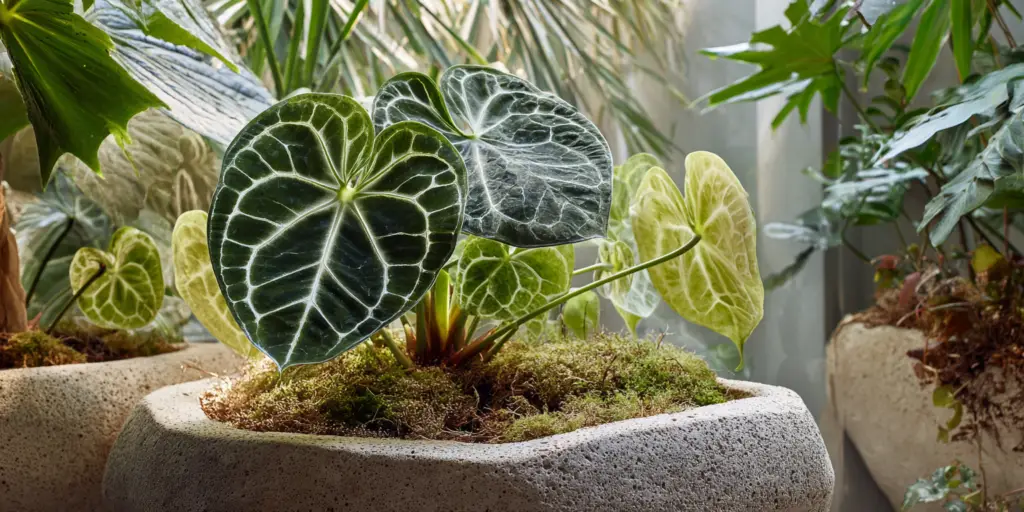
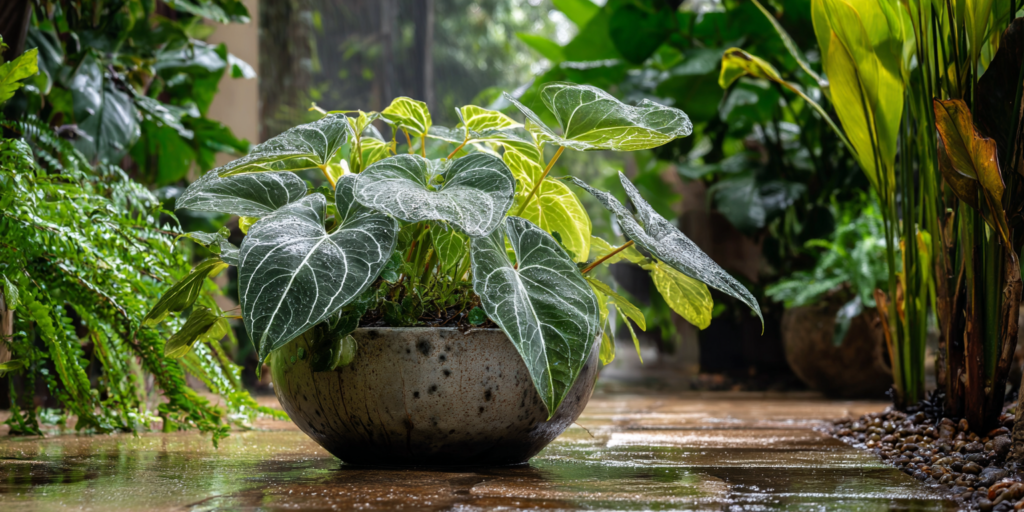
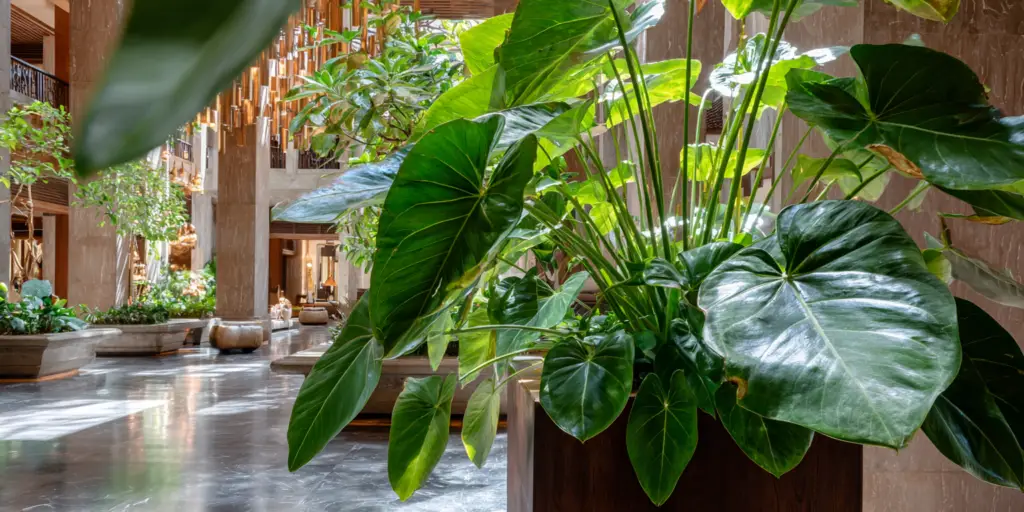
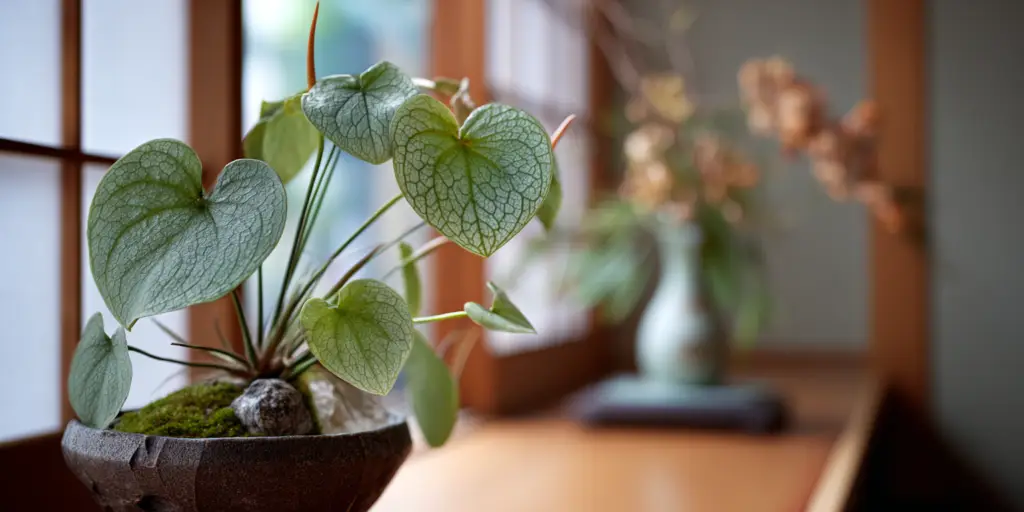
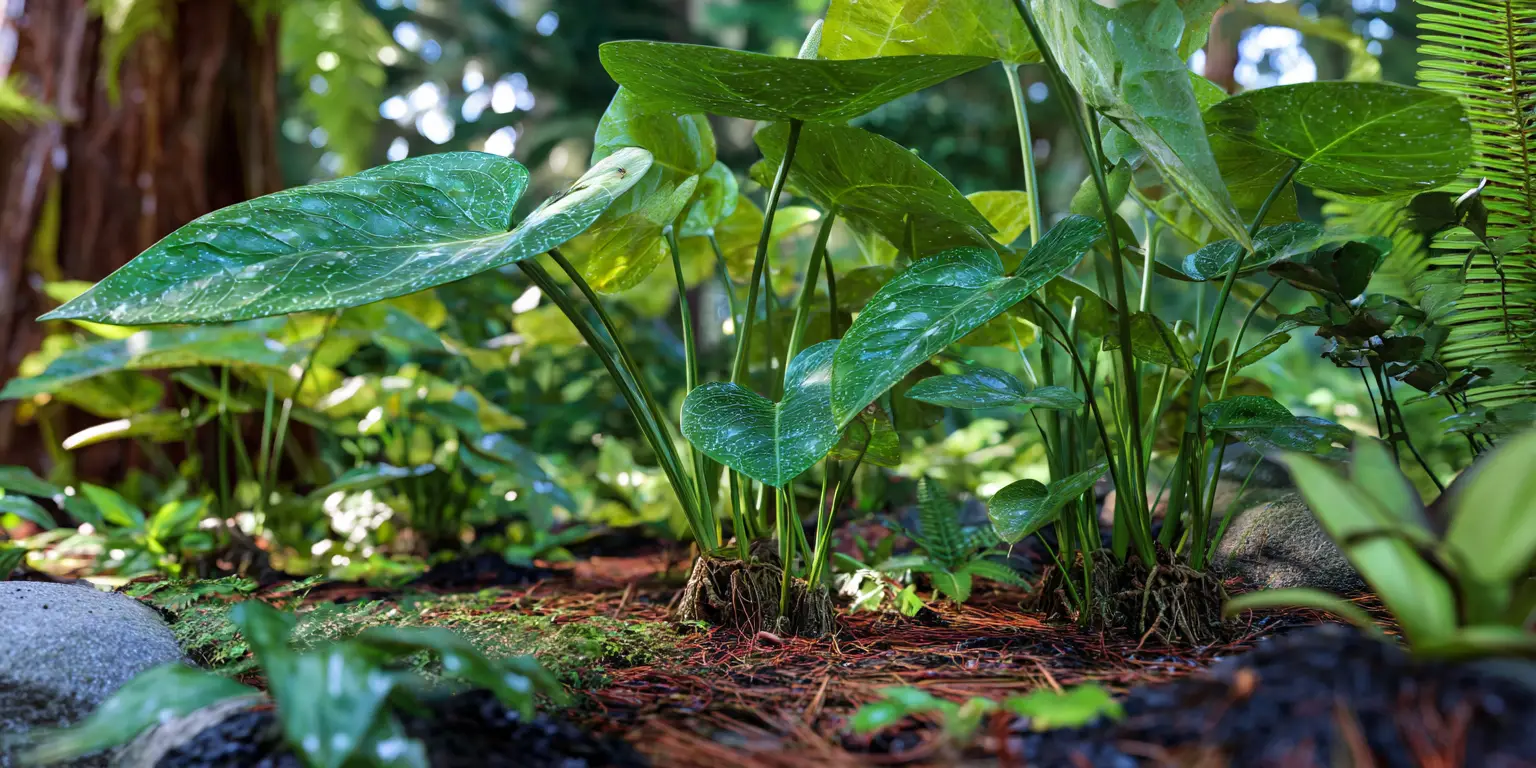
It helps to know that anthurium splits into two worlds before you shop. One is the flowering houseplants grown for their spathes; the other is a group of velvet-leaf collector species grown purely for their foliage, the kind the tabs on this page show. The table below sorts the common names people meet.
| Anthurium type | Grown for | Signature look | Note |
|---|---|---|---|
| Anthurium andraeanum | Flowers | Classic waxy, heart-shaped flamingo flower with a straight spadix | The plant most stores sell; the source of most hybrids |
| Anthurium scherzerianum | Flowers | The pigtail anthurium, with a curled, corkscrew spadix | More compact; tolerates slightly cooler rooms |
| Anthurium clarinervium | Foliage | Dark, rounded leaves with bold white veins | A collector plant; wants high humidity |
| Anthurium crystallinum | Foliage | Velvety heart-shaped leaves with silvery veining | Similar care to clarinervium |
| Anthurium warocqueanum | Foliage | Long, pendulous "queen" leaves | Advanced; demands steady warmth and humidity |
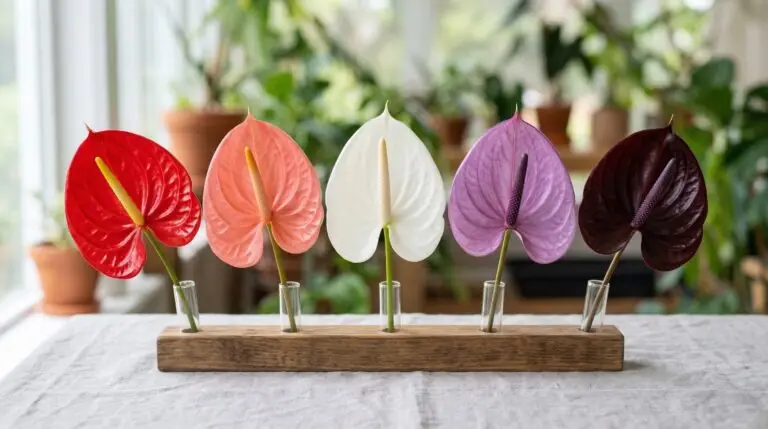
Flowering anthuriums come in red, pink, white, purple, green, orange, and near-black shades, and breeders keep pushing the palette. One caution worth carrying to the shop: a true blue anthurium and a bright, uniform yellow are not natural colors. Those are dyed, and the dye fades, so a red bloom sits at the honest center of what anthurium owns among red flowers.
Named cultivars, and who actually named them
UF/IFAS calls Anthurium the largest genus in the family Araceae with nearly 1,000 species, and a 2025 review in Ornamental Plant Research counts over 2,000 documented varieties inside the cultivated hybrid complex alone, bred in under a century. Nobody chooses among that. The same review sorts the flowering type by spathe shape into three named forms, standard, obake and tulip, which is the axis most retail colour and shape variation actually runs along. The badge under each photo answers one question: did a university name this plant, or does everything known about it come from the company selling it.
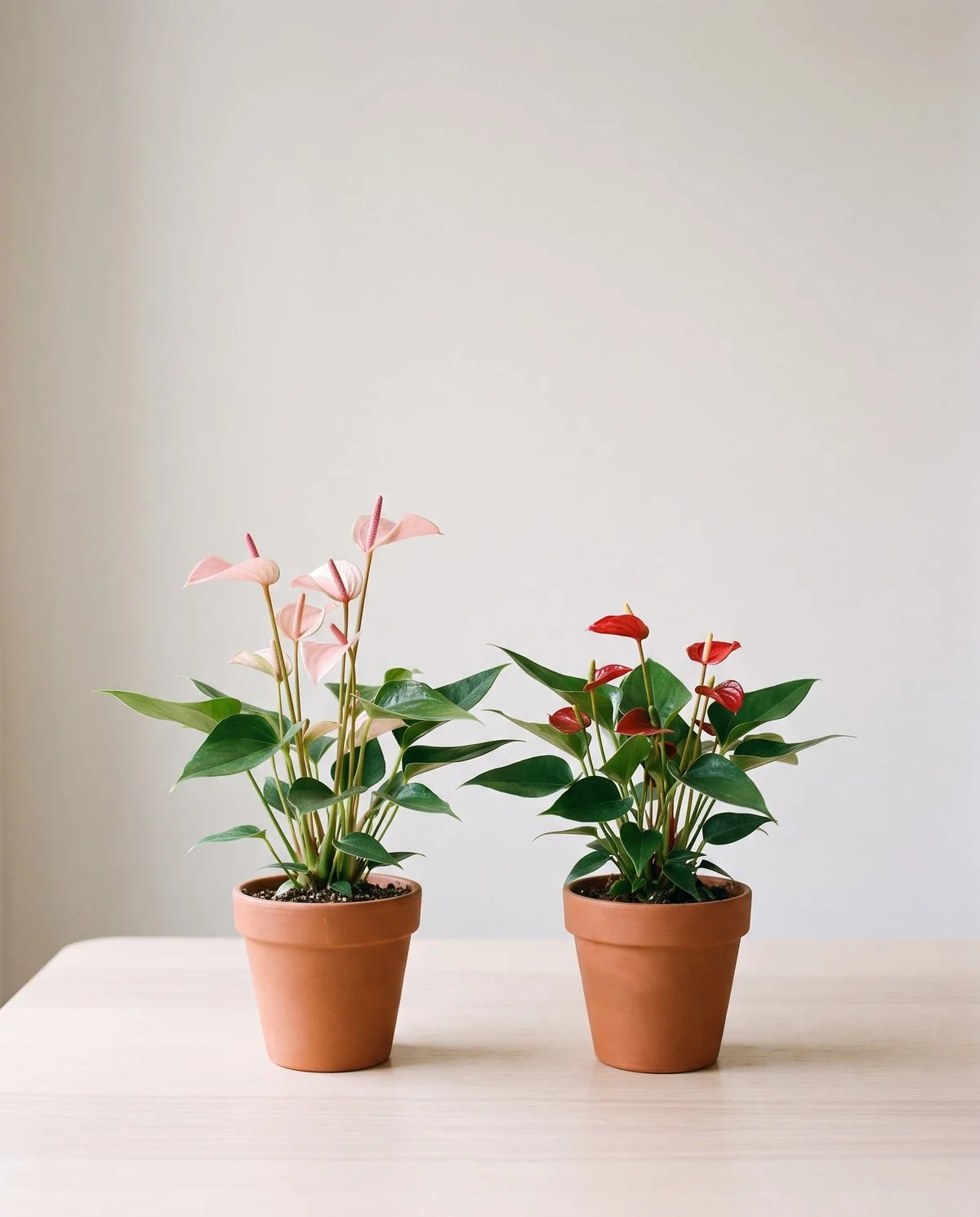
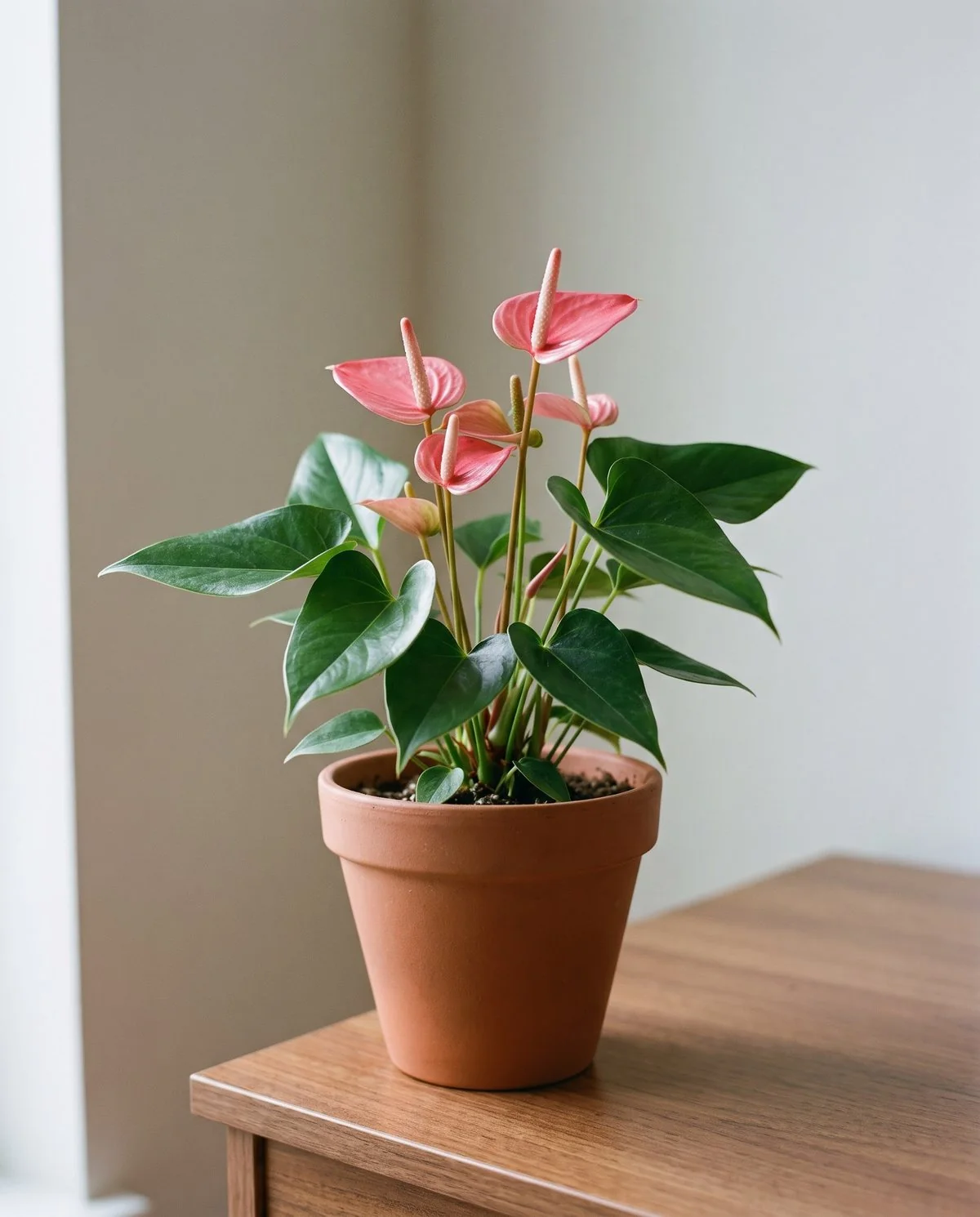
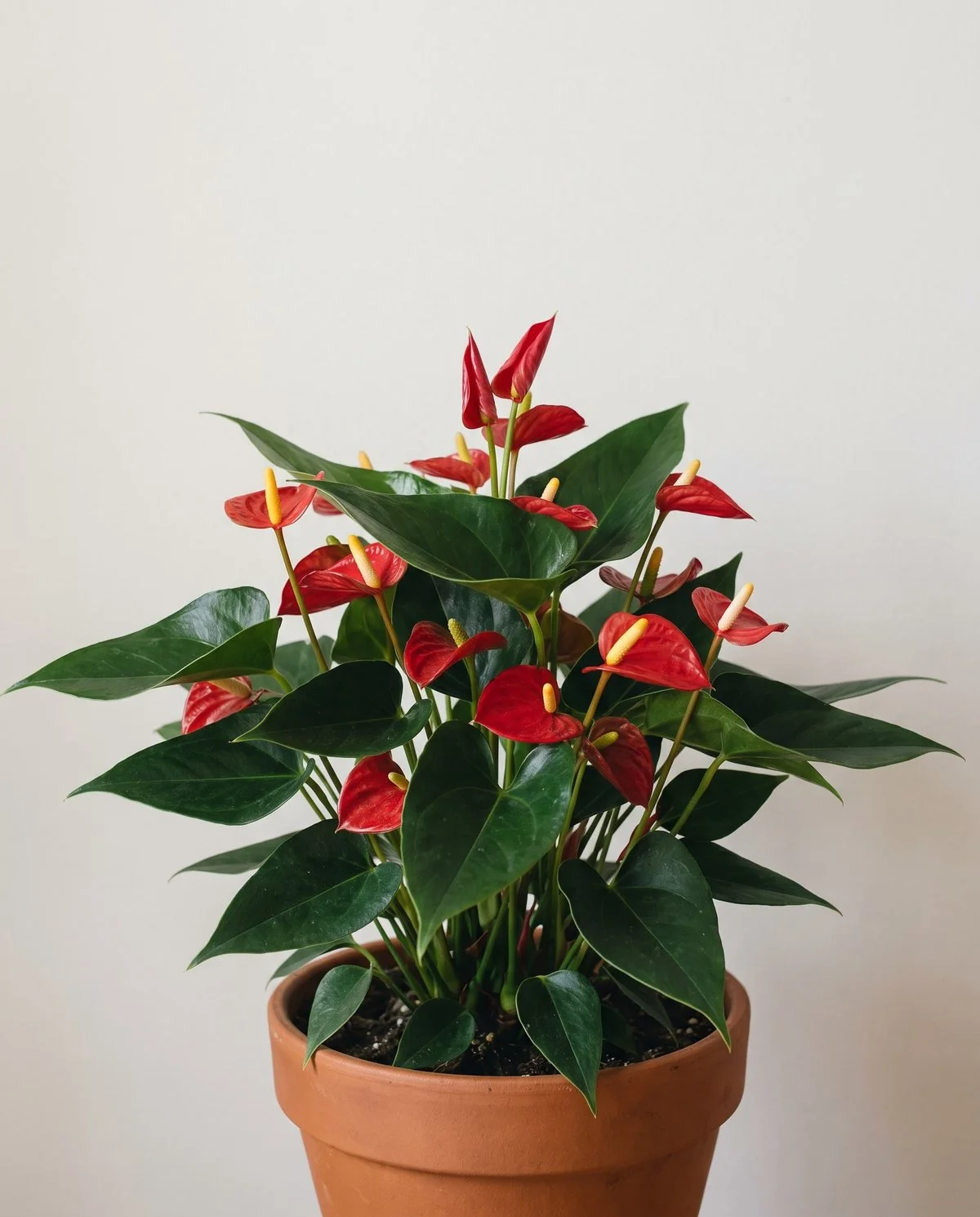
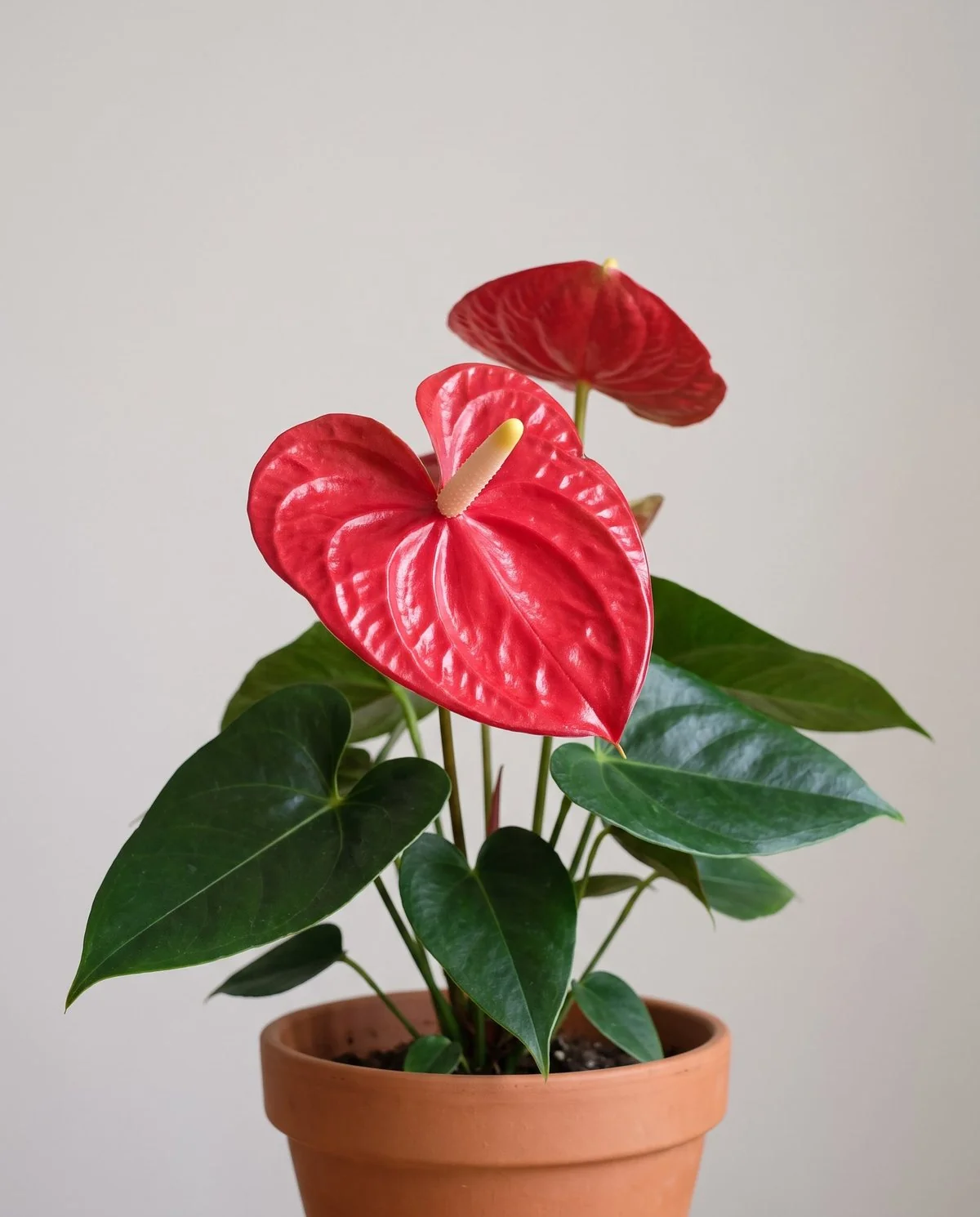
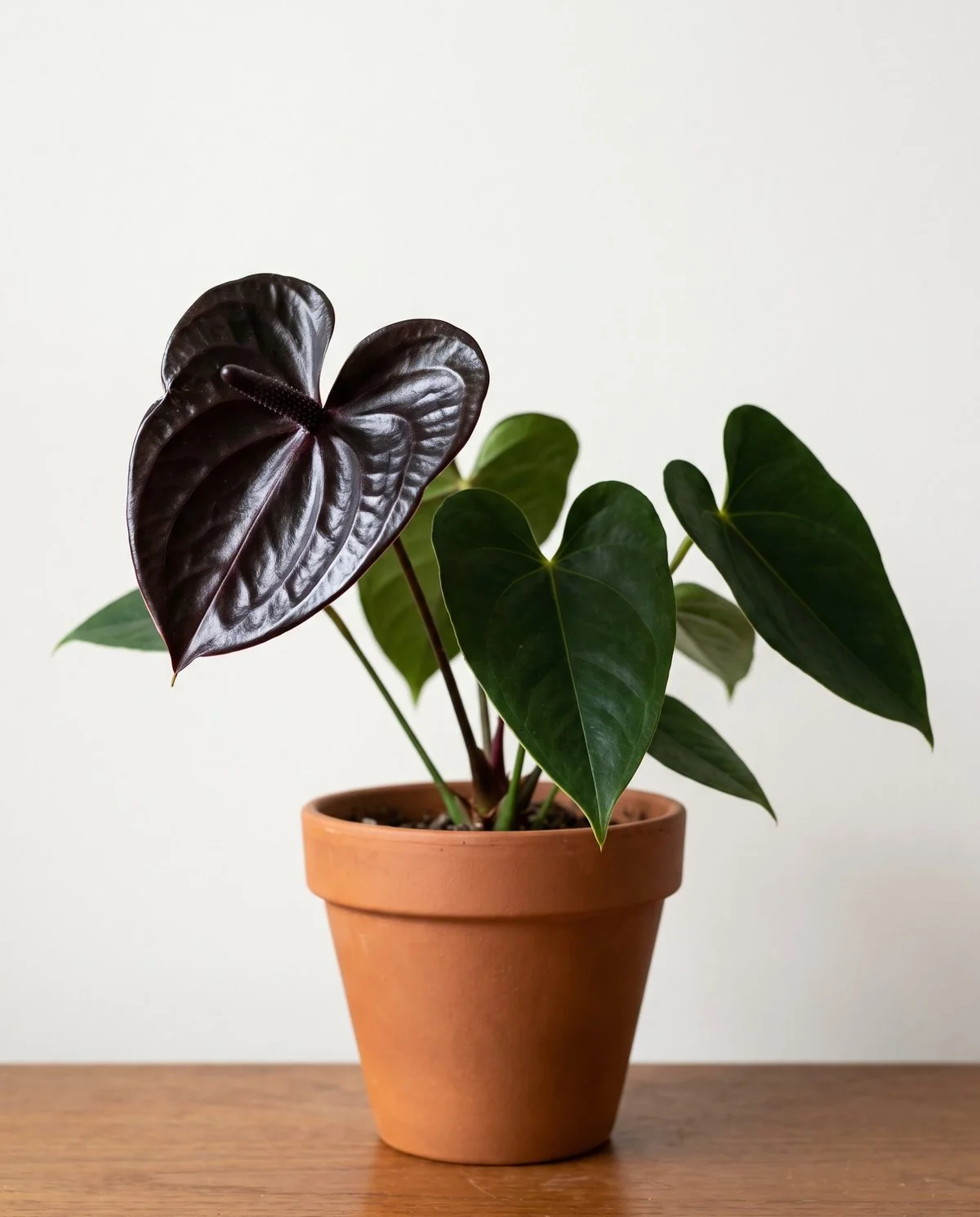
The compact potted line has an unusually well-confirmed pedigree: UF, University of Hawaii and the 2025 Ornamental Plant Research review separately name Anthurium amnicola and Anthurium antioquiense as its parent species, so a mini bought for a desk is a deliberate breeding outcome rather than a stunted standard plant. One cultivar is deliberately kept out of the grid. New Era is widely credited with resistance to both blight and anthracnose, which is consistent with the UF and University of Hawaii breeding literature, but the vase-life and flowers-per-year figures repeated alongside it trace only to a grower blog reached through a search summary, so they are used nowhere here.
Bloom time
Indoors, anthurium can flower at almost any time of year given steady warmth, light, and humidity. It blooms in waves rather than on one seasonal schedule, and each spathe holds for several weeks, sometimes longer, so a healthy plant can look as though it is always in bloom. That "always something open" state is the goal, and it is reachable, but only when the plant has what it needs to fund flowers.
When flowering stalls, light is almost always the first lever to check. Enough bright, indirect light is the single biggest factor in reblooming; a plant sitting in a dim corner puts its energy into leaves and skips flowers. The second lever is feeding: during active growth, a fertilizer slightly higher in phosphorus supports bloom production, so a plant that has gone hungry for months will hold back. The third is the pot. Anthurium likes to be a little snug and even blooms better slightly root-bound, but a plant packed hard against the wall of an exhausted pot, or one that has been starved of nutrients, will stall until it is refreshed. Steady warmth and humidity round it out. Move a non-flowering plant brighter, feed it through the growing season, and keep it warm, and spathes usually return.

How long to first bloom, and what keeps it going
UF states that almost all cultivars are now propagated through tissue culture, and that decides the first timeline: a tissue-culture microcutting reaches flowering size markedly faster than a seed-grown plant, with consumer sources putting the microcutting at roughly nine to ten months in a small pot against a much longer and more variable window from seed, commonly cited at one and a half to four years. Neither figure was confirmed against a university propagation trial in this research, and both are retail-tier rather than measured. What is measured is the part that matters to somebody who already owns the plant: UF's own interior study had cultivars flowering continuously at 100 foot-candles for over one and a half years, which makes a healthy plant in an ordinary bright room the tested baseline for working as intended rather than an aspirational outlier. What continuous flowering means in UF's phrasing is a rolling succession of new inflorescences rather than one seasonal flush. Missouri Botanical Garden's two-year repotting interval belongs in the same timeline for a counter-intuitive reason: it is framed around clearing unabsorbed minerals out of the medium rather than around the plant filling its pot, so a plant that looks perfectly fine is still on that clock, and the leaf-margin and tip injury that soluble-salt buildup produces is the thing the interval prevents. The breeding runs on a timeline of its own. University of Hawaii's programme has released blight-tolerant cultivars, naming Tropic Fire as bright red and blight tolerant, precisely because bacterial blight is common enough in production to be worth breeding against, so choosing a named, blight-bred plant over an unlabelled one is a real difference in long-term risk, even though it is close to impossible to verify at the point of sale.
The six-week clock on every bloom, and the hormone story
The waves of bloom described above run on a clock that has an actual number: on the plant, a single spathe holds for about six weeks, and cut for a vase it lasts several. That number is the missing reference point for the greening question this page's FAQ answers further down. A spathe that starts to fade and green after five or six weeks open has simply finished its term, and the right response is to cut it at the base and let the plant spend the energy on the next one. The same shift arriving in the second week is a different event, the light-starvation version, and the difference between the two is read straight off the calendar. One caution before reading any green as a fault: check which spathe form the plant carries first, because the obake forms are bred two-tone, and on them a broad green margin around the colored center is the variety's whole point rather than a symptom of anything.
The explanation that dominates videos and forum answers, that a shop anthurium was forced with greenhouse hormones which then wear off at home, has no research source behind it that this page's checks could find. What the record does show runs against it: anthurium initiates flowers under ordinary growing conditions with no hormone input at all, growth regulators appear in the trade literature mainly as a branching trick and a breeding tool, and the interior trial already cited on this page kept plants in continuous bloom for over a year and a half in nothing stronger than ordinary room light. A healthy plant needs no chemical push to keep flowering, so when blooms green early or stop coming, the useful suspects are the light, the feeding, and the calendar, not an imagined withdrawal.
Height and spread
Most potted anthuriums stay compact, roughly 12 to 18 inches tall (30 to 45 cm) with a similar spread. The leaves run about 4 to 8 inches long on slender stems rising from a short central crown. Over time the plant forms a small clump as new growth pushes up from the base, which is also what gives you divisions later. A few species grow much larger in the wild, but they rarely turn up as ordinary houseplants.
Light
Bright, indirect light is the heart of good anthurium care. An east-facing window is close to ideal, catching gentle morning sun, or set the plant back from a brighter window behind a sheer curtain. Strong midday sun is the thing to avoid: direct rays scorch the leaves and fade the spathes, bleaching that waxy color you bought the plant for. Too little light causes the opposite problem, fewer flowers and slower, leggier growth. The plant will tell you which way to move it. Deep green leaves paired with no blooms for months means it wants more light, so shift it closer to the window. Pale, washed-out patches or crisp, browned edges mean it is getting too much direct sun, so pull it back.

Water
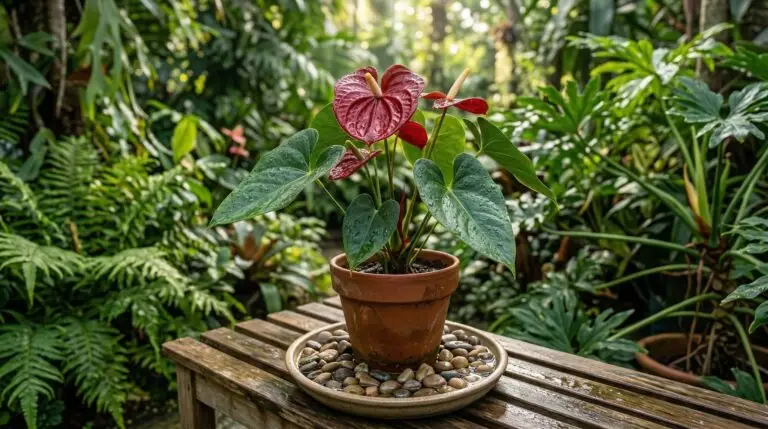
Water when the top inch of the mix feels dry to the touch. When you do, soak the pot thoroughly until water runs from the drainage holes, then empty the saucer so the roots never sit in standing water. The rule that keeps anthurium alive is that its roots want moisture and air at the same time; the mix should be damp, never soggy. In practice this often lands around once a week, but the real interval depends on light, temperature, and pot size, so trust your finger over the calendar. Because it is a tropical plant, humidity matters as much as watering, especially in dry winter air when heaters strip moisture from a room. A pebble tray under the pot or a small humidifier nearby keeps the leaves from crisping at the tips.
Three beliefs, and which UF publication each one comes from
The myth: Misting is always the right answer for an anthurium's humidity.
The reality: Two UF publications say different things because they are written for different situations, and the gap is the useful part. UF's interior-care guidance recommends misting a finished interior plant specifically to dislodge dust and temporarily increase relative humidity. UF's own disease-control publication for growers states that bacterial blight bacteria swim across wet surfaces, instructs that foliage be kept dry, and calls drip irrigation the most effective way to prevent disease spread. That second rule exists because a greenhouse bench holds hundreds of plants that can infect one another, and the same publication notes that infected plants can stay symptomless for months while still infecting their neighbours. Wet leaves are how the disease travels, which is the reason behind the caution rather than an argument against it.
The myth: Pale, washed-out leaves mean the plant needs feeding.
The reality: Not necessarily, and UF says so directly: light above its stated range produces pale, washed-out leaf colour that is often misdiagnosed as a nutrient deficiency. Its production range is 1,000 to 2,500 foot-candles, and its ceiling is 2,500, past which the damage stops being cosmetic and becomes broad dry tan blotches. A pale plant in a bright window is a light reading first and a fertilizer question second.
The myth: Cutting off spent flowers is bad for the plant, or at least pointless.
The reality: UF lists removing expired flowers as needed among its own interior-care practices, so it is standard rather than risky. NC State separately names a higher-phosphorus fertilizer as encouraging more blooms, which is the other half of the same job: take the finished inflorescence off, and fund the next one.
Soil and pH
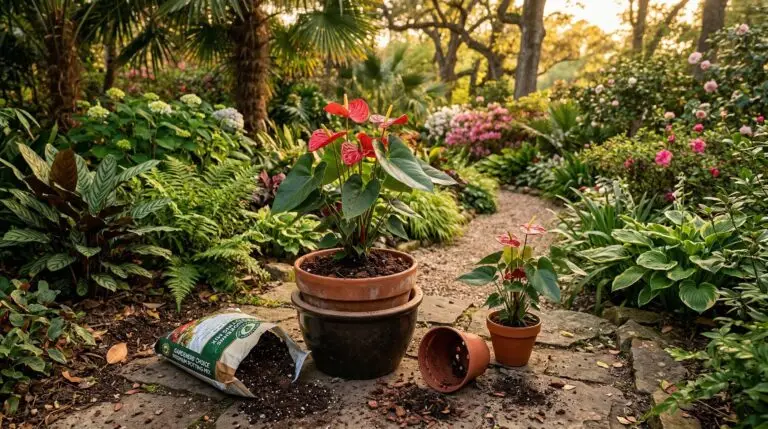
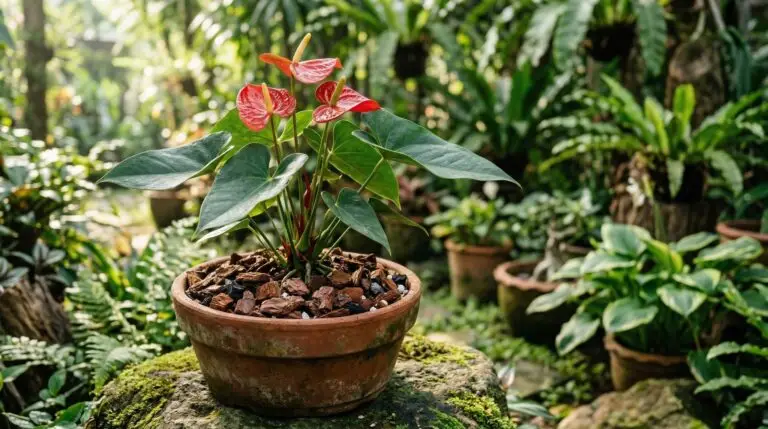
Anthurium needs a loose, chunky, fast-draining mix, not dense potting soil. A blend of regular potting mix with orchid bark and perlite works well, as does a ready-made aroid or orchid mix. The goal is a medium that holds some moisture while letting air move freely to the roots, which is exactly what an epiphyte expects. Aim for slightly acidic conditions, around pH 5.5 to 6.5, though the plant tolerates near-neutral soil as long as drainage stays sharp. Repot every couple of years, or sooner if the mix has compacted or the roots have filled the pot, moving up just one pot size so the plant does not sit in a large volume of wet soil.

USDA hardiness
Anthurium is a tender tropical that lives outdoors year-round only in USDA zones 11 to 12, so for almost everyone it is an indoor or greenhouse plant. It is happiest between about 65 and 80 F (18 to 27 C) and suffers once temperatures drop into the mid-50s or below. It can spend summer outside in a shaded, sheltered spot where nights stay warm, but it needs to come back indoors well before the first cool nights of fall, and cold drafts from an open door or a chilly window are worth guarding against even indoors.
The indoor numbers, measured rather than described
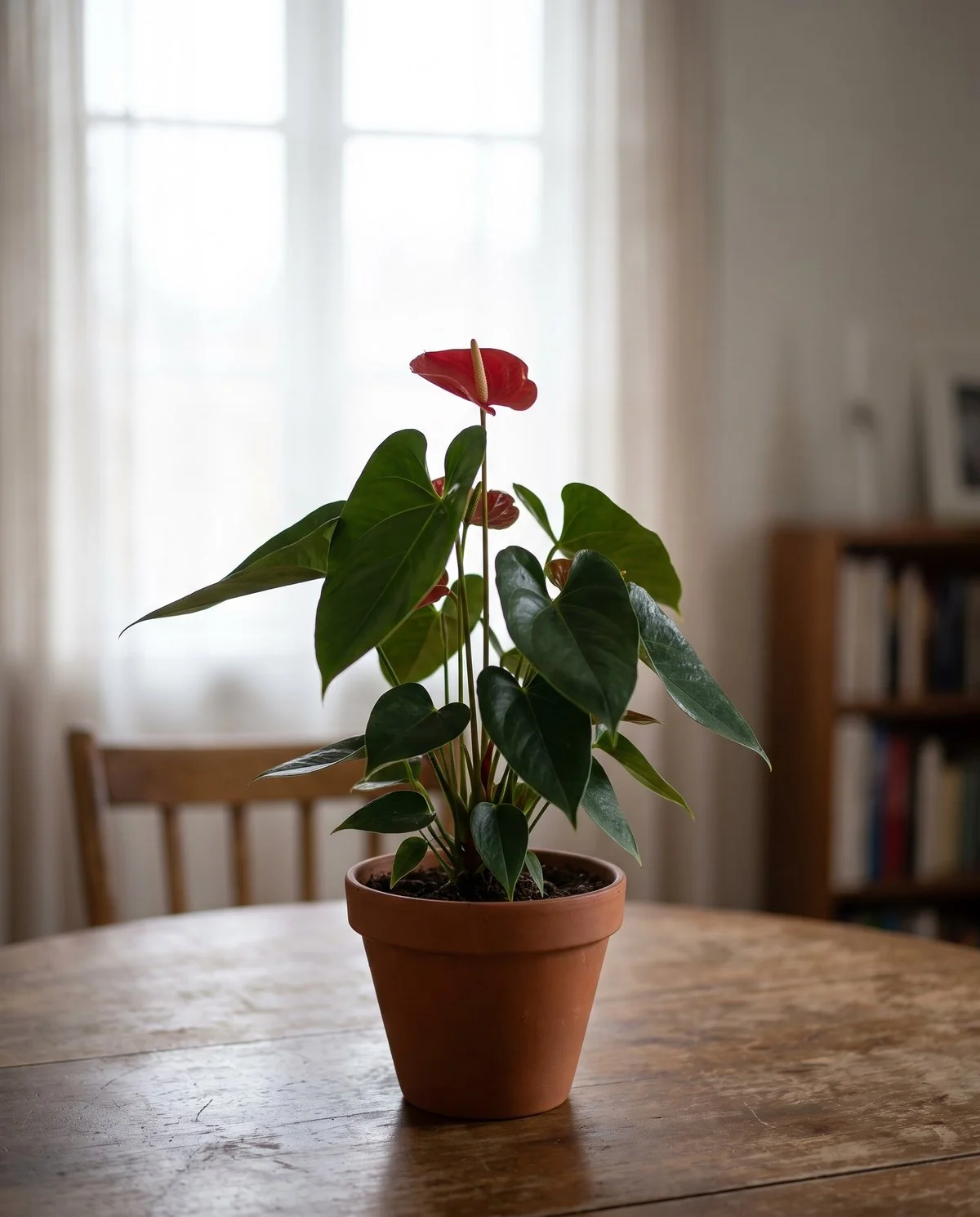
A houseplant has no planting zone, so this is the equivalent: the real figures behind bright indirect light and feed occasionally. UF/IFAS EDIS ENH956 by Chen, McConnell, Henny and Everitt is the only source found in this research that publishes exact numbers for both commercial and interior conditions, cross-checked against Missouri Botanical Garden's Plant Finder.
Propagation and longevity
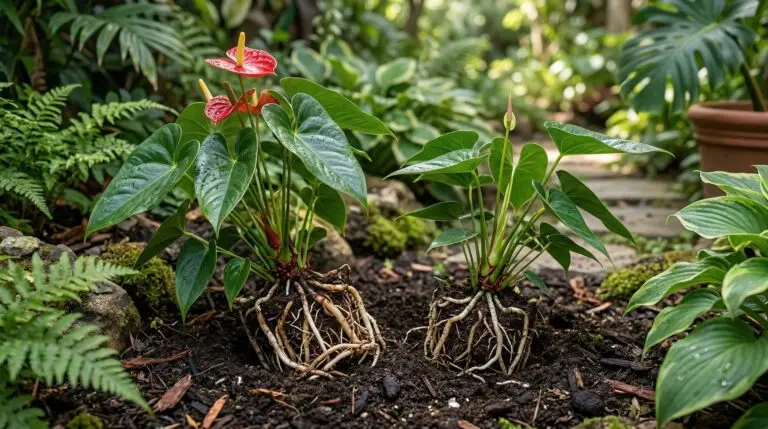
The easiest way to make more anthuriums is division. When you repot in spring or early summer, look for offsets, the small plantlets that form at the base of the crown, and separate a section that has its own roots and at least one leaf. Pot each division into fresh, airy mix and keep it warm, lightly moist, and humid until new growth signals it has taken. A well-kept plant lives many years indoors. It has no true dormancy, though growth slows through winter, so it asks for little more than repotting every couple of years, the odd trim of tired leaves, and light feeding during active growth. Older plants tend to stretch, dropping lower leaves and revealing a longer bare stem; you can refresh one by repotting it deeper or by cutting the top and re-rooting it.

Fragrance
Anthurium is essentially fragrance-free. The showy "flower" is a spathe wrapped around a spadix, admired for its color and sculptural form rather than any scent. That makes it an easy choice for scent-sensitive homes and for rooms where a strong floral perfume would be unwelcome.
Toxicity and pet safety
Anthurium is toxic, and this is not a plant to be casual about. Like many members of the arum family, it carries insoluble calcium oxalate crystals throughout its tissue, and chewing any part releases them, causing burning and irritation of the mouth and throat. A pet that bites a leaf may drool, paw at its mouth, or refuse food, and the sap can leave the skin and eyes irritated as well, so it is worth washing your hands after pruning or repotting. The ASPCA lists it, under the name flamingo flower, as toxic to cats, dogs, and horses, and NC State notes the same calcium oxalate irritation for people. Keep it well out of reach of pets and small children, and if you share your home with curious animals, browse genuinely pet-safe flowers and plants for the spots they can reach.

Vase life
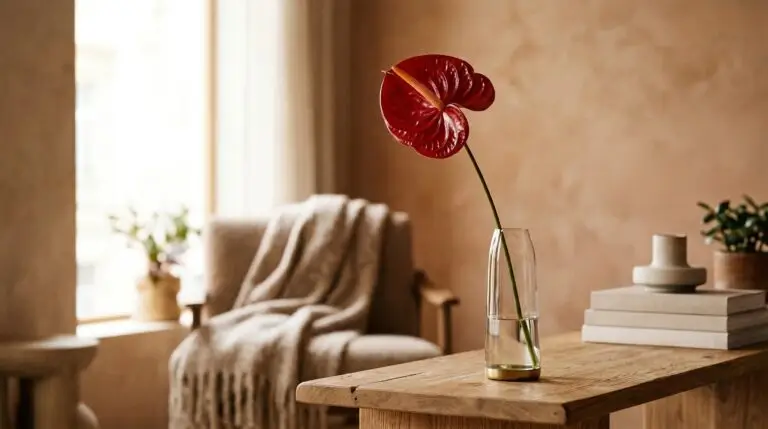
Cut anthurium spathes are among the longest-lasting flowers you can put in water, commonly holding 2 to 3 weeks and stretching further in a cool room. Some individual stems fade sooner, closer to 10 to 14 days, so 2 to 3 weeks is a realistic upper range rather than a guarantee. Start with a clean vase, change the water every few days, and trim a little off the stem each time you refresh it. Keep the arrangement out of direct sun and away from both heaters and cold drafts, and the spathes will reward you with weeks of color, which is why anthurium anchors so many long-life bouquets alongside another tropical stayer, the orchid.
Measured vase life, and the one thing never to do to a cut anthurium
Two sources measured this rather than estimated it, three decades apart: UC Davis's postharvest fact sheet by Michael S. Reid of the Department of Plant Sciences, and a 1972 University of Hawaii conference paper by Ernest K. Akamine, Professor of Plant Physiology, read as the original scanned document. Where a figure comes from Akamine's trial it is given with the variety it was measured on, because his four varieties differed by 21 days.
The fridge is the safe place for cut flowers, including this one.
Not for anthurium. Below 10C it purples, then browns, then dies, and Akamine adds that refrigeration only helps if the flower is held continuously at 55F, because moving a refrigerated flower back to room conditions erases the benefit.
Keep it away from the fruit bowl, like any other cut flower.
Unnecessary here. UC Davis states that anthurium is not sensitive to ethylene and that anti-ethylene treatments provide no benefit, which separates it from most cut flowers and from the orchids it often stands beside.
A stem that arrives limp from shipping is finished.
Not always. Akamine documented naturally short-lived varieties, Ozaki Red among them, wilting immediately when placed straight into a vase even after a fresh cut, and the documented fix is a full one-and-a-half-hour immersion of the whole flower in tap water after recutting the stem, which restores turgor. Longer immersion causes purple discoloration on the spathe, so the timing is specific rather than the more the better.
Pests and diseases
The pests that find anthurium indoors are the usual houseplant culprits: mealybugs, scale, spider mites, and aphids. Check the undersides of leaves and the joints where leaf meets stem, since that is where they gather. A rinse in the sink or shower knocks many of them off, and you can follow up with insecticidal soap used per its label, repeating every week or so and isolating the plant while you treat it. Disease, when it comes, almost always traces back to water: root rot in a waterlogged mix is the main killer, and leaf spots appear when foliage stays wet with no airflow. A fast-draining mix, watering only once the surface dries, and skipping constant misting prevent nearly all of it. Remove the worst-spotted leaves with clean scissors and improve air movement around the plant.
Most day-to-day complaints are cultural rather than pest-driven, and they follow a short list of patterns. The table below reads a symptom back to its likely cause and the fix.
| Symptom | Likely cause | Fix |
|---|---|---|
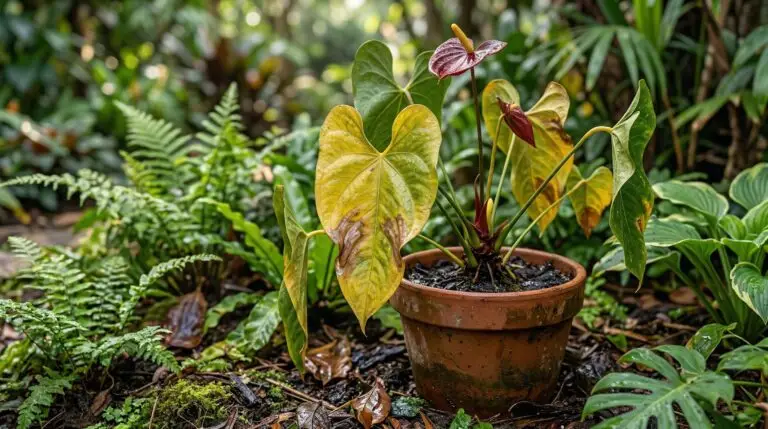
| Yellowing leaves | Overwatering and soggy mix leading to root rot; also cold drafts or old lower leaves aging out | Let the top inch dry before watering, improve drainage, and check roots for rot; one or two old lower leaves yellowing is normal |
| Brown, crispy leaf tips | Low humidity, underwatering, or salt and fluoride buildup from tap water | Raise humidity with a pebble tray or humidifier, water more evenly, and flush the pot or switch to filtered water |
| No flowers | Too little light, missed feeding, or the plant is starved in an exhausted pot | Move it to bright indirect light, feed with a higher-phosphorus fertilizer in the growing season, and refresh the mix |
| Leggy stem, little new growth | Insufficient light or an aging plant with a long bare stem | Increase light; repot deeper or cut and re-root the top to rejuvenate it |
| Brown, mushy stem base | Advanced root or crown rot from staying wet | Unpot, cut away all rotted tissue, and re-root any firm, healthy top section in fresh airy mix |
What actually goes wrong, by frequency
Counted from 1,200 unique posts pulled through the Arctic Shift Reddit archive, 700 from the dedicated r/Anthurium subreddit plus 200 from r/plantclinic and 300 from r/houseplants, deduplicated by post id. A pass separating problem-framed posts from show-and-tell found 776 of the 1,200 problem-framed, 64.7 percent, and the shares below are of those 776, which is the honest denominator for anything except how often a topic simply comes up. One thing has to be said about this corpus: r/Anthurium is dominated by velvet-leaf species collectors rather than by owners of a flowering supermarket plant, and that is exactly why two real problems sit near the bottom of this list. Themes overlap, so the shares do not sum to 100.
Whether anything is wrong at all. The largest theme and the noisiest: many are collectors documenting a repot rather than reporting a failure, and it is still a real question, given how often plants arrive root-bound from a big-box store.
Which leaf, and whether the veins keep their green.
The roots, and the smell of the pot. Heavy overlap with root rot and with pests: a plant in this corpus rarely droops for only one reason.
New leaves, for scarring that is already fixed in place. Thrips dominate here, and internationally shipped rare plants arrive with thrips damage repeatedly, which matches NC State's own pest list for the genus.
Whether the pot smells. Frequently entangled with the repotting theme, since many of these posts are literally about repotting because of rot.
The spadix first, then the leaf surface. This is a demand type a garden-flower pack never sees at this scale, driven by unlabelled big-box plants and no-ID sales in the collector trade.
The lesion margin. Almost every post in this theme is an uncertain is this bacterial or fungal, which confirms that these fingerprints are genuinely hard to call from a phone photo without reference material.
Soluble salts and humidity before disease. Posters themselves most often blame acclimation on a newly imported plant or dry air, which matches UF's own table.
Whether an earlier leaf carries thrips scarring. Posters most often blame transplant shock, a light change, or unresolved thrips damage from a prior leaf.
Whether the blotch has an edge. Small in count and clean in fingerprint: broad, dry and tan with no lesion margin.
How long that spathe has been open. Treat this as an under-count: a spathe greening over weeks is a gradual change with nothing dramatic to photograph, on a photo-driven collector forum.
Light, and then which plant it is. This is the clearest measure of the collector skew: most of this subreddit owns foliage species that are not grown for flowers at all, while UF's own troubleshooting table lists many leaves but few or no flowers as its first physiological problem for the genus.
Nothing, and the absence is the finding. The ASPCA's classification for this plant is precise and real, and it came up in essentially none of these posts, which says more about what gets asked on a hobby forum rather than into a search box than about the size of the concern.
Two failures, in the order UF checks them
The two most consequential problems for a flowering anthurium are a plant that makes leaves and no spathes, and leaves going yellow. UF/IFAS publishes a physiological-problems table that answers both, and the order below follows it: light and water before feed, and feed before any pest or disease.
Five calls that a phone photo keeps getting wrong
Almost every spotting post in the forum corpus behind this research is an uncertain is this bacterial or fungal, which is the honest measure of how hard these are to tell apart. UF/IFAS publishes on Anthurium diseases precisely because growers cannot reliably call them by eye either, so three of the five cards below carry the university's own wording as the tell.
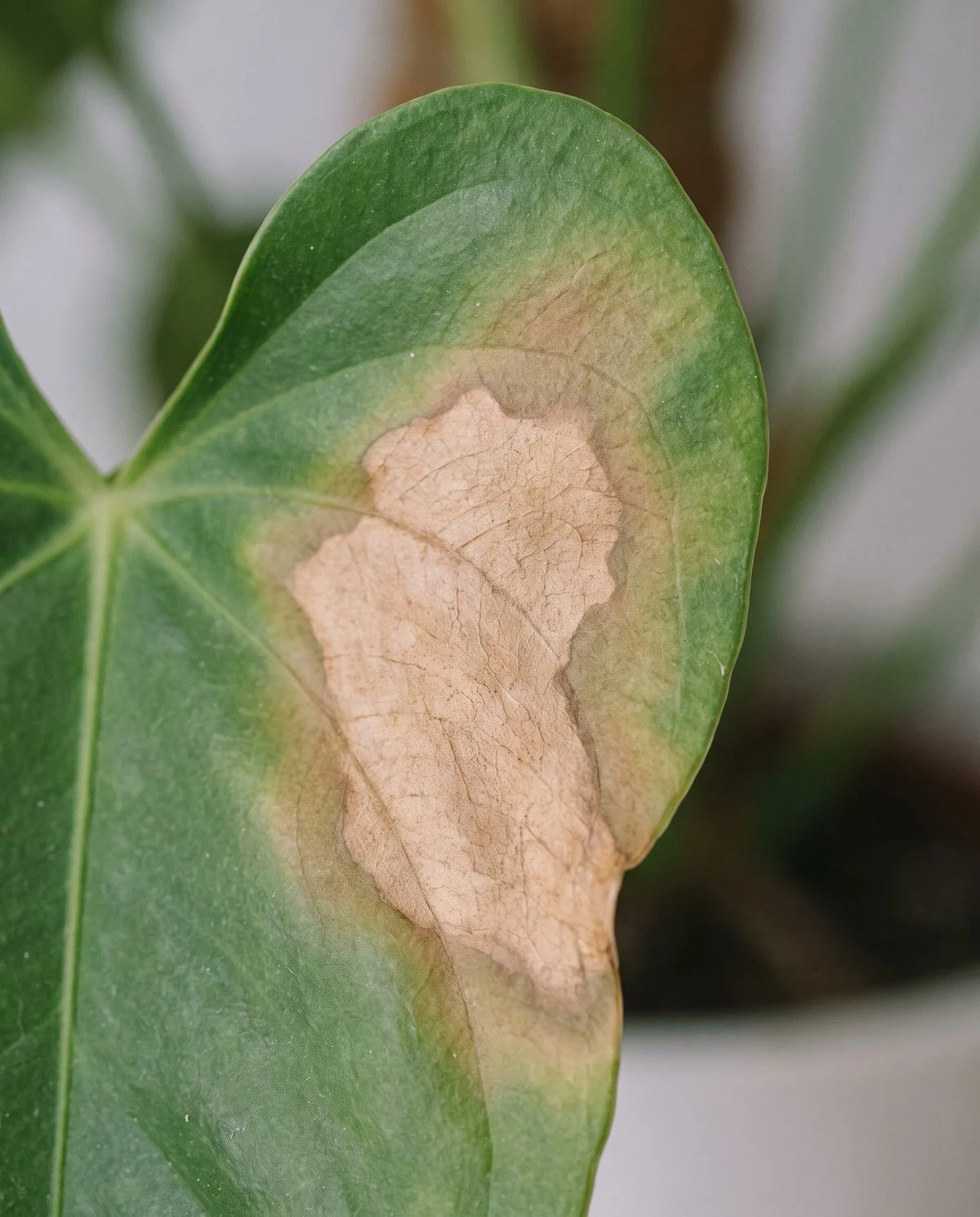
UF's own physiological table names it in four words, broad, dry, tan blotches on leaves, with excess light as the cause and 2,500 foot-candles as the ceiling not to exceed. It is uniform and edgeless. Bacterial blight looks nothing like that in UF's disease publication: the first visible symptoms are yellowed, water-soaked lesions along the leaf margins that grow rapidly into dead V-shaped lesions characteristic of the disease, because the bacteria enter through hydathodes, the pores at the leaf margin where guttation droplets form overnight. Systemically infected leaves take on a bronzed cast, lesions can appear on the flowers too, and some infected plants stay symptomless for months while still infecting their neighbours. There is no photo of the blight side here on purpose: that V-shaped, water-soaked margin is a checkable fingerprint that has to come from a real reference photo.
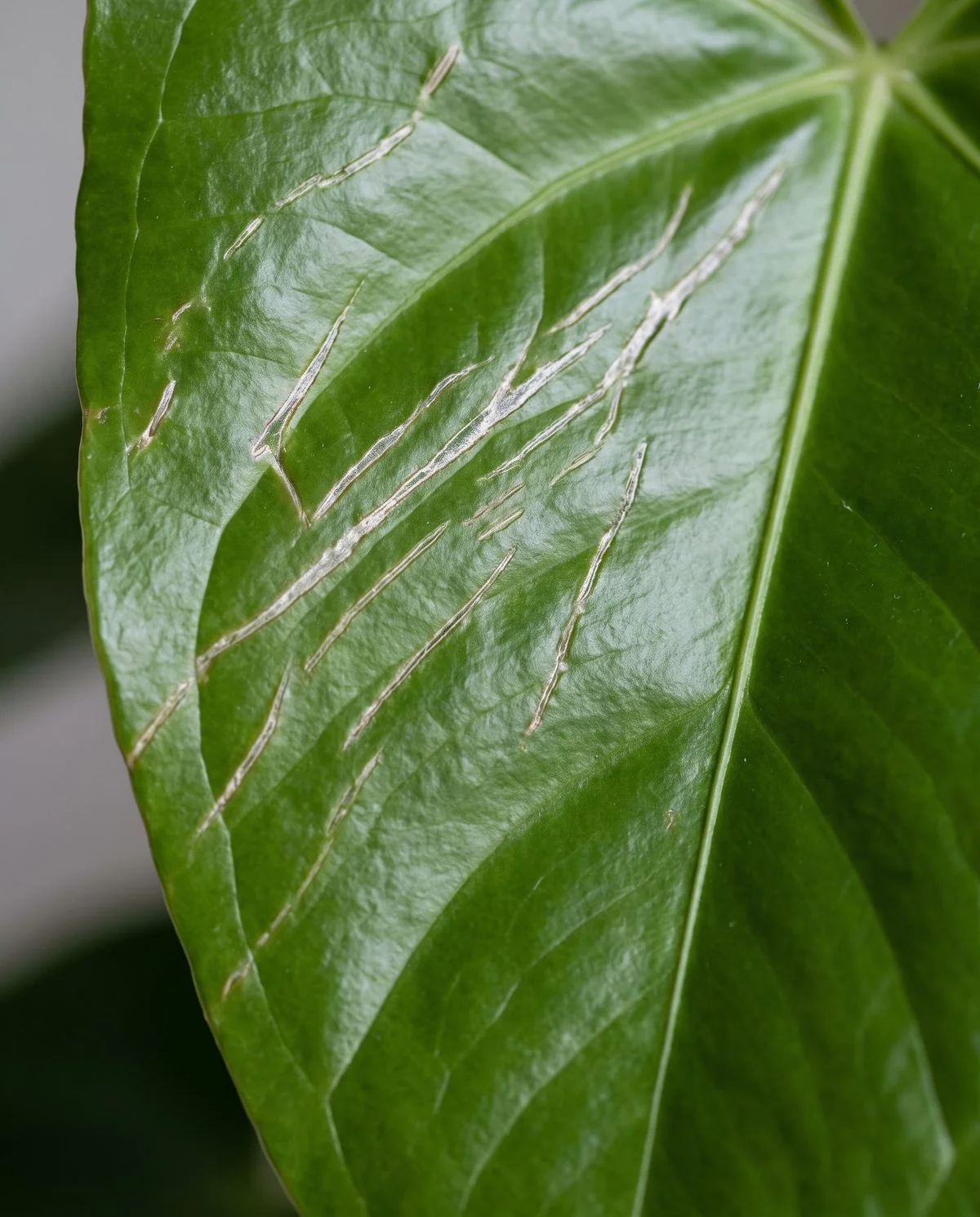
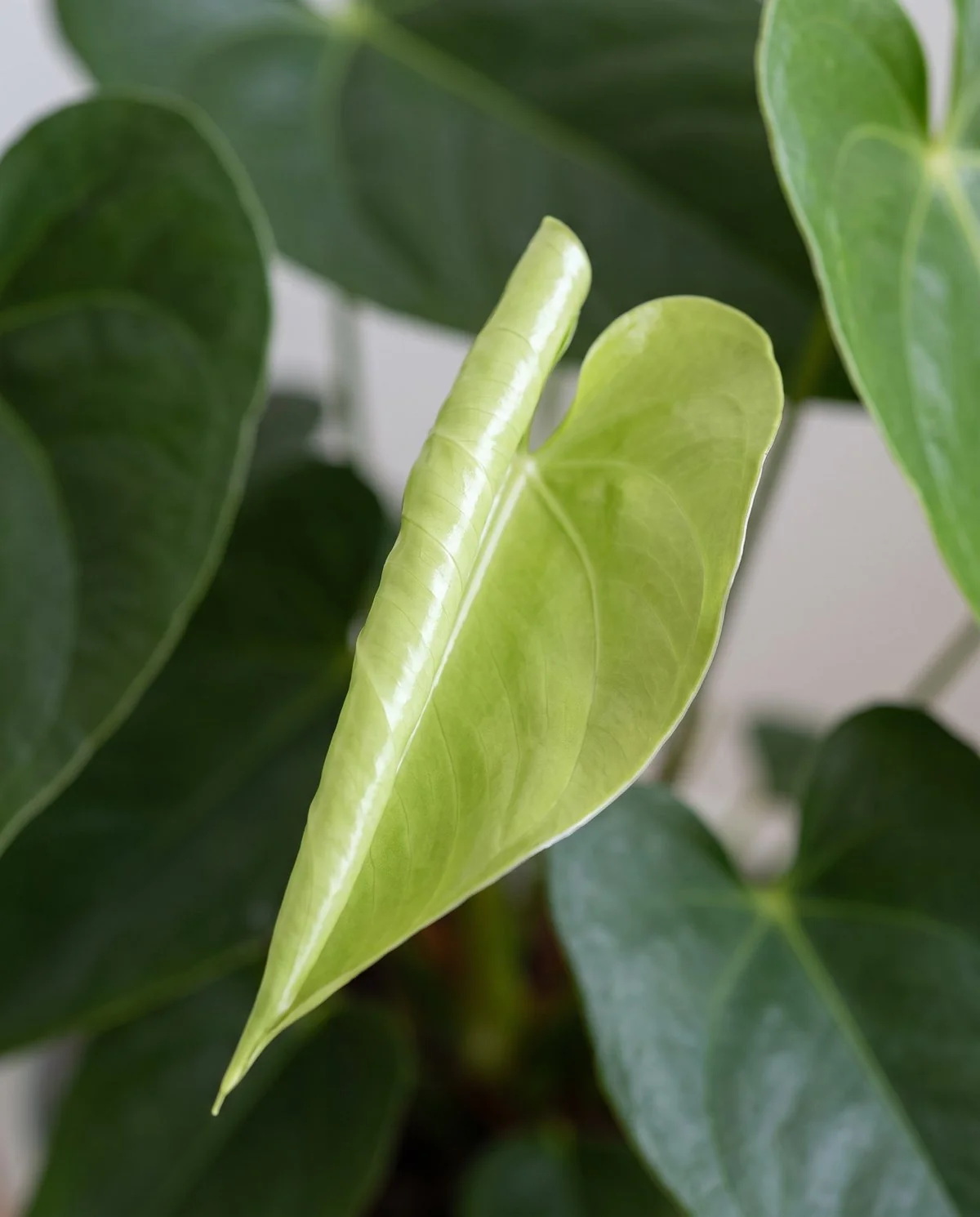
The scarring is fixed in place. Thrips feed on a leaf while it is still furled, so the silvering, stippling and slit texture expand with the leaf and stay visible long after the insects are gone, which is why treating the plant does not repair the leaf. A healthy new leaf unfurls glossy and uniformly coloured and follows the plant's normal colour progression as it hardens off. NC State's pest list for the genus names thrips alongside mealybugs, spider mites, whiteflies, scale and aphids, and thrips is the single most-named pest in the corpus, repeatedly on internationally shipped plants that arrived already damaged.
UF's disease publication describes Rhizoctonia as damping-off in young growth with water-soaked, girdled stems and discoloured brown roots, and it produces small irregular brown sclerotia that resemble soil particles and stick to pots and trays, which is how it travels. The water molds, Phytophthora and Pythium, show wilting, leaf yellowing and root sloughing, which UF calls the primary diagnostic tool, with black-to-brown leaf lesions in severe cases. UF then states the differentiator outright: fungal strands, mycelial growth, are rarely observed with Phytophthora or Pythium infections. Neither side is illustrated here, because both are pathogen fingerprints.
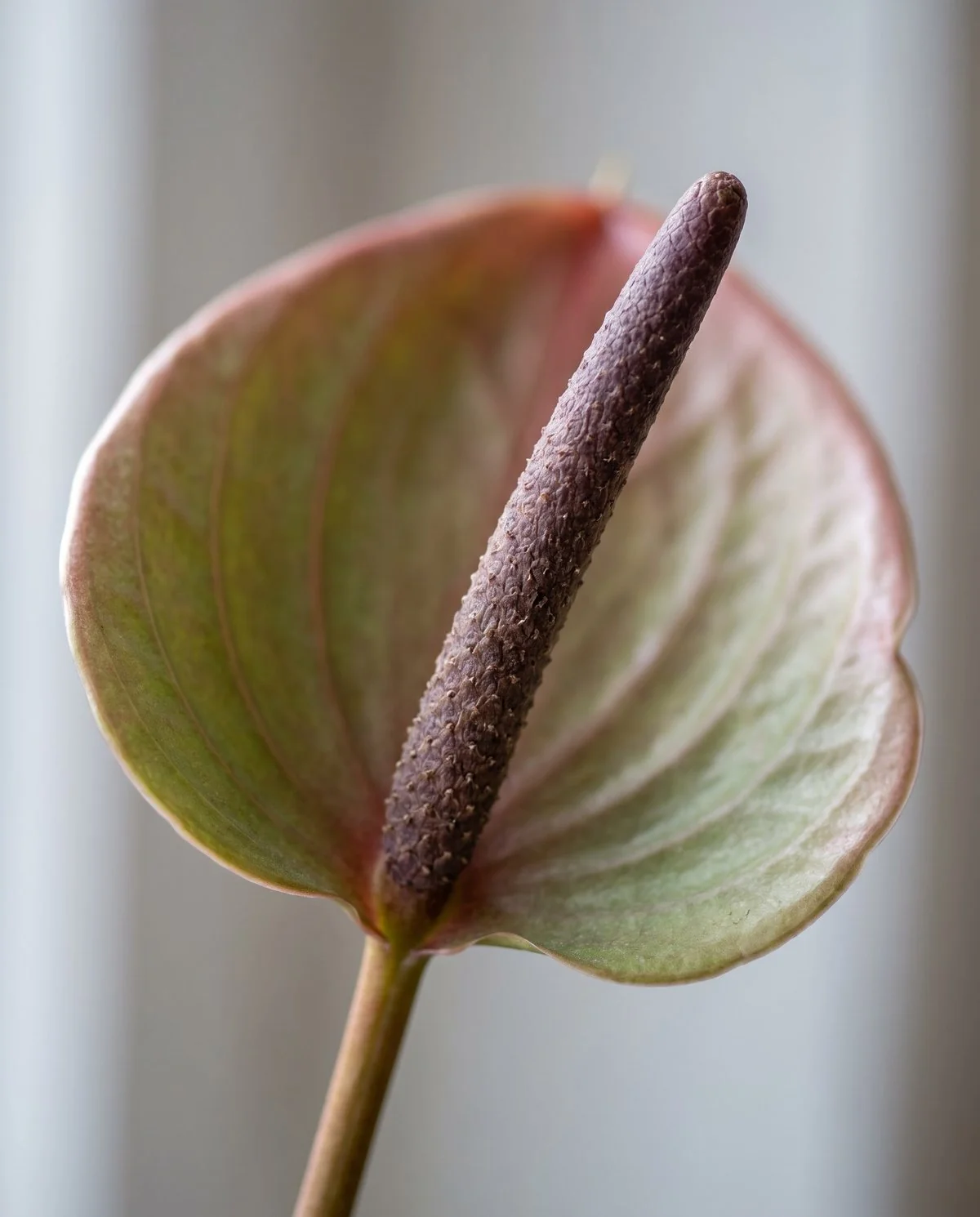
Normal ageing darkens the spadix gradually and uniformly as the true flowers along it finish, with no discrete flecks and no wet texture. Black nose is Colletotrichum gloeosporioides, and UF notes it is unusual for that fungus in attacking only the spadix portion of the flower, the nose: small brown-to-black flecks that enlarge, turn watery and may take in the whole spadix, which can eventually fall off. It is favoured by warm humid conditions and readily invades tissue already damaged by pesticides, fertilizer burn or bacterial blight, so it often arrives second rather than first.
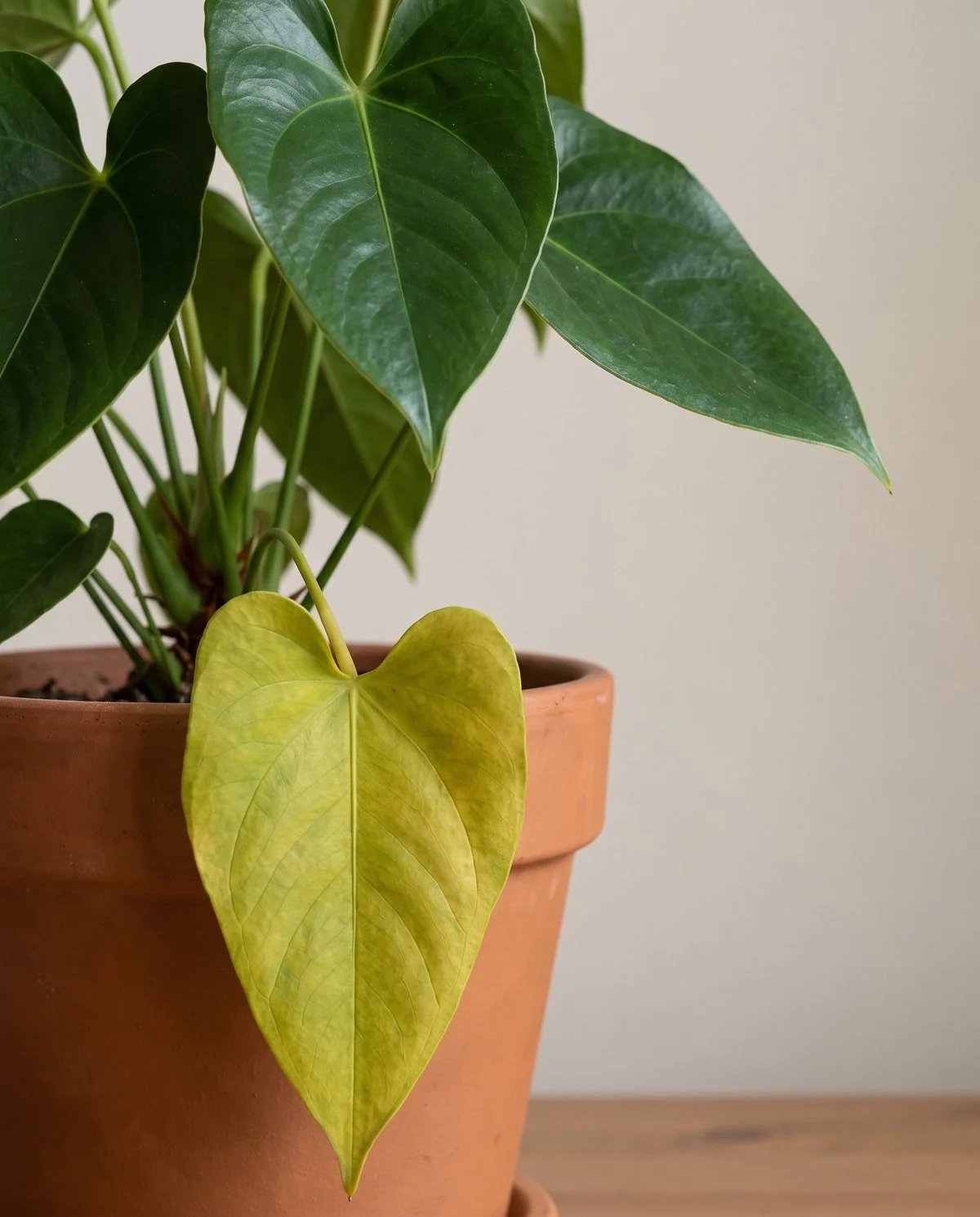
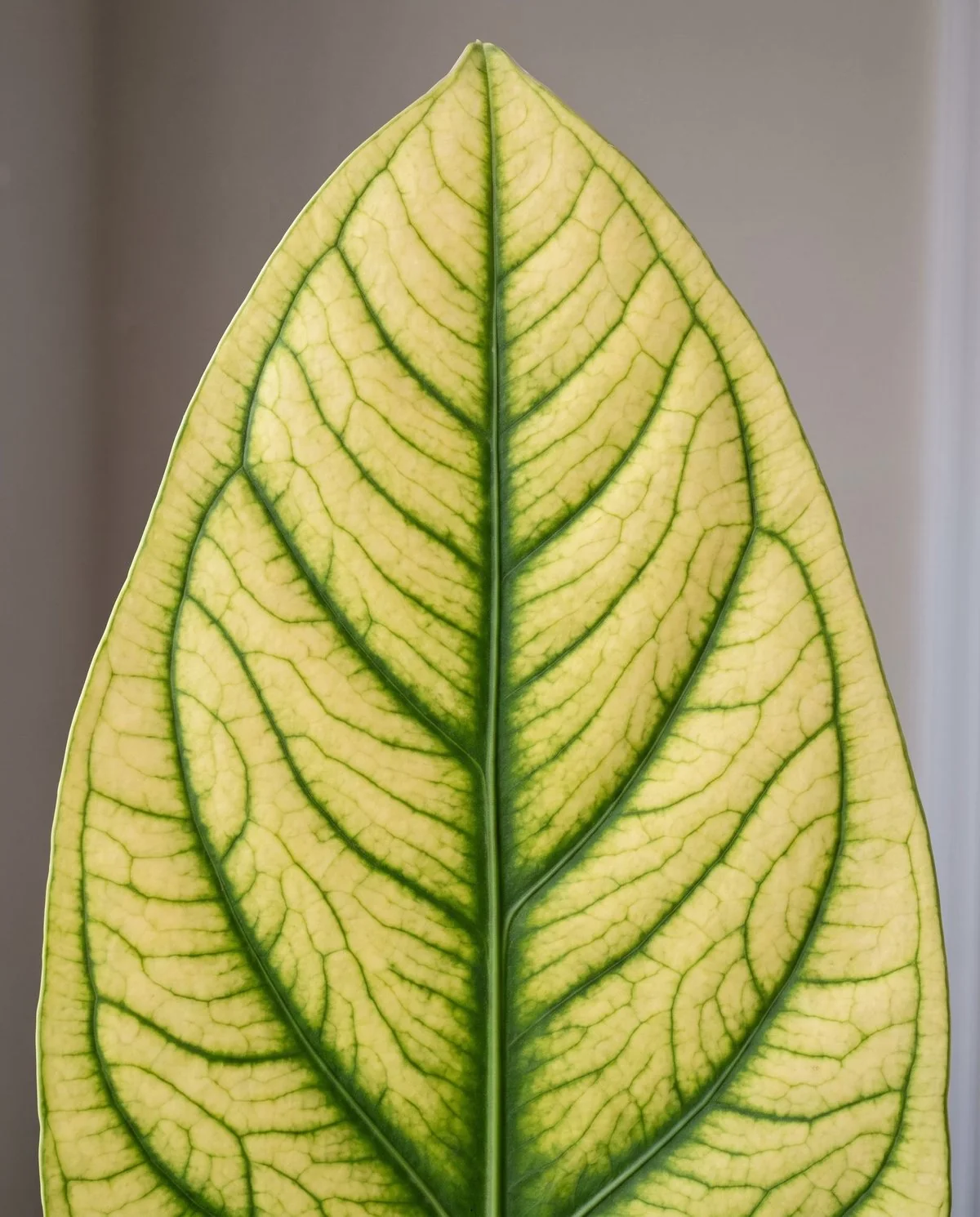
One oldest leaf yellowing and being shed while newer leaves stay dark green and glossy is ordinary senescence. UF's table names the alternatives in its own words: overwatering as chlorotic older leaves with root damage, underwatering as tip burn, root damage and reduced growth, and magnesium deficiency as interveinal yellowing or chlorosis on older leaves, where the veins keep their green while the tissue between them fades. Which leaf, how many, and whether the veins hold colour is the whole call.
Flower photos


FAQ
How do I get my anthurium to bloom again?
Light first. Enough bright, indirect light is the number-one reason an anthurium flowers or refuses to, so move a stalled plant closer to an east window or behind a sheer curtain. Then feed it through the growing season with a fertilizer slightly higher in phosphorus, keep it warm and humid, and do not let it sit starved in a spent pot. Anthurium likes to be a touch root-bound, so snugness itself is fine; a well-lit, well-fed plant blooms in waves and can stay in color most of the year.
Why are my anthurium's leaves turning yellow?
The most common cause by far is overwatering and a mix that stays soggy, which suffocates and rots the roots. Let the top inch of mix dry before you water again, make sure the pot drains freely, and check the roots for soft brown rot if yellowing spreads. Light extremes and cold drafts can also yellow leaves, and an occasional lower leaf turning yellow as it ages is simply the plant’s normal turnover. Brown, crispy tips are a different signal, usually low humidity, underwatering, or salt buildup from tap water.
How often should I water an anthurium?
Water when the top inch of the mix feels dry, which often works out to about once a week but varies with light, warmth, and pot size. Soak thoroughly, let it drain fully, and empty the saucer so the roots never sit in water. The mix should be moist but never soggy, since the roots need air as much as moisture.
Are anthuriums toxic to pets?
Yes. Anthurium contains insoluble calcium oxalate crystals and is listed as toxic to cats, dogs, and horses by the ASPCA. Chewing it irritates the mouth and throat and may cause drooling, and the sap can irritate skin and eyes, so keep the plant out of reach of pets and small children.
Can anthuriums grow in low light?
They survive in low light but rarely thrive in it. In a dim spot the plant tends to stop flowering, grow slowly, and stretch toward the nearest window. It will keep its leaves in moderate light, but for the weeks-long spathes people grow it for, it needs bright, indirect light.
How long do anthurium blooms last?
Each spathe holds for several weeks on the plant, and cut spathes commonly last 2 to 3 weeks in a vase, longer in a cool room. Because the plant flowers in waves, a healthy anthurium usually has something open at almost any time of year.
How do I propagate an anthurium?
Divide it. When repotting in spring or early summer, separate an offset from the base that has its own roots and at least one leaf, then pot it into fresh airy mix and keep it warm, lightly moist, and humid until it puts out new growth.
When should I repot, and what mix should I use?
This is the single largest question in the corpus, 16 percent of the problem-framed posts. Repot when the plant is root-bound, and roughly every 2 years regardless, since Missouri Botanical Garden frames that interval around ridding the soil of unabsorbed minerals rather than around pot size. UF's own production recipe is 1:1:1 peat, perlite and bark at pH 6.0 to 6.5, and the home equivalent of that principle is roughly equal parts standard potting mix and orchid bark or perlite: maximum drainage and aeration, because the roots want air as much as water.
What's wrong with these spots, bacterial or fungal?
Check the shape and the margin. UF's bacterial-blight fingerprint is a V-shaped lesion with a water-soaked margin starting at the leaf edge, sometimes with a bronzed cast across a badly infected leaf. The fungal root rots, Rhizoctonia and the Phytophthora and Pythium water molds, show up in the roots and at the stem base far more than as leaf spots. A broad, dry, uniformly tan blotch with no defined lesion margin is more likely sunburn than either disease.
Why is my anthurium flower turning green?
A spathe fading and developing green streaks toward the end of its bloom cycle is expected, and poor light makes the same shift happen faster and more intensely, since the spathe is a modified leaf and can produce chlorophyll when it is light-starved. The honest caveat: no extension or university source found in this research states the mechanism or a timeline for spathe greening, so that account is consumer-tier and is presented as such rather than dressed up with a citation it does not have.
It smells bad and the leaves are drooping. What is that?
A genuine bad odour coming from the pot is a strong signal of anaerobic root rot from overwatering or poor drainage, and it is the diagnostic no photo can carry. Check the roots rather than the leaves, and expect soft, dark, foul-smelling tissue rather than the firm whitish-to-tan roots of a healthy plant.
What kind of anthurium do I have?
Identification is a real category here, 6.6 percent of the problem-framed posts, because unlabelled big-box plants and no-ID sales in the collector trade both arrive nameless. Check the spadix first: straight means the andraeanum type, the common flowering anthurium, and tightly curled or corkscrewed means Anthurium scherzerianum, a different species entirely per NC State. A velvet, non-glossy, patterned leaf with no flower in sight is very likely one of the foliage species, clarinervium, crystallinum, warocqueanum and their many named hybrids, grown for the leaf rather than the bloom.
Interesting tips
Wipe dusty leaves with a soft, damp cloth every few weeks so they can breathe and shine, and skip commercial leaf-shine sprays, since the film they leave behind only attracts more dust. When shopping, remember that anthurium’s real colors run red, pink, orange, white, green, and bicolor; a true blue is not natural and a uniform bright yellow is uncommon, so treat vividly dyed plants with a little caution because that color washes out over time. The plant carries a warm meaning of hospitality and welcome, which is part of why it turns up so often as a housewarming gift, and it is grown commercially across the tropics precisely because those spathes last so long in arrangements. For a flowering houseplant that keeps its color for weeks on end, anthurium is a rewarding pick: give it bright filtered light, an airy mix, and steady but never soggy moisture, and it largely takes care of itself.
Related Guides & Flowers
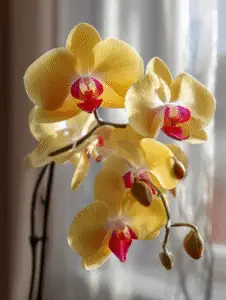
Moth Orchid
(Phalaenopsis)
Short note: Another long blooming tropical houseplant that likes bright, indirect light and steady warmth. Great for a similar indoor, elegant look.
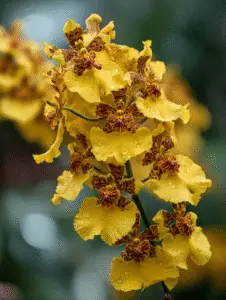
Oncidium Orchid
Short note: A different orchid style with airy sprays of blooms, still fits the same tropical, indoor plant vibe as Anthurium.
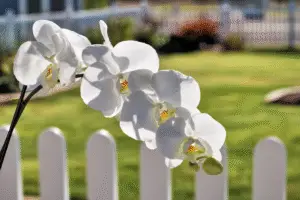
Orchid
Short note: A general orchid guide page that pairs naturally with Anthurium for indoor care, humidity, and bright indirect light topics.

Bird of Paradise
Short note: Bold tropical foliage and statement blooms, ideal if the reader wants the same exotic, modern interior feel but on a larger scale.
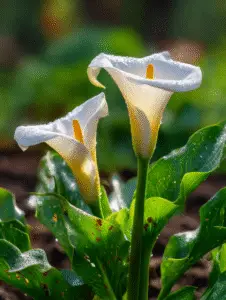
Calla Lily
Short note: Similar visual effect with a sleek spathe shape, popular in modern decor and bouquets, good as a related flower lookalike.
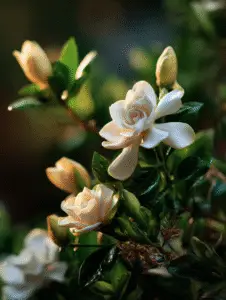
Gardenia
Short note: Another premium indoor or patio plant with glossy leaves and a luxury vibe, strong contrast to Anthurium because fragrance is the main feature.
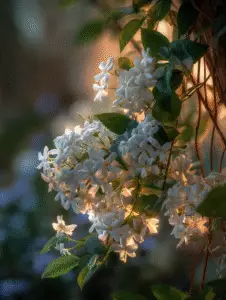
Jasmine Flower
Short note: If your reader wants a tropical style plant plus fragrance, jasmine is a strong next step, especially for bright windows and trellises.
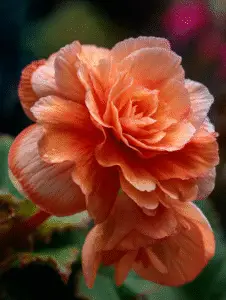
Begonia
Short note: Decorative foliage, indoor friendly, and color impact in smaller spaces, good for readers who want easier care options.
References
Enjoying our flower guides? Add YourFlowersGuide as a preferred source on Google. It helps more readers find us.
Add to Preferred Sources