
In the language of flowers
What jasmine symbolizes
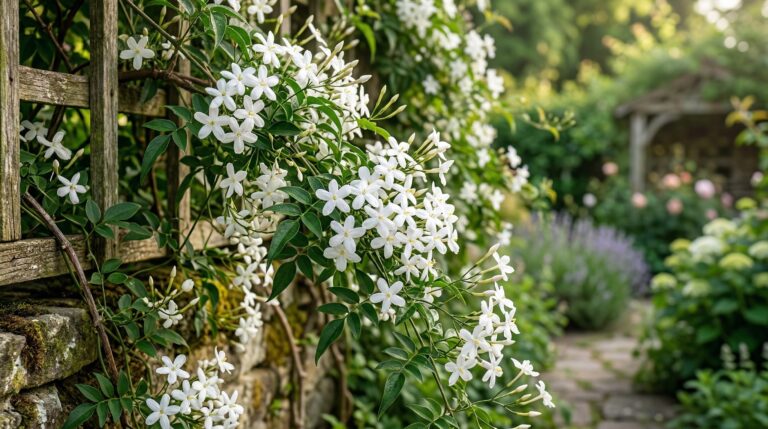
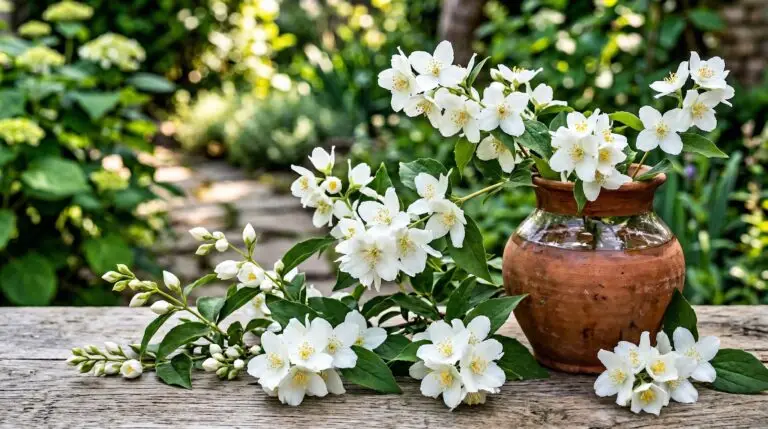
Jasmine traditionally stands for love, sweetness, and sensual attachment, with the white kind read as grace and modesty.
The Victorian reading. In Victorian flower lists jasmine signified amiability, and the white kind in particular was tied to sweetness and modesty.
- White Traditionally read as grace, sweetness, and modesty, the reading most often attached to common white jasmine.
What to write on the cardFor a deep love, jasmine carries the line "I attach myself to you."
Which jasmine do you actually have
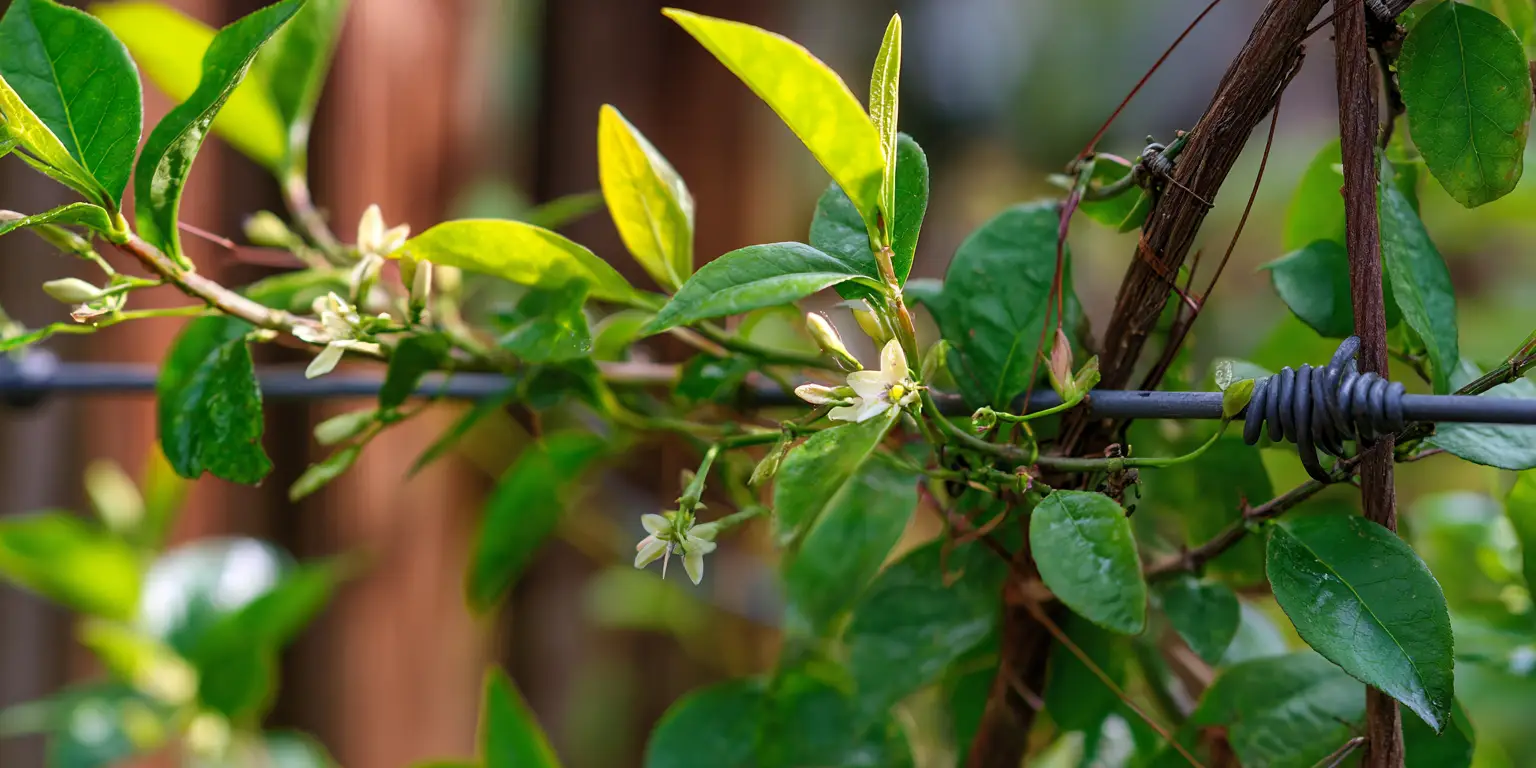
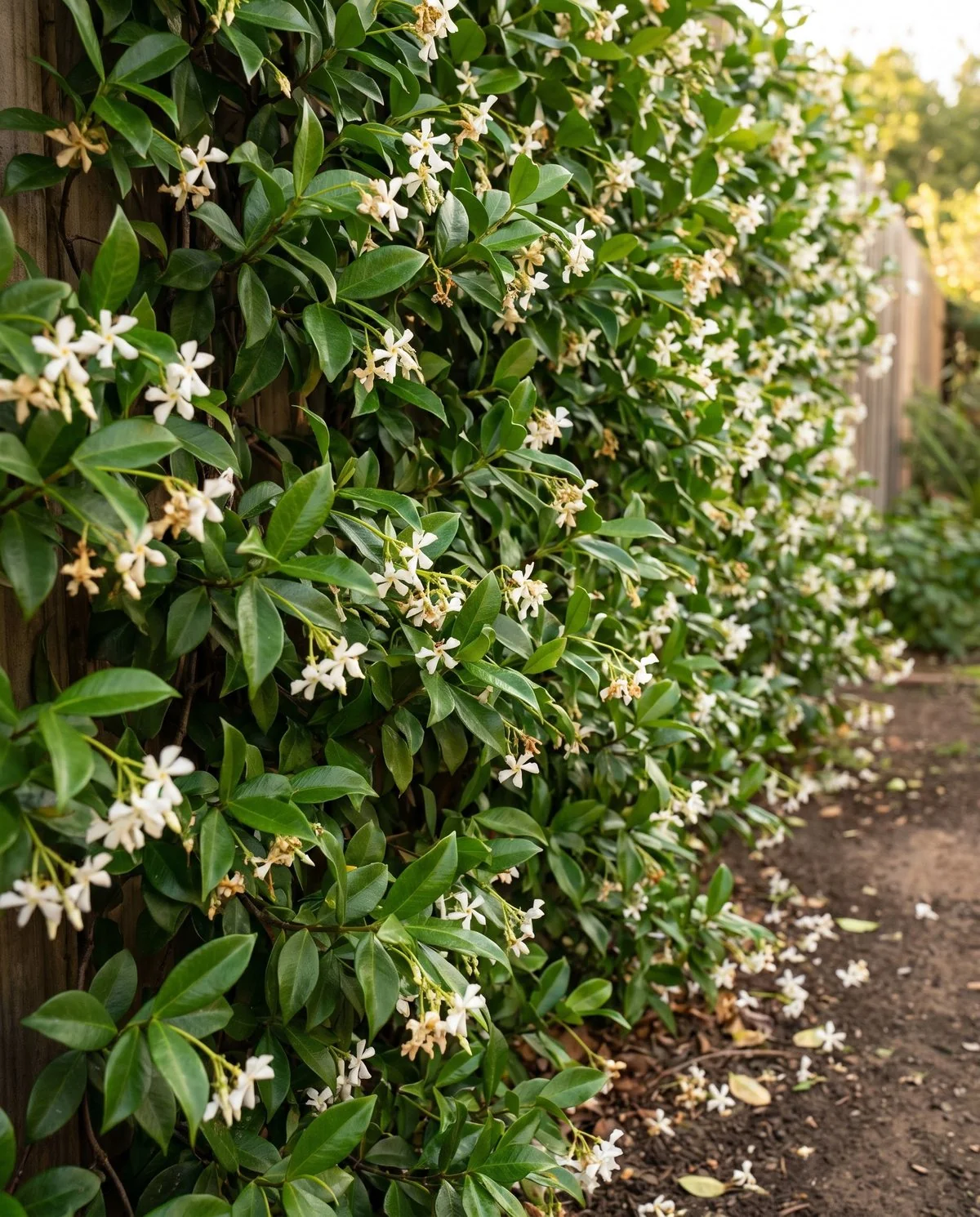
Start with the sap. Pull a leaf off its stalk and watch the break: star jasmine, the glossy evergreen vine most Americans have on a fence, is a dogbane and bleeds white latex within a second or two, while every true Jasminum runs clear. The test works out of bloom, when the question usually arises. Then the leaves, always in opposite pairs and split across the genus between simple and pinnate: common and pink jasmine have divided, slightly ferny foliage, five to seven leaflets with a longer one at the tip. Arabian jasmine has simple, rounded, faintly puckered leaves, star jasmine leathery pointed ones that flush bronze when new, and winter jasmine leaves in threes on green, four-angled stems stiff enough to feel with a thumbnail.
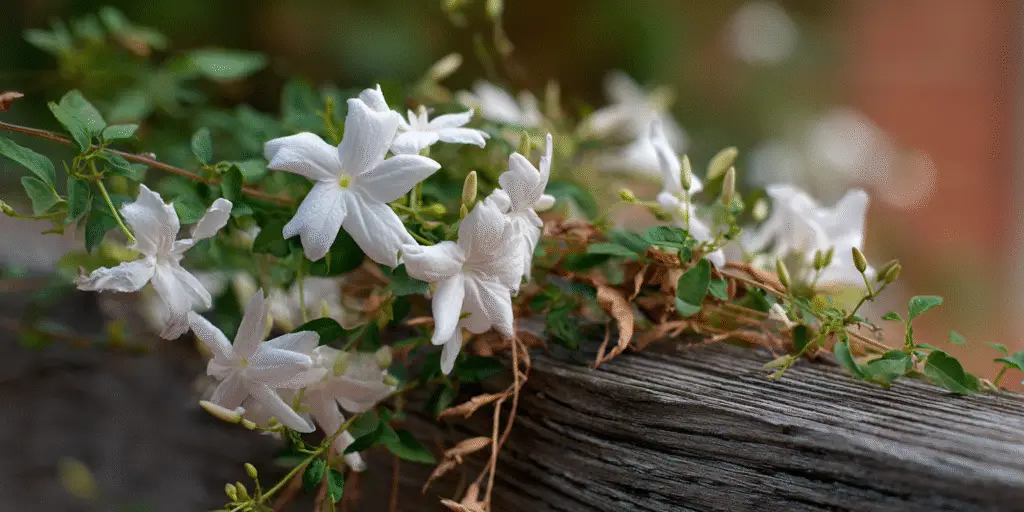
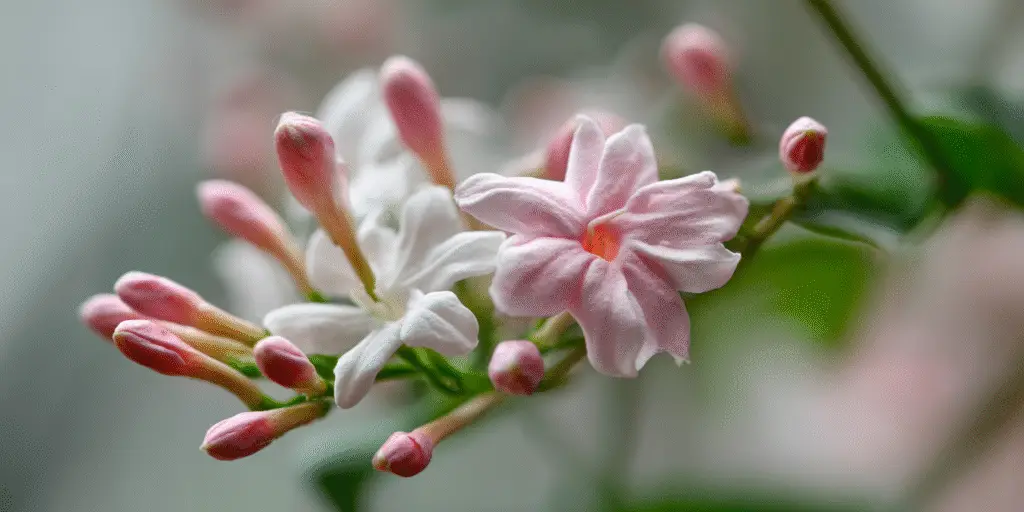
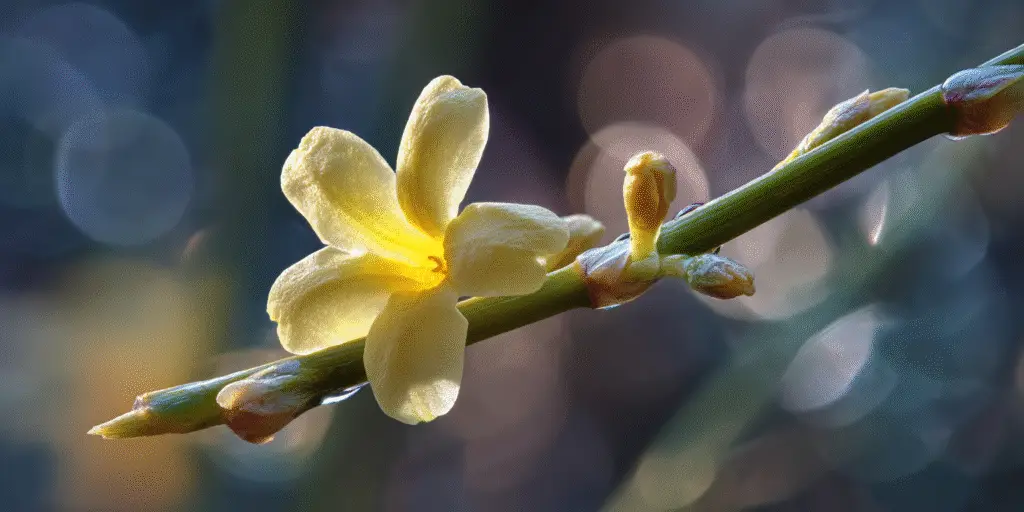
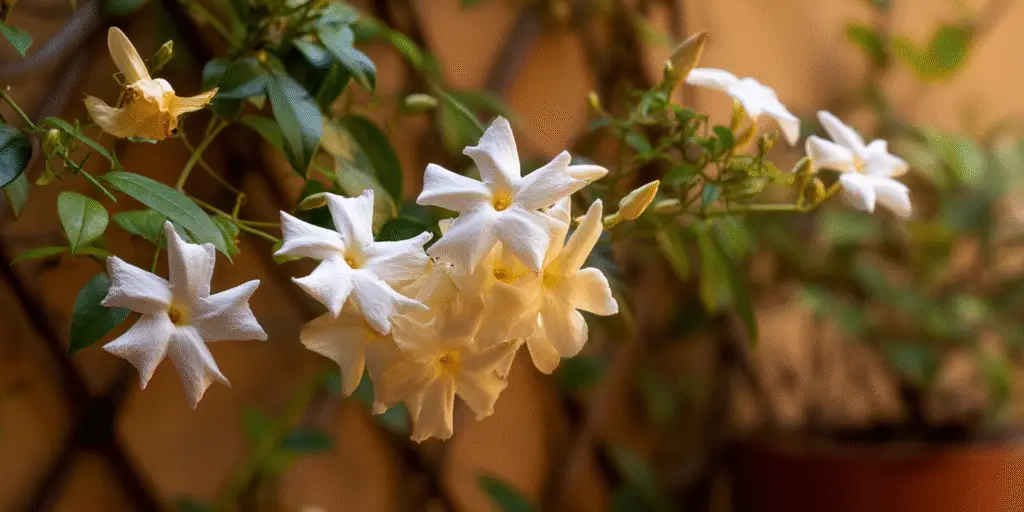
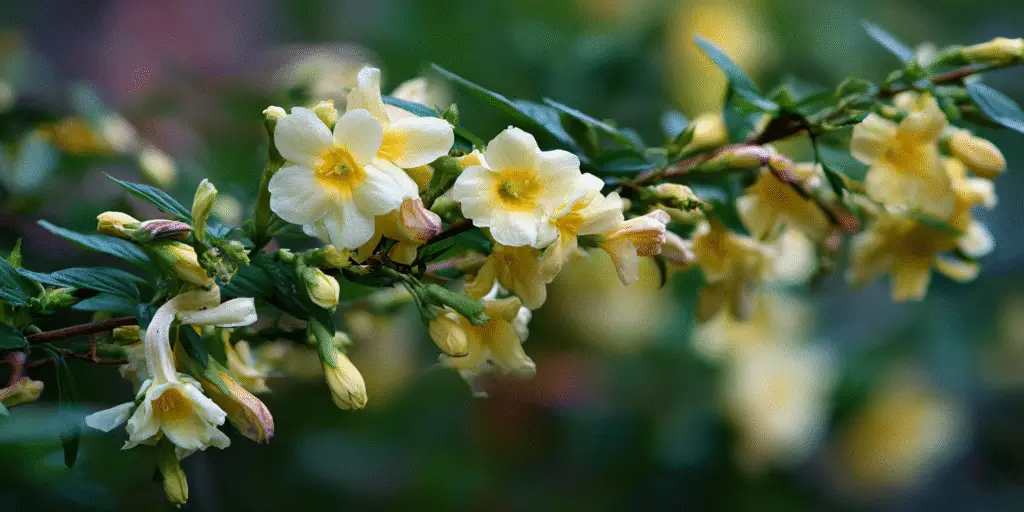
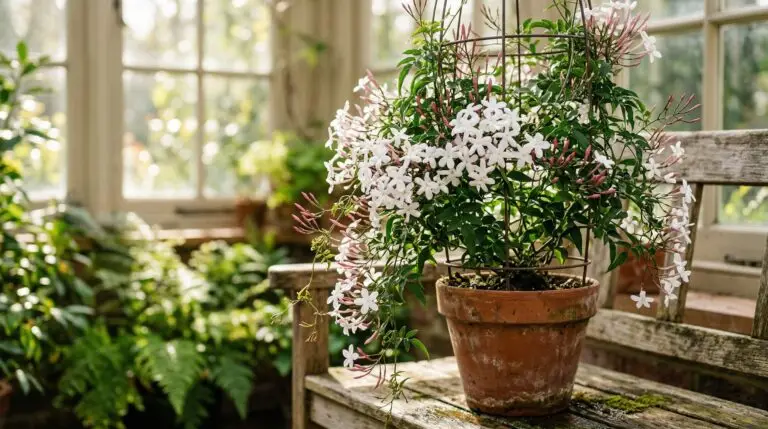
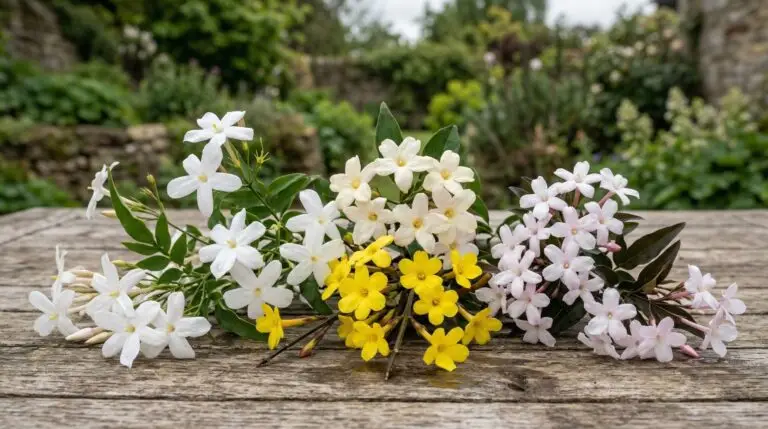
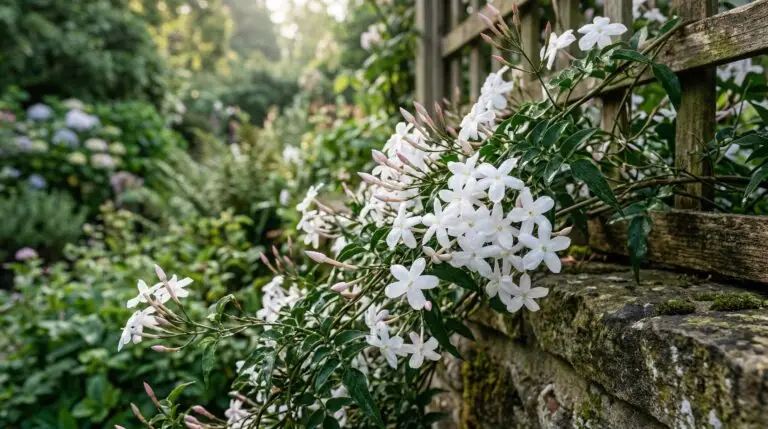
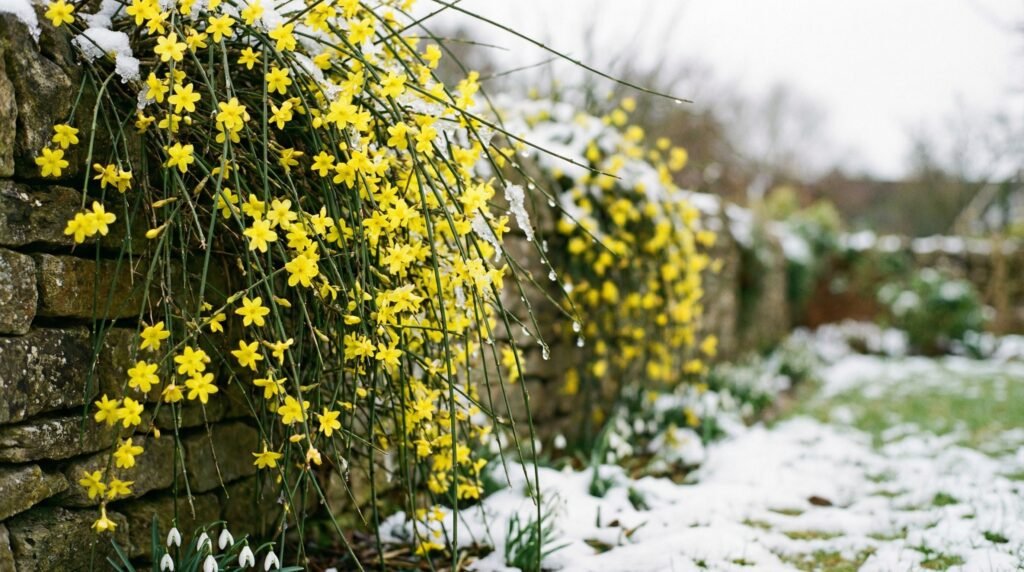
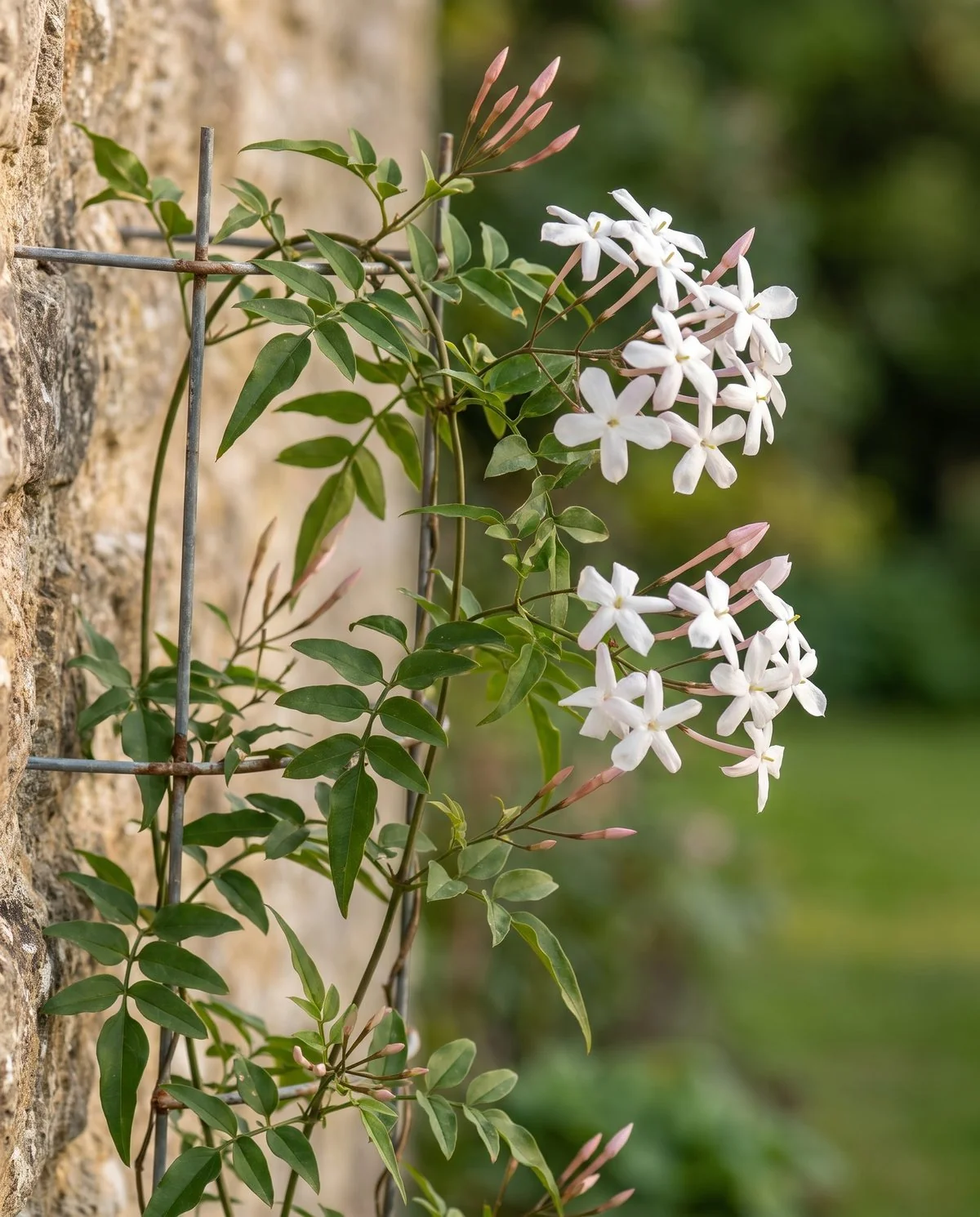
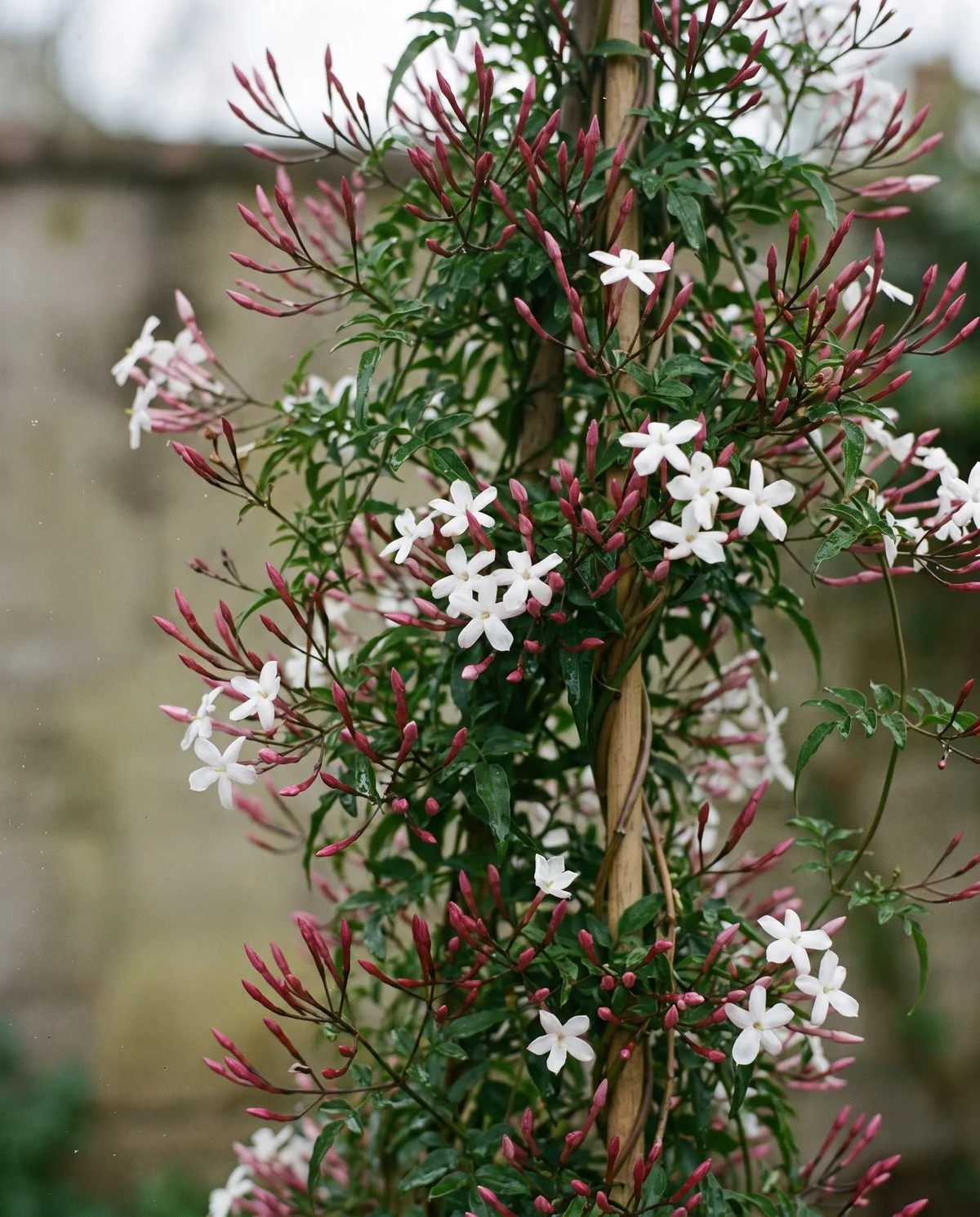
Flower color and season settle the rest. White pinwheels in high summer mean common jasmine, Jasminum officinale; a late-winter cloud of pink-budded white means pink jasmine, Jasminum polyanthum, sold on a wire hoop in flower shops; waxy doubles on a compact shrub mean Arabian jasmine, Jasminum sambac. Yellow demands a careful look, because that is where the risk lives. Small unscented yellow flowers on bare green stems in midwinter are winter jasmine, Jasminum nudiflorum, a harmless true jasmine routinely mistaken for forsythia, while bright fragrant yellow trumpets on a wiry evergreen vine in late winter across the Southeast are Carolina jessamine, a different family and poisonous throughout. Two more borrowed names: night-blooming jessamine, Cestrum nocturnum, a lanky nightshade whose greenish-white tubes stay shut all day and then scent a yard after dark, and Madagascar jasmine, which is stephanotis, the waxy wedding-bouquet flower, another dogbane with star jasmine's milky sap.
| What you see | The plant | True jasmine? | Around pets |
|---|---|---|---|
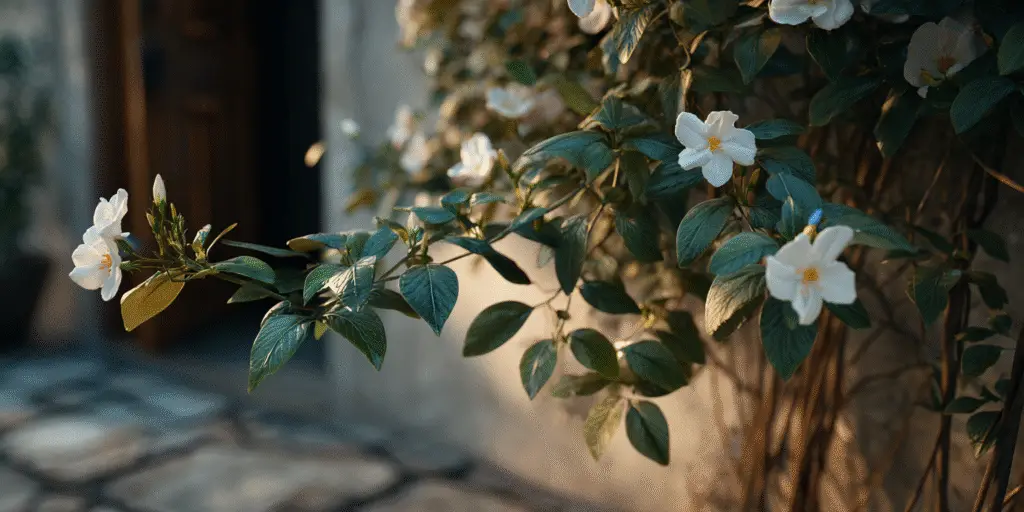
| White pinwheels, glossy leathery simple leaves, milky sap | Star or Confederate jasmine (Trachelospermum jasminoides) | No, dogbane family | Non-toxic per ASPCA |
| White pinwheels in summer, leaves divided into leaflets, clear sap | Common jasmine (Jasminum officinale) | Yes | Non-toxic per ASPCA |
| Pink buds opening white in a late-winter cloud, very fast growth | Pink jasmine (Jasminum polyanthum) | Yes | Non-toxic per ASPCA |
| Waxy white flowers, often double, compact shrub, simple leaves | Arabian jasmine (Jasminum sambac) | Yes | Non-toxic per ASPCA |
| Small yellow flowers, no scent, bare green angular stems in midwinter | Winter jasmine (Jasminum nudiflorum) | Yes | Non-toxic per ASPCA |
| Yellow fragrant trumpets, evergreen wiry vine, late winter in the Southeast | Carolina jessamine (Gelsemium sempervirens) | No, Gelsemiaceae | Poisonous in all parts |
| Narrow greenish-white tubes, scent only after dark, lanky shrub | Night-blooming jessamine (Cestrum nocturnum) | No, nightshade family | Toxic, keep out of reach |
Taxonomy and origin
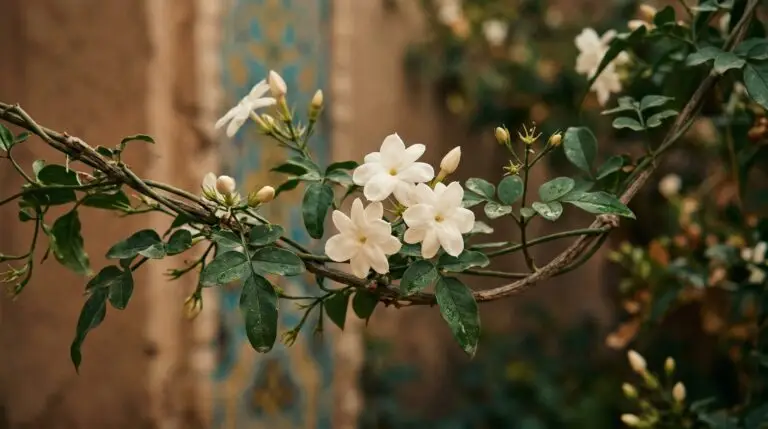
Jasminum sits in Oleaceae, the olive family, alongside the olive tree, lilac, privet, ash and forsythia, a kinship that shows in winter jasmine flowering yellow on bare stems in the cold. Botanists recognize around 200 species, concentrated in tropical and subtropical Asia and reaching into Africa and Australasia: common jasmine ranges from the Caucasus and Iran east through the Himalaya into western China, pink jasmine comes from Yunnan, and Arabian jasmine, despite its name, is native to South and Southeast Asia. Each bloom is a narrow tube that flares abruptly at the mouth into a whorl of four to nine spreading lobes, reading as a pinwheel rather than a cup or a trumpet, which is what people mean by calling jasmine star-shaped. The name traces through Arabic to the Persian yasmin.
Eight plants sold as jasmine, and what the toxicity sources say about each
The name is applied across at least seven genera in five plant families, and the safety verdict follows the genus rather than the label. Five of these were checked one plant page at a time against the ASPCA database, NC State Extension carries the Carolina jessamine verdict, and where a plant went unchecked it is marked unchecked rather than assumed safe.
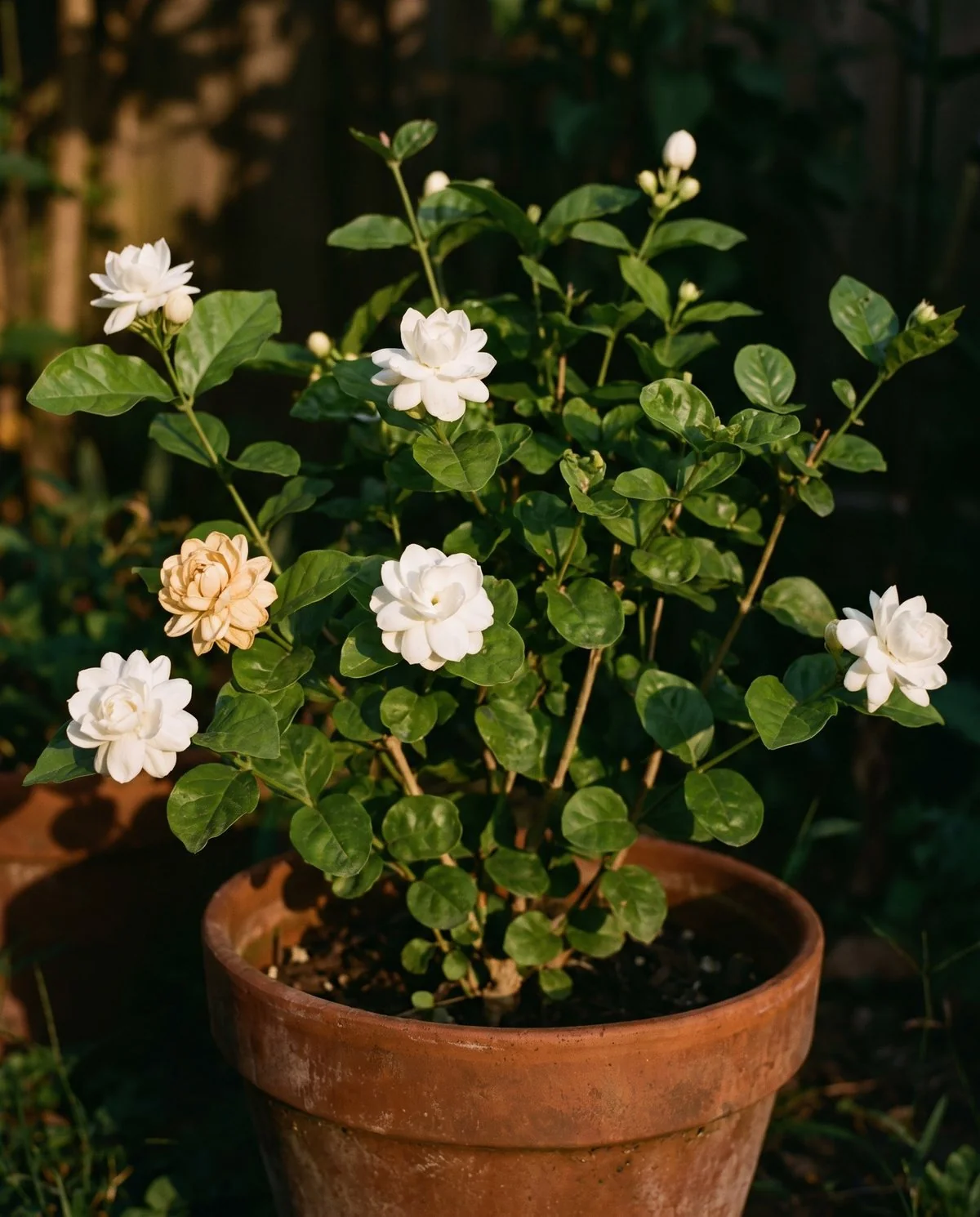
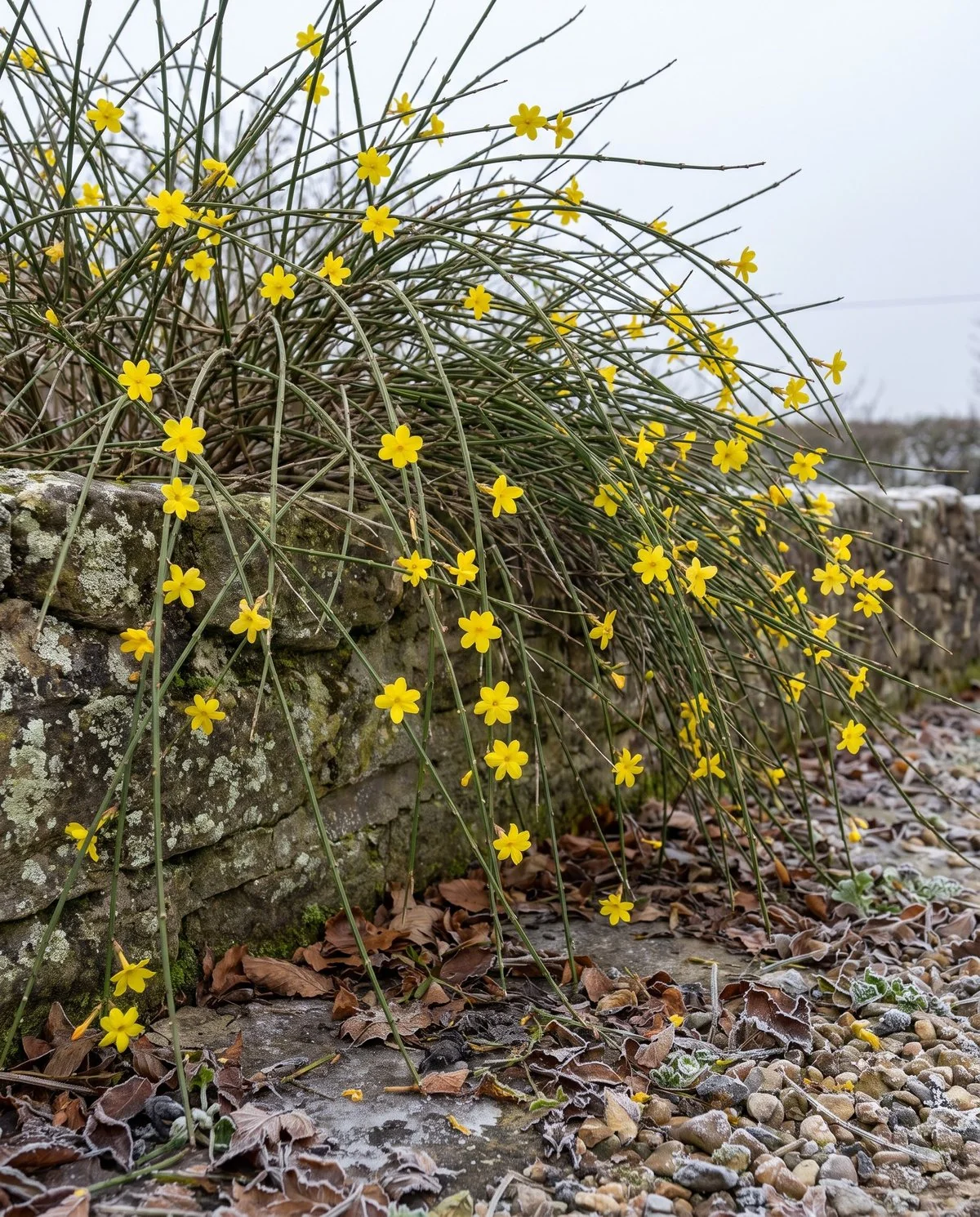
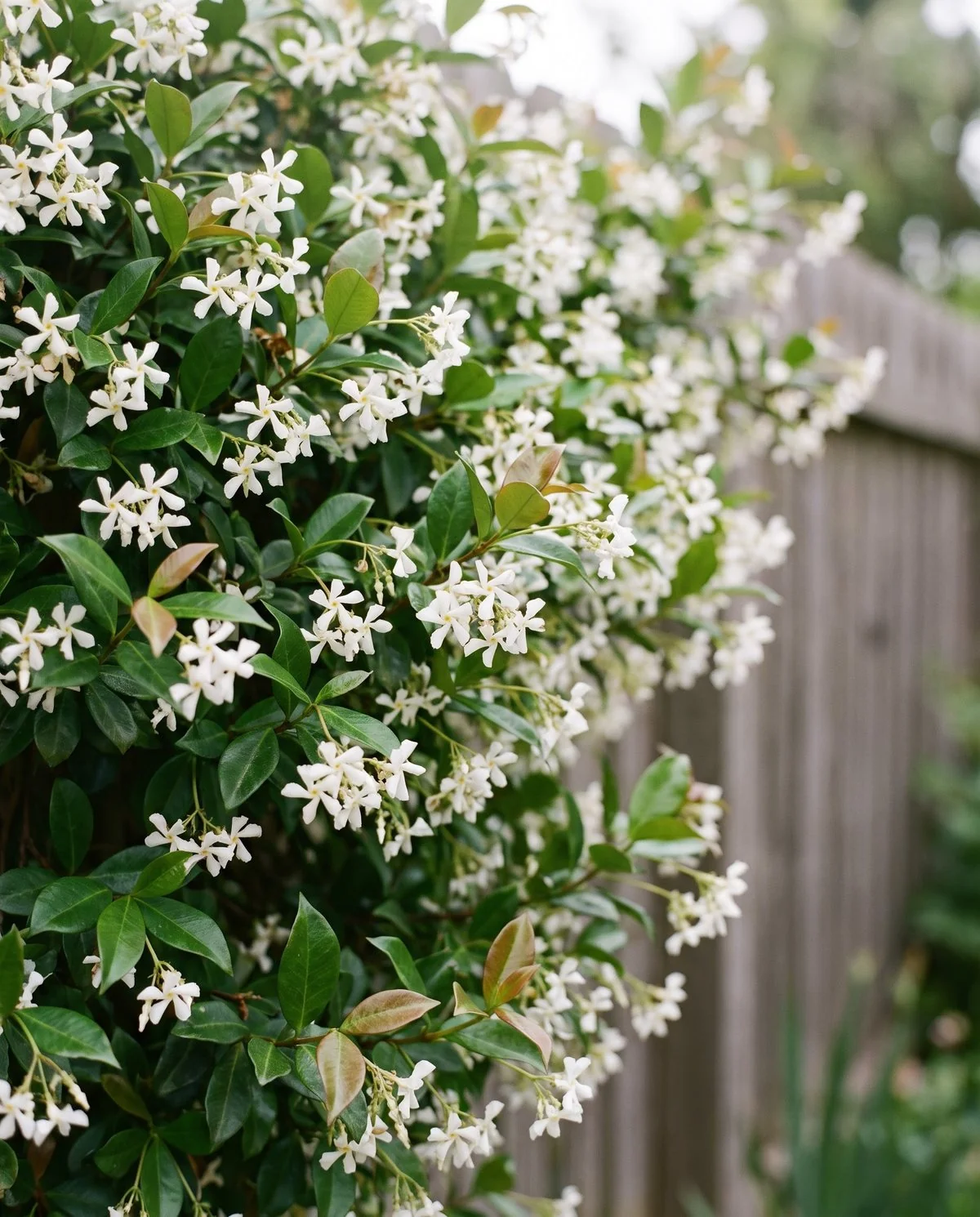
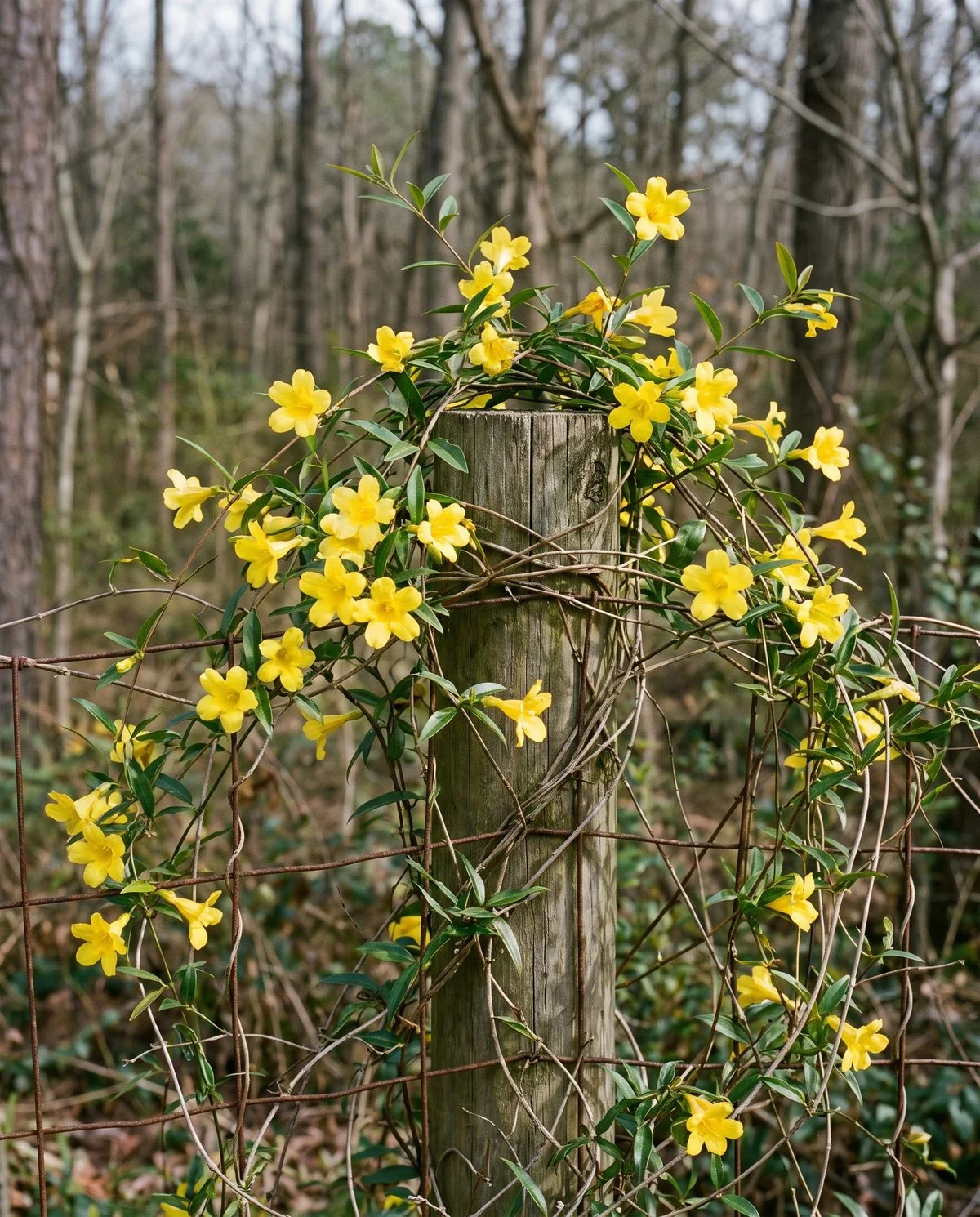
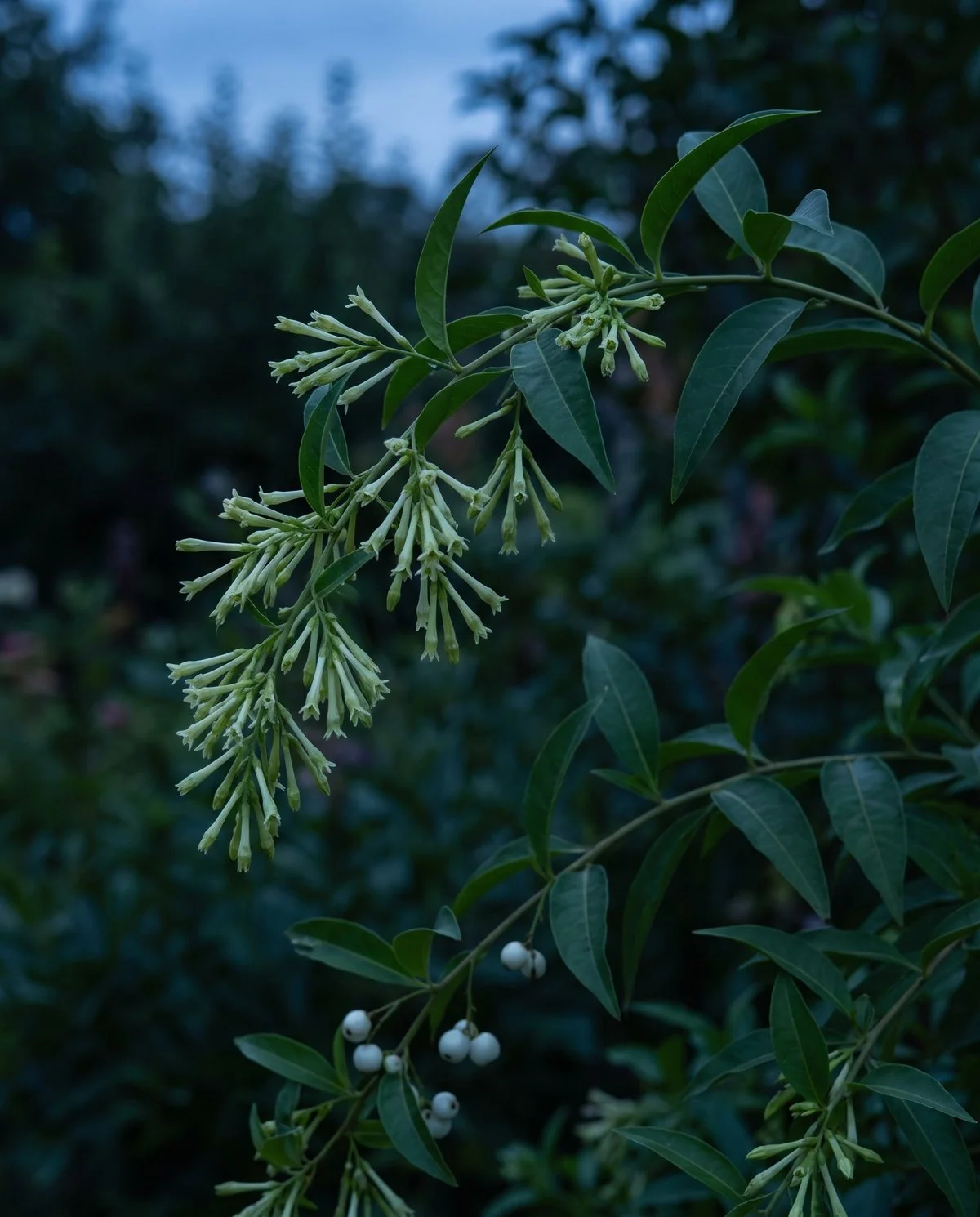
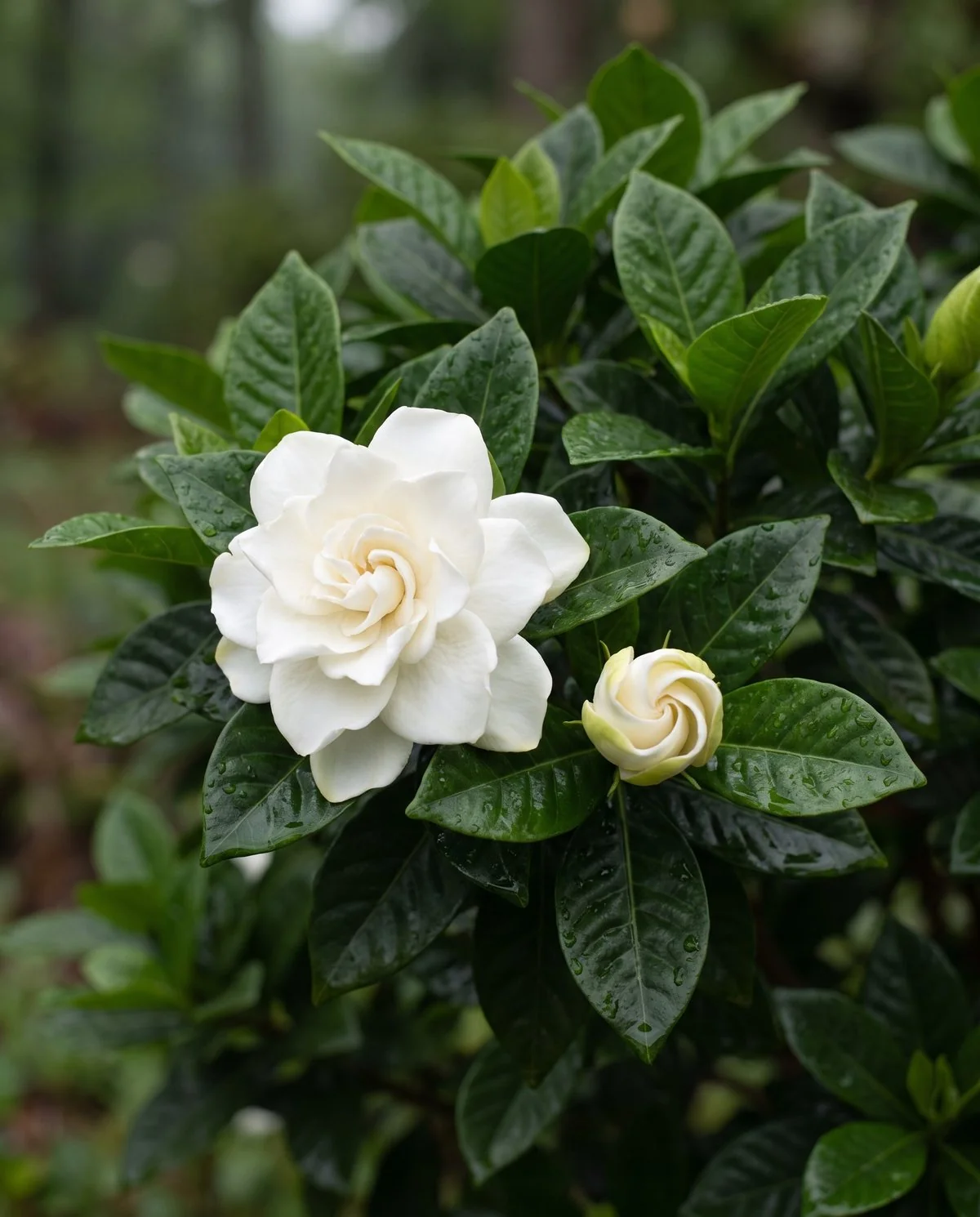
Five more carry the name and sit outside this grid. Paraguayan jasmine, Brunfelsia, is listed by ASPCA as toxic to dogs, cats and horses for brunfelsamidine, with tremors, seizures running for several days, diarrhea, vomiting, hypersalivation, lethargy, incoordination and coughing. Madagascar jasmine, Stephanotis floribunda, is another dogbane sold as jasmine and appears twice in this research corpus under that name; it went unchecked against ASPCA and is treated as unchecked. Angel-wing jasmine, Jasminum nitidum, is a true Jasminum that also carries the common name star jasmine, so those two words point at two plants in two different families. Clemson adds showy jasmine, Jasminum floridum, hardy in the Lower Piedmont, with scentless yellow flowers from April to June and, in Clemson's own words, grown more for its foliage than its flowers. Asiatic star jasmine, Trachelospermum asiaticum, is more cold-tolerant than its cousin, carries smaller leaves and yellowish-white flowers, and turns genuinely invasive in warm humid climates if it is left untrimmed.
Bloom time
Something called jasmine is in flower nearly every month of the year, so bloom time alone identifies nothing without a look at the foliage. Winter jasmine opens first, midwinter into early spring, scattering yellow along bare stems while the ground is still frozen; pink jasmine follows in late winter with a flush of four to six weeks that then stops; star jasmine gives one heavy flush in late spring; common jasmine runs from early summer into early fall; and Arabian jasmine, given warmth, repeats in waves nearly year round, its flowers self-dating as they open pure white, age through cream to purplish pink, then drop.
For scent the daily clock matters more than the calendar. Most fragrant species open in the evening and hold peak output through the middle of the night, Arabian jasmine most heavily in the small hours, because a white flower advertising by smell in darkness is built for night-flying moths rather than bees.

Year one, year two, and after
Year one goes into establishment and training rather than into flowers. NC State records Jasminum officinale putting on 12 to 24 inches a year, and Clemson's first-season guidance is to pinch new growth often, which builds a full framework instead of one long runner and costs that season's bloom on a young plant, particularly one raised from a cutting. Year two is decided by a mechanism rather than by the calendar: pink jasmine sets its buds across roughly six weeks of cool autumn air with a genuine day-to-night swing, so a plant that spends every autumn in an evenly heated room stays green, healthy and budless indefinitely. That is the most likely reading of the posts describing a jasmine that used to carry a lot of flowers and now carries none, though no individual case in that sample was confirmed. Hardiness belongs to the named plant rather than to the word jasmine, which is why a zone 8b star jasmine can die back every winter after being sold as an evergreen: Clemson's own note is that Confederate jasmine is hardy in central and coastal South Carolina and tender in the Piedmont, with 'Madison' selected for the colder end of that range. From year three a jasmine is long-lived and low-maintenance, in Clemson's framing light pruning to control shape and size rather than continuous intervention, with one exception worth naming: Asiatic star jasmine in warm humid climates, where long-lived turns into needing regular cutting back to stay where it was planted.
Two paths, worked in order
Both start with the things that are not a pest or a disease, because that is where the answer usually is.
Height and spread
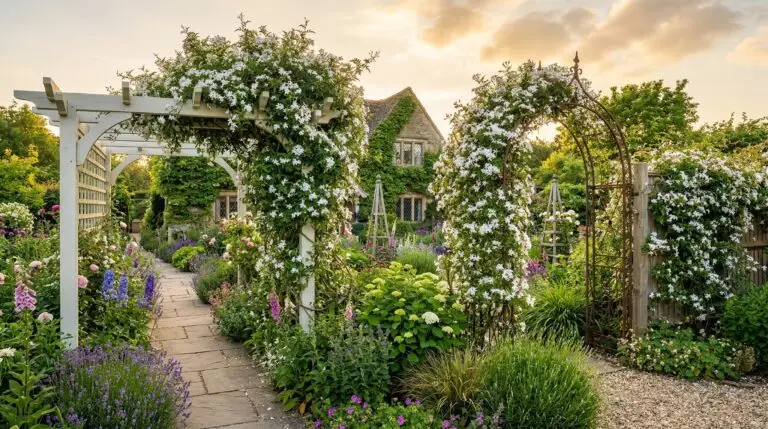
Size varies more here than in almost any group sharing a name. Common jasmine climbs 15 to 30 feet given wires and time, pink jasmine 10 to 20 feet and faster, while Arabian jasmine stays a 3 to 6 foot shrub held at knee height in a pot. Winter jasmine makes an arching mound about 4 feet tall and 7 feet wide, or covers a wall to 15 feet when tied in, and star jasmine reaches 15 to 20 feet on a support or 18 to 24 inches deep as groundcover. Support is the detail new growers get wrong: jasmine twines and has no adhesive pads or aerial roots, so it will not climb bare brick the way ivy does or hold on a flat fence panel. Give it wires, netting or a trellis a few inches off the wall for airflow.
Gold Coast and Brazilian jasmine, both true Jasminum species, are Category I invaders in South Florida, smothering native hardwood canopy, and pink jasmine layers and root-suckers so freely that in frost-free gardens it becomes a thicket to dig out rather than prune. In zone 9 and warmer, keep the fast species in a bed or a container.
Light
Flower production tracks sunlight: most jasmines want six hours or more of direct light, and the gap between five and eight hours is usually the gap between a green vine and a flowering one. Star jasmine is the exception, blooming respectably in half a day of sun or dappled shade, so it works on north and east walls where a true jasmine only makes growth. Where summers are hot and dry, Arabian jasmine and containers do better with afternoon shade, since heat reflected off a wall scorches leaf margins and drops buds. Indoors the bar is higher than it looks, since glass and overhangs strip more light than the eye registers: pink jasmine wants the brightest, unshaded, south-facing window in the house through winter. In dim positions it stretches, with pale leaves and no buds, so if the stems between leaves are longer than on the plant you bought, suspect light first.

Water
In growth and bloom jasmine wants soil evenly moist and never saturated: when the top inch feels dry to a fingertip, water until it runs from the drainage holes, then let it approach dryness again. Established plants in mild climates manage on rainfall plus occasional deep soaks, and a two to three inch mulch held back from the stems beats frequent shallow watering. Container plants are where things go wrong: a jasmine in bud that dries out even once drops those buds several days later, so cause and effect look unrelated, which is the usual reason a pink jasmine bought in full bud goes bare within two weeks in a heated room. Check container jasmine daily while it flowers and stand the pot on moist gravel for humidity. Winter is the opposite discipline: plants resting cool need only enough water to keep the root ball from going bone dry, because cold wet soil kills jasmine outright.
Soil and pH
Jasmine grows best in fertile, freely draining soil with plenty of organic matter, in a pH band from about 6.0 to 7.5, and most garden soils qualify without adjustment. Heavy clay is the real obstacle, and a raised bed, a slope or a large container solves drainage more reliably than any amendment worked into a hole that then behaves like a bucket. Feeding decides the bloom. Nitrogen builds leaves and stems, so a jasmine on a general lawn-type feed grows enthusiastically and then declines to flower, while potassium supports bud development, so container jasmine does better on the high-potassium liquid feed sold for tomatoes, stopped once the plant goes into its cool rest. Plants in decent garden soil often need nothing beyond an annual mulch.

USDA hardiness
Cold tolerance splits this group harder than any other trait, so the zone question is really which plant to buy. Winter jasmine is the tough one, reliable to roughly zone 6 and hardy across most of the country. Common jasmine is hardy through about zones 7 to 10 and can be cut to the ground by a hard freeze at the cold end, resprouting in spring. Star jasmine holds in zones 8 through 10, with 'Madison' selected for extra cold tolerance; Arabian and pink jasmine are safe outdoors year round only in about zones 9 to 11; Carolina jessamine sits around zones 7 to 9. North of that the answer is a pot, and the overwintering decides whether it ever flowers again: not a warm room but a bright, cool, frost-free place, an unheated porch or a spare bedroom in the fifties.
Pruning and training
One rule covers nearly every jasmine: prune immediately after it finishes flowering, and at no other time. The first and heaviest flush forms on wood that grew the previous year, so anything cut in late winter or spring is next season's flowers in the compost, and many jasmines that "stopped blooming" were simply tidied at the wrong moment year after year. In dates: common jasmine in late summer or early fall once the last flowers have gone, leaving new growth time to ripen; winter jasmine in early spring as its yellow flowers finish; pink jasmine right after its late-winter flush, when it most needs shortening; star jasmine after its late-spring flush. Take flowered stems back to a strong side shoot and thin out crossing, weak, dead and tangled growth: a congested jasmine flowers only on its outer shell.
Renovation works: an overgrown, bare-based plant cut back to two feet regrows from the old wood at the cost of one season of flowers. Training matters as much as cutting: a stem tied roughly horizontal flowers along its whole length while one running straight up flowers only at the top, so fanning the leaders sideways along wires turns a green curtain with flowers on the gutter into a wall of scent at nose height.
Cold tolerance and bloom trigger, plant by plant
One zone band cannot cover jasmine, because the plants sharing the name come from different climates and different families. These four had their cold tolerance and their bloom trigger sourced individually, and the tier of each source is stated rather than implied.
Propagation and longevity
Jasmine roots easily from cuttings, and semi-ripe material taken in early to midsummer is the most forgiving. Take a four to six inch shoot, firm at the base and flexible at the tip, cut below a leaf joint, strip the lower leaves, dip in rooting hormone, and set it in gritty free-draining compost under a propagator or clear bag; rooting takes four to eight weeks in warmth. Layering is easier still: pin a low, flexible stem to the soil with a wire staple, nick the underside at the contact point and cover it with an inch of soil, and roots form there over a season, after which the new plant can be severed. Pink and winter jasmine do this unassisted, a free supply of plants and the reason they spread further than intended in mild climates. A common or star jasmine on a wall is a multi-decade proposition, and a container Arabian jasmine runs ten years or more with an annual root prune and fresh compost.

Fragrance
A large share of jasmines have no scent at all. Winter jasmine is scentless, as are primrose and showy jasmine, both yellow-flowered species widely planted in the South. The famous perfume comes from a short list: common jasmine, Spanish or royal jasmine, pink jasmine, and above all Arabian jasmine. Star jasmine, though unrelated, is heavily fragrant in its own right, sweeter and greener than the true jasmines.
The smell carries an internal contradiction. Benzyl acetate and linalool supply the bright top, cis-jasmone and methyl jasmonate the warm floral body, and underneath sits indole, a few percent of the whole, which on its own smells frankly animalic. That small dirty note is what stops jasmine smelling like soap, and it explains why real jasmine at the nose can seem overripe while the same plant six feet down an evening path smells clean.
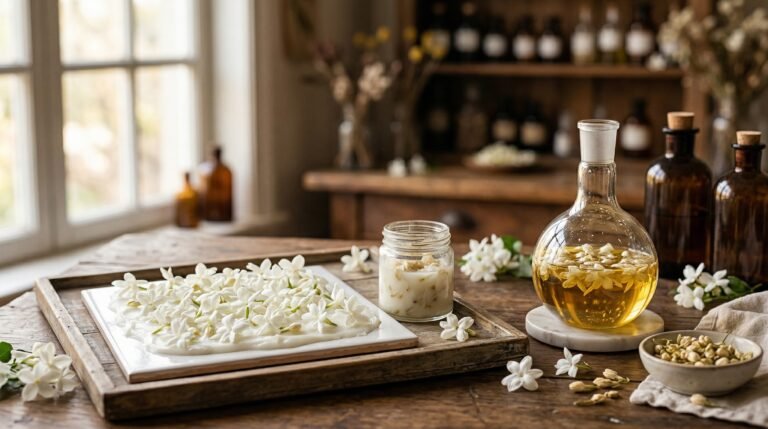
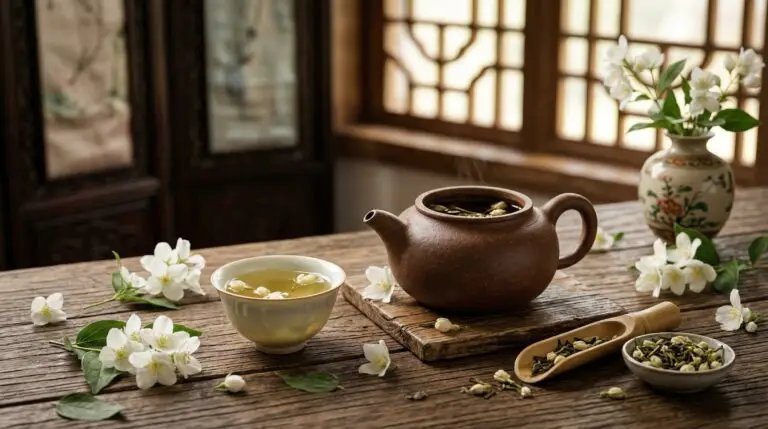
Getting that scent into a bottle is laborious. Jasmine cannot be steam distilled, since heat destroys the smell, so flowers are solvent-extracted into a waxy concrete and washed with alcohol to yield the absolute, hundreds of pounds of hand-picked blossoms to a single pound, gathered in darkness while output peaks. Jasmine tea works the same biology differently: closed buds of Arabian jasmine are picked in the afternoon, layered with dried green tea, and left overnight to open in the dark and scent the leaf, repeated as many as seven times for the highest grades. In an evening garden jasmine pairs naturally with moonflower, which opens on the same schedule for the same reason.
Why your jasmine will not bloom
A jasmine with healthy foliage and no flowers is reporting one of six problems, and which one depends on the species. Too little light is the most common outdoors, recognizable by stretched growth between the leaves and pale foliage. Second is the pruning date, since a spring tidy-up carries next year's buds off with the prunings. Third is nitrogen, since a general or lawn-type fertilizer makes luxuriant growth and few flowers.
Fourth catches indoor growers and is the main reason pink jasmine never repeats: that species sets its buds in response to cool fall conditions, wanting nights in the forties and fifties Fahrenheit and days not much above sixty, sustained for several weeks. A plant that spends autumn in a heated living room never receives the signal and flowers not at all, whatever light and feed it gets. Keep it outdoors until frost genuinely threatens, then overwinter it somewhere bright and deliberately cold, and bring it into room warmth only once buds are visible. Fifth is age and disturbance: a newly planted star jasmine spends two or three seasons building roots before it flowers well, and a plant just moved into a much larger container spends a year filling it with roots, so a slightly snug pot beats a generous one. Sixth is bud drop rather than bud failure, when buds already formed shed unopened several days after the root ball dried out, a sudden temperature change, or a draft.
Toxicity and pet safety
The ASPCA lists jasmine, meaning Jasminum species in the olive family, as non-toxic to dogs, cats and horses, and lists star jasmine and Confederate jasmine, both names for Trachelospermum jasminoides, as non-toxic as well. So the two plants most households actually own under the name jasmine are among the safer flowering plants a pet owner can keep. A search for jasmine toxicity turns up alarming results belonging to entirely different plants.
Those plants deserve naming. Carolina jessamine, Gelsemium sempervirens, is poisonous in all its parts, flowers and nectar included, through alkaloids related to strychnine. Children have been poisoned sucking nectar from the flowers, it is toxic to livestock, and NC State Extension records its pollen as toxic to honeybee colonies. It is also the state flower of South Carolina and is planted by the thousand across the Southeast, so the risk is not exotic. Night-blooming jessamine, Cestrum nocturnum, belongs to the nightshade family and is documented as poisonous to livestock. And in a reversal most readers do not expect, the ASPCA does list Cape jasmine, another name for gardenia, as toxic to dogs, cats and horses, with vomiting, diarrhea and hives among the reported signs.
The rule that follows is to identify by botanical name rather than by the word on the front of the label. A plant tagged simply "jasmine" in a Southeastern garden center in late winter, carrying bright yellow trumpets on an evergreen vine, is Gelsemium, and no amount of reassuring general information about jasmine applies to it. Wash hands after pruning any unidentified vine, keep prunings away from grazing animals, and if a pet has chewed something you cannot name, call a veterinarian with the plant in hand. For the same question across the rest of the garden, see the guide to flowers safe for cats and dogs.

What the word jasmine does and does not tell you
The myth: Jasmine is one plant.
The reality: Across the sources gathered here the name covers at least seven genera in five plant families. Clemson HGIC separates true Jasminum from the plants borrowing the name and states outright that Confederate or star jasmine is not a true jasmine at all, and NC State Extension carries its own pages for Gelsemium and both Trachelospermum species. The range runs from completely non-toxic to seriously toxic within the one common name.
The myth: Star jasmine and Carolina jessamine are close relatives, so what is true of one is roughly true of the other.
The reality: They are not in the same plant family. Star jasmine is Trachelospermum jasminoides in the dogbane family, Apocynaceae, and ASPCA lists it as non-toxic to dogs, cats and horses. Carolina jessamine is Gelsemium sempervirens in its own family, Gelsemiaceae, toxic in all parts per NC State Extension, and it has been South Carolina's state flower since 1924, so it is planted by the thousand in the same gardens.
The myth: Jasmine tea is tea with jasmine flavouring or oil added to it.
The reality: It is a physical scenting process rather than an additive. Real flowers, usually Jasminum sambac, are layered with the tea leaves so the leaf takes up the flowers' fragrance compounds, and the spent flowers are then removed rather than left in the product. No university food-science source describing the process was found this session, so it is reported as consistent trade knowledge rather than as a sourced fact.
The myth: Jasmine rice is scented with jasmine, or comes from a related plant.
The reality: There is no botanical relationship. Jasmine rice is ordinary Oryza sativa, named for an aroma that resembles the flower. The compound behind that aroma, 2-acetyl-1-pyrroline, occurs independently in rice, in pandan leaves, in basmati and separately in jasmine flowers themselves: shared chemistry rather than a shared plant.
Vase life
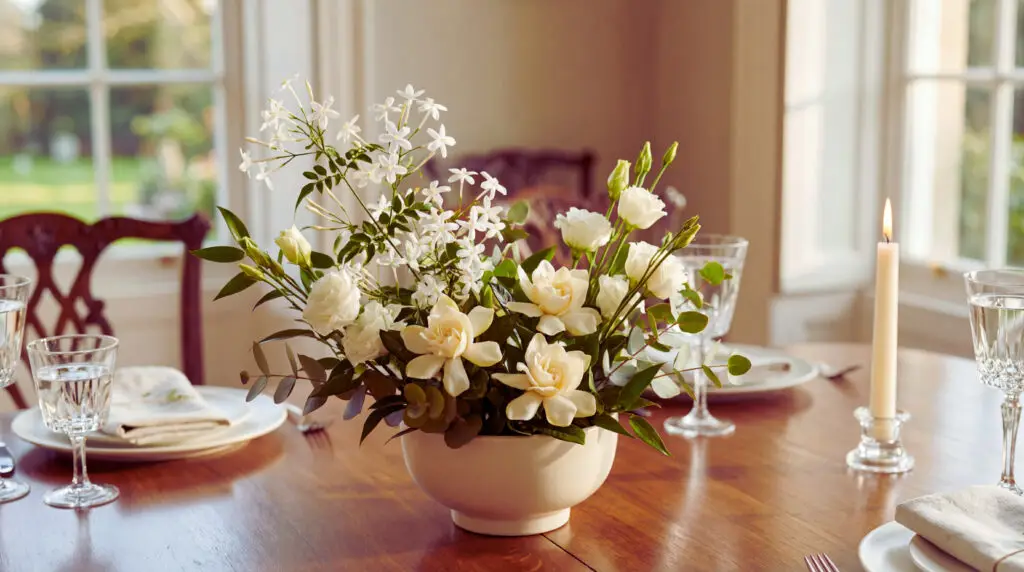
Jasmine is barely a cut flower: the blooms are small, they sit on soft stalks with no structure to hold an arrangement, and on Arabian jasmine they discolor within a day of opening. What jasmine is for is scent detached from arrangement: sampaguita blossoms strung into garlands in the Philippines, the same flowers wound into gajra worn in the hair in India, single blossoms floated in a shallow bowl to perfume a room for one evening.
Where jasmine does go into water it goes as a cut spray, and sprays of common, pink or star jasmine hold three to seven days: cut them in the morning when buds show color but most have not opened, strip leaves below the waterline, recut the ends, and change the water daily. A small spray perfumes a room out of all proportion to its size, and in a closed bedroom it is often too much by the middle of the night.
The indoor numbers behind a jasmine that flowers
Jasmine spends most of its life as a living vine indoors rather than in water, and that side of it runs on numbers: light hours, two rest temperatures and a swing between day and night. These are the sourced ones, with the tier of each source stated.
A penny, an aspirin or a splash of vodka in the water makes cut jasmine last longer.
Absent evidence rather than a debunk. Jasmine is barely handled as a cut flower in Western floristry, and no source consulted here tests any vase additive on jasmine in either direction. It is reported as unknown rather than dressed up as settled.
A jasmine kept warm and brightly lit indoors all year is being looked after well.
Clemson's prescription runs the other way: cool, well circulated air rather than the warm still air of a heated interior, which suits the pests better than the plant, plus a genuine cool rest before the plant will set buds at all.
Pests and diseases
Outdoors, healthy jasmine in good light is rarely troubled. Aphids cluster on soft new growth in spring and come off with a jet of water, and winter jasmine is prone to spider mites that leave the shrub bronzed by late summer, answered by cutting it to the ground after flowering, which it regrows from readily. Indoors the list is longer, because dry warm air suits the pests better than the plant: spider mites stipple the upper leaf surface and web the axils, mealybugs sit as white cottony blobs where leaf meets stem, and scale as brown limpets that, with the mealybugs, leave honeydew growing sooty mold. Raising humidity, washing the foliage, and weekly insecticidal soap or horticultural oil handles almost all of it.
Root rot in waterlogged soil is the disease that kills plants, while powdery mildew and leaf spots follow stagnant air and wet foliage and respond better to thinning than to spraying. Yellow leaves deserve diagnosis rather than fertilizer, because the pattern gives the cause: uniformly yellow lower leaves over soggy soil mean overwatering, yellow blades with sharply green veins mean iron locked up in alkaline soil, and wholesale yellowing in autumn on winter or common jasmine is a deciduous plant behaving normally.
Photo pairs for the jasmine mix-ups
Four pairs carry photographs on both sides. Two carry one side or none on purpose: pest identity and fungal leaf spot are checkable fingerprints, and a generated photograph of either would teach the wrong thing to somebody trying to identify what is on their own plant.
Watch the habit, because the colour and the season are the same. Winter jasmine arches and cascades in sprays and carries six-petalled flat stars with no scent; Carolina jessamine twines, wrapping whatever it can reach, and carries five-petalled funnels. One is a harmless true jasmine and the other is toxic in every part.
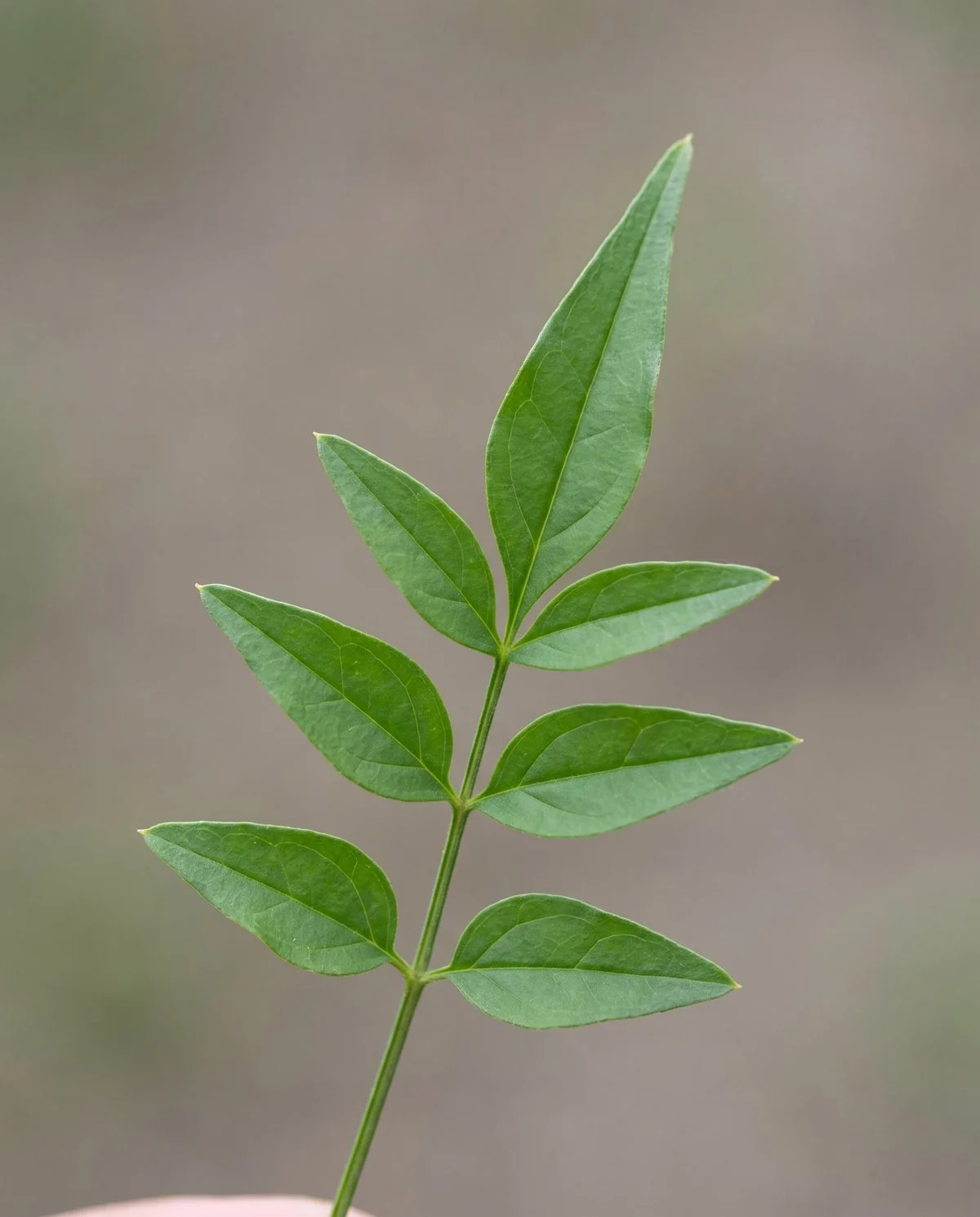
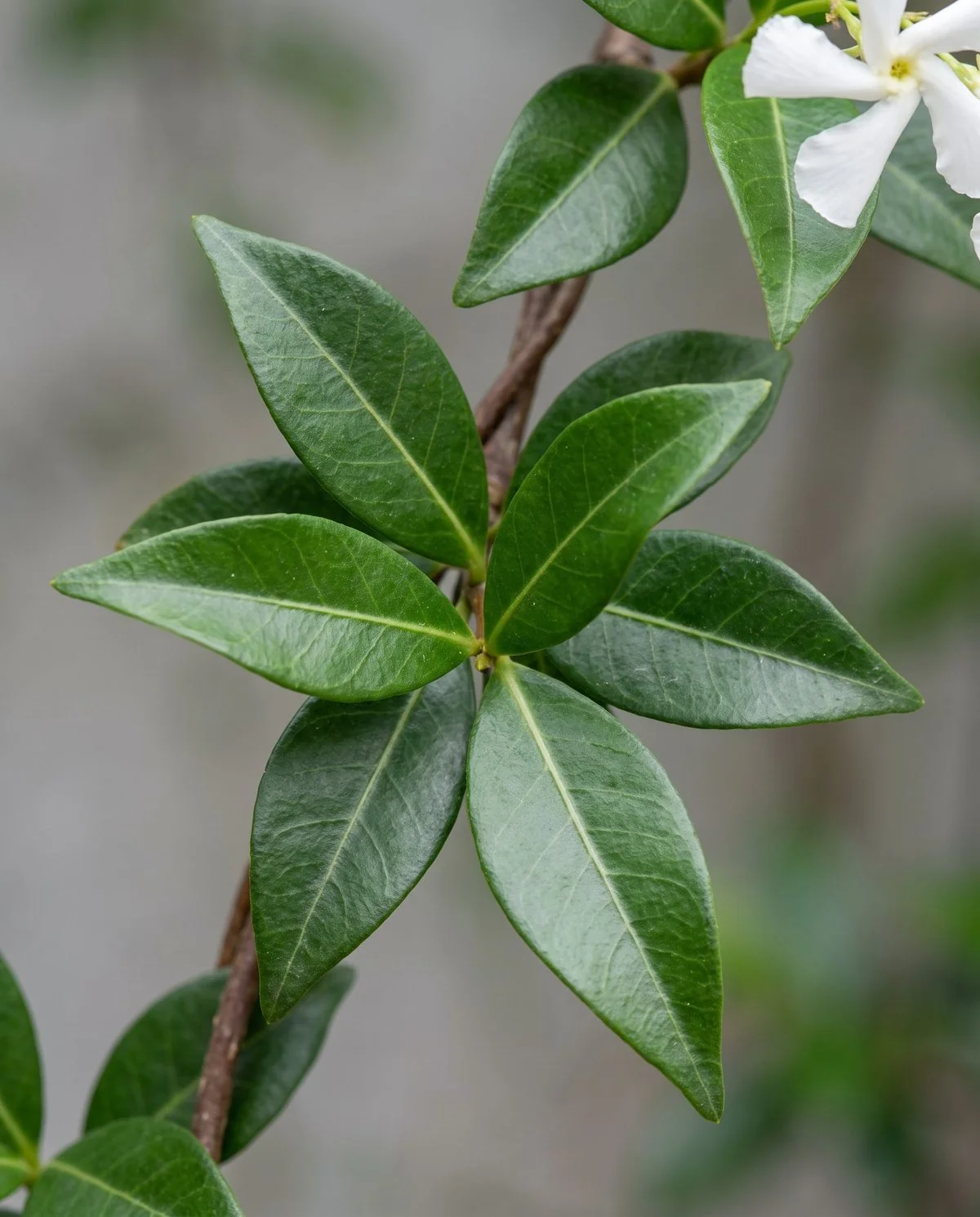
Read the leaf rather than the flower. A true Jasminum carries compound pinnate leaves, several leaflets to one stalk; Confederate or star jasmine carries simple, single, glossy opposite leaves and flat five-lobed flowers that Clemson describes as phlox-like.
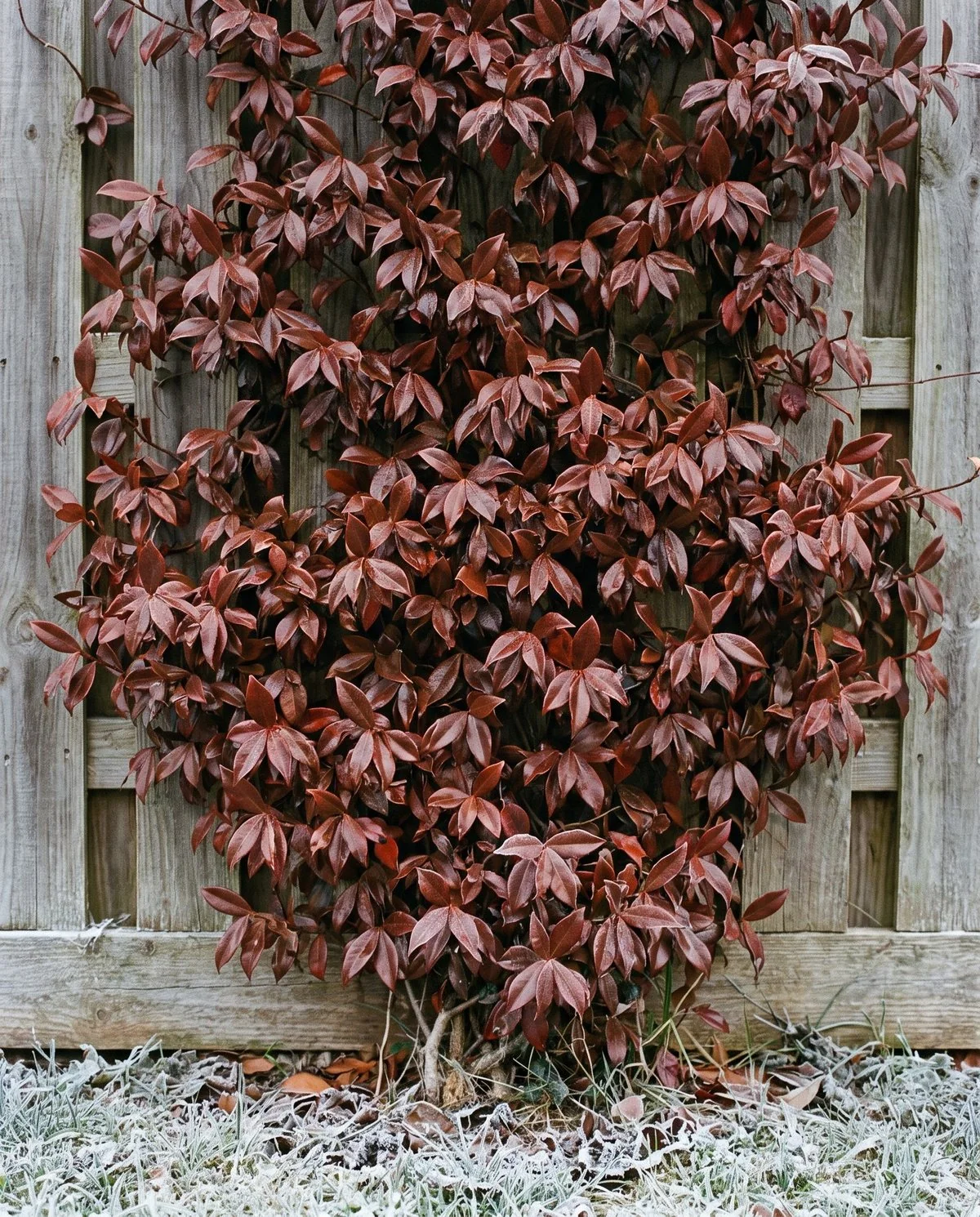
Date it. Bronze-red foliage in cold weather is an anthocyanin response that fades back to green as temperatures rise; redness that holds through spring and into summer, past the point cold can explain, points at over- or under-watering or a phosphorus or potassium shortage. No university source covering star jasmine reddening specifically was found, so this is reported as general plant physiology.
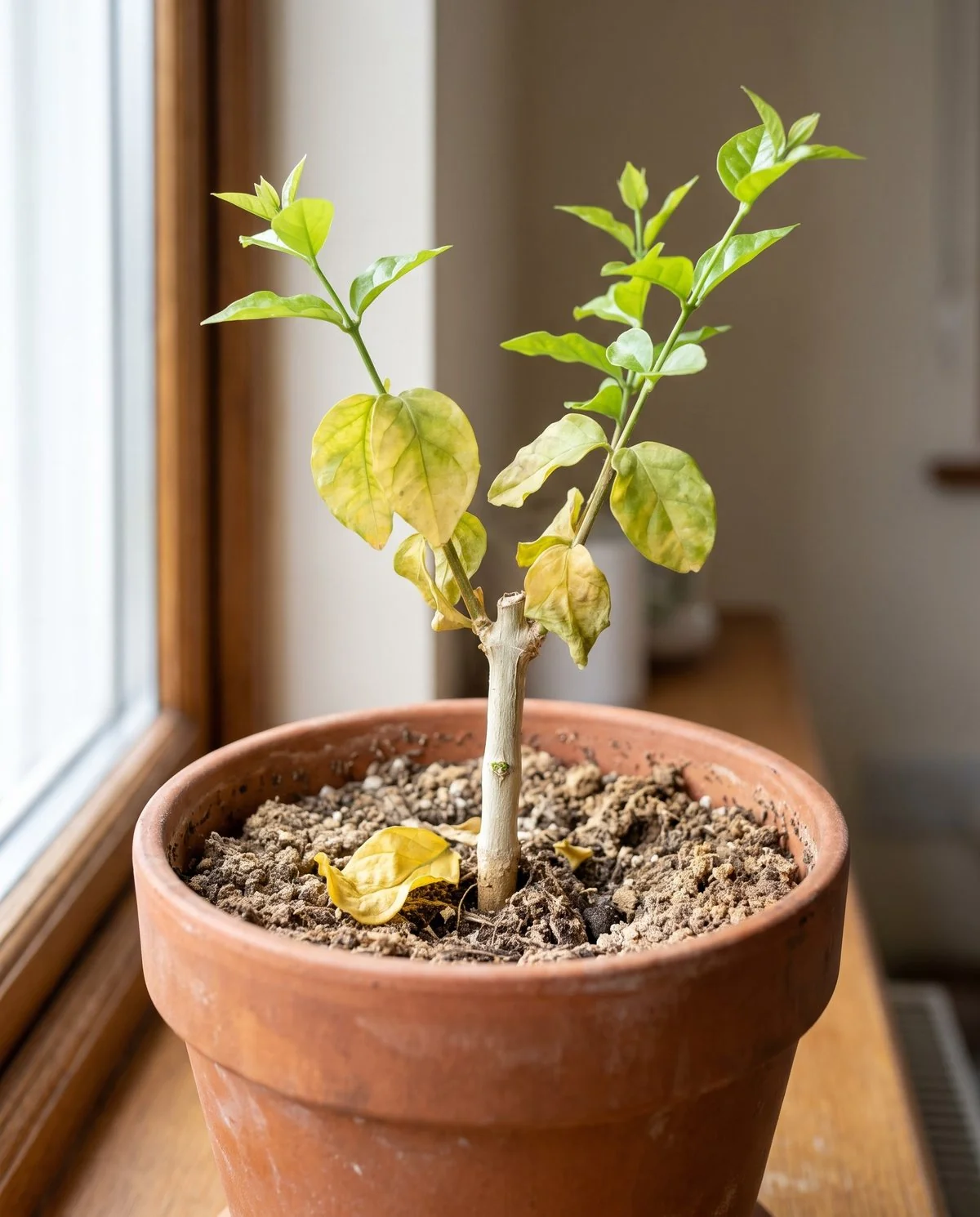
Feel the stem at the soil line. A handful of older lower leaves yellowing while new growth continues elsewhere, on a firm stem, follows a move, a repot or a change of light. Yellowing that runs through the whole plant, with the stem softening and darkening near the soil over soil that stays wet, is rot. Only the healthy side is photographed here.
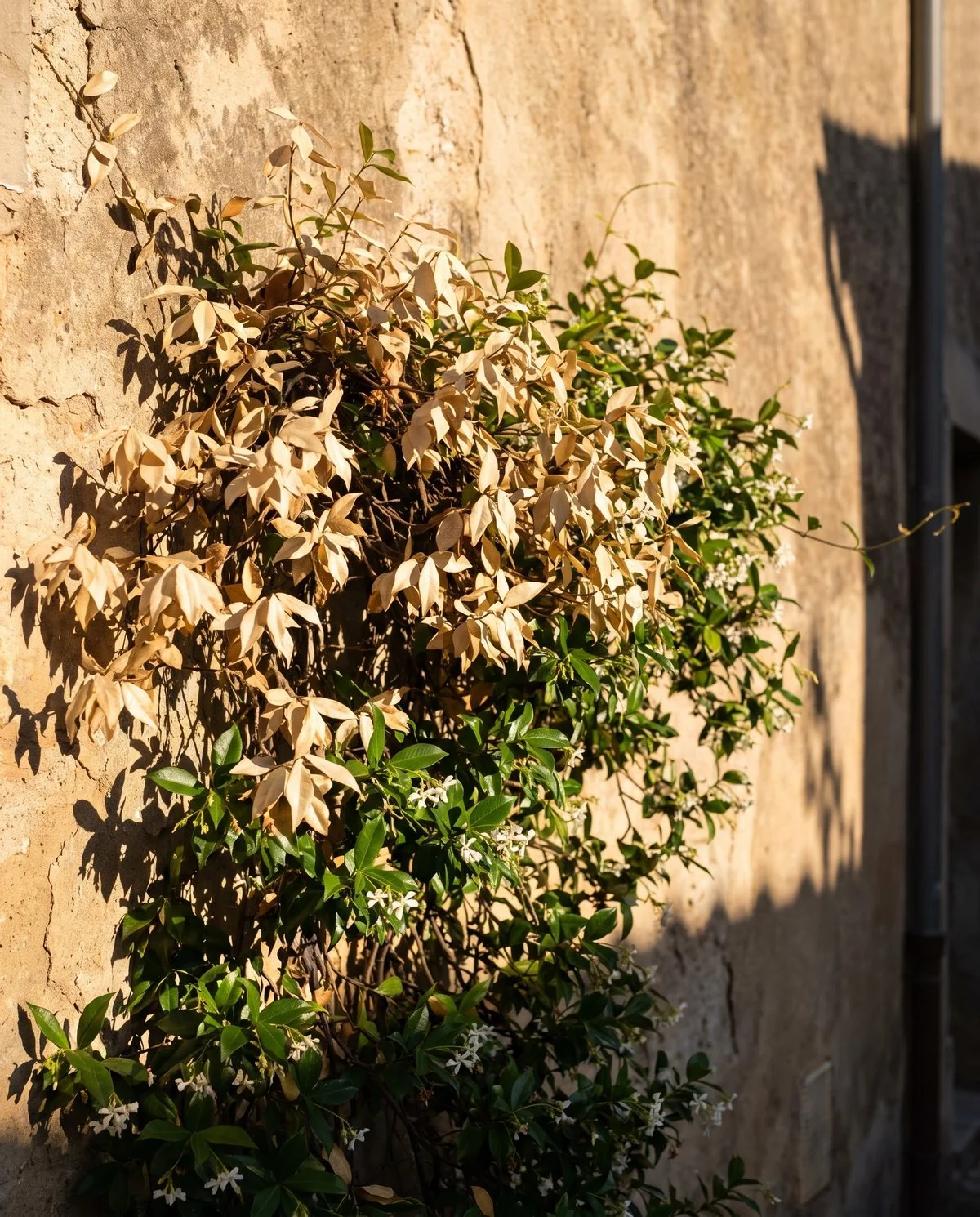
Scorch is flat and bleached, concentrated on the side facing hot afternoon sun, and it stops changing. The fungal spots are raised, enlarge to about a quarter inch and turn reddish-brown or purple over days in warm wet weather that spreads them on splashing water. The fungal side is deliberately not photographed.
Mealybugs move and carry a cottony white wax, clustering in leaf axils and stem joints; scale settles permanently and hardens into a waxy shell-like bump on the stem that can be taken for part of the woody stem at a glance. Both are named on UC IPM's jasmine page. Neither side is photographed here, because the mobile-and-cottony against fixed-and-waxy difference is the whole comparison and a generated image would blur it.
What actually goes wrong with jasmine, ranked by how often it is asked about
This ranking rests on a small sample and is reported as one: 31 posts from r/gardening and r/plantclinic, gathered through an archive API that rate-limited most of the follow-up queries this research tried to run. Thirty-one posts show the shape of the demand, not its proportions, so read the percentages as direction rather than measurement. Themes overlap, so they do not add to 100.
Whether it moves. Mealybugs are mobile and wrapped in cottony white wax, clustering where a leaf meets a stem, while scale settles once and hardens into a waxy bump on the stem that reads as part of the wood. UC IPM names black scale and mealybugs on its jasmine page.
The stem at the soil line, by hand. Firm stem with new growth somewhere else on the plant is a stress shed; soft and darkening at the base over soil that has stayed wet is rot, and rot is the failure that kills potted jasmine.
What the plant did last autumn. Pink jasmine sets its buds over roughly six weeks of cool autumn weather with a real difference between day and night, so a plant kept evenly warm indoors can look perfect and never bud.
The leaf and the flower before anything else. Compound leaves with several leaflets, and a tube flaring into four to nine narrow lobes, mean a true Jasminum; the plants borrowing the name carry simple leaves and differently built flowers, and several of them are toxic.
The cultivar rather than the species. Clemson's note that Confederate jasmine is hardy in central and coastal South Carolina and tender in the Piedmont, with 'Madison' selected for colder ground, explains more zone 8 losses than any care mistake does.
Whether a callus has formed at the cut. A callus is a normal early stage rather than a failure, though it guarantees nothing; take material carrying a leaf bud, cut just below a node, use rooting hormone and keep the mix moist under plastic.
The month. Bronze-red foliage in winter is a cold anthocyanin response that reverses as spring warms; redness still present through summer points at watering or at a phosphorus or potassium shortage instead.
Flower photos


FAQ
What is the difference between jasmine and star jasmine?
Unrelated plants sharing a scent and a flower shape. True jasmine is Jasminum, olive family, clear sap, and in the common climbers leaves divided into leaflets. Star jasmine is Trachelospermum jasminoides, dogbane family, hardy to about zone 8, with simple glossy leaves and milky sap that shows within a second when a leaf stalk is snapped. The ASPCA lists both as non-toxic to cats and dogs.
Is jasmine poisonous to cats and dogs?
True jasmine is not. The ASPCA lists Jasminum species, star jasmine and Confederate jasmine as non-toxic to dogs, cats and horses. The danger belongs to plants borrowing the name: Carolina jessamine, Gelsemium sempervirens, is poisonous in every part including the nectar; night-blooming jessamine, Cestrum nocturnum, is a nightshade poisonous to livestock; and Cape jasmine, which is gardenia, is on the ASPCA toxic list. Identify by botanical name first.
Why is my jasmine not blooming?
Six causes: too little direct sun, pruning at the wrong time of year, too much nitrogen, no cool fall period for indoor pink jasmine, a plant too young or freshly potted up, and bud drop after drying out. Indoors the cool fall accounts for most cases, outdoors the pruning date or the light.
When and how should I prune jasmine?
Immediately after flowering and never before, since the main flush forms on the previous year's wood. Common jasmine in late summer or early fall, winter jasmine in early spring as its flowers finish, pink jasmine after its late-winter flush, star jasmine after its late-spring flush. Take out no more than about one-third of the plant at a time, shortening long shoots with clean, sharp pruners, thinning crowded growth, and cutting vines back to keep them in bounds and encourage branching, while shrubby types take a light trim all over. Dead or diseased stems can come out whenever you notice them.
Can I grow jasmine indoors as a houseplant?
Yes, on two conditions most indoor jasmines never get: the brightest, unshaded, south-facing window in the house, and for pink jasmine several weeks of cool fall nights in the forties and fifties to set buds. Kept warm year round it never flowers again.
Which jasmine is used for tea and perfume?
Jasmine tea is scented with Arabian jasmine, Jasminum sambac: closed buds picked in the afternoon are layered with dried green tea overnight so they open in the dark and scent the leaf. Perfumery draws on common jasmine and Spanish or royal jasmine, solvent-extracted rather than distilled.
Is jasmine a vine or a shrub?
Jasmine can be either, depending on the species. Some, like Jasminum officinale, are climbing vines that need support. Others, such as Jasminum sambac, grow as upright shrubs. There are also trailing types that spread along the ground, including Jasminum nudiflorum.
Can jasmine survive winter in cold climates?
It depends on the species and the winter lows where you live. Many jasmines are tropical or subtropical and do not tolerate frost. Jasminum polyanthum and Jasminum sambac are often grown in pots in cold regions so they can be brought indoors before hard freezes. Hardier types do better outdoors. Jasminum officinale can handle colder weather with protection in parts of Zone 7, and Jasminum nudiflorum is often grown in Zone 6. If winter temperatures regularly drop below 32°F (0°C), plan on overwintering jasmine indoors unless you have a cold-hardy type planted in a sheltered spot.
What are the different types of jasmine plants?
Popular types include Jasminum officinale (a hardy deciduous vine with white flowers), Jasminum sambac (an evergreen shrub used for tea and leis), Jasminum nudiflorum (a yellow-flowering winter-blooming shrub with little scent), and Jasminum polyanthum (a vigorous vine with pink buds that open white). Other species include Jasminum humile (Italian jasmine) and Jasminum mesnyi (primrose jasmine). Growth habit and bloom season vary, so choosing a type often comes down to your climate and whether you want a vine, a shrub, early flowers, or the strongest fragrance.
This white cottony growth appeared on my star jasmine. Is it mealybugs or a fungus?
Mealybugs, most likely. The tell is movement and texture: mealybugs are mobile and wrapped in cottony white wax, clustering where a leaf meets a stem, while scale insects settle permanently into harder waxy bumps directly on stems and leaf undersides. UC IPM names black scale and mealybugs among the documented jasmine pests.
Why are my star jasmine leaves turning red?
Most often cold. The foliage produces protective anthocyanin pigments in winter and shifts from glossy green to bronze-red, then returns to green as temperatures rise in spring. Redness that persists into summer, past the point cold explains it, points instead at over- or under-watering or a phosphorus or potassium shortage. No university page on star jasmine reddening specifically was found, so the mechanism is reported as general plant physiology.
My cutting grew a callus but no roots after a month. Is it dead?
A callus at the cut end is a normal early stage rather than a failure, though it does not guarantee roots either. Take material that includes a leaf bud, trim just below a leaf node, dip it in rooting hormone and keep the mix moist under plastic until roots develop.
Are the berries on night-blooming jasmine dangerous to children?
Yes. Cestrum nocturnum is a member of the nightshade family rather than a jasmine, all parts are treated as toxic, and the small white berries are singled out as the particular risk to children because they look appealing.
Is Asiatic star jasmine a safe groundcover?
It is the more cold-hardy of the two Trachelospermum, with smaller leaves and yellowish-white flowers, and it comes with two honest caveats. It can turn genuinely invasive in warm humid climates if it is never trimmed, and it was not checked individually against the ASPCA database in this research, so it is treated as unchecked rather than safe by association with its cousin.
Interesting tips
Buy jasmine in flower and smell it first, because a good half of the plants labeled jasmine have no scent at all. For a container plant that flowers in a warm room, Arabian jasmine is the reliable choice, with 'Maid of Orleans' the freest-flowering single form and 'Grand Duke of Tuscany' the slower, showier one whose double rosettes perfume drinking water overnight across Asia. Place the plant for the evening rather than the view: these flowers open after dark, so jasmine belongs beside a doorway used at dusk, along an evening path, or under a window that gets opened at night.
Arabian jasmine is the national flower of the Philippines as sampaguita and one of Indonesia's three, as melati putih, while common jasmine is Pakistan's, known as chambeli. For an evening garden built around scent and pale color, jasmine sits among the night-legible blooms on the white flowers hub, readable at dusk long after red and purple have gone flat.
- Jasmine is the national flower of several countries, including Pakistan, the Philippines (sampaguita), and Indonesia (melati).
- In many places, fresh jasmine flowers are strung into garlands or tucked into hair. Even a small handful can scent the air for hours.
- If you have cold winters, try jasmine in a large pot so you can move it indoors or into a greenhouse before frost.
- For vining jasmine, put up the trellis early and tie in young shoots. Training them while they are flexible keeps the plant neater later.
- Jasmine fragrance often peaks after sunset. Plant it near a patio or a window you open in the evening.
- The name "jasmine" traces back to the Persian word "yasmin," sometimes translated as "gift from God."
Related Guides & Flowers
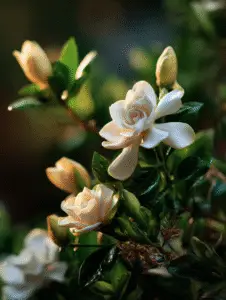
Gardenia
Intensely fragrant evergreen shrub with creamy white, waxy blooms; a classic alternative for warm climates.
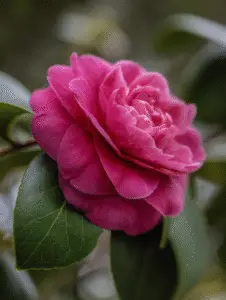
Camellia
Glossy evergreen shrub; many white or soft-pink cultivars and similar Southern-garden appeal.
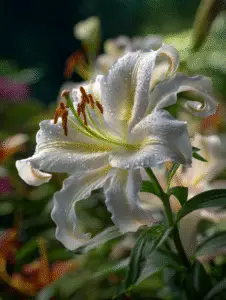
Lily
Strongly scented trumpets and Oriental hybrids; white forms echo the jasmine palette for evening fragrance.
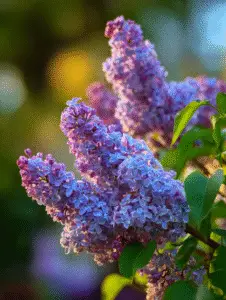
Lilacs
Cold-climate fragrance powerhouse; flower clusters satisfy readers seeking jasmine-like perfume up North.
Oncidium Orchid – "Dancing Lady" orchids; several species and hybrids are pleasantly fragrant and suit indoor growers.
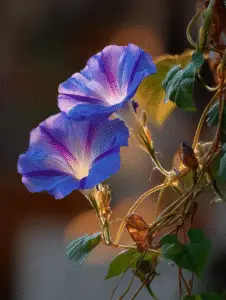
Morning Glories
Fast climbers with starry blooms; great for readers exploring trellised vines beside jasmine.
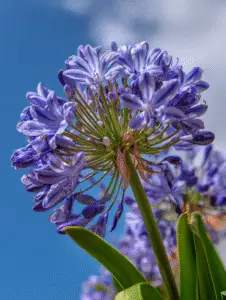
Agapanthus
Architectural strappy foliage; white selections pair nicely in moon-garden schemes with jasmine.
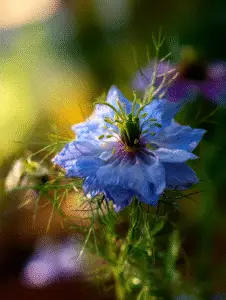
Love-in-a-Mist
Airy annual with romantic, star-like flowers; a delicate companion for soft, perfumed borders.
References
- North Carolina Extension – Jasminum (genus overview)Cultural needs, pruning on old wood, size, and light requirements.
- Clemson HGIC – JasminePractical guidance for training on arbors vs shrubs, bloom season, and maintenance.
- UF/IFAS Gardening Solutions – Star JasmineClarifies that star jasmine is not a true Jasminum species and gives care tips for Trachelospermum jasminoides. Useful for the "look-alike" section.
- ASPCA – Star Jasmine ToxicityPet safety reference showing star jasmine is non-toxic to cats, dogs, and horses. Perfect for your toxicity box.
Enjoying our flower guides? Add YourFlowersGuide as a preferred source on Google. It helps more readers find us.
Add to Preferred Sources