Taxonomy and origin
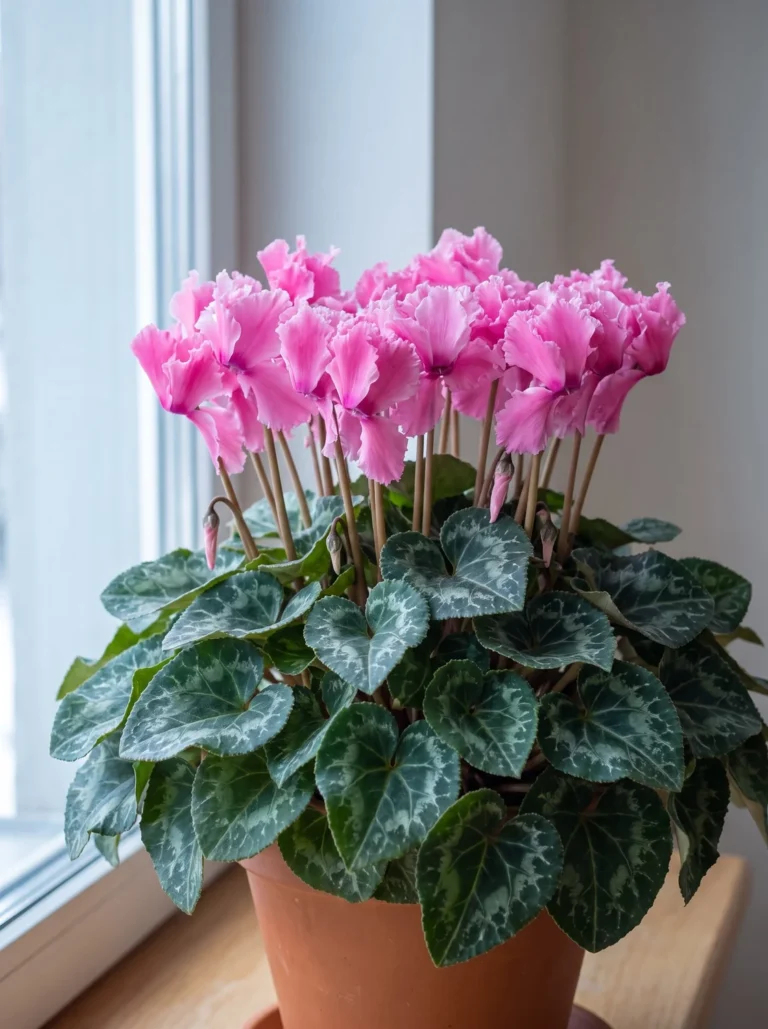
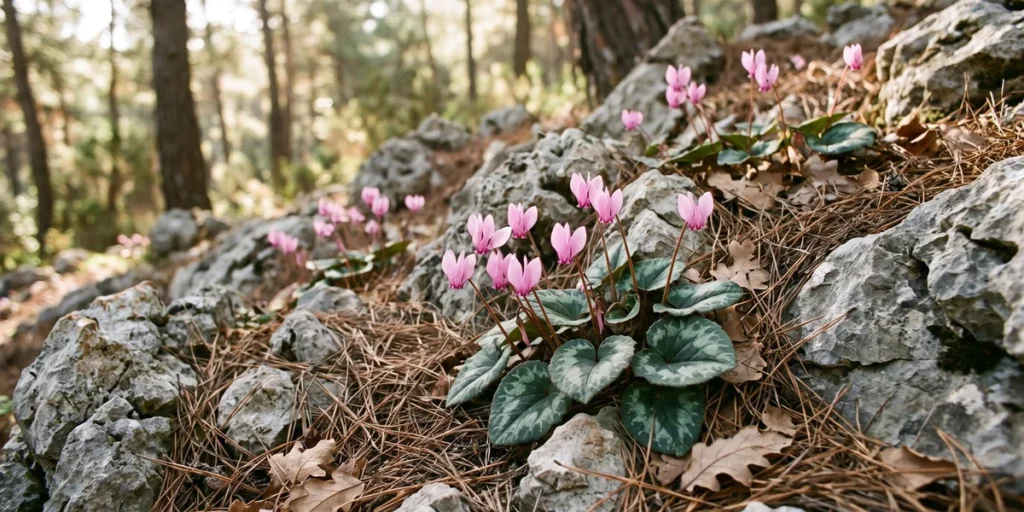
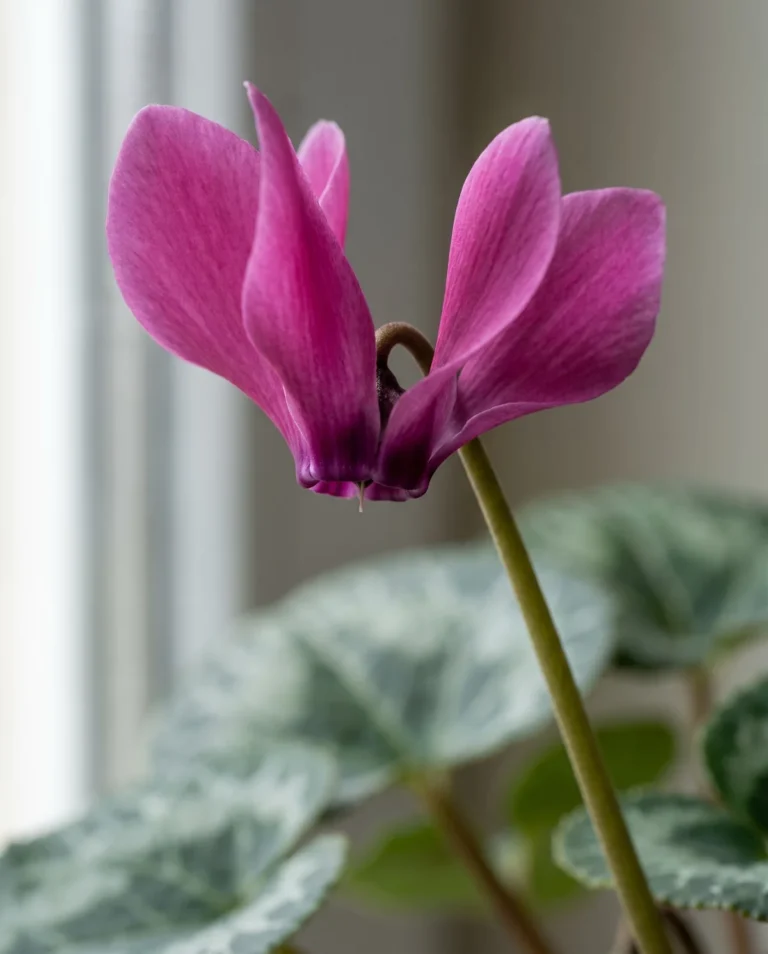
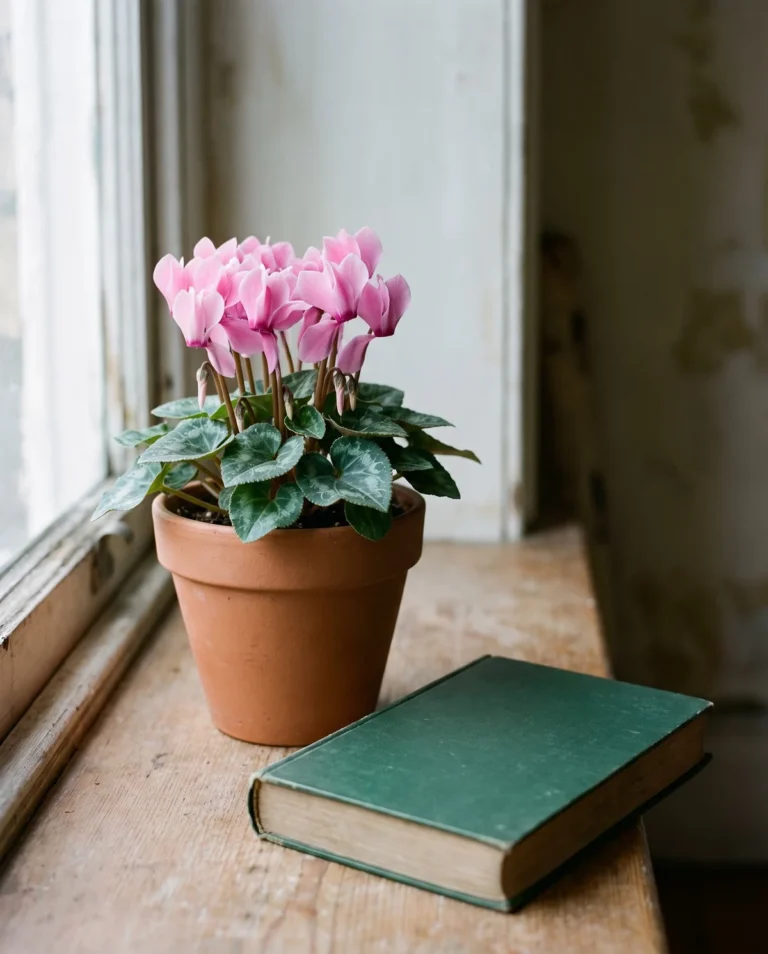
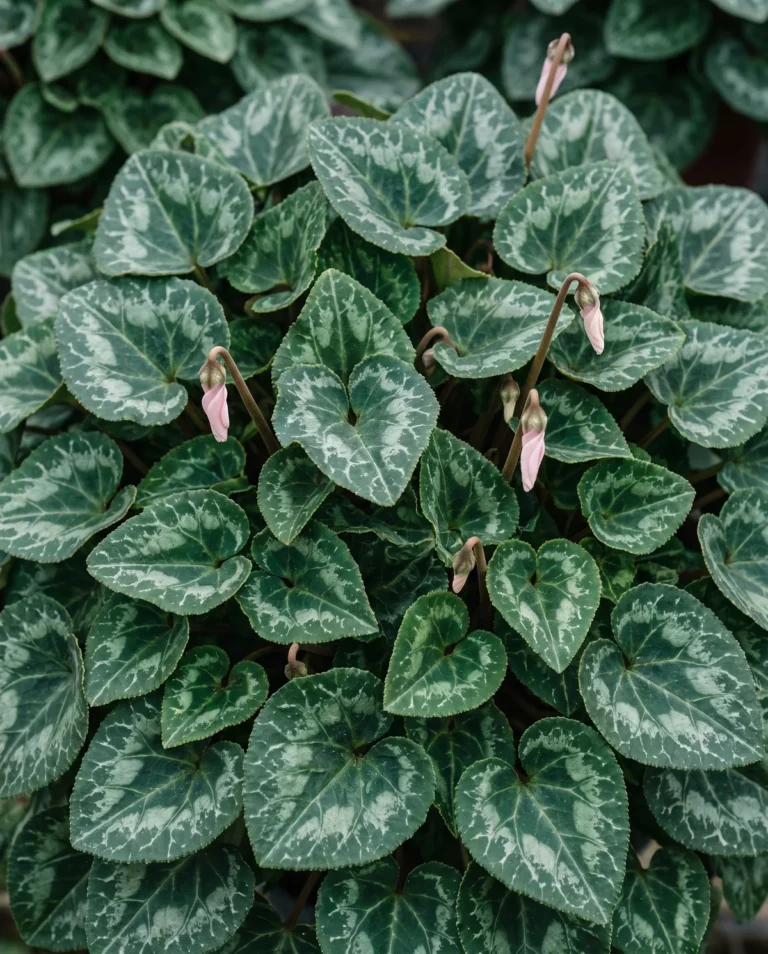
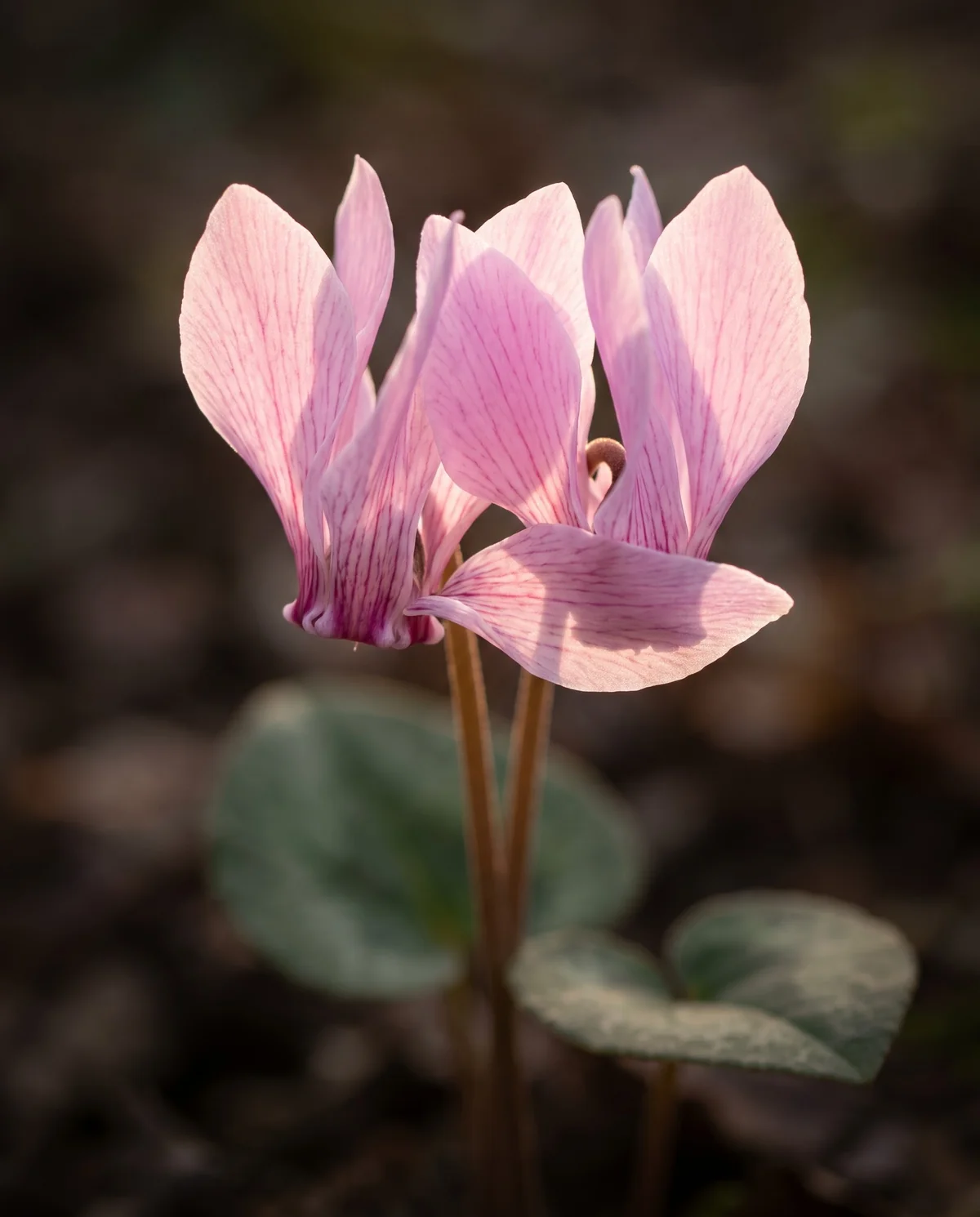
Cyclamen is a genus of roughly two dozen species of tuberous perennials in the primrose family, Primulaceae, all native to the Mediterranean region and its surroundings. The florist's cyclamen on winter windowsills is Cyclamen persicum, whose own wild range runs from Algeria east to the pine woods, oak thickets, and rocky slopes of the eastern Mediterranean, and its build explains its habits: everything rises straight from a flattened round tuber, heart-shaped leaves on their own stalks, flowers on theirs, with no above-ground stem at all. The genus name comes from the Greek word for circle, after that tuber, and the plant has been in the written record since Theophrastus in the third century BCE. Its least glamorous name is the most memorable: sowbread, earned because pigs root up and eat the tubers. The flower itself is the trademark. Five twisted petals sweep sharply backward from a nodding face, the shape garden writers keep comparing to a shooting star, and the blooms hover in numbers over mottled, silver-veined foliage that would justify the pot even out of bloom.
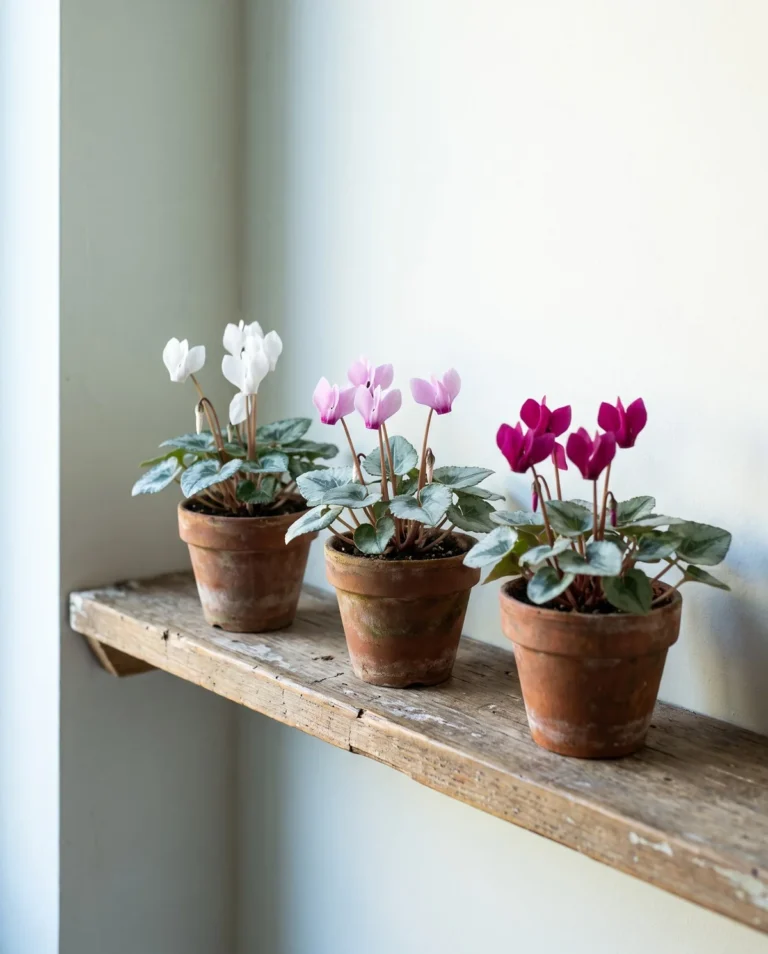
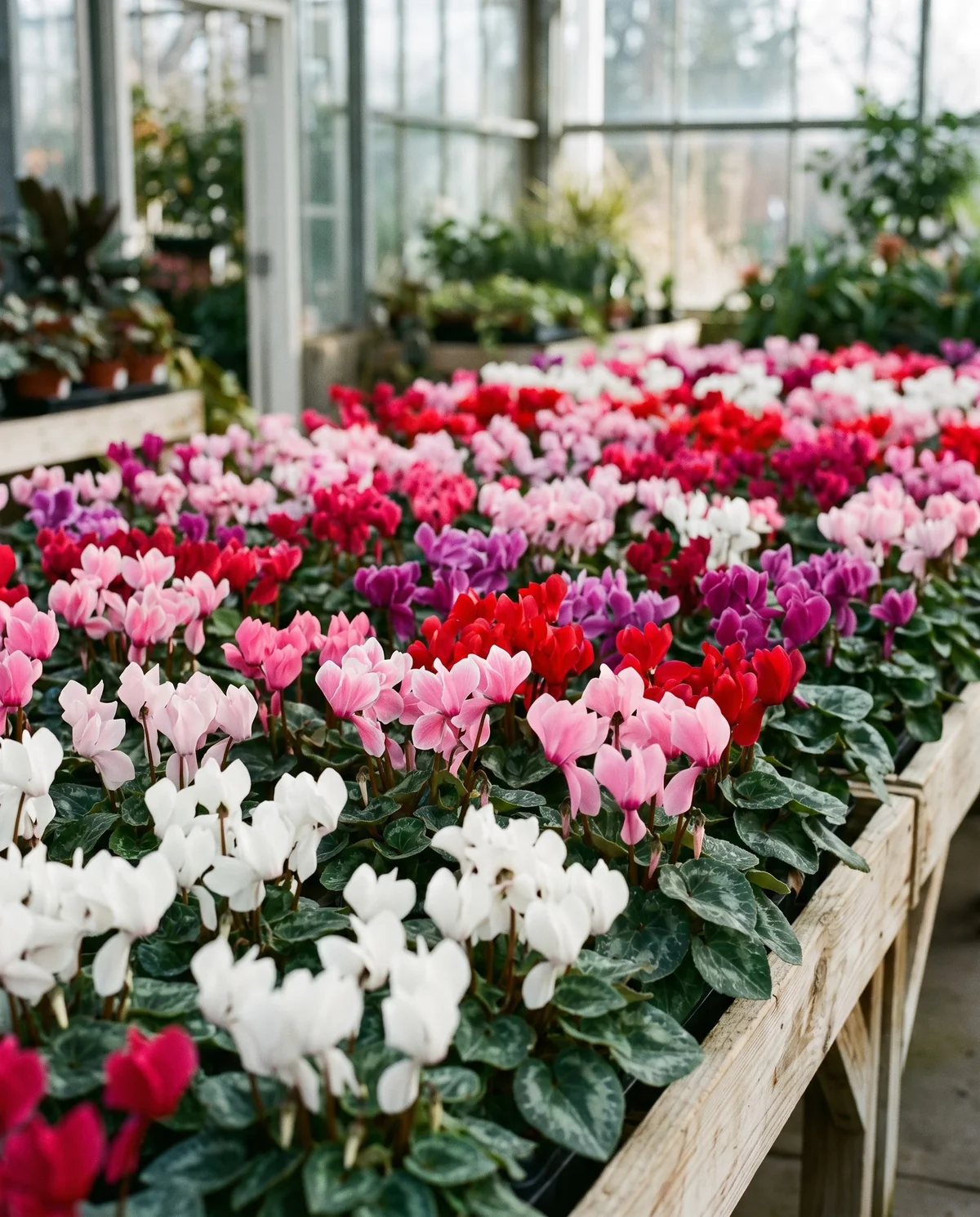
The species reached western European gardens in the early seventeenth century, and the transformation into the florist's plant happened mostly in England, Germany, and the Netherlands, where breeders enlarged the flowers, multiplied the colors, and added ruffled, fringed, and double forms. Modern florist hybrids run from white through every pink to rose, salmon, scarlet, burgundy, and violet, on plants sold in two main sizes, the classic large-flowered standards and the newer minis, which tend to keep more of the wild species' perfume. What all of them gave up is hardiness: florist's cyclamen tolerates no real frost, and the winter-garden members of the family are different species altogether, covered under hardiness below. The trade sells the plant at its two natural peaks, the winter holidays and Valentine's Day, and its colors, from white to saturated magenta, carry their own vocabulary explored in flower color meanings.
Eight cyclamen worth telling apart, from gift standards to the zone-5 carpet
Cyclamen sells by color and size, not by cultivar name, and no neutral source reviews the trade series, so this grid works in the units that matter at the store and in the garden: the florist types you can actually pick from a bench, and the hardy species that survive real winters outdoors. The badge is derived: green means the form or species carries its description from a named source, red means the entry is a trade type shown for recognition.
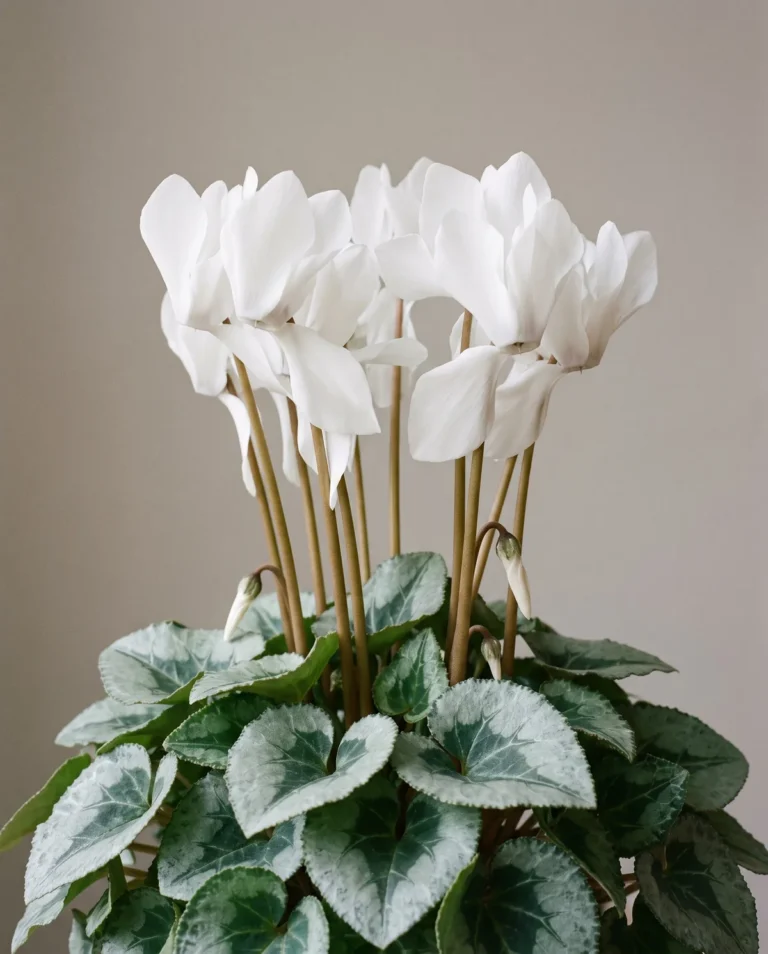
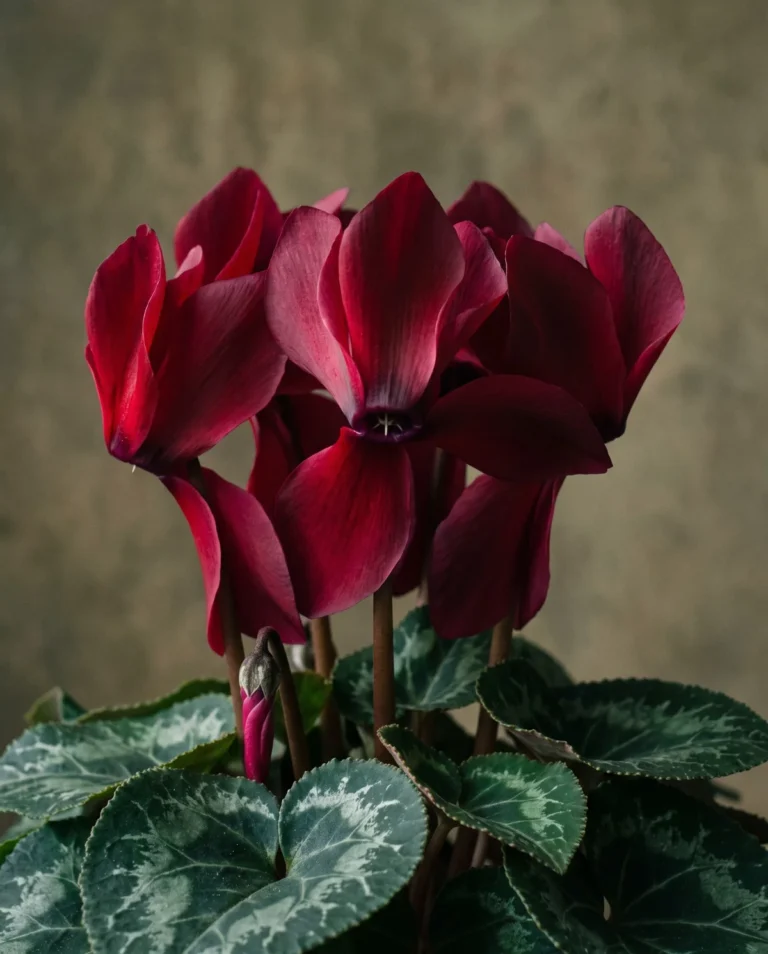
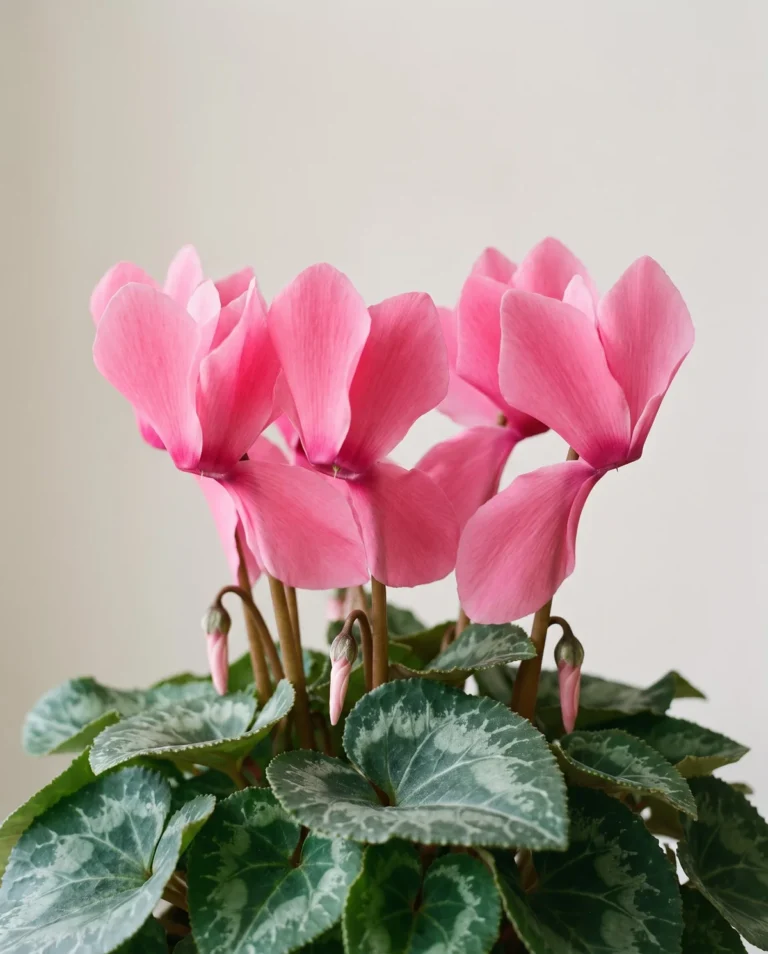
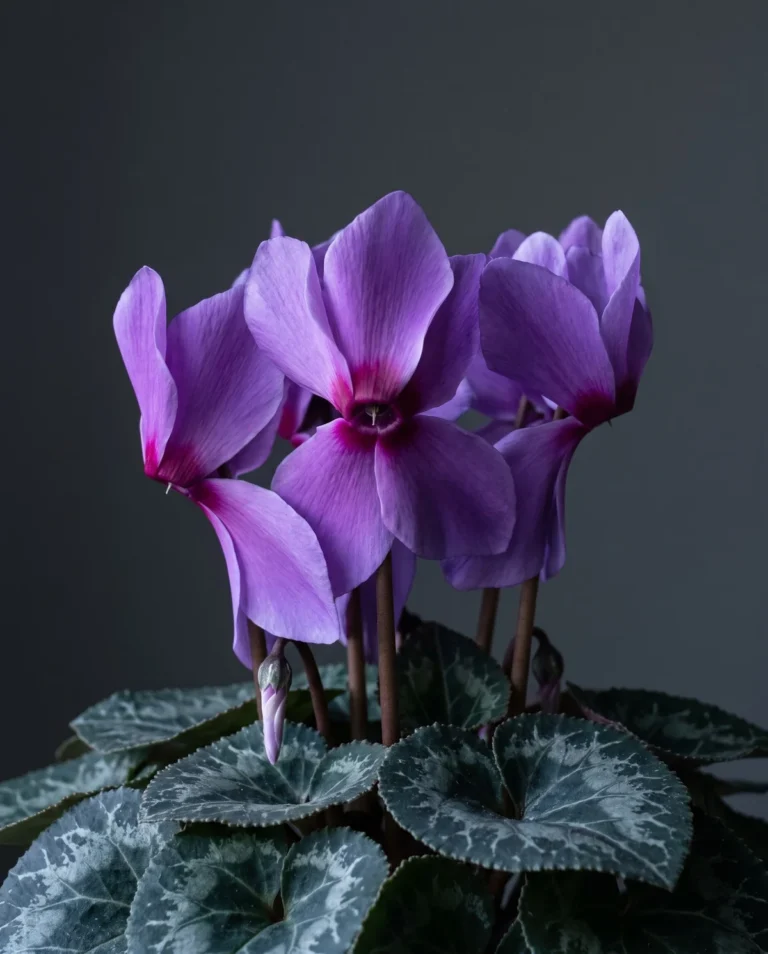
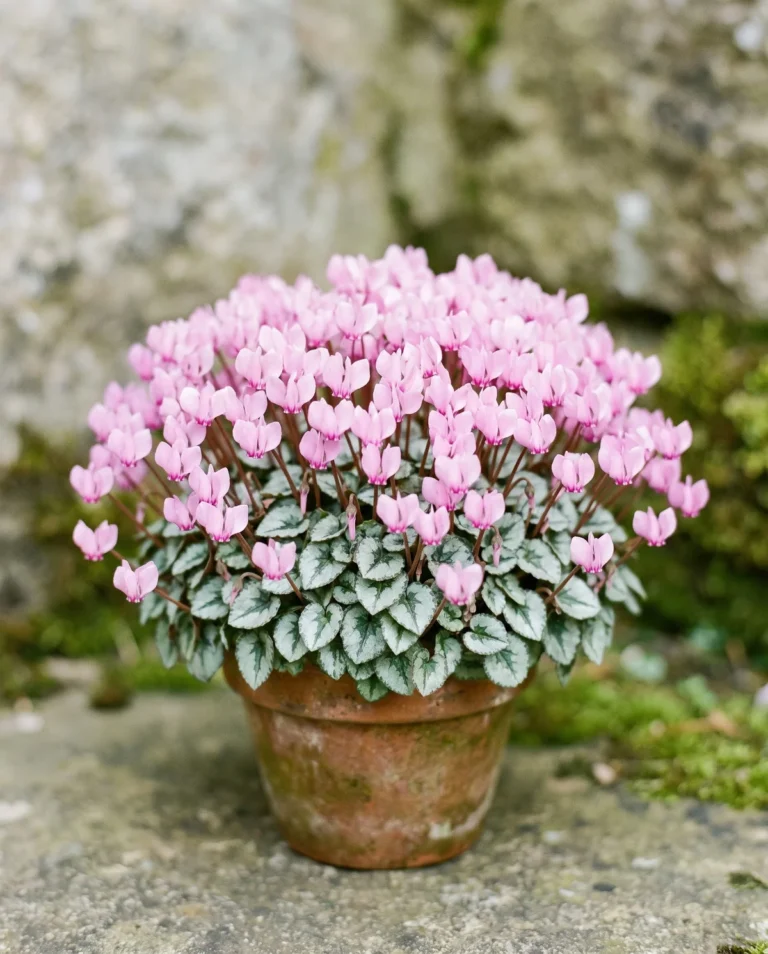
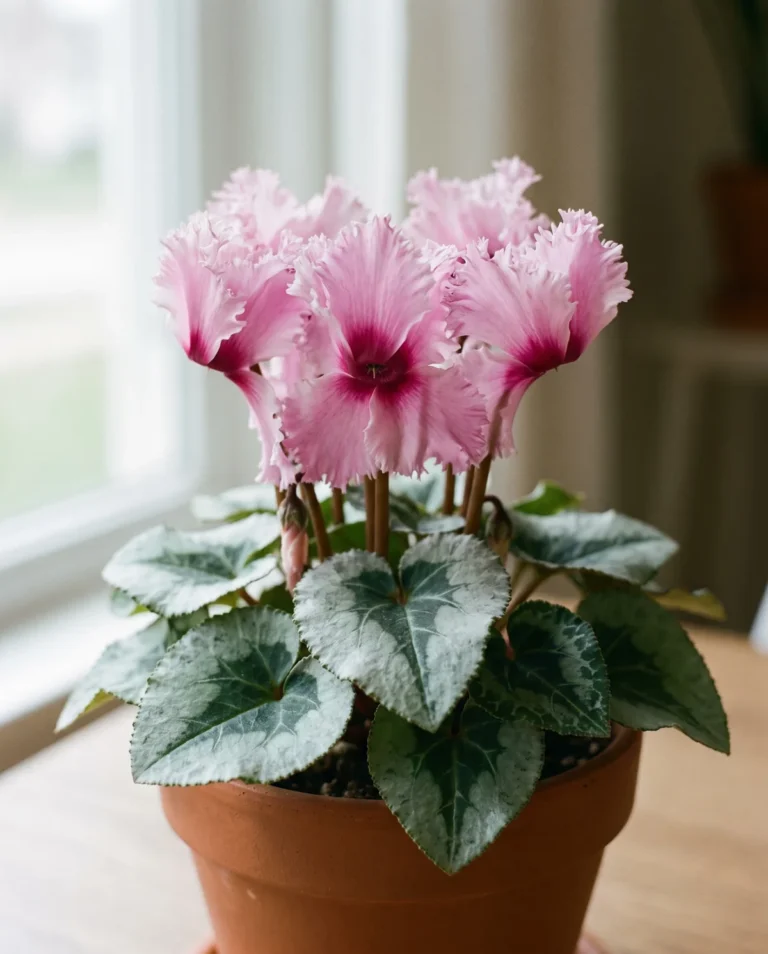
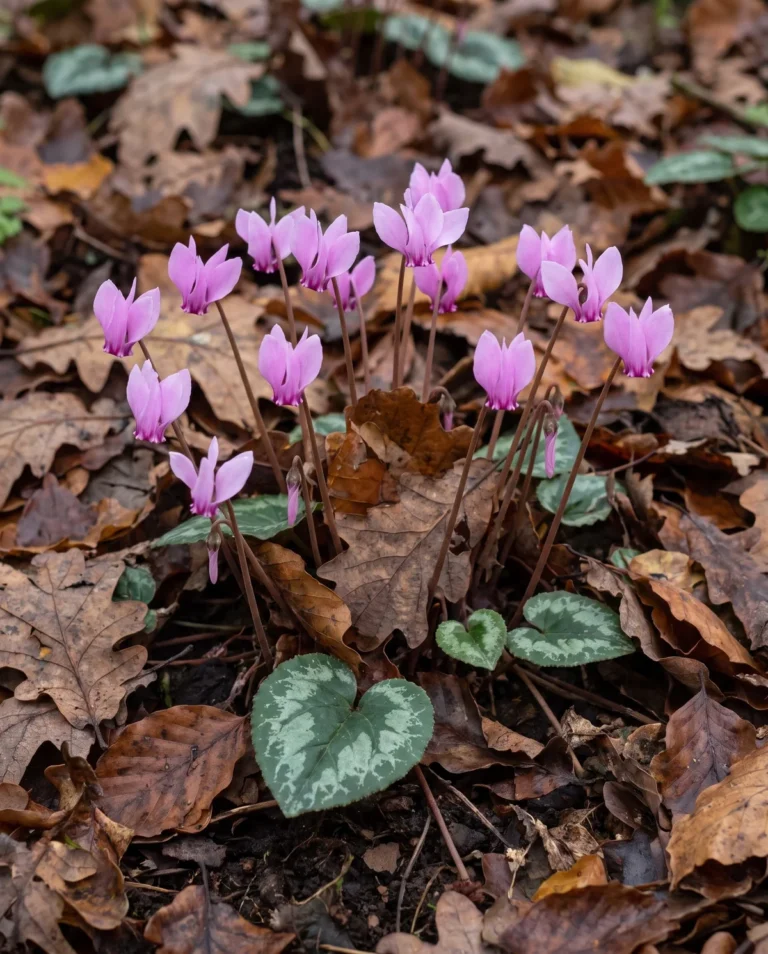
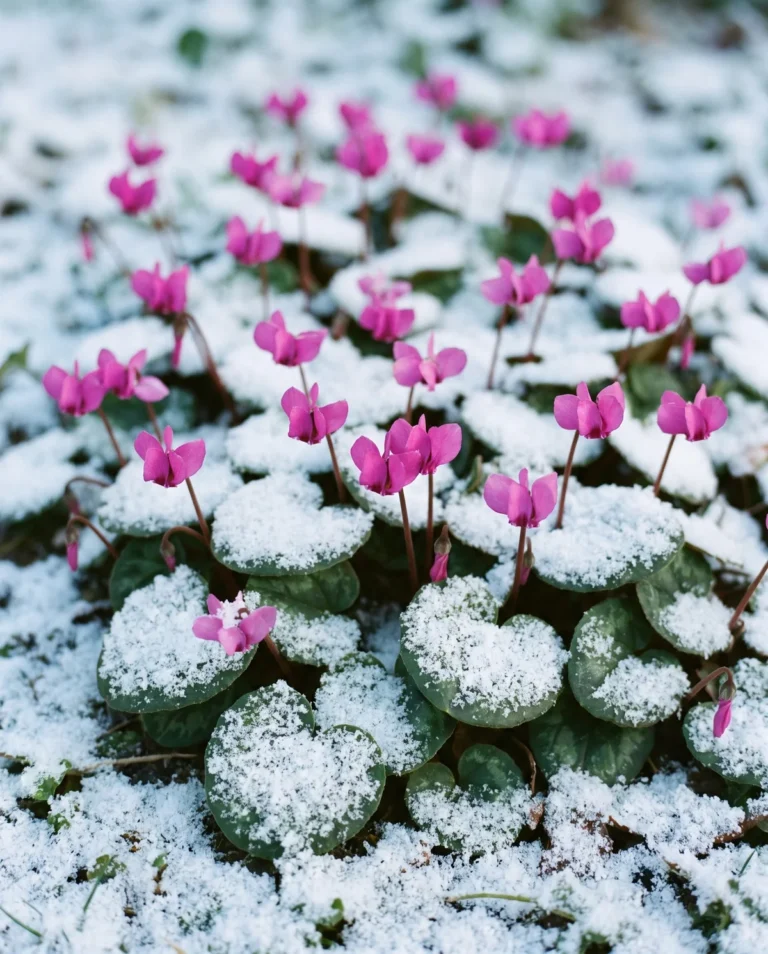
One class is missing on purpose: the mid-size plants the trade calls midis. The class exists on price tags, but no university or botanical-garden source documents it, so the honest grid stops at standards, minis and the hardy species.
Bloom time
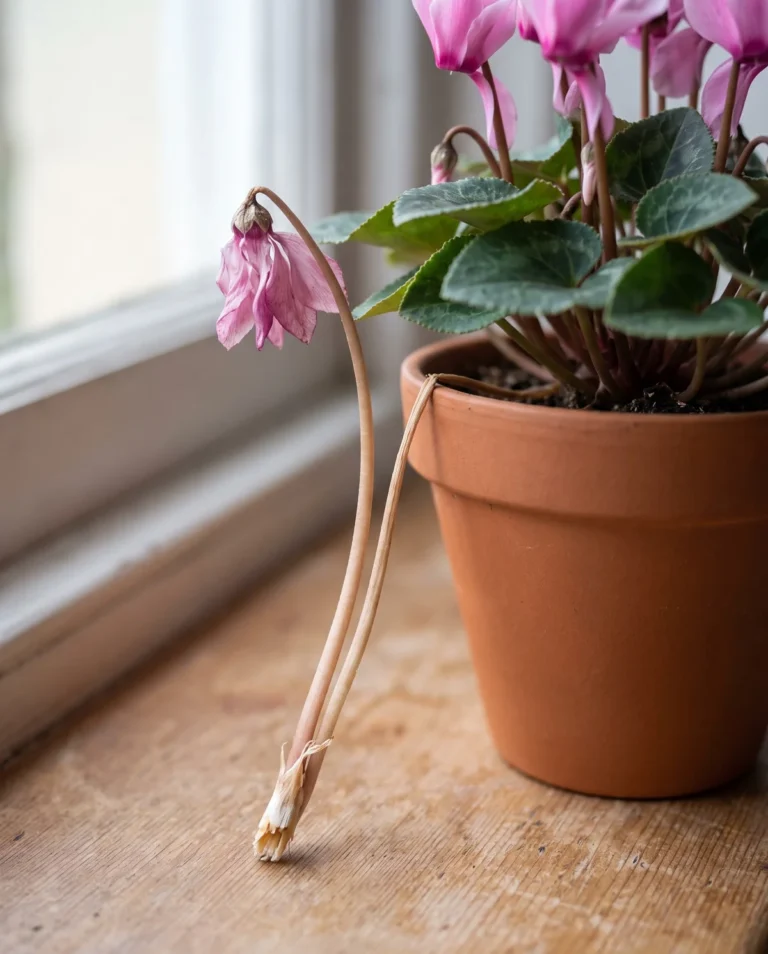
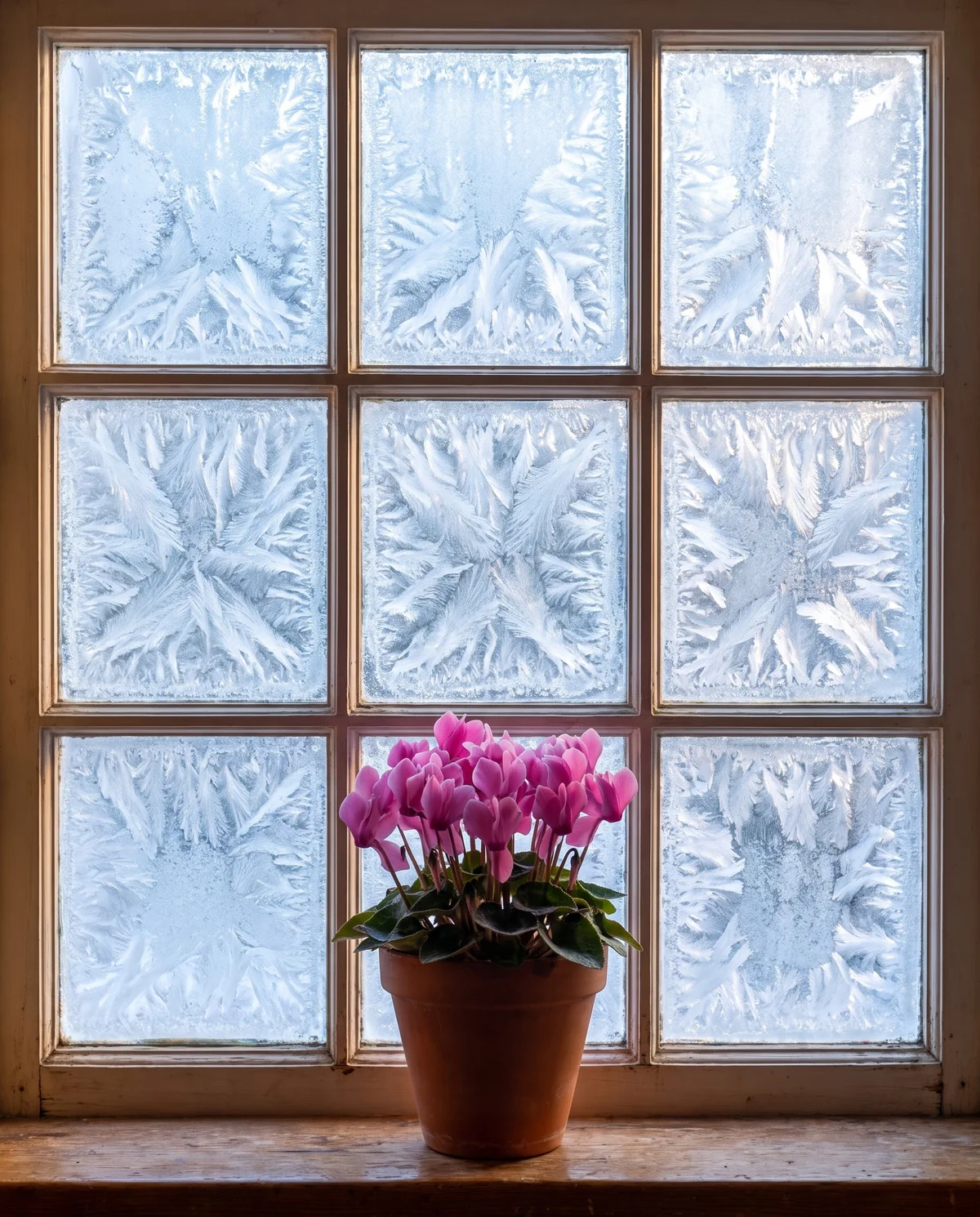
Florist's cyclamen blooms in the dead season, November into March, with individual flowers rising one per stalk in a steady relay above the leaves. How long the relay runs depends on the room, and the published figures disagree in a revealing way: Clemson promises up to four weeks of bloom, Wisconsin and NC State state up to three months, and both are right, because the variable between them is temperature. In a warm room the buds abort and the show ends fast; in a cool one the same plant keeps producing flowers for a quarter of the year. Deadheading extends the relay, and the technique matters on a plant this compactly built: spent flowers are removed with a sharp tug of the whole stalk from the base, twisting slightly, since a scissor cut leaves a stub to rot in the crown.
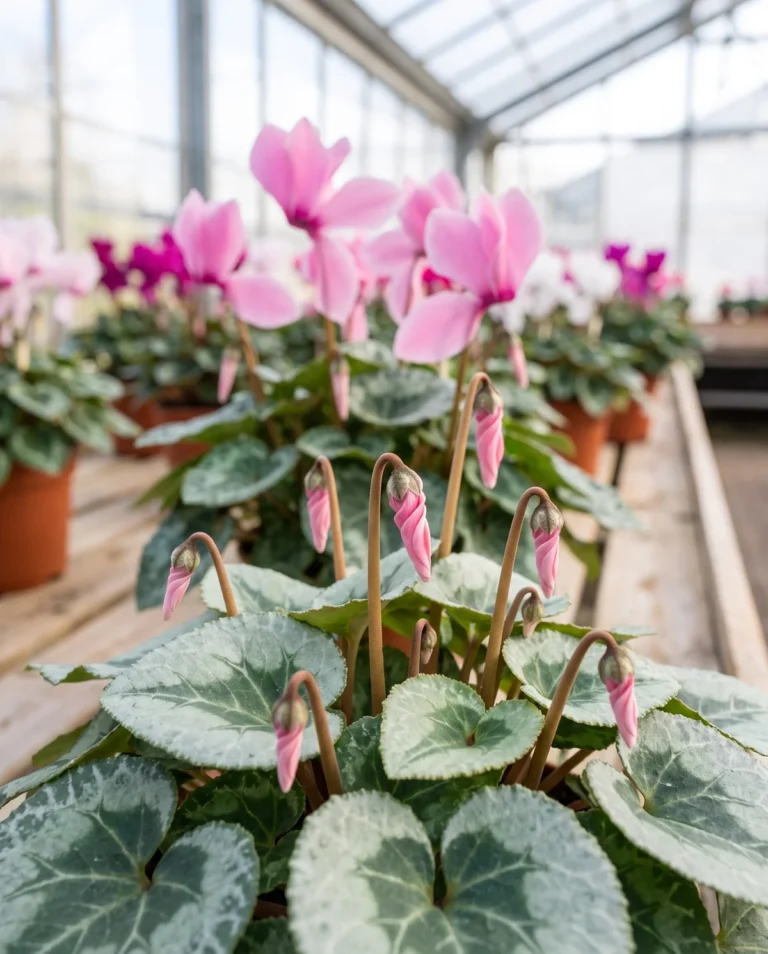
Buying well adds weeks to the season. A cyclamen spends its buds in order, so a plant sold in full flower is a plant partly spent, while one with sturdy dark leaves and a crowd of unopened buds still tucked under the canopy has its whole performance ahead. Wisconsin, Iowa State, and the New York Botanical Garden all give the same shopping advice: lift the leaves, count the buds coming, and choose the plant that looks slightly less impressive on the shelf. From there the calendar is simple. Bloom slows as spring warms, stops in late spring, and the plant moves toward its summer rest; a specimen restarted in September flowers again by midwinter, so one tuber, handled on its own terms, covers winter after winter.
Four flowers out of eighty-five
Across the eighty-five flowers in this site's data table, only four carry bloom months coded entirely inside the November-to-March window: the poinsettia, the Christmas cactus, the snowdrop, and this one. That scarcity is the cyclamen's market niche, since a flower shop in January is mostly selling stems flown across hemispheres, while the cyclamen blooms through that same stretch on a windowsill for the price of a cool room. It also explains the plant's inverted year better than any care instruction: a species that spends its strength on the darkest months has to sleep somewhere, and it sleeps through the season when the other eighty-one are doing their blooming. Of the four winter bloomers, it holds the longest run, months of it, a strange kind of championship for a plant regularly thrown away in June by owners who think it has died.
The first winter, the first summer, and the years after
The first winter is the honeymoon, and its length is set at purchase plus placement: a plant bought with a crowd of unopened buds under the canopy, per Iowa State's shopping advice, and kept on a cool bright sill delivers the long version of the season, the three months NC State and Wisconsin describe, while the same plant in a warm room gives the four weeks Clemson warns of and is gone by February. The first summer is the test that decides whether there are more winters, because everything in the plant's appearance argues for the trash can: flowering stops, leaves yellow and drop, and by July the pot is bare mix around a woody disk. The owners who pass the test are the ones who checked that the tuber was firm and then did almost nothing, six to eight weeks of cool shaded rest with barely any water. From the second September onward the plant becomes a fixture rather than a purchase: restarted in mid-September per Clemson's calendar, it is back in bloom by midwinter, and each cycle the tuber grows broader and pushes more flower stalks than the year before. The hardy garden species run the same arc outdoors without supervision, and add succession: ants carry away the sticky-coated seeds, per NC State's genus page, so a zone-5 planting of C. hederifolium becomes a widening carpet that blooms every fall while its indoor cousin is still waking up.
Height and spread
A standard florist's cyclamen makes a low mound of heart-shaped leaves, six to nine inches tall and about as wide, with the flowers held on bare stalks just above the foliage, and the whole architecture rises directly from a single tuber sitting at the soil surface. Minis and miniatures shrink the same design to teacup scale, and they have become the breeding trend, since a windowsill holds three of them in the footprint of one standard. The hardy garden species are smaller still, four to six inches of leaf and flower carpeting the ground under trees. None of them spreads or climbs indoors; the plant's size at purchase is essentially its size for life, and growth means a denser mound and more flower stalks from the same tuber. Weight and balance are trivial, making this one houseplant equally at home on a narrow sill, a desk, or a bedside table, anywhere cool enough to deserve it.
Light
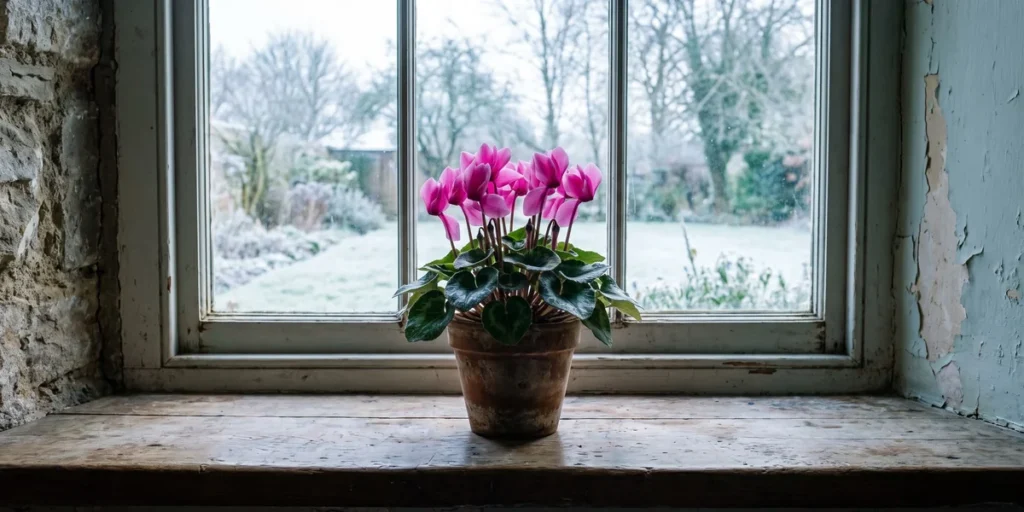
Bright and indirect is the target, with the emphasis shifting by season. In winter, while the plant is in full growth and bloom, give it the brightest window available short of hot direct sun, an east window being close to ideal, a south window softened by a sheer curtain acceptable, because winter sun through glass is gentle and the plant is working hard. What it cannot use is heat delivered as light: sun strong enough to warm the leaves is sun strong enough to shorten the bloom, and a plant glowing on a bright radiator-side sill is being cooked in slow motion regardless of how good the light looks. Outdoors in its native scrub the species grows in the broken shade of pines and oaks, and the houseplant keeps that preference for filtered brightness. During summer dormancy light stops mattering almost entirely, since a leafless resting tuber photosynthesizes nothing, and the pot can rest in any cool shaded corner until September. When growth restarts, back to the bright window, and the winter cycle begins again.
Water
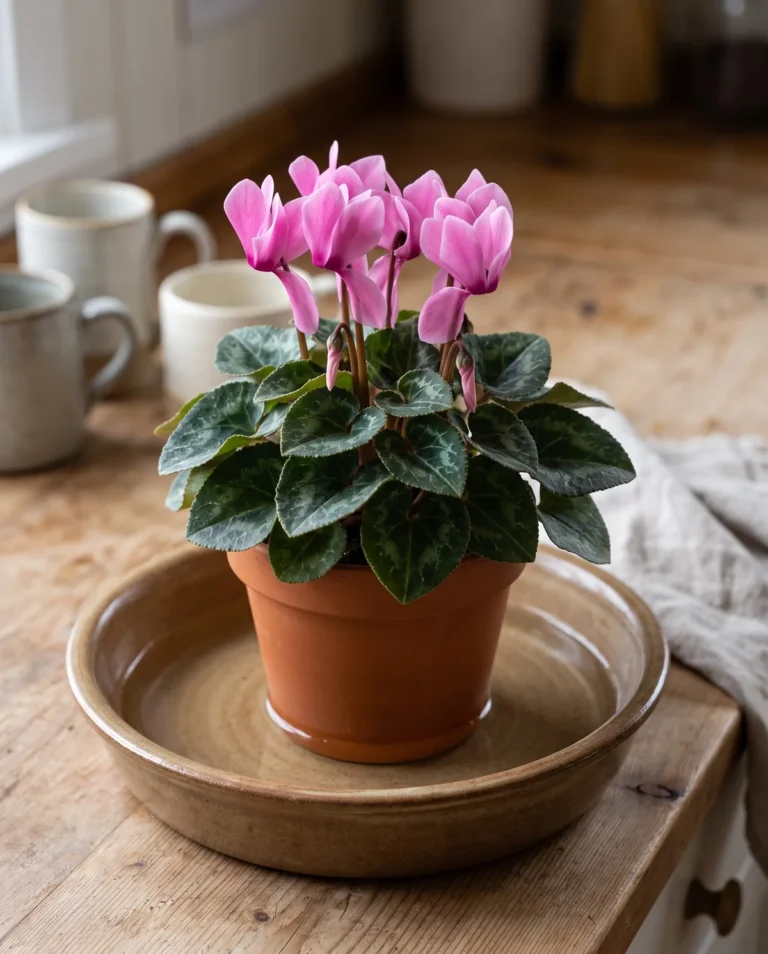
Water from below; the crown must stay dry. The tuber sits at or above the soil surface with its growing point exposed, and water poured onto it pools in the crown and starts the rot that is this plant's classic killer. The cleanest method is the one botanical gardens teach: stand the pot in a shallow bowl of room-temperature water for about fifteen minutes, let the mix drink from the drain holes, then lift it out and let it finish draining, never leaving the pot parked in a filled saucer. Frequency follows the finger test, watering when the surface begins to feel dry while the plant is in leaf and bloom. The plant forgives neither extreme, wilting dramatically when parched and rotting quietly when soggy, but it recovers from the first and rarely from the second, so when in doubt, wait a day. Feeding is light, a half-strength low-nitrogen or blooming-plant fertilizer every two weeks during active growth, because generous feeding buys lush disease-prone foliage at the expense of flowers. As bloom winds down in spring, stretch the intervals and let the plant tell you it is leaving for the summer.
Four things everyone believes about cyclamen, tested
The myth: A cyclamen is a one-season plant, like a bouquet in a pot.
The reality: The dataset behind this site codes cyclamen a true houseplant, grown for years through repeated dormancy cycles, and NC State describes the same loop: fall regrowth, about three months of winter bloom, summer sleep. Wisconsin's calendar even offers a storage variant, lifting the withered tuber into dry vermiculite at about 50 degrees Fahrenheit for 6 to 12 weeks. What ends in spring is the display, and treating that as the plant's death is how a perennial gets rebought annually.
The myth: Water it like any other houseplant.
The reality: No other common houseplant carries its growing point exposed in the middle of the pot. Iowa State states that water in the crown promotes rotting, and the technique every source converges on is bottom watering: the New York Botanical Garden's version is fifteen minutes standing in a shallow bowl of water, then full drainage, never a filled saucer. NC State names overwatering the direct cause of tuber rot, the plant's real killer.
The myth: A cold windowsill will kill a delicate winter flower.
The reality: The cold windowsill is the whole trick. Clemson's published range is 60 to 65 degrees Fahrenheit by day and around 50 at night, with buds failing above 70, and the New York Botanical Garden states that warm rooms are the usual reason the plants are short-lived. The documented difference is dramatic: about four weeks of bloom in a warm room against up to three months in a cool one, per Clemson and Wisconsin respectively.
The myth: Cyclamen cannot survive an American winter outdoors.
The reality: The florist's species cannot, being hardy only to zone 9. Its cousins can: Missouri Botanical Garden rates Cyclamen hederifolium to zone 5 and advises mulching the corms, NC State stretches the hardy trio's rating to 4a, and RHS rates C. coum H5, flowering January to March through frost and snow. The gift plant and the garden carpet are different species running the same Mediterranean playbook.
Soil and pH
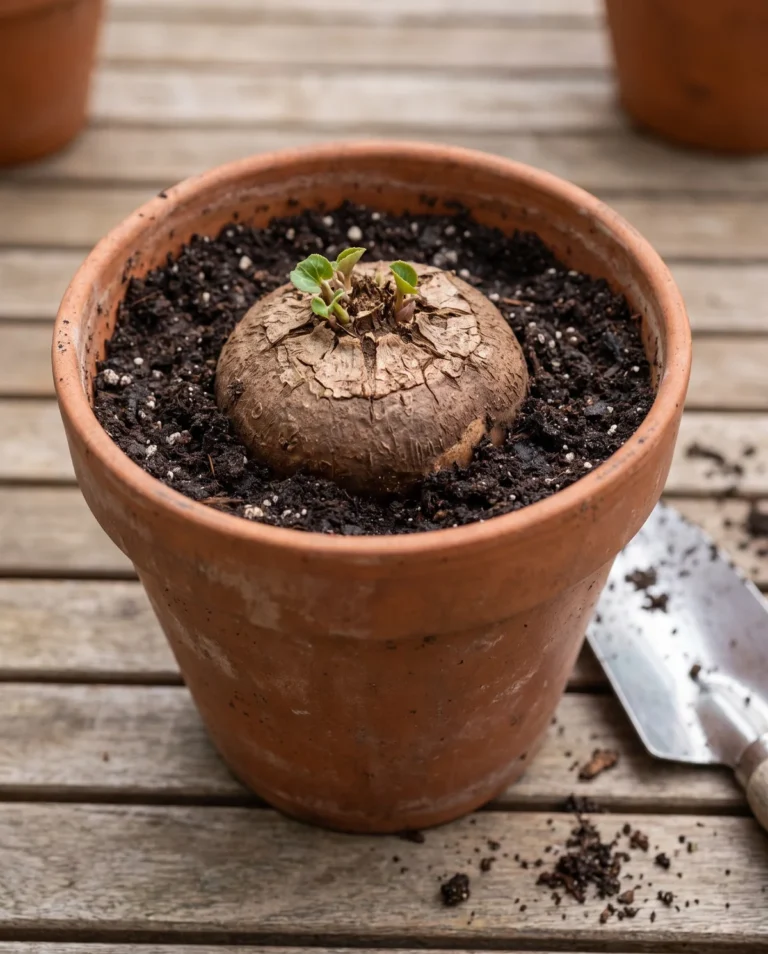
Any quality peat- or coir-based potting mix with sharp drainage suits a cyclamen, with chemistry in the slightly acid to neutral range and nothing exotic required. The planting depth is the detail that matters more than the recipe: the tuber is set high, its top third to half proud of the soil surface, which keeps the crown and its growing point out of the wet zone entirely. A tuber buried flush, as instinct suggests, sits with its most vulnerable tissue wrapped in moist mix, and the rot risk that bottom watering works so hard to avoid gets built into the pot from day one. Repotting is a once-a-year affair at most, done in summer while the tuber sleeps or at the September restart, into a pot only modestly larger, since a snug root run and a high-set tuber are both part of the formula. Garden soil for the hardy outdoor species follows the same logic outdoors: humus-rich, sharply drained, under deciduous shade, with the tubers shallow and never in winter-wet ground.
USDA hardiness
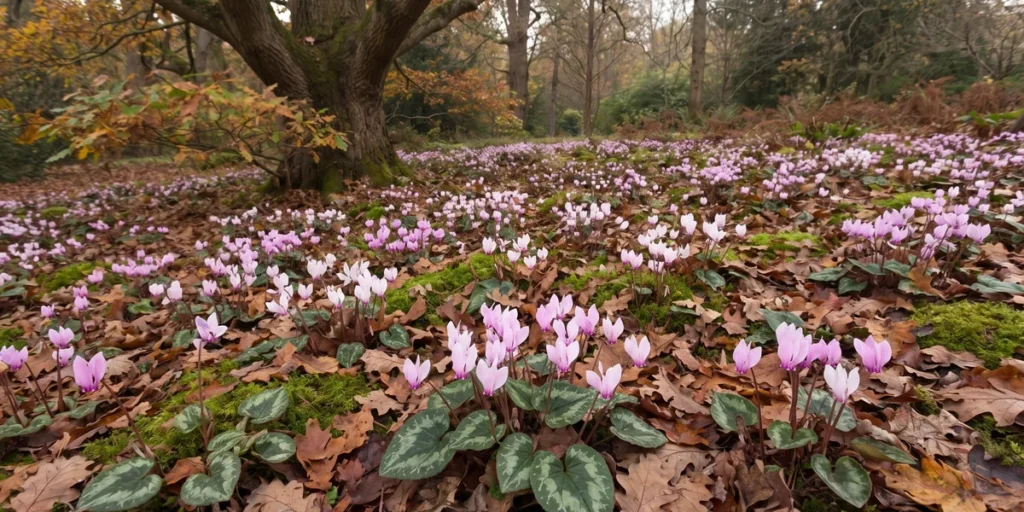
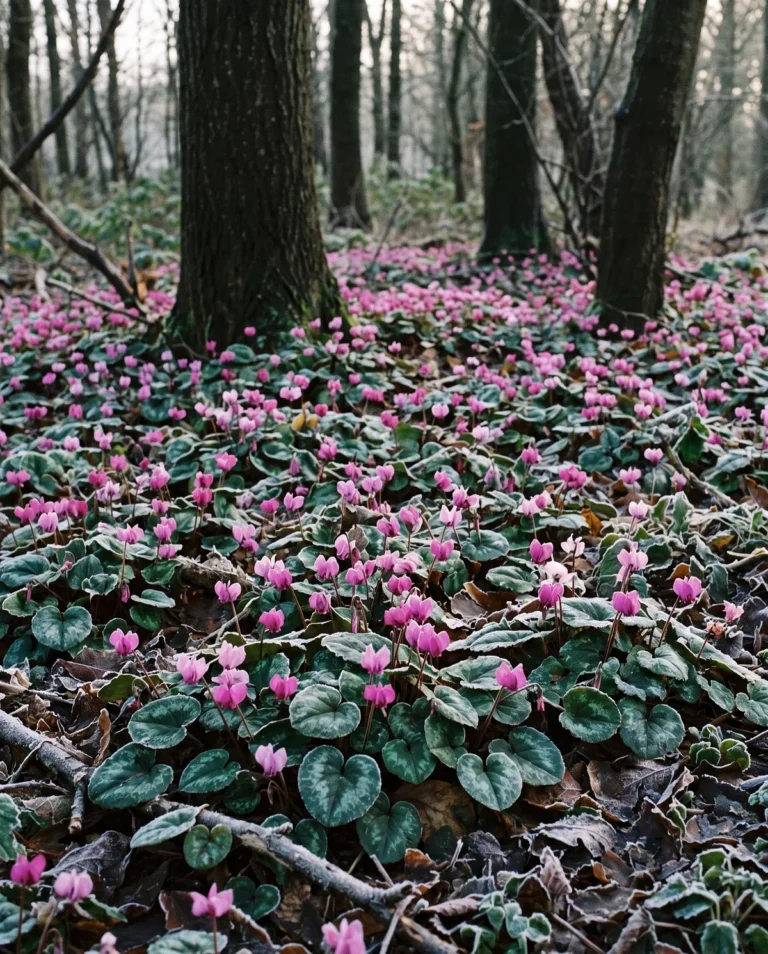
Florist's cyclamen is hardy outdoors only in zones 9 through 11, which for most of the country makes it strictly a cool-room houseplant, and even in those mild zones it serves as winter bedding more than a permanent fixture. The genus, though, has members built for real winters, and they are among the best-kept secrets of shade gardening. Ivy-leaved cyclamen, Cyclamen hederifolium, is rated zone 5 to 9 by the Missouri Botanical Garden, blooming pink to white in September and October before the leaves emerge. Cyclamen coum answers it at the other end of winter, flowering magenta to white from January into March through snow and hard weather, and NC State rates it hardy all the way to zone 4a. Both are miniature plants for dry shade under trees, spreading slowly into carpets that handle the exact conditions, root competition and summer drought, that defeat most groundcovers, and they share the hellebore's knack for blooming when the garden is otherwise shut. The florist's plant on the sill and the hardy carpet under the oak are cousins, not the same plant, and the most common hardiness mistake is planting the gift pot outdoors in zone 6 and expecting it to behave like its relatives.
| Cyclamen | Hardy in | Blooms |
|---|---|---|
| Florist's (C. persicum) | Zones 9 to 11 | November to March indoors |
| Ivy-leaved (C. hederifolium) | Zone 5 | September to October |
| C. coum | Zone 5, NC State says 4a | January to March |
The winter flower deer walk past
The hardy garden cyclamens carry an advantage the catalogs undersell: the deer-resistance ratings used by landscape professionals place cyclamen in the seldom-severely-damaged class, and it appears on rabbit-resistance lists as well. The same saponins that make the tuber a hazard indoors make the whole plant an unrewarding bite outdoors, which fits what the damage surveys record, and grazing pressure that strips tulips and hostas to stubs tends to leave a cyclamen carpet alone. The timing multiplies the value, because a fall- or winter-blooming groundcover is exactly the planting that cannot be fenced or sprayed on a reasonable schedule, and the two garden species bloom precisely when gardens are least defended. Under bare trees in November, in the root-riddled dry shade where little else grows, an unbrowsed flower is the reason the planting still exists in spring.
Two calendars: the windowsill plant and the zone-5 carpet
The florist's cyclamen and its hardy cousins run on the same Mediterranean logic, active in the cool months and asleep in the hot ones, but their calendars are published by different sources for different worlds. Each row names its own.
Propagation and longevity
Home propagation is difficult, and the sources say so directly. The florist's cyclamen is raised commercially from seed, a slow, controlled process taking many months from sowing to a blooming plant, and NC State describes both seed and tuber division as hard enough for this species that simply replacing a plant is the common choice. Division in particular runs against the plant's anatomy, since the tuber is a single storage organ, and cutting it invites the rot the whole care system is designed to prevent. Seed from a home plant is possible for the patient, but the named hybrids will not come true. The realistic longevity play is continuity: one tuber, carried through its annual cycle of winter bloom and summer sleep, grows larger and more floriferous for years, and the hardy garden species do their own multiplying by seed, spread by ants, into slowly widening colonies. Indoors, the difference between a six-week cyclamen and a six-year cyclamen comes down to whether its dormancy is read as death or as the calendar working.
Summer dormancy
Sometime in late spring the best-kept cyclamen starts what looks like organ failure: flowering stops, leaves yellow a few at a time, and within weeks the pot holds nothing but bare mix and the exposed top of the tuber. This is the species remembering the Mediterranean, where summer is the dead season and every wild cyclamen sleeps through it underground, and extension services document both the cycle and the two standard ways owners defeat themselves, throwing out a healthy dormant tuber as dead, or drowning it with rescue watering until it actually is. As leaves yellow, stretch the watering intervals gradually to mimic a drying season, stop feeding, and once the plant is bare, move the pot to a cool, shaded, airy place, around 45 to 50°F where possible, watering only barely and occasionally so the tuber does not shrivel to a husk. The published rest period runs six to eight weeks at minimum and stretches toward two or three months in practice.
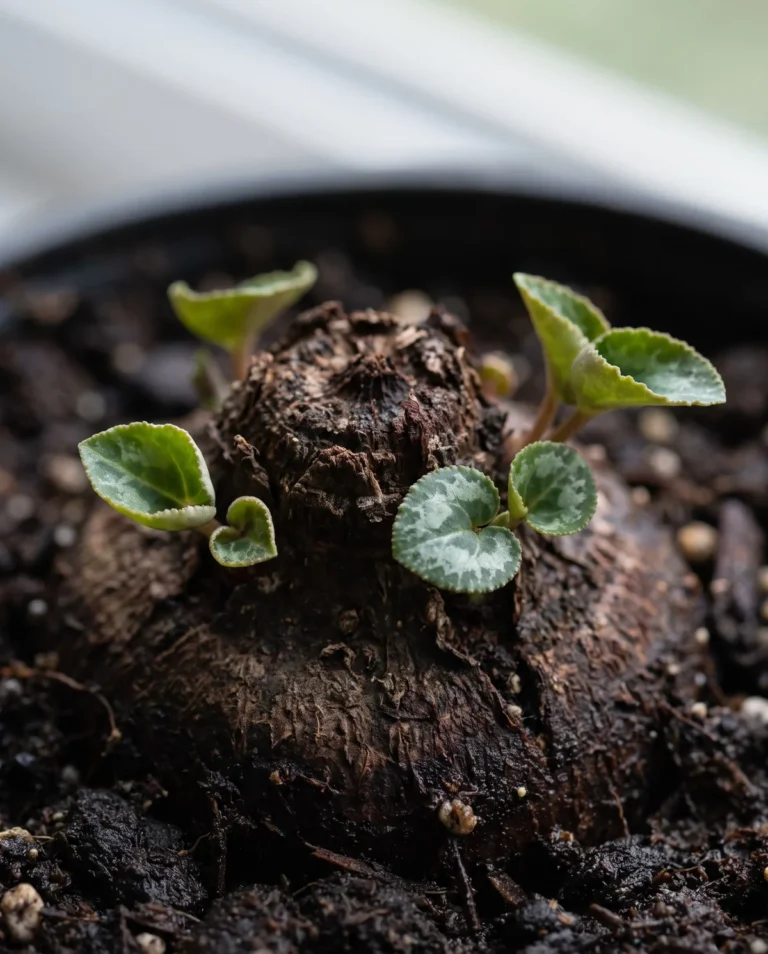
The restart is a September appointment. Around midmonth, or whenever the first tiny new leaves show at the crown, repot if needed with the tuber's upper half proud of fresh mix, move the pot back to a bright cool window, and resume real watering from below; growth builds through fall and the plant is back in bloom by midwinter. The scratch-your-head moment usually comes earlier, in July, when a bare pot tests anyone's faith. The check is the tuber itself: firm, heavy, and unblemished means asleep, soft, hollow, or moldy means gone, and a firm tuber needs nothing from you but patience. Handled this way the same plant blooms every winter for years, and the summer nap turns out to be the reason a Mediterranean plant can afford to flower through the darkest months at all.
Fragrance
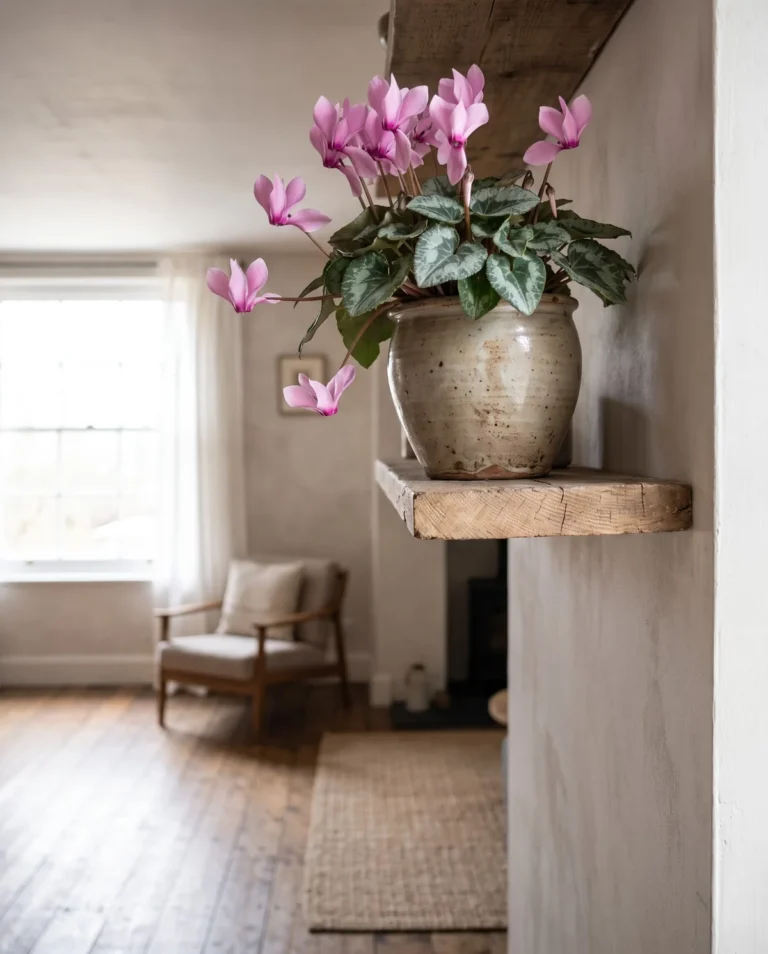
Breeding spent most of this plant's scent. The wild Cyclamen persicum is fragrant, described by NC State as sweetly scented, but the big-flowered florist standards traded most of that perfume away in the pursuit of size and color, and a typical gift plant offers at best a faint, powdery trace up close. The exception runs small: the mini and miniature lines sit closer to the species, and Missouri's extension coverage notes they are the ones most likely to still carry real scent, which gives fragrance hunters an easy rule, buy small and sniff before buying. Outdoors the family does better, and the summer-blooming hardy species Cyclamen purpurascens is described by the Royal Horticultural Society as very fragrant. For most households the outcome is neutral: a standard cyclamen adds winter color without competing with anything else the season puts on the table, and a scented mini is a findable upgrade.
Toxicity and pet safety
Of the winter windowsill trio, this is the plant that earns a real warning. The ASPCA lists cyclamen as toxic to cats, dogs, and horses, with terpenoid saponins as the toxic principle, and the typical outcome of a pet chewing leaves or flowers is drooling, vomiting, and diarrhea, unpleasant and usually self-limiting. The serious scenario is concentrated in the tuber: following large ingestions of tubers, in the ASPCA's wording, the documented signs escalate to heart rhythm abnormalities, seizures, and death. That combination, mild from the greenery, dangerous from the tuber, writes its own placement rule, since the tuber sits exposed at the soil surface exactly where a digging cat or a bored puppy works. Keep the pot on a shelf or stand pets cannot reach, and treat a knocked-over, dug-out plant as a reason to call the vet rather than wait. For people the picture is milder: NC State rates cyclamen a low-severity human poison, with stomach upset from ingestion and skin irritation from handling the tuber as the documented effects, so gloves at repotting cover it. Households wanting winter color with no such asterisk have an easy answer one shelf over, the Christmas cactus, which the ASPCA clears entirely.
How long it lasts indoors
Coolness converts directly into display time. The documented range runs from about a month of bloom in a warm room to a full three months in a properly cool one, with the mechanism sitting in the buds, which abort above roughly 70°F and keep developing below it. The winning placement is the coolest bright spot the house offers, an unheated sunroom, a drafty-in-the-good-way windowsill, an entry hall, targeting days in the low 60s and nights near 50. The same coolness stretches each individual flower's life and keeps the foliage dense; heat shows up first as yellowing leaves and an end to new buds, long before anything wilts.
Bought well and kept cold, a single plant covers the dark half of the year, and the relay extends past the first season for anyone willing to grant the summer nap covered above. In the same aisle, the poinsettia offers six to eight louder weeks and the Christmas cactus offers decades on a different rhythm, which leaves the cyclamen the middle path, months of continuous delicate bloom, renewable annually, for the price of a cool room and a bowl of water.
How long a cyclamen really lasts indoors, by who measured it
Not a cut flower, and the dataset codes it that way; the numbers that exist measure the potted display, and they disagree in the most useful way possible, because the disagreement is the thermometer.
A warm cozy room and generous watering keep the flowers coming.
Both halves are backward. Heat above 70 degrees aborts the buds per Clemson, and water from above rots the crown per Iowa State. The plant wants the coolest bright spot in the house and its water served from below, fifteen minutes in a bowl.
Buy the plant in fullest, most spectacular flower.
That plant has already spent part of its season on the store bench. The extension shopping rule is the opposite: count the unopened buds under the leaves and take the plant whose show is still ahead of it.
Yellowing leaves mean it needs more water.
Yellowing has five documented readings, and more water answers only one of them. The New York Botanical Garden's list runs light, heat, overwatering and underwatering, and from late spring the fifth reading, normal dormancy, outranks them all. Feel the soil and check the calendar before reaching for the can.
Pests and diseases
Overall pest pressure is rated low, but the two problems worth knowing are distinctive. The first is the cyclamen mite, a pest so small, under a hundredth of an inch, that the damage is always seen before the animal is: new leaves come in curled inward, puckered, brittle, and undersized, and buds emerge distorted or refuse to open at all, because the mites feed hidden inside them, in the moist, dark folds of buds and the youngest leaves. Clemson's advice for an infested houseplant is disposal, since control at home is impractical and the mite travels to other plants. The second is gray mold, Botrytis, which in cyclamen has a signature move: it invades the flower stalk, the stalk rots at a point, and the bloom collapses overnight, with fuzzy gray growth following in humid, stagnant air. Airflow, cool temperatures, prompt removal of spent flowers and yellowed leaves, and the dry-crown watering discipline prevent nearly all of it. Everything else is occasional, aphids, spider mites in dry heat, and the tuber rot already covered, which remains the classic killer and is a watering decision more than an infection.
Six forks, and the calendar decides the biggest one
Most cyclamen emergencies are the same three symptoms read in the wrong season. The date, the soil, and the tuber settle nearly every case below. Where a card has no photo, that is deliberate: mold textures and mite damage are diagnostic fingerprints that need real reference photos, not generated approximations.
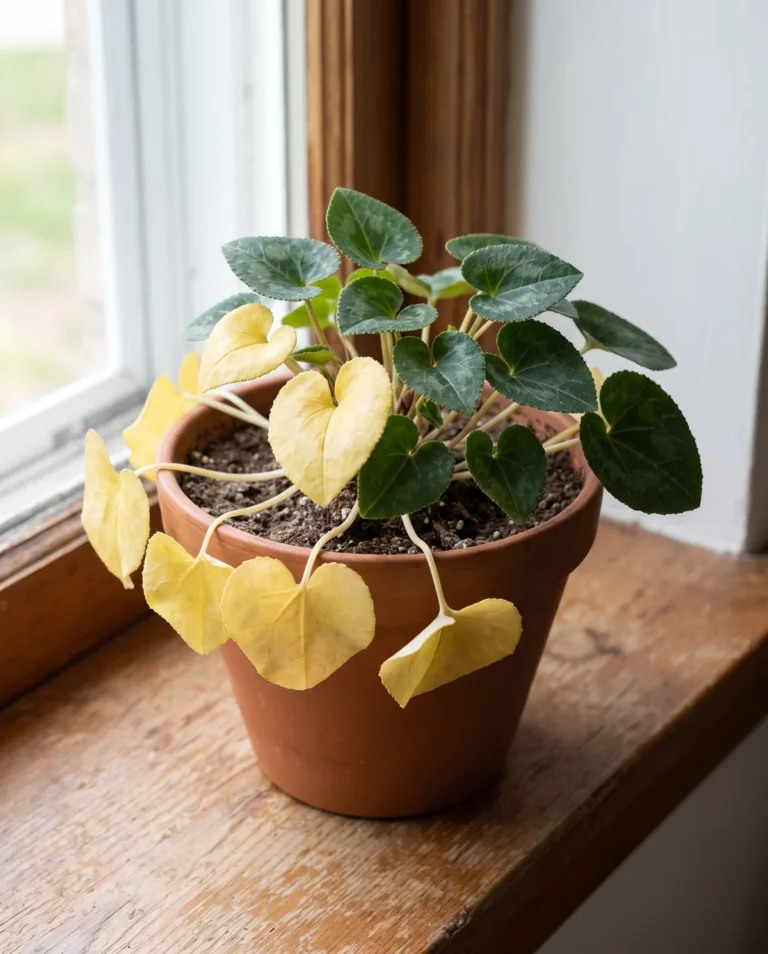
Clemson and NC State document the cycle: after flowering, the plant moves its energy back into the tuber and sheds its leaves for the Mediterranean dry season it still remembers. The taper is the whole technique. The New York Botanical Garden has watering reduced gradually over several weeks as leaves yellow, Iowa State cuts frequency step by step to mimic a drying season, and the rest itself runs six to eight weeks by their shared figure, with Wisconsin allowing two to three months. Feeding stops with the first yellow leaf, and the bare pot then waits somewhere cool and shaded until September.
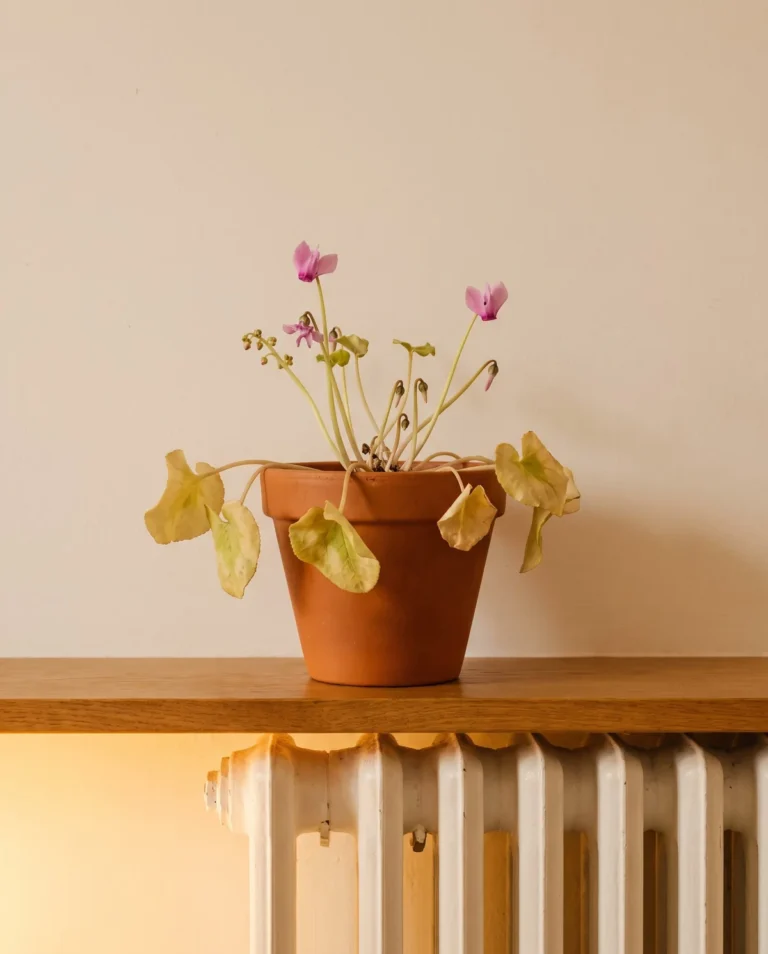
The New York Botanical Garden's diagnostic list for yellow leaves runs too little light, too much heat, overwatering, underwatering, and in a heated living room heat leads the list; Clemson draws the hard line at 70 degrees Fahrenheit, above which flower buds fail to develop. The date separates this from dormancy: a cyclamen has no business winding down in December. Move it to the coolest bright spot in the house, days near 60 to 65 and nights around 50, and new buds resume within weeks.
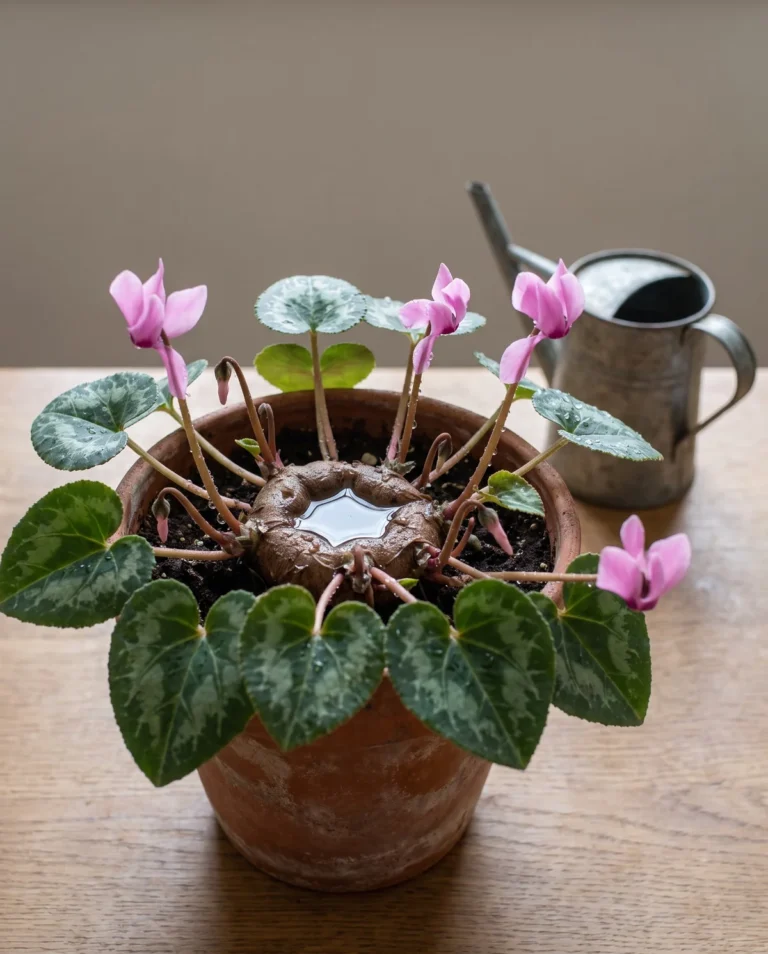
NC State names overwatering the direct cause of tuber rot, and Iowa State pins the entry point: water sitting in the crown of the plant promotes rotting. A wet-soil wilt with a still-firm tuber is a plant that can be saved by drainage and dry-crown watering from below; a soft, spongy tuber is past saving, and the honest response is to start over. This is why every extension teaches the same technique, water along the pot edge or from beneath, never over the top of the plant.
The University of Connecticut's IPM sheet explains why nobody ever sees the culprit: the mite is under a hundredth of an inch, avoids light, and hides in the moist, dark folds of buds and the youngest leaves, so the distortion appears long before any pest could be spotted. Clemson's verdict on an infested houseplant is disposal, because home control is impractical and the mite moves to other plants. No photo by policy: the damage pattern is the diagnostic fingerprint, and it needs a real reference image, not a generated one.
The University of Illinois plant-disease report documents the sequence: Botrytis blossom and bud blight invades the flower stalk, the pedicel rots, and the bloom folds. Humid stagnant air, crowded benches and dead material feed it, and the RHS lists cyclamen grey mould among the plant's standing problems. The counters are mechanical: airflow, coolness, prompt removal of spent flowers by twisting the whole stalk from the base, and the dry-crown watering that keeps the plant's center from ever sitting wet. No photo by policy: mold texture is a fingerprint for a real reference image.
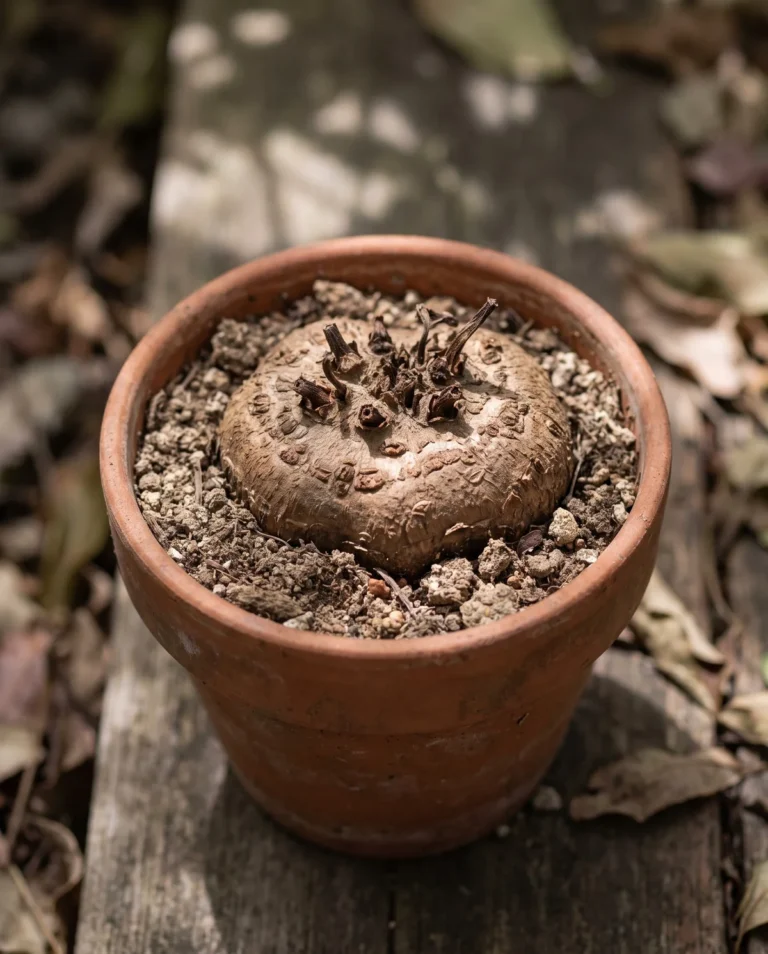
This is what a resting cyclamen is supposed to look like, and the tuber itself gives the verdict: firm, heavy and unblemished means alive and asleep, soft, hollow or moldy means gone. A sleeping tuber needs shade, coolness around 45 to 50 degrees Fahrenheit, and only the barest occasional water so it does not shrivel, per Iowa State. Mark the calendar for mid-September, when Clemson's restart applies: fresh light, real watering from below, and bloom again by midwinter.
Two ordered paths, and the thermometer goes first
The cyclamen's two classic emergencies, a plant that seems to be dying and a plant that never came back, are both usually calendar and temperature stories. The checks run in order of likelihood and cost, and the expensive guesses, disease and pests, sit correctly at the bottom.
What actually goes wrong with cyclamen, by the clinics that see them
No percentages are claimed, because no honest sample of home cyclamen trouble exists to count. Each line carries the wording of the institution that handles the complaint, and the check line is the first thing to rule out.
The thermometer, before anything else. The documented spread runs from about four weeks of bloom in warmth to three months in a cool room, and temperature is the whole difference.
Where the water lands. Iowa State: water in the crown promotes rot; NC State: overwatering is the direct cause. Bottom watering with a fifteen-minute soak and full drainage prevents nearly all of it.
The tuber, by feel. Firm and heavy means asleep; soft or hollow means gone. Wisconsin's alternative for the summer is storing the lifted tuber in dry vermiculite at about 50 degrees for 6 to 12 weeks, which makes the bare-pot question disappear entirely.
New growth, not old: curled, puckered, brittle young leaves and buds that never open. Warm dry air favors it, and the extension verdict for an infested houseplant is disposal.
Air and hygiene. Stagnant humid corners and spent flowers left standing feed gray mold; twist whole stalks out at the base and give the plant moving air.
FAQ
My cyclamen is dying after flowering. Can I save it?
It is almost certainly going dormant, not dying, which is normal for the species in late spring. Let the leaves yellow and drop, cut watering back to nearly nothing, and rest the bare pot in a cool shaded spot for the summer. Restart bright light and bottom watering in mid-September and it blooms again by midwinter. A firm tuber means a living plant.
Are cyclamen poisonous to cats and dogs?
Yes. The ASPCA lists cyclamen as toxic to cats, dogs, and horses. Chewed leaves typically cause drooling, vomiting, and diarrhea, but large ingestions of the tuber can cause heart rhythm abnormalities, seizures, and death. Keep the plant out of reach and call the vet if the tuber has been dug up and eaten.
How long do cyclamen flowers last?
From about four weeks in a warm room to three months in a cool one; temperature is the whole difference. Keep the plant below about 70°F by day, cooler at night, and remove spent flowers by twisting the whole stalk from the base.
How do I water a cyclamen?
From below: stand the pot in a shallow bowl of room-temperature water for about fifteen minutes, then drain. Never pour water over the tuber, and never let the pot sit in a filled saucer. Water when the surface begins to dry.
Will my cyclamen bloom again next year?
Yes, if it gets its summer rest. After dormancy, restart it in September in a cool bright window with bottom watering, and expect flowers by midwinter. The cycle repeats for years from the same tuber.
Can I plant cyclamen outside?
The florist's cyclamen only in zones 9 to 11. For real winters, plant the hardy species instead: Cyclamen hederifolium (zone 5, blooming September to October) and Cyclamen coum (January to March) thrive in dry shade under trees.
Why are the leaves turning yellow?
Check four things in order: heat first (over about 70°F stops buds and stresses foliage), then light too dim, watering too much, watering too little. If it is late spring and bloom has finished, yellowing is the normal start of summer dormancy and nothing is wrong.
The next questions people ask, answered short
The dormant pot can, per Wisconsin guidance: a shaded dry spot, protection from rain so the sleeping mix never stays wet, and back indoors before cold weather. What it cannot do is stay out through winter anywhere colder than zone 9.
Heat first: above 70 degrees Fahrenheit buds fail to develop, per Clemson. If the room is genuinely cool and new leaves are also coming in curled and brittle, suspect cyclamen mite, which feeds inside buds, and treat an infested plant as a loss.
At most, and only at the summer restart: fresh mix, a pot just one size up if any, and the tuber's top third to half above the soil line per RHS and Wisconsin. Mid-season repotting trades months of bloom for no benefit.
Cyclamen hederifolium, zone 5 per Missouri Botanical Garden with winter mulch, blooming September to October, and C. coum, flowering January to March, rated H5 by RHS. NC State rates the hardy group to zone 4a. The florist's plant is not one of them.
By ant. NC State's genus page documents seeds carried off by ants and woodlice for their sticky coating, and RHS notes C. coum self-sows into carpets of leaves and flowers over the years, planted one ant-trip at a time.
Flower photos
Interesting tips
The seed stalks perform the plant's best trick: in many cyclamen, once a flower is pollinated, its stalk coils downward into a tight spiral, winching the seed capsule to the soil surface, which is why old plants seem to plant their own children around their feet. The seeds travel from there by ant, carried off for their sticky coating and dropped conveniently under the next tree, which is how a single hardy cyclamen becomes a carpet. History adds a comic footnote: the elegant windowsill flower spent centuries under the name sowbread, for pigs' enthusiasm for the tubers, after entering the record with Theophrastus over two thousand years ago. At the store, take the mini if fragrance matters, and walk past anything parked beside a heat vent no matter how perfect it looks. And if the December windowsill is already crowded, remember the outdoor branch of the family, which extends the December birth flower season at both ends, C. hederifolium before it and C. coum after, in parts of the garden nothing else will decorate.
Related Guides & Flowers
Poinsettia
the six-week icon of December windowsills.
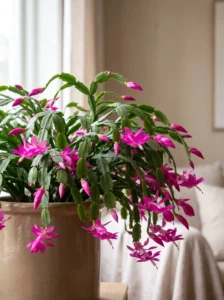
Christmas Cactus
decades-long winter bloomer, safe for pets.
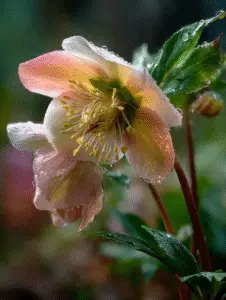
Hellebore
winter roses for the frozen garden.
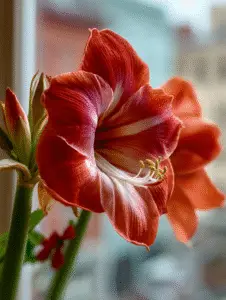
Amaryllis
the easy rebloomer of the holiday table.
Enjoying our flower guides? Add YourFlowersGuide as a preferred source on Google. It helps more readers find us.
Add to Preferred Sources