What mandevilla is and where it comes from
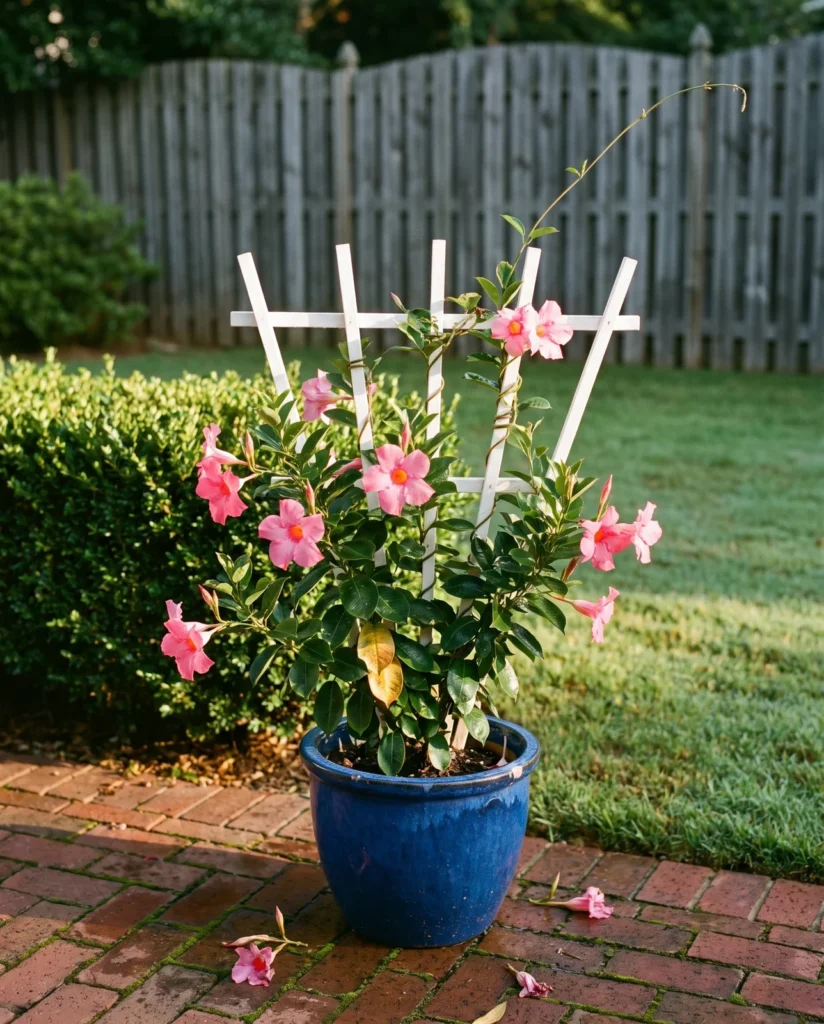
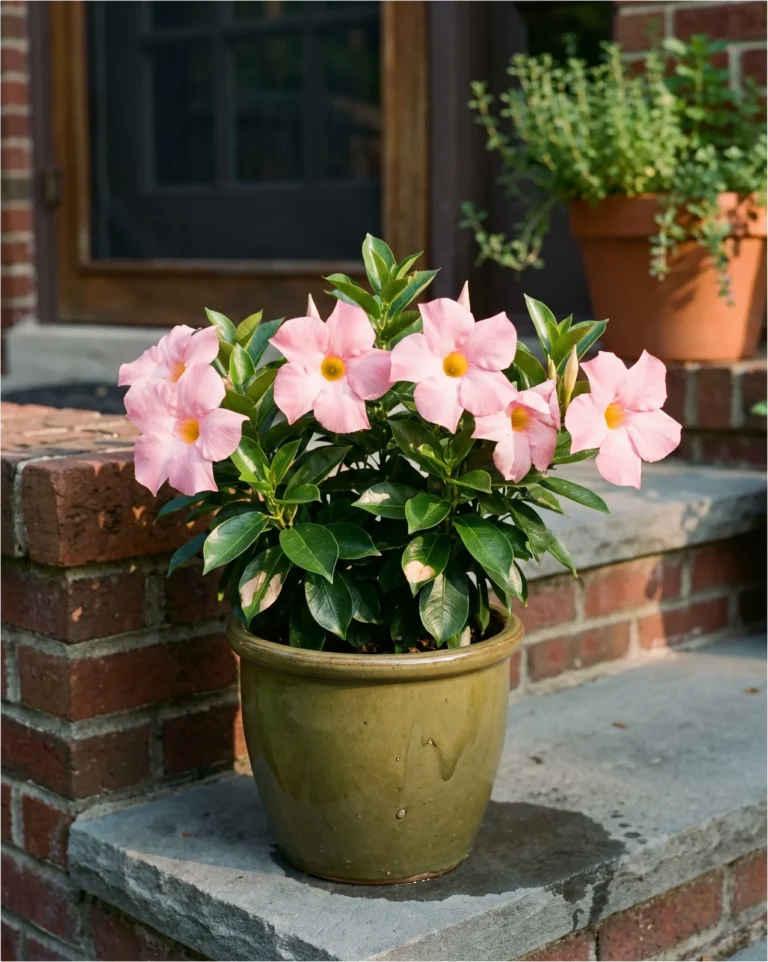
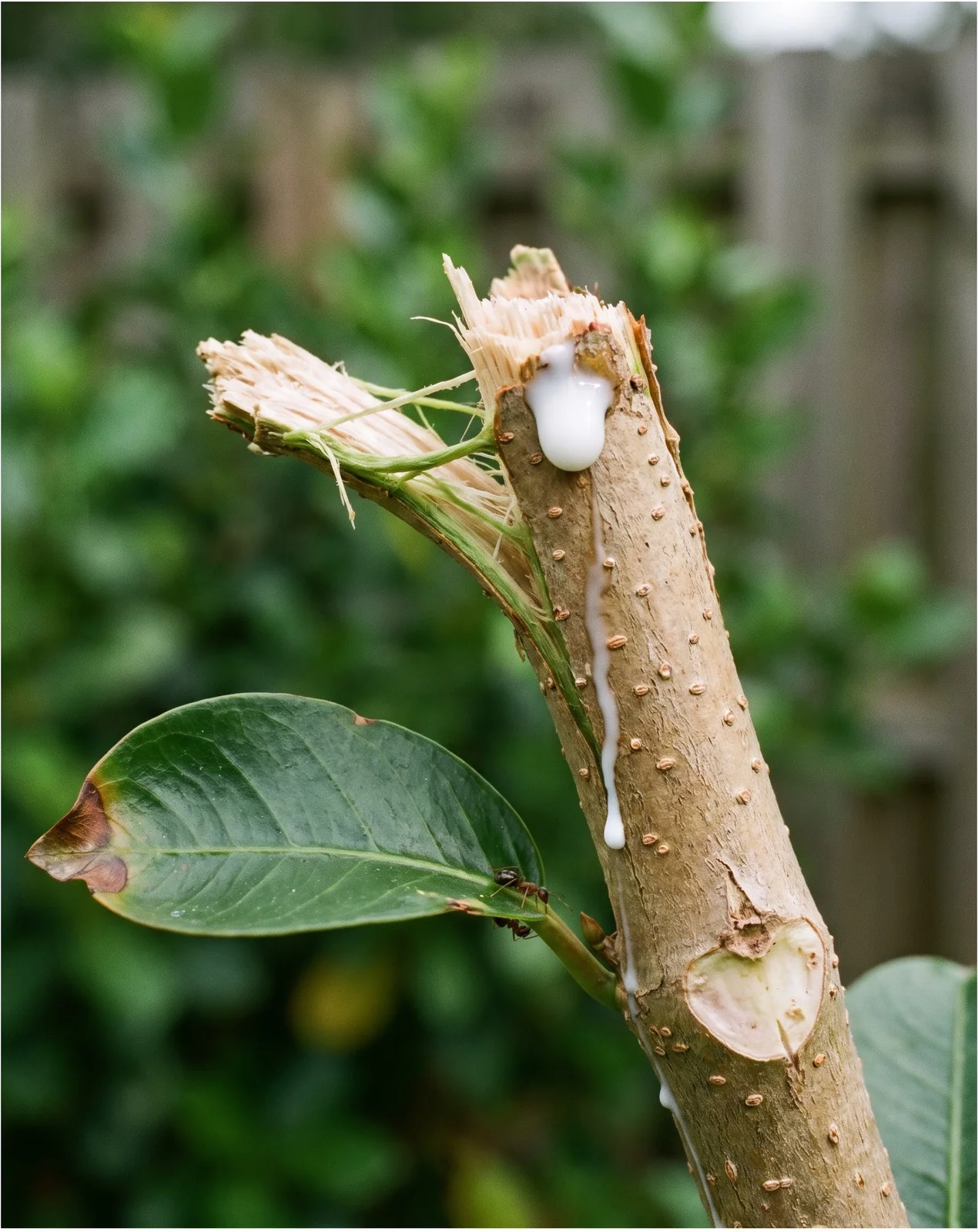
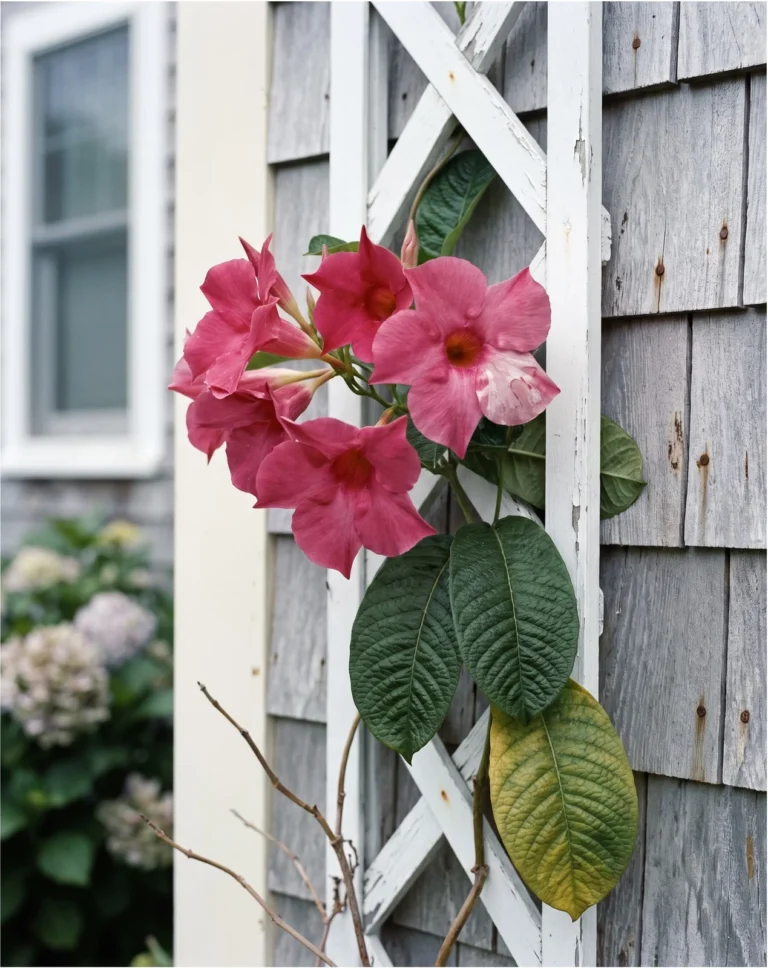
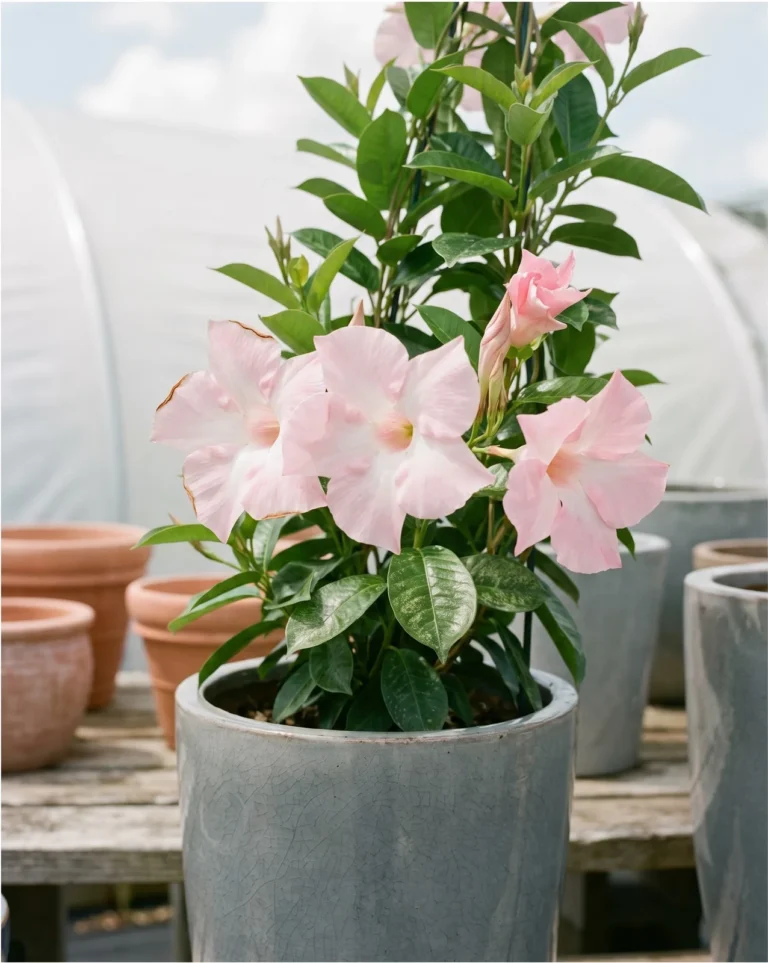
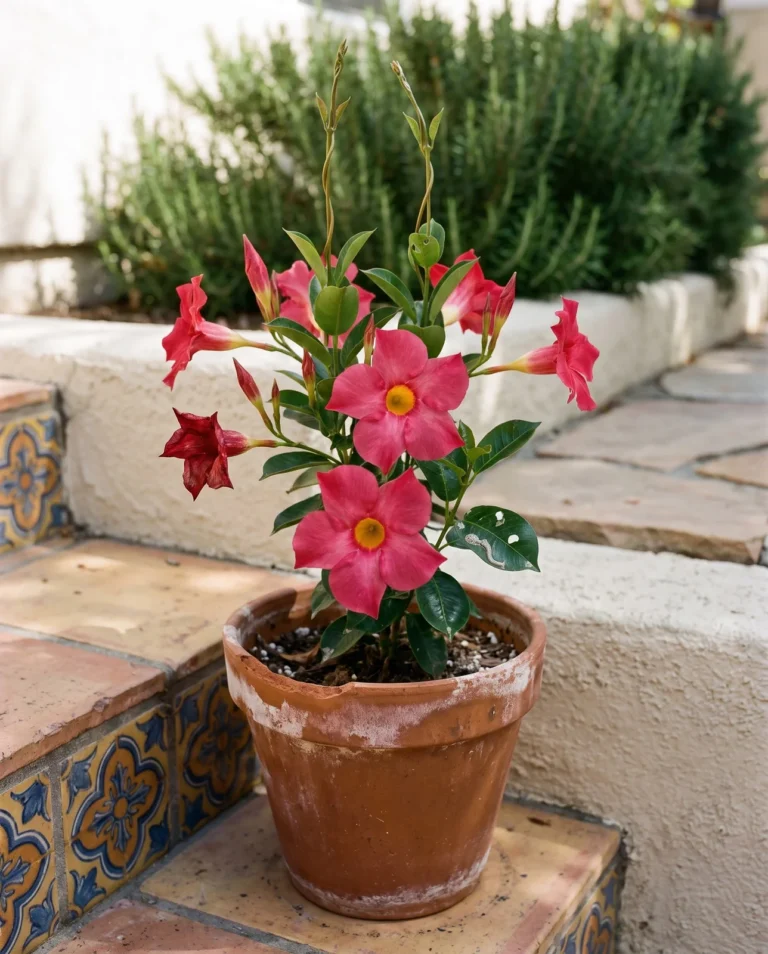
Mandevilla is a genus of tropical shrubs and vines in the dogbane family, Apocynaceae, alongside oleander, plumeria and vinca. The plants are American, from the desert Southwest through Mexico and Central America into South America, many of them Brazilian. The flower is what people buy: a funnel flaring into five rounded lobes, usually white to rose with a yellow center, against deep green glossy leaves. Cut any stem and it bleeds thick milky sap.
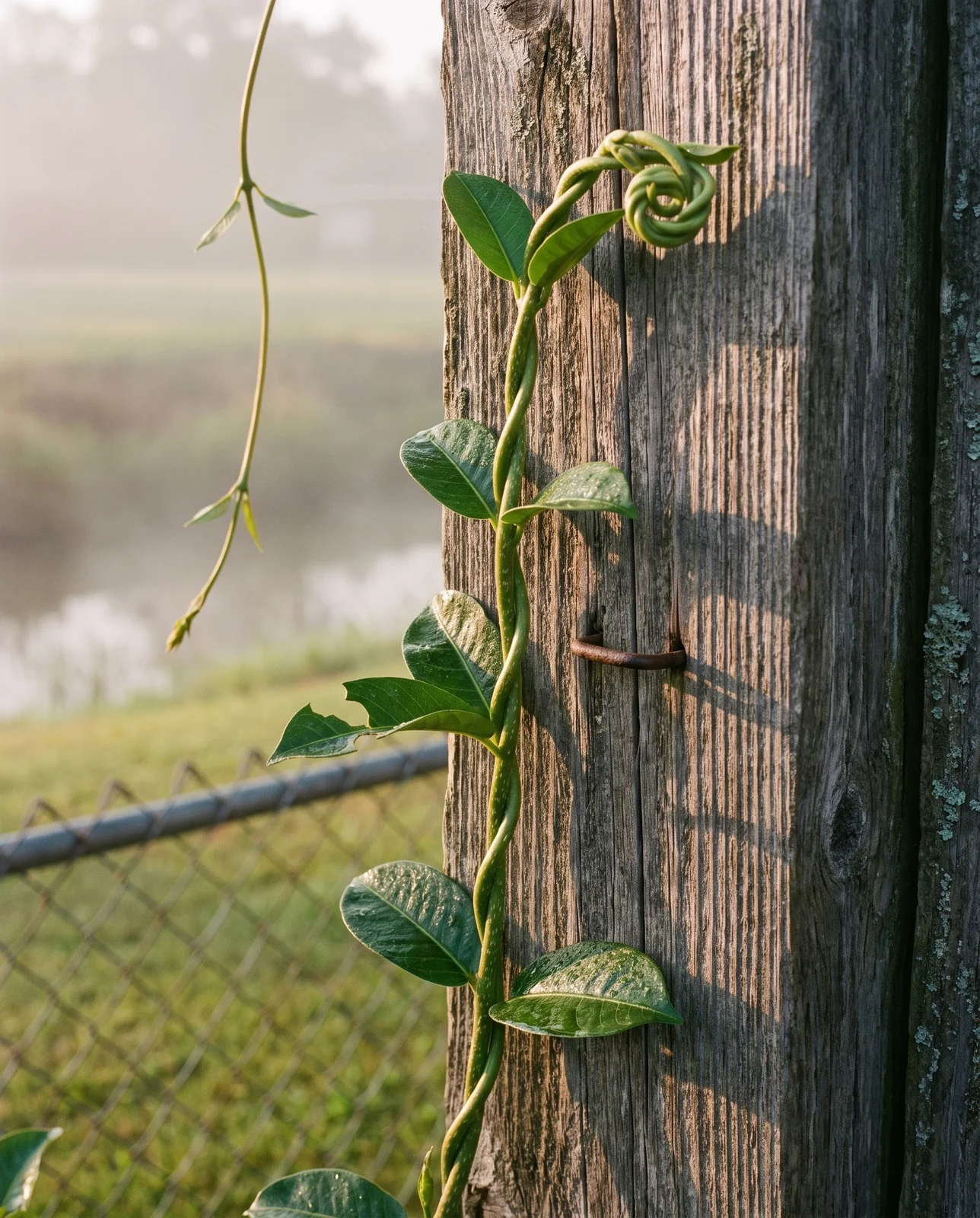
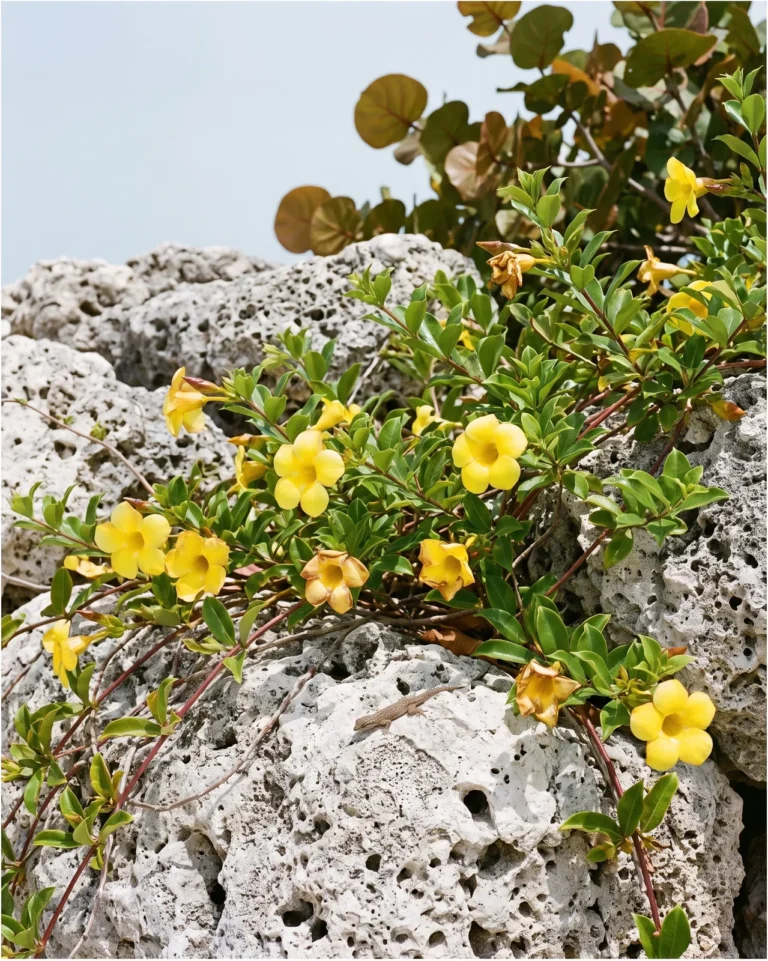
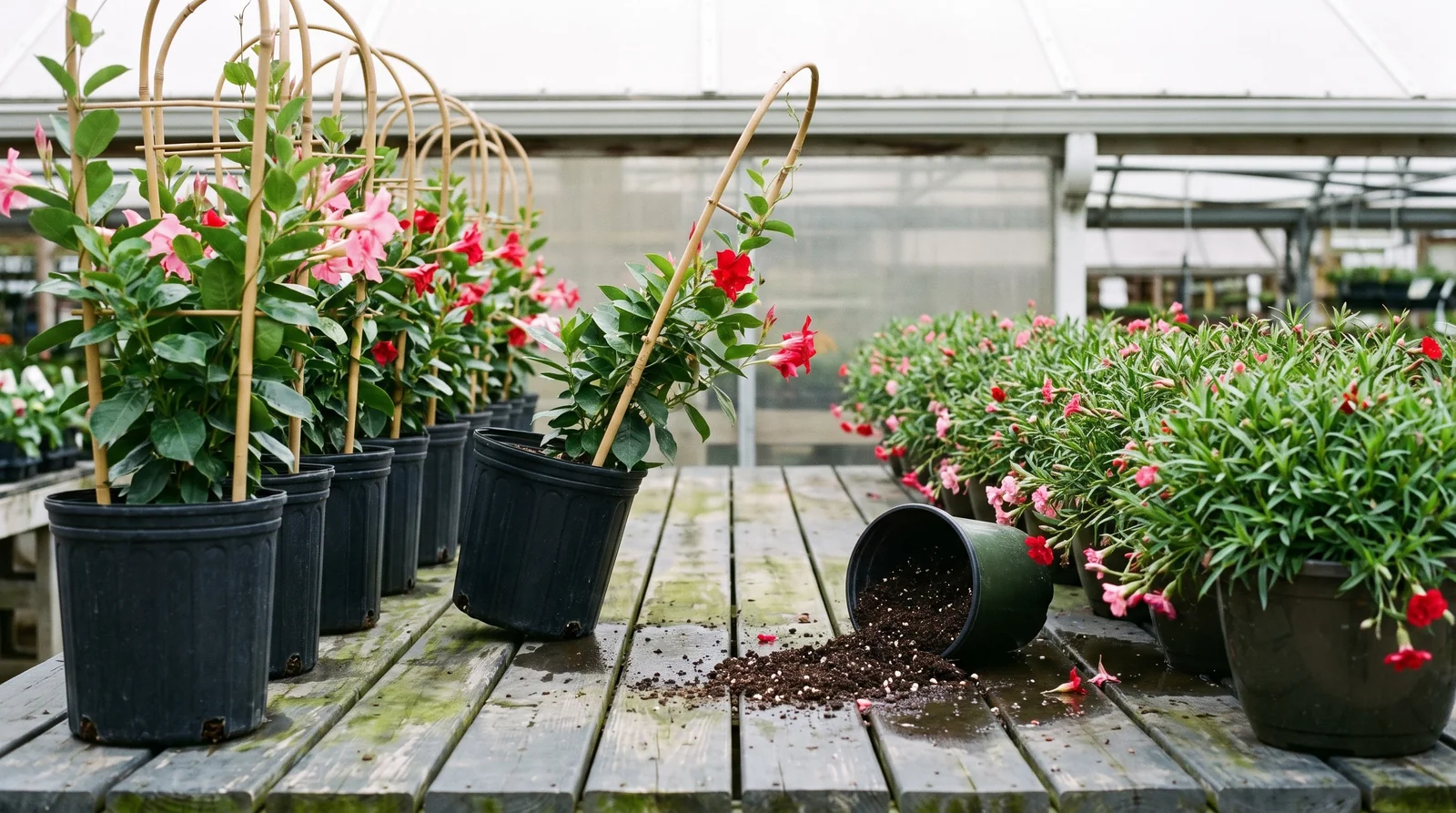
What you buy is either a twining vine or a low bush, and the word on the tag follows that split more closely than it follows botany. The vine wraps around poles, wires or lattice and needs something to hold. It spirals one way only, and a shoot wound back the other way will not take. The bushy plants sold as dipladenia were once a separate genus and now sit inside Mandevilla. They twine little and take more shade. Rock trumpet covers both, and the vines also answer to Chilean jasmine. Cold is the line the plant will not cross: these vines are evergreen where winters are tropical and die back once they meet freezing temperatures.
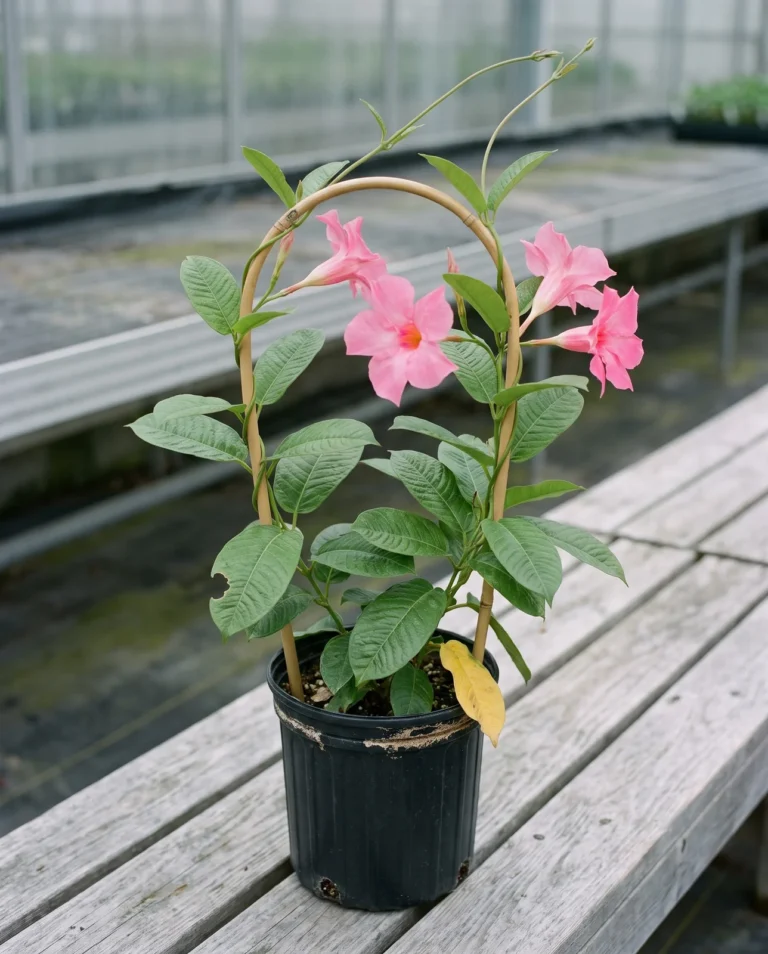
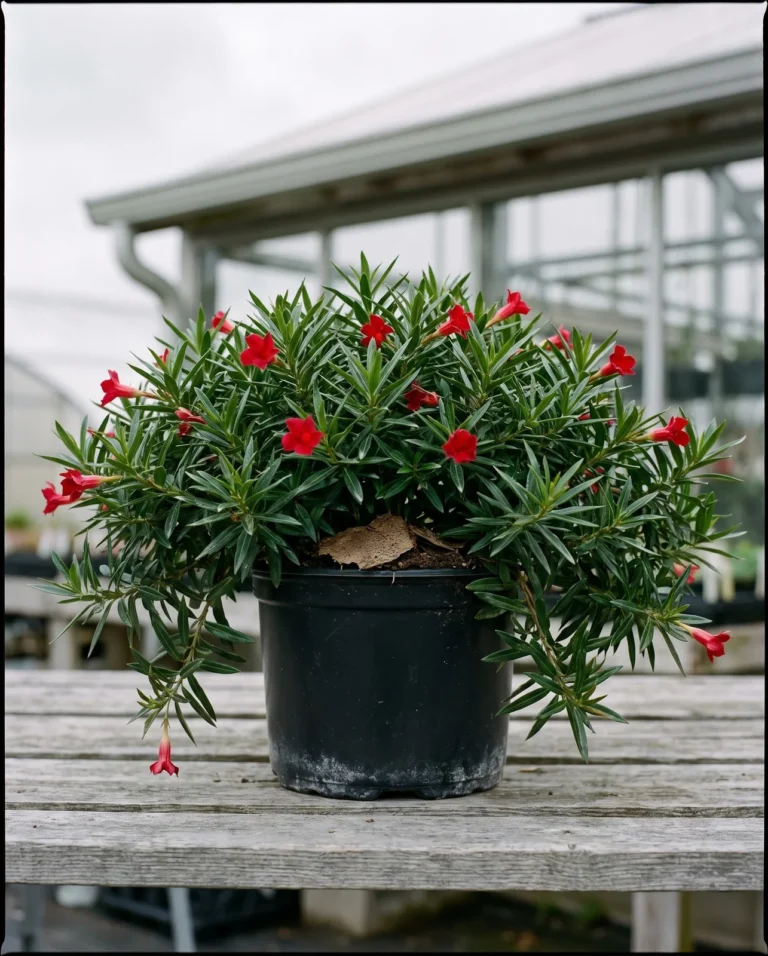
Mandevilla or dipladenia: what the tag means
The two names describe habit and leaf size, so you can sort these apart by eye before they flower.
When it blooms and for how long
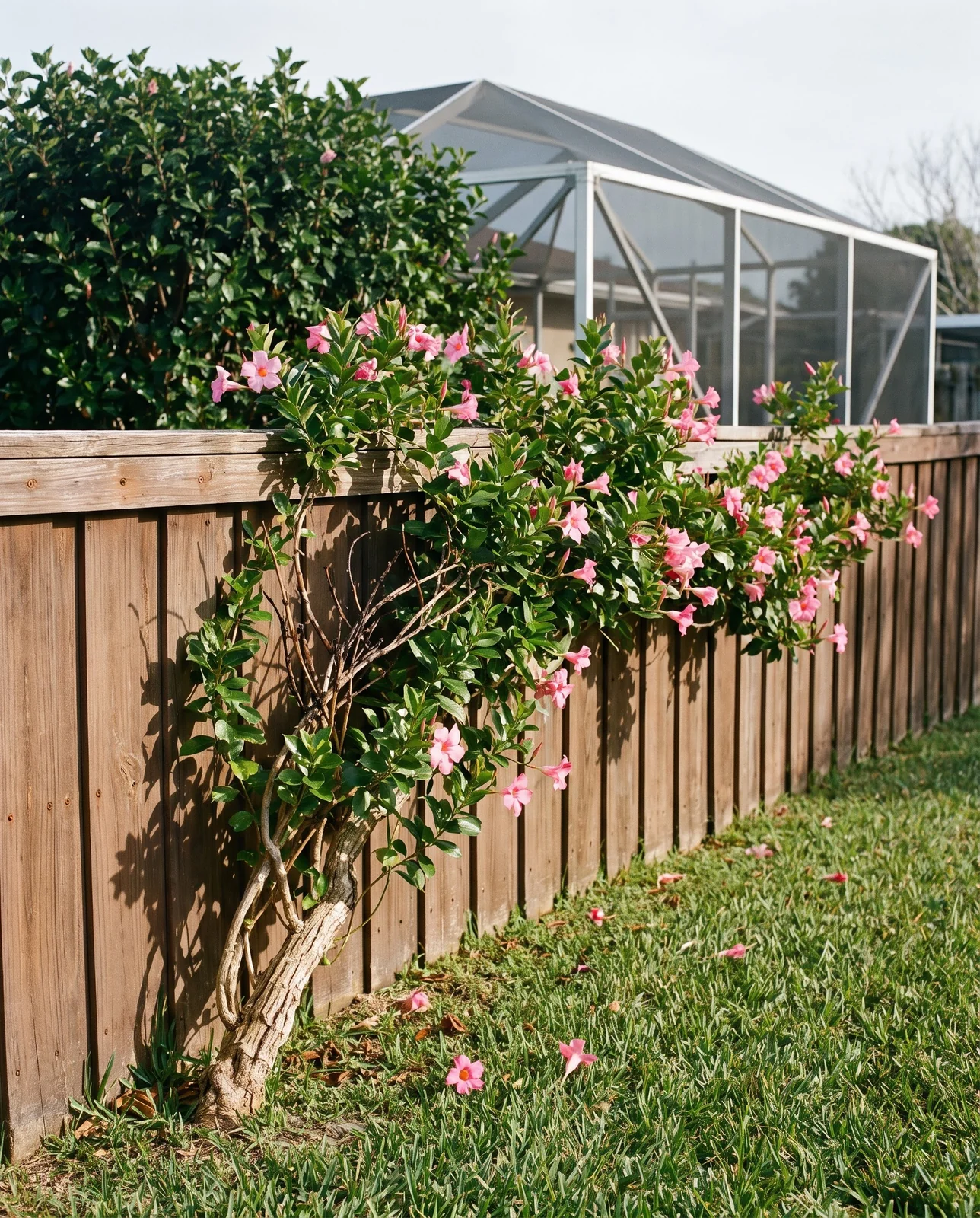
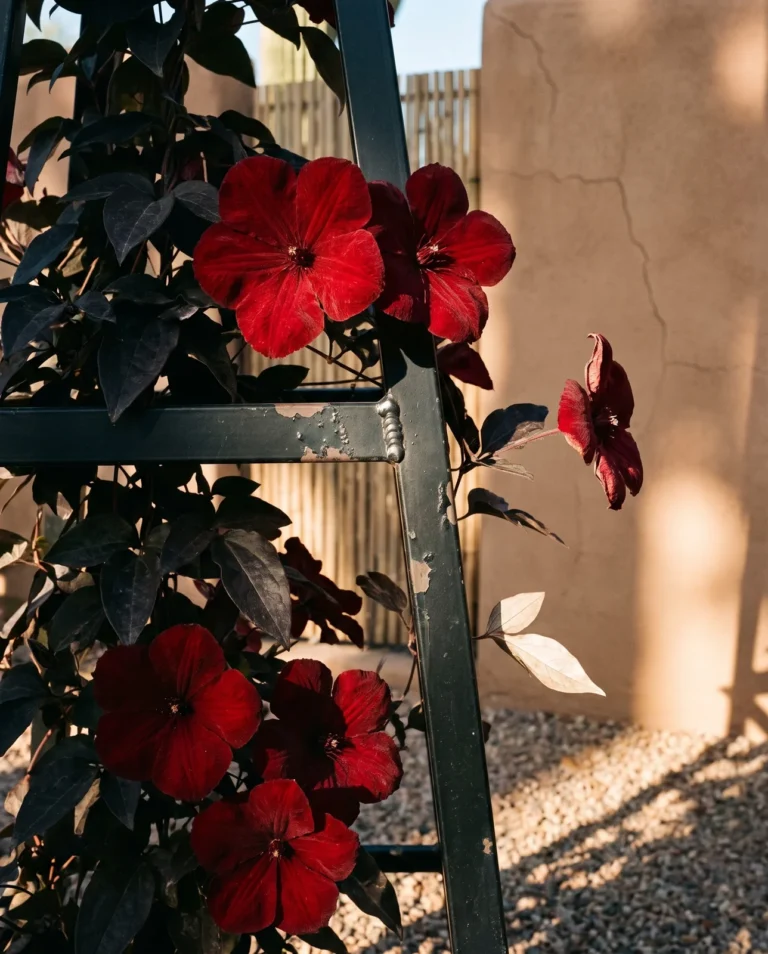
Outdoors mandevilla flowers from late spring to fall, and where winter never brings frost the bloom runs nearly year round. Summer is the heaviest stretch, and in zones 10 and 11 some plants never stop. On very young plants it can come in two flushes, early summer and early fall. Nothing needs deadheading: the flowers are self-cleaning and drop on their own. Flower size runs 2 to 6 inches across, in white, pink, red and burgundy, gold and yellow, and purple to lavender. Indoors the picture changes completely. A plant wintered in the house goes out of flower and may drop leaves to get through the season.
Does it come back, and how to overwinter it
Mandevilla comes back on its own wherever winter stays frost free, and everywhere colder it is replaced each spring or carried indoors. Frost free means zones 10 and 11. The plant sets its own deadline: it tolerates nothing below 45 to 50 degrees Fahrenheit, so it comes in once outdoor temperatures drop to 50. A container makes the move possible, and anyone who carries hibiscus through winter in a pot knows the routine.
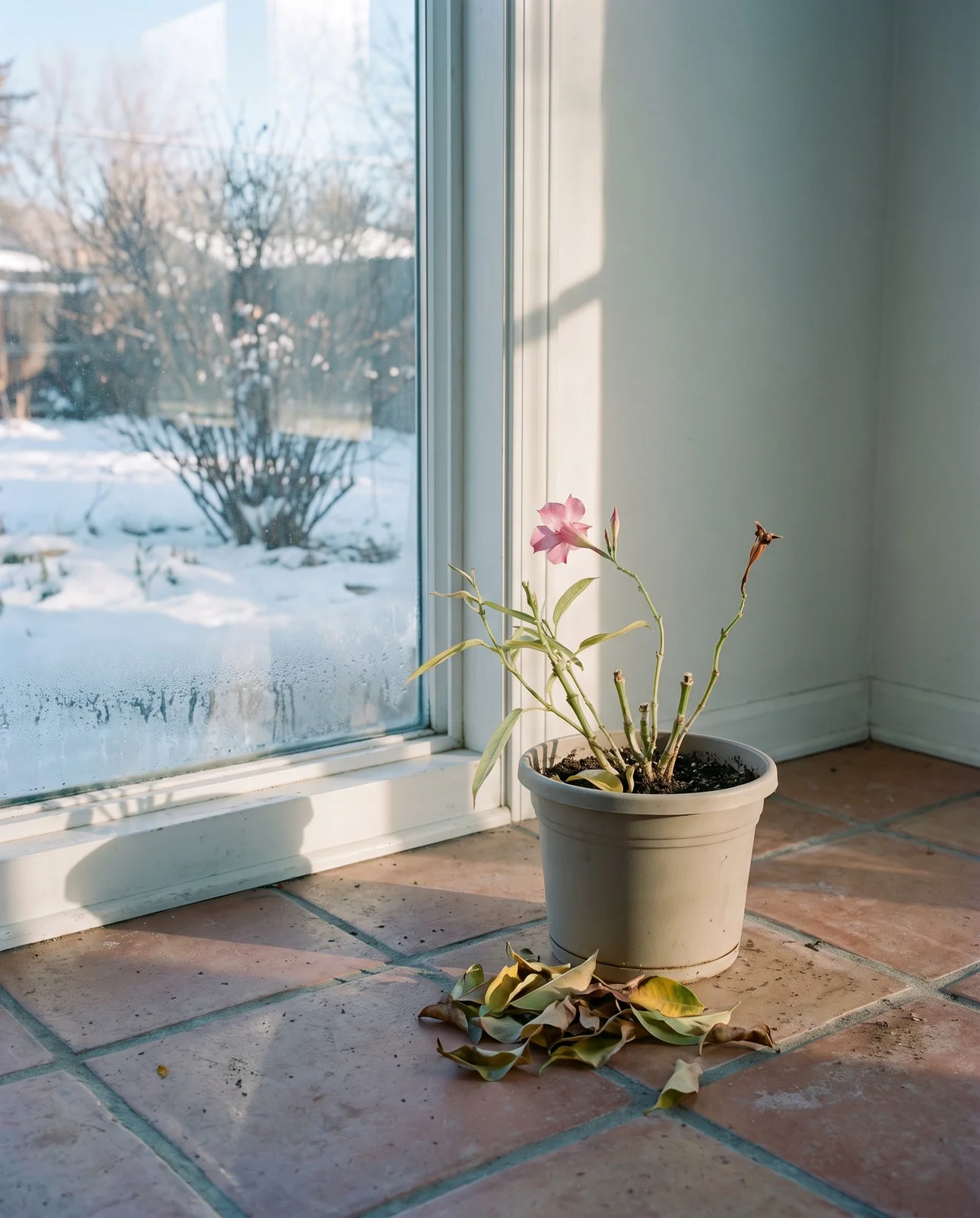
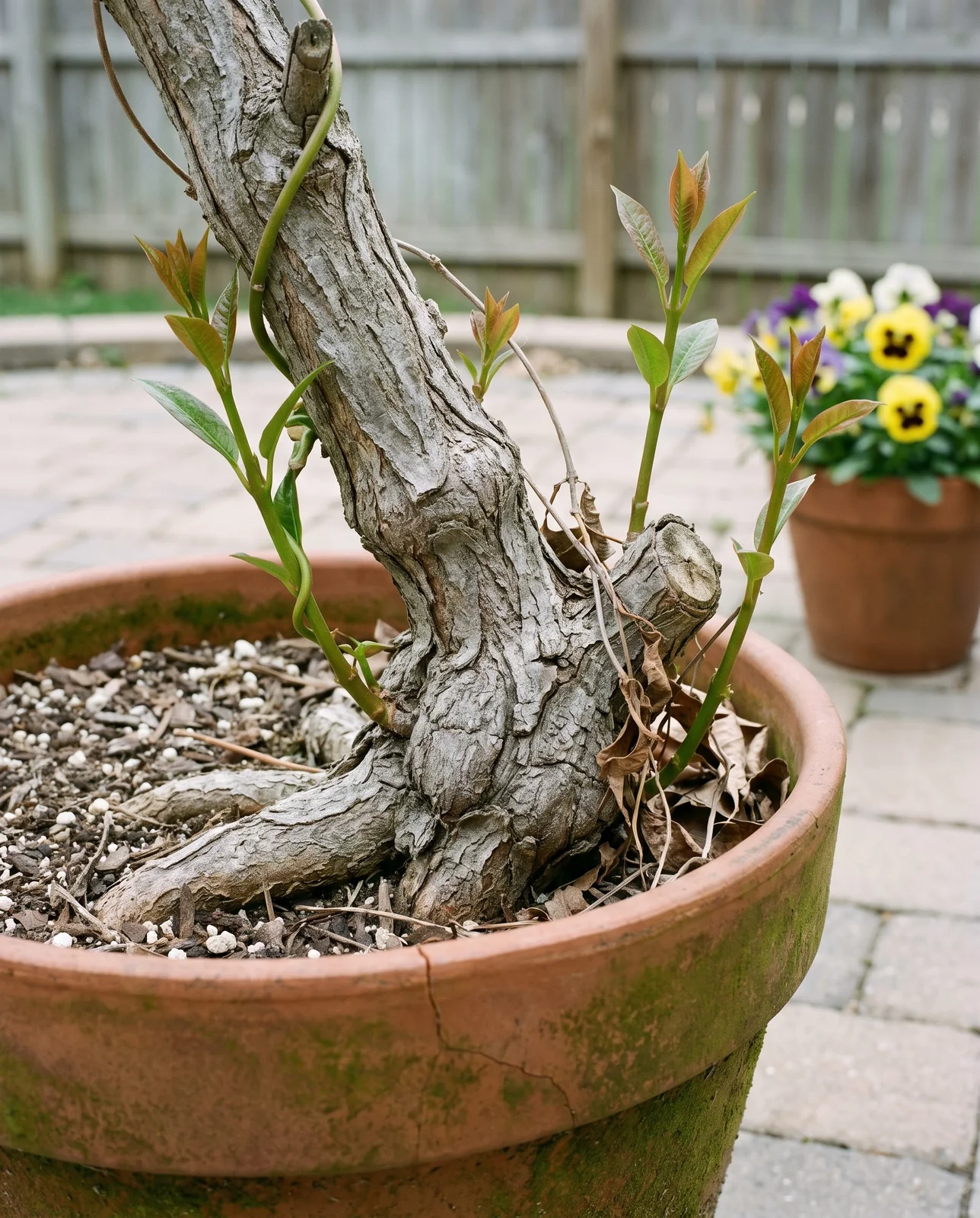
The houseplant route keeps the plant awake. Cut it back by half before it comes through the door and give it the brightest place you have, a sunroom or a big south window. Then lower your expectations. Illinois Extension is blunt: the plant looks messy, drops leaves slowly and carries undersized blooms until the longer days of March. Cut back on water and skip fertilizer until it pushes new growth. Check for pests before it crosses the threshold, since indoor winters bring aphids, scale, mealybugs, spider mites and whitefly.
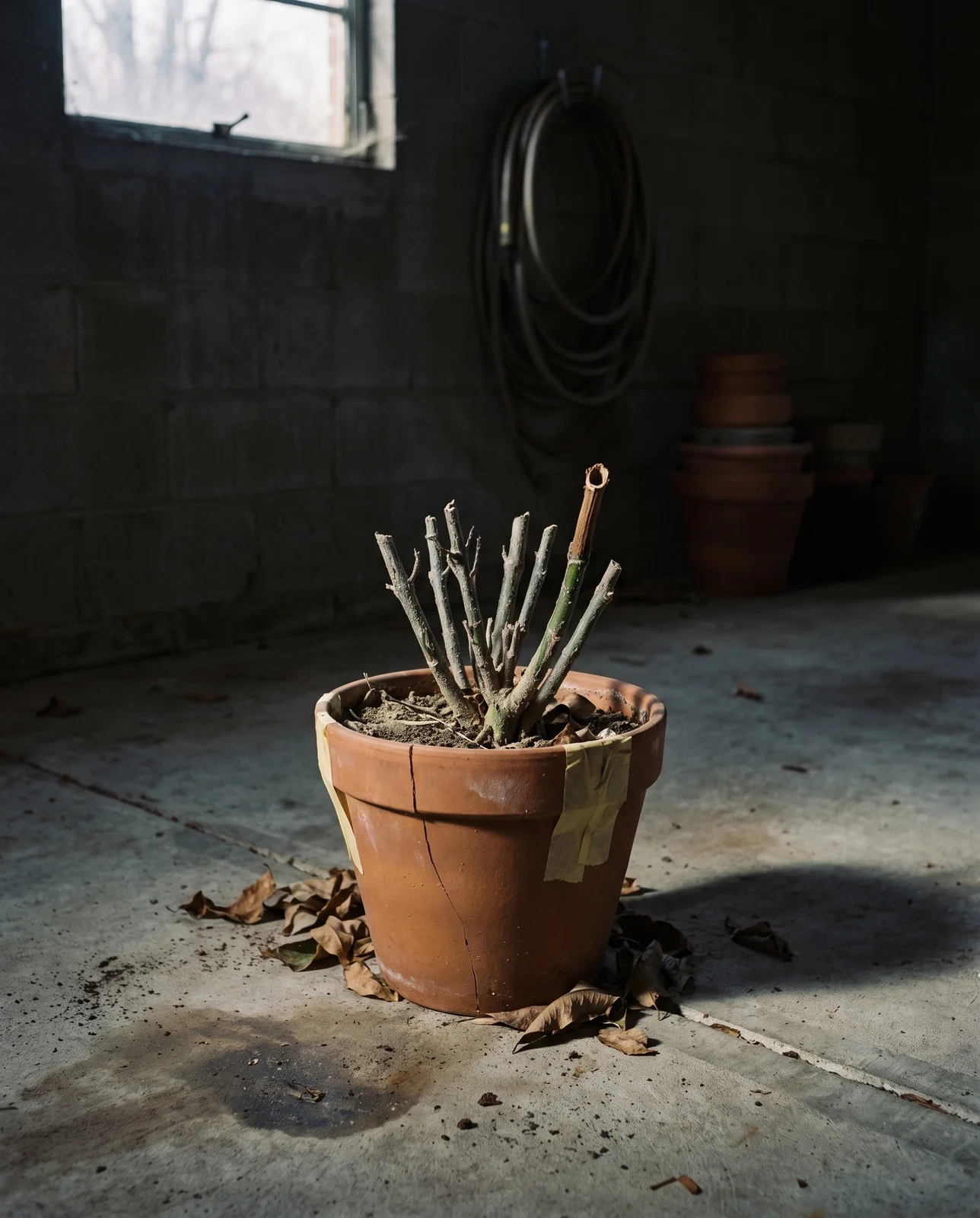
The dormant route puts it to sleep. After the first frost, cut the foliage back hard, move the root ball into a container and store it cool and dark. A garage or shed that gets cold but never freezes works, and the plant sits out the winter alive and semi-dormant. Water only enough that the mix does not shrink from the sides of the pot. A month before your last frost it moves into the light and gets more water, then hardens off outside after the last frost. The third choice is to let the frost have it, since mandevilla is cheap and easy to find. Even a saved plant ends there: after several winters the base goes woody, and you start again from rooted cuttings.
Four ways through winter, compared
The same plant behaves very differently by route. These are the numbers each one runs on.
Why a healthy plant stops flowering
A mandevilla making leaves and no flowers is nearly always short of direct sun. It has to be in full sun to flower well, and heavy flowering takes at least 6 to 8 hours a day. It tolerates less, and that is the trap. In partial shade of two to six hours it keeps growing; in denser shade it twines and flowers far less heavily. Heat is rarely the problem it looks like, since growth runs best between 68 and 90 degrees Fahrenheit. Hot regions need only afternoon relief, which keeps the leaves from scorching.
Feeding is the second lever. Give the plant something every two weeks through spring and summer while it grows, and a formula high in phosphorus such as 10-20-10 is the usual choice for bloom. The rhythm matters more than the numbers on the bag.
Yellow leaves come from four regular causes. Constant wet soil is the first: overwatering can bring root rot and fungal disease, while a plant kept too dry runs to stress and fewer flowers. Winter is the second: a plant brought inside goes out of flower and may shed leaves to survive the dark months. Insects are the third, since aphids, mealybugs and whitefly all yellow indoor leaves. Disease is the fourth: anthracnose starts as tan to brown spots that can be followed by yellowing and leaf drop.
No flowers: what to check first
Run the checks in this order, because the cheap ones rule out the expensive ones.
Pruning and training
Prune in late winter or early spring, before growth begins, taking out old crowded stems and shortening what remains. Cutting the whole plant back by up to a third is the usual measure. The timing is safe because mandevilla flowers on new growth, so an early prune and feed give it a head start for May or June. Even a plant cut almost to the ground blooms that same summer on new shoots from the base. Cut stems bleed a sap that can irritate skin, so wear gloves.
Pinching is the other half. Pinch long stems for a bushier habit, pinch young plants to make them branch, and pinch the tips to keep the shape full. Training is mostly going with the plant. It encircles a support in one direction only, and a shoot wound the other way will not take. Guide each new shoot the way the last one went, and tie it loosely where it crosses a gap.
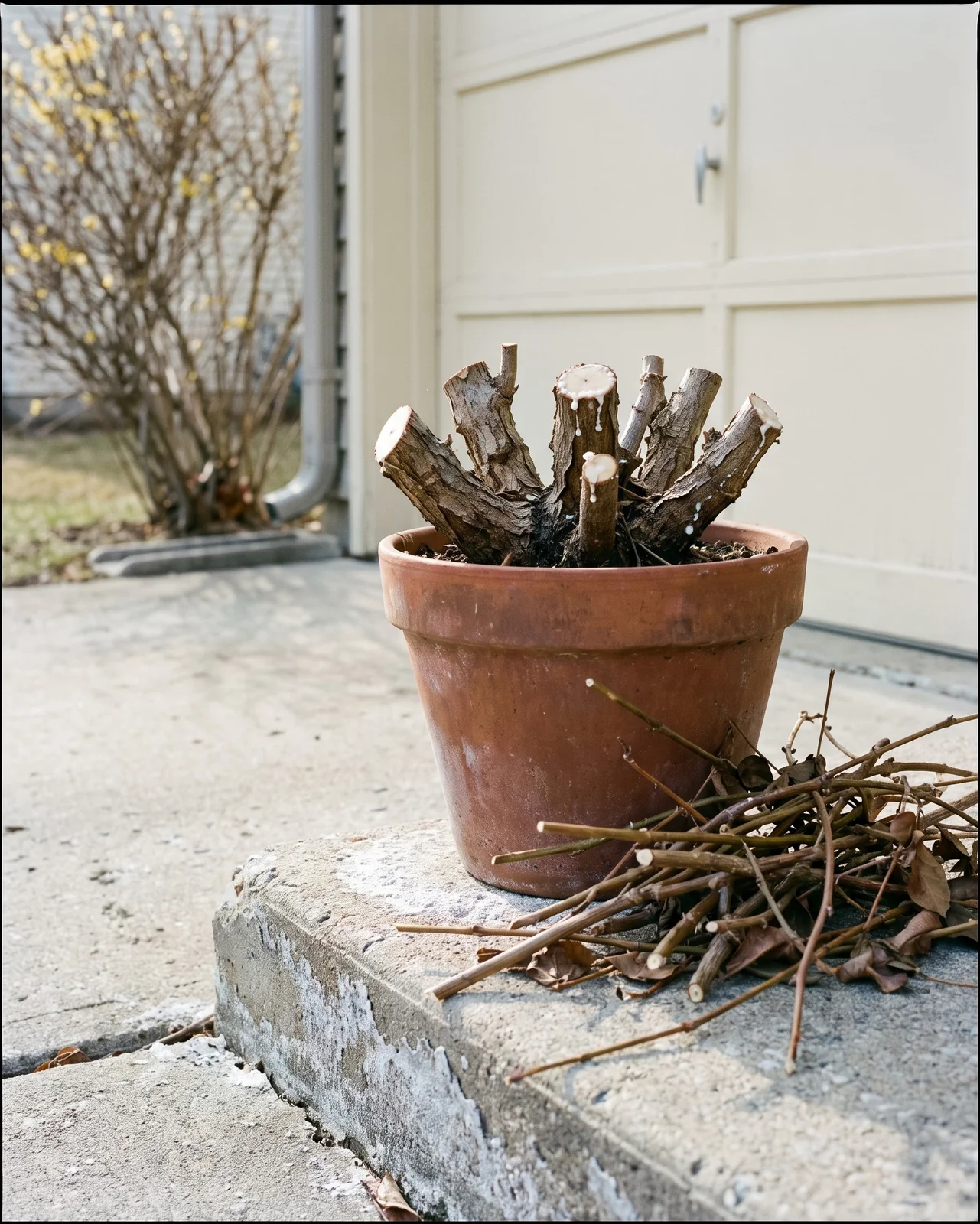
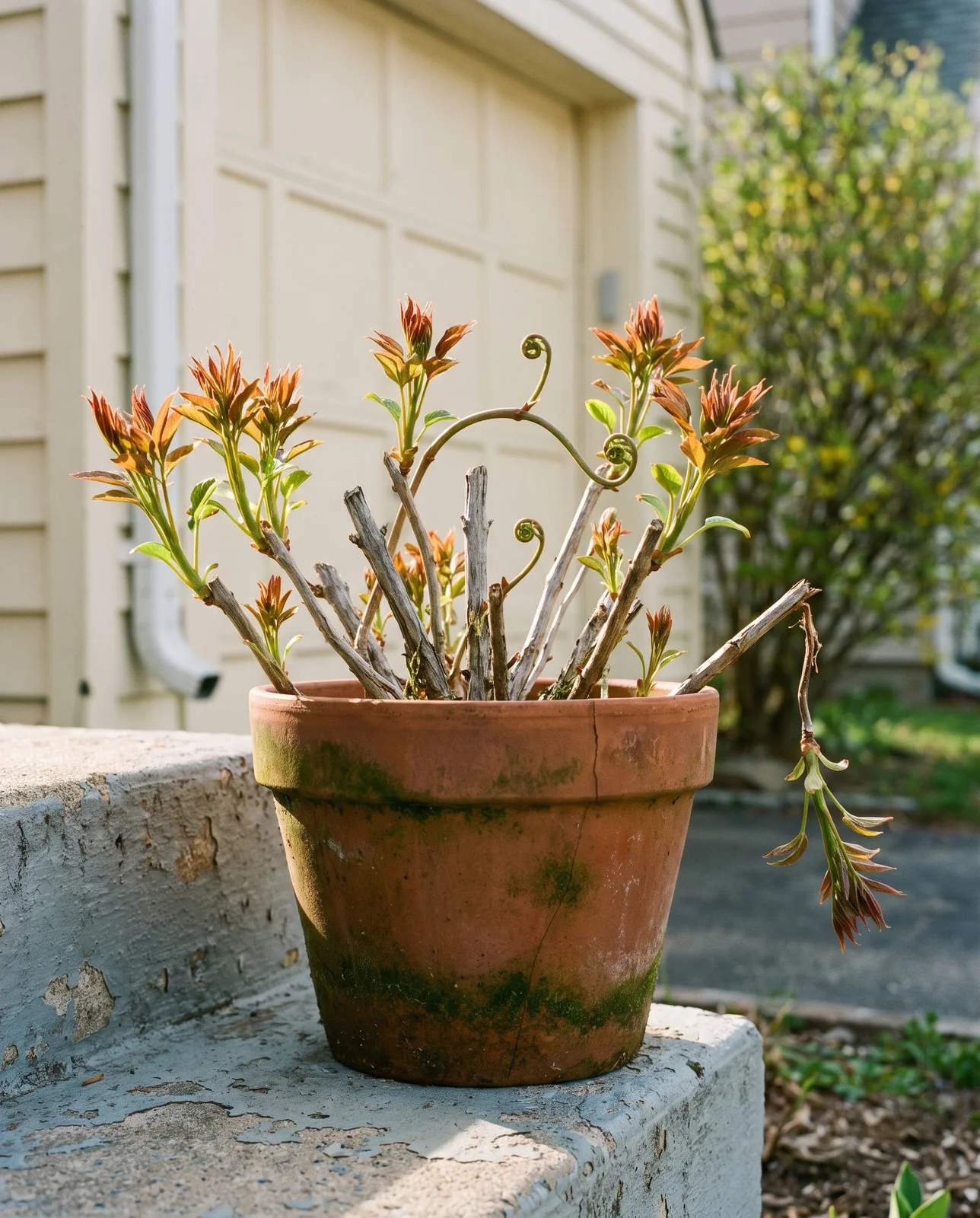
Pots, mix, and a support it cannot outgrow
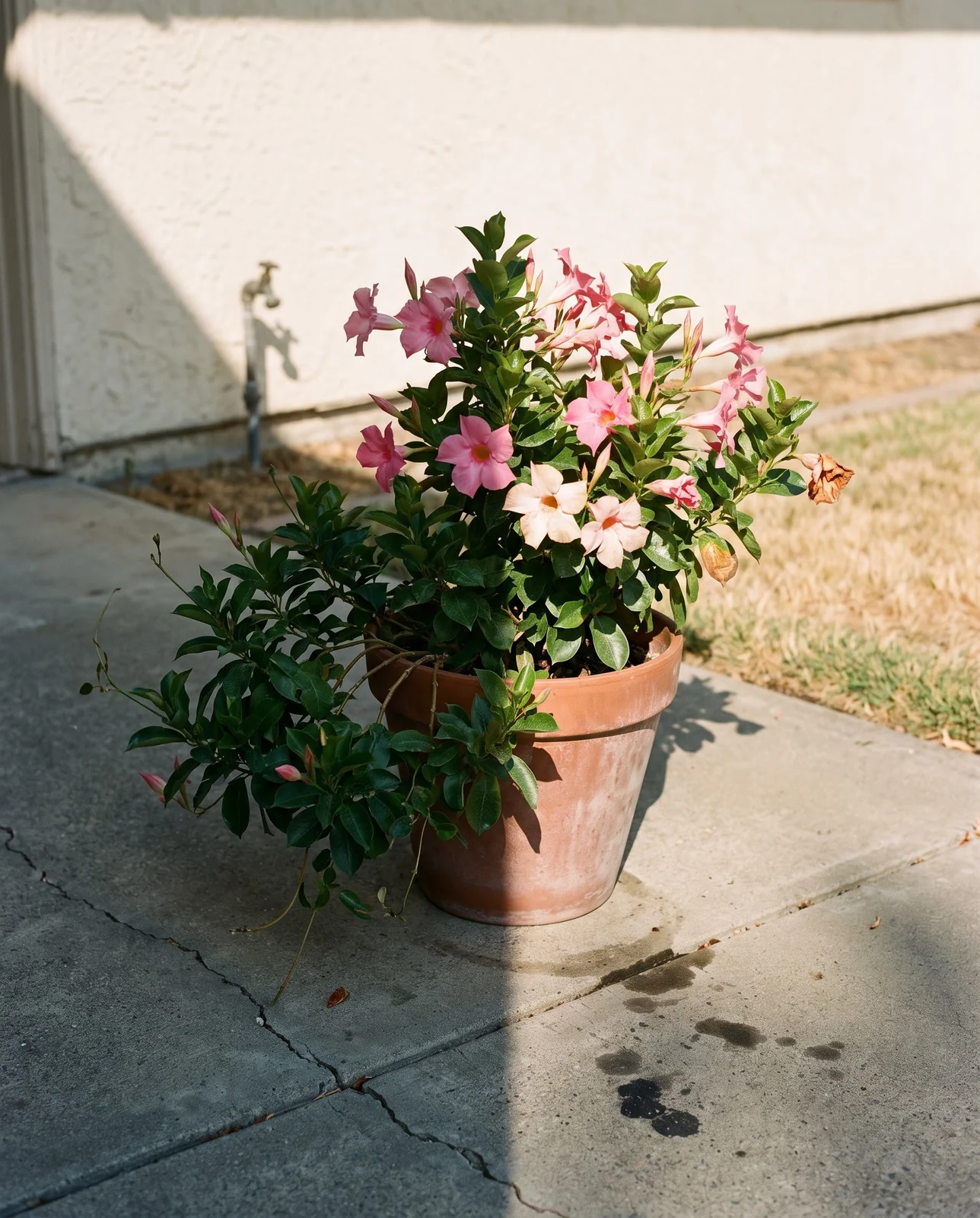
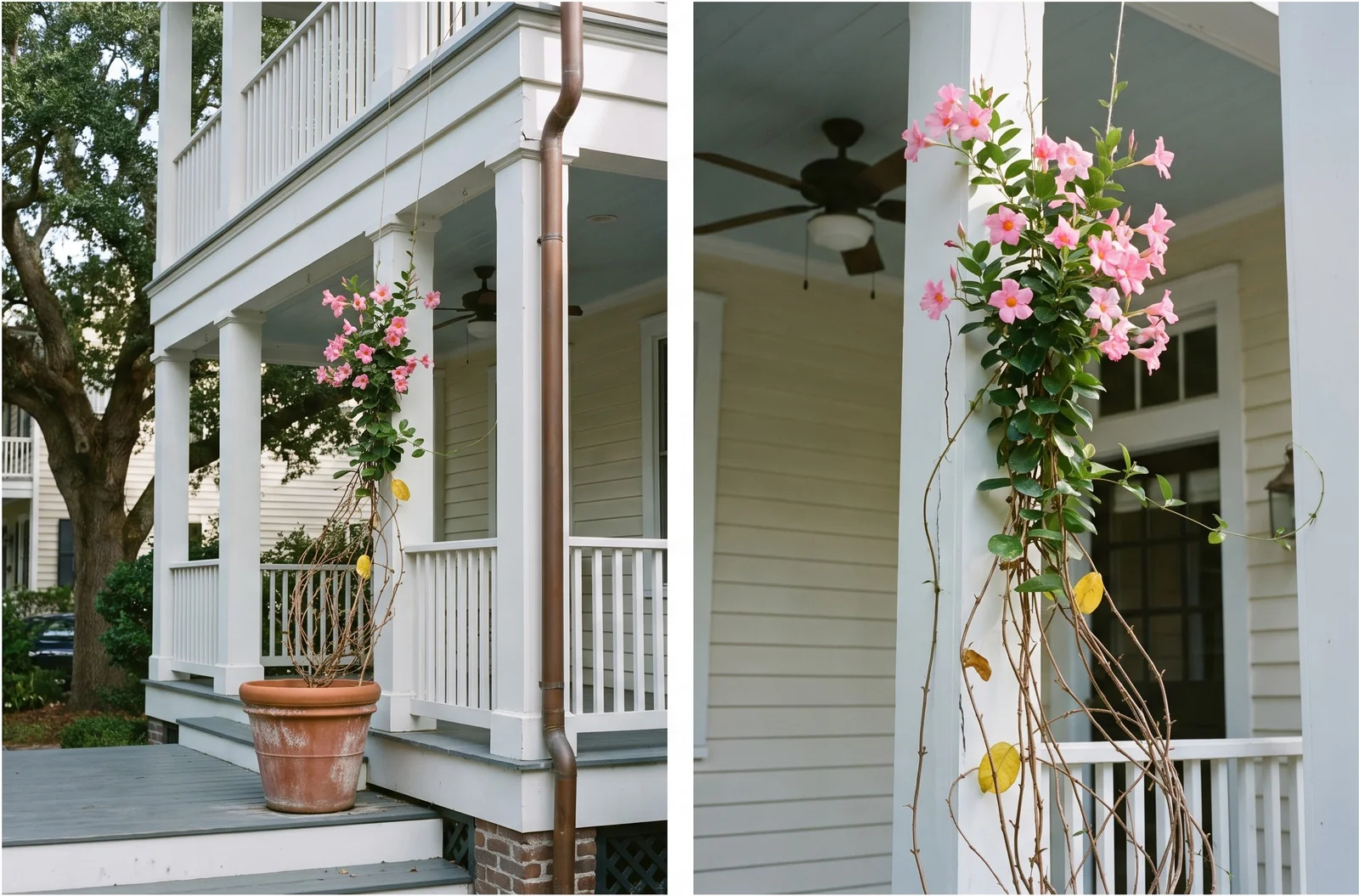
In a container the plant is a different size altogether. The vine that climbs to 20 feet in frost-free ground puts on 3 to 5 feet in a season in a pot. Start bigger than looks necessary: a large container, 20 inches across if you have the room, with a premium mix that drains well. A plant that will winter indoors does well in equal parts peat moss, potting mix and builder's sand.
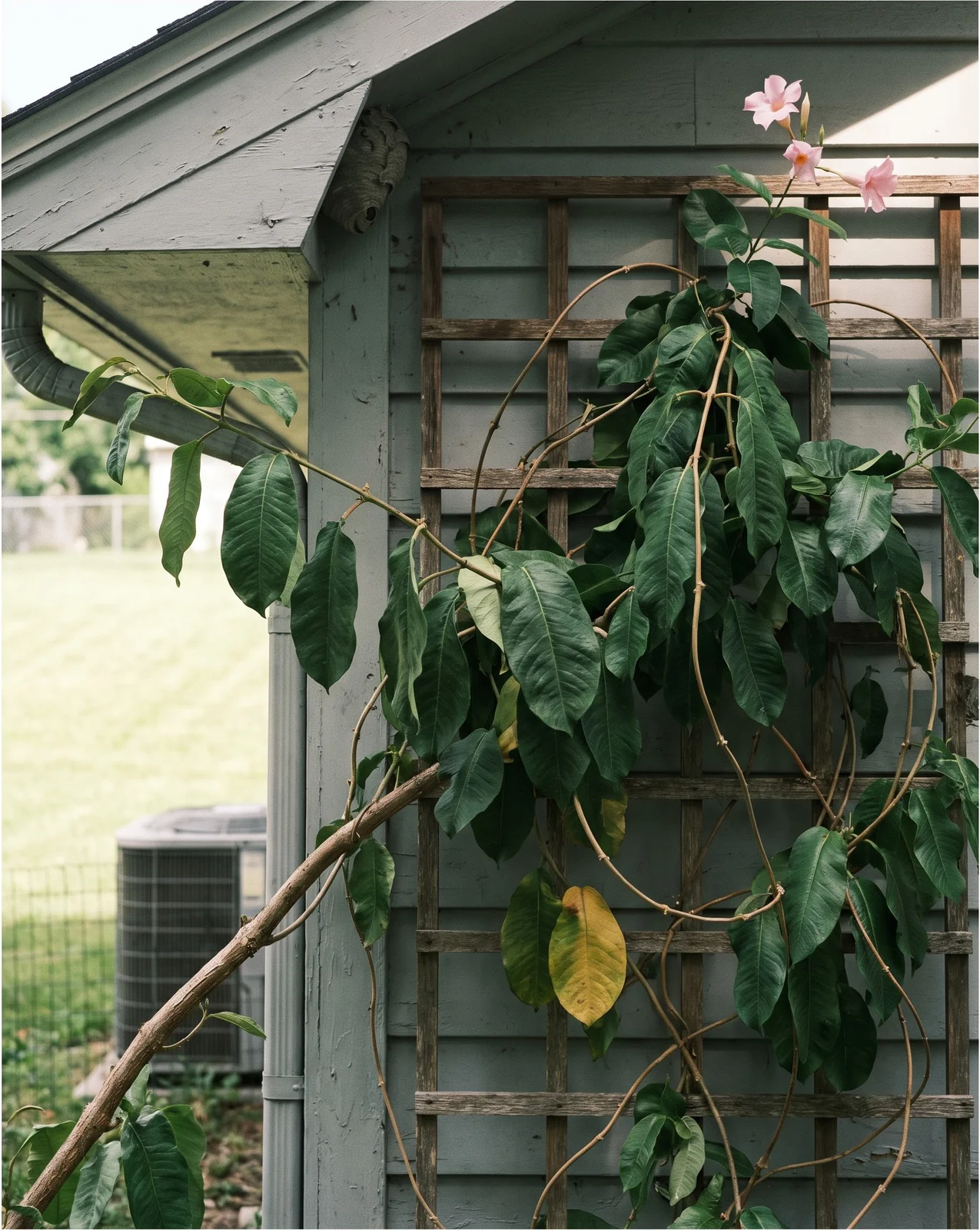
A climbing type needs a freestanding structure to wind around, a trellis, pergola, obelisk or arbor. Twining climbers such as morning glory make the same demand, and the same mistake gets made with both: the support is sized to the pot when it should be sized to the season's growth. A small trellis up to 3 feet tall, pushed into the container, suits a compact selection and fails a vigorous one. Stems of the larger varieties can run twenty feet in a single season. Where the structure must stay small, pick the plant to fit: 'Rio Pink' or Sun Parasol 'Burgundy' will cover a mailbox.
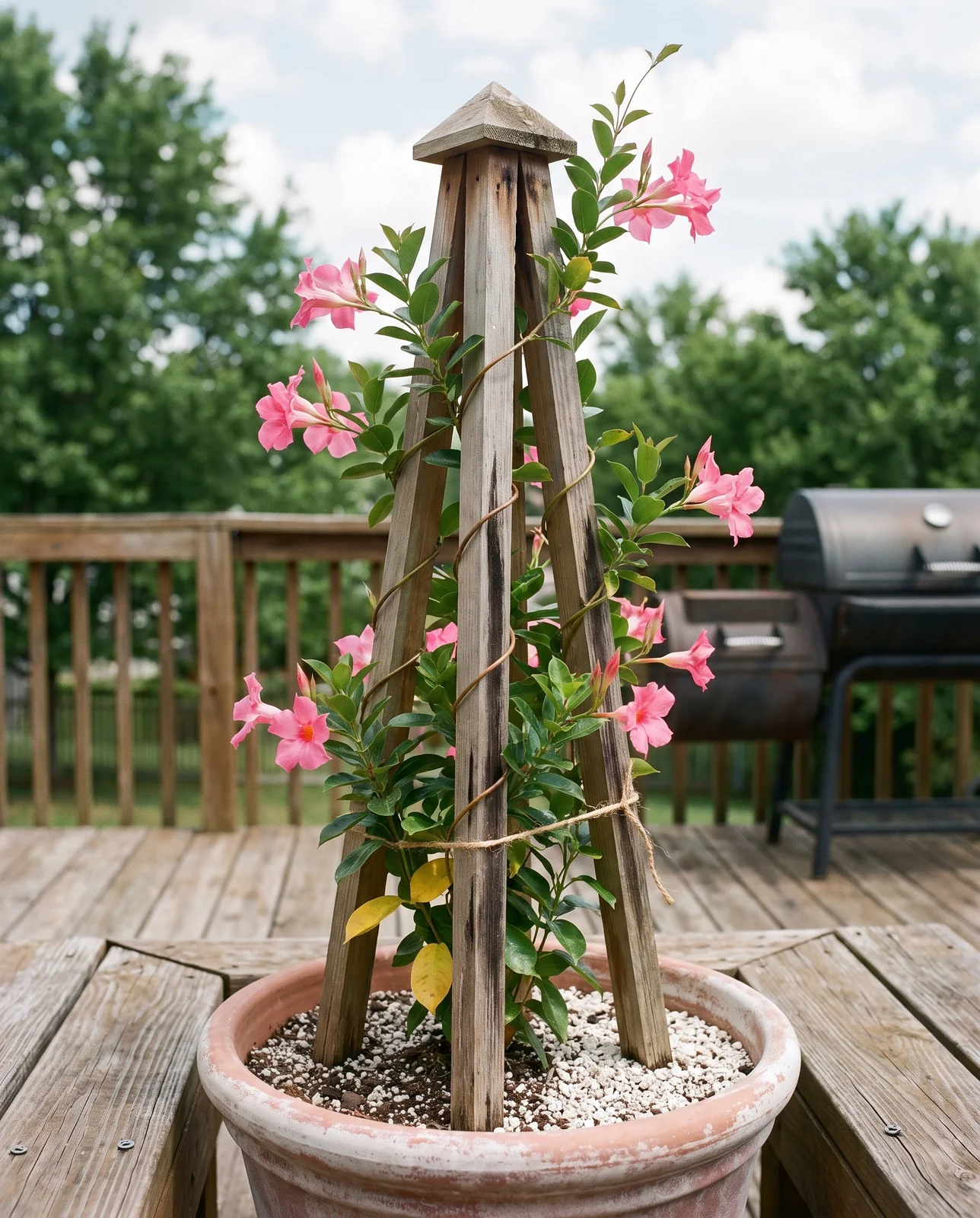
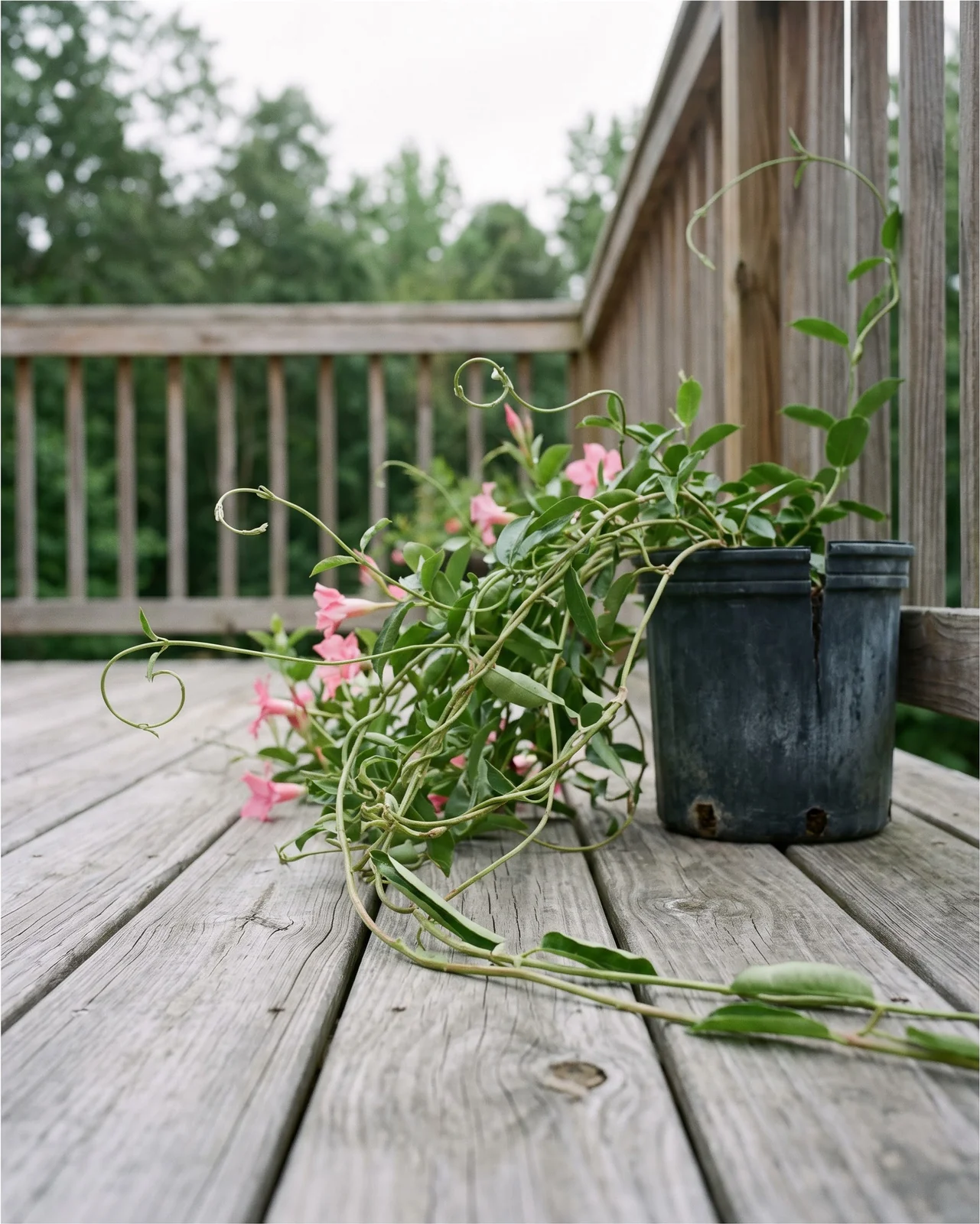
Sap, toxicity, and pets
Mandevilla does not appear on the ASPCA plant lists in either direction. There is no toxic entry and no non-toxic one, though the same list names other dogbane relatives, including desert rose and dogbane hemp. The horse lists are silent too. That leaves neither a warning nor an all-clear, so a dog or cat that has chewed a stem is a question for a veterinarian.
The sap is what you actually meet. Cut stems bleed a milky sap that can irritate skin and may be toxic if swallowed. Every stem does it, the thin ones you pinch out included. Wear gloves for pruning, pinching and untangling, and wash your hands afterward. Sweep the prunings off the patio, since a puppy will chew what falls. Larger grazers are a smaller worry: mandevilla is considered deer resistant, though deer may browse it when food is scarce.
Varieties worth telling apart
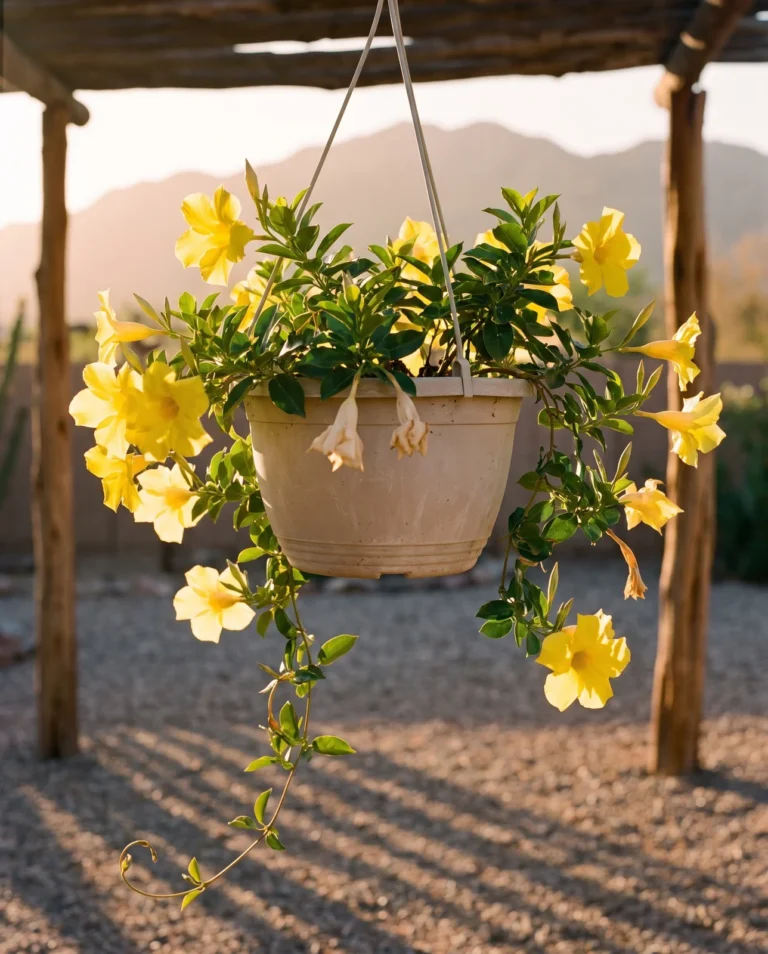
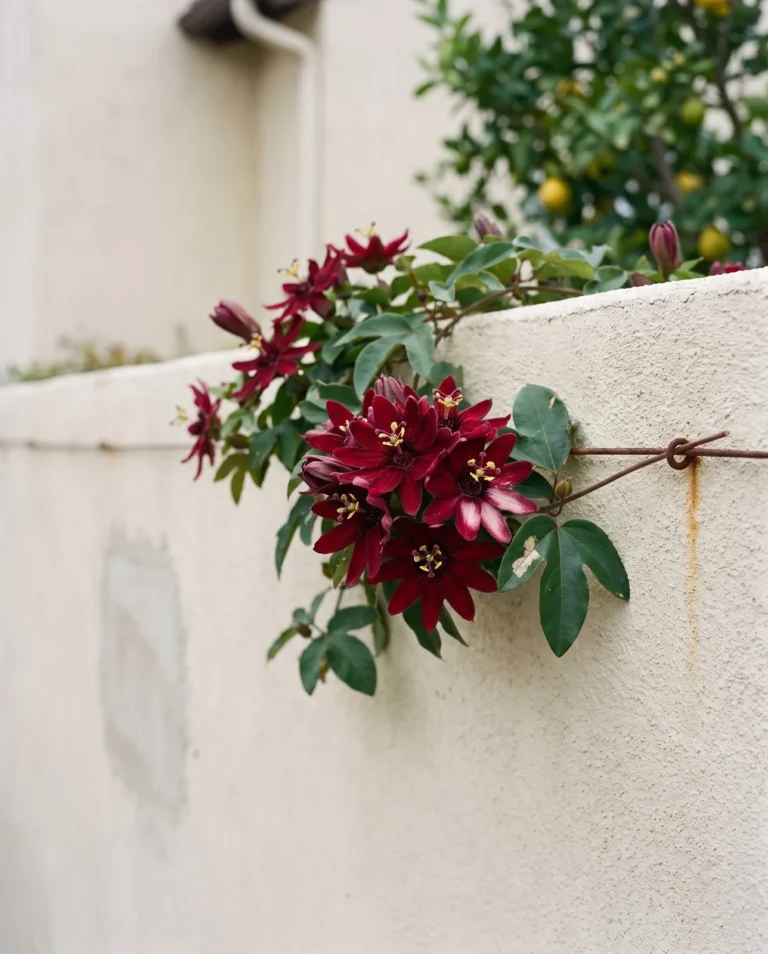
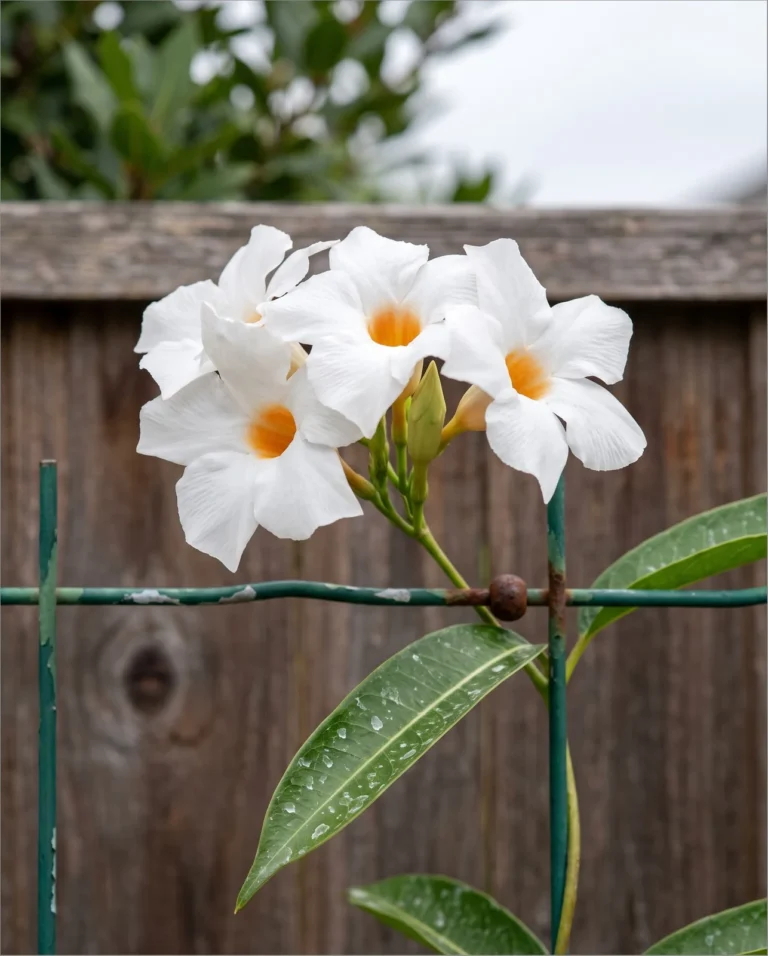
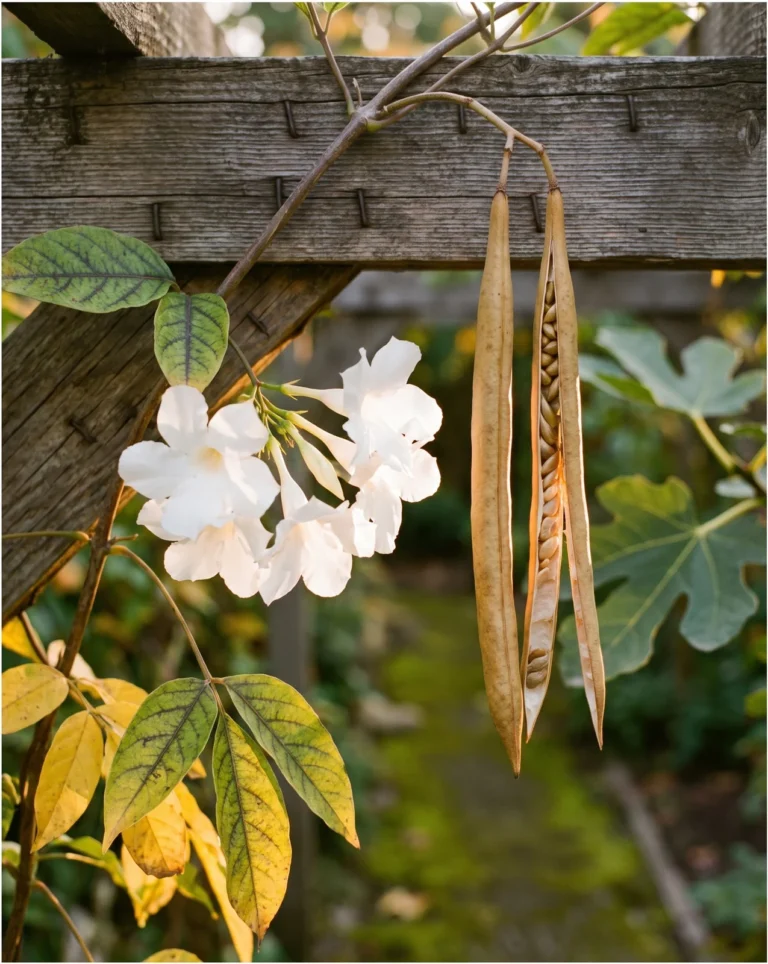
Nursery mandevillas are nearly all hybrids, and breeding keeps pushing toward shrubbier plants and more colors. Read the mature height first.
How much sun it needs, and where to stand the pot
Outdoors mandevilla is a full sun plant. Indoors it wants the brightest position you are willing to give it. Heat changes the outdoor answer more than shade does: in hot summers the plant appreciates some shade through the afternoon. A west-facing wall that holds heat until evening is a harder spot than an east exposure that falls into shadow by mid-afternoon. If a plant flowers on one side of a patio and sulks on the other, move it and leave it alone for a few weeks.
Watering, and why the routine flips in winter
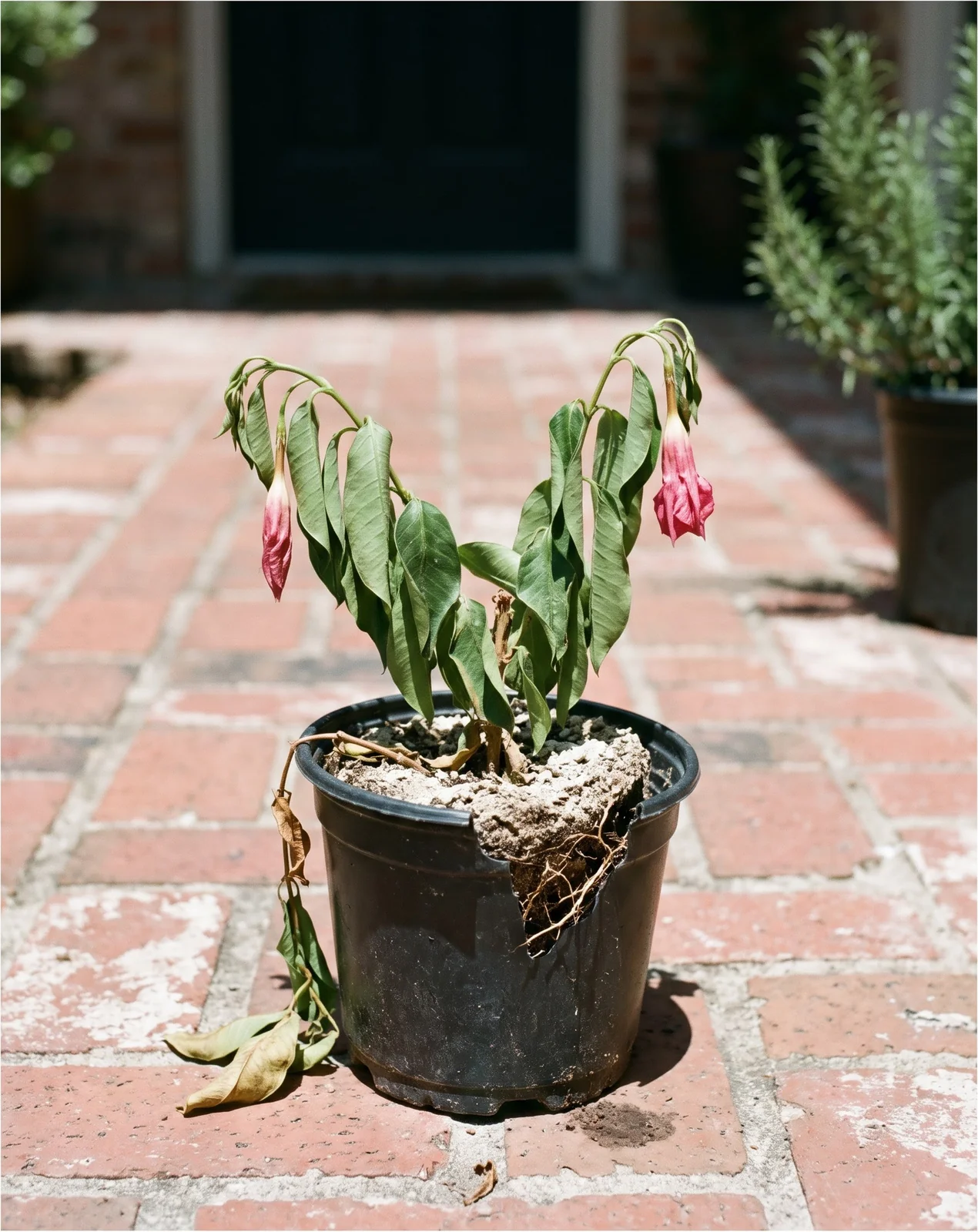
Water a growing mandevilla once the surface of the mix has dried 1 to 2 inches down. Winter reverses the rule. The soil of a house plant is left to dry out over the cold months, and a stored plant gets water only every few weeks, enough that the mix does not shrink from the sides of the pot. The switch makes sense once the plant stops working: a nearly leafless stem in a cool room draws almost nothing, while wet soil around idle roots can bring root rot. Hold the thermostat in the 60s or low 70s, because a warmer room dries the plant out, and keep the humidity around it up. A heated house in January does neither on its own.
Soil, drainage, and what to feed
Mandevilla is relaxed about soil chemistry and unforgiving about drainage. It grows at any pH from 6 to 8, which covers most garden soil and nearly every bagged mix, so pH is seldom what is wrong with a struggling plant. What it wants is a sandy, free-draining medium amended with compost. Feeding tracks the season: something every two weeks while it is in growth, nothing once it moves inside. A mix that holds water can turn that feeding into root rot.
Cold, heat, and the zones it really survives
Mandevilla survives winter outdoors only at the warm end of the country, in zones 10 and 11. The zone map only approximates the thing that decides it, temperature. The plant tolerates nothing below 45 to 50 degrees Fahrenheit, and cold damage appears below that same 45 to 50. One species genuinely breaks the pattern. Chilean jasmine is a climbing, woody, deciduous vine to 15 feet, and its roots are hardy to about 5 degrees Fahrenheit even though the top growth is not. It is hardier than most others in the genus.
Storage temperature is where a saved plant is won or lost. It wants a garage or shed that gets cold but never freezes, ever. A garage sharing a wall with the house holds that line better than a detached shed, and a cheap thermometer on the shelf beats any published number.
How big it gets, and how fast
One set of numbers cannot describe this genus, because the plants sold under the name run from a low shrub to a rope. Across the genus it stands 3 to 10 feet tall and 3 to 4 feet wide. Individual types sit anywhere around that: the stems of 'Splendens' reach 10 to 15 feet, and a twining plant can put on up to 10 feet in one season. That last figure is what matters when you buy the support. A hardy climber such as clematis is chosen on its mature height, built over years. A mandevilla is chosen on what one season will do to it.
Pests and diseases, and which ones actually show up
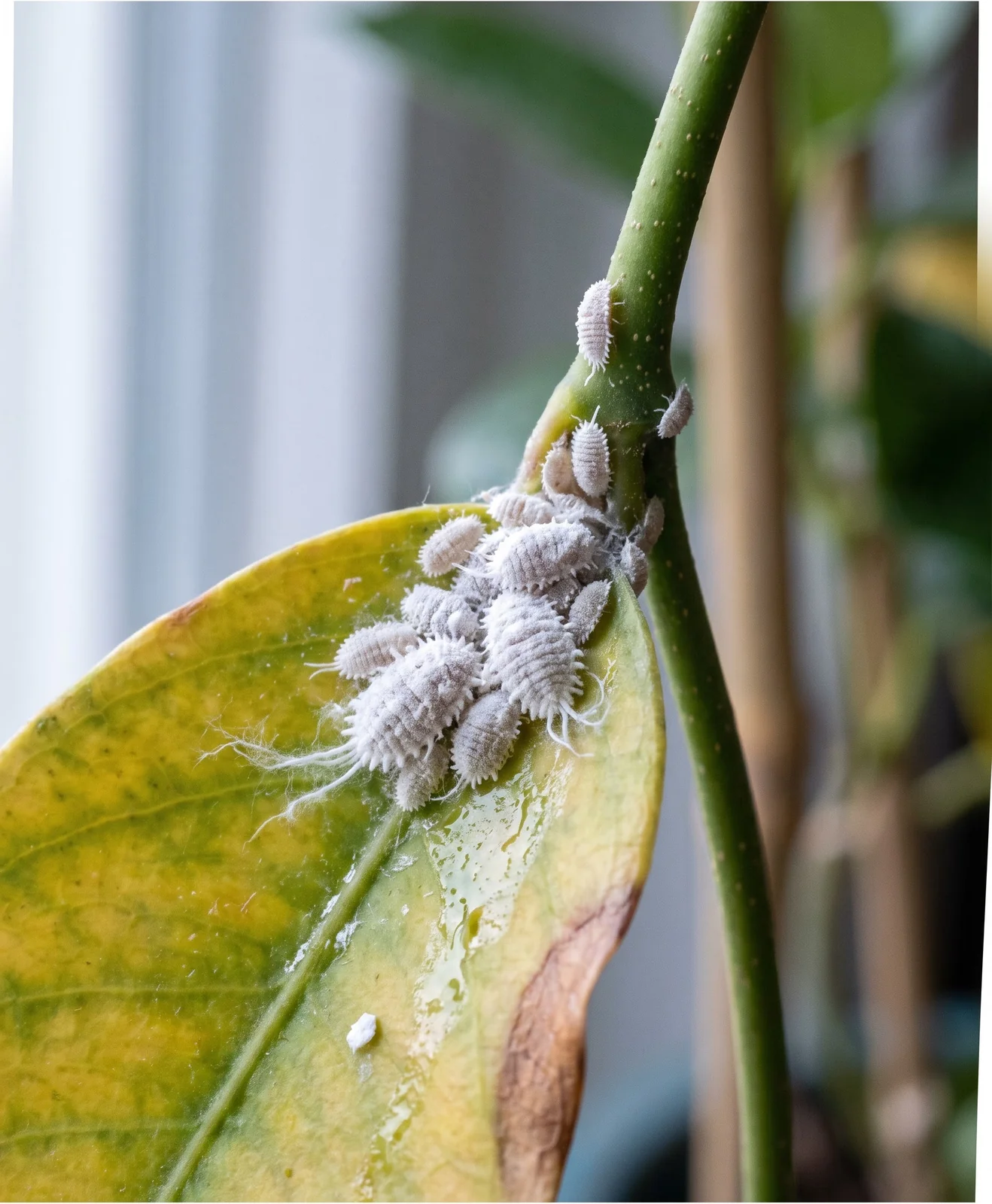
Mandevilla has no serious pest or disease problems outdoors and a short, predictable list of them under cover. The names that recur are mealybugs, scale, whiteflies and red spider mites, and they turn up particularly on overwintering plants. Each has a tell worth learning before the damage is obvious. Scale insects are soft-bodied and produce honeydew, a shiny, sticky secretion, so a glossy film on a lower leaf is a reason to look at the stem above it. Thrips scrape leaves with rasping mouthparts and drink the fluid released, which silvers the surface and leaves no holes.
Disease here is mostly a water problem wearing different names: root rot, powdery mildew, anthracnose, leaf spot, botrytis, fusarium rot, Southern wilt and crown gall. Nearly all of it follows a soggy root ball or foliage that stays wet. Anthracnose is the one to recognize, because its tan to brown leaf spots can be followed by yellowing and leaf drop. Water the soil, keep the foliage dry, and leave air space around a container.
What actually goes wrong, in order
These come up most, in that order. No flowers and the dipladenia mix-up have their own sections above.
Symptoms: most or all leaves fall within weeks of the move inside. Cause: short days. Management: a plant in a bright room stays messy until the longer days of March. Cut the water and skip fertilizer until new growth appears.
Symptoms: white cottony masses in the leaf joints or fine webbing at the tips, with yellowing and wilting where feeding is heavy. Cause: a plant carried in with passengers. Management: check every plant at the door and isolate anything already carrying them.
Symptoms: lower leaves yellow and drop with no obvious pest. Cause: usually the watering. Management: settle the water first, since overwatering can bring root rot while a plant kept too dry runs to stress and fewer flowers. Then look for a shiny film, which points to scale.
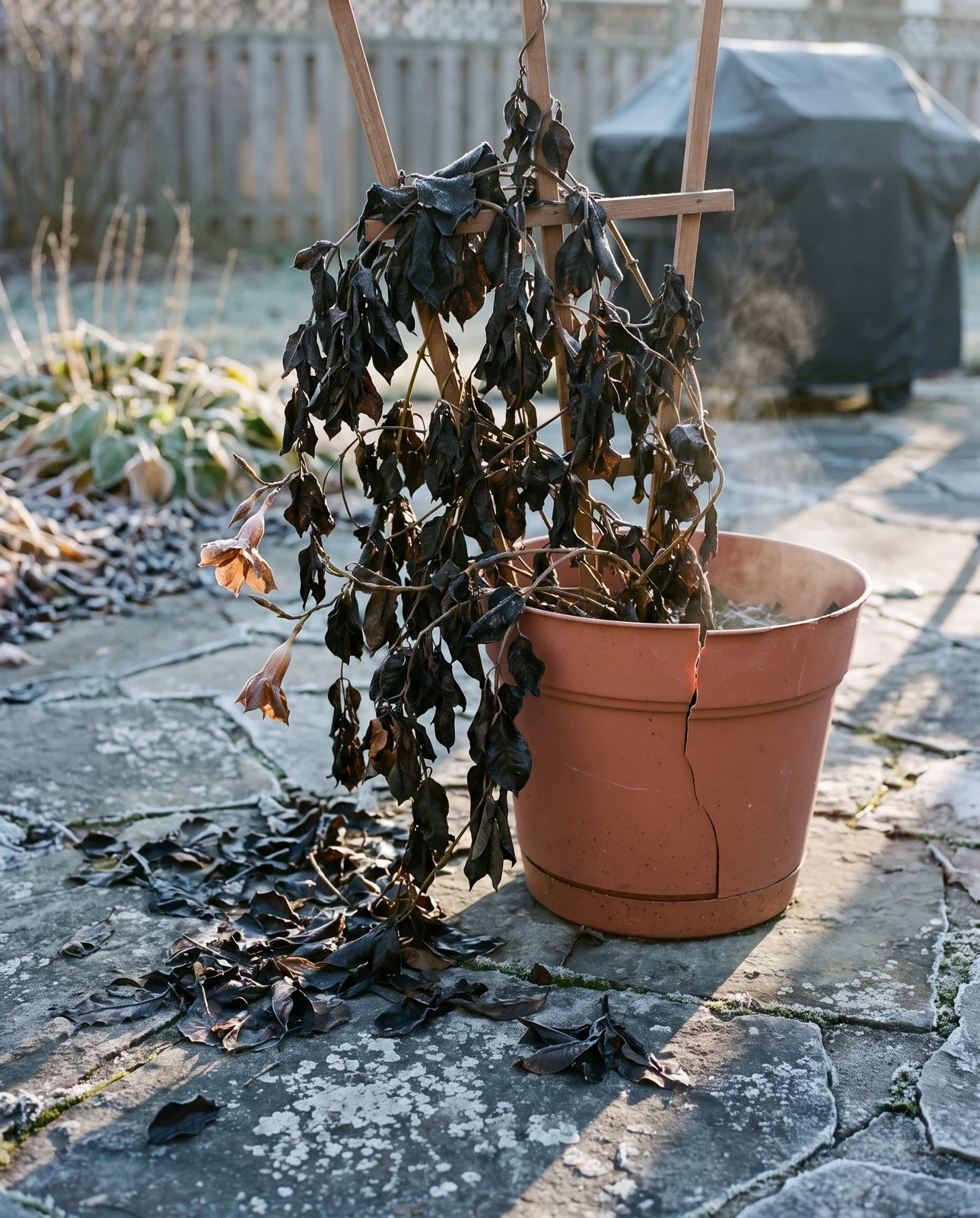
Symptoms: the vine blackens overnight after an early frost. Cause: it stayed out too long. Management: these vines die back once they meet freezing temperatures, so the move indoors belongs at 50 degrees Fahrenheit, well before the first frost date.
Symptoms: chewed leaves or a cut stem, and an owner who needs an answer now. Cause: no rating exists. Management: neither name appears on the standard toxic and non-toxic plant lists for dogs. Call a veterinarian who can see the animal.
Symptoms: a knot of stems around an undersized trellis by midsummer. Cause: the support was sized to the pot. Management: prune before growth begins in late winter, taking out old crowded stems. A badly tangled plant can be cut to the ground in winter and will bloom on the new growth.
Propagation, and how long one plant lasts
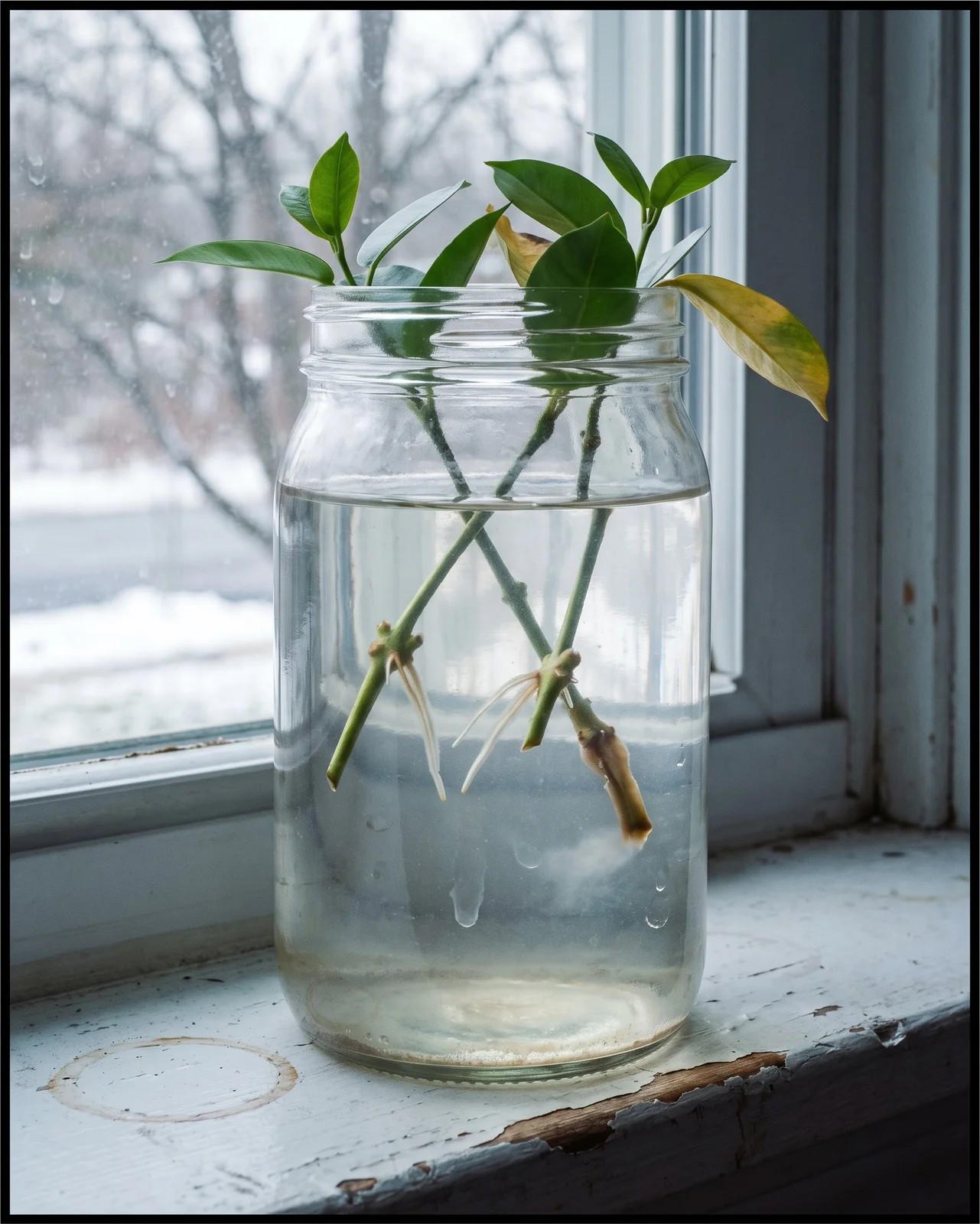
Mandevilla is renewed from cuttings taken during a job you were doing anyway. A woody vine kept for winter is dug up and potted as a houseplant. After several years, once the base has grown too woody to handle, it is started over by rooting stems in water. That is where the lifespan question lands: there is no fixed span, only the number of winters you are prepared to carry. Take the stems at the late winter cut, when the old crowded growth comes out anyway, and one afternoon gives you a pruned plant and its replacement.
Planting it in the ground
Putting mandevilla in open ground is a permanent decision only in zones 10 and 11. Everywhere colder it is a summer arrangement that ends at the first freeze. It is still worth doing. A season in the ground buys a size no container will produce: the plant that adds 3 to 5 feet in a pot climbs to 20 feet where it can stay year-round. Give it the support before it needs one, since a twining plant that finds a downspout first has to be cut free.
The name behind the plant, and what it is for
Mandevilla carries a person's name: the genus honors Henry Mandeville, a British diplomat and gardener. What the plant is for is easier to settle. It is one of the red flowers people buy to hold a rail, a mailbox or a patio corner through the heat, and the tubular flowers are shaped for hummingbirds and butterflies. Salt air does not trouble it either, so it earns a place on a coastal deck.
Four things people repeat that the sources do not support
These four come up on every mandevilla thread, and all four are wrong.
The myth: Dipladenia is a different plant from mandevilla.
The reality: One genus, two shopping words. Everything sold as dipladenia sits inside Mandevilla, and the old name survives only as a synonym. The tag describes habit, loosely: the white-flowered species is sold as white dipladenia and climbs to 12 feet.
The myth: Mandevilla is an annual and cannot be kept past one season.
The reality: It is a tender perennial sold as an annual, and it comes back on its own wherever winter stays frost free. One species goes further: the roots of Chilean jasmine are hardy to about 5 degrees Fahrenheit even where the top growth is not.
The myth: A mandevilla on a bright windowsill will keep blooming all winter.
The reality: Bright is not the missing input. Day length is. An indoor plant drops leaves slowly and carries undersized blooms until the longer days of March. Cut the water, hold the fertilizer until new growth appears, and prune hard again in February.
The myth: Yellow leaves mean the plant needs more water.
The reality: Both directions produce a sick plant: overwatering can bring root rot, while too little water shows as stress and fewer flowers. Insects yellow leaves too, and a shiny, sticky film points to scale.
What to expect, season by season
Three seasons of one plant, if you decide to keep it.
First summer. The plant flowers almost at once and keeps at it, since even very small plants in 4-inch pots bloom, and there is nothing to deadhead. In a container it puts on 3 to 5 feet of growth over the season, which fills a small trellis and overwhelms a cheap one.
First winter. The leaves come off whichever route you take. A plant kept in the house sheds them slowly and gives undersized blooms at best. A stored plant goes fully leafless and semi-dormant, watered lightly every few weeks. Neither state means the plant has died, and there is no point judging it until it has been back in warmth and light for several weeks.
Years two and three. A saved plant starts earlier and larger. A spring cut of up to a third feeds straight into the growth that carries the flowers, and even a plant taken almost to the ground blooms that summer on shoots from the base. The base is the thing to watch. It thickens every year, and this plant dislikes being pot bound, so each spring the question is whether it moves up a size or gets cut down to cuttings.
FAQ
Does mandevilla come back every year?
Only where winter stays frost free, in zones 10 and 11. Everywhere colder it is replaced each spring or wintered indoors in a pot.
Is mandevilla a sun plant or a shade plant?
A sun plant. Full sun is what makes it flower, and heavy flowering takes 6 to 8 hours a day.
Does mandevilla do well in pots?
Yes, and that is how most of the country grows it. Use a large pot, 20 inches across if you can, and expect 3 to 5 feet of growth in a season.
Can a mandevilla live indoors over winter?
Yes, in the brightest room you have, and it will look rough until the longer days of March. Give it 60 to 65 degrees at night and above 70 by day.
How do you bring a mandevilla back to life in spring?
A month before your last frost, move it into the light and water it more; after the last frost it hardens off outside. A house-wintered plant gets another pruning in February.
Why are my mandevilla leaves turning yellow?
Wet soil is the usual answer. Indoor pests do it too, and anthracnose begins as tan to brown spots followed by yellowing and leaf drop.
How long does a mandevilla live?
As long as you keep carrying it through winters. A saved plant runs on until the base grows too woody to handle, then starts again from stems rooted in water.
Is mandevilla or dipladenia poisonous to dogs?
Neither name is on the standard toxic or non-toxic plant lists for dogs. The milky sap can irritate skin and may be toxic if swallowed, so a dog that chewed one is a question for a veterinarian.
What animal eats mandevilla?
Very little does. It is considered deer resistant, and the real feeders are insects: mites, aphids, thrips and whitefly outdoors, mealybugs and scale under cover.
Which grows faster, mandevilla or dipladenia?
The climbing types, by a wide margin. Their stems can reach twenty feet in a single season, while a compact bred series holds at about 2 feet by 2 feet.
Interesting tips
- Leaf texture separates the two tags faster than the flowers do. Dipladenia foliage is smoother and shinier, while mandevilla leaves are longer and more textured.
- The white one is a wild species in its own right. Mandevilla boliviensis grows in Bolivia and Ecuador, as either a woody twining vine or a sprawling shrub.
- Size and vigor are not a trade. The Velvet series carries flowers 3 to 4 inches across on vigorous plants.
Related Guides & Flowers
Bougainvillea
The other tropical climber people fight to keep through winter, with the same hard zone limit.
Plumeria
A relative in the same family, grown in a pot outdoors and stored dormant over winter.
Pink flowers
Where the classic pink climbers sit among the other pink garden flowers.
Types of flowers
The index of flower guides by type, for whatever shares the patio next season.
Enjoying our flower guides? Add YourFlowersGuide as a preferred source on Google. It helps more readers find us.
Add to Preferred Sources