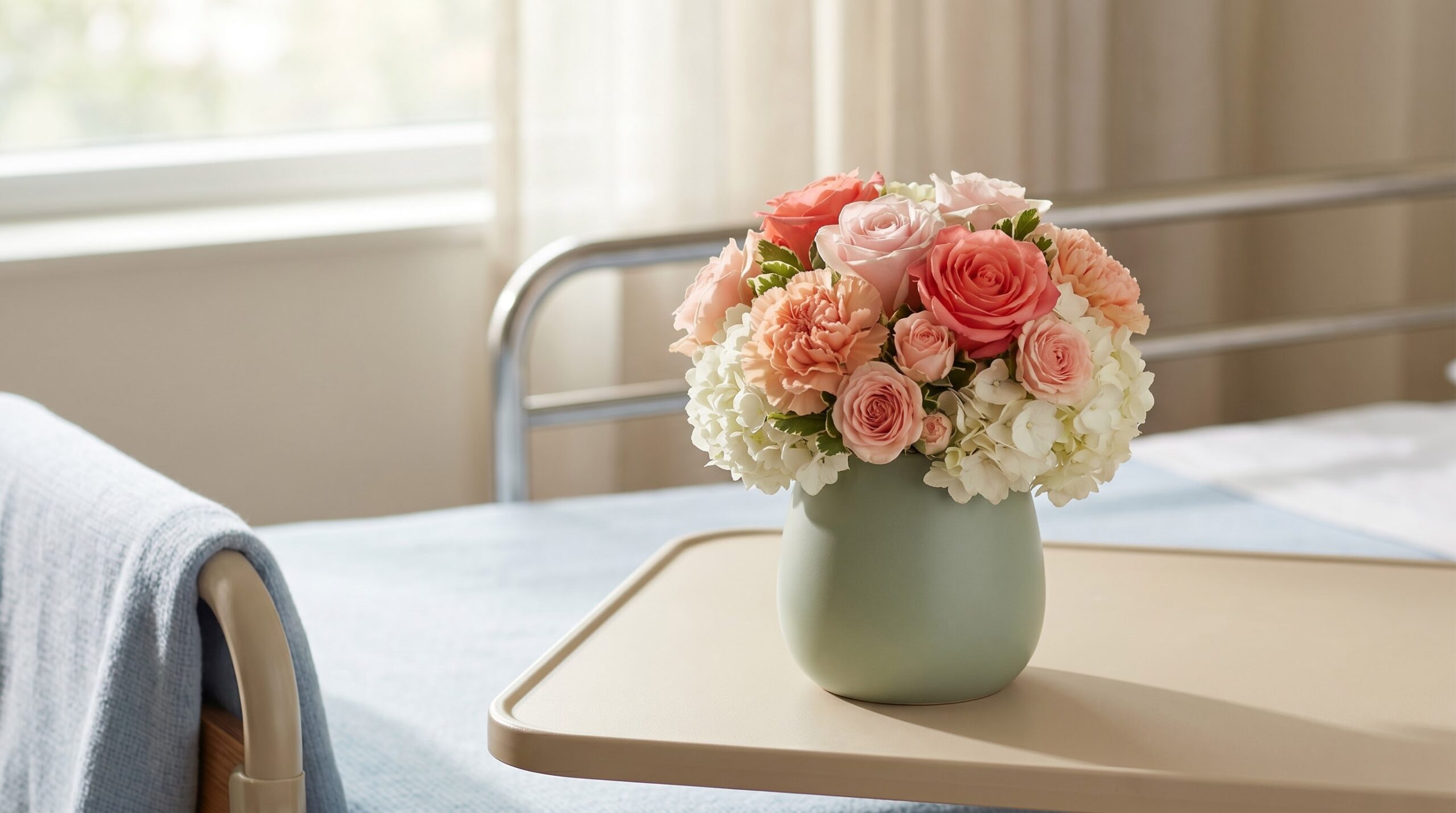
Yes. If your friend or relative is in a regular room, most US hospitals still accept flowers, and the order you already placed is very likely fine. The panic making the rounds, the one where someone's mam is "certain hospitals stopped taking flowers" and now you're second-guessing the whole thing, is half true at most. Blanket bans don't exist. Unit bans do. Intensive care, cancer floors, transplant units, and some newborn areas really will turn a bouquet away, and a few fragrance-free hospitals restrict scented stems on every floor. Everywhere else, your flowers will reach the room. The rest of this page is how to know which situation you're in before the delivery van shows up, and how to adjust the order so nobody at the nurses' station has to think twice about it.
Which floors take flowers and which turn them away
The unit decides the answer, not the hospital's name on the sign outside. A patient recovering from a knee replacement on a general ward and a patient three days into a stem cell transplant are governed by completely different rules inside the same building, and the transplant rules are strict for a documented reason.
The federal guideline everyone downstream is following comes from the CDC. Its infection-control committee recommends keeping fresh flowers, dried flowers, and potted plants out of patient-care areas for immunosuppressed patients, the kind found in hematopoietic stem cell transplant units, because Aspergillus mold has been cultured from flower water, soil, and even dried arrangements. For everyone else, the same guideline is refreshingly plain: flowers and potted plants "need not be restricted from areas for immunocompetent patients," with only mild handling precautions for staff. That single distinction, immunosuppressed versus not, explains almost every policy below.
Here is how six common unit types actually handle it, drawn from the policies hospitals publish for their own visitors.
| Unit | Flowers usually allowed? | Why | Send instead |
|---|---|---|---|
| Regular / general ward room | Yes | No evidence links flowers to infection in these patients; the hospital's flower room or front desk logs deliveries and staff carry them up | Compact arrangement in its own non-glass vase |
| ICU / CCU | Almost never | Critically ill patients, infection precautions, and no spare surface around the equipment. Cleveland Clinic warns ICU visitors they "may need to" skip "bringing food or flowers"; MD Anderson tells ICU visitors not to bring "live plants, or flowers" | Foil balloon and card, or wait for the step-down floor |
| Oncology / cancer center | Often no, and the strictest | Chemo and transplant patients are immunosuppressed; CDC cites mold risk. Johns Hopkins states "restrictions for gifts may apply to the Intensive Care Unit and Oncology Unit"; MD Anderson warns "some patients may not be able to keep fresh flowers or live plants" | Sealed snacks or a card; confirm with the charge nurse |
| Transplant / bone marrow (HSCT) | No | The CDC guideline names these units specifically for exclusion of fresh and dried flowers and potted plants | Card, foil balloon, or a gift timed for home |
| Maternity | Postpartum room often yes; call for labor and delivery | Postpartum rooms commonly allow them; some labor-and-delivery and newborn areas restrict flowers, and NICUs do not permit them | Flowers to the postpartum room or the house; foil balloon |
| Fragrance-free facility | Depends | Staff and patient scent sensitivities; strongly scented stems like lilies are barred building-wide | Unscented, low-pollen stems or a small plant, confirmed first |
Swipe →
There's an honest tension underneath these six rows. The bans on ICU, oncology, and transplant units protect patients whose immune systems genuinely cannot defend against mold spores, and those are worth respecting without argument. The softer restrictions elsewhere are a different animal. When a general ward discourages flowers, it is usually about workload and caution rather than proven danger, a point even hospital infection-control staff concede. One professional quoted by the Advisory Board put it plainly: "it's not cut-and-dried, which is why you see a spectrum of what hospitals will and won't allow." So the reasoning column matters. It tells you which rules are safety and which are preference, and a preference is something a two-minute phone call can often clear.
That call is the whole game. Ring the unit's nursing station, not the main switchboard, and ask two things: does this floor accept flowers, and is the patient well enough to have them in the room. For an ICU or cancer floor, read why ICUs almost never allow flowers, and what works instead before you order anything, because the answer there is usually no and the alternatives are worth knowing in advance.
Who actually carries the flowers to the room
The second fear that shows up in thread after thread is quieter but real: "would I just be pissing off the hospital staff, giving them extra work ferrying flowers to someone?" It's a considerate worry, and yes, flowers do land on someone's to-do list, so the goal is to make that list as short as possible.

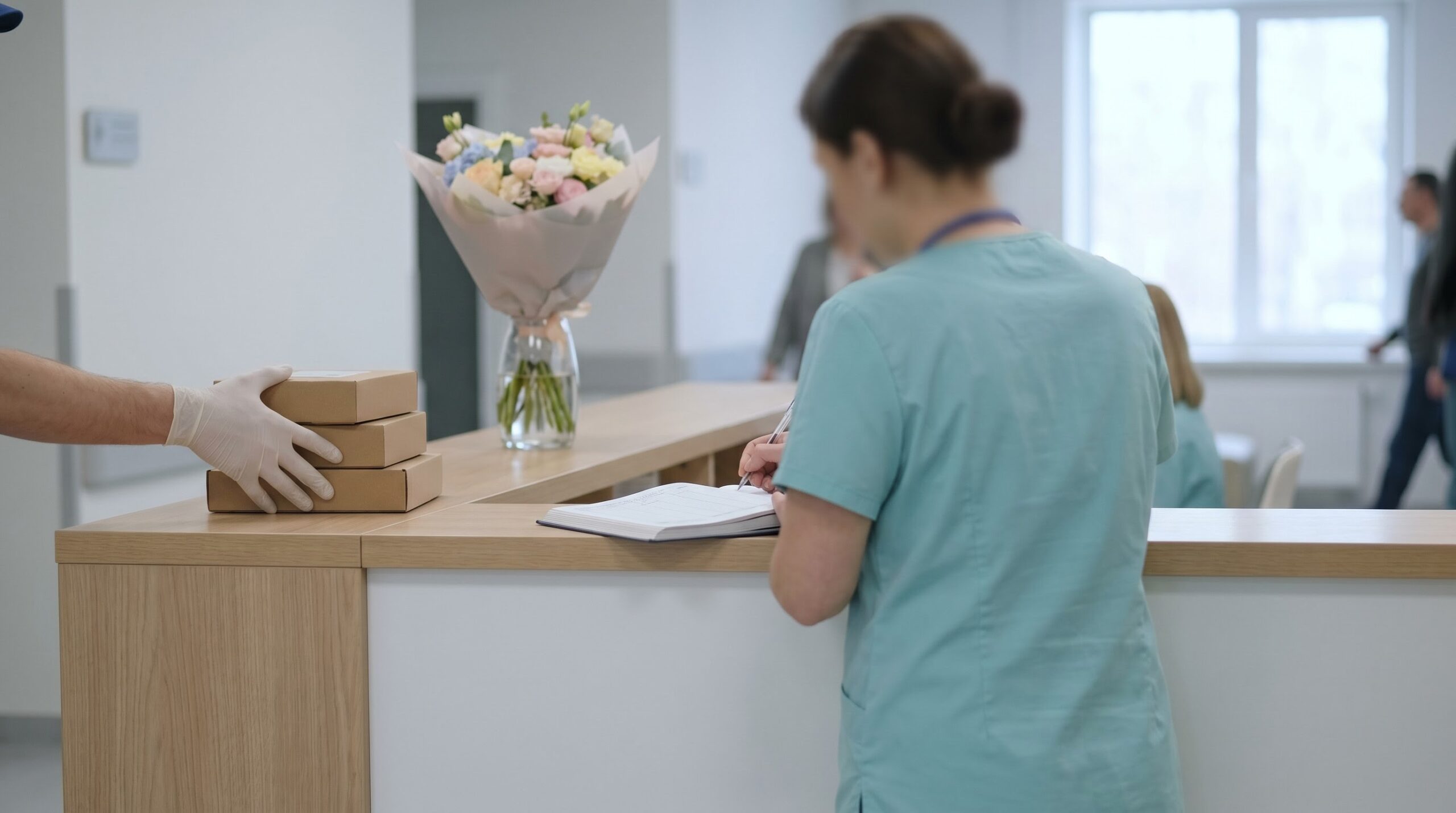
Couriers do not walk into patient rooms. FedEx, UPS, and most delivery drivers hand off at a central point, and hospital staff or volunteers take it from there. Larger systems run a dedicated flower room that logs each arrangement and routes it up. So between the front desk and the bedside, a nurse or aide is lifting your vase, finding a spot for it, topping up the water over a few days, and eventually clearing it out. None of that is heavy. All of it is avoidable design choices on your end.
The nurses' real complaint, when researchers actually asked them, was never infection. A BMJ study out of Imperial College London found staff were "more concerned about the practical implications of managing flowers than risks of infection." Knocked-over vases, water rings on equipment, no counter space, stems shedding into a room that has to stay clean. So order against every one of those. Pick an arrangement that arrives in its own container, compact enough for a crowded bedside table, in a sturdy vessel rather than glass. That last point answers another question people ask out loud: "do we also need to take a vase, and would a glass vase even be allowed for health and safety reasons?" Skip the glass. A ceramic or heavy resin container that can't shatter near an IV line or a barefoot patient is the safer call, and it means nobody has to hunt for a vase to put loose stems in. Send it self-contained, and the answer to your worry becomes: nobody has to do anything.
What to pick so the room stays safe to breathe in
A shared hospital room is a small sealed box with at least one person in it who feels terrible. Scent and pollen carry further there than they do in a living room, and the wrong bouquet can genuinely make a roommate miserable. This is where the choice of flower stops being about looks.

Lilies are the classic mistake. A physician in one heavily upvoted thread was blunt about it: if you absolutely must bring flowers, skip lilies, because "you can smell them in the whole corridor." The scent alone can trigger nausea or headaches in someone already nauseated from anesthesia or medication. Ohio State University Extension's guidance for hospital gifts lands in the same place and adds the pollen problem, flagging daisies, lilies, baby's breath, chamomile, goldenrod, chrysanthemums, and sunflowers as stems to avoid because of high or airborne pollen that irritates allergy-prone patients, visitors, and staff alike.
The safe list is long enough that you lose nothing by switching. Low-pollen, low-scent picks that the same extension guidance calls suitable include carnations, roses, hydrangeas, tulips, peonies, daffodils, and iris. Orchids in a small pot are another strong option, tidy and long-lasting, and easy to take home later. If you want to read what different flowers say before you commit to a color or type, that's worth a minute too, since some stems carry associations you may not intend.
One caution reaches past the hospital walls. If the patient is heading home to a house with a cat, keep true lilies out of the arrangement entirely. The FDA warns that eating a small amount of leaf or petal, or even licking a few grains of pollen off its fur, can cause a cat fatal kidney failure in under three days, and the ASPCA notes that "drinking the water containing a lily" is enough to do it. That risk waits at the house, days after the hospital visit ends, so it's worth catching before the bouquet ever leaves the shop.
The message the flowers send before you do
Flowers speak before you get a chance to, and in a hospital the reading can go sideways in two directions. The first is romance you didn't mean. A dozen red roses sent to a coworker or a new acquaintance can land as a declaration rather than a get-well, so unless that's genuinely the message, steer toward mixed brights, yellows, and soft pastels that read as warmth without the subtext.
The second misread is heavier. In many East Asian cultures white flowers, and white chrysanthemums or white lilies in particular, are funeral flowers, the blooms you send to a death rather than a recovery. An all-white arrangement delivered to a patient from that background can read as an omen instead of a kindness. The extension guidance flags exactly this, noting that in some cultures white lilies represent death and make a poor choice for a get-well gift. When you're not certain, color your way out of it: cheerful, saturated, unmistakably alive.
Getting the delivery to actually reach them
You can order the perfect bouquet and still have it stall in a hallway if the address is thin. "I know what hospital they are at, but not what room" is one of the most common snags, and the good news is that a room number is helpful but not strictly required. What the florist genuinely needs is the patient's full legal name, the exact facility (big systems span several buildings and addresses, so the campus and building matter), and the unit or floor if you have it. Reception and the flower room match arrivals by name, so a complete name beats a guessed room number every time.
There's a timing trap worth naming. Order early in the stay, not late. Ohio State's guidance opens by telling senders to call and confirm the patient is still admitted, because "by the time we receive news of the patient, it may be close to their discharge time," and courier delays only widen that gap. A bouquet that arrives to an empty, already-cleaned room helps no one.
If all of this feels like too many variables, there's a shortcut that removes most of them: the hospital's own gift shop. Many run in-house delivery, know their own unit rules cold, and will simply not accept an order for a floor that bans flowers. Johns Hopkins Howard County's shop, for instance, delivers to patients and notes that its staff can advise on the ICU and oncology restrictions before you buy. That single call outsources the guesswork to people who already know the answer.
When to skip the hospital and send to the house
Here's the question almost nobody asks until it's too late, and it may be the most useful one on this page: is the hospital even the right destination? Modern stays are short, often two to four days, and a reader's worry captures the downside perfectly. The patient "may not even stay and be left with task of getting them home," hauling a vase and a hospital bag out to a car they can barely climb into.
If the stay is short or nearly over, send the flowers to their home, timed to land the day after discharge or the morning of it. They walk into a welcome instead of wrestling a bouquet through a parking garage, and the arrangement lasts in a normal room with normal air and no pollen rules. For anything tied to a scheduled operation, it's worth thinking through when to time flowers around a surgery, whether hospital room or home before you pick a delivery date. And when the unit flatly won't take flowers at all, an ICU or a transplant floor, that's the moment to pivot to what to send when flowers can't go in rather than force a delivery that gets held at a desk.
Before you place the order
Run these five checks and your bouquet sails through. Call the unit's nursing station, not the switchboard, and confirm the floor accepts flowers and the patient can have them. Give the florist the patient's full name plus the campus and building, room number if you have it. Choose a compact arrangement in its own non-glass vase, low scent, low pollen, no lilies. Send a foil balloon rather than a latex one if you want a balloon, since latex triggers allergies and gets banned on many floors. And if the stay is nearly done, or the unit says no, send it to the house after discharge instead. The decision rule underneath all of it is simple enough to hold in your head: if they'll be in a regular room for more than a day, the hospital is fine; if they're in intensive care, cancer, transplant, or newborn units, or almost home, send it elsewhere.
Enjoying our flower guides? Add YourFlowersGuide as a preferred source on Google. It helps more readers find us.
Add to Preferred Sources