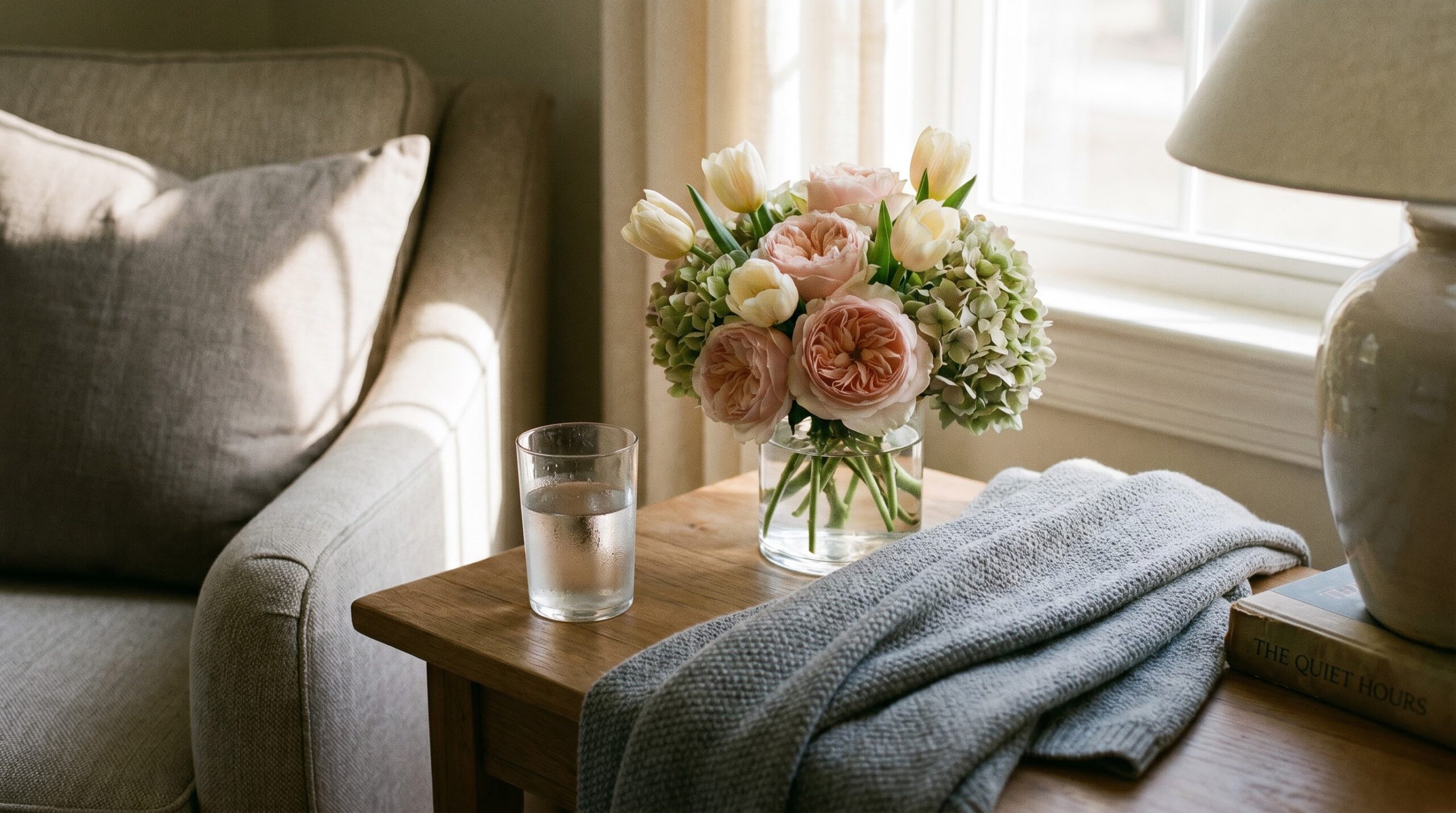
Hospital room or home, settled before you order
The text lands: surgery went fine. You are on your phone within minutes, ready to send flowers, and then someone mentions she will be discharged in a day or two, and the plan wobbles. Do you send to the hospital room she is in right now, or to the house she will be in by the weekend? Almost nobody spends more than a night or two in the hospital anymore, and plenty of procedures do not involve an overnight stay at all, so the default that almost never fails is skipping the hospital delivery window and sending the flowers home instead, timed for day two, three, or four of recovery, when she is awake, past the anesthesia fog, and actually there to open the door. The hospital window does exist. It is just narrower than most senders assume, and reading it takes about thirty seconds once you know what to check.
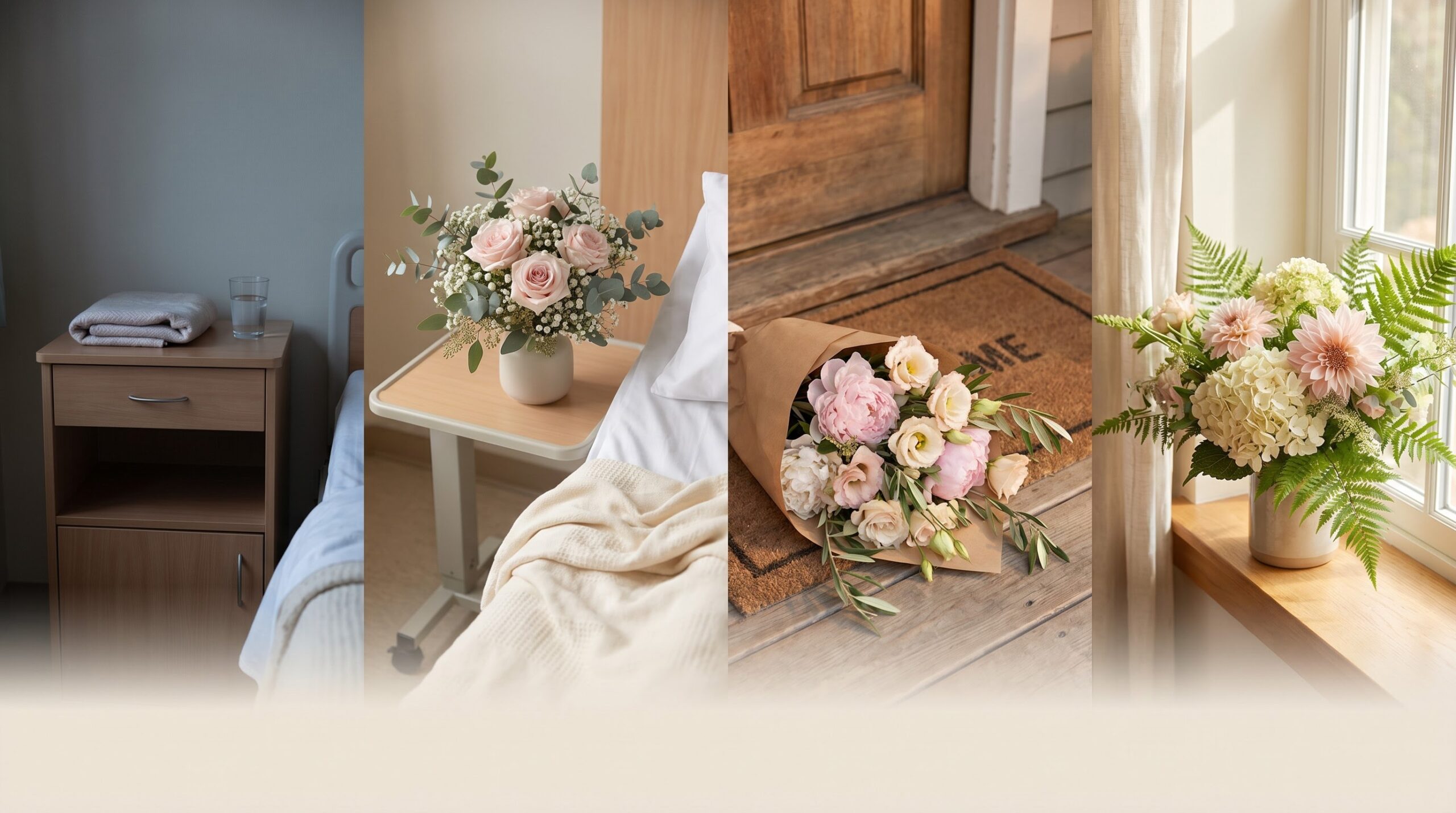
That check is really four separate questions squeezed into one decision: is she still admitted, is she staying long enough for a delivery to matter, is the flower safe for someone still working off anesthesia, and will it be a burden to receive. Laid out by stage, the choice gets a lot less foggy.
| Recovery stage | Do flowers land well | Where to send them | What to send |
|---|---|---|---|
| Day of surgery | Not yet | Nowhere. Hold the order. | Nothing helps here. She is groggy, often nauseated from the anesthesia, and may not even have a settled room yet. |
| Hospital, days 1 to 3 (confirmed still admitted) | Sometimes | The hospital room, but only after you call and confirm she is still there | A small, vase-included arrangement that needs no unpacking, built from low-pollen stems: carnations, roses, hydrangeas, or tulips |
| First days home, day 2 to 4 | Yes, the default | Her home address | Any low-scent, low-pollen arrangement, vase-included so there is nothing to hunt for |
| Home, weeks 1 to 4 | Yes | Her home address | A fuller, longer-lasting, low-maintenance arrangement, or a small potted plant that can sit on a nightstand for weeks |
Swipe →
Federal hospital-utilization data tracked by the Agency for Healthcare Research and Quality reflects the same pattern nationally: the length of a typical surgical hospital stay has been trending shorter for years, and a growing share of procedures now qualify as same-day, no overnight stay required. That is a large part of why the home-delivery default works as well as it does for so many senders.
Sending flowers before surgery, which is one of the questions people quietly wonder about, is rarer than senders assume and mostly unnecessary. There is little for a pre-op patient to do with a bouquet in a room she is about to leave for the operating table. Save the flowers for after, once there is someone in a bed or a house who can actually look at them.
Why sending flowers home avoids the real hassle
Sending to the hospital at all carries a logistics problem senders rarely think through until it is too late. News of a friend's or coworker's surgery often reaches you secondhand and a little late, and by the time you place the order, she may already be close to discharge. The Ohio State University Extension's guidance on sending flowers to hospital patients puts it plainly: call first and verify the patient is still admitted, because delivery schedules and courier timing can easily outrun how fast a patient recovers and leaves. And even once you have confirmed she is there, a courier cannot carry the arrangement to her room. UPS, FedEx, and most delivery services hand off at the loading dock or the front desk; hospital or clinic staff carry it the rest of the way, on their own schedule, layered on top of everything else they are handling that shift. Whether you can send flowers to a hospital at all, and each unit's rules, is worth checking separately before you commit to that route, since some units restrict flowers or plants outright over allergen and infection concerns.
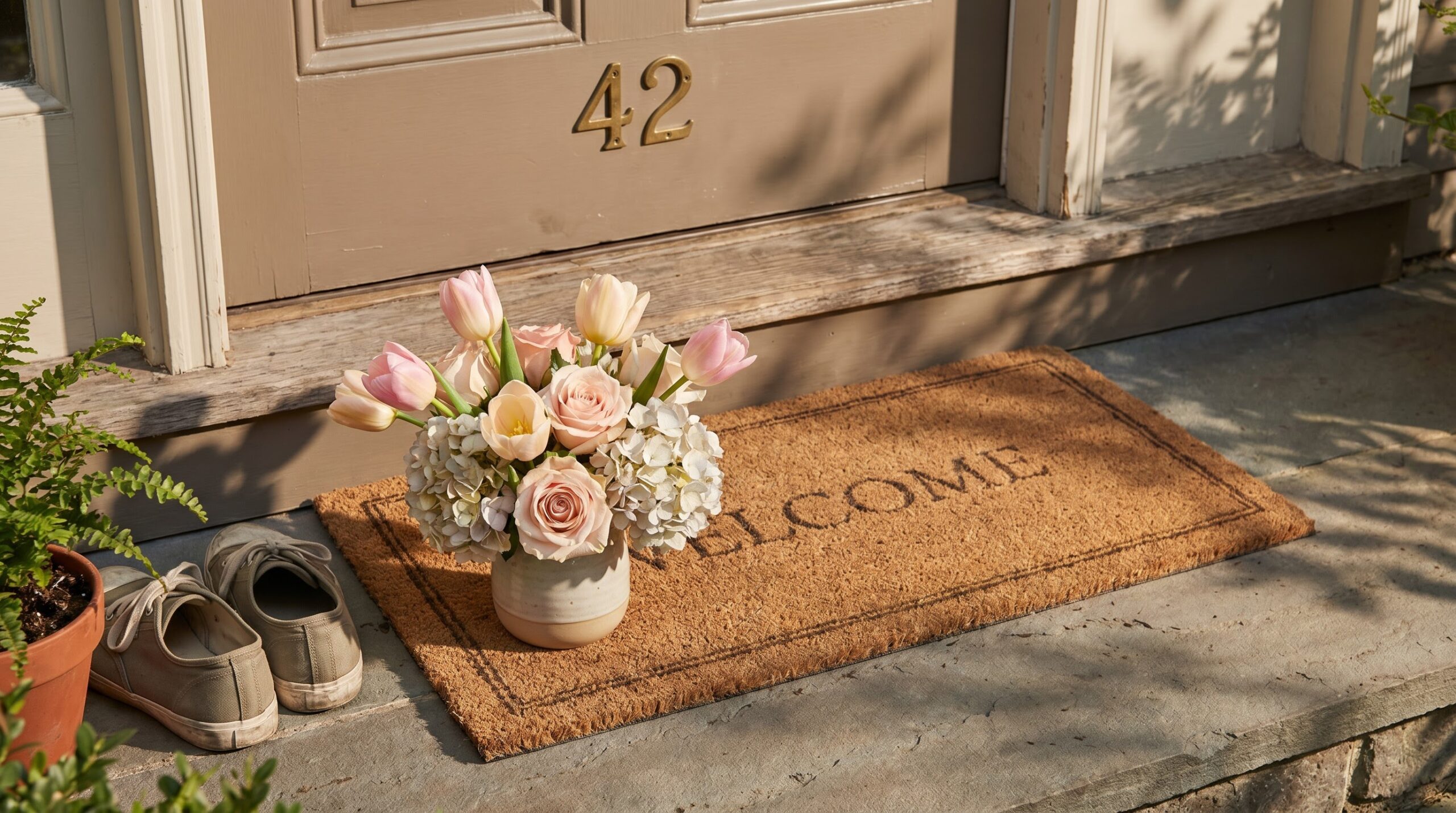
That is exactly the kind of thing senders keep circling back to online: "I don't want to clutter up the space or just have one more thing to deal with when they leave," as one person put it, and another worried flatly that she may not even stay and be left with the task of getting them home. A large arrangement sent to a hospital room does not disappear the moment she is discharged. It becomes cargo, something to balance on top of the paperwork and the going-home bag in a car that already has too much in it. None of that happens if the flowers go to the house instead. There is no vase to hunt down in an unfamiliar room, no staff member pulled away to carry a bouquet down a hallway, and no awkward parcel riding home on someone's lap.
If she is still inpatient and you would rather not gamble on a particular unit's rules at all, sending something else while she's still inpatient is often the simpler move, saving the flowers for the moment she is actually settled somewhere she can enjoy them.
What actually suits a body just off anesthesia
Once the destination is settled, flower selection has fewer traps than it seems, though the ones that exist are worth taking seriously. Anesthesia leaves most people nauseated and unusually sensitive to smell for a day or two afterward, and a strongly scented arrangement sitting a few feet from the bed can turn a kind gesture into a source of discomfort. Lilies are the classic offender here. One piece of advice from a physician, shared widely enough online that it has become something like folk wisdom by now, warns against bringing lilies into a hospital room at all, because the scent carries down the whole corridor, not just through the one room. The Ohio State Extension guidance backs this up from the pollen side too: carnations, roses, hydrangeas, daffodils, peonies, and tulips carry low pollen counts and travel well as get-well flowers, while daisies, lilies, baby's breath, chrysanthemums, and sunflowers carry pollen that becomes airborne easily and can trigger a headache or watery eyes in someone whose body is already working overtime.
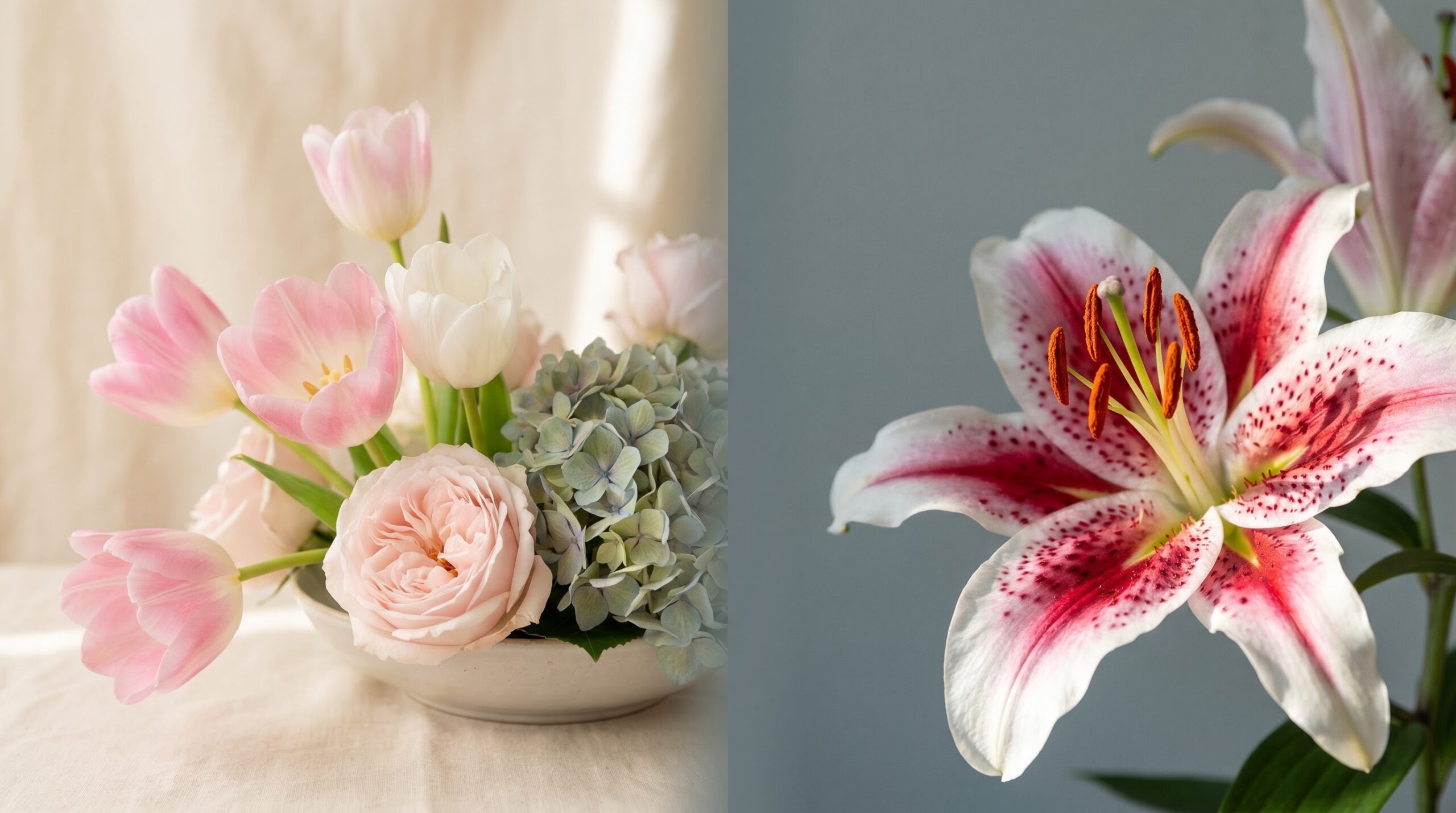
These are two different problems wearing similar disguises. Fragrance is a nausea and headache risk for someone still working off anesthesia. Pollen is a separate allergy risk for anyone in the room with sensitivities, a category the Asthma and Allergy Foundation of America lists strong perfumes and odors under as known irritants for an already inflamed airway. A safe arrangement solves both at once by sticking to the low-pollen list and skipping the heaviest scents, particularly true lilies, stargazer varieties especially, along with freesia and hyacinth, all of which read as generous from across a room and overwhelming from six feet away.
If the flowers are going home, check for a cat first
If the flowers are headed to a house rather than a hospital room, there is one more check worth thirty seconds, and it applies even if you have never met the cat. The FDA warns that lilies from the true lily and daylily families are dangerous enough to cats that every part of the plant counts as a hazard: the stem, the leaves, the petals, the pollen, and even the water sitting in the vase. A cat does not have to eat a flower to be poisoned. Grooming a few grains of pollen off its fur or lapping at the vase water is enough. Left untreated, that kind of exposure can cause fatal kidney failure in less than three days, with the earliest signs, a drooping appetite, drooling, lower energy, showing up within about twelve hours, and real kidney damage setting in within a day. Veterinarians can often treat it if they catch it early, but once treatment is delayed past roughly eighteen hours, the damage generally cannot be reversed.
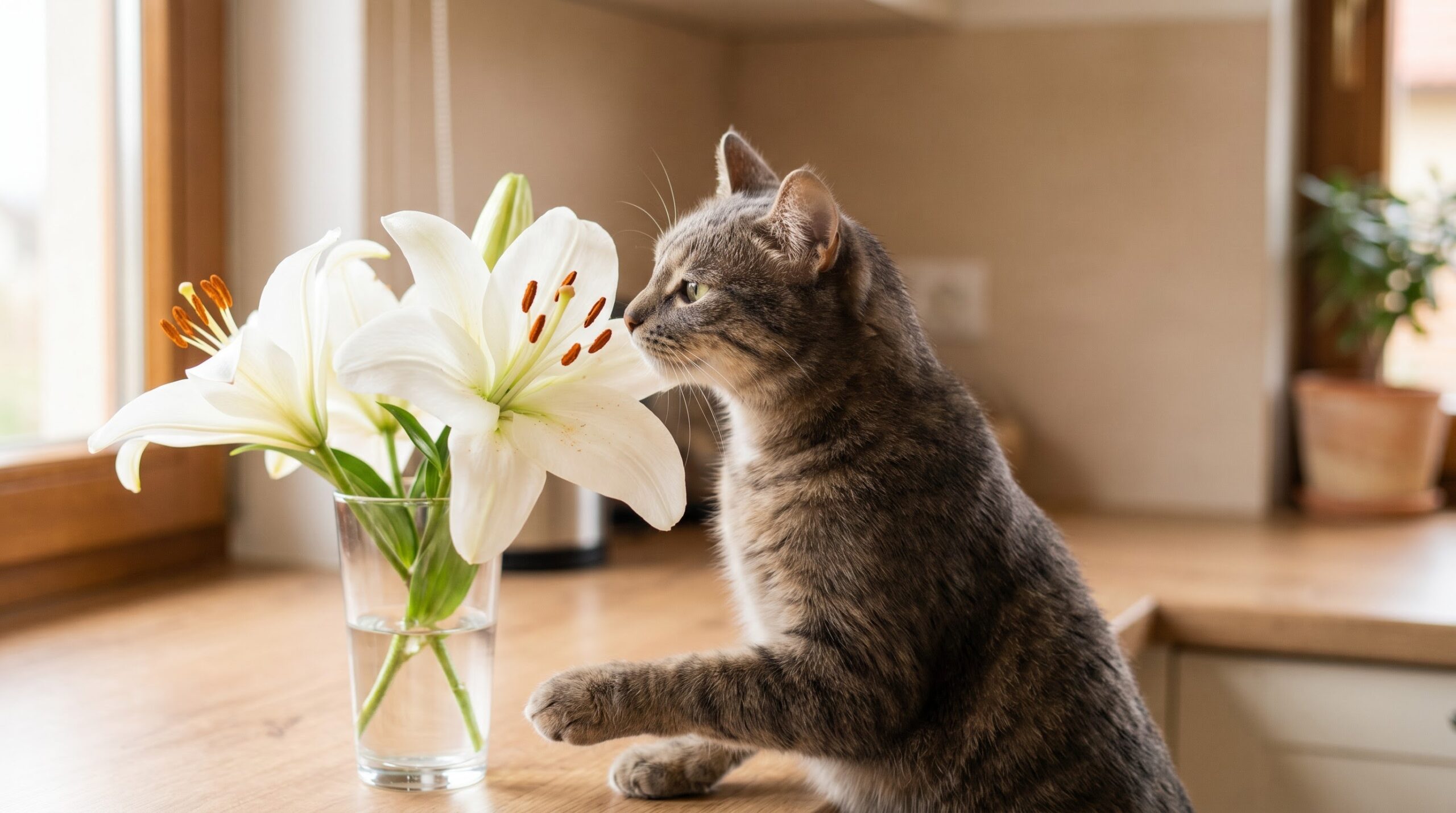
Not every flower with "lily" in the name carries that risk. The ASPCA is clear that Peruvian lilies (the alstroemeria common in mixed bouquets) and peace lilies are not true lilies at all, and both tend to cause milder problems, typically an upset stomach rather than kidney failure, if a curious cat takes a bite. Still, if you are not certain whether the house you are sending flowers to has a cat, the simplest move is to skip true lilies (Asiatic, Easter, Stargazer, Tiger, and their relatives) altogether and build the arrangement around tulips, roses, or hydrangeas instead: the same low-pollen stems that already suit a body recovering from anesthesia work here too.
Getting the color and the card message right
Color carries its own message, and getting it wrong is an easy way to have the bouquet say something you did not intend. Red roses are the classic misfire for a coworker or an early-stage partner: they read as romantic even when the sender means nothing more than get well soon, and more than one sender has second-guessed an order at the last minute, worried, as one put it, that it might be too much too soon. An all-white arrangement can misfire in the opposite direction. In several cultures, white flowers, and white lilies specifically, are strongly associated with funerals and mourning, so an all-white bouquet meant as something cheerful can land as something closer to condolences. What different flowers traditionally say goes deeper into this if you want the fuller picture, including cases like chrysanthemums, which read as a funeral flower across parts of continental Europe the way lilies do elsewhere. A mixed, colorful arrangement, bright without leaning red-heavy or all-white, sidesteps both problems at once and reads correctly no matter who receives it or where they are from.
The card gets easier once the flowers are sorted. Skip anything that leans toward sympathy language; that register belongs on a different kind of card entirely. Plain and warm outperforms clever nearly every time. Something like "thinking of you, hoping you're feeling more like yourself soon" does more work than a pun, and "sending you strength for the recovery" reads better than a joke about hospital food. Keep it to a line or two. Nobody recovering from surgery is reading a card as an essay.
Once you know the day, the destination, and the flowers to avoid, placing the order takes less time than reading this did. Default to home delivery on day two, three, or four unless you have specifically confirmed a multi-day hospital stay. Pick a low-scent, low-pollen arrangement, check for a cat in the house before any true lily goes near the order, and keep the card short and warm. If you would rather hand the flowers over yourself, holding the order and bringing them during a home visit works just as well. Either way, she gets flowers timed to when she can actually enjoy them, with nobody stuck babysitting a vase in the meantime.
Common questions about flowers after surgery
Does heart surgery or another major operation change any of this?
Bigger surgeries often mean a longer hospital stay, sometimes with time in an ICU or a step-down unit first, and flowers are almost never allowed in the ICU. The same home-delivery default still applies once she's discharged; it just means waiting longer, sometimes a week or two, before day two of home recovery arrives.
What about flowers for men after surgery?
The safety rules do not change by gender: low scent, low pollen, and a cat check if the flowers are headed home. If you want to skip the traditionally "flowery" look, lean on a greens-forward arrangement or a simple all-tulip bunch rather than a rounded rose bouquet. The message lands the same either way.
Should it be a fresh bouquet or something longer lasting?
For a short hospital stay, fresh and vase-included is fine since she will not be there long. For home recovery that stretches into weeks, a longer-lasting arrangement or a low-maintenance potted plant earns its keep far better than a bouquet that wilts before she is back on her feet.
Enjoying our flower guides? Add YourFlowersGuide as a preferred source on Google. It helps more readers find us.
Add to Preferred Sources