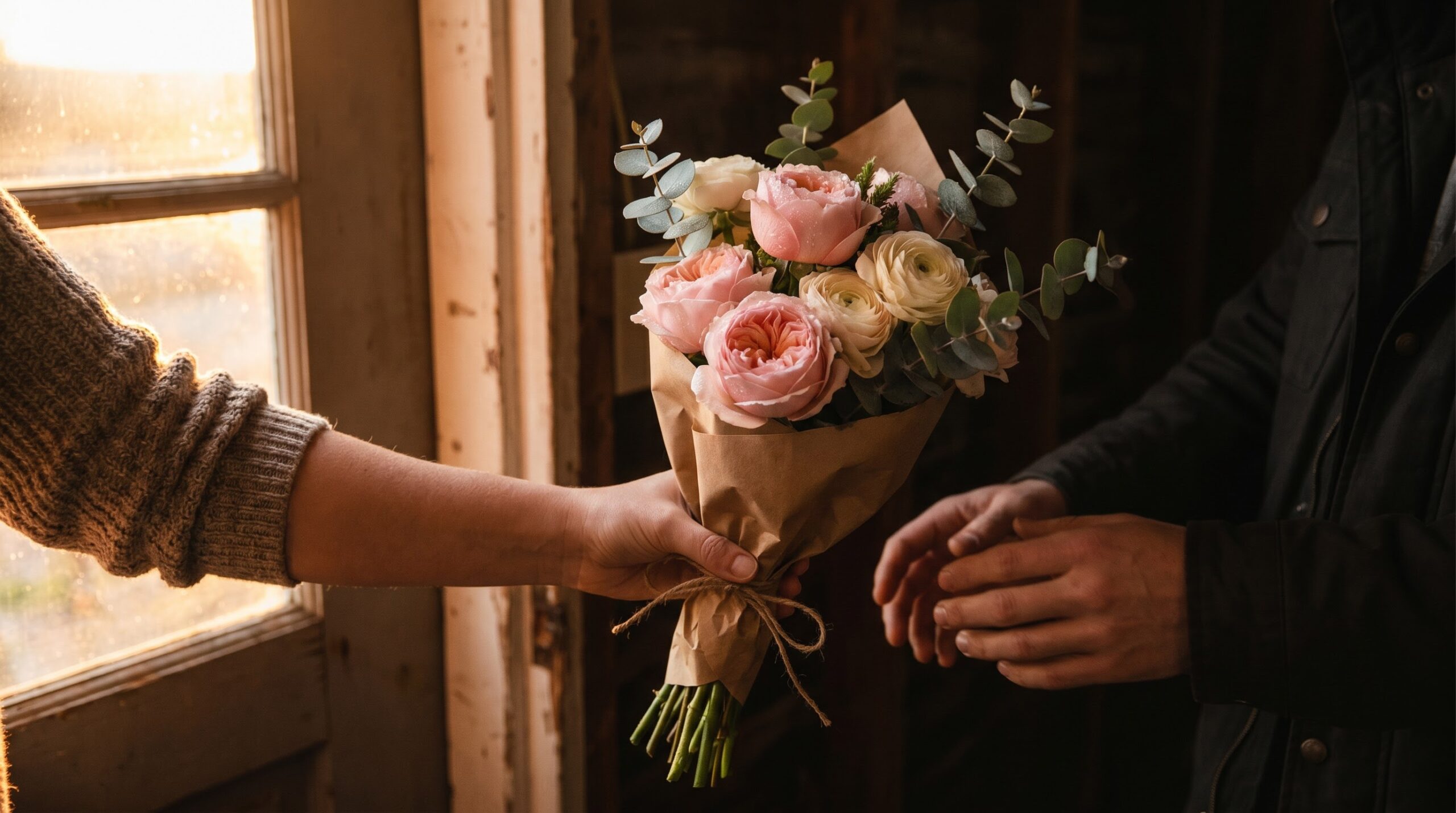
You do not need to know a bit of florist symbolism to get this right. There is a short list of flowers that reads as pure, thoughtful romance on almost anyone, and one rule that beats every trick the florist sites are selling you: buy fewer flowers of better quality instead of a big, cheap wrap. That single choice is the whole difference between a bouquet that reads as an afterthought and one that reads as care, even when the flowers themselves are identical. One Reddit poster summed up how most people actually shop: "I know nothing about flowers, so I just picked the ones that I thought looked the nicest." That instinct is not wrong. It just needs one adjustment before you get to the register.
Roses still lead, and for good reason: a dozen reds is the one arrangement in a flower shop with a fixed, unmistakable message, which is exactly why it works when you mean it and misfires when you don't. Tulips do almost the same emotional job with less weight behind them, which makes them the better opening move; our tulip meaning page has the color-by-color read if you want the card line to match. Peonies carry a softer, more established kind of romance, more anniversary than first date; the backstory is on our peony meaning page. Orchids read expensive and a little exotic without being loud, a good pick when you want restraint to do the talking. And then there are carnations, which deserve a full pause, because the flower itself is not the problem.
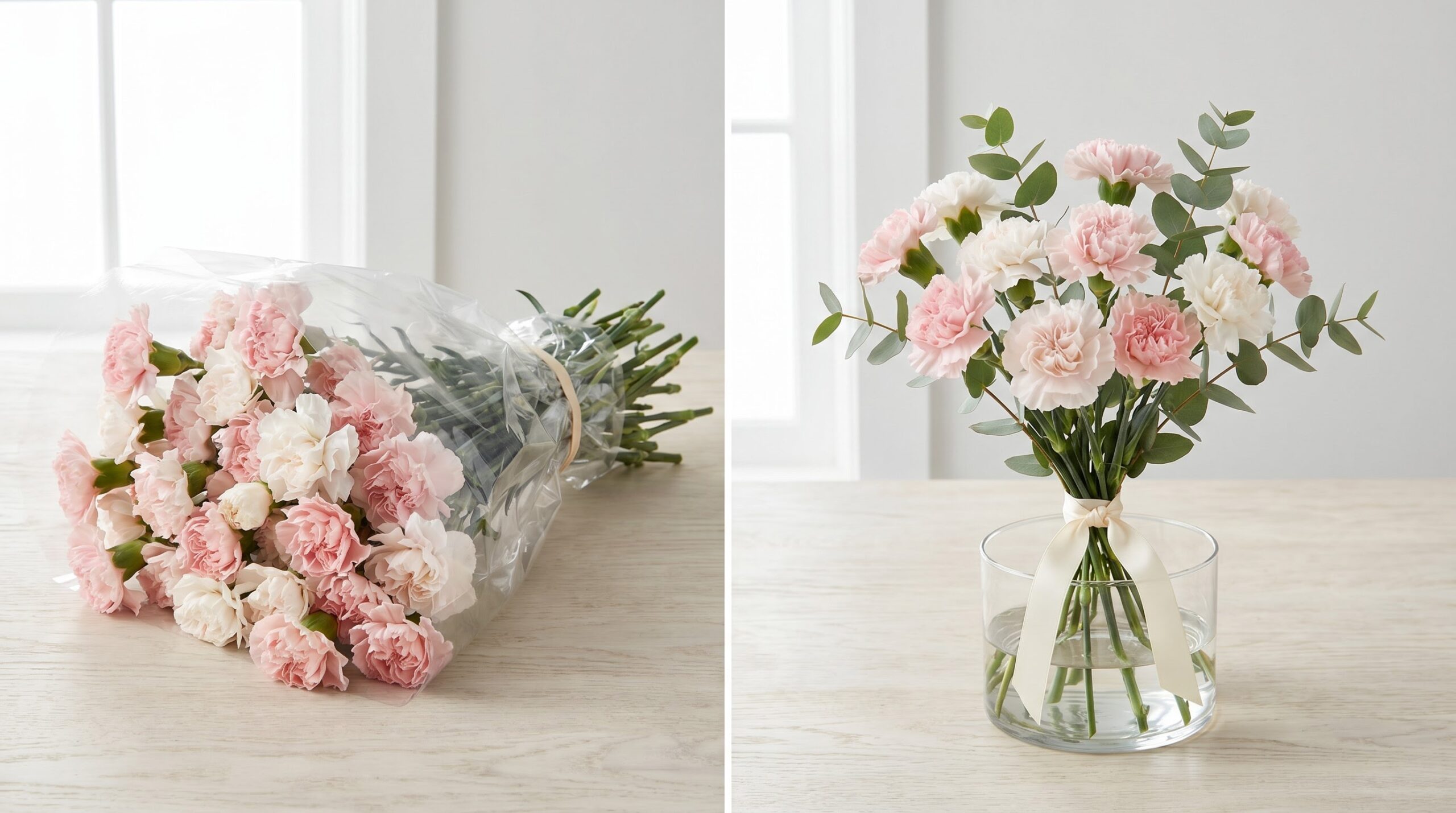
Carnations get blamed for something that was never their fault. "Carnations tend to get a bad rap because they were overused as cheap, long lasting filler flowers in the 80's and 90's," as one Reddit thread on the subject put it, and that history stuck around decades after the trend that caused it. A former florist in the same thread put a number on how deep the aversion runs: "in college I worked at a high end florist, the number one preference request: 'no carnations.' Even people who had zero other preferences would ask." The flower itself never earned that reputation. How it usually gets sold did, stuffed into an oversized, cellophane-wrapped bundle that says "filler" before anyone even reads the card. The fix is the rule itself, stated best by the same thread: "When in doubt go for fewer flowers of a higher quality than cheap but large. Almost everyone prefers a thoughtfully arranged bouquet to a giant $9.99 wrap of carnations." Buy a dozen well-shaped carnations, properly arranged, and you get a flower with real texture and a long vase life instead of a stigma. Buy the giant wrap because it looked like more for the money, and you get exactly what the price tag promised: filler.
If red feels like too much too soon, or the relationship simply is not there yet, our romantic flowers that aren't roses guide runs the full alternative picker by stage and message. The short version lives right here: the rule matters more than the species.
Is buying flowers actually worth the money
Somewhere behind the "flowers just die in a week" logic is a real, researched effect, and it holds up better than the marketing version of it usually does. A Rutgers University team led by psychologist Jeannette Haviland-Jones ran a study where women were given one of three gifts: a candle, a fruit basket, or a bouquet. The flowers produced a Duchenne smile, the genuine kind that involves the eyes and not just the mouth, in every single recipient who got them, a higher rate than either the candle or the fruit-basket gift. Candles and fruit baskets produced the same genuine smile in far fewer recipients, and flower recipients kept reporting better moods days after the gift arrived. That is not a same-day sugar high. That is a multi-day mood shift from a gift that costs less than dinner out.
Here is the part the florist blogs leave out: the Rutgers research was funded in part by the Society of American Florists, the flower industry's own trade group. That does not make the finding fake. It was peer-reviewed and published in the academic journal Evolutionary Psychology, and the smile response was measured, not self-reported. But it is fair to know who paid for the study before you repeat its headline number, and it is fair for us to say so out loud instead of hiding it in a footnote. Knowing that the flower industry helped fund the research doesn't erase the smiles the researchers actually measured.
What to pick early in a relationship versus years in
The same bouquet does not land the same way at every stage, and this is where most first-timers overcorrect in one direction or the other, usually toward too much, too soon. One man described the gap in basic knowledge that catches a lot of guys off guard: "One man here. Until I read this post I did not know there were different colors of roses." That gap is normal. It just means the default reflex, roses because "they're the default romantic flower," as one Reddit answer put it, needs a stage check before it becomes the actual pick.
| Where you are | What reads right | What to leave at the shop | Why |
|---|---|---|---|
| A few dates in | A single well-chosen stem, or a small, loose, casual bunch | A dozen long-stem red roses, anything that reads like a proposal | Big and red both signal escalation you haven't earned yet |
| Several months in, dating steadily | A modest, well-arranged mixed bouquet in colors she actually likes | The identical grocery-store dozen, every single time | Repetition starts to read as autopilot, not romance |
| Married or years into it | Her real favorite flower, or red roses if that's genuinely still your thing | Generic sameness, whatever's cheapest and closest to the door | The relationship can carry more weight; use it instead of wasting it on habit |
| Long distance | Something that holds up in transit, paired with a note about the specific reason | An oversized arrangement she has no one nearby to show off | The gesture has to survive being unwrapped alone in an apartment |
| Making up after a rough patch | Fewer stems, higher quality, paired with a specific line, not a blanket sorry | A defensive, oversized bouquet that looks like it's trying to buy forgiveness | Size doesn't apologize faster; specificity does |
Swipe →
If you're standing at the "how much, how often" question rather than the "what kind" question, that math, including the yellow-flowers-mean-something-different anxiety and the girlfriend's-mom wrinkle, lives on our page about how often and how much to spend on flowers for a girlfriend. And if this is date one or two, not month six, the etiquette runs differently enough that it gets its own dedicated breakdown on flowers on a first date. Seasonal dates change the math too. Bringing flowers on Valentine's Day carries its own crowded, specific expectations, covered separately in our Valentine's Day flowers guide, and a specific wedding-anniversary year has its own traditions, which our anniversary flowers guide runs year by year.
Where to actually buy from
This is the part no florist site will tell you straight, because it argues against the thing they're selling. Ask around on any forum where people compare experiences buying flowers online, and the consensus is close to unanimous. "Virtually all flower orders are a rip off and a disappointment," one person wrote in a thread that has been echoed almost word for word across at least five separate discussions on the same subreddit. "Just stop ordering flowers online and research a local florist." The pattern behind that complaint is consistent: a glossy photo online, a sparse, wilting arrangement on arrival, and a delivery fee that quietly doubled the price.
A local florist, walked into in person, almost always beats the online aggregator, because you can see exactly what you're buying before you pay for it, and the person arranging it has a reputation in the neighborhood to protect. A grocery store bouquet is not a downgrade either. It's usually cut from the same wholesale supply chains as a mid-range florist, at a fraction of the markup, and a $12 grocery bunch handed over in person carries more warmth than an $80 arrangement that showed up by app while you weren't there to see it land. The online aggregator earns its bad reputation the same way every middleman does: it adds a fee, a delivery window, and a stock photo between you and the actual flowers, and none of those three things make the bouquet better.
Flowers for him: the gesture, the vase problem, and the real numbers
Buying flowers for a man trips people up because the entire category feels coded female, and the coding is mostly wrong. On a thread specifically asking men what they actually want, the answer that kept getting upvoted was blunt: "It's the gesture we're after. Get us a 6 pack and some beef jerky." Strip the joke off that and the actual advice underneath is sound: the size and species of the bouquet matter far less for a man than the fact that someone thought to bring one at all. A masculine-leaning arrangement, something structural with eucalyptus, thistle, or sunflowers rather than a pastel round bouquet, solves the aesthetic half of the problem in about thirty seconds of thinking.
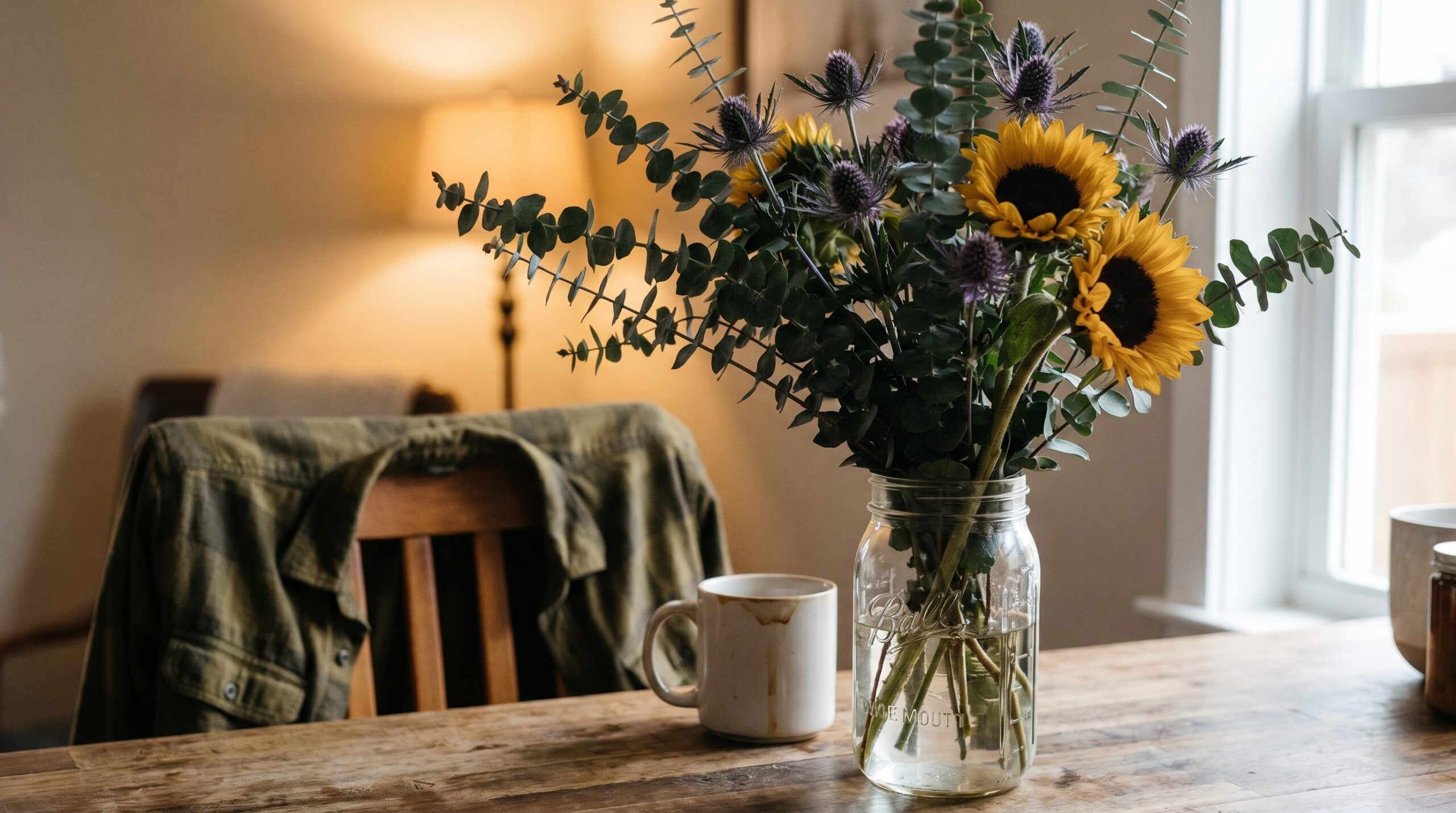
The other half is entirely practical, and it comes up often enough to be its own running joke online: "The problem with giving a guy flowers is that he absolutely doesn't have a vase to put them in," a complaint that shows up almost identically across several threads. The fix costs nothing extra. Bring the flowers already in something, a mason jar, an old pint glass, anything with water in it, and the entire practical objection disappears before it starts. One man described what actually happens when the gesture lands right, gender assumptions aside: "The first time my now wife gave me flowers, I bawled for at least an hour." Reactions like that aren't a fluke. They're what happens when someone gets a gift they were quietly told for years they weren't supposed to want.
The numbers on how common this actually is are genuinely contested, and it's worth seeing both sides rather than repeating whichever one sounds more dramatic.
| Survey | What it found |
|---|---|
| Interflora (UK) | 88% of men say they have never been given flowers, but 48% said they would want to receive them |
| SWNS / 72Point, survey of 2,000 adults | About two-thirds of men who had been given a bouquet said they'd received one at some point, and 78% of those men said they liked getting it |
| The "95% of men only get flowers at their funeral" claim | Circulates widely online with no primary study behind it; treat it as marketing folklore, not data |
Swipe →
Those first two surveys were run by companies with a stake in the answer, which is worth knowing, but they were at least measuring something specific rather than repeating an unsourced number that sounds good in a headline. Read together, here's what the numbers actually say: most men have gotten little to no practice receiving flowers, a meaningful share of them would genuinely welcome it, and among the ones who have already received a bouquet, most liked it. None of that supports the viral funeral-only claim, which nobody has ever managed to trace back to an actual study.
If it's specifically his birthday, our flowers for her birthday and flowers for a man's birthday guides go deeper on the occasion-specific rules than we will here. And if the reason you're reading this is that he's sick rather than celebrating, hospital and get-well gifting has its own etiquette, covered separately in our get-well flowers guide.
If he never brings you flowers, or you just had a baby
A different gap runs the opposite direction, and it shows up constantly in relationship forums: women whose partners never think to buy flowers unprompted, sometimes for years. One woman described handling it the only way that actually worked for her: "No but I love flowers and he knows this so I buy them for myself and he comes home confused like who got me flowers. I'm passive aggressive." That answer got variations of the same response from other women in the same thread, which tells you the workaround is common, not unusual.
The more direct fix, which shows up just as often and gets just as much agreement, is simply saying it out loud. "Tell him; 'I'd like flowers for my birthday and Valentine's Day. These are my favorite kinds.' Be clear about what you want," read one piece of advice that multiple people echoed almost word for word in the same thread. There is no shame tax on asking directly for something you'd genuinely like. Most partners who never buy flowers unprompted aren't withholding them on purpose; they simply never learned that it mattered, and nobody ever told them plainly.
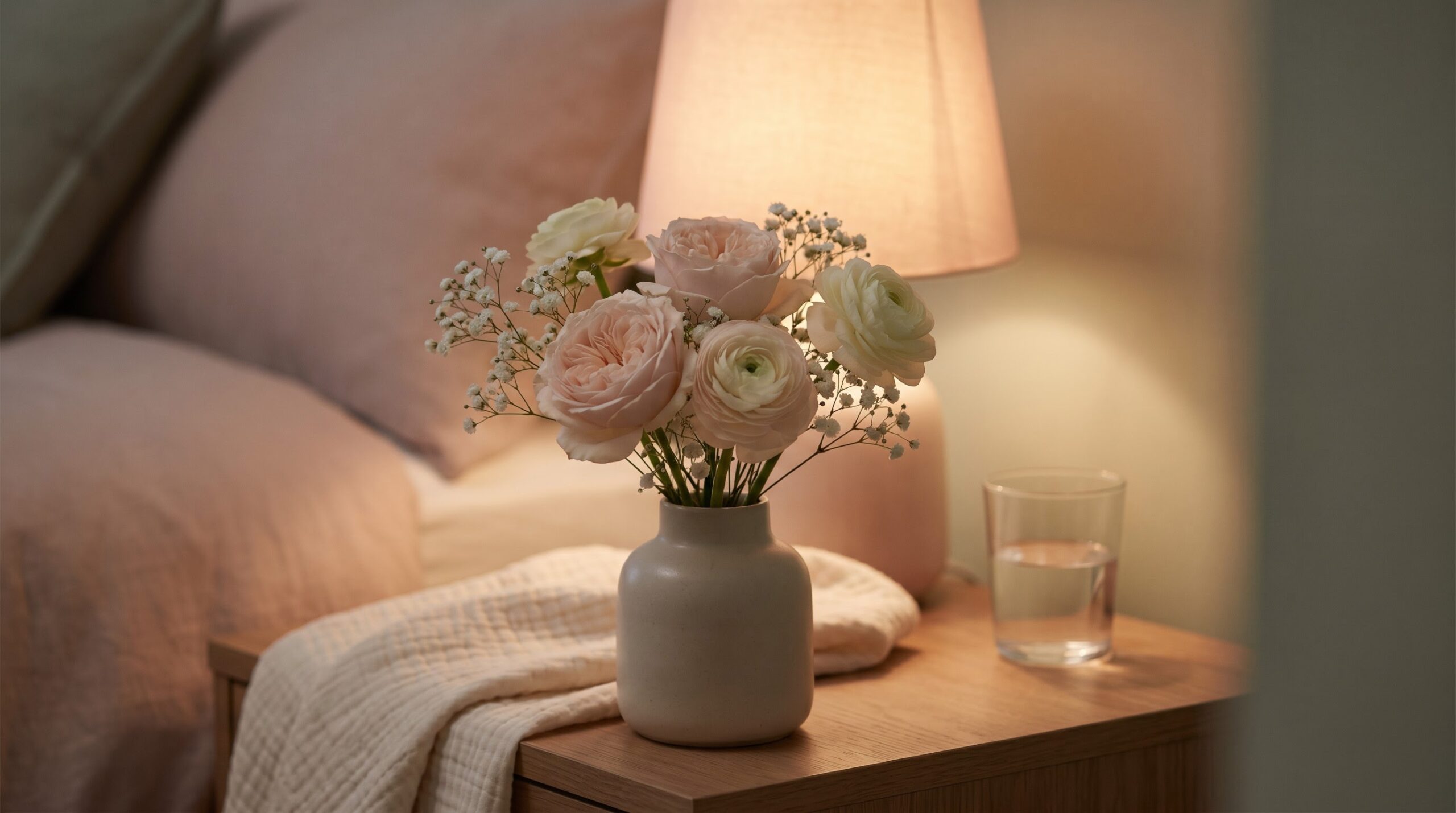
One version of this deserves its own gentle note. If your partner just went through childbirth, this is not the moment for a subtle hint campaign or a wait-and-see approach. A soft, uncomplicated arrangement, something calm on a nightstand rather than anything requiring effort to arrange or admire, tends to land better than a showpiece bouquet in those first exhausted weeks. The gesture matters far more than the scale of it right now. For the fuller etiquette layer on how often is normal and what a fair budget actually looks like, our girlfriend flowers etiquette guide runs the full picture.
What to walk out with
Pick fewer, better flowers over a bigger, cheaper wrap. Buy from a local florist you can see in person or a grocery store bouquet handed over with a hug, not a flashy online aggregator with a delivery fee bolted on. Match the pick to where the relationship actually is, not where you wish it were. That's the whole decision, and it works whether you're three dates in or thirty years in.
If a sharper question brought you here, the answer probably lives on one of our other pages rather than this one. For flowers that skip roses entirely, our full not-roses picker by stage and message covers that. If you're trying to figure out what to actually write on the card once the flowers are picked, we have a full bank of lines by relationship stage at what to actually write on the card. If he brought flowers home with no occasion attached and you're trying to read the gesture, or you're the one sending them for no stated reason, our page on what it means when he brings flowers for no reason covers exactly that. Whatever brought you here, you already know enough to walk out with the right pick.
Questions people ask before they buy
What's the difference between just-because flowers, first-date flowers, and everyday romantic flowers?
Just-because flowers are unprompted, no occasion attached, and usually smaller in scale precisely because there's no event to justify the size. First-date flowers follow a separate, more cautious etiquette because the relationship hasn't earned a big gesture yet. Everyday romantic flowers, the subject of this page, sit in between: a genuine relationship, no specific occasion, just the choice to bring something home.
Why are roses considered the default romantic flower?
Mostly habit and marketing repetition rather than any deep symbolism most people could explain. Red specifically reads as love across most of Western flower culture, which made roses the safe, unmissable choice for generations of buyers who didn't want to think too hard about it. They still work. They're just not the only option, and often not the most thoughtful one.
What flower symbolizes love and romance?
Red roses carry the clearest, most universally understood love message of any flower, with pink read as the gentler, less intense version of the same signal. Our flower colour meanings page runs the full breakdown of what each color actually communicates, rose or otherwise.
Enjoying our flower guides? Add YourFlowersGuide as a preferred source on Google. It helps more readers find us.
Add to Preferred Sources