Fall wedding flowers split into three different sets depending on whether the date lands in September, October, or November. Early autumn still has field-grown dahlias, marigolds, and celosia at full stretch. By late October the fields have thinned to frost-hardy chrysanthemums and asters, and a November date works mostly from greenhouse mums, calla lilies, garden roses, amaranthus, and berried branches. The dividing line is not the calendar. It is the first killing frost where the flowers are grown, and that date swings by weeks from one region to the next.
That is why two weddings in the same month can end up with completely different flowers, and why a board of saved photos put together in spring can be out of season by the day it matters. Ordering what growers are actually cutting that week keeps the budget off costly out-of-season imports and keeps an unexpected regional freeze from canceling part of the order. Two other things shape the result: chrysanthemums set their buds by night length rather than by temperature, so a variety chosen for a late date may never open, and the gap between market buckets and a full-service florist is measured in hours of your own labor as much as in dollars. What follows covers what blooms in each month, the palettes those flowers build on their own, three honest ways to budget, when to book and when to cut, and what survives to the date on the invitation.
On this page 6 sections
What’s blooming for a fall wedding, month by month
Bloom windows and frost cutoffs for fall wedding flowers
Four flowers carry most fall weddings, and each one stops on a different signal. The substitute line is what a florist reaches for once that flower is gone for the year.
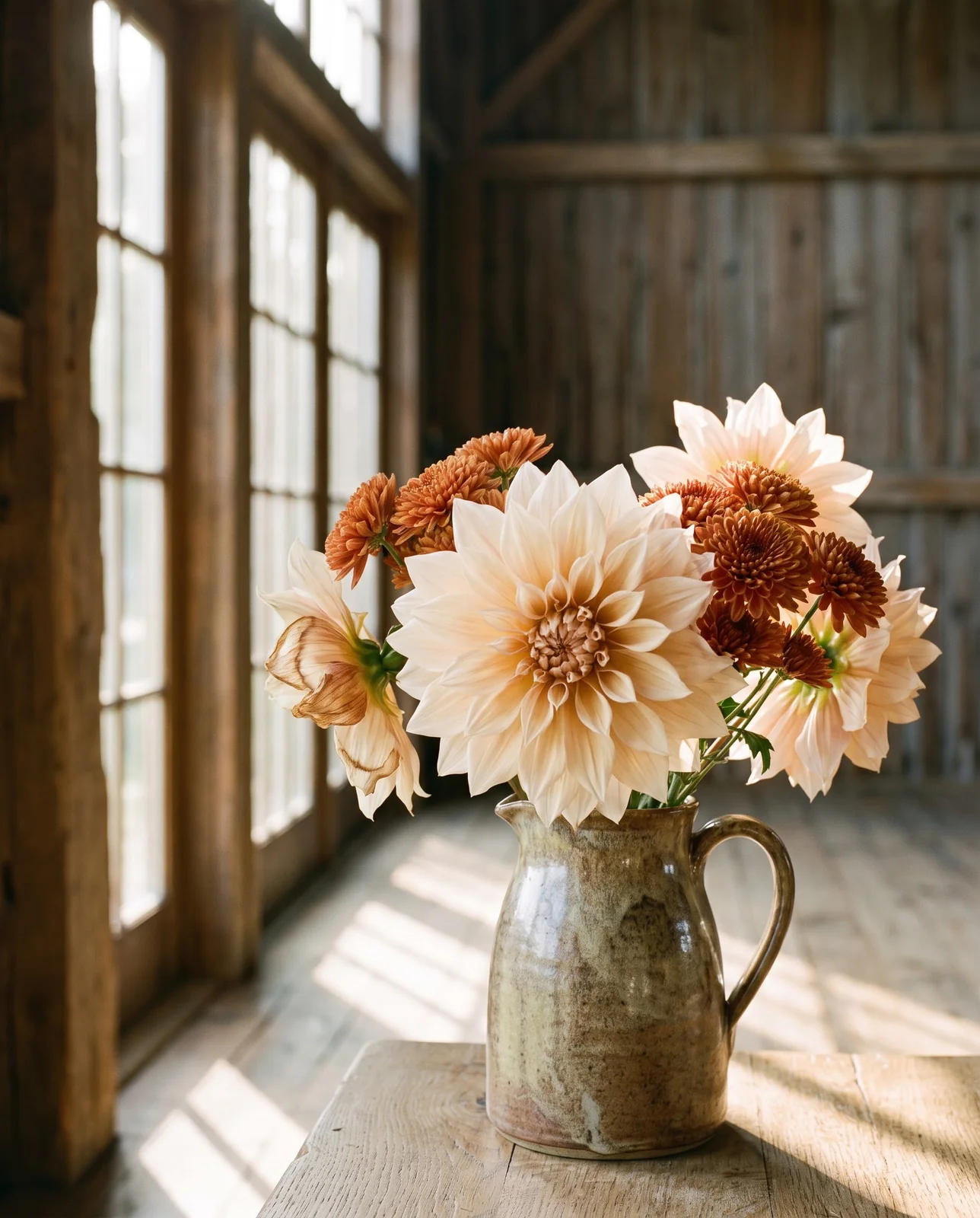
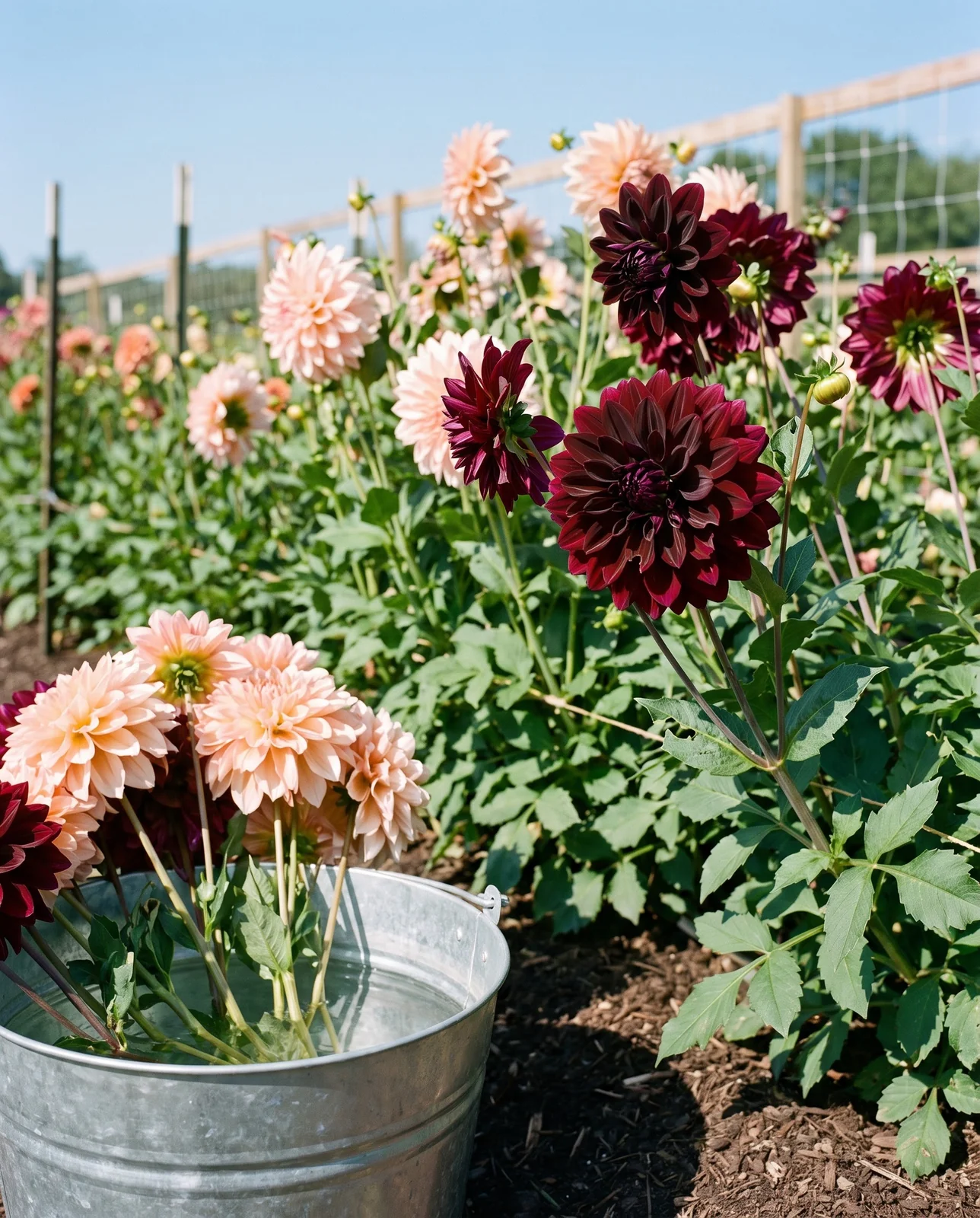
September is the one month of fall when the biggest, softest flowers are still coming out of open fields. Dahlias hit their heaviest flush now, including the blush-taupe Café au Lait cultivar that couples ask for by name. It helps to know that this is a field crop with a fixed schedule behind it. Oregon State University Extension puts tuber planting in late spring, once soil holds around 60°F for several days running, in a spot with at least six hours of direct sun and a soil pH of 6.5 to 7.0, fed with a low-nitrogen 5-10-10 or 10-20-20 and then cut off from fertilizer in September so the tubers harden off. Every step of that calendar ends at the first freeze, which is why the same stem costs a florist far more three weeks later. Marigolds hold the cheap end of a September palette: Penn State Extension puts French types at 6 to 24 inches, sprouting within a week in warm soil and flowering about two months from seed. Celosia and the first ripe berry branches fill out the loose, garden-style arrangements that early autumn does better than any other season.
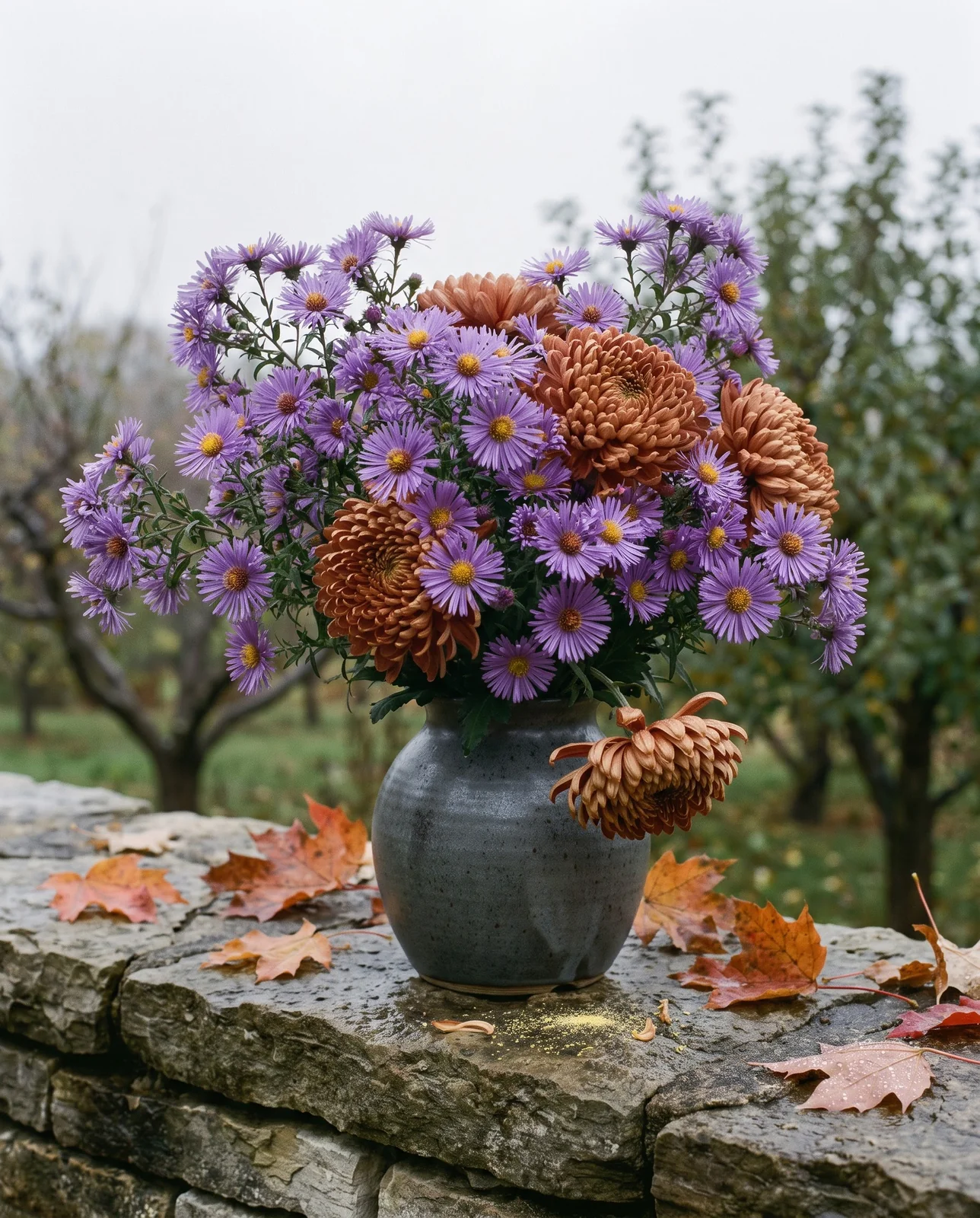
October hands the wedding over to chrysanthemums. They are the month’s structural bloom, its mass filler, and its cheapest reliable color, and they arrive on a clock that has almost nothing to do with the weather. SDSU Extension explains that mums develop flower buds in response to the length of the night rather than to falling temperatures, and that once late-summer nights get long enough the initiation process begins. The earliest hardy garden types need seven to nine weeks of long nights, which is how a cultivar like Mammoth Pink, developed at the University of Minnesota, starts flowering as early as mid-August and holds for four weeks or more. The same clock explains the most common mistake made with mums: shearing them after August 1 interrupts initiation and leaves fewer flowers than not shearing at all. New England aster supplies the cool half of an October palette. NC State Extension Plant Toolbox gives its bloom window as August to October and its habit as bushy clumps 3 to 6 feet tall, carrying 1.5-inch heads with up to 100 purple rays around a yellow disc. Marigolds are October’s birth flower, which makes them a warm and inexpensive counterweight to all that purple.
November is a pivot rather than a continuation. Once a killing freeze goes through, open-field production stops, and what remains outdoors is a short list. Hardy garden mums in the Korean and Rubellum groups keep going in mixed borders, but SDSU Extension’s warning matters most here: late-flowering varieties that need 10 to 16 weeks of long nights usually meet a heavy frost with their buds still closed, and those buds are damaged before they can open. For dates past mid-November, designers work from greenhouse exhibition mums, the florist type NC State Extension describes as grown under glass rather than in garden beds, and build depth from material that does not depend on a field at all: architectural calla lilies, cascading amaranthus, dark viburnum berries, and garden roses, which run year-round. Calla lilies also carry the old floriography meanings of beauty, marital bliss, faithfulness, love, and peace, which is part of why they anchor so many late-season bouquets.
Fall wedding color palettes
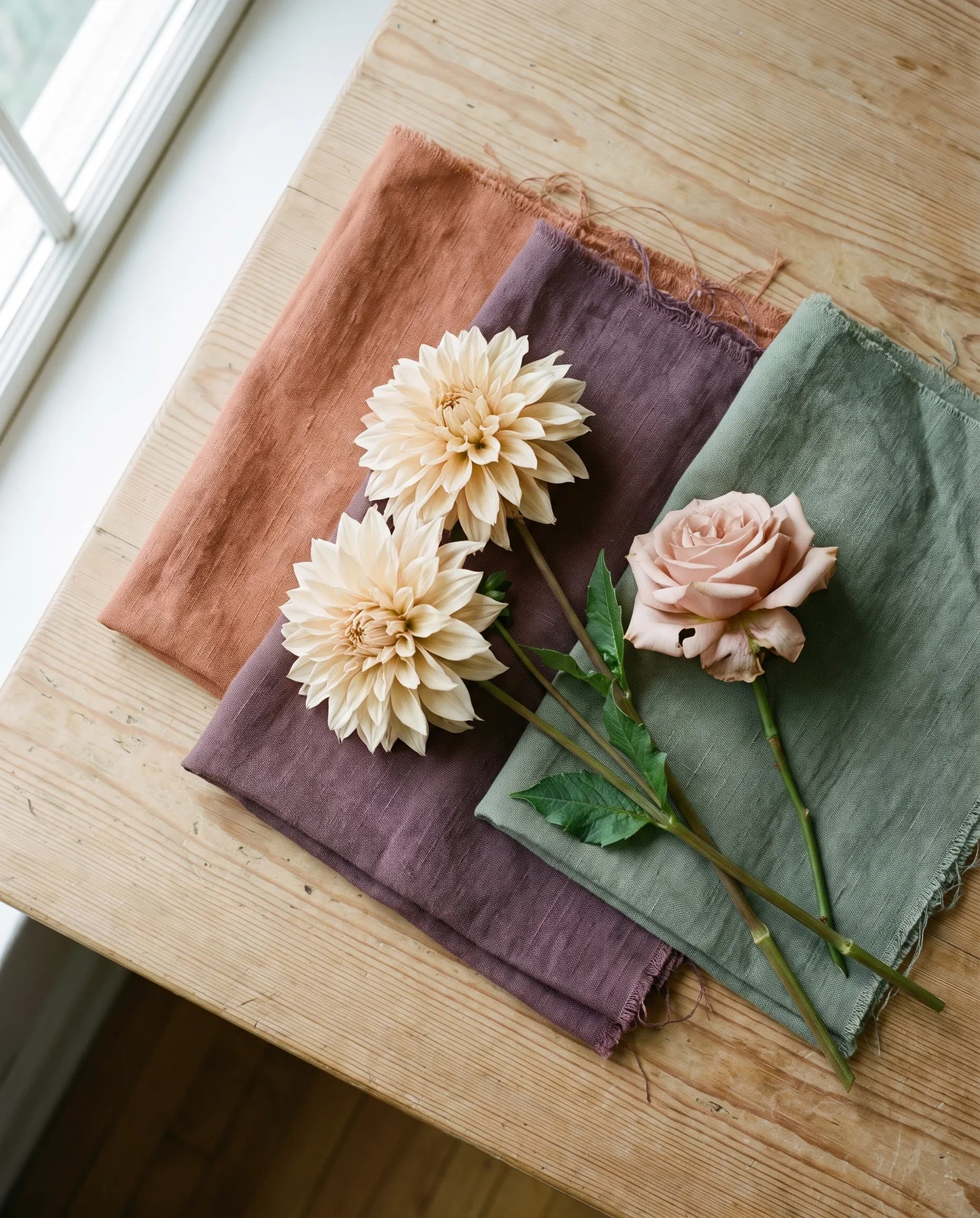
Café au Lait and warm rust is the early-to-mid autumn default, and it is built almost entirely from what September and early October already produce: creamy blush-taupe dinnerplate dahlias, copper spray chrysanthemums, rust French marigolds, trailing amaranthus. Clemson University Cooperative Extension calls a mix of seasonal flowers in rich oranges and golden yellows a timeless fall arrangement, and reads orange itself as energy, enthusiasm, passion, and warmth. What makes the combination work on a table rather than only in a photograph is the muted undertone of the dahlia, which keeps saturated rust and copper from settling into one heavy block of color. Dried grasses, seed pods, and woody stems extend the same range at a fraction of the stem cost, and that difference shows up fast once the count runs to twenty guest tables.
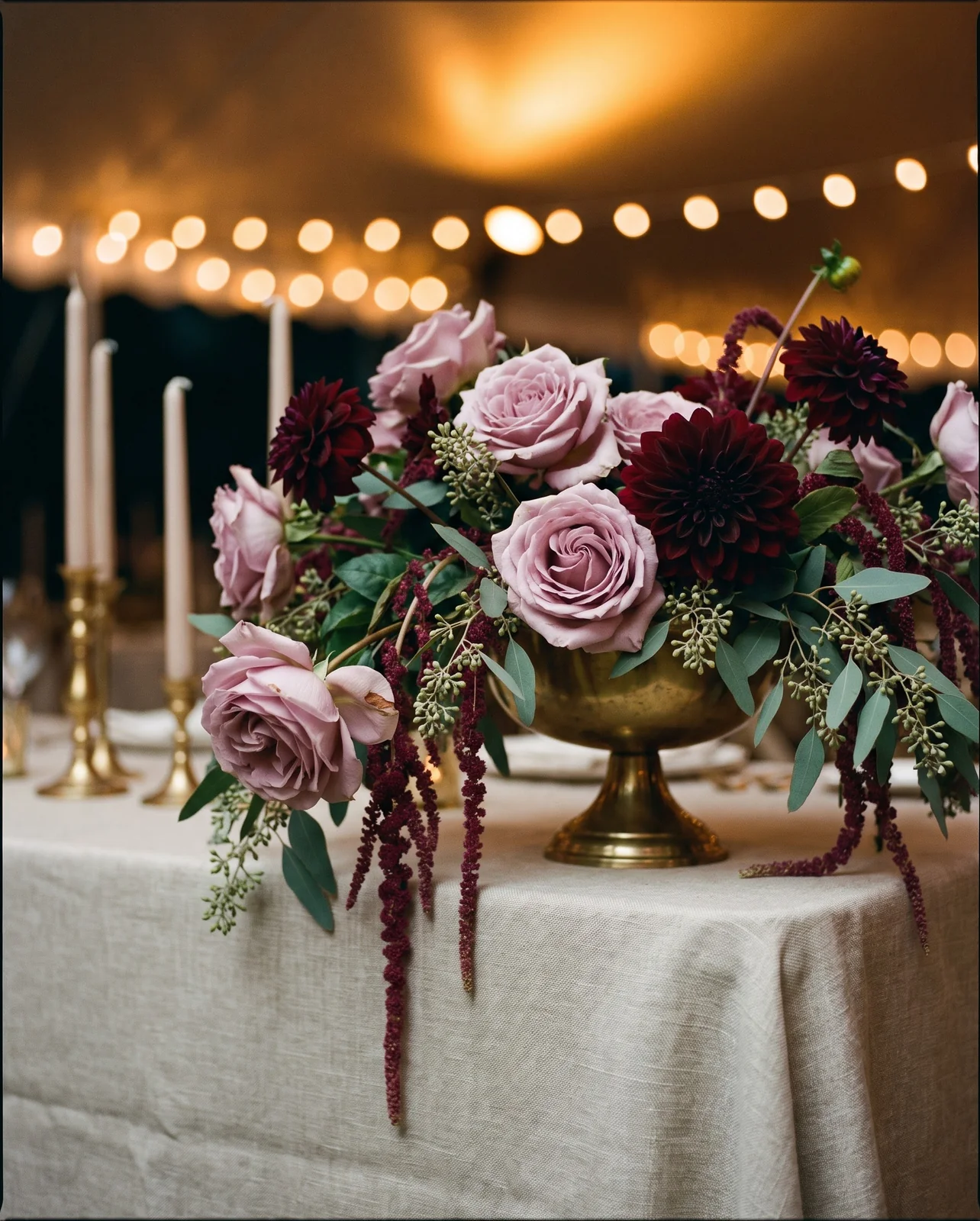
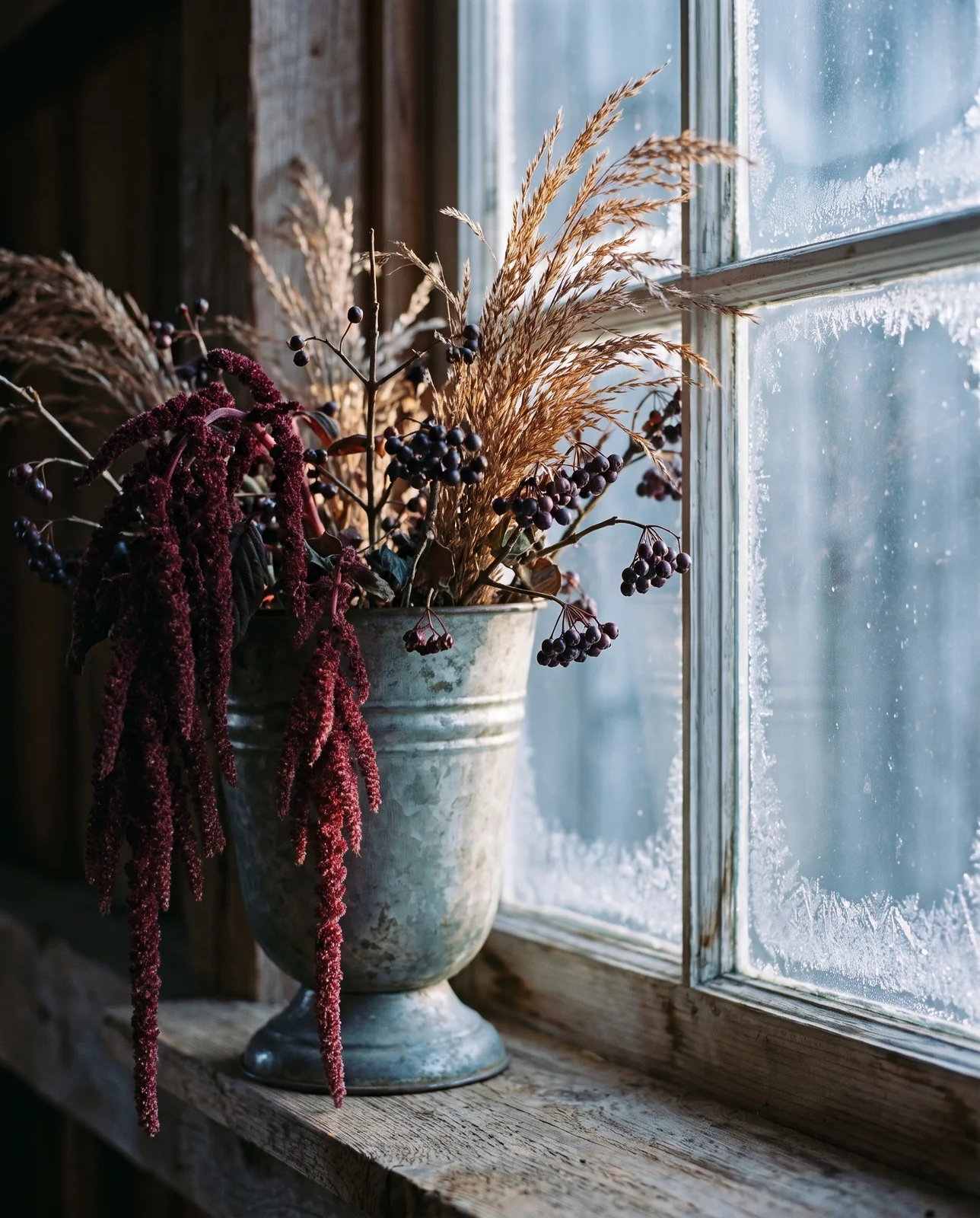
Plum, wine, and sage runs darker and suits late October and November, when the flowers that supply it are the ones still standing. Burgundy decorative dahlias and deep maroon florist mums carry the wine tones, and the purple rays of New England aster cut across them with something cooler, which is what keeps the arrangement from reading as a single bruise-colored mass. Pale sage foliage and soft seasonal greens do the work in between. Trailing elements, dark red hanging amaranthus or deep purple calla lilies, give tall ceremony urns their downward movement without adding another flower type to the order. Indoors, under evening light, the palette holds its shape through a long reception better than a pale one does.
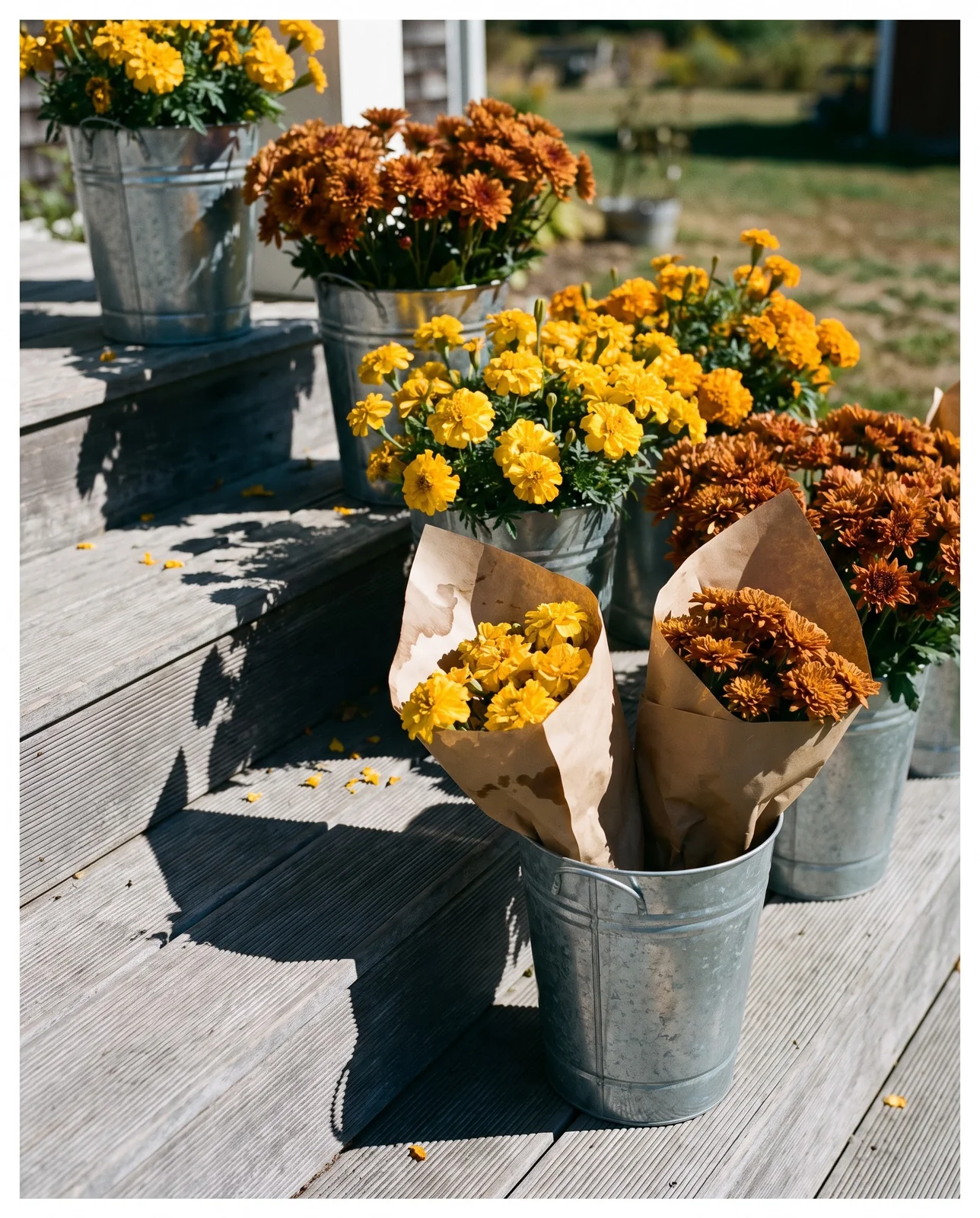
Terracotta, amber, and espresso is the warmest of the three and the only one with a story attached. It runs on golden-yellow African marigolds, orange French marigolds, bronze garden mums, and dark calla lilies. Penn State Extension reads the bright orange and yellow of the marigold as sunbeams and as light paths guiding departed souls during Mexico’s Dia de los Muertos. A couple who wants an autumn meaning rather than only an autumn color has something real to say at the table. Deep espresso foliage and dried seed pods keep the gold from turning brassy. The palette sits well in barn and vineyard rooms, where the wood and stone are already in the same range.
Three ways to budget fall wedding flowers
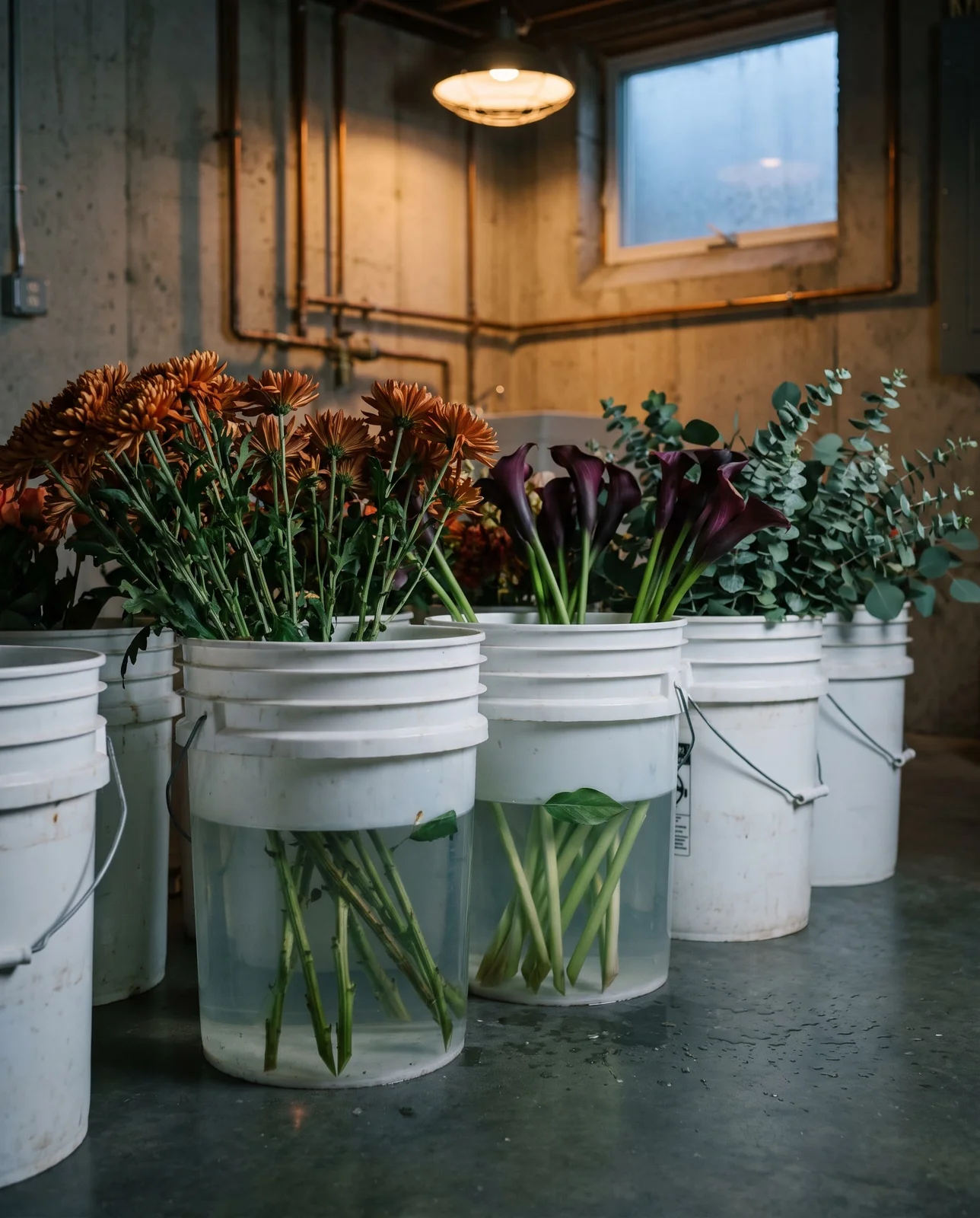
Clemson University Cooperative Extension gives the cheapest rule in this section: choose flowers that are in season and readily available, because out-of-season stems carry a premium for greenhouse forcing and fast transport. Buying mixed buckets straight from local growers takes that rule to its limit, with field-grown garden chrysanthemums, French marigolds, and New England asters at the lowest cost per stem you will find. What the price leaves out is the work. Buckets travel in a climate-controlled car, sit in a cool space out of direct sun, and get processed 24 to 48 hours before the event. Every leaf that would end up under water comes off first, a step Penn State Extension ties directly to bacterial growth and foul water. Hundreds of stems, clean buckets, floral shears, preservative, and 15 to 30 hours of somebody’s time later, the savings are real but narrower than the per-stem math suggested, especially once buffer stems for transit damage go into the order.
The hybrid approach splits the job at the point where flowers get photographed. A florist builds the bridal bouquet, the bridesmaids’ posies, and the boutonnieres from the delicate focal stems, Café au Lait dahlias, calla lilies, and garden roses, where a wilted head shows in every close-up. Reception tables and aisle styling get potted garden chrysanthemums or bulk market bunches dropped into ceramic urns. NC State Extension rates garden hardy mums as container and mixed-border plants, and a single Mammoth type from Minnesota can reach 3 feet across, which is a great deal of bloom for the price of a nursery pot. The trade is two to four hours of placing pots instead of an assembly line of guest-table centerpieces on the morning of the ceremony.
Full service moves every logistic to somebody else: procurement, mechanics, delivery, styling, and the strike at the end of the night. It is the tier that makes sense for large guest counts and for venues that want a ceremony arbor, a hanging installation, or a long head-table runner, none of which a first-timer can build standing on a chair at four in the afternoon. The stems are the uniform ones, premium greenhouse exhibition mums, imported calla lilies, dinnerplate dahlias cut to matching size, cascading amaranthus, moved in temperature-controlled vans so nothing arrives heat-stressed or chilled. The team handles hydration, vessel stabilization, on-site mechanics, and breakdown after the reception. It costs the most, and what it buys back is the wedding week itself.
Three ways to source fall wedding flowers, and what each costs in time
The stem cost is only part of the price. The labor a couple puts in against the labor a florist absorbs moves in the opposite direction as the budget rises.
Ordering and cutting timeline
Autumn is the busiest wedding season in most of the country, so the calendar works against you before the flowers do. Book the floral designer, or reserve stems with a grower, 6 to 9 months ahead of the date. That lead time is not only about the florist’s schedule: it is what lets a farm plant specific dahlia rows and mum cultivars against your date and your regional frost. Final stem counts, vessel sizes, and color changes get locked 30 days before the event. If the flowers are coming from your own garden or a contracted crop, the pinching calendar matters as much as the order form. NC State Extension advises cutting mums back in summer for bushier plants and a later bloom, while SDSU Extension sets the hard stop at August 1, after which shearing interferes with bud initiation. Pinching New England aster in spring works the same way, delaying bloom and producing a denser plant for a late harvest.
Harvest and conditioning land 2 to 3 days before the ceremony. Stems are cut in the cool of the morning and go straight into clean buckets of water with commercial floral preservative. Dahlias hydrate through the stem and nowhere else: Oregon State University Extension notes that overhead water on open blooms causes bloom spot and bends or breaks the heavy heads, so nothing in that bucket gets misted from above. Strip every leaf that would sit below the water line, in the bucket first and again in the vase. Anyone processing mums in bulk should wear garden gloves, since contact with the foliage causes mild rashes in sensitive people. Marigolds meant for dried accents get their foliage stripped and hang upside down until dry. Finished arrangements wait in a cool, dark room away from direct sun and heat vents, and the water gets topped off on the wedding morning.
What actually survives to your wedding date
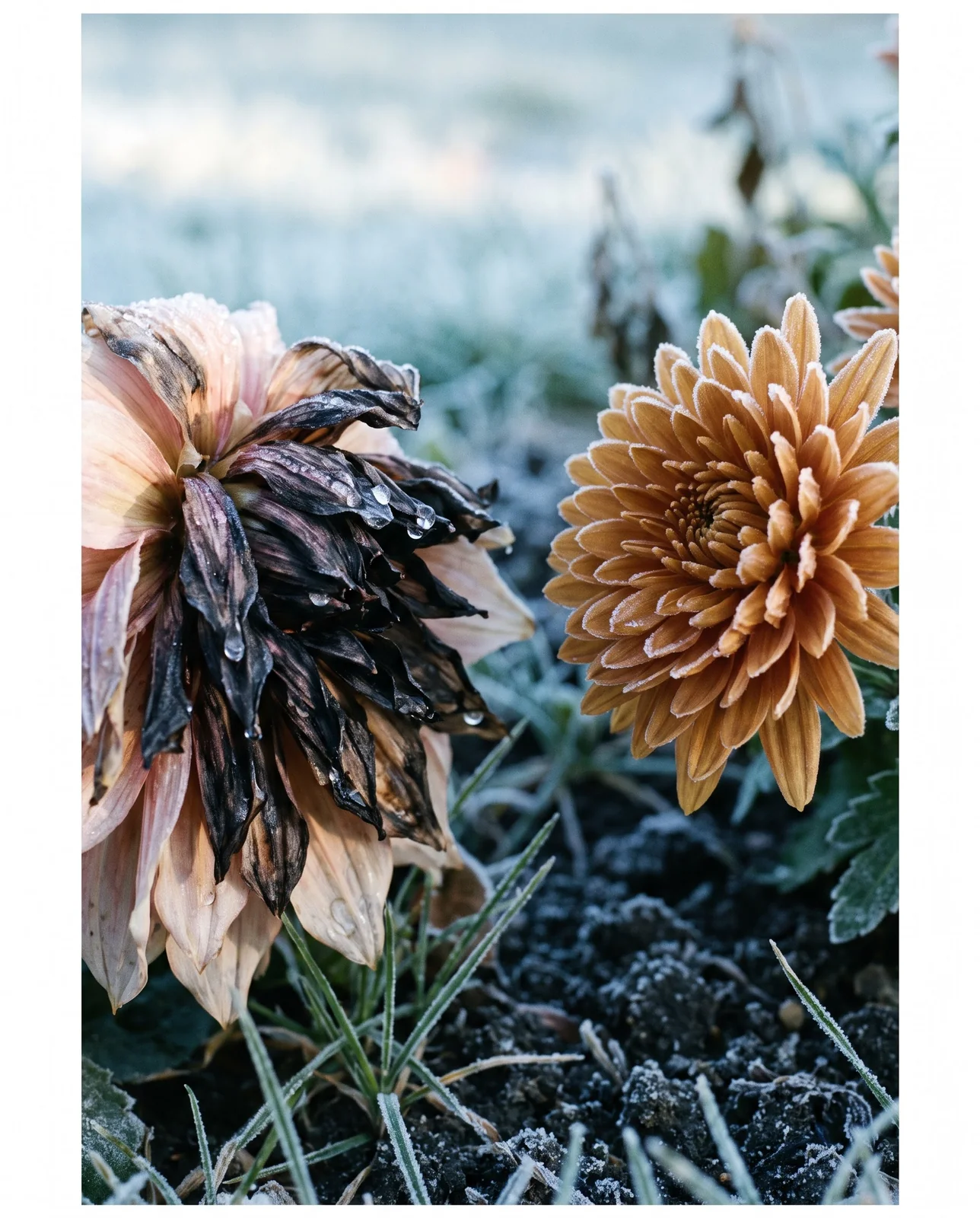
Cold does not arrive as a dimmer switch. Tender field annuals and hardy perennials answer the same night in opposite ways, and that difference decides what a farm can cut for you. Dahlias and French marigolds carry soft succulent foliage and thin petal tissue, so a freezing night turns both black by morning and takes a producing field out of the picture in one go. Garden chrysanthemums and New England asters take an early light frost without structural damage, which is the whole reason they dominate late-season weddings. The limit on the asters is their own calendar rather than the cold, since their bloom cycle finishes in October and a late November date is past them whatever the weather does. The limit on the mums runs the other way: a late-flowering variety can meet a heavy frost with its buds still closed, and SDSU Extension is blunt about the result, damaged buds and a plant that never flowers.
Where the flowers grow matters more than what the calendar says. An October wedding in coastal Virginia or northern Georgia sits in a climate where dahlia fields are still cutting, while the same October date in northern Michigan, upstate New York, or Minnesota usually falls after the killing freeze that ended field production for the year. One more variable belongs to the venue rather than the region. Because mums time their buds by night length, bright exterior string lights, spotlights, or a parking-lot lamp burning near potted mums interrupt the dark period the plants are counting, and the buds stall or stop short of opening. Mums held in real darkness in the days before the wedding open on schedule; the ones parked under a lit portico may not.
Four assumptions about fall wedding flowers that do not hold
The myth: Dahlias can be cut from outdoor local gardens for a late November wedding.
The reality: Dahlias are tender, and both foliage and open blooms collapse when freezing weather arrives. A late autumn date runs on greenhouse-grown stems or cold-hardy substitutes instead.
The myth: Evening string lights and outdoor fixtures at the venue have no effect on potted wedding chrysanthemums.
The reality: Mums are photoperiodic and need uninterrupted dark nights to open their buds. Continuous artificial light near the display can delay or halt flowering.
The myth: Buying wholesale buckets automatically saves thousands of dollars over hiring a florist.
The reality: Bulk buckets lower the cost per stem, but replacement stems for damage, preservative and supplies, transport, and 15 to 30 hours of labor narrow the net saving.
The myth: Garden marigolds and New England asters keep blooming outdoors straight through Thanksgiving.
The reality: New England asters finish their bloom cycle between August and October, and marigolds collapse under the first freezing weather.
FAQ
What flowers are in season for a fall wedding?
Early autumn gives you field-grown dahlias, French and African marigolds, celosia, and the first garden chrysanthemums. From mid-October on the list shifts to New England asters, frost-hardy mums, calla lilies, garden roses, amaranthus, and viburnum berries.
What is the most popular fall wedding flower?
The blush-taupe Café au Lait dinnerplate dahlia, asked for by name more than any other fall bloom. It is frost-tender and will not survive a late autumn freeze, so a late-season date should plan on garden roses or greenhouse exhibition mums instead.
How much do fall wedding flowers cost, and is DIY cheaper?
Costs run from budget grower buckets of marigolds and mums up to full-service production with dinnerplate dahlias and calla lilies. Farm buckets cut the stem expense, but buffer stems for damage and 15 to 30 hours of conditioning and arranging close much of the gap.
What flowers survive to November or after a frost?
Garden hardy chrysanthemums, late asters, and durable material like amaranthus and berries come through an early light frost. After a killing frost the outdoor field is done, and late November weddings depend on greenhouse exhibition mums, imported calla lilies, and garden roses.
When should I order wedding flowers?
Autumn is peak wedding season, so book the floral designer or reserve farm stems 6 to 9 months out. Lock final stem counts, vessels, and specific varieties with the florist or grower at least 30 days before the date.
More About Occasion flowers
Thanksgiving flowers: centerpieces you build yourself
Diwali flowers: marigold garlands and DIY toran
Dia de los Muertos flowers and what each bloom means
Halloween flowers: real black blooms and safe DIY builds
Homecoming corsage and boutonniere guide
Fall bouquet from your garden: what to cut and how
Friendship flowers
Thank you flowers
Get well flowers
Enjoying our flower guides? Add YourFlowersGuide as a preferred source on Google. It helps more readers find us.
Add to Preferred Sources