Ornamental kale is a cool-season annual grown entirely for its leaves: a low rosette of ruffled, deeply cut foliage that turns cream, pink, magenta or purple, built from thick fleshy leaves that store their own water and nutrients. It belongs to Brassica oleracea, the same species as broccoli and garden cabbage, and it holds that color through frosts that flatten every summer annual around it. The color runs on a temperature switch rather than a calendar date, which is why plants bought green in September often stay green for weeks.
Nights have to turn genuinely cold before the green pigment steps back and the pale inner leaves show through, and the extension programs that name a threshold do not agree on the number. Almost everything else follows from that: buy plants at the size you want them, since transplants put on very little new growth once potted in fall, and give them full sun, rich soil that drains, and stems set deep enough that the lowest leaves rest on the surface. What follows covers why the color runs late, how to tell kale from ornamental cabbage at the garden center, when to sow and when to plant, how much cold the rosettes survive, the spring bolting that alarms anyone who overwinters them, the pests worth watching, whether the leaves are worth eating, and what to grow alongside them.
On this page 9 sections
Why the color hasn’t shown up yet
A kale that stays solid green through September and October is almost never diseased or badly bred. Pigment is a response to cold, and a plant sold in early fall has not felt any yet. Where sources part company is the number. Wisconsin Horticulture Extension puts the start of white, pink and red pigment at temperatures below 50°F, while the University of Florida’s IFAS extension states that ornamental kale requires 40°F nights to color up. Neither figure is wrong for where it was written: a northern planting shifts under mild autumn chill, a southern one waits for a distinct cold snap. The practical version is a range, consistently cool nights in the 40s, with color deepening as the season pushes toward frost.
Two growing habits hold the change back. Late doses of high-nitrogen fertilizer keep the plant making chlorophyll and pushing soft new leaves, which suppresses the red and purple anthocyanins the display depends on; a balanced slow-release feed at planting avoids that. Shade does the same and adds a second problem. Six hours of direct sun a day is the working minimum, and North Carolina State Extension notes that Brassica oleracea grown without full sun becomes prone to downy mildew, so a low-light corner costs both color and leaf health.
Why the foliage is staying green through September and October
Three causes explain leaves that stay solid green and never take on pink, white or purple. Work down the list; the fix for each cause sits directly below it.
Kale form vs. cabbage form
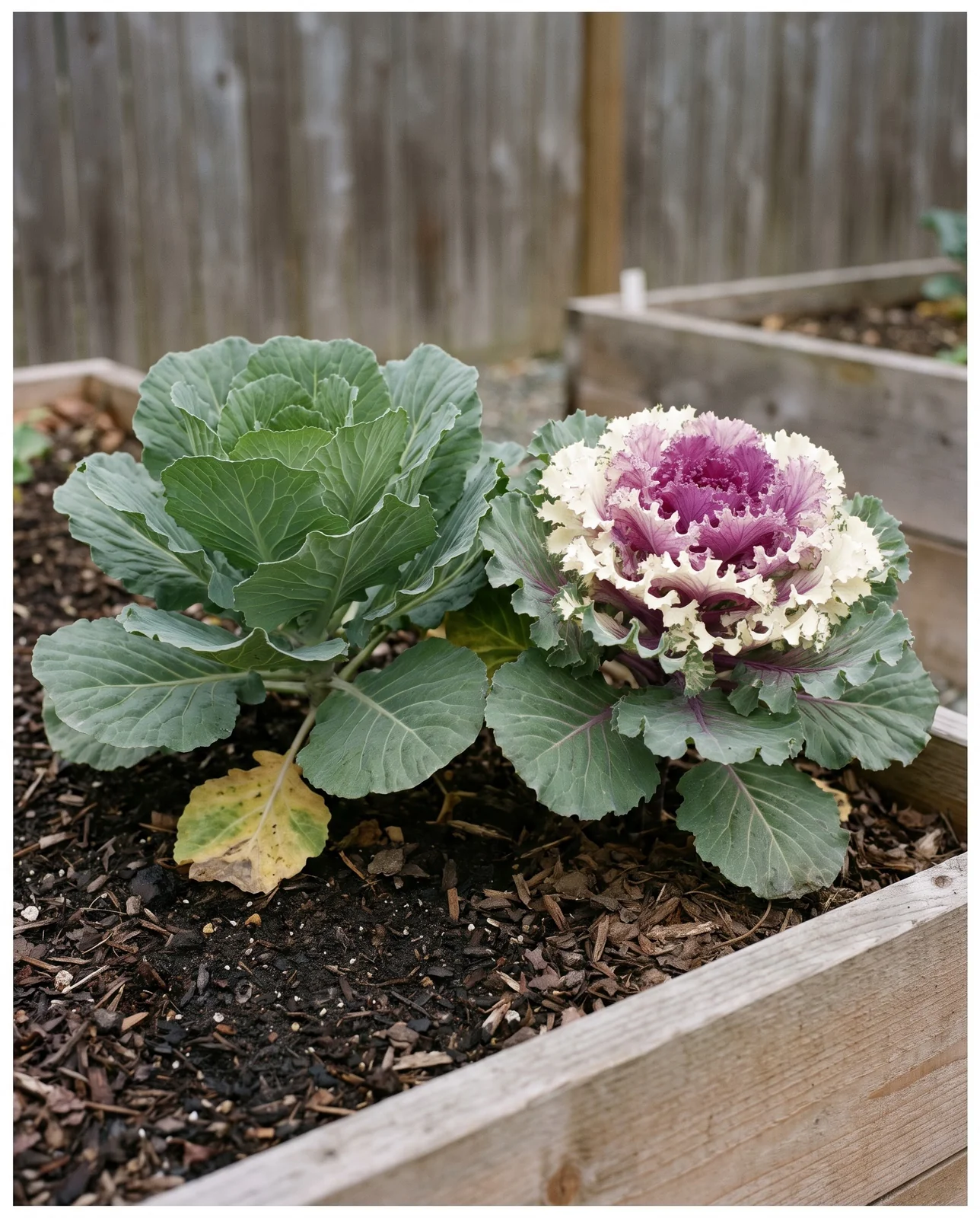
Garden centers rarely label the two apart, which makes the difference hard to see when both sit in the same flat under one generic sign. Botanically there is none. Both are Brassica oleracea, the species that also produced broccoli and cauliflower, and Wisconsin Horticulture Extension points out that all of them are technically kales, since they build tight leaf rosettes instead of the solid head a true cabbage makes.
The trade splits them on leaf shape, and that is the distinction worth learning at the bench. Ornamental kale means deeply cut, curly, frilly or ruffled margins. Ornamental cabbage means broad, flat leaves edged in a contrasting color. Both forms reach about 1 foot wide and 15 inches tall in the garden, so the choice is texture rather than scale. Named cultivars sharpen it further: ‘Pigeon Purple’ carries wavy blue-green leaves veined in purple-red, and ‘Glamour Red’ is a ruffled purple-red form with unusual heat tolerance that finishes at roughly a foot each way.
Planting and transplant timing
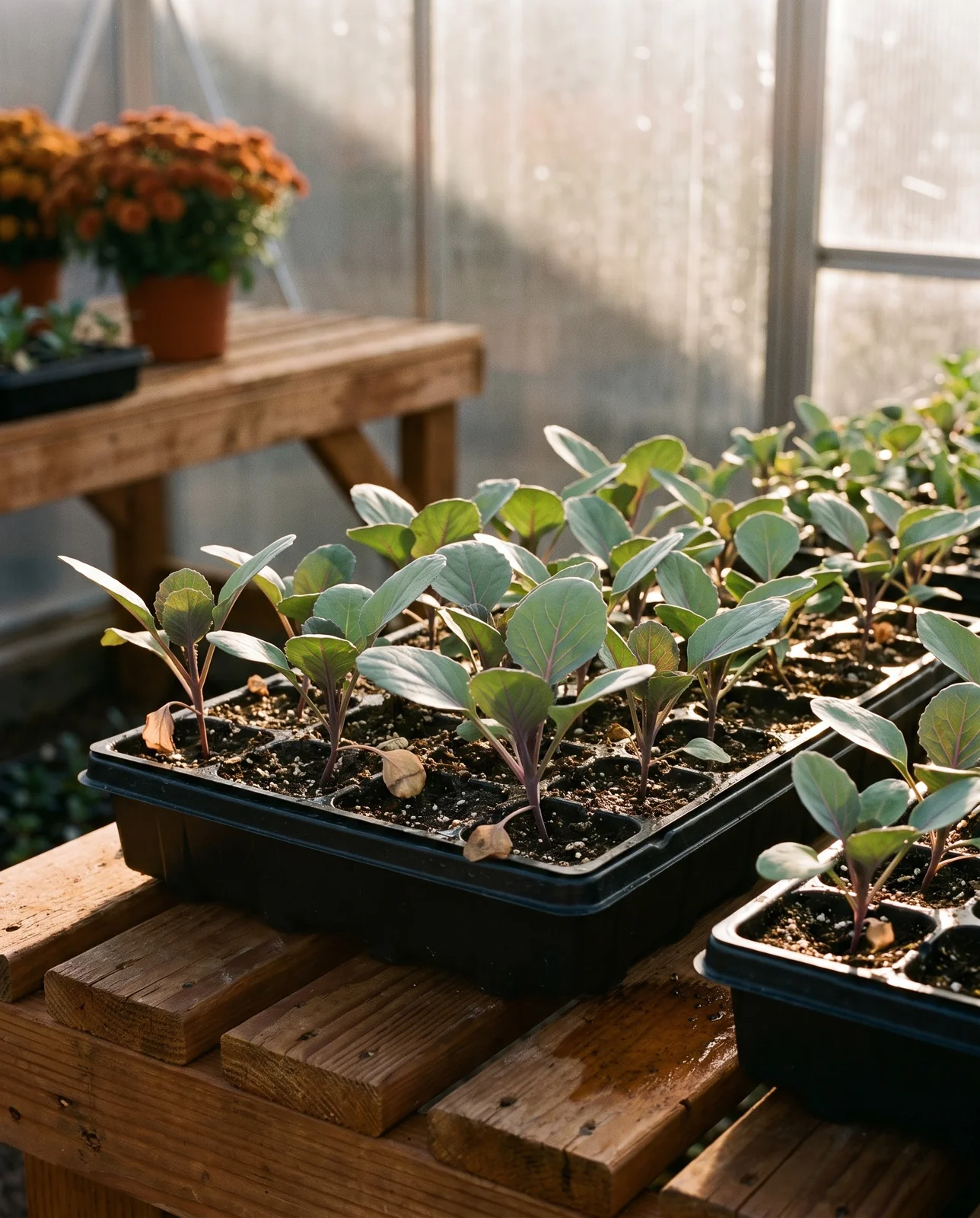
Heat is the constraint that sets the schedule, because this plant will not sit through a hot summer. Wisconsin Horticulture Extension puts sowing at six to 10 weeks before the average first fall frost, with the seed and the young plants kept cool from the start. One detail catches people out. The seed needs light to germinate, so it is pressed gently onto the surface of a moist seed-starting mix and left uncovered; seed buried under potting soil simply does not come up.
Most gardeners skip that and buy finished plants in early autumn, where the thing to know is that what you carry home is roughly what you get. Transplants add very little size after planting, especially once the roots have circled a nursery cell, so pick plants already scaled to the display you want rather than counting on small plugs to fill out. Wait for temperatures to start cooling, then set them in a sunny spot in moist, rich soil that drains, burying the stem deep enough that the lowest leaves sit flush with the surface. In the South the plants often arrive from somewhere else entirely: Florida’s IFAS extension notes that ornamental kales sold there are usually grown in Georgia or farther north, then shipped down once local temperatures moderate.
How much cold it actually takes
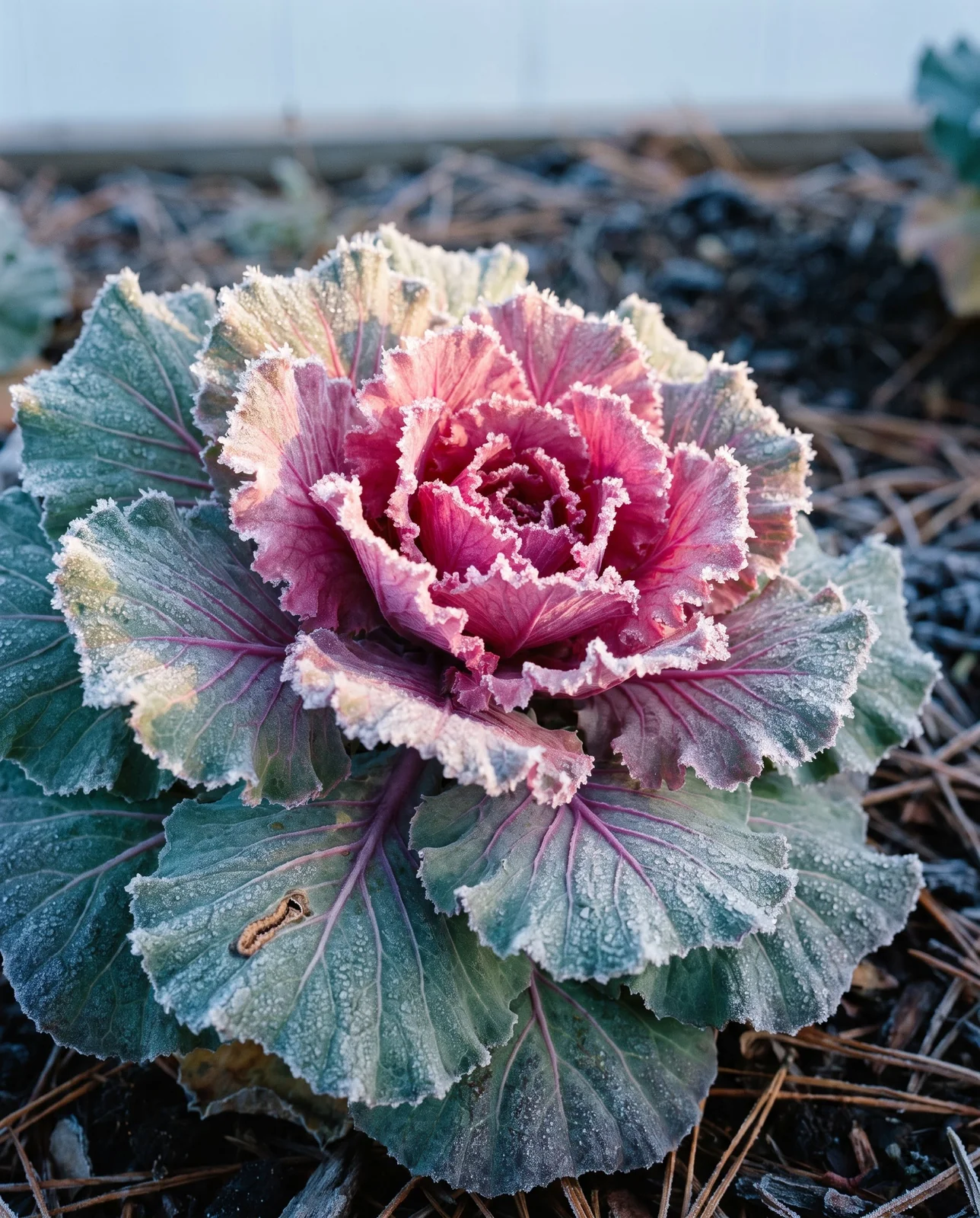
Frost works in this plant’s favor. Where tender summer annuals go to black mush overnight, ornamental kale takes the light frosts of a normal autumn without damage, and the cold speeds up the breakdown of green pigment, so the pink, purple and cream at the center sharpens while the rest of the bed is finishing.
The real limit sits well below freezing. Once a plant has rooted in and acclimated to its site, Wisconsin Horticulture Extension reports survival down to 5°F, which is why kale set out in early autumn still reads as a finished planting through November and December across much of the North. That qualifier is doing work: the number describes a plant settled into its spot for weeks, not one moved outside last weekend. Unseasonable hard freezes below zero collapse the leaf cells eventually, but the moderate winter cold in between acts as a preservative.
Temperature tolerances and physiological thresholds
Three thresholds govern how ornamental kale colors up and how much cold it can take once it is established.
The spring problem: bolting and leggy stems
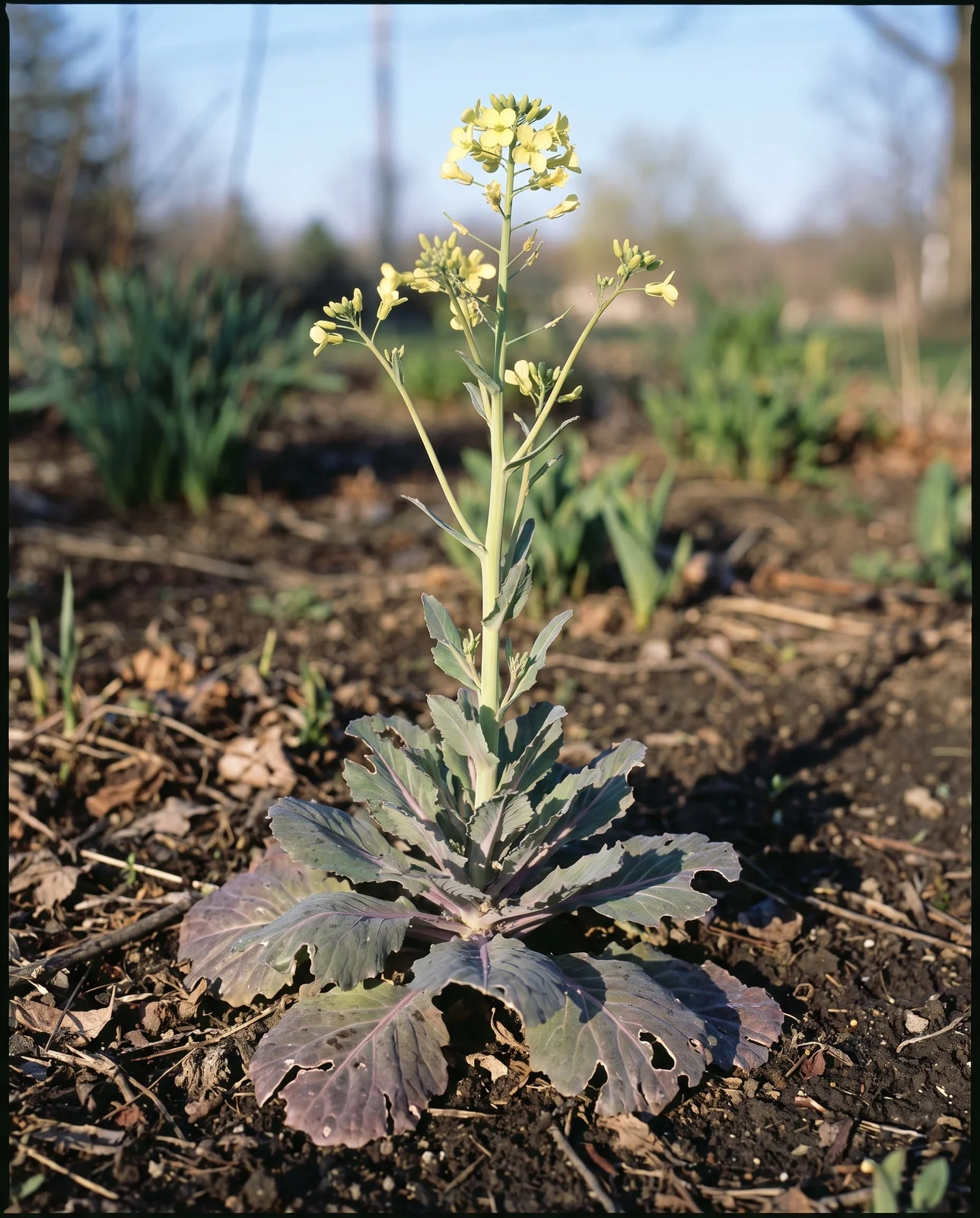
Kale left in the ground over winter changes shape as late winter turns into spring. The tight rosette starts to stretch, the center rises into a tall leggy stalk, and the neat mound is gone. This is bolting, and it gets misread as disease, insect damage or a feeding problem. It is none of those. Warming temperatures and lengthening days are pushing the plant into its reproductive stage on schedule.
Brassica oleracea is a biennial, so it needs a winter’s chill before it can flower in its second year, and the stalk that appears is the flowering stem: pale yellow blooms with four petals and six stamens, the two outer stamens shorter than the four inner ones, as North Carolina State Extension describes the species. Once those open the lower leaves deteriorate, the compact rosette cannot be restored, and the plant is finished as an ornamental, though it still has a use in the garden. The same source lists the species as a larval host for butterflies, moths, flies, sawflies and beetles, so a spring flower stalk left standing gives local pollinators early support before the bed gets cleared for summer planting.
Pests worth watching
Planting date does most of the pest control. Wisconsin Horticulture Extension points out that ornamental cabbage and kale, grown late in the season, run into far fewer pest problems than the same species grown as a spring or summer vegetable. A warm autumn can still keep insects working a few extra weeks.
Caterpillars are the main threat, and the lists differ by program. North Carolina State Extension names slugs, snails, aphids and white caterpillars for Brassica oleracea, Wisconsin Horticulture Extension adds cabbage worms and cutworms, and Florida’s IFAS extension singles out the cabbage looper, which chews irregular holes through the leaves. Hand-picking clears a container or two, and an occasional spray of Bacillus thuringiensis (Bt) handles a heavier run. Slugs and snails come off by hand or stay off behind a standard barrier ring around the base of the pot.
Is it actually edible?
Because these are the same species as the kale in the produce aisle, the question comes up constantly, and two extension programs land on the same answer independently. Wisconsin Horticulture Extension and Florida’s IFAS extension both call the leaves edible but bitter, and both put them on the plate as a garnish rather than a side dish.
The bitterness follows from what breeders were selecting for, which was cold-weather color and a compact rosette rather than tenderness or mild flavor. For anyone who wants to cook the foliage anyway, Wisconsin’s method is specific: boil the leaves, throw out the water, then either boil them a second time in fresh water or finish them in olive oil before serving. Two rounds of water to make a green palatable is a fair summary of how it compares with a culinary variety.
Pairing it in containers
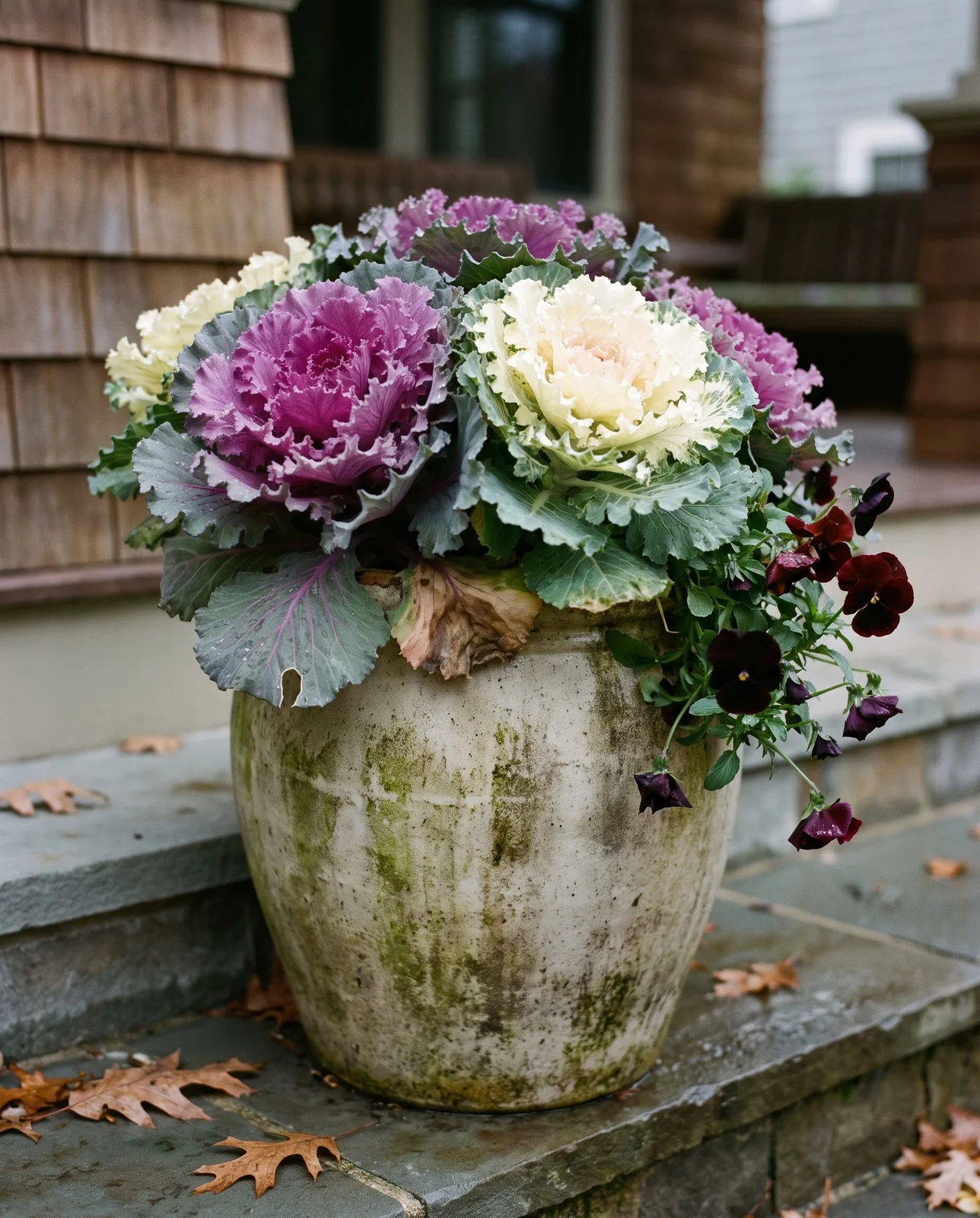
Ornamental kale earns its place in a fall container as the solid, geometric thing everything else moves around. The simplest version, the one Wisconsin Horticulture Extension recommends, is a single kale or ornamental cabbage centered in a pot with pansies ringed around it to spill over the rim. In a border it belongs at the front with perennials at their peak in fall, little bluestem grass (Schizachyrium scoparium), dark-leaved sedums (Sedum spp.) and asters (Aster spp.).
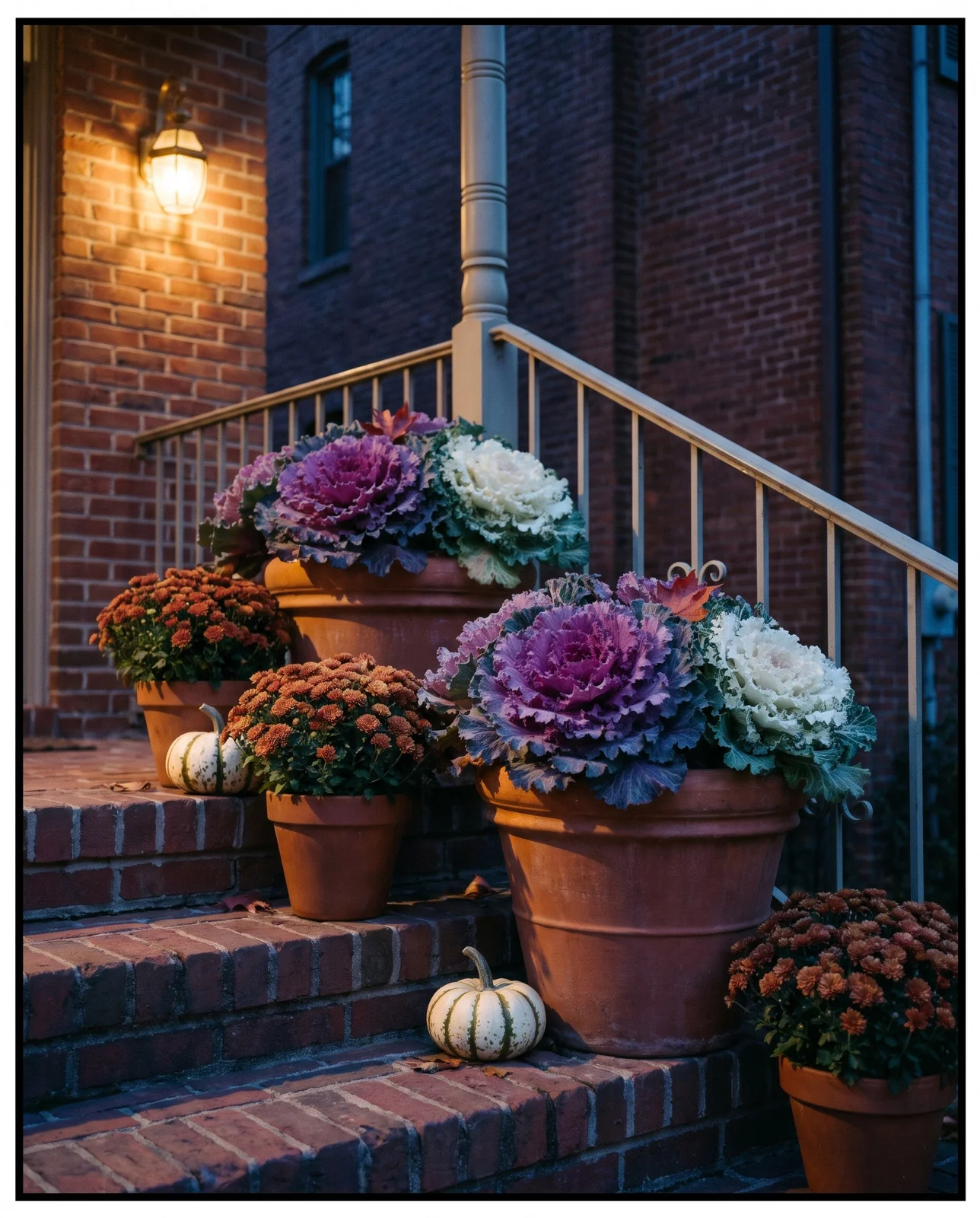
On a porch it goes with potted chrysanthemums more naturally than with anything else. Ruffled blue-green and magenta leaves against gold or bronze flower heads is the whole reason the combination turns up in every fall porch display of mums and pumpkins. The same logic holds for chrysanthemum companions in a fall border or asters grown in containers: kale gives airy daisy sprays something dense to sit against. Whichever pairing you pick, the pot needs open drainage holes: North Carolina State Extension calls well-draining soil a requirement for the species. Florida’s IFAS extension sets the rest of the container formula at steady moisture without waterlogging, six hours of sun and a slow-release feed, which is what carries the plants intact into winter.
FAQ
Is ornamental kale edible?
Technically yes, but these varieties are bred for leaf color rather than tenderness, and the leaves come out more bitter and tougher than culinary kale. Most people use them as a plate garnish, or boil them twice, discarding the first water, to take the edge off.
Why is my ornamental kale still green in October?
Pigment starts once night temperatures drop below 50°F, and the strongest color arrives after light frosts with nights in the 40s. A warm early autumn simply delays the whole show.
Does ornamental kale survive the winter and return every year?
It behaves as a cool-season annual or biennial. Acclimated plants hold through temperatures as low as 5°F and often look good into early winter, but spring warmth makes them bolt: the rosette stretches, a yellow flower stalk rises, and the plant finishes its life cycle instead of starting a second season.
What is the visual difference between ornamental kale and cabbage?
Look at the leaf edges. Ornamental kale has deeply cut, ruffled or frilly margins on an open rosette. Ornamental cabbage has broad, smooth, flat-edged leaves marked with a contrasting color.
Is ornamental kale toxic to cats or dogs?
Ornamental kale carries no established toxicity warning from major poison-control sources. For a checked list of what is and is not safe around pets, see the guide to types of flowers safe for cats and dogs.
More About Types of flowers
November flowers: what’s still blooming, by zone
October flowers: what’s blooming and what to plant now
Spider lily (Lycoris radiata): care and bloom guide
Heather plant care: is it a perennial or fall decor
Flowers that bloom in winter: true bloomers by zone
Fall flowers: the full list by color, zone, and bloom time
September flowers: what’s blooming and what to plant now
Enjoying our flower guides? Add YourFlowersGuide as a preferred source on Google. It helps more readers find us.
Add to Preferred Sources