
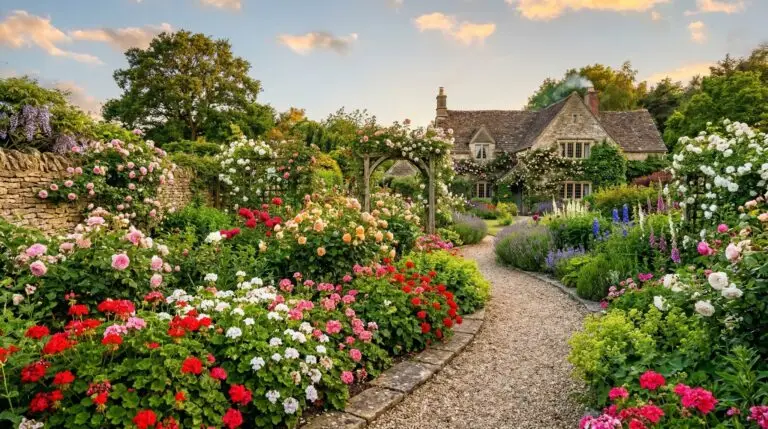
Geranium bloom time across the US
Interactive map
 See the interactive map
Drag the date and the bloom moves north across the country. Every point has its own window, and the map says where it has no records rather than guessing. Free, with nothing to sign up for. Open the geranium map.
City by city
Typical window, earliest first. Cultivars of the same flower can open days or weeks apart.
Taxonomy and origin
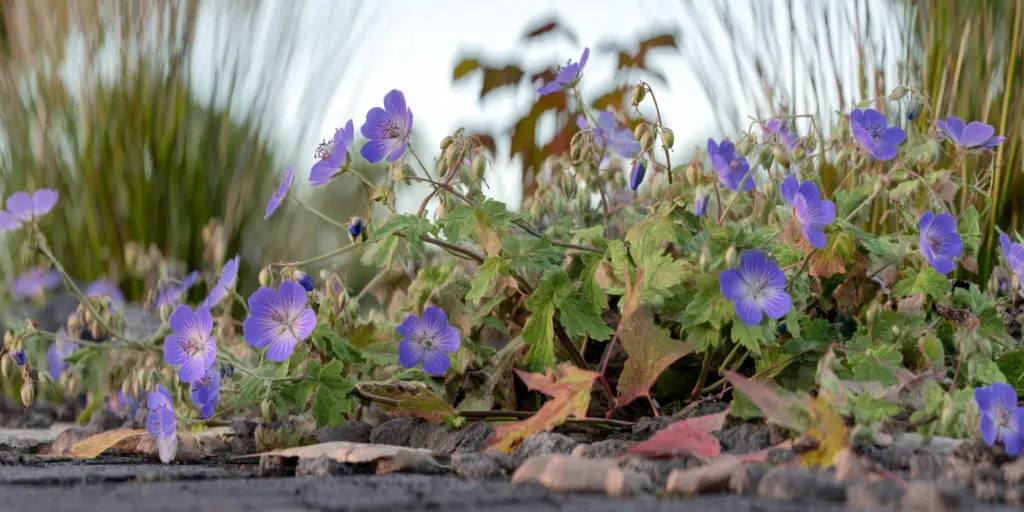
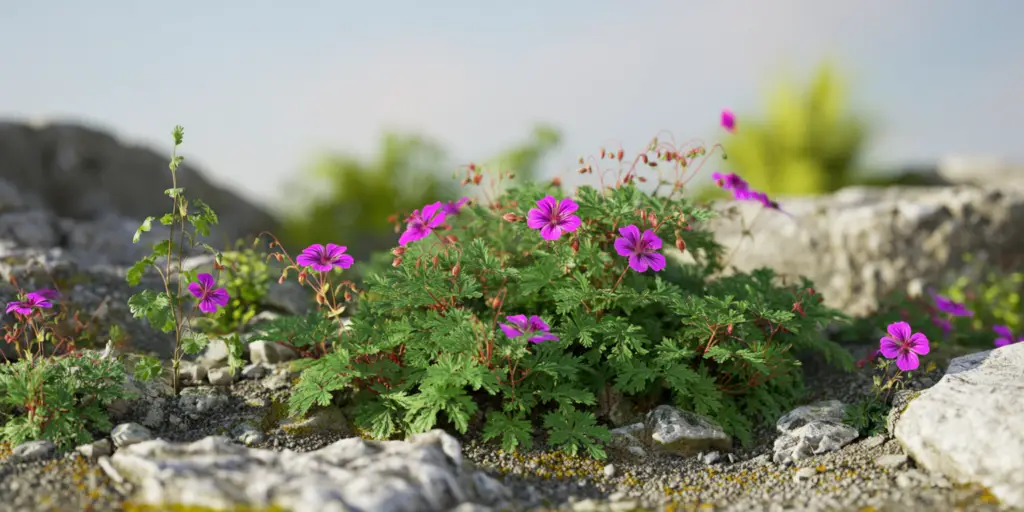
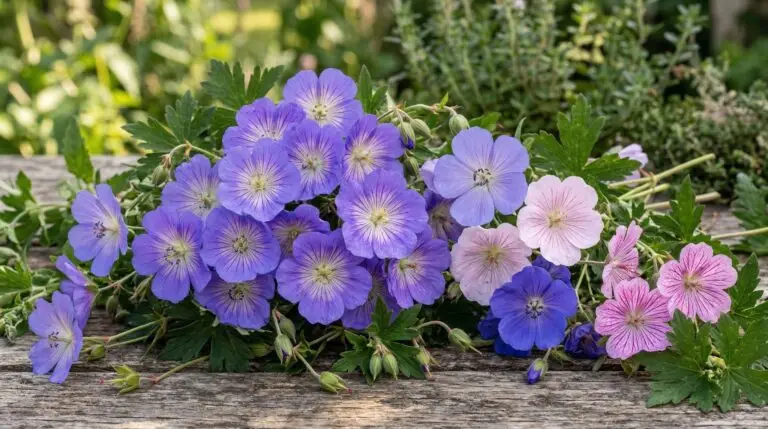
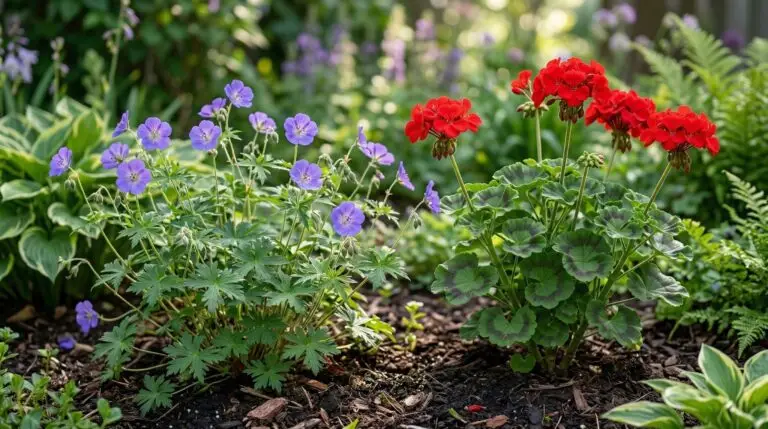
Both plants sit in the family Geraniaceae, which is the root of the long-running mix-up. The genus Geranium, the hardy or true geraniums, contains more than 400 species of annuals, biennials, and perennials spread across the temperate world, with a concentration around the Mediterranean and a habit of growing wild in woodland, meadow, and mountain. Its flowers are radially symmetric, five near-identical petals arranged like a pinwheel, and its slender seed pods taper to a long point. The name comes from the Greek geranos, a crane, because that pointed pod resembles a crane's bill, which is why these plants are called cranesbills. Pelargonium, the tender plants most people picture when they hear the word geranium, is a separate genus of roughly 200 species, most of them from South Africa, with flowers that are bilaterally symmetric: the two upper petals differ in size and marking from the three below. Its pods suggested a stork's bill instead, from the Greek pelargos, so its members are storksbills. Carl Linnaeus first grouped both under Geranium in the eighteenth century, and the French botanist Charles L'Heritier de Brutelle split Pelargonium off in 1789, but the old common name stuck and never left.
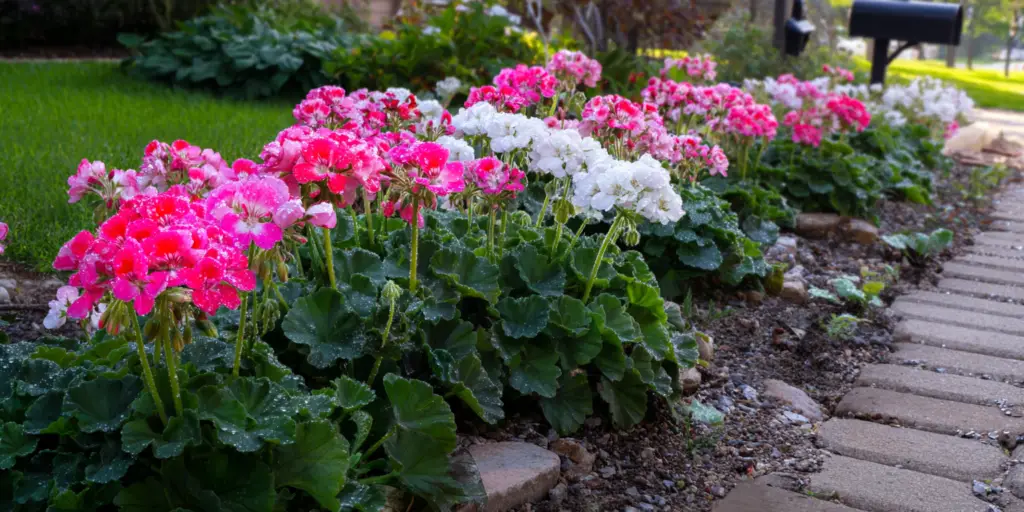
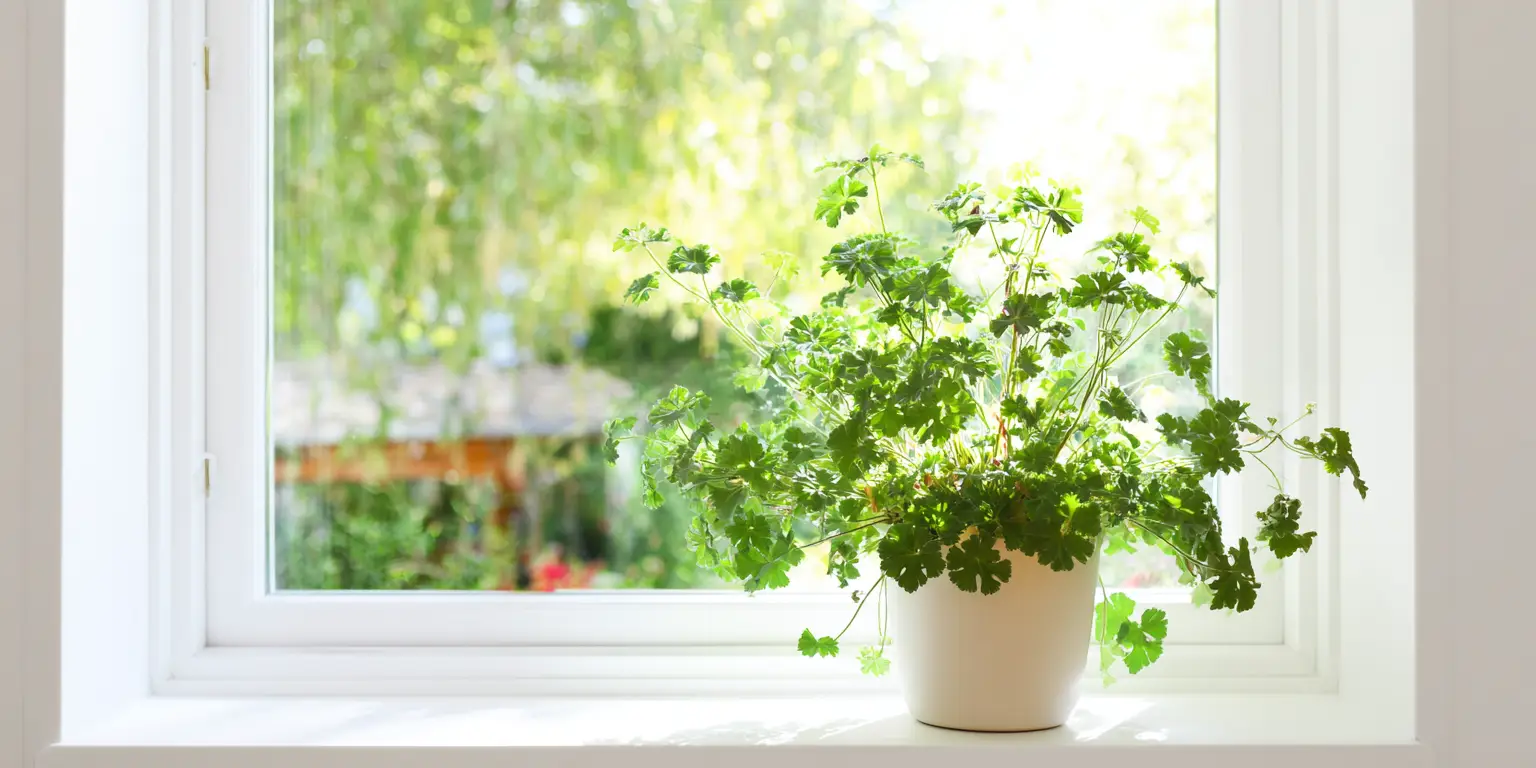
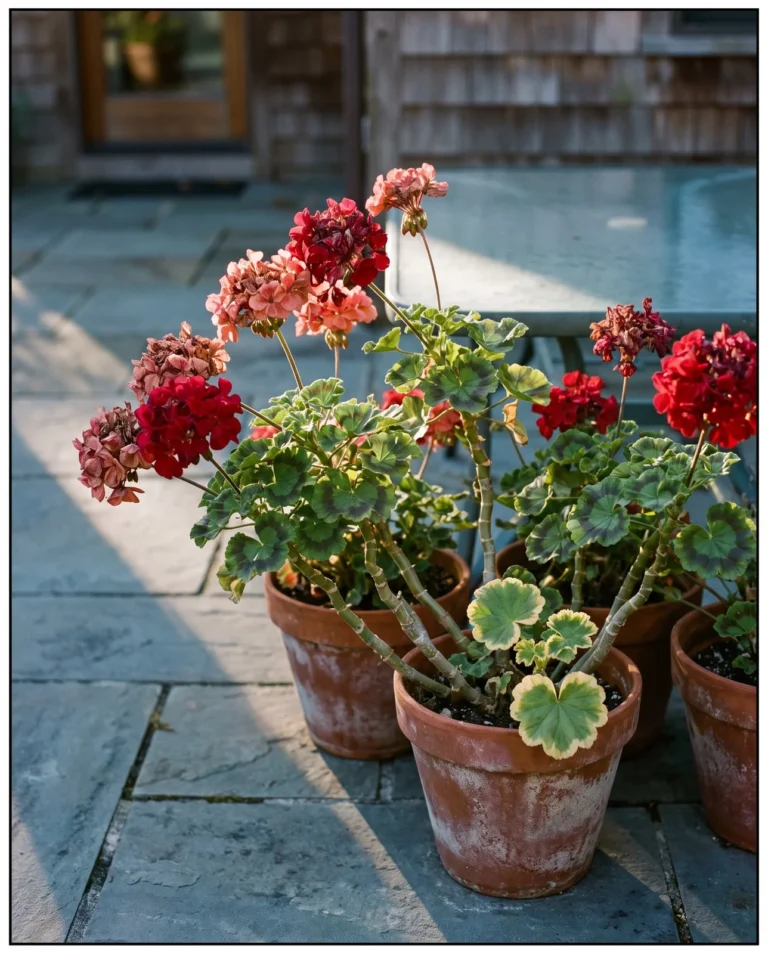
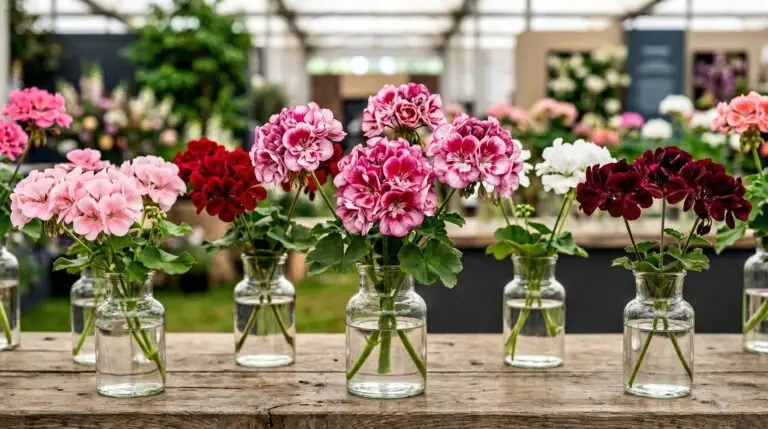
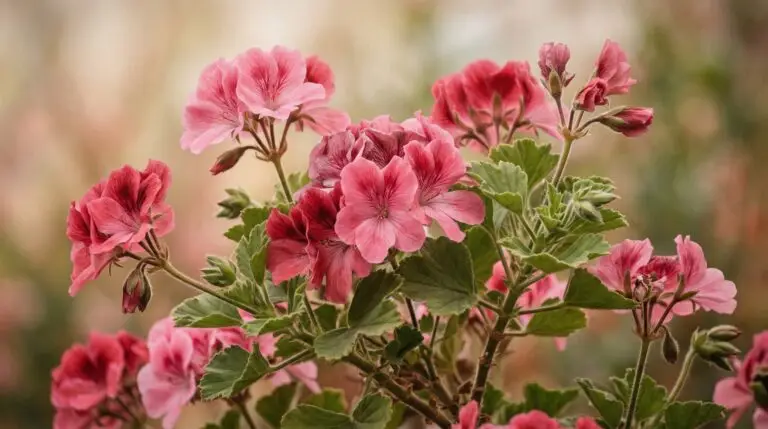
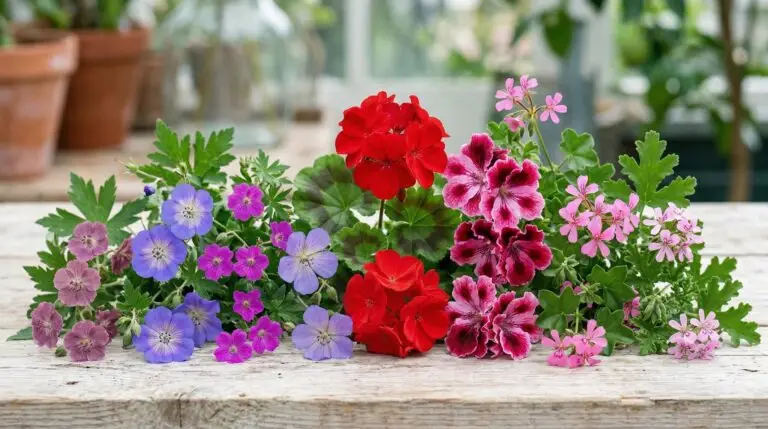
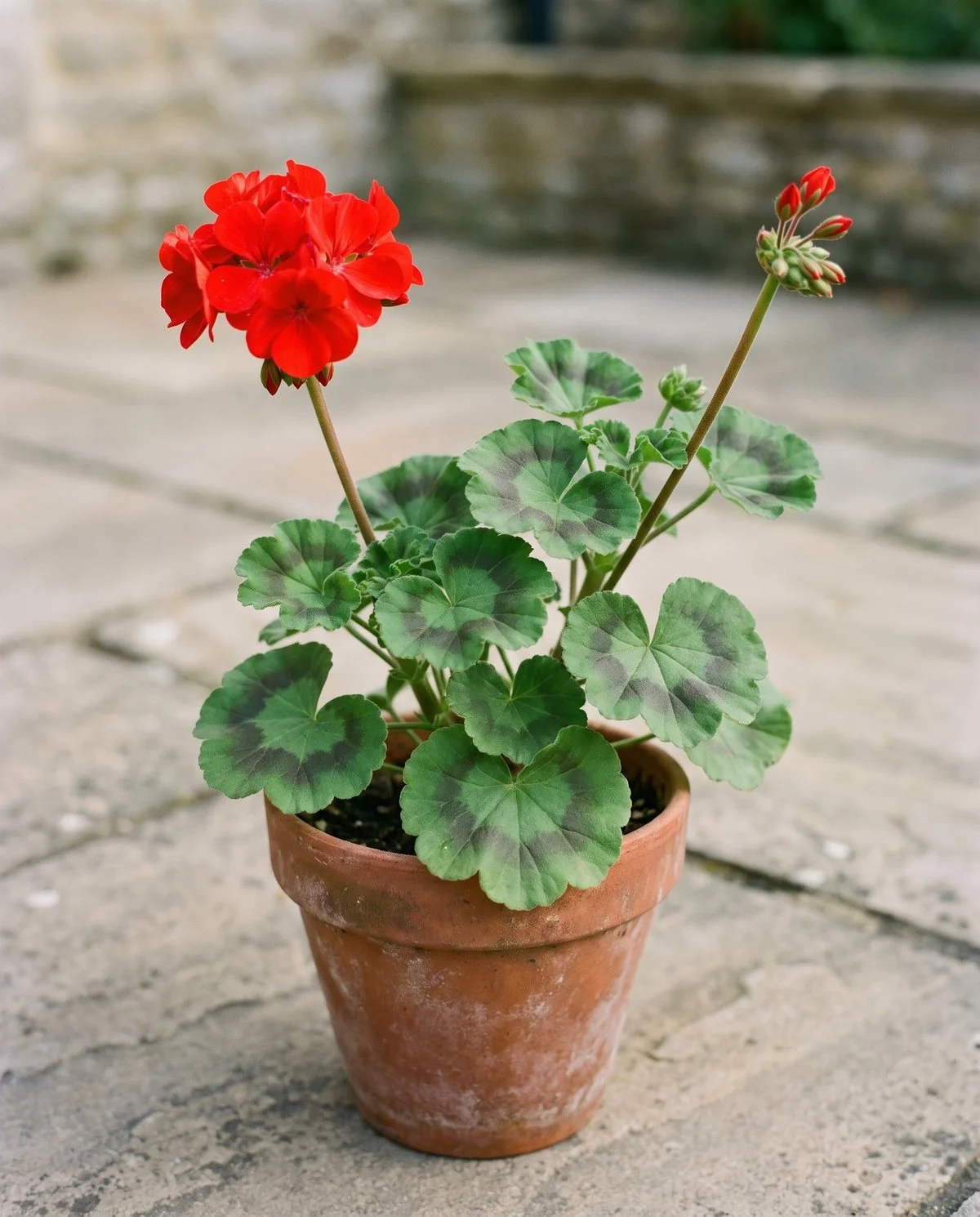
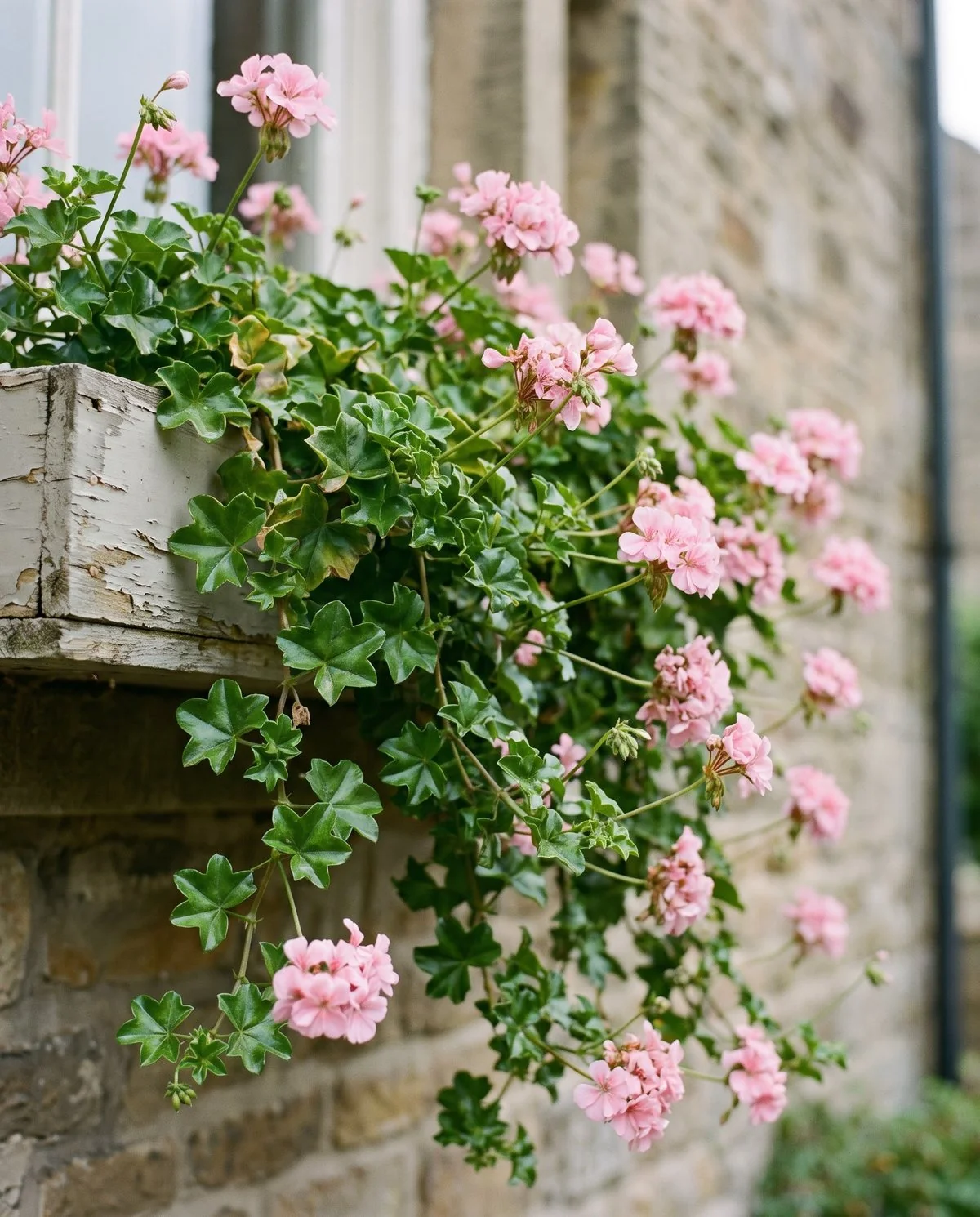
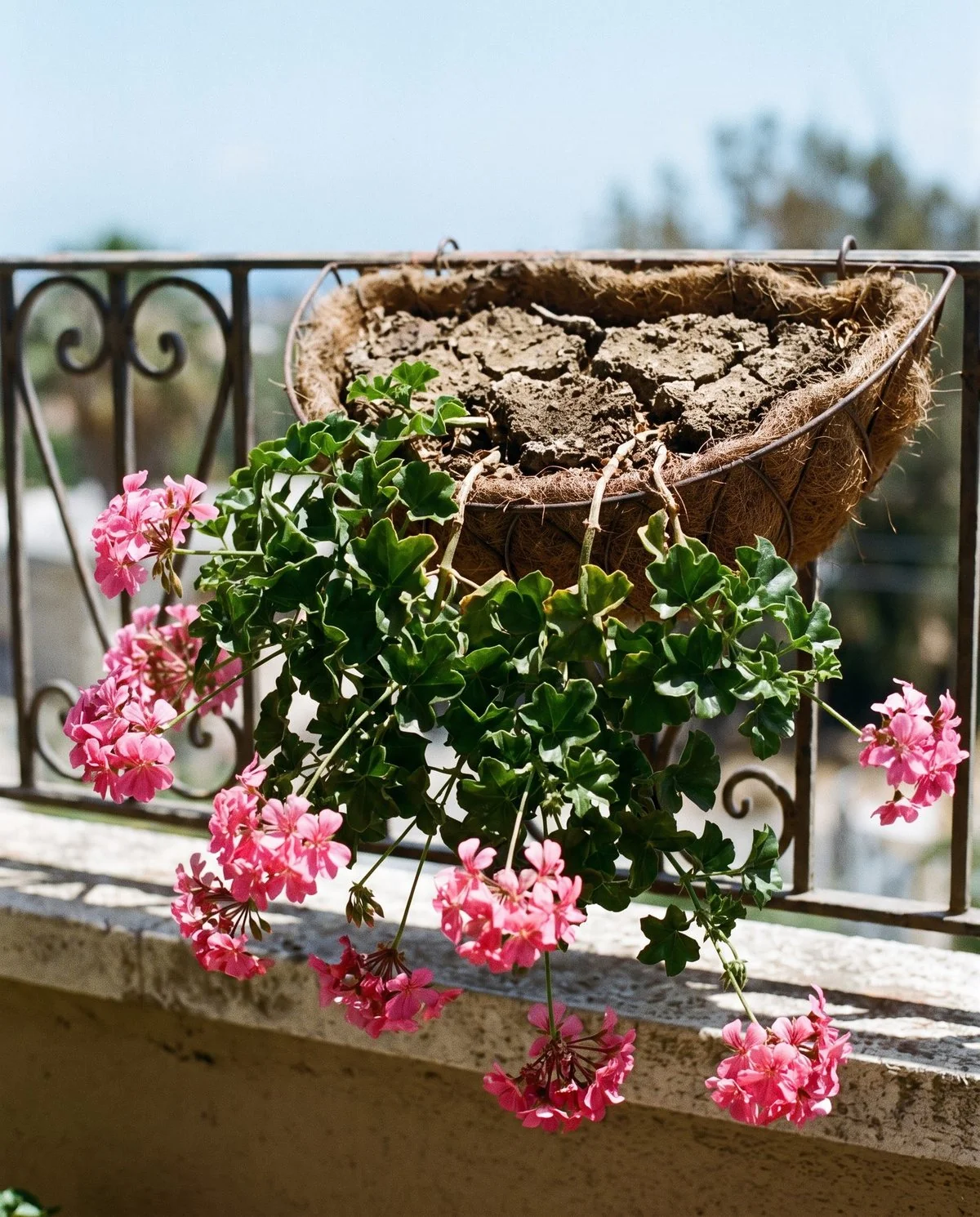
Within the tender pelargoniums, four groups cover almost everything sold. Zonal geraniums (Pelargonium x hortorum) are the upright bedding plants marked with a dark horseshoe band, or zone, on each rounded leaf, carrying the familiar ball-shaped clusters of red, pink, salmon, or white. Ivy geraniums (P. peltatum) trail, with glossy, thick leaves built for hanging baskets and window boxes. Regal or Martha Washington geraniums (P. x domesticum) bear larger, ruffled, often two-toned blooms but flower in a shorter spring window and want cooler nights. Scented-leaf geraniums, led by rose-perfumed P. graveolens, are grown for foliage that releases rose, lemon, mint, or apple when brushed. The hardy cranesbills run a different gamut, from the ground-hugging Geranium sanguineum to the aromatic, shade-tough G. macrorrhizum and the modern nonstop bloomer 'Rozanne.' The table below sorts the two camps so you can place whichever one you are holding, and the fuller story of why the garden world muddles the two fills in the rest.
Ten plants, two genera, and how to tell which one you are holding
University of Minnesota Extension states the split as plainly as a source can: they are not true geraniums but belong to the genus Pelargonium, and true geraniums belong to the genus Geranium and are grown as perennials in Minnesota. Clemson's factsheet supplies the four Pelargonium groups below. Every hardy cultivar below carries the RHS Award of Garden Merit, a trial-garden distinction rather than a marketing label.
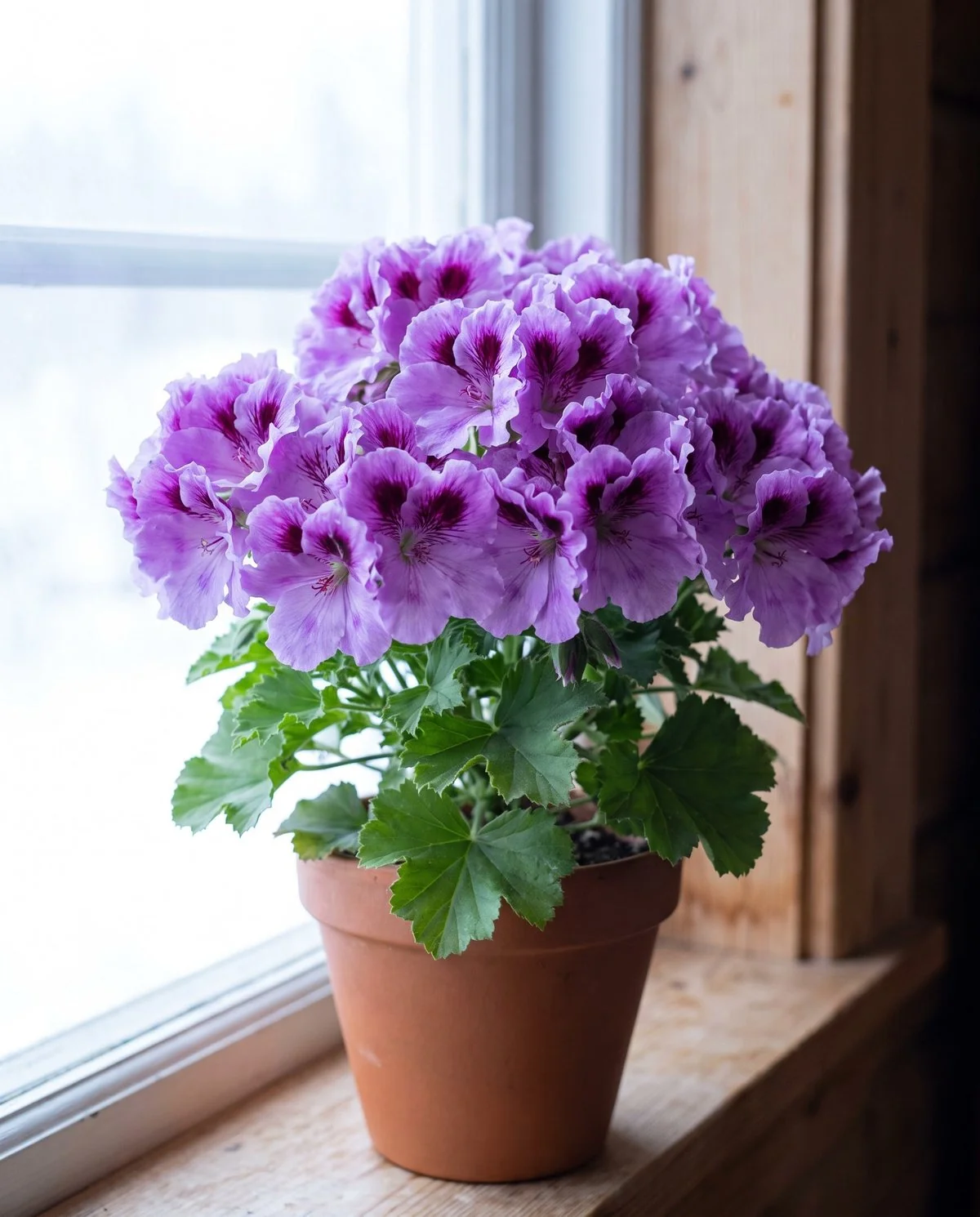
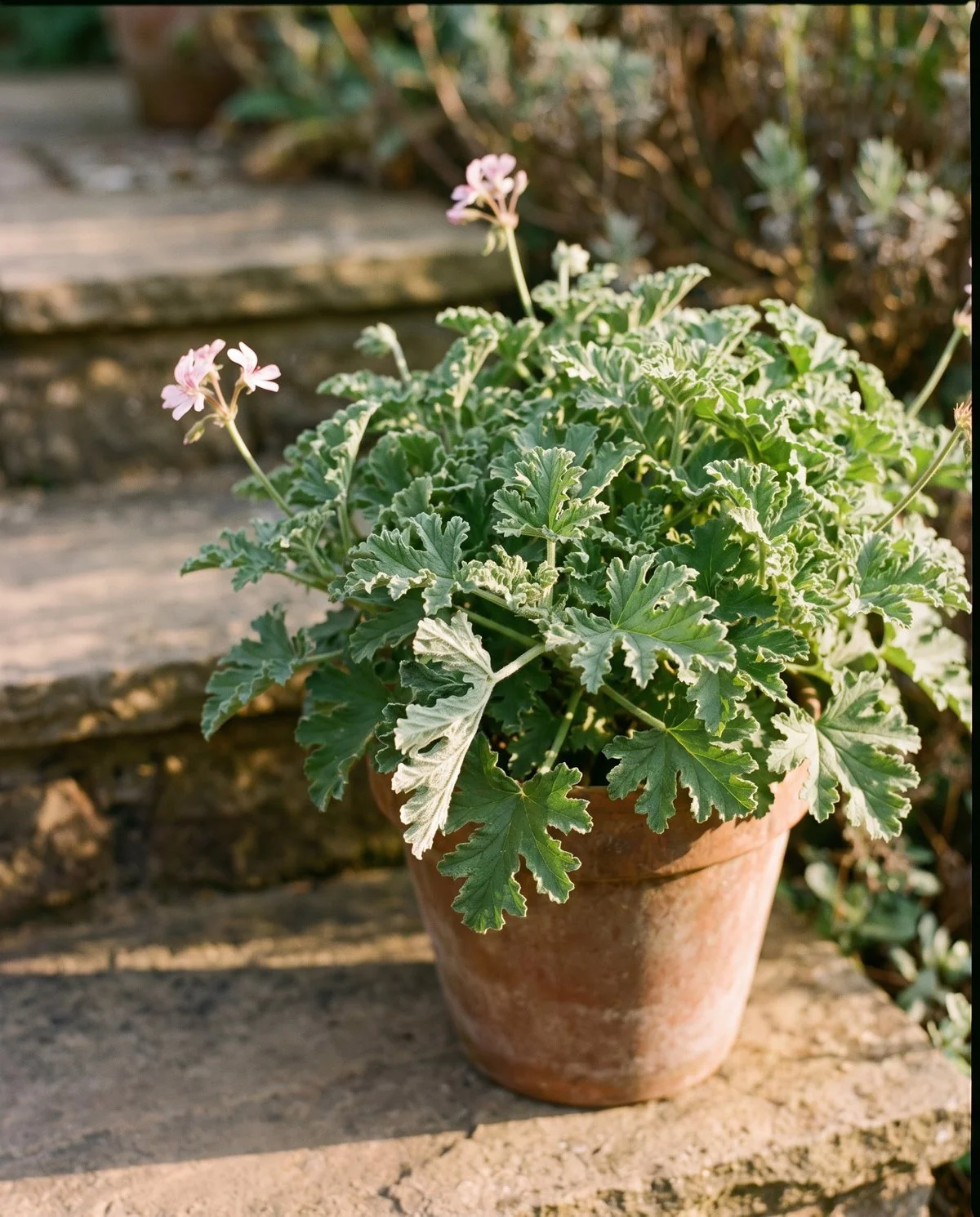
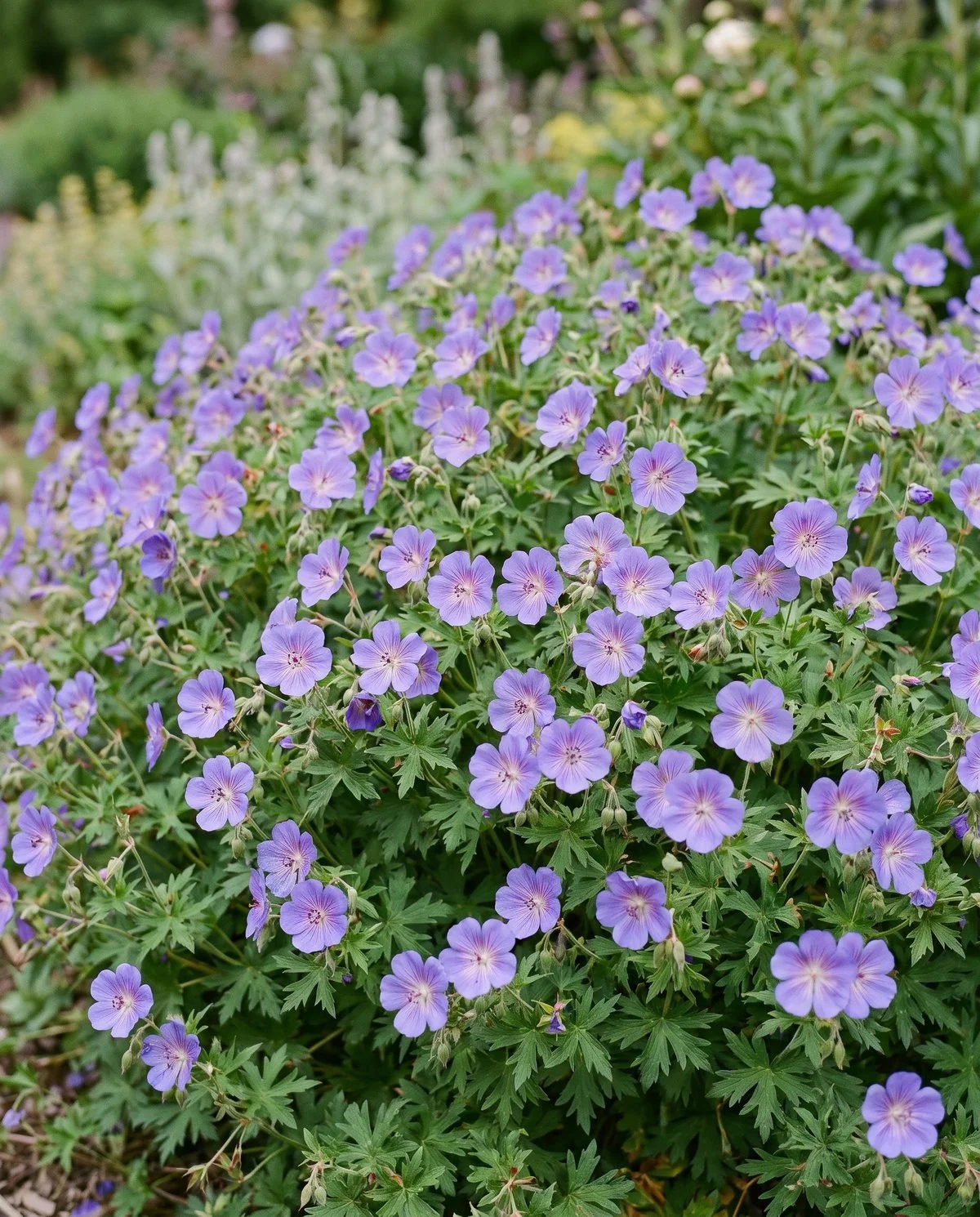
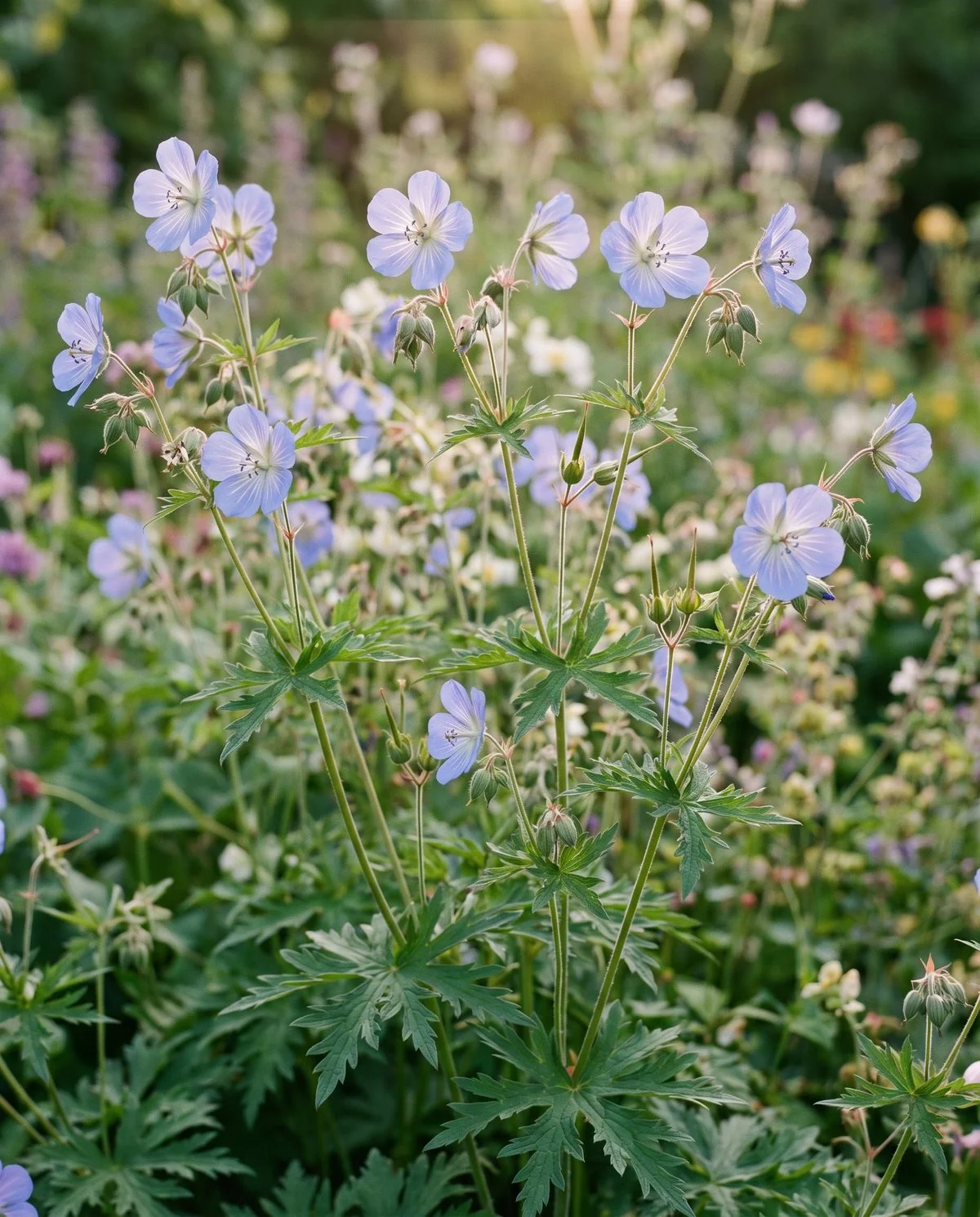
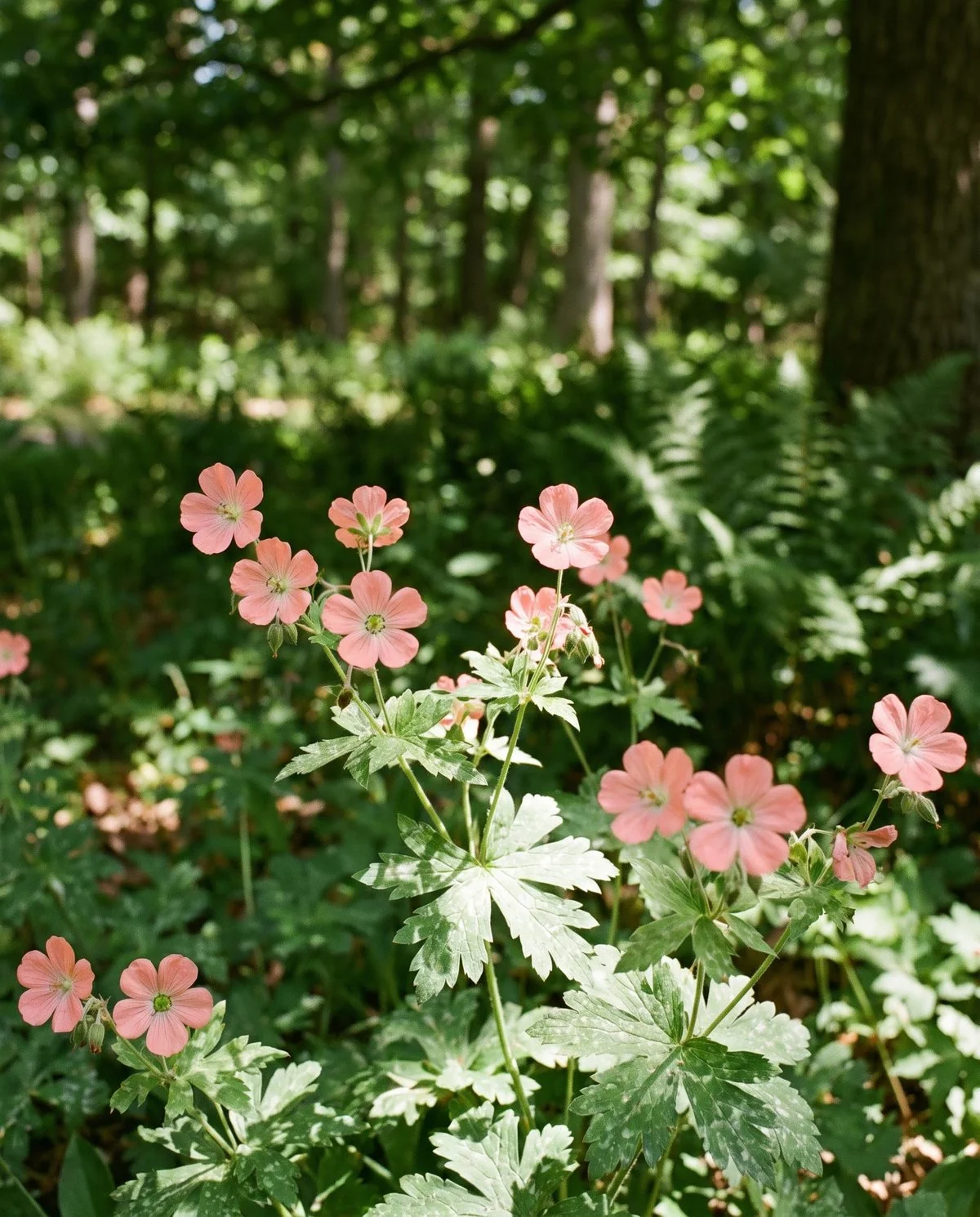
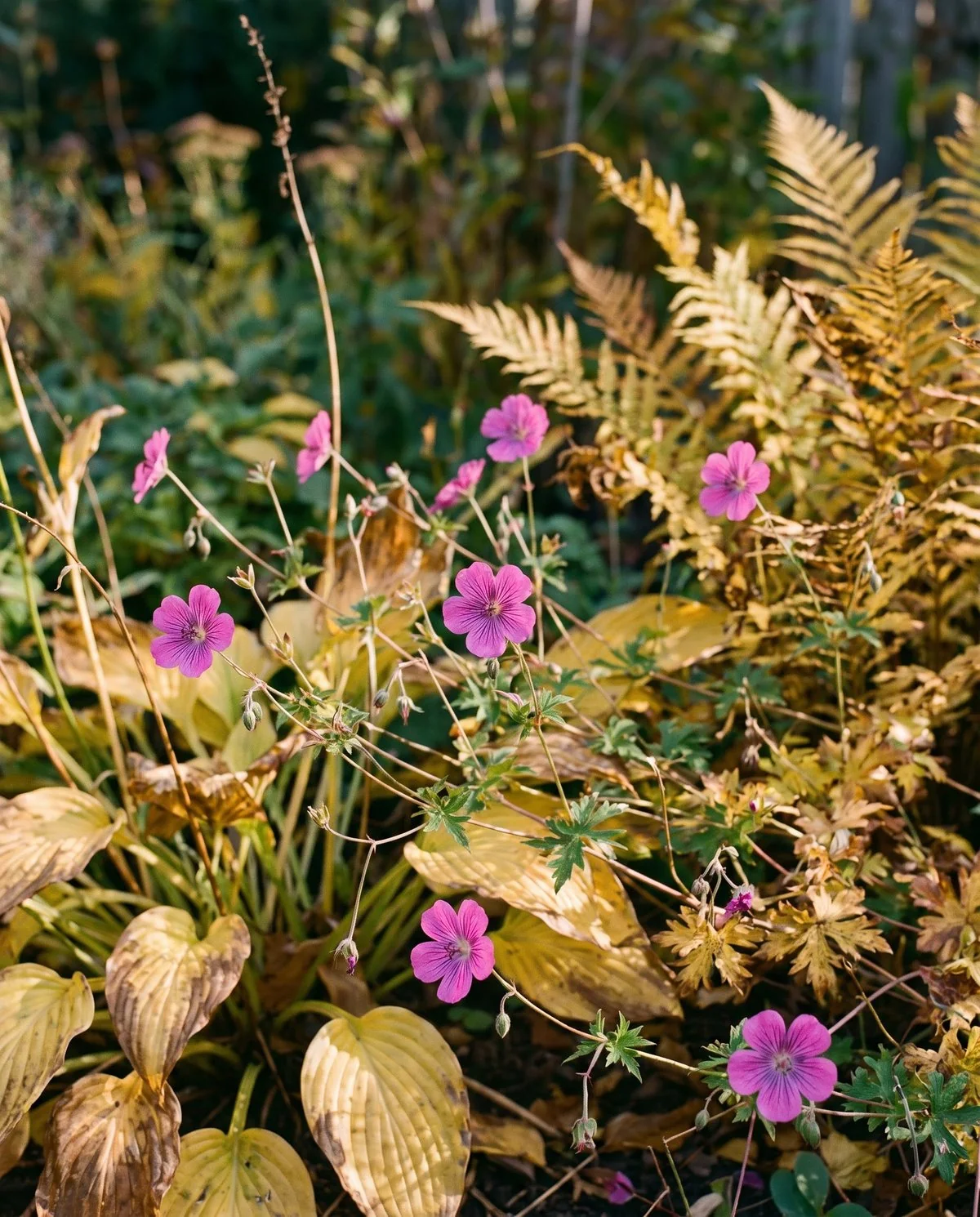
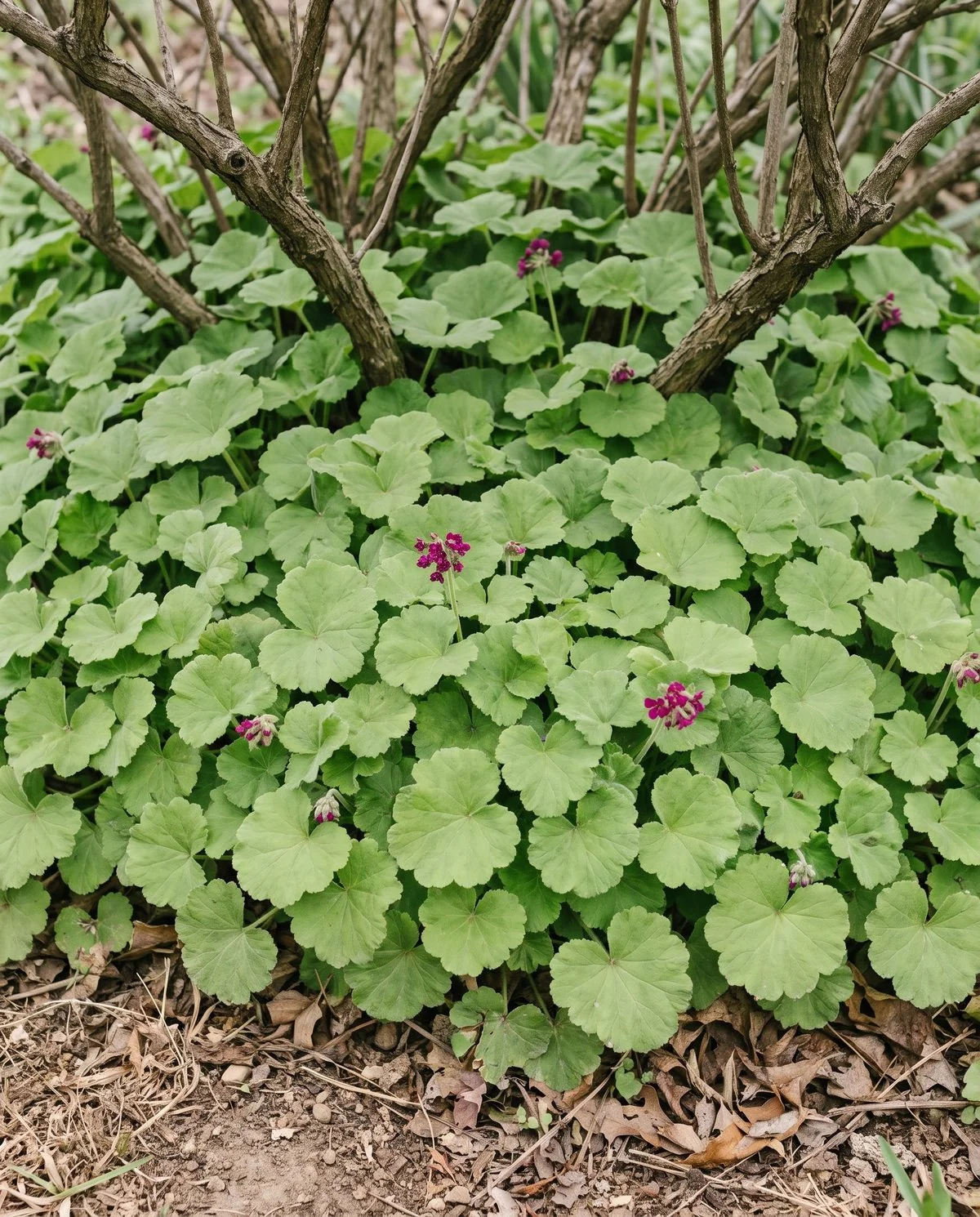
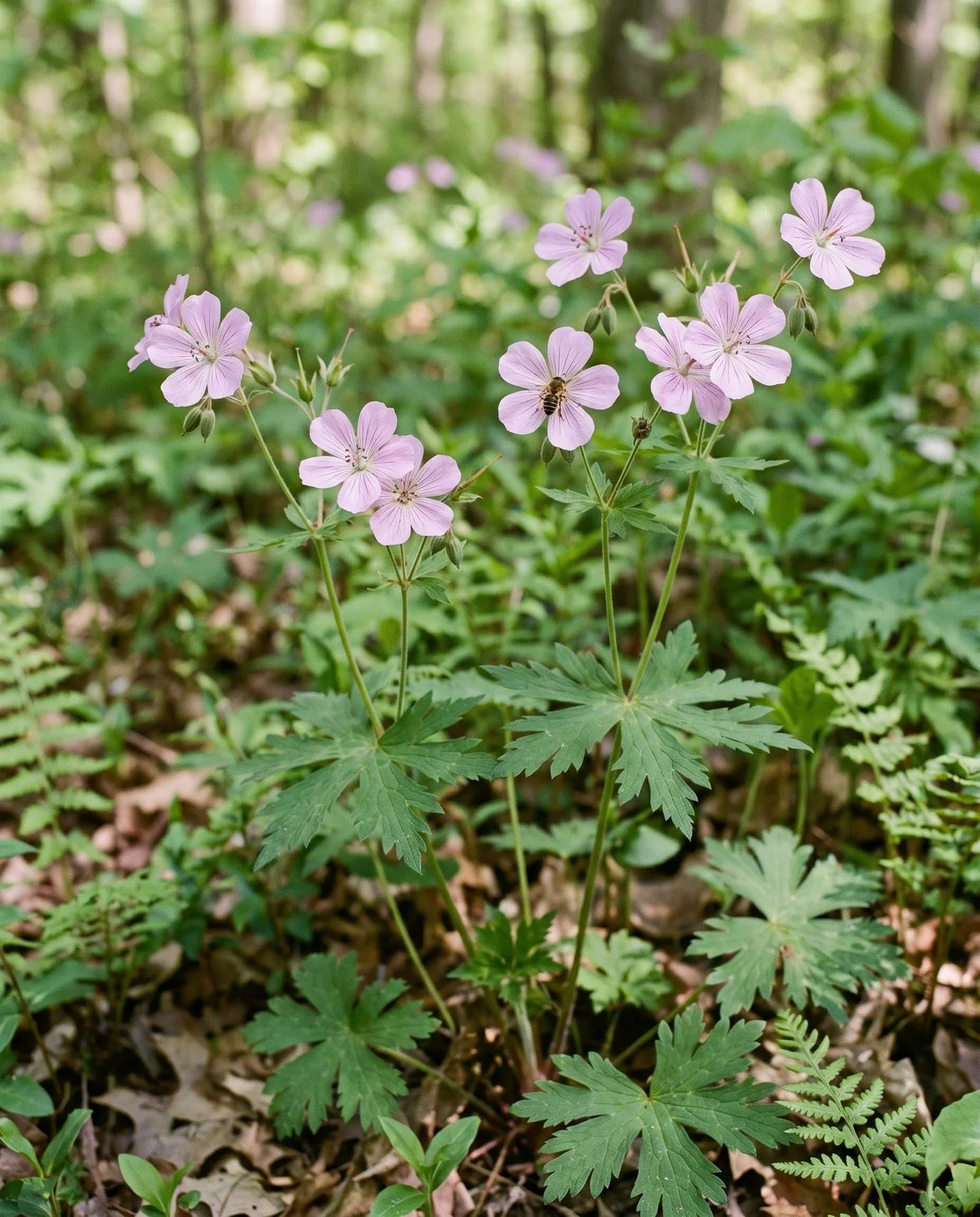
Two axes decide the choice and they are not the same axis. The genus decides whether the plant survives a frost at all. Within the tender genus, the group decides where it goes: upright in a bed, trailing over a basket rim, or on a windowsill for its leaves. The RHS's own ten also includes 'Orion' at 75 cm with large lavender-tinted blue flowers and purple veins, 'Mavis Simpson' at 20 cm with rose-pink flowers under a silvery overlay, blooming June to October, and Geranium sanguineum 'Album' at 50 cm in pure white on the bloody cranesbill species, whose straight species Missouri Botanical Garden records as mounding 9 to 12 in and spreading to 24 in, blooming primarily in May and June with a sparse but variable rebloom.
Bloom time
Geraniums earn their place by flowering for a long stretch, though the two types run on different clocks. Hardy cranesbills open in late spring, often around May, and carry through early summer, with many modern hybrids pushing well into fall. Pelargoniums, given warmth, flower from early summer until frost cuts them down, which in a mild climate can mean nearly year-round color. The lever that keeps either one going is removing spent flowers. On pelargoniums, snap or cut each finished flower stalk cleanly at its base so the plant spends its energy on new buds rather than on setting seed, and the clusters keep coming. Hardy geraniums answer to a blunter tool: once the first flush fades and the plant sprawls open and tired in midsummer, cut the whole thing back hard, by half or even to a few inches, and it responds with a fresh mound of clean foliage and a second wave of bloom within a few weeks, a technique worth its own midsummer cut-back for a second flush. The exception is Geranium 'Rozanne,' a sterile hybrid that cannot set seed and so never stops trying: it pours out violet-blue flowers from early summer to frost with no deadheading at all, which is a large part of why it became a garden fixture.

Two paths, worked in order
Both start with the genus, the group and the growing conditions rather than with a disease, because the sourced material puts temperature, light and fertility ahead of pathogens for both of these complaints.
Height and spread
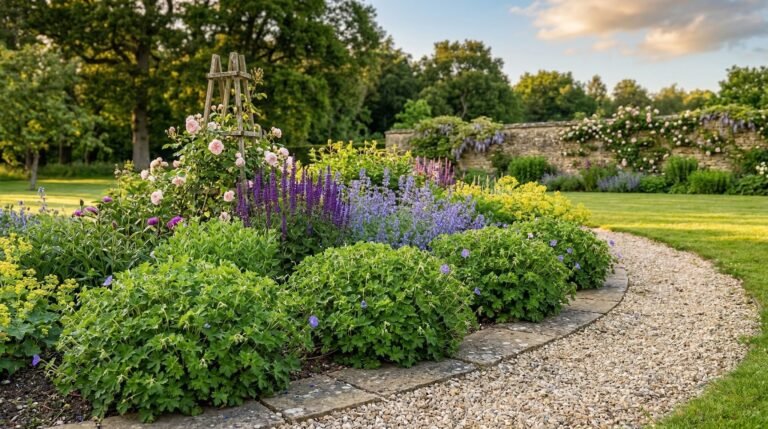
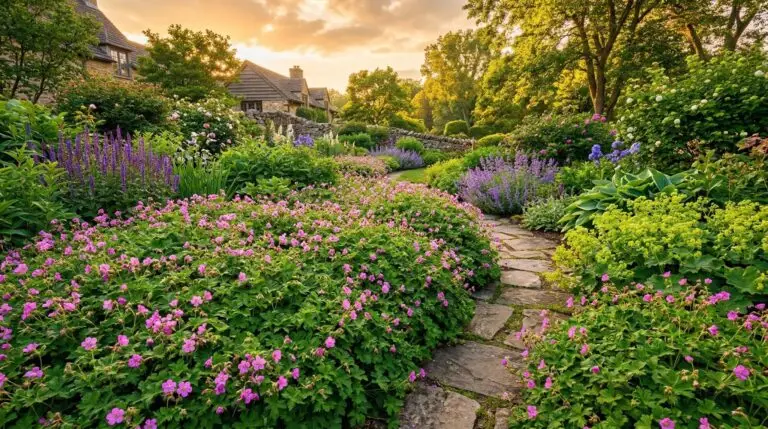
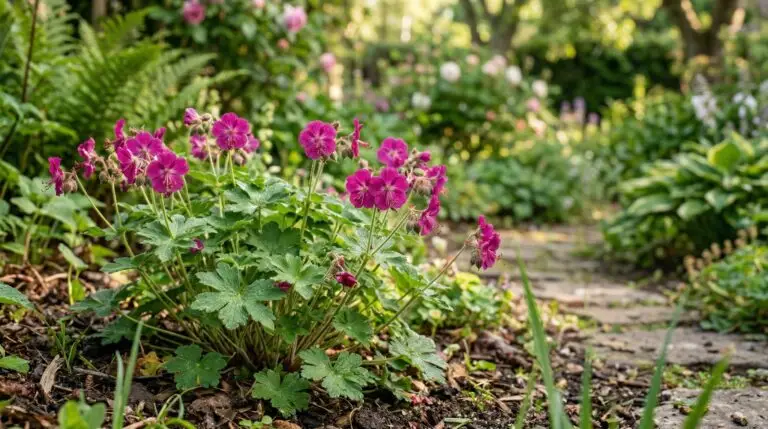
Size runs the full range of the two genera. Dwarf and ground-cover cranesbills stay 6 to 8 inches tall and knit into low mats for edging and rock gardens, while the common border kinds form mounds 12 to 24 inches high and 1 to 3 feet wide as they clump outward, and a few reach 2 to 3 feet in both directions. Zonal pelargoniums usually stand 1 to 3 feet in a pot or bed, and ivy types trail a foot or more over the rim of a basket. Because most geraniums branch low and weave rather than tower, they belong in the front to middle of a border, shorter than a sunflower but taller than a carpet of alyssum. The hardy kinds are especially good at filling space: their mounding stems spread through gaps and smother weeds without choking their neighbors, so a clump tucked under leggy roses or around the base of shrubs covers the bare ankles those plants tend to show. Many cranesbills widen a little each year by rhizome or by self-sown seedlings, thickening slowly into a dependable patch rather than running out of bounds.
Light
Geraniums flower best in strong light, and most want at least 6 hours of direct sun a day. Full sun brings the heaviest bloom and the sturdiest, most compact growth on both the tender and the hardy kinds, provided the plants have enough water to match. In the hottest climates, an afternoon of light shade spares zonal pelargoniums from scorched leaf edges and heat stall, and many woodland cranesbills are content in dappled shade all day, keeping their foliage even where bloom thins. Low light is where geraniums disappoint: starved of sun, a plant stretches toward the window on long, weak, bare stems and throws far fewer flowers, the classic leggy geranium. The cure is more light first, then a pinch or a hard cutback to force branching from lower down. Scented-leaf and other aromatic types sit comfortably beside sun-lovers such as lavender, which want the same open, bright, well-drained spot. If a geranium leafs out but barely blooms, too little light is the first thing to check, ahead of feeding or watering.

Water
Geraniums take a moderate amount of water and resent both extremes, but the tender pelargoniums lean toward the dry side because their thick, semi-succulent stems store moisture. Let the top inch of soil dry before watering again, then soak thoroughly, and empty any saucer so the roots never stand in water. The most common mistake is kindness: constant watering keeps the soil soggy, and the plant answers with yellowing lower leaves, soft stems, and root rot. Overwatering also drives edema, a disorder covered in the pests and diseases section, where the roots pull in more water than the leaves can release. Water at the base rather than over the top, since wet foliage in the evening invites mildew and rust, and morning watering lets any splash dry fast. Hardy geraniums in the ground, once established and mulched, get by on rainfall and the occasional deep soak, and forgive a missed watering more readily than most flowering shrubs would. Container plants are the exception: potting mix in a summer pot can dry out daily in heat, so a zonal or ivy geranium in full sun may want water every morning.
Five claims about geraniums, checked against the source that settles each
Two of these were tested in a field trial and a research fact sheet. The other three are naming and classification errors that change what a reader does with the plant.
The myth: A citronella or scented geranium on the patio keeps mosquitoes away
The reality: Tested directly and rejected. A field trial at the University of Guelph placed the citrosa plant, Pelargonium citrosum, marketed as the mosquito plant, in a clear cage with a human volunteer and counted actual mosquito bites. The paper's own conclusion is that there was no significant difference between citrosa-treated and nontreated subjects, while a DEET control in the same study reduced bites by 90 percent. Essential-oil yield from fresh material measured 0.2 plus or minus 0.1 percent, a small fraction of what a protective vapour barrier would require. The scented types genuinely do contain citronellal in their leaf tissue, which is why crushing a leaf smells citrus-like, but an intact plant sitting on a patio releases nowhere near enough of it into the air to matter. Matsuda and colleagues, Journal of the American Mosquito Control Association, volume 12 issue 1, pages 69 to 74, 1996, Department of Environmental Biology, University of Guelph.
The myth: Geranium and Pelargonium are two names for the same plant
The reality: Two different genera, and the difference decides everything that follows. UMN Extension: they are not true geraniums, but belong to the genus Pelargonium, which means stork in Latin due to the long, slender fruit capsule resembling a stork's bill, and true geraniums belong to the genus Geranium and are grown as perennials in Minnesota. Pelargonium is winter-hardy only in USDA Zones 10 to 11 and tender everywhere colder; true Geranium runs Zones 3 to 8 depending on the species. The lifespans as typically grown differ the same way, and so does the toxicity status below. In this pack's own 508-post corpus only 3 percent of posters asked which genus they had, and that number is a floor rather than a rate, because both halves of the corpus write my geranium without noticing the ambiguity.
The myth: Geranium 'Rozanne' was named Plant of the Year 2013
The reality: That phrase conflates two real awards, from two different organizations, in two different years. The Perennial Plant Association named hardy Geranium 'Rozanne' its 2008 Perennial Plant of the Year, confirmed on Purdue Consumer Horticulture's own page, which cites outstanding flower size, unique color, and long blooming season, and records the plant as hardy in USDA Zones 5 through 8, blooming from late spring through mid autumn, at 20 to 24 inches tall and about 28 inches in spread. The Royal Horticultural Society separately named it Plant of the Centenary in 2013, voted by the public to mark the 100th Chelsea Flower Show and selected as the public's pick for the show's 1993 to 2002 decade. Both titles are real and neither of them is Plant of the Year 2013.
The myth: Epsom salts are a general tonic for an ailing geranium
The reality: Overstated, and the source that addresses it is not geranium-specific, which is said here rather than glossed. Clemson HGIC's own piece on Epsom salt in the garden holds that most garden soils already contain sufficient magnesium, especially where organic matter has been added, so the treatment adds a nutrient that usually is not missing. Worse, excess magnesium can interfere with calcium uptake and over time begin accumulating around each plant's root zone, blocking the plant's ability to take up water from the surrounding soil. Clemson's recommended alternative is compost, aged manure or mulch, plus an actual soil test before adding anything at all. Its own named examples are tomato, pepper and eggplant, and no geranium-specific Epsom-salt trial was found in this pack's sourcing.
The myth: Geraniums are toxic to cats and dogs, full stop
The reality: True for the tender bedding genus, and unestablished for the hardy one, and the pack keeps the two apart on purpose. The ASPCA's toxic-plant entry titled Geranium is keyed to Pelargonium species, listed as toxic to dogs, toxic to cats and toxic to horses, with geraniol and linalool as the toxic principles and vomiting, anorexia, depression and dermatitis as the clinical signs. A separate ASPCA Scented Geranium entry adds that cats are the most sensitive species, with larger exposures able to cause ataxia, muscle weakness or hypothermia. No separate ASPCA listing for true Geranium, the hardy cranesbill, was found in this pack's own search: its absence from the toxic list is suggestive but it is not the same thing as an explicit non-toxic confirmation, so the absence is stated rather than converted into a clearance.
Soil and pH
Geraniums are not fussy about soil as long as it drains. They grow in sand, loam, or amended clay, and the one thing they will not forgive is water pooling around their roots, which rots stems and crowns. A moderately fertile soil with some compost worked in suits the hardy kinds well. The tender pelargoniums actually prefer lean ground: rich, high-nitrogen soil or heavy feeding pushes them into leaf at the expense of flowers, so an overfed window-box geranium can grow large and green and barely bloom. A balanced or slightly phosphorus-heavy fertilizer at half strength, every few weeks through the growing season, gives pot geraniums enough without tipping them into foliage. On pH, geraniums are easygoing, preferring a slightly acidic to neutral range around 6.0 to 7.0 but tolerating mildly alkaline soil, and unlike a bigleaf hydrangea their flower color does not shift with soil chemistry. A 2 to 3 inch mulch over the root zone of garden geraniums holds moisture and keeps the crown cool, though it should stay clear of the stems themselves.

USDA hardiness
Hardiness is where the two geraniums separate most sharply, and it decides whether the plant lives outdoors all year or has to be rescued each fall. Hardy cranesbills are genuine cold-climate perennials: many are reliable to USDA zone 4 and some to zone 3, dying back to the ground in winter and re-sprouting from their roots in spring. They hold up through zone 8 and sometimes 9, though the hottest, most humid summers thin them out. Pelargoniums are the opposite, hardy only in the frost-free warmth of zones 10 and 11, so anywhere colder a fall freeze kills them outright unless they are brought in.
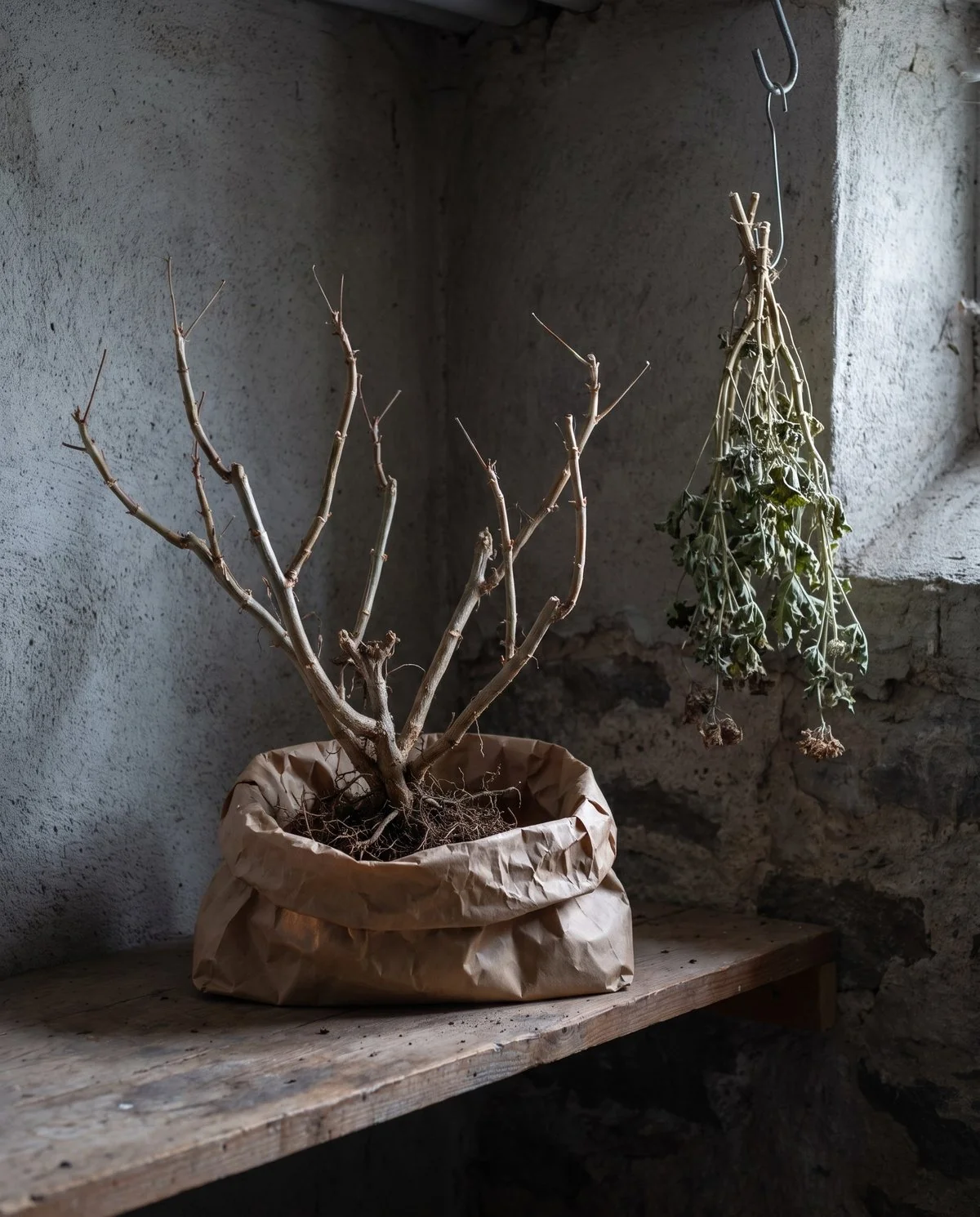
Saving a favorite pelargonium through winter takes one of three approaches. The simplest is to lift the whole pot indoors before the first frost and keep it in a cool, bright window, where it may bloom weakly or just idle until spring. The second is to take 3 to 4 inch cuttings from healthy stems in late summer, root them in moist mix, and grow small plants on a windowsill to set out after the last frost, which clones the parent and takes little space. The third is the old bare-root method for gardeners short on light: dig the plant before frost, shake or rinse the soil off the roots, and hang it upside down or slip it into a paper bag in a cool, dark, dry basement or garage held around 45 to 50 degrees and never freezing. The thick, water-storing stems let it survive dormant for months, and if the roots turn brittle a one-hour soak revives them before you pot the plant back up in spring. Hardy geraniums need none of this: cut the dead top away after a freeze, add a little mulch in the coldest zones, and the plant returns on its own.
The same calendar, run twice, because the genus changes what a month means
Every row below is split. UMN Extension supplies the Pelargonium dates and thresholds and Wisconsin Extension the storage temperatures; the RHS supplies a UK planting date that is deliberately left as a UK date rather than converted. Where the sourced material simply has nothing for the hardy genus, the row says so instead of borrowing the tender genus's number.
Propagation and longevity
Geraniums are easy to increase, and the method follows the type. Hardy cranesbills are best divided: every few years, lift a mature clump in spring or early fall, pull or cut it into sections that each carry roots and shoots, and replant them, which both multiplies the plant and rejuvenates a clump gone woody or hollow in the center. Most divisions settle in fast and flower the next season. Pelargoniums propagate from stem cuttings, the same softwood pieces used to overwinter them, rooting readily in a few weeks in moist, well-drained mix and coming true to the parent. Both can be raised from seed, though seedlings are slower to reach blooming size, often taking a year or more, and named hybrids will not come true from seed. Cranesbills sow themselves freely, their seed capsules drying, coiling, and flinging the seeds a surprising distance, so volunteer seedlings turn up around established plants, simple to move or weed out as you please. For longevity, hardy geraniums are among the most durable garden perennials, living many years and often decades on nothing more than an occasional division. Pelargoniums are perennials too, just tender ones, and kept above freezing a single plant grows woody and shrub-like over the years, which is why cuttings from a treasured old geranium can carry it on almost indefinitely.

One genus needs no plan, the other needs one every autumn
The two genera diverge here more sharply than anywhere else on the page. A hardy Geranium planted inside its zone range in soil that drains is not a gamble: it returns every year the way any well-sited herbaceous perennial does, and 'Rozanne' flowers July to October in the RHS's words in its own first full season, with two decades of cultivation behind its two awards. What the sourced material does not supply is a fill-in timeline, and none is invented here: Missouri Botanical Garden gives the eventual 24 in spread of Geranium macrorrhizum and Geranium sanguineum without saying how many seasons it takes to reach it. A Pelargonium left outdoors through a real winter anywhere colder than Zone 10 dies, and that part is not a maybe. Turning it into a multi-year plant takes one of the three deliberate interventions in the calendar above, and no controlled university survival rate exists for any of them. What exists instead is first-person testimony from this pack's own corpus: posters reporting 6-, 7- and 8-year-old Pelargonium kept alive purely by repeated seasonal overwintering, alongside posters in the same corpus describing partial or total failure, one of them writing that they were not entirely successful at wintering their pelargoniums. Read together those are real evidence that overwintering is an achievable multi-year strategy that plenty of ordinary gardeners pull off, and equally real evidence that it is not guaranteed, and no false-precision success rate is manufactured to smooth the gap. Of the three methods, cuttings carry the strongest relative endorsement rather than a measured one: UMN, Wisconsin Extension and the RHS all describe the method, and the RHS's own pelargonium growing guide ranks taking cuttings as most reliable for soft-stemmed types against bare-rooted plants as least reliable, suitable only for tough woody varieties. No source compares the three numerically. Rooting time is given as a range for the same reason, three weeks in UMN's words, check the cuttings for roots in about three weeks, against six to eight weeks in Wisconsin Extension's, and the two are left unreconciled rather than averaged.
Fragrance
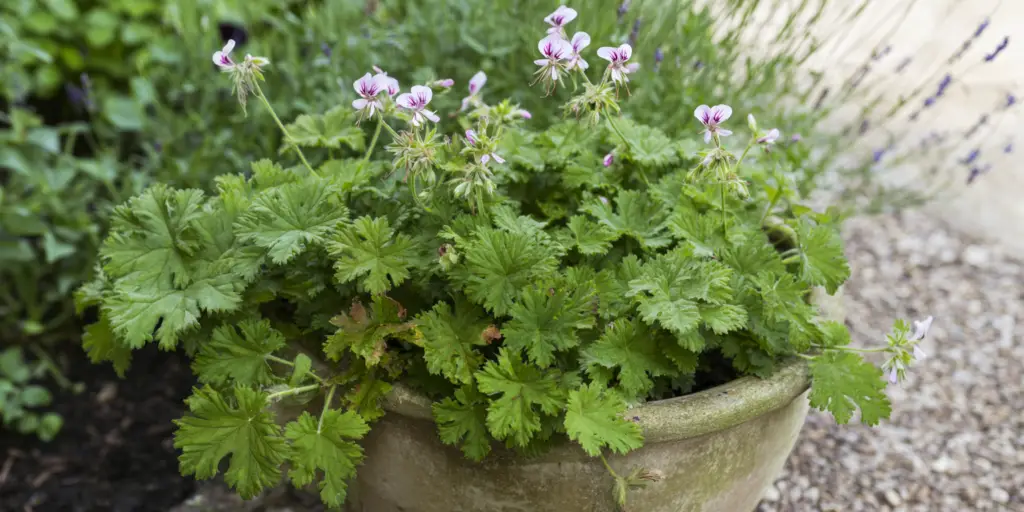
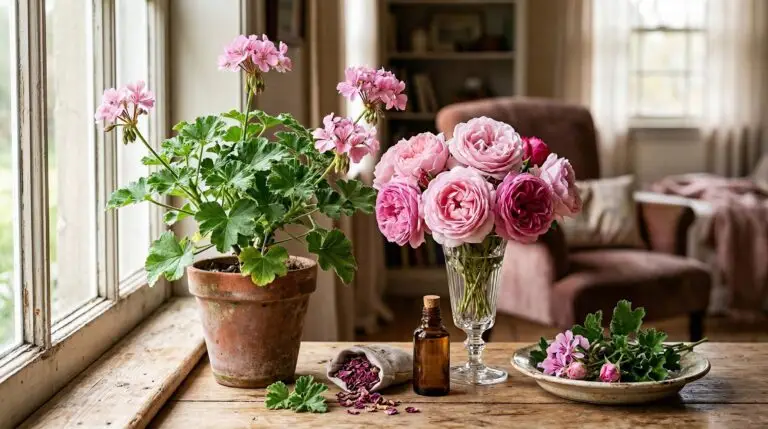
The flowers themselves offer little perfume, so no one grows a geranium for the scent of its blooms the way they might a rose or lavender. The fragrance lives in the leaves. Many geraniums hold aromatic oils in their foliage that release when the leaves are brushed or crushed, and a whole class of pelargoniums, the scented-leaf types, is grown for exactly this. Rose-scented Pelargonium graveolens is the best known, its leaves used in potpourri and, a leaf or two at a time, to perfume a sugar or a sponge cake, while other cultivars mimic lemon, mint, apple, nutmeg, or chocolate. Among the hardy kinds, Geranium macrorrhizum gives off a strong resinous, herbal smell that some gardeners enjoy and browsing deer plainly do not. Because the scent sits in the foliage rather than the open air, these plants pay off best beside a path or at the edge of a container, where a passing hand or sleeve sets them off.
Toxicity and pet safety
The geranium most people keep, the pelargonium, is listed by the ASPCA as toxic to cats, dogs, and horses. The culprits are two aromatic compounds in the plant, geraniol and linalool, and a pet that chews the leaves or flowers may drool, vomit, lose its appetite, seem depressed, or develop a rash where the sap touched skin. The reactions are usually mild and pass on their own, and most animals are put off quickly by the bitter, strongly scented foliage, so serious cases are uncommon. Even so, the plant is a genuine irritant rather than a safe one, so it is worth keeping pots out of reach of a pet that likes to nibble greenery and calling a veterinarian if a large amount goes down or symptoms linger. The same oils can raise a mild contact dermatitis on sensitive skin, which makes gloves sensible when taking cuttings or pruning. Gardeners planting with animals in mind can weigh their options in the guide to flowers safe for cats and dogs; geraniums fall well short of the danger a true lily poses to a cat, but they are not on the safe list.

Vase life
Geraniums are not really a cut flower, and it is fair to keep expectations low. The hardy cranesbill's small blooms wilt within a day or two of cutting, and even the sturdier zonal pelargonium holds only a few days before its florets shatter and drop, which is why the plant belongs to the garden and the pot rather than the vase. If you do bring stems in, cut them in the cool of the morning, strip every leaf that would sit below the water, and stand them in a clean vase of fresh water changed often, since geranium foliage fouls water quickly as it rots. The more lasting contribution geraniums make to arrangements is their foliage: a few sprigs of scented-leaf pelargonium add texture and a clean herbal fragrance to a mixed bouquet, and they will often start to root in the water, a small bonus that says more about the plant's toughness than about its life as a cut flower.
A container plant, measured as a container plant
Neither genus is a cut-flower crop, and no vase-life trial for either was found in this pack's sourcing, so what follows is the data that does exist: how the containers behave, and the one subgroup whose leaves go into the kitchen.
A hardy cranesbill will work in a basket the way a bedding geranium does.
Unestablished in the sourced material. The extension literature fetched for this pack concentrates on Pelargonium for container-specific advice and on borders and ground cover for the hardy genus, so the basket data stays where it was measured instead of being carried across the genus line on an assumption.
Pests and diseases
For all their reputation as easy plants, geraniums draw a few specific problems worth knowing by sight. The most maddening is the geranium budworm, the caterpillar of the tobacco budworm moth, which bores straight into flower buds so they either fail to open or unfurl full of ragged holes, often with no insect in view because the culprit is hidden inside. The same pest riddles petunias and nicotiana, feeds after dark, and spends the day near the soil, so the reliable defense is to handpick at dusk and to pull off any bud showing an entry hole or a speck of frass. The popular biological spray Bt does little against budworm on geraniums specifically, because the caterpillar eats its way inside the bud rather than grazing the surface where the bacterium would be waiting, so handpicking and bud removal do more than spraying here. A second and very different trouble is edema, which shows up as corky, blister-like bumps on the undersides of the leaves. No spray will fix it, because it is a water-balance disorder: the roots take up more water than the leaves can transpire on cool, humid, overcast days, and ivy geraniums are the most prone. Easing off the water, improving drainage, and opening up air movement clears it, though the marked leaves themselves do not heal.
On the fungal side, zonal pelargoniums are subject to geranium rust, rusty-orange pustules speckling the leaf undersides that trigger yellowing and leaf drop, managed by stripping infected leaves and improving airflow. Damp, crowded conditions bring gray mold (botrytis) on spent flowers and powdery mildew on hardy geraniums late in the season, both eased by spacing, cleanup, and base watering. Aphids cluster on soft new growth, and whiteflies and spider mites trouble pelargoniums under glass or indoors, all controllable with a water blast or insecticidal soap. One piece of good news is that geraniums are usually passed over by deer and rabbits, which dislike the aromatic, textured foliage, though a hungry animal will still sample young growth. The table below pairs the common complaints with their fixes.
| Problem | What you see | Cause | Fix |
|---|---|---|---|
| Few or no flowers | Lush leaves, little bloom | Too little sun, or too much nitrogen | Move to full sun, feed less, deadhead spent heads |
| Leggy, stretched plant | Long bare stems, sparse leaves | Insufficient light | More sun, pinch or cut back hard to force branching |
| Yellowing lower leaves | Lower leaves yellow, soft stems | Overwatering, poor drainage | Let soil dry between waterings, improve drainage |
| Corky bumps under leaves | Tan blister-like bumps, mainly beneath | Edema, roots over-taking water | Water less, improve drainage and air movement |
| Holes in buds, buds fail to open | Chewed buds, frass, no bloom | Geranium (tobacco) budworm | Handpick at dusk, remove holed buds; Bt weak here |
| Orange spots under leaves | Rusty pustules, yellowing, leaf drop | Geranium rust, mostly on zonal types | Remove infected leaves, improve airflow, fungicide |
| Gray fuzz on flowers or leaves | Moldy spent blooms, rotting tissue | Botrytis gray mold in damp weather | Clear debris, space plants, water at the base |
| Tender plant killed by cold | Blackened, collapsed after frost | Pelargonium is not frost-hardy | Overwinter indoors or by cuttings, or treat as annual |
Photo pairs, and the three fingerprints left to real photographs
Structural identification, water states, growth habit and insect chew damage are safe to photograph and are here in full. Edema's corky blister texture, bacterial blight's sunken spots and rust's concentric spore rings are checkable diagnostic details, and Oregon State's own page exists because edema is mistaken for both of the others, so those wait for real reference photographs.
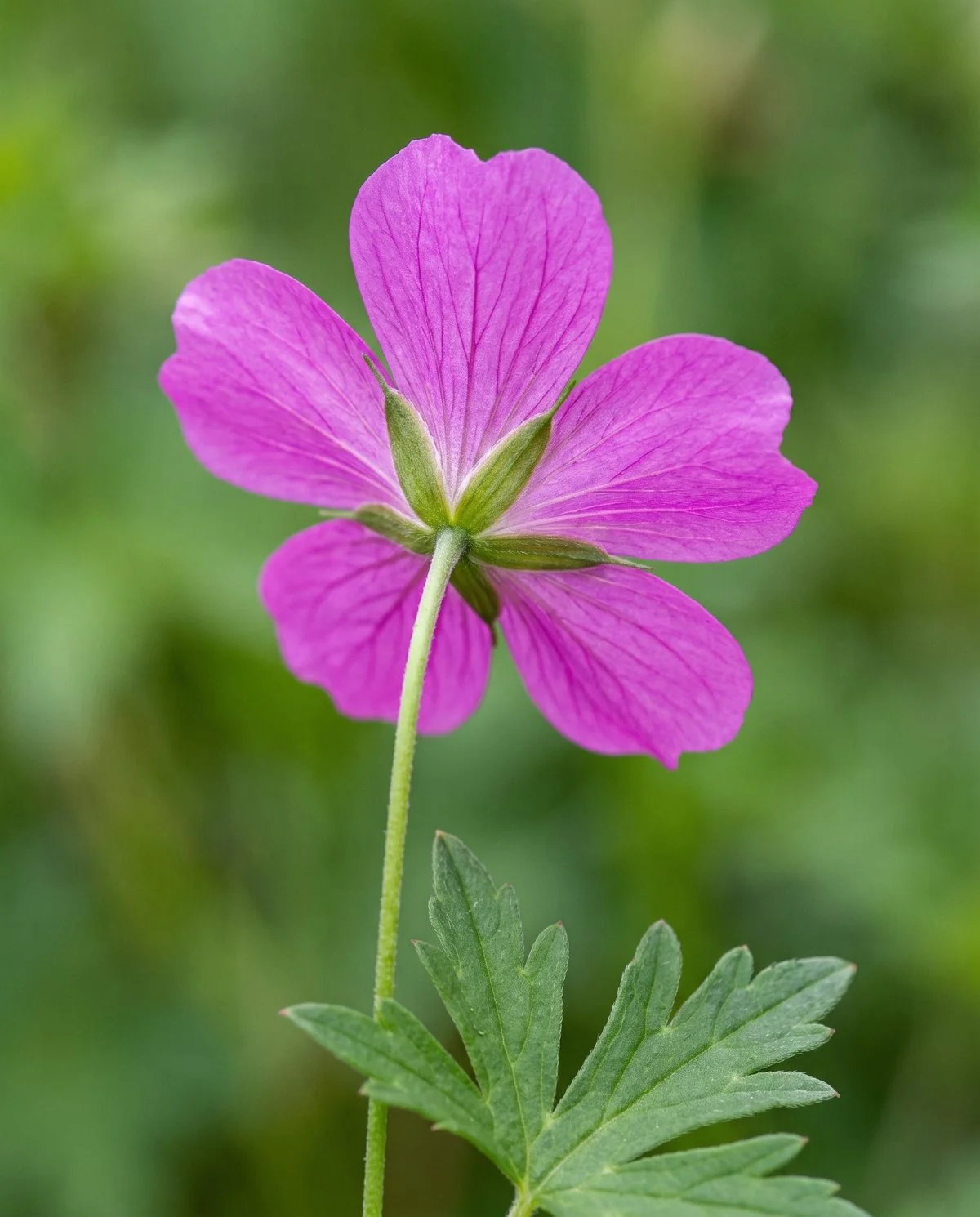
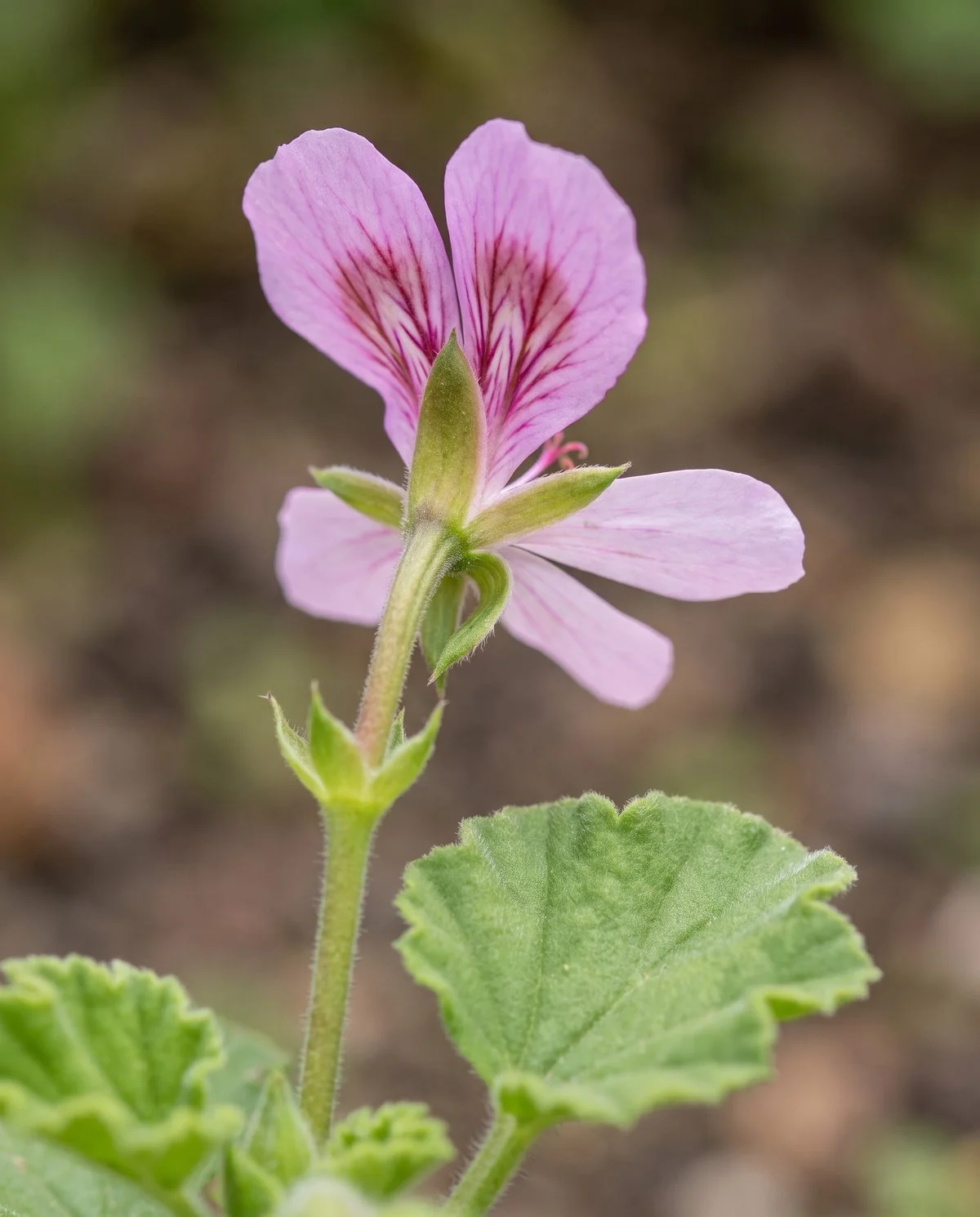
Look at the back of the flower. A true Geranium flower is flat, saucer-shaped and radially symmetric, five petals with no spur behind it. A Pelargonium flower is slightly irregular, zygomorphic, with a nectar spur fused to the flower stalk, a structural feature true Geranium flowers lack entirely. The supporting tells run the same way: thin wiry branching stems and thin, deeply palmately lobed leaves with no thick velvety feel and no darker ring on the true Geranium, against thicker more succulent stems and rounded, often velvety leaves frequently marked with a darker horseshoe-shaped zone band, or cut into a distinct ivy shape, on the Pelargonium.
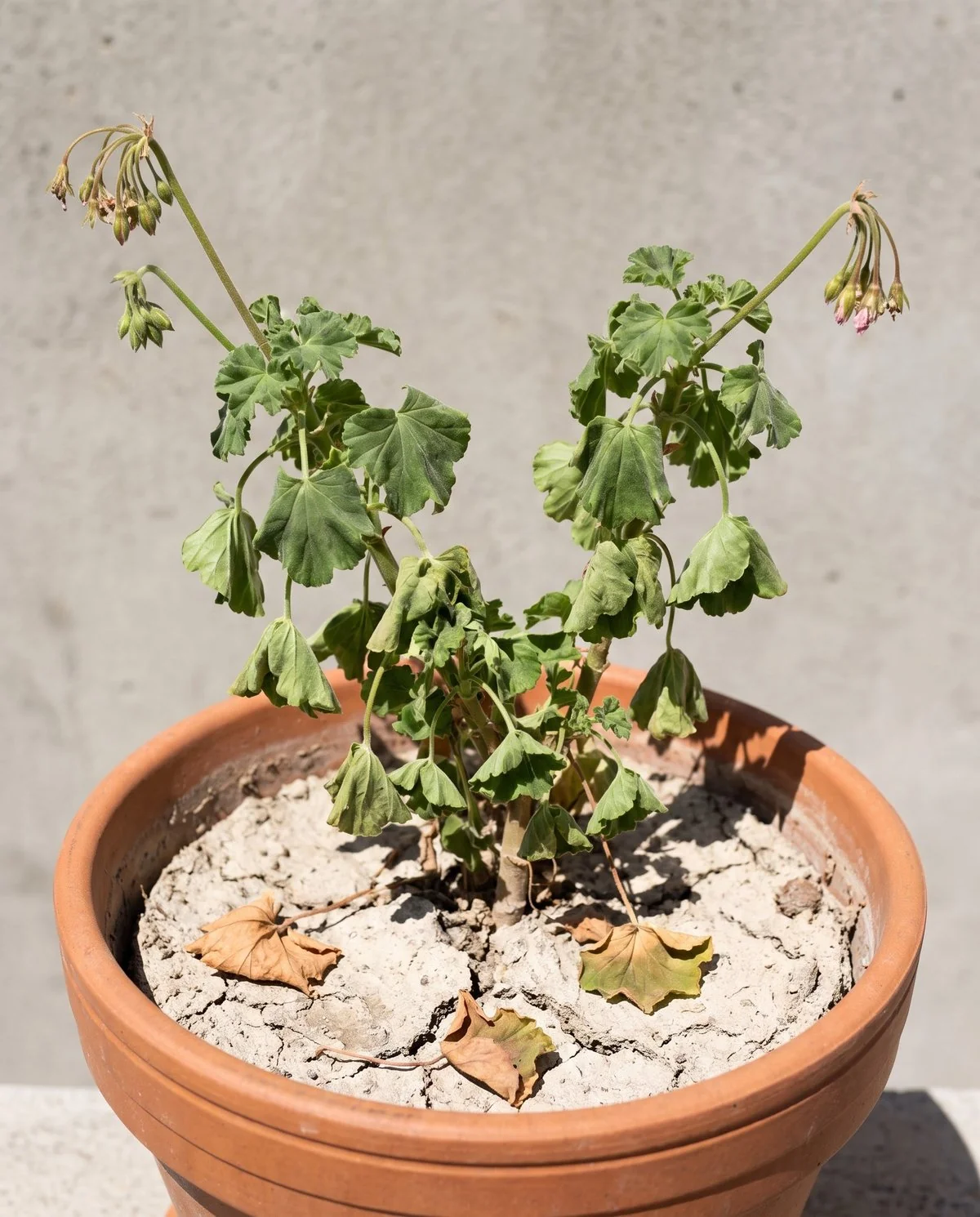
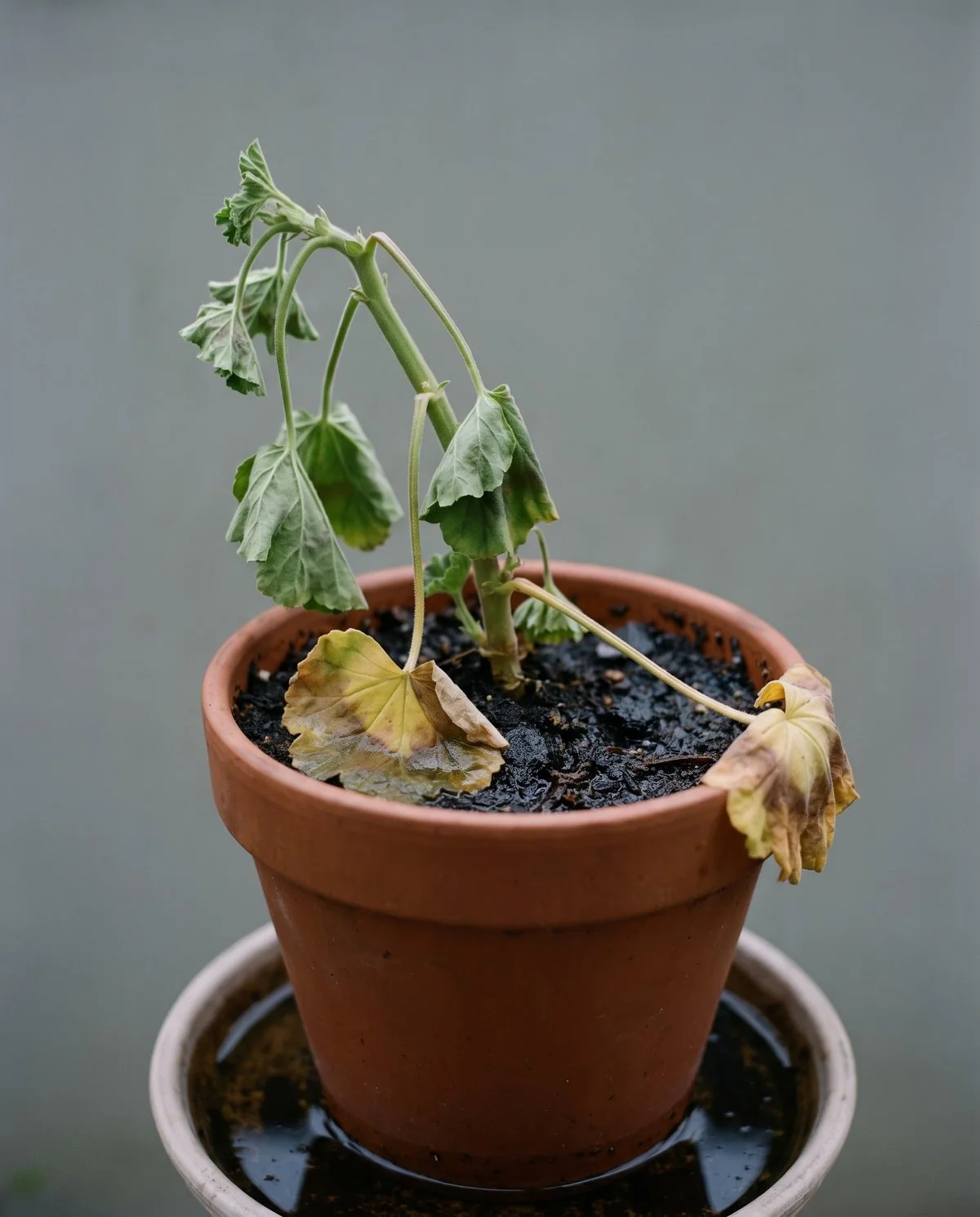
Water it once and come back in a few hours. UMN's dry-soil description is direct: if too dry, geraniums will wilt, drop leaves and not grow well, and the soil is visibly dry one to two inches down, and that wilt resolves within hours of watering. An overwatered plant stays wilted after watering because the roots are damaged rather than thirsty, with yellowing lower leaves and soil that has been wet for days, and at the worst end blackened mushy roots, which one poster in this pack's corpus found and described themselves before asking for confirmation.
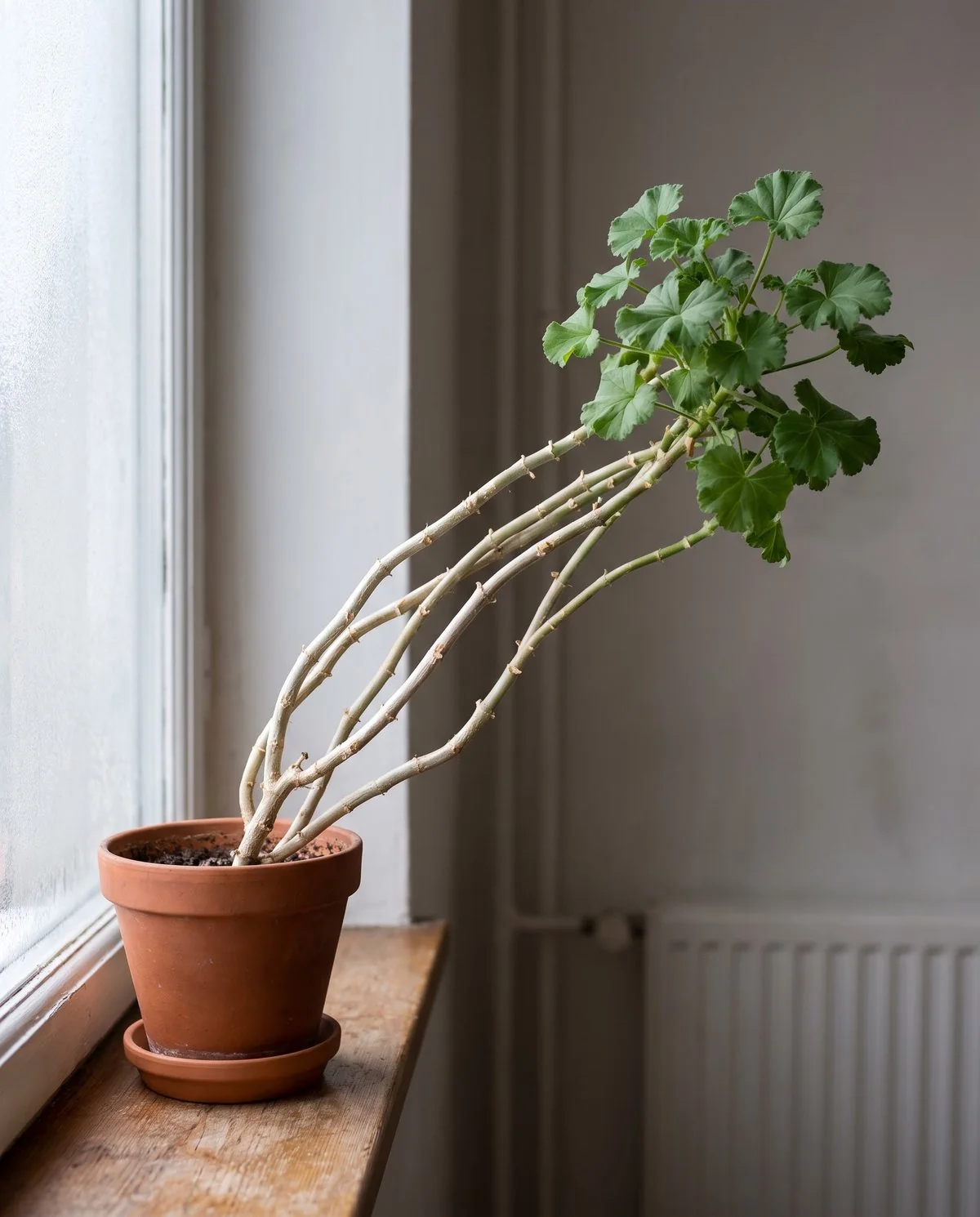
Check whether anything else is wrong with the plant. Legginess on its own is a growth-habit problem: UMN attributes the long spaces on stems between the leaf nodes directly to reduced light, the classic indoor-overwintering symptom, and the plant stays green and turgid throughout. A genuinely declining plant shows legginess together with spotting, wilting that does not answer to water, stem blackening, or leaves dropped from growth that was well lit, and it is the combination rather than the legginess that is the tell. Nearly a third of the leggy posts in this pack's own corpus show healthy green growth with no disease signs at all.
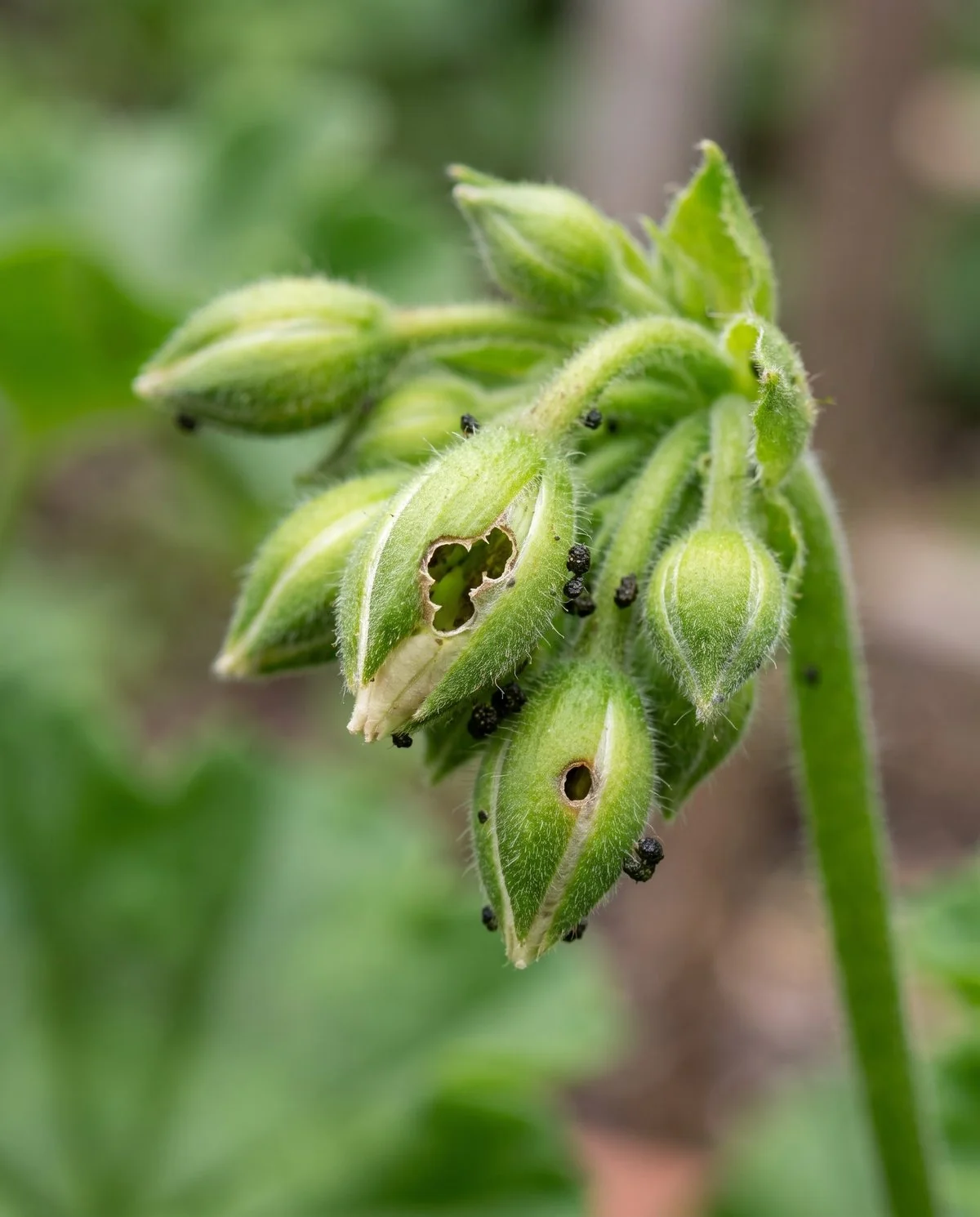
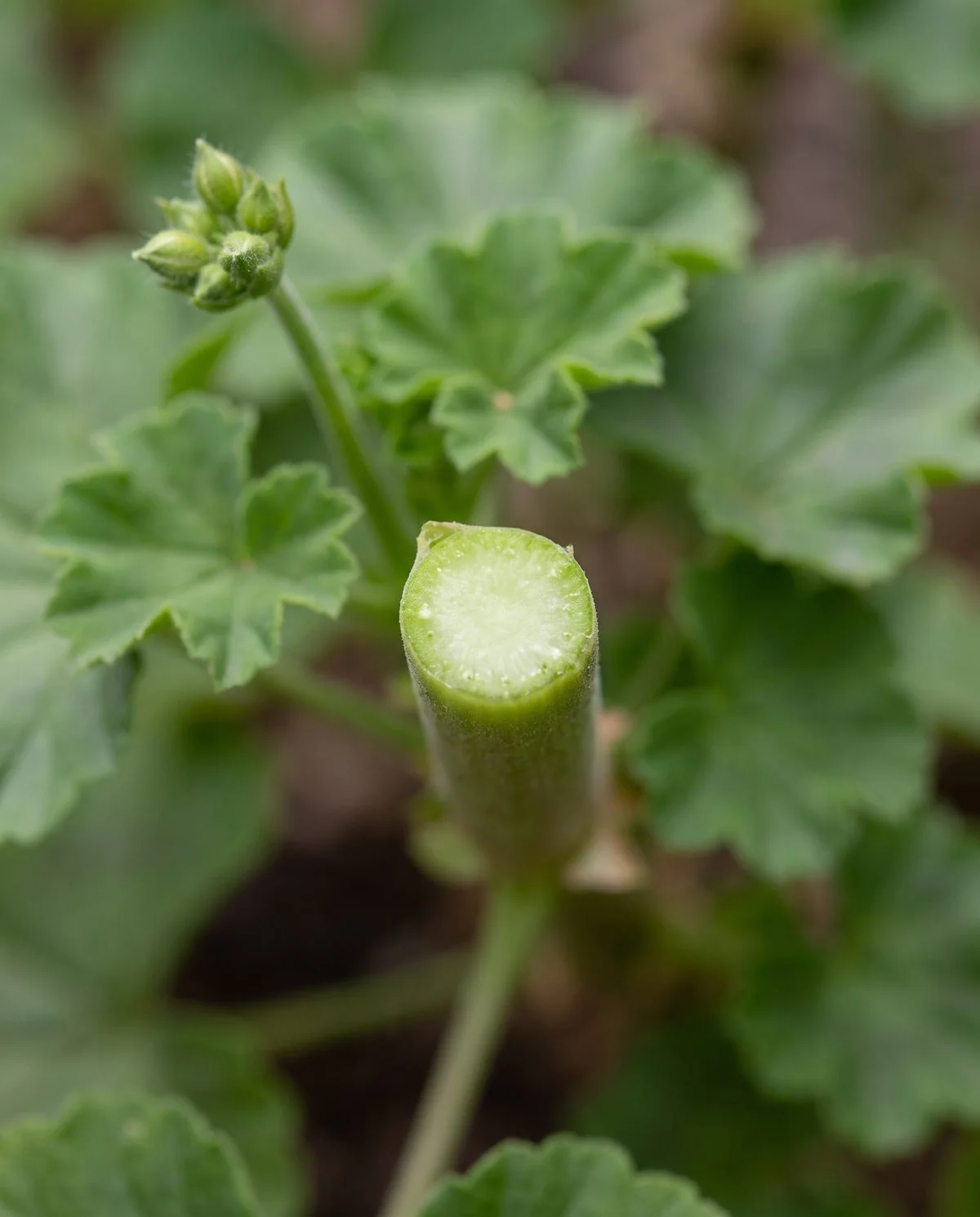
Look for frass, and look at whether the bud was spent. Budworm leaves irregular or round holes chewed into unopened buds, sometimes with small black specks of caterpillar excrement on the damaged bud, and the caterpillars themselves are variably coloured, black, pale brown, yellow, green or red, with pale stripes running the length of the body, clustering late in summer. Kansas State University Extension Entomology names both host plants in its own title, geraniums and petunias beware of the tobacco budworm, and Clemson confirms for zonal geranium specifically that tobacco budworm may chew holes in flower buds. A deadheading cut is clean and deliberate, made just below a spent flower head, with no ragged margin and no frass, and it removes a bloom that had already finished rather than one that never opened.
Three different problems with three different responses, and this is the one grouping the pack refuses to photograph. Iowa State describes edema as tiny blisters on the undersides of leaves that enlarge and turn tan or brown and appear corky, sometimes concentrated near the leaf margin, caused by roots absorbing water faster than the leaves can transpire it; Oregon State's handbook adds that it is more prominent when air temperatures are lower than soil temperatures, names ivy geraniums and the cultivar 'Irene' as especially susceptible, and warns that the symptoms can look like a rust or bacterial infection. Bacterial blight, Xanthomonas hortorum pv. pelargonii, gives round spots that are dark green to black, about 0.0625 to 0.125 inch wide and slightly sunken, or angular dead patches bounded by the leaf veins, with infected leaves wilting and staying attached for days, and stems developing blue-black rotting in advanced cases, and cuttings taken from infected stock failing to root. Rust, Puccinia pelargonii-zonalis, gives small yellow spots on the upper surface over whitish blisters that develop into brown powdery spore masses underneath, often in concentric rings, with badly affected leaves yellowing and dropping. Neither side of any of these three is generated here.
What geranium owners actually ask about, ranked by frequency
508 unique posts from r/gardening and r/plantclinic, 298 and 210 respectively, deduplicated by post id across ten title-filtered queries. Themes overlap, since a wilting post is usually also a watering post, so the shares do not sum to 100. One figure below is deliberately conservative rather than impressive: the explicit genus-confusion count is a floor, because most conflation is silent and never asked about at all.
Whether the wilt answers to water. UMN's own line is that geraniums tolerate dry soil better than overly wet soil, and that if too dry, geraniums will wilt, drop leaves and not grow well. A dry-soil wilt lifts within hours of watering; a wet-soil wilt does not, because the roots are damaged rather than thirsty.
Whether the poster can name it at all. This bucket is aphids, whiteflies, mealybugs and unnamed crawling things, and it is mostly what is this and how do I get rid of it rather than a named pest, which is what a weekly look at the leaf undersides and the bud tips answers.
Which surface it sits on and what shape it takes. The RHS describes pelargonium rust as small yellow spots on the upper leaf surface over whitish blisters, developing into brown powdery masses of rust spores on the underside, often in concentric rings. The PNW Plant Disease Management Handbook describes bacterial blight as round spots that are dark green to black, about 0.0625 to 0.125 inch wide, and slightly sunken, or angular dead patches bounded by leaf veins.
The soil, before the leaf. This bucket is counted separately from wilting but arrives paired with a watering question often enough that the pack treats it as the same underlying ambiguity.
The light, then the growing tip. UMN names reduced light as the direct cause of the long spaces on stems between the leaf nodes, and prescribes the same correction for a young plant and an overwintered one: prune or pinch back stems just above a leaf node.
Whether the poster has already worked it out. This is frequently self-diagnosed correctly before the question is asked, which says the risk is well known in the community rather than mysterious. UMN's own diagnostic page names Pythium, Rhizoctonia and Thielaviopsis root rot as common in wet, poorly drained soil.
Which of the three methods is in play, because they are not equivalent. UMN and Wisconsin Extension name growing the plant on as a houseplant at 60 to 65 F in bright light, storing it dormant and bare-root at 45 to 50 F per UMN or 45 to 55 F per Wisconsin, and taking stem cuttings in late summer or fall.
Read this row as a floor rather than a rate. A cruder count of posts merely containing the word pelargonium or cranesbill reaches 33.5 percent of the corpus, but two of the five search terms that built the corpus were those exact words, so that figure is a method artifact and is not used here. Most conflation is silent: a poster growing Pelargonium x hortorum in a basket and a poster growing Geranium 'Rozanne' in a border both simply write my geranium.
The type before the care. UMN states that the Regal or Martha Washington group requires cool 50 to 60 F night temperatures to blossom, so it flowers in early summer and autumn rather than through a hot summer. Read this row as a floor too: a plant with no flowers that otherwise looks healthy is a duller photograph than a wilting one, so it under-recruits on a photo-driven forum.
Whether the damage is above ground or at the roots. This bucket is squirrels, unnamed diggers and critters eating the roots of potted plants rather than foliage browsing.
The date of the purchase or the repot. Six posts in the whole corpus land here, and all of them are within weeks of the plant changing pots or changing hands.
Which surface the blisters are on. Iowa State Extension describes tiny blisters on the undersides of leaves that enlarge, turn tan or brown and appear corky. Oregon State's handbook supplies the reason this row is small: edema is slow and easily missed, it is more prominent when air temperatures are lower than soil temperatures, and to the naked eye it can look like a rust or bacterial infection.
Whether the size of this row surprises you. It is a tenth the size of the overwatering bucket, which matches UMN's own framing that geraniums tolerate dry soil better than overly wet soil, so drying out is the rarer failure among people who ask for help.
Flower photos


FAQ
Is a geranium an annual or a perennial?
Both, depending on which plant you have. The hardy geranium or cranesbill, the true genus Geranium, is a perennial that survives winter and returns each year, dependable through roughly USDA zones 4 to 8. The plant most people buy in flats for pots and window boxes is a Pelargonium, a tender perennial from South Africa that cannot take frost, so across most of the country it is grown as an annual or carried indoors over winter.
What is the difference between a geranium and a pelargonium?
They are separate genera in the same family, Geraniaceae. True geraniums (cranesbills) are cold-hardy perennials with radially symmetric flowers of five matching petals, used as ground covers and border plants. Pelargoniums, universally sold as "geraniums," are tender plants whose two upper petals differ from the three lower ones, grown in pots and beds and killed by frost. Linnaeus grouped them together; the botanist Charles L'Heritier separated Pelargonium in 1789, but the common name never caught up.
How do I overwinter my geraniums?
This applies to the tender pelargoniums, since hardy geraniums stay in the ground. Before the first frost, either bring the potted plant to a cool, sunny window, take 3 to 4 inch cuttings and root them indoors, or dig the plant, bare its roots, and store it dormant in a paper bag or hung upside down in a cool (about 45 to 50 degrees), dark, frost-free basement or garage, soaking the roots briefly if they dry out. Pot stored plants back up in spring.
Why won't my geranium bloom?
Usually too little light or too much nitrogen. Geraniums need several hours of direct sun to flower well, and rich soil or heavy feeding pushes leaves instead of buds, so move the plant to full sun and ease off the fertilizer. If you keep feeding, swap the high-nitrogen product for a balanced or higher-phosphorus bloom formula. Leaving spent flowers on also slows the show, so deadhead pelargoniums regularly, and shear hardy geraniums back after the first flush to spark a second.
Why are my geranium's lower leaves turning yellow?
Most often overwatering. Geraniums, and pelargoniums especially, like to dry out slightly between waterings, and constantly wet soil yellows the lower leaves and can rot the roots. Let the top inch of soil dry, water deeply then, and make sure the pot drains freely. Corky bumps on the leaf undersides point to the same excess water, a disorder called edema.
Are geraniums poisonous to cats and dogs?
Yes, mildly. The ASPCA lists the pelargonium geranium as toxic to cats, dogs, and horses, with the compounds geraniol and linalool causing drooling, vomiting, loss of appetite, and skin irritation. The reactions are usually mild and most pets avoid the bitter leaves, but keep plants out of reach of nibblers and call a veterinarian if a pet eats a lot.
What is eating holes in my geranium buds?
Almost certainly the geranium budworm, the caterpillar of the tobacco budworm moth, which bores into the buds so they never open or open shredded. Look for a small entry hole and dark specks of frass, and pick off every affected bud. The caterpillar feeds at night and hides near the soil by day, so handpicking at dusk works best. The Bt spray that handles many garden caterpillars does little here, because this one feeds inside the bud where it never meets the treated surface.
Do geraniums need full sun to bloom well?
Geraniums bloom best with ample sunlight, but many will still flower in partial sun. Ideally, most geranium varieties prefer full sun (about 6 hours of direct sunlight daily) to produce the most abundant blooms. In full sun, you’ll get sturdy plants and continuous flowering, provided you keep them watered. However, in very hot climates, intense all-day sun can be stressful, so geraniums often appreciate partial shade during the hottest part of the afternoon. Partial sun (around 4-6 hours of direct sun) can be sufficient, especially for hardy geraniums, and may even be preferable in hot regions. In more shaded conditions (for example, only 2-3 hours of sun or bright dappled light), a geranium will survive and its foliage will thrive, but it may flower sparsely or not at all if light is too low. If your geranium isn’t blooming well and it’s in heavy shade, consider moving it to a brighter spot. Conversely, if it’s in full sun but struggling (wilting or scorched leaves), try a location with a bit of afternoon shade. Finding the right balance of light in your particular climate will ensure your geranium delivers a good show of flowers.
Are geraniums used in weddings or bouquets?
Geraniums are not among the most common wedding flowers, but they can play a role in certain arrangements, especially for rustic or garden-themed celebrations. Florists usually favor blooms like roses, peonies, lilies, and other traditional choices for bridal bouquets and centerpieces. Geranium flowers themselves (particularly the hardy geranium types) are small and delicate, which makes them less suited as focal flowers in formal bouquets. However, the lush green leaves of geraniums, especially scented geranium (Pelargonium) foliage, are sometimes used as greenery in bouquets and arrangements to add texture and a pleasant fragrance. In potted form, blooming geraniums can serve as cheerful decorations for wedding entrances or garden-party style receptions. Their vibrant colors and classic charm can enhance outdoor wedding décor. While you might not see geranium blooms featured prominently in a wedding flowers guide, creative florists and DIY brides have occasionally incorporated them for a personal touch. Overall, geraniums are a bit unconventional for elegant weddings, but in the right setting they can contribute to a charming and memorable floral design.
What is this rust-coloured spotting on my geranium leaves?
Two different diseases look like that and the underside decides which. The RHS describes pelargonium rust as small yellow spots on the upper leaf surface corresponding initially to whitish blisters, which on the underside develop into brown, powdery masses of rust spores, often occurring in concentric rings, with badly affected leaves yellowing and dropping. Bacterial blight instead gives round spots that are dark green to black, about 0.0625 to 0.125 inch wide and slightly sunken, or angular dead patches bounded by the leaf veins, and it spreads through cuttings and tools, with cuttings from infected stock failing to root. The RHS's own cultural measures for rust are worth knowing whatever else is done: isolate new plants for two weeks, ventilate greenhouses, and dispose of heavily infected plants.
Why do the blisters under my leaves look like rust when nothing else fits?
Because Oregon State says they do. Its handbook warns that edema symptoms can look like a rust or bacterial infection to the naked eye, which is the whole reason the page exists. Edema is physiological rather than infectious: Iowa State's description is tiny blisters on the undersides of leaves that enlarge and turn tan or brown and appear corky, sometimes concentrated near the leaf margin, caused by roots absorbing water faster than the leaves can transpire it, classically when warm wet soil meets cool humid air. Oregon State adds that it is more prominent when air temperatures are lower than soil temperatures, and names ivy geraniums and the cultivar 'Irene' as especially susceptible.
Is overwintering actually worth it, or should I just buy new plants every spring?
There is no measured answer, and that is stated rather than filled in. No controlled university survival rate for overwintered Pelargonium was found in this pack's sourcing. What its own forum corpus contains is posters keeping the same plant alive for six, seven and eight years by overwintering it, alongside posters in the same corpus reporting partial or total failure. If it is attempted, cuttings carry the strongest relative endorsement: the RHS ranks taking cuttings as most reliable for soft-stemmed types and bare-rooted plants as least reliable, suitable only for tough woody varieties, and rooting takes about three weeks per UMN or six to eight per Wisconsin Extension.
Which cranesbill flowers for the longest?
'Rozanne' on the RHS's own comparison, with prolific saucer-shaped flowers open from July to October, the longest window among the ten award-winning hardy geraniums it lists, and Purdue records the same plant as beginning in late spring and continuing to bloom profusely through mid autumn, so the two sources describe the same season from different latitudes. Two others in the same list run close: 'Dilys' from July until a hard frost, and 'Mavis Simpson' from June to October at only 20 cm tall. 'Mrs Kendall Clark' is the outlier, June to July with a second flush only if it is deadheaded.
Why does my Martha Washington geranium stop flowering in summer?
Temperature, not care. UMN Extension states that the Regal or Martha Washington group requires cool 50 to 60 degrees Fahrenheit night temperatures to blossom, so in a climate like Minnesota's it blooms in early summer and autumn and simply will not carry a hot summer the way a zonal type does. Clemson agrees from the other direction, calling it not heat-tolerant and saying it will not perform as well outdoors as the common types, and recommending it be treated as a cool-season or indoor plant.
Interesting tips
A few details reward anyone who grows geraniums closely. The naming muddle is old but simple to keep straight once you know the trick: Linnaeus lumped the two, L'Heritier split them in 1789, and remembering that the crane-billed cranesbills are the hardy Geranium while the stork-billed storksbills are the tender Pelargonium lets you read any plant label correctly. The cranesbill's seed pods are worth watching in late summer, when they dry, spring open, and fling their seeds several feet, scattering volunteer seedlings that are simple to move or pull. Among the hardy kinds, Geranium 'Rozanne' stands out for good reason: voted the Royal Horticultural Society's Plant of the Centenary in 2013, chosen by public vote from a century of Chelsea Flower Show winners, it is a sterile hybrid that pours out violet-blue flowers from early summer to frost without ever needing to be deadheaded. Scented-leaf pelargoniums, Victorian windowsill favorites, still earn their keep: a rubbed leaf perfumes a room, and a rose- or lemon-scented leaf tucked under a cake or into a summer drink lends a faint botanical note. Set near roses, geraniums are sometimes credited with helping against Japanese beetles, which can be briefly paralyzed after feeding on the petals, an old companion-planting notion more charming than reliable. Above all, treat the two geraniums as the different plants they are: divide and mulch the hardy ones and they will outlast you, and take autumn cuttings of the tender ones so a beloved window-box geranium carries on for decades.
- Historical naming quirk: The confusion between "geraniums" and "pelargoniums" dates back to the 18th century. Botanist Carl Linnaeus originally grouped them in the same genus. It wasn’t until 1789 that Charles L’Héritier separated the South African types into the genus Pelargonium. This historical mix-up is why gardeners still call Pelargonium hybrids "geraniums" today, even though true geraniums (cranesbills) are different. Knowing this, you can impress fellow plant enthusiasts by identifying which "geranium" is which in a garden.
- Seed dispersal mechanism: Geraniums have a fascinating way of spreading their seeds. The common name cranesbill comes from the seed capsule’s long, beak-like structure. When the seed pod dries, it springs open suddenly, flinging seeds away from the parent plant. This can result in new volunteer geranium seedlings popping up nearby. Gardeners sometimes collect seeds before this explosive release if they want to control where new plants grow, or simply let nature do the work for a pleasantly scattered effect.
- Scented geranium uses: Scented geraniums (Pelargoniums) were beloved in Victorian times and continue to be valued for their fragrant leaves. People would place potted rose geraniums or lemon geraniums on windowsills and occasionally rub a leaf between their fingers for a burst of perfume. Today, the essential oils from rose-scented geranium and others are used in aromatherapy and natural cosmetics. In the kitchen, creative cooks use these plants too. For example, a small cutting of a lemon-scented geranium in a summer drink or a dessert can infuse a subtle citrus flavor, a trick that clever cooks employ to add an unexpected botanical note.
- Natural pest deterrent: The leaves of geraniums contain aromatic oils that can help deter certain pests. In fact, planting geraniums alongside other plants may offer some companion planting benefits. For example, some gardeners place geraniums near roses to help repel pests like Japanese beetles. Interestingly, if Japanese beetles do chew on geranium petals, a natural compound in the flowers can actually paralyze the beetles for a short time, making them easy prey for predators or allowing gardeners to dispose of them. While geraniums won’t eliminate garden pests, they can contribute to an eco-friendly pest management strategy in a small way.
- Award-winning varieties: A number of geranium cultivars have earned accolades in the horticultural world. For instance, Geranium ‘Rozanne’ (a hybrid cranesbill) was named the Royal Horticultural Society’s Plant of the Year in 2013, celebrated for its nonstop violet-blue blooms and vigorous growth. This variety can flower for months on end without deadheading. Such award-winners demonstrate the improvements breeders have achieved, offering gardeners exceptional geraniums that provide long-lasting color and require minimal fuss.
- Cultural symbolism: In the language of flowers, geraniums have carried various meanings. Victorians associated the geranium with folly or stupidity (possibly a jab at how common and easy to grow it was, making it a humble flower compared to prized orchids or roses). On a more positive note, geraniums also symbolize friendship and well-wishes in some cultures. They have been given as housewarming gifts to convey comfort and good health. This dual symbolism is a quirky footnote in floral history, reflecting how a single flower can have multiple interpretations over time.
- Longevity in the garden: Hardy geraniums are often described as "plant-and-forget" perennials. Once established, they can thrive for years with minimal care. Some gardeners have noted clumps of cranesbill geranium in old gardens that have persisted for decades, blooming reliably each year with little more than occasional trimming. This resilience makes them a great choice for low-maintenance or cottage gardens. If you happen to inherit a garden with flourishing geraniums, it’s likely they were planted by a gardener long before you, and they are still going strong.
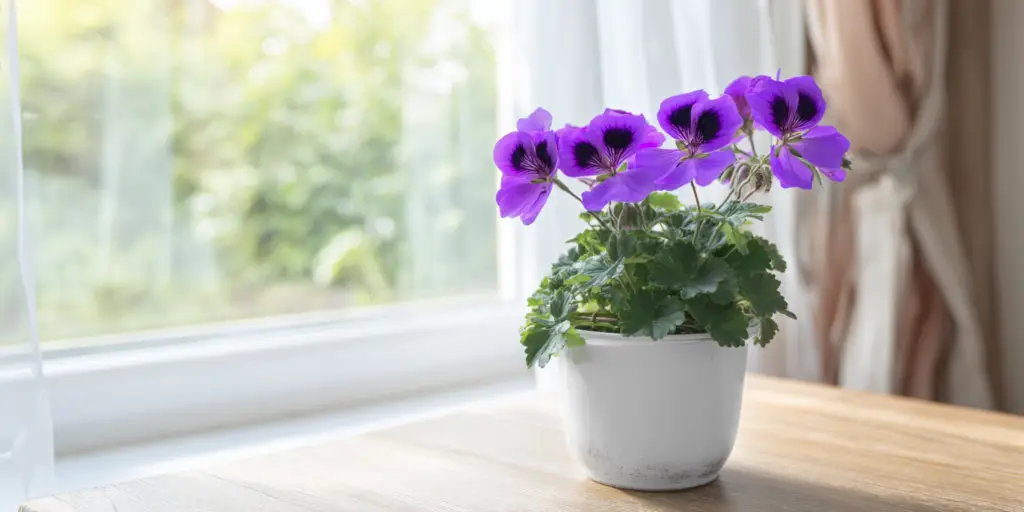
- Geraniums indoors: While primarily known as outdoor plants, geraniums can also be grown indoors given the right conditions. Ivy geraniums (trailing types) and zonal geraniums do well in pots on sunny windowsills or sunrooms, sometimes blooming through the winter if they receive enough light. They prefer cool nights (around 50-60 °F), so an unheated room that stays just a bit cool can actually encourage bud formation. Their ability to adapt to indoor life means you can enjoy geranium blooms and fragrance year-round, not just in the summer garden.
Related Guides & Flowers
Petunia
Short description: Colorful petunias are classic sun loving bedding and container flowers that pair well with geraniums in mixed pots and window boxes.
Impatiens flower
Impatiens offer nonstop color in part shade and can replace geraniums in cooler or low light spots on a porch or patio.
Lantana
Heat loving lantana forms mounded or trailing plants with bright flower clusters that combine well with geraniums in hot sunny containers.
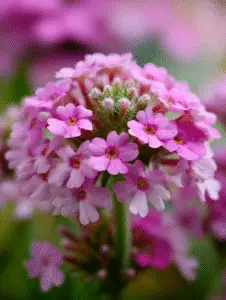
Verbena
Trailing verbena brings long lasting clusters of small blooms that spill over the edges of pots and hanging baskets planted with geraniums.
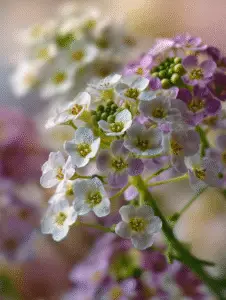
Sweet alyssum
Low growing sweet alyssum creates a fragrant edging under geraniums and helps fill gaps at the front of borders and containers.
References
- Growing Geraniums Indoors, Clemson Cooperative ExtensionShort description: Fact sheet on indoor geranium culture with practical guidance on watering, light, temperature, fertilizing, and general care for potted plants.
- Growing Annual Geraniums, Iowa State University Extension and OutreachShort description: Explains planting time, preferred soil type, sun requirements, spacing, and basic maintenance for annual geraniums grown outdoors in garden beds and containers.
- Growing geraniums as annual flowers in Minnesota, University of Minnesota ExtensionShort description: Covers temperature ranges, light levels, watering schedules, and indoor overwintering tips for geraniums in cooler climates, useful when you write about cold weather care.
- Growing Geraniums, University of Massachusetts Amherst Greenhouse and Floriculture ProgramShort description: Technical guide with recommended temperature ranges, growth rates, and production notes that you can use for precise data on ideal temperatures and flowering behavior.
- Pelargonium, North Carolina State University Extension Gardener Plant ToolboxShort description: Reference page on Pelargonium species that summarizes toxicity for humans and pets, symptoms like vomiting and dermatitis, and the toxic principles geraniol and linalool.
Enjoying our flower guides? Add YourFlowersGuide as a preferred source on Google. It helps more readers find us.
Add to Preferred Sources